Design and Analysis of Information-Theoretically Secure
Authentication Codes with Non-Uniformly Random Keys
Junji Shikata
Graduate School of Environment and Information Sciences, Yokohama National University, Japan.
Abstract
The authentication code (A-code) is the one of the most fundamental cryptographic protocols in information-theoretic cryptography, and it provides information-theoretic integrity or authenticity, i.e., preventing information from being altered or substituted by the adversary having unbounded computational powers. In addition, it has a wide range of applications such as multiparty compu-tations and quantum key distribution protocols. The traditional A-code theory states that a good A-code is characterized as an A-code which satisfies equality of a lower bound on size of secret-keys, i.e., an A-code satisfying|K|=ϵ−2, where |K|is cardinality of the set of secret-keys and ϵis the
success probability of attacks of the adversary. However, good A-codes imply that secret-keys must be uniformly distributed. Therefore, if a non-uniformly random key is given, we cannot realize a good A-code by using it as a secret-key. Then, a natural question about this is: what is a good A-code having non-uniformly random keys? And, how can we design such a good A-code having non-uniformly random keys? To answer the questions, in this paper, we perform analysis of A-codes having non-uniformly random keys, and show the principle that guides the design for such good A-codes.
Specifically, the contribution of this paper is as follows. We first derive a new lower bound on entropy of secret-keys, and it is described in terms of R´enyi entropy. Next, we define that a good A-code having non-uniformly random keys is the one satisfying equality of the bound, and it is characterized by the min-entropy (a special case of R´enyi entropy). Furthermore, we introduce the classification methodology for A-codes which are realizable from a biased key-source. This classification is performed by using a mathematical tool, i.e., a group action on the set of authentication matrices. By this analysis, we can understand what kind of A-codes is actually constructable. Finally, we design how to construct good A-codes having 1-bit messages from von Neumann sources. We also show that our construction methodology is superior to the one by applying von Neumann extractors and the traditional optimal A-code constructions. Although the case of 1-bit messages may be restricted, however, this case is simple and we believe that a general case will develop from this simple case.
Keywords: authentication code, non-uniformly random key, information-theoretic security, uncondi-tional security, lower bound, von Neumann source
1
Introduction
the other hand, information-theoretic cryptography has drawbacks, compared to the computational one, in realizable mechanisms and achievable efficiency in cryptographic protocols, in particular, it usually requires long uniformly random secret-keys. Among cryptographic protocols in information-theoretic cryptography, the most important and fundamental protocols include the encryption (cryp-tosystem) and the authentication code (A-code for short): the former provides confidentiality (or privacy), i.e., keeping information secret from the adversary; and the latter achieves integrity (or au-thenticity), i.e., preventing information from being altered or substituted by the adversary. Actually, these protocols were studied in the first stage of research of cryptology in history. The encryption was first studied by Shannon [23] in 1949, by which the study of information-theoretic cryptography started. On the other hand, the A-code was invented by Gilbert, MacWilliams, and Sloane in 1974 [7], and the theory of A-codes was intensively developed by Simmons in the 1980’s [25]. The purpose of this paper is to further develop the study on the A-code in information-theoretic cryptography, more specifically, the A-code having non-uniformly random secret-keys.
1.1 Background: the study on the A-code
Let us consider a model of the A-code where there are three entities, a sender (or transmitter), a receiver and an adversary (or opponent). An A-code π consists of ([PK],Auth,Vrfy), where [PK] is a
key generation algorithm (or a key-source) which outputs a secret-key k according to a probability distribution PK over a finite set K, Auth is an authentication algorithm, and Vrfy is a verification
algorithm. Suppose that the sender and the receiver share a secret keyk∈ K. For a messagem∈ M, the sender creates an authenticator (or a tag) a = Auth(k, m), and transmits the authenticated message (m, a) to the receiver via an insecure channel to which the adversary can have perfect read-and-write access1. On receiving the authenticated message (m, a), the receiver checks its validity. If
Vrfy(k,(m, a)) = 1, the receiver acceptsm and regards it being sent from the sender. Otherwise, i.e.,
Vrfy(k, σ) = 0, the receiver rejects it. In this model, the adversary having unlimited computational power can insert an authenticated message (m, a) into the channel, and/or can substitute an observed authenticated message (m, a) with another one (m′, a′) ̸= (m, a). These two attacks are traditionally called theimpersonation attack and substitution attack, respectively, and the success probabilities of these two attacks are formally defined as follows.
PI,π := max
(m,a)Pr{Vrfy(K,(m, a)) = 1},
PS,πkma:= ∑
(m,a)
PM A(m, a) max
(m′,a′)̸=(m,a)Pr{Vrfy(K,(m
′, a′)) = 1|(m, a)},
where the probabilities Pr{...} above in RHSs are considered with respect to K.
By performing these two kinds of attacks, the goal of the adversary is that the authenticated message inserted and/or substituted by him/her is accepted by the receiver. The A-code is considered to be secure, if the success probabilities of two attacks are at most a small quantity ϵ ∈ (0,1] (note thatϵ= 0 is impossible), which we call ϵ-securityin this paper. Then, the following lower bounds on the size of secret-keys are well known:
Proposition 1 (Lower bound, [25]) Suppose that an A-code π satisfies PI,π ≤ ϵ and PS,πkma ≤ ϵ. Then, it holds that|K| ≥ϵ−2. More generally, it holds thatH(K)≥ −logPI,πPS,πkma, whereH(·)is the Shannon entropy.
1
In order to satisfy PS,πkma ≤ϵfor every distribution of messages PM, it is sufficient to satisfy that
PS,πmax := max
(m,a)(m′,amax′)̸=(m,a)Pr{Vrfy(K,(m
′, a′)) = 1|(m, a)}
is not larger thanϵ, sincePS,πkma ≤PS,πmaxby definition. This observation and Proposition 1 immediately show that:
Proposition 2 (Lower bound) log|K| ≥H(K)≥ −logPI,πPS,πmax.
There are severaloptimal constructions of A-codes in the sense that those constructions meet the lower bounds with equalities in Propositions 1 and 2. Specifically, those constructions are proposed by using mathematical structures such as algebra (polynomials over finite fields), geometry (projective spaces in finite geometry), and combinatorics (orthogonal arrays). For the above results on the lower bounds and optimal constructions of A-codes, see [6, 13, 14, 15, 16, 20, 22, 25, 26, 29, 31].
1.2 Motivation and Our Contribution
As explained in the previous section, the traditional theory of A-codes brings us the following results: Forϵ-secure A-codes (i.e., max{PI,π, PS,πkma, PS,πmax} ≤ϵ), we obtain
(i) Lower bound on keysis given by log|K| ≥H(K)≥ −2 logϵ;
(ii) Optimal A-codemeans an A-code π such that|K|=ϵ−2.
Based on this, the designing principle forgood A-codes is made clear (i.e., a good A-code means an optimal A-code). In addition, several optimal constructions of A-codes are already known. However, the above optimality implies thatPK must be the uniform distribution, since log|K|=H(K).
There-fore, if a non-uniformly random key K is given, we cannot realize an optimal A-code by using it as a secret-key. Then, a natural question about this is: what is a good A-code having non-uniformly random keys? And, how can we design such a good A-code having non-uniformly random keys? For example, can we construct a good A-code from a biased key-source by applying extractors and opti-mal construction above? To answer the questions, in this paper, we perform the detailed analysis of A-codes having non-uniformly random keys, and show the principle that guides the design for good A-codes having non-uniformly random keys. Specifically, the contribution of this paper is as follows.
Analysis of A-codes having non-uniformly random keys. In order to define a good A-code having non-uniformly random keys, we derive a new lower bound on keys in Section 5:
(i) Lower bound on keys. For any A-codeπ, it holdsRα(K)≥ −logPI,πPS,πmax for anyα∈[0,∞],
whereRα(·) is the R´enyi entropy of orderα (See Appendix A for the R´enyi entropy).
Based on this bound, in Section 6, we define theoptimalityof A-codes having non-uniformly random keys (i.e., a definition of good A-codes with biased keys) by the equality of the bound whenα=∞:
(ii) ∞-optimality. An A-codeπ having a key-source [PK] is∞-optimal, if it satisfies
R∞(K) =−logPI,πPS,πmax,
The reasonability of the definition of optimality is also explained in Section 6. Therefore, we con-sider that a good A-code having non-uniformly random keys is the one satisfying the condition of
∞-optimality in this paper. Note that optimality of A-codes having uniform random keys was char-acterized by the Hartley entropy (i.e., logarithm of the cardinality of a finite set), while optimality of A-codes having non-uniformly random keys is characterized by the min-entropy.
Furthermore, in Section 7, we introduce a classification methodology for A-codes which are re-alizable from a biased key-source. This classification is performed by using a mathematical tool, a group action on the set of authentication matrices. By this analysis, we can understand what kind of A-codes is actually constructable or not. In addition, we analyze a very simple case – A-codes with 1-bit messages and 1-bit authenticators – as a first illustration of this methodology, since it is generally complicated to clarify all constractable A-codes from an arbitrarily given biased key source.
Design of A-codes with non-uniformly random keys (1-bit message A-codes). In this paper, we design good A-codes having 1-bit messages by using a biased key-source. For doing it, in Section 7, we completely classify A-codes with 1-bit messages and 1-bit authenticators, and show that three kinds of codes are realizable. Based on this results, we explicitly show how to construct good A-codes from von Neumann sources. The reason why we focus on the von Neumann source includes: it is simple in the sense that it outputs a (biased) binary string based on i.i.d. according to a binary distribution [p,1−p] with some p ∈ (0,1); and it is universal in the sense that we do not have to know such p explicitly. We also show that our construction methodology is superior to the one by applying von Neumann extractor and the traditional optimal A-code construction. Although the case of 1-bit messages may be restricted, however, this case is simple and we believe that a general case will develop from this simple case.
1.3 Related Works
Dodis and Spencer first investigated the A-codes having non-uniformly random keys in [3]. The purpose of the paper [3] is to investigate the strength ofcryptographic sources, i.e., imperfect sources enough for cryptographic usage of the encryption or the A-code, compared to other sources such as simulatable sources (enough for simulating BPP algorithms) and extractable sources (enough for extracting uniformly random bits). The main result of [3] is that cryptographic sources lie in between simulatable and extractable sources. In the process of showing this result, they focused on the min-entropy of an imperfect source and success probability of substitution attack of an A-code. They only discussed a particular source and an A-code to show the existence of a source and an A-code satisfying the above main result, and our purpose of this paper is different from their aim. However, our results are influenced by their idea and approach, since we also give the definition of optimality of A-codes by the min-entropy of the key-source. Therefore, our results can be regarded as further investigation of A-codes having a non-uniform key-source.
To the best of author’s knowledge, all works about A-codes except for [3] assume that uniformly random sources (random keys) are more or less available: the works for traditional A-codes using uniformly random key-sources [6, 13, 14, 15, 16, 20, 22, 25, 26, 29, 31], or (interactive) A-codes using uniformly random sources and biased ones [4]. Therefore, this paper faces a challenge of establishing theory of (non-interactive) A-codes based on non-uniformly random key-sources, like the traditional theory developed by Simmons and others.
2
Authentication Codes (A-codes)
is formally defined as follows.
Definition 1 (A-code) Anauthentication code without secrecy2πconsists of algorithms ([PK],Auth, Vrfy) with finite setsM,A,K defined as follows.
• Finite sets and random variables. Kis a finite set ofkeysshared by the sender and the receiver, and PK (resp., K) denotes a probability distribution over K (resp., a random variable taking
values inK);Mis a finite set ofmessages3, andPM (resp.,M) denotes a probability distribution
over M (resp., a random variable taking values in M). In this paper, we assume that PK is
statistically independent ofPM; A is a finite set of authenticators(or tags), and PA (resp., A)
denotes a probability distribution overA (resp., a random variable taking values inA).
• Random key source and sampling algorithm. [PK] is a key generation algorithm (or a key-source),
and it outputs a keyk∈ Kaccording to PK.
• Authentication and verification algorithms. Auth is an authentication algorithm which takes a keyk∈ K and a messagem∈ M as input and outputs an authenticatora←Auth(k, m);Vrfy
is a verification algorithm which takes a key k ∈ K and a pair of messages and authenticators (m, a), which we call an authenticated message4, and outputs a bit b←Vrfy(k, m, a): if b= 1, it means that (m, a) is valid; otherwise (i.e., b= 0), it means that (m, a) is invalid.
The protocol execution of the above authentication code is described in Table 1.
Table 1: Protocol execution ofπ = ([PK],Auth,Vrfy).
– Inner input of Sender: k∈ K
– Outer input of Sender: m∈ M
– Inner input of Receiver: k∈ K
– Outer output of Receiver: a bitb∈ {0,1}
1. Auth computesa←Auth(k, m) and sends (m, a) to the receiver by an insecure channel.
2. Vrfycomputes b←Vrfy(k, m, a) and outputs b.
In this paper, for simplicity, we use the terminology of anauthentication code(or more simply, an
A-code) instead of an authentication code without secrecy mentioned above. In Definition 1, we require the correctness property of the A-code: For any possiblek∈ K,m∈ M, it holds thatVrfy(k, m, a) = 1 fora←Auth(k, m).
Also, an A-codeπ = ([PK],Auth,Vrfy) is called an A-code without splitting, if Auth is a
determin-istic algorithm, and called anA-code with splittingotherwise (i.e.,Auth is randomized). Ifπ= ([PK], Auth, Vrfy) is an A-code without splitting, we can simply suppose that Vrfy is trivially constructed by Auth: Vrfy(k, m, a) = 1 if and only if Auth(k, m) = a. In this paper, for simplicity, we only deal with an A-code without splitting, and we call it an A-code for short, again.
2It is often called aCartesian authentication code. 3
In the model of authentication codes, the termsource state is traditionally used. However, in this paper we use the termmessageas usually used in the context of cryptographic schemes for providing computational authenticity or integrity such as MAC and digital signatures.
4
The traditional security notion of authentication codes was given in [25]. In the attacking model it is assumed that the adversary can insert an authenticated message into the channel, and/or also can substitute an observed authenticated message with another one. These two attacks are traditionally called theimpersonation attackand thesubstitution attack, respectively. By performing these attacks, the goal of the adversary is that the authenticated message inserted and/or substituted by him could be accepted as authentic by the receiver. However, there are several possible ways how to formally define the security of A-codes, essentially formalization of substitution attacks, as follows.
Definition 2 (Attacking model) Letπ= ([PK],Auth,Vrfy)be an A-code. The success probabilities of impersonation and substitution attacks are defined as follows, where the probabilities Pr{...} below in RHSs are considered with respect to K.
1. Success probability of the impersonation attack: PI,π = max
(m,a)Pr{Vrfy(K,(m, a)) = 1}.
2. Success probability of the substitution attack:
PS,πkma= ∑
(m,a)
PM A(m, a) max
(m′,a′)̸=(m,a)Pr{Vrfy(K,(m
′, a′)) = 1|(m, a)},
PS,πcma= max
m
∑
a
PA|M(a|m) max
(m′,a′)̸=(m,a)Pr{Vrfy(K,(m
′, a′)) = 1|(m, a)},
PS,πmax= max
(m,a)(m′,amax′)̸=(m,a)Pr{Vrfy(K,(m
′, a′)) = 1|(m, a)}.
Intuitively, the success probabilities of the above three kinds of substitution attacks have the following operational meaning:
• PS,πkma: Suppose that the sender selects a message m according to PM and he has a secret-key
k chosen according to PK. And, an authenticated message (m, a) which occurs with PM A is
sent by the sender and observed by the adversary. Then, the adversary will replace it with an illegal (m′, a′) ̸= (m, a) by taking his best strategy, and PS,πkma means the success probability of this attack. In cryptography, this attack can be considered to be theknown message attack. For example, this kind of the substitution attack is considered in [7, 15, 16, 20, 25, 31] for (multiple) A-codes, and in [10] for variants of A-codes.
• PS,πcma: Suppose that the adversary selects a message m of his arbitrary choice, and queries it to the sender by regarding him as an authentication oracle, and then he obtains an authenticated message (m, a), where a is generated by a random secret-key with distributionPK. Then, the
adversary will create an illegal (m′, a′)̸= (m, a) by taking his best strategy hoping that (m′, a′) will be accepted by the receiver. PS,πcma means the success probability of this kind of the attack, and in cryptography, this attack can be considered to be thechosen message attack. This kind of the substitution attack is considered in [3, 4] for (interactive) A-codes using biased key-sources.
• PS,πmax: The last kind of the attack describes the possibility of the substitution attack in principle. Namely, it is supposed that the adversary can obtain an authenticated message (m, a) of his arbitrary choice so that substitution by (m′, a′) ̸= (m, a) will be most effective. This is also considered to be thechosen message attack, however, in the formalization the success probability of this attack, denoted byPmax
S,π , is evaluated as the maximum over all possible (m, a) and (m′, a′).
By definition, it is easy to observe the following relation among substitution attacks holds: PS,πmax≥ PS,πcma≥PS,πkma.
Definition 3 (Security) Letπ be an A-code. Then, security of π is defined as follows5.
(i) π is said to beϵ-KMA-secure, if max{PI,π, PS,πkma} ≤ϵ.
(ii) π is said to beϵ-CMA-secure, if max{PI,π, PS,πcma} ≤ϵ.
(iii) π is said to beϵ-strongly-CMA-secure, if max{PI,π, PS,πmax} ≤ϵ.
3
Representing A-codes by Matrices (Arrays)
Let π be an A-code with a message-set M and an authenticator-set A which has a key-source [PK]
overK. In general, an A-code can be represented by a|M|×|K|matrix, and it is calledauthentication matrix6.
Definition 4 (Authentication Matrix, e.g., [2]) For an A-code π = ([PK],Auth,Vrfy), an au-thentication matrixof π, denoted by Aπ, is a |M| × |K|matrix in which the rows are indexed by the
setM, the columns are indexed by the setK, and the (m, k)-entry form∈ M andk∈ Kis given by
a=Auth(k, m)∈ A.
So far, we have not paid much attention to orders of indexed sets of rows and columns of au-thentication matrices, since we have focused on the uniformly random secret-keys over K. In order to deal with A-codes having non-uniformly random secret keys over K, we need to pay attention to the orders of the indexed sets. Specifically, we consider orders of indexed sets of rows and columns of authentication matrices as follows.
• Suppose that (K,≤K) is a totally ordered set having a probability distribution PK7, and the
columns of Aπ are indexed by the elements in K as follows. For K := {k1, k2, . . . , k|K|}, an
ordered sequence of all elements in K is given, i.e., k1 ≤K k2 ≤ . . . ≤K k|K|, with respect to
the order ≤K, and this fixed sequence is used for indexing the columns. In the following, we
consider the order≤K defined byki ≤K kj ⇐⇒PK(ki)≥PK(kj) and an ordered sequence with
respect to≤K is given, if we do not explain anything about it.
• Similarly, (M,≤M) is a totally ordered set having a probability distribution PM, and the rows
ofAπ are indexed by the elements inM. In the following, we also consider the order≤M defined
by mi ≤M mj ⇐⇒ PM(mi) ≥PM(mj), and suppose that an ordered sequence with respect to
≤M is given and fixed, if we do not explain anything about it.
Remark 1 Conversely, if a distributionPK over a totally ordered finite set(K,≤K),PM over(M,≤M
), and ans×u matrixAwith|K|=u and|M|=sin which each entry is an element of at-symbol set are given, an A-codeπ having a message-set (M,≤M), an authenticator-setA, and a key-set(K,≤K) such that |A| =t and A= Aπ is determined. For simplicity, we write πA for an A-code determined from the matrixA in this way, if it is clear from the context.
5
See also Remark 2 in Section 5
6
In several literatures (e.g., [2]), the authentication matrix is defined as the|K|×|M|matrix, and the relation between its transpose and an orthogonal array will be considered. However, for simplicity, we define the authentication matrix as above so that we do not have to consider its transpose.
7Note that the order≤
Definition 5 (Reduced Authentication Matrix) An authentication matrix Aπ is said to be re-duced, if every two columns ofAπ are different.
Let [PK] be a key-source and letπbe an A-code having a message-set (M,≤M), an
authenticator-setA, and a key-set (K,≤K). If there arei1, i2such that (a1,i1, a2,i1, . . . , a|M|,i1) = (a1,i2, a2,i2, . . . , a|M|,i2)
(i.e., there are the same columns) in Aπ, where aj,i := Auth(ki, mj), we can integrate the two keys
ki1 and ki2 into one key ki1,i2 with probability PK′(ki1,i2) := PK(ki1) +PK(ki2), and the index of
secret-keys is rearranged by a new distribution PK′ over a set K′ := (K \ {ki1, ki2})
∪
{ki1,i2} with
the total order≤K′. Suppose that Aπ is transformed in this way several times until all columns are
different, and then, the resulting probability distribution and authentication matrix are denoted by
PK(R) and A
(R)
π , respectively. Then, we give the following definition.
Definition 6 (Reduced Form) Suppose that an A-codeπ having a key-source distributionPK over
(K,≤K) is given, and letAπ be its authentication matrix. An authentication matrixB is said to be a reduced formofAπ, ifB is reduced andB can be obtained fromAπ by repeating the above procedure.
Considering the procedure mentioned above to obtain a reduced form is reasonable and natural, since the procedure does not change security of π (i.e., all of PI,π, PS,πkma, PS,πcma, and PS,πmax) and
it simplifies the authentication matrix of π. The description of success probabilities of attacks by reduced forms is given in the next section.
4
Representing Success Probabilities of Attacks by Reduced Forms
Letπ = ([PK],Auth,Vrfy) be an A-code having a message-set (M,≤M), an authenticator-setA, and
a key-set (K,≤K). For any (m, a)∈ M × A, we define
K(m, a) :={k∈ K |Auth(k, m) =a}. (1)
Note that, for arbitrarym∈ Manda, a′ ∈ Awitha̸=a′, we haveK(m, a)∩K(m, a′) =∅, and hence, for arbitrarym∈ M, we have
K= ⨿
a∈A
K(m, a). (2)
Furthermore, for arbitrary m0, m1 ∈ M with m0 ̸=m1, let π|{m0,m1} to be the A-code obtained
fromπby restricting its message-set{m0, m1}, i.e.,πhaving the message-set consisting of two elements
m0, m1. In addition, let Aπ|{m0,m1} be the authentication matrix of π|{m0,m1}, and suppose that A(πR|)
{m0,m1} is a reduced form of Aπ|{m0,m1}. Then, we denote an induced key-set and an induced
distribution over it byKm(R0),m1 andPK(R)
m0,m1, respectively. Now, we define the following set in a similar
way as (1): Form∈ {m0, m1},
K(R)
m0,m1(m, a) :={k∈ K
(R)
Then, we define
PI,π(m0) := max a
∑
k∈K(m0,a)
PK(k),
PS,πmax(m0, m1) := max m∈{m0,m1}
max
a
max
k∈K(mR0),m1(m,a) P
Km(R0),m1
(k)
∑
k∈K(mR0),m1(m,a) P
Km(R0),m1
(k),
PS,πcma(m0, m1) := max m∈{m0,m1}
∑
a
max
k∈K(mR0),m1(m,a) P
K(mR0),m1
(k).
Then, by definition, it can be shown that
PI,π = max
m PI,π(m),
PS,πmax = max
(m,m′), m̸=m′ P max
S,π (m, m′),
PS,πcma = max
(m,m′), m̸=m′ P cma
S,π(m, m′).
5
New Bounds for A-codes
By definition, it is straightforward to see thatPS,πkma ≤PS,πcma≤PS,πmax for any A-codeπ. First, we show thatPI,π ≤PS,πcma for any A-codeπ.
Theorem 1 For any A-code π, we have PI,π ≤PS,πcma.
Proof. First, we show the following lemmas.
Lemma 1 For any A-code π with 1-bit messages, we havePI,π ≤PS,πcma.
Proof. Let M = {m0, m1}. Suppose that an arbitrary A-code π = ([PK],Auth,Vrfy) having M is
given. Without loss of generality, we assume that an authentication matrix of π, denoted by Aπ, is
an element of the orthogonal array of degree 2 and orders, OA(2, s) (see Remark 5), by considering its reduced form.
For m0, m1∈ M withm0 ̸=m1, we recall the definitions:
PI,π(mi) = max a∈A
∑
k∈K(mi,a)
PK(k) fori= 0,1, and
PS,πcma = max
m∈{m0,m1}
∑
a
max
k∈K(m,a)PK(k).
Without loss of generality, we supposePI,π(m0)≥PI,π(m1) and (m0, a0) satisfies
a0 = argPI,π(m0).
LetK(m0, a0) ={ki1, ki2, . . . , kij} (1≤j ≤s), and aih :=Auth(kih, m1) for 1≤h ≤j. Then, we see
that ai1, ai2, . . . , aij are all different, since all columns of Aπ ∈OA(2, s) are different. Therefore, for
distinctai1, ai2, . . . , aij, we have kih∈ K(m1, aih) for 1≤h≤j, and hence
PS,πcma≥∑
a
max
k∈K(m1,a)
PK(k)≥ j
∑
h=1
PK(kih) =PI,π(m0) =PI,π.
Lemma 2 For any A-code π, we have
max{PI,π(m0), PI,π(m1)} ≤PS,πcma(m0, m1)
for allm0, m1 ∈ M with m0 ̸=m1.
Proof. For any A-code π with a message-space M and arbitrary m0, m1 ∈ M, we consider the
A-code π with a restricted message-space ¯M:= {m0, m1}. Then, we apply Lemma 1, and the proof is
completed.
Proof of Theorem 1. Let mmax ∈ M be a message which gives PI,π, i.e., PI,π = PI,π(mmax). For
m∈ Mwithm̸=mmax, we have
PI,π = PI,π(mmax)
= max{PI,π(mmax), PI,π(m)}
≤ PS,πcma(mmax, m) (4)
≤ max
m,m′P cma
S,π (m, m′)
= PS,πcma,
where (4) follows from Lemma 2. Therefore, the proof is completed.
Corollary 1 For any A-code π, it holds thatPI,π ≤PS,πmax.
Proof. The proof immediately follows from the trivial relation PS,πcma ≤ PS,πmax and the inequality
PI,π ≤PS,πcma by Theorem 1.
Remark 2 One may think that the above inequalities in Theorem 1 and Corollary 1 are straightfor-ward, since the adversary having a certain information is not less powerful than the adversary having no information. However, it does not hold that PI,π ≤ PS,πkma in general. To the best of author’s knowledge, the above inequalities have not explicitly been mentioned before. Actually, several papers provided two kinds of proofs to show that both success probabilities of impersonation and substitution attacks of proposed A-codes are small. On the other hand, a few papers consider only the substitution attackPS,πcma or PS,πmax, and do not focus on the impersonation attack, e.g., see [3, Section 4] for PS,πcma, and [18, Section II-C] forPS,πmax. This could be considered to be reasonable from the above inequalities. Furthermore, if we take into account the above inequalities, we can give a simpler security definition rather than Definition 3: π is said to be ϵ-strongly-CMA-secure if PS,πmax ≤ ϵ; and π is said to be
ϵ-CMA-secure if PS,πcma ≤ϵ.
Now, we show a lower bound on key-size in terms of both PI,π and PS,πmax.
Theorem 2 Let π be an A-code having a key-source [PK]. Then, for anyα∈[0,∞], we have
Rα(K)≥ −logPI,πPS,πmax.
Proof. The proof follows from Lemma 3 below and the fact that R´enyi entropyRα(X) is a monotone
decreasing function ofα∈[0,∞].
Proof. For arbitrarily given m ∈ M, we arrange elements in A by a1(m), a2(m), . . . , at(m), where
t=|A|, such that
∑
k∈K(m,a1(m))
PK(k)≥
∑
k∈K(m,a2(m))
PK(k)≥ · · · ≥
∑
k∈K(m,at(m))
PK(k).
Then, by considering the impersonation attack using (m, a1(m)), we obtain
PI,π ≥
∑
k∈K(m,a1(m))
PK(k). (5)
Also, we define, for anyi∈ {1,2, . . . , t},
qi(m) := max
k∈K(m,ai(m))
PK(k).
Then, it follows that, for anym∈ M and anyi∈ {1,2, . . . , t},
PS,πmax≥ ∑ qi(m)
k∈K(m,ai(m))PK(k)
. (6)
Letkmax:= maxkPK(k) and, for givenm, supposekmax ∈ K(m, aj(m)) for somej∈ {1,2, . . . , t}.
Then, we obtain
PI,πPS,πmax ≥
∑
k∈K(m,aj(m)) PK(k)
(
qj(m)
∑
k∈K(m,aj(m))PK(k)
)
(7)
= qj(m) =kmax = max
k PK(k),
where (7) follows from (5) and (6). This completes the proof.
Remark 3 The lower bound of Proposition 2 is a special case of Theorem 2, since it is obtained by taking α= 1 in Theorem 2. Furthermore, by combining Theorem 2 and Corollary 1, we get
Rα(K)≥ −2 logPS,πmax. (8)
However, if we discuss optimality in terms of equality of the bound (8), namely,Rα(K) =−2 logPS,πmax, it is implicitly assumed that PI,π = PS,πmax which may be too strong condition. Therefore, we put importance on the lower bound in Theorem 2 which is more general than the bound (8). For this illustration of A-codes with 1-bit messages and 1-bit authenticators, see Proposition 4, Theorem 6, and Theorem 7 in Section 7.
Next, we show a lower bound on key-size in terms of Pkma
S,π and PS,πcma, instead ofPS,πmax.
Theorem 3 Let π be an A-code having a key-source [PK]. Then, it holds that, for any α∈[0,2],
Rα(K) ≥ −logPI,πPS,πkma, (9)
Rα(K) ≥ −logPI,πPS,πcma. (10)
Proof. The second inequality follows from the first inequality and the relationPS,πkma ≤PS,πcma. Further-more, sinceRα(X) is a monotone decreasing function of α (see also Proposition 6 in Appendix), we
Lemma 4 For any A-code π having a key-source [PK], we haveR2(K)≥ −logPI,πPS,πkma.
Proof. By (2) in Section 4, for arbitrarym∈ M, we have
K= ⨿
a∈A
K(m, a). (11)
For arbitrarily fixed m∈ M, we arrange elements inA bya1, a2, . . . , at, where t=|A|, such that
∑
k∈K(m,a1)
PK(k)≥
∑
k∈K(m,a2)
PK(k)≥ · · · ≥
∑
k∈K(m,at)
PK(k). (12)
Then, by considering the impersonation attack using (m, a1), we obtain
PI,π ≥
∑
k∈K(m,a1)
PK(k).
We next define, for any m∈ Mand for any i∈ {1,2, . . . , t},
qi(m) := max
k∈K(m,ai)
PK(k), (13)
f(m) := ∑
a
PA|M(a|m) max
(m′,a′)̸=(m,a)Pr{Vrfy(K,(m
′, a′)) = 1|(m, a)}. (14)
Then, for eachi∈ {1,2, . . . , t}, we have
PA|M(ai|m) max
(m′,a′)̸=(m,a)Pr{Vrfy(K,(m
′, a′)) = 1|(m, a)}
≥PA|M(ai|m)·
qi(m)
PA|M(ai|m)
=qi(m),
and hence, it follows thatf(m)≥∑ti=1qi(m).
Therefore, for arbitrary m∈ M, we have
PI,πf(m) ≥
∑
k∈K(m,a1) PK(k)
( t ∑
i=1
qi(m)
) ≥ t ∑ i=1 qi(m)
∑
k∈K(m,ai) PK(k)
(15) ≥ t ∑ i=1 ∑
k∈K(m,ai)
PK(k)2 (16)
= ∑
k∈K
PK(k)2, (17)
where (15), (16), and (17) follow from (12), (13), and (11), respectively. Hence, we obtain
PI,πPS,πkma = PI,π
( ∑
m
PM(m)f(m)
)
= ∑
m
PM(m) (PI,πf(m))
≥ ∑
k∈K
PK(k)2, (18)
Remark 4 The lower bounds in Proposition 1 are special cases of Theorem 3, since they are obtained by taking α = 0,1 in the lower bound (9) of Theorem 3. And the proof of Theorem 3 is essentially completed by showing the lower bound on R´enyi entropy of order two of secret-keys (see Lemma 4). Our proof technique is mathematically simple and elementary compared to previous proofs of
H(K)≥ −logPI,πPS,πkma. (19)
In fact, the traditional proof technique for the inequality (19) first shows the lower bounds onPI,π and
PS,πkma,
logPI,π ≥ −I(K;M A), logPS,πkma ≥ −H(K |M, A),
by using the log-sum inequality and the Jensen’s inequality, and next derives the bound (19) by combin-ing these two inequalities. For this technique, for example, see [25] for A-codes and [10] for a variant of A-codes. Another proof technique for the inequality (19) is to use hypothesis testing theory, and see [15] for this technique. Our proof technique is mathematically different from these two previous techniques.
A natural question is whether the inequalities (9) and (10) hold for α ∈ (2,∞]. The following proposition shows that neither (9) nor (10) holds for α∈[5,∞] in general, while we do not have the answer for the caseα∈(2,5).
Proposition 3 There exists an A-code π having a key-source [PK] such that
R5(K) < −logPI,πPS,πkma,
R5(K) < −logPI,πPS,πcma.
Proof. Consider the Type-I constructionπof A-codes in Section 7 having a 4-symbol-key-source whose probability distribution is given by p1 = 7/10, p2 =p3 = p4 = 1/10. Then, PI,π = PS,πkma = PS,πcma =
p1+p2 = 4/5. Since
∑
ip5i >(PI,πPS,πcma)4 = (PI,πPS,πkma)4, the two inequalities of the proposition are
satisfied in this construction.
6
Optimality of A-codes
From a theoretical viewpoint, it is important to find a construction π of A-codes having a key-source [PK] such that, given small ϵ0 and ϵ1 which mean security level, π satisfies PI,π ≤ ϵ0 and
PS,πmax≤ϵ1 requiring as short secret-keys as possible, and such a construction is often called anoptimal construction. Thus, we are interested in (optimal) constructionsπwhich meet our generic lower bound in Theorem 2 with equality, i.e.,Rα(K) =−logPI,πPS,πmax for some α∈[0,∞].
In this section, we try to characterize the level of optimality for various constructions for A-codes, in particular, for A-codes having not necessarily uniform random keys. To do this, by taking into account the bound in Theorem 2, we first give the following definition for the level of optimal constructions.
Definition 7 Let π be a construction of A-codes having a key-source[PK]. Then, forα∈N∪ {0,∞},
π is said to be optimal of levelα (α-optimal for short)8, if π satisfies
Rβ(K)> Rα(K) =−logPI,πPS,πmax
for allβ < α withβ ∈N∪ {0}.
8
The above definition seems to capture a wide range of optimal constructions. However, interest-ingly, we next show that the only possibleα-optimality of constructions are the cases of α= 0,∞.
Theorem 4 Let α∈N∪ {0,∞}. Then, there exists anα-optimal construction of A-codes if and only if α= 0,∞.
Proof. First, if there exists an α-optimal construction π of A-codes for some α ∈ N∪ {0,∞}, we show α= 0,∞. For this, we prove that there is noα-optimal construction if α∈N. Suppose on the contrary that there exists an α-optimal construction π for some α ∈ N. Then, by Theorem 2 and Definition 7, we have
Rα−1(K)> Rα(K) =Rα+1(K) =Rα+2(K) =· · ·=−logPI,πPS,πmax.
We note that Rβ(K) is a monotone decreasing function of non-negative real numbers β, and in
particular, for α, γ ∈ N with α < γ (say, γ = α+ 1), it holds that Rα(K) = Rγ(K) if and only
if PK is uniform over the set Supp(PK) := {k | PK(K) > 0} (See Proposition 7 in the appendix).
Without loss of generality, we suppose Supp(PK) =K. If PK is uniform overK,Rβ(K) = log|K|for
all β ∈ N∪ {0,∞}. Thus, in this case, π is 0-optimal, which contradicts the assumption of α ∈ N. Therefore, there is no α-optimal construction such that α∈N, which impliesα= 0,∞.
Next, we show the converse part. Forα= 0, it is trivial that there exists a 0-optimal construction of A-codes, since there is already known constructionπ which meets |K|= (PI,πPS,πmax)−1. Forα=∞,
we will actually propose an∞-optimal construction of A-codes in Sections 7 and 8.
Note that the 0-optimal construction implies that PK is uniform over Supp(PK)(= K). In other
words, the construction which meets |K| ≥ {PI,πPS,πmax}−1 with equality is 0-optimal, and in such
a construction, uniform random keys are always required, since it holds that log|K| = H(K)(=
−logPI,πPS,πmax). Up to date, to the best of author’s knowledge, all constructions for A-codes focused
on in terms of short key-size are this kind of constructions (i.e., the ones with uniform random keys). The purpose of this section is to characterize optimality of constructions of A-codes with non-uniformly random keys, and hence, it is reasonable to do it by using the other notion of optimality, namely,∞ -optimality. In this paper, we adopt the notion of∞-optimality for optimal constructions of A-codes having non-uniformly random keys.
As explained in Section 1.3, Dodis and Spencer investigated A-codes having non-uniformly random key-sources for analyzing cryptographic sources in [3]. And, in it they focused on the min-entropy of an imperfect source and success probability of the substitution attack of an A-code. Therefore, even from this line of research, it would be reasonable to adopt our∞-optimality for optimal constructions of A-codes having non-uniformly random keys.
7
Classification of Authentication Matrices by Group Actions
In Section 3, we have seen that any A-code with a message-setM, an authenticator-setA, and a key-setKis represented by a|M| × |K|matrix (i.e., authentication matrix) whose entries are chosen from
|A|-symbols. Since the cardinality of the sets are essentially important for discussing authentication matrices, we set s = |M| and t = |A|. Then, for arbitrarily given distribution PK over K, all
A-codes having M and A, respectively, are represented by s×ts matrices by considering reduced forms of authentication matrices: Since the number of alls×1 column vectors with t symbols ists, without loss of generality, we assume that any distributionPK overK connected to A-codes havings
Let M(s, t) be the set of alls×tsarrays with entries from a set oftsymbols (say,{0,1,2, . . . , t−1}) such that every s×1 column vector with t symbols appears one time. In this section, without loss of generality, we assume that M={0,1,2, . . . , s−1} and A ={0,1,2, . . . , t−1}, and we deal with A-codes whose authentication matrices are reduced and given as elements of M(s, t). In the following, for a positive integern,Sndenotes the set of all permutations over then-symbol set{0,1,2, . . . , n−1}.
Now, we consider the following transformations over M(s, t).
• For arbitrary positive integersℓ1, ℓ2 with 1≤ℓ1 ≤ℓ2≤s, the transformation Tℓ1,ℓ2 over M(s, t)
is defined as follows: ForA∈M(s, t),Tℓ1,ℓ2(A) is the element of M(s, t) obtained by exchanging
theℓ1-th row and the ℓ2-th one ofA.
• For an arbitrary positive integer ℓ with 1 ≤ ℓ ≤ s and for arbitrary σ ∈ St, the
trans-formation Tℓ,σ over M(s, t) is defined as follows: For A ∈ M(s, t), Tℓ,σ(A) is the element
of M(s, t) in which the ℓ-th row vector (aℓ,1, aℓ,2, . . . , aℓ,ts) of A is replaced with the vector
(σ(aℓ,1), σ(aℓ,2), . . . , σ(aℓ,ts)).
Then, it is straightforward to see that the transformations above satisfy the following relation: For all integersℓ1, ℓ2, ℓ3∈[1, s], and for all permutations σ, τ ∈St, it holds that
Tℓ1,ℓ1 = 1, Tℓ2,ℓ3 =Tℓ1,ℓ2Tℓ2,ℓ3Tℓ1,ℓ3, Tℓ1,id = 1, Tℓ1,τTℓ1,σ =Tℓ1,τ σ, Tℓ2,σTℓ1,ℓ2 =Tℓ1,ℓ2Tℓ1,σ,
whereidis the identity element ofSt, and 1 is the identity transformation over M(s, t), i.e., for every
A∈M(s, t), 1(A) =A.
Let Gbe a group generated by all transformations above, i.e., Tℓ1,ℓ2(A) (1≤∀ ℓ1 ≤∀ ℓ2 ≤s), and Tℓ,σ (1 ≤∀ ℓ ≤ s and ∀σ ∈ St). Then, G acts on the set M(s, t). The reason why we consider the
groupGis explained by the following theorem.
Theorem 5 For any A∈M(s, t) and any T ∈G, it holds that
PI,πA =PI,πT(A), P
cma S,πA =P
cma
S,πT(A), P
max S,πA =P
max S,πT(A),
namely,PI,πA, P cma S,πA, P
max
S,πA are G-invariant.
Proof. It is not difficult to see that, by definition, each of Tℓ1,ℓ2 (1≤ℓ1 ≤ℓ2 ≤s) andTℓ,σ (1≤ℓ≤s
and σ ∈ St) does not change success probabilities of the attacks, and hence any T ∈ G does not
change them.
Next, for arbitrarily givenPK over (K,≤K), we investigate how many kinds of A-codes having the
key-source [PK] can be constructed. To see this, we define an equivalence relation∼on the set M(s, t)
by the G-action as follows: ForA, B∈M(s, t), we define
A∼B ⇐⇒B =T(A) for someT ∈G. (20)
When we focus onPI,π, PS,πcma, PS,πmax for any possible constructionπ for A-codes9, it is mathematically
reasonable to consider M(s, t)/∼from Theorem 5. Then, we can see that there are|M(s, t)/∼ |kinds of constructions for A-codes.
9In particular, we are interested inP
Remark 5 Let OA(s, t) be the set of all orthogonal arrays of degree s (or constraints s) and order
t (or level t), namely, the set of all s×t2 arrays with entries from a set of t symbols such that, for every 2×t2 submatrix, every2×1 column vector appears one time. It is known that an A-code which meets the lower bound with equality is well characterized by OA(s, t), where s = |M| and t = |A|, since a 1t-secure A-code meets|K|=t2 (i.e., equality of the lower bound) iff its authentication matrix becomes an element of OA(s, t)and PK is uniformly random (for example, see [2, Section 3.2] for the survey). We note that the group G considered above also acts on the set OA(s, t), i.e., for ∀T ∈ G,
∀A∈OA(s, t),T(A)∈OA(s, t). Therefore, the same discussion for classifying all elements of OA(s, t)
is possible.
In the following, as a simple illustration, we analyze A-codes having 1-bit messages and 1-bit authenticators (i.e., M=A={0,1}) based on the discussion above. Therefore, we apply s=t= 2 in the above discussion. By setting s=t= 2 above, we note that M(2,2)=OA(2,2) is the set of all 2×4 arrays with entries from the set{0,1}such that every 2×1 column vector appears one time. For this simple case, suppose that an arbitrary key-source [PK] over a 4-symbol set K = {k1, k2, k3, k4}
(say, K ={0,1}2) is given. In addition, without loss of generality, we assume that p
i := PK(ki) for
1≤i≤4 and p1 ≥p2 ≥p3 ≥p4.
We define two kinds of transformations over M(2,2) as follows.
• ForA∈M(2,2),T1,2exchanges the first row and the second one ofA, i.e., forA=
[
a b c d
e f g h
]
,
T1,2(A) :=
[
e f g h
a b c d
]
.
• Letσbe the permutation over{0,1}defined byσ(x) = ¯xforx∈ {0,1}. ForA=
[
a b c d
e f g h
]
,
T1,σ(A) :=
[
¯
a ¯b ¯c d¯
e f g h
]
andT2,σ(A) :=
[
a b c d
¯
e f¯ g¯ h¯
]
.
Then, we can observe that the following relations hold:
T12,2 = 1, T12,σ = 1, T22,σ= 1,
T1,σT2,σ=T2,σT1,σ, T1,σT1,2 =T1,2T2,σ,
where 1 means the identity transformation, i.e., for everyA∈M(2,2), 1(A) =A.
LetGbe the group generated byT1,2,T1,σandT2,σ, i.e.,G:=⟨T1,2, T1,σ, T2,σ⟩. Then,Gacts on the
set M(2,2), and we define the equivalence relation∼ on M(2,2) by the G-action: ForA, B ∈M(2,2), we defineA∼B if and only ifB =T(A) for someT ∈G. Then, we note that|M(2,2)|= 4! = 24 and
|G|= 8, and we obtain
M(2,2)/∼= {A¯I,A¯II,A¯III},
where the equivalence classes ¯AI,A¯II,A¯III are represented by
AI=
[
0 0 1 1 0 1 0 1
]
, AII=
[
0 1 0 1 1 0 0 1
]
, AIII =
[
0 0 1 1 1 0 0 1
]
.
From this, it follows that M(2,2) is divided into the following subsets by theG-action:
M(2,2) = G(AI)⨿G(AII)⨿G(AIII),
G(Ai) = {Ai, T1,2(Ai), T1,σ(Ai), T2,σ(Ai),(T1,2T1,σ)(Ai),
fori∈ {I, II, III}.
We say that πA, a construction of A-codes by A ∈M(2,2), is Type-I construction if A ∈ G(AI).
Similarly, we call πA Type-II (resp., Type-III) construction if A ∈ G(AII) (resp., A ∈ G(AIII)). In
Table 2, we give success probabilities of the attacks, PI,π, PS,πmax, and PS,πcma, for Type-I, Type-II, and
Type-III constructions.
Table 2: Success probabilities of the attacks for Type-I, Type-II, and Type-III constructions: PK =
(p1, p2, p3, p4) withp1≥p2≥p3 ≥p4.
Type-I Type-II Type-III
PS,πmax max( p1
p1+p3,
p2
p2+p4)
p1
p1+p4
p1
p1+p4
Substitution PS,πcma p1+p2 p1+p2 p1+p2
Impersonation PI,π p1+p2 p1+p3 p1+p2
The following proposition analyzes necessary and sufficient conditions for∞-optimality of Type-I, Type-II, and Type-III constructions, respectively.
Proposition 4 Necessary and sufficient conditions for∞-optimality of Type-I, Type-II, and Type-III constructions are given as follows.
(i) A Type-I construction πA (A ∈ G(AI)) is ∞-optimal if and only if p1 ≥ p2 = p3 ≥ p4 and
p1p4 ≥p22.
(ii) A Type-II construction πA (A∈G(AII)) is ∞-optimal if and only if p1 ≥p2 ≥p3 =p4.
(iii) A Type-III construction πA (A∈G(AIII)) is ∞-optimal if and only if p1 ≥p2 =p3=p4.
Proof. Note that the∞-optimal conditionR∞(K) =−logPI,πPS,πmax is equivalent to
max
k PK(k) =PI,πP max
S,π . (21)
(i) From the assumptionp1≥p2≥p3≥p4 and our results in Table 2, it follows that (21) holds iff
p1 = (p1+p2)·max(p1p+1p3,p2p+2p4), which is equivalent top2 =p3 and p1p4 ≥p22.
(ii) Similarly, by our results in Table 2, (21) holds iffp1 = (p1+p3)·p1p+1p4, which is equivalent to
p3 =p4.
(iii) Similarly again, by our results in Table 2, (21) holds iffp1 = (p1+p2)·p1p+1p4, which is equivalent
top2 =p4.
Based on the above proposition, the following theorem explicitly shows which kind of construction is∞-optimal for a given key-source over a 4-symbol set.
Theorem 6 It holds that:
(i) If p2 =p3 =p4, all of Type-I, Type-II, and Type-III constructions are ∞-optimal;
(ii) If p2 =p3 > p4, only Type-I construction is ∞-optimal;
(iv) Otherwise (i.e.,p2 > p3 > p4), none of Type-I, Type-II and Type-III constructions is∞-optimal.
Proof. The proof immediately follows from Proposition 4.
For anϵ-strongly CMA-secure A-codeπ, it holds thatR∞(K)≥ −2 logϵby Theorem 2 or Lemma 3. Then, we consider the following natural question: Which kind of construction satisfies the above lower bound with equality (i.e., R∞(K) = −2 logϵ)? For analyzing a condition for the equality, we need to consider the case PI,π =PS,πmax =ϵ. Therefore, we prove the following theorem to explicitly
show the condition.
Theorem 7 A necessary and sufficient condition that an A-codeπ satisfies∞-optimality andPI,π =
PS,πmax is given as follows:
(i) If π is a Type-II or Type-III construction, PK is uniform over K or deterministic.
(ii) If π is a Type-I construction, PK is given by p4 =ϵ, p3 =p2 =√ϵ−ϵ, and p1 = (1−√ϵ)2 for a real numberϵ∈[0,1/4].
Proof. First, we show the case where π is a Type-III construction. By Proposition 4, we have
p2 =p3 =p4, ifπ satisfies∞-optimality. Letp2 =p3 =p4 =ϵ∈[0,1] andp1 = 1−3ϵ. Then, by the
assumption ofPI,π =PS,πmax, we havep1+p2 = p1p+1p2, which is equivalent toϵ−4ϵ2= 0. From this, it
follows that ϵ= 0 orϵ= 1/4. Therefore, PK is deterministic if ϵ= 0, and PK is uniform if ϵ= 1/4.
Conversely, ifPK is uniform over K or deterministic, π satisfies ∞-optimality andPI,π =PS,πmax.
Second, we show the case where π is a Type-II construction. By Proposition 4, we have p3 =p4,
if π satisfies ∞-optimality. Let p3 = p4 = ϵ ∈ [0,1], p2 = δ ∈ [0,1], and p1 = 1−2ϵ−δ with the
condition
0≤ϵ≤δ≤1−2ϵ−δ≤1. (22)
Then, by the assumption ofPI,π =PS,πmax, we havep1+p3= p1p+1p3, which is equivalent to 1−2ϵ−δ =
(1−ϵ−δ)2. From this, we obtain
ϵ=√δ−δ. (23)
From the condition (23) andϵ≤δ by (22), it follows that√δ−δ≤δ, which is equivalent to
δ = 0 or δ ≥1/4. (24)
On the other hand, from the condition (23) and δ ≤ 1−2ϵ−δ by (22), it follows that δ ≤ 1/4. Combining this condition with (24), we haveδ= 0 orδ = 1/4. Therefore,PK is deterministic ifδ = 0,
andPK is uniform over K ifδ= 1/4. Conversely, ifPK is uniform overK or deterministic, π satisfies
∞-optimality andPI,π =PS,πmax.
Third, we show the case whereπ is a Type-I construction. By Proposition 4, we havep2 =p3 and
p1p4 ≥p22, if π satisfies ∞-optimality. Let p4 = ϵ∈[0,1], p2 =p3 =δ ∈[0,1], and p1 = 1−ϵ−2δ.
Then, the conditions ofp4 ≤p3,p2≤p1, and p1p4 ≥p22 are equivalent to
ϵ≤δ, (25)
ϵ≤1−3δ, (26)
respectively. In addition, by the assumption of PI,π = PS,πmax, we have p1 +p2 = p1p+1p2, which is
equivalent to 1−ϵ−2δ = (1−ϵ−δ)2. By this, we obtain
δ=√ϵ−ϵ. (28)
In addition, from (25)–(27), it follows that 0≤ϵ≤1/4.
Conversely, for arbitrary ϵ∈[0,1/4], we setδ :=√ϵ−ϵ. Then, suchϵ andδ satisfy (25)–(27). From the above discussion, the proof is completed.
For considering A-codes having non-uniformly random keys, Theorem 7 explains that an interesting construction is only the Type-I construction, since other constructions require uniformly random keys or deterministic keys.
Remark 6 It is well known that the following construction of A-codes is traditionally optimal (i.e., 0-optimal): LetFq be a finite field of q elements. For a message m∈Fq and a secret-keyk:= (b1, b2)∈ F2
q, a corresponding authenticator a ∈ Fq is computed by a = Auth(k, m) := b1m +b2. For 1-bit messages and 1-bit authenticators, we setq= 2 in the construction above. And, we suppose that each ofb1andb2is randomly generated according to the probability distributionPr(b1= 0) = Pr(b2 = 0) =p and Pr(b1 = 1) = Pr(b2 = 1) = 1−p with some p ∈ (0,1). Then, this construction is traditionally optimal (i.e., 0-optimal) if p = 1/2 (i.e., it is uniform). However, this construction is a Type-II construction, and hence, it is not interesting from the above reason if p̸= 1/2.
Furthermore, letp:= 1−√ϵin (ii) of Theorem 7. Then, we havep∈[1/2,1] and
p1 =p2, p2 =p3 =p(1−p), p4= (1−p)2.
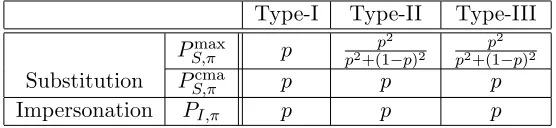
This probability distribution is naturally captured by the von Neumann source over K = {0,1}2. In the next section, we will present construction methodology for 1-bit message A-codes from von Neumann sources in general.
8
Design of A-codes from von Neumann Sources
In this section, we explicitly show how to construct good A-codes (i.e., ∞-optimal A-codes) having 1-bit messages from von Neumann sources.
A distribution PK over {0,1}n is a von Neumann source, if for K = (K1, K2, . . . , Kn), PKi(0) = p ∈ (0,1) for every 1 ≤ i≤ n, i.e., K is the i.i.d. according to a binary distribution [p,1−p]. For simplicity, we assume 1/2≤p <1.
In the following, for a non-negative integer z, we denote its binary string by [z]2. On the other
hand, for a binary string x, [x]10 denotes the non-negative integer whose binary string is x. In this
section, for a von-Neumann source [PK] over ({0,1}n,≤K), if there is no explanation about the order
≤K, we assume that it is given as follows: for x, y∈ {0,1}n, we define x≤K y if [x]10≤[y]10.
8.1 Compositional Construction
For ans×umatrixX= (xi,j) and ans×vmatrixY = (yi,j), we define an s×uv matrixZ :=X⊙Y
by
Z = (zi,j), zi,(j1−1)v+j2 := (xi,j1 ∥yi,j2) for 1≤i≤s, 1≤j1 ≤u, 1≤j2 ≤v,