The Cryosphere, 7, 375–393, 2013 www.the-cryosphere.net/7/375/2013/ doi:10.5194/tc-7-375-2013
© Author(s) 2013. CC Attribution 3.0 License.
EGU Journal Logos (RGB)
Advances in
Geosciences
Open Access
Natural Hazards
and Earth System
Sciences
Open AccessAnnales
Geophysicae
Open AccessNonlinear Processes
in Geophysics
Open AccessAtmospheric
Chemistry
and Physics
Open AccessAtmospheric
Chemistry
and Physics
Open Access DiscussionsAtmospheric
Measurement
Techniques
Open AccessAtmospheric
Measurement
Techniques
Open Access DiscussionsBiogeosciences
Open Access Open Access
Biogeosciences
Discussions
Climate
of the Past
Open Access Open Access
Climate
of the Past
Discussions
Earth System
Dynamics
Open Access Open Access
Earth System
Dynamics
DiscussionsGeoscientific
Instrumentation
Methods and
Data Systems
Open Access
Geoscientific
Instrumentation
Methods and
Data Systems
Open Access DiscussionsGeoscientific
Model Development
Open Access Open Access
Geoscientific
Model Development
DiscussionsHydrology and
Earth System
Sciences
Open AccessHydrology and
Earth System
Sciences
Open Access DiscussionsOcean Science
Open Access Open Access
Ocean Science
Discussions
Solid Earth
Open Access Open Access
Solid Earth
Discussions
The Cryosphere
Open Access Open Access
The Cryosphere
DiscussionsNatural Hazards
and Earth System
Sciences
Open Access
Discussions
Bedmap2: improved ice bed, surface
and thickness datasets for Antarctica
P. Fretwell1,*, H. D. Pritchard1,*, D. G. Vaughan1, J. L. Bamber2, N. E. Barrand1, R. Bell3, C. Bianchi4,
R. G. Bingham5, D. D. Blankenship6, G. Casassa7, G. Catania6, D. Callens8, H. Conway9, A. J. Cook10, H. F. J. Corr1, D. Damaske11, V. Damm11, F. Ferraccioli1, R. Forsberg12, S. Fujita13, Y. Gim14, P. Gogineni15, J. A. Griggs2,
R. C. A. Hindmarsh1, P. Holmlund16, J. W. Holt6, R. W. Jacobel17, A. Jenkins1, W. Jokat18, T. Jordan1, E. C. King1, J. Kohler19, W. Krabill20, M. Riger-Kusk21, K. A. Langley22, G. Leitchenkov23, C. Leuschen15, B. P. Luyendyk24, K. Matsuoka25, J. Mouginot26, F. O. Nitsche3, Y. Nogi27, O. A. Nost25, S. V. Popov28, E. Rignot29, D. M. Rippin30, A. Rivera7, J. Roberts31, N. Ross32, M. J. Siegert2, A. M. Smith1, D. Steinhage18, M. Studinger33, B. Sun34, B. K.Tinto3, B. C. Welch18, D. Wilson35, D. A. Young6, C. Xiangbin34, and A. Zirizzotti4
1British Antarctic Survey, Cambridge, UK
2School of Geographical Sciences, University of Bristol, UK
3Lamont-Doherty Earth Observatory of Columbia University, Palisades, USA 4Istituto Nazionale di Geofisica e Vulcanologia, Rome, Italy
5School of Geosciences, University of Aberdeen, UK 6Institute for Geophysics, University of Texas at Austin, USA 7Centro de Estudios Cientificos, Santiago, Chile
8Laboratoire de Glaciologie, Universit´e Libre de Bruxelles, Brussels, Belgium 9Earth and Space Sciences, University of Washington, Seattle, USA
10Department of Geography, Swansea University, Swansea, UK
11Federal Institute for Geosciences and Natural Resources, Hannover, Germany 12National Space Institute, Technical University of Denmark, Denmark 13National Institute of Polar Research, Tokyo, Japan
14Jet Propulsion Laboratory. California Institute of Technology, Pasadena, USA 15Electrical Engineering & Computer Science, University of Kansas, Lawrence, USA 16Stockholm University, Stockholm, Sweden
17St. Olaf College, Northfield, MN 55057, USA 18Alfred Wegener Institute, Bremerhaven, Germany 19Norwegian Polar Institute, Fram Centre, Tromsø, Norway 20NASA Wallops Flight Facility, Virginia, USA
21College of Science, University of Canterbury, Christchurch, New Zealand 22Department of Geosciences, University of Oslo, Norway
23Institute for Geology and Mineral Resources of the World Ocean, St.-Petersburg, Russia 24Earth Research Institute, University of California in Santa Barbara, USA
25Norwegian Polar Institute, Tromso, Norway
26Department of Earth System Science, University of California, Irvine, USA 27National Institute of Polar Research, Tokyo, Japan
28Polar Marine Geosurvey Expedition, St.-Petersburg, Russia 29School of Physical Sciences, University of California, Irvine, USA
30Environment Department, University of York, Heslington, York, YO10 5DD, UK 31Department of Sustainability, Environment, Water, Population and Communities, Australian Antarctic Division, Hobart, Tasmania, Australia
376 P. Fretwell et al.: Improved ice bed, surface and thickness datasets for Antarctica
33NASA Goddard Space Flight Center, Greenbelt, USA 34Polar Research Institute of China, Shanghai, China
35Institute for Crustal Studies, University of California in Santa Barbara, USA ∗These authors contributed equally to this work.
Correspondence to: P. Fretwell ([email protected])
Received: 31 July 2012 – Published in The Cryosphere Discuss.: 11 October 2012 Revised: 17 January 2013 – Accepted: 23 January 2013 – Published: 28 February 2013
Abstract. We present Bedmap2, a new suite of gridded
products describing surface elevation, ice-thickness and the seafloor and subglacial bed elevation of the Antarctic south of 60◦S. We derived these products using data from a va-riety of sources, including many substantial surveys com-pleted since the original Bedmap compilation (Bedmap1) in 2001. In particular, the Bedmap2 ice thickness grid is made from 25 million measurements, over two orders of magnitude more than were used in Bedmap1. In most parts of Antarc-tica the subglacial landscape is visible in much greater de-tail than was previously available and the improved data-coverage has in many areas revealed the full scale of moun-tain ranges, valleys, basins and troughs, only fragments of which were previously indicated in local surveys. The de-rived statistics for Bedmap2 show that the volume of ice contained in the Antarctic ice sheet (27 million km3) and its potential contribution to sea-level rise (58 m) are simi-lar to those of Bedmap1, but the mean thickness of the ice sheet is 4.6 % greater, the mean depth of the bed beneath the grounded ice sheet is 72 m lower and the area of ice sheet grounded on bed below sea level is increased by 10 %. The Bedmap2 compilation highlights several areas beneath the ice sheet where the bed elevation is substantially lower than the deepest bed indicated by Bedmap1. These products, along with grids of data coverage and uncertainty, provide new opportunities for detailed modelling of the past and fu-ture evolution of the Antarctic ice sheets.
1 Introduction
It is more than a decade since grids of ice-surface eleva-tion, ice thickness and subglacial topography for Antarc-tica were presented by the BEDMAP Consortium as digital products (hereafter we refer to these products collectively as Bedmap1, Lythe et al., 2001), and as a printed map (Lythe et al., 2000). Since then, Bedmap1 products have been widely used in a variety of scientific applications, ranging from ge-ological (e.g., Jamieson et al., 2005) and glacige-ological mod-elling (e.g., Wu and Jezek, 2004), to support for geophys-ical data interpretation (e.g., Riedel et al., 2012), as a ba-sis for tectonic interpretation (e.g., Eagles et al., 2009), as a baseline for comparison of newly-acquired subglacial
in-formation (e.g., Welch and Jacobel, 2003), and even to help improve understanding of the distribution of marine species (Vaughan et al., 2011).
Like their predecessors (e.g., Drewry and Jordan, 1983), Bedmap1 products were based on a compilation of data col-lected by a large number of researchers using a variety of techniques, with the aim of representing a snap-shot of un-derstanding, and as such, Bedmap1 has provided a valuable resource for more than a decade. However, in recent years, inconsistencies (such as negative water column thickness be-neath some ice-shelf areas) in Bedmap1 have proved to be limitations and several new versions have been developed (e.g., Le Brocq et al., 2010; Timmerman et al., 2010), which have proved very useful to the community. Since Bedmap1 was completed, a substantial quantity of ice-thickness and subglacial and seabed topographic data have been acquired by researchers from many nations. The major improvement in coverage and precision that could be achieved by incor-porating these data into a single new compilation is obvi-ous. Here we present such a compilation, Bedmap2, which maintains several useful features of Bedmap1, but provides many improvements; higher resolution, orders of magnitude increase in data volume, improved data coverage and pre-cision; improved GIS techniques employed in the gridding; better quality assurance of input data; a more thorough map-ping of uncertainties; and finally fewer inconsistencies in the gridded products.
General philosophy of approach
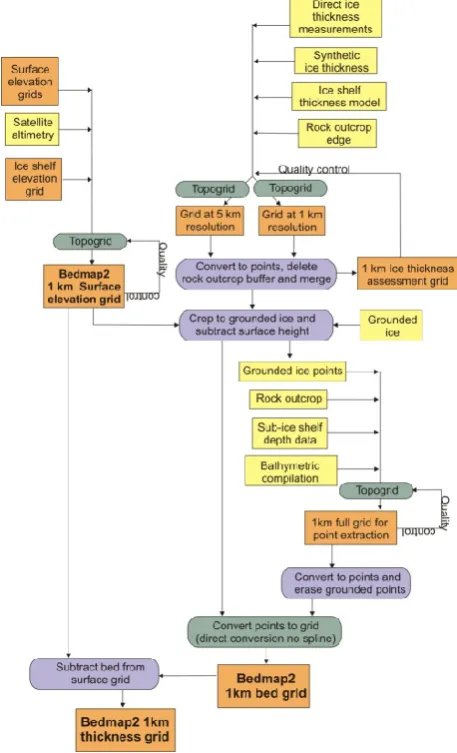
The general approach used to derive the Bedmap2 products was to incorporate all available data, both geophysical and cartographic, and in particular, we endeavoured to include all measurements available to date. However, it should be noted that the disparities between varied input data sources, the inhomogeneous spatial distribution of data, and its highly-variable reliability, means that we needed to develop a rather complicated, multi-stepped process of automatic GIS anal-yses and manual intervention (summarised in Fig. 1). Be-low, we describe the steps of these processes in detail. Some steps required specific judgments to be made with regard to conflicting measurements, with the consequence that not all measurements are honoured.
P. Fretwell et al.: Improved ice bed, surface and thickness datasets for Antarctica 377
35 900
901 Fig. 1. Flow diagram of steps to construct the three Bedmap2
grids. Yellow boxes indicate vector data, orange represent gridded datasets, purple represent processes and green gridding. The three bold Bedmap2 boxes show the final outputs.
We took care, however, to ensure self-consistency in the ice-surface, ice-thickness, and bed-elevation grids, and con-sistency between the specific values in these grids and the known flotation/grounded condition of the ice in particular regions.
The aim of the Bedmap2 project was to produce a com-plete product covering the entire continent, which would be appropriate for use in a wide range of scientific disciplines, and this has dictated the choice of processes employed. For example; as with Bedmap1, the gridding techniques used in deriving Bedmap2 relied solely on input data and general as-sumptions about the nature of the ice-surface and sub-glacial landscape. They did not rely on ice-flow assumptions that could improve performance in areas with limited data (Le Brocq et al., 2008b; Morlighem et al., 2011; Roberts et al.,
2011), but which would preclude their use in many glacio-logical analyses.
2 Grounding line, coastline, ice shelf limits, geoid and projection
To ensure that Bedmap2 grids provide a self-consistent prod-uct where the bed-elevation in all grounded areas is equal to ice-surface minus ice-thickness, and in all areas of float-ing ice shelf, ice-bottom (ice-surface minus ice-thickness) is above the bed-topography, we require defined domains of grounded ice sheet, floating ice shelves and open sea. In the-ory, these could be extracted from sufficiently accurate grids of ice thickness, surface elevation and bed elevation, but in reality, using the known distribution of floating ice provides extra control on the derivation of the gridded products. We combined a grounding line delineated from MODIS imagery (Haran et al., 2005) with one interpreted from satellite SAR interferometry (Rignot et al., 2011). In general, we favoured the latter in all locations where good satellite data were avail-able, and where multiple grounding lines arose from the SAR interferometry we used the most seaward line. The excep-tion to this was Pine Island Glacier, where an intermediate grounding line from the year 2000 corresponded most closely in acquisition date with the majority of the radar sounding data in the compilation. From these sources, we created a 1 km gridded mask to define the limit of grounded ice in Antarctica.
To define the seaward limit of the ice shelves, we used the MODIS-derived limits as of 2003/4 (Bohlander and Scam-bos, 2007). As an absolute reference for elevation, we used the GL04C geoid (Forste et al., 2008) throughout, and for the grid products, we used Polar Stereographic projection (Sny-der, 1987) based on the WGS84 ellipsoid, with true scale at 71◦S . For area and volume calculations, we used the Lam-bert Azimuthal Equal Area projection (Snyder, 1987).
2.1 Note on grid resolution
378 P. Fretwell et al.: Improved ice bed, surface and thickness datasets for Antarctica
36
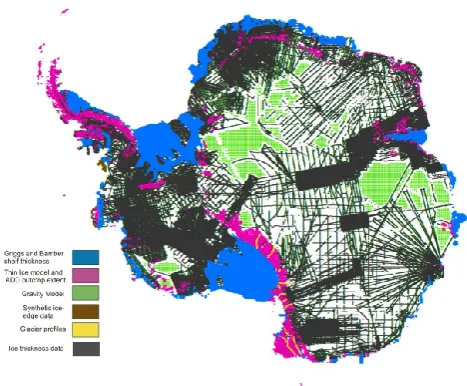
Figure 2, Coverage of datasets used in the construction of the ice thickness grids 902
903
Fig. 2. Coverage of datasets used in the construction of the ice
thick-ness grids.
between flight lines of 5 km. To better capture the complex-ity of rock outcrop and mountainous areas, though, we used a finer 1-km grid spacing in areas within 10 km of rock out-crop. This renders the mountain ranges particularly well and this high level of detail has been maintained in the subse-quent bed model. The final 1 km ice thickness grid is the combination of the thickness from these 5 km and 1 km grids, rendered at 1 km.
3 Derivation of the ice-thickness grid
The Bedmap2 ice thickness grid, subtracted from the surface elevation (see following section), allows us to map the bed topography of the grounded part of the ice sheet and it also provides a continuous representation of both the grounded ice sheet and floating ice shelves. To grid thickness, we broadly followed the methodology set out in Bedmap1. The primary data sources comprised of direct ice thickness mea-surements (largely from airborne radar surveys), a grid of ice-shelf thickness derived from satellite altimetry measurements of freeboard (Griggs and Bamber, 2011), and rock–outcrop boundaries that define isopleths of zero ice thickness (Scien-tific Committee on Antarctic Research, 2012). In areas where primary data were unavailable, we estimated thickness using a satellite-derived gravity field, and in some places, we gen-erated “synthetic” thickness data to ensure consistency of the grid with known topographic features and ice-flotation.
3.1 Direct ice thickness measurements
The database of direct ice thickness measurements compiled for Bedmap2 is ten times larger than that for Bedmap1. The Bedmap1 data were acquired using a variety of methods and
often were not located with the high accuracy possible with modern GPS, and so the variable quality of the input data was a considerable issue (Lythe et al., 2001). The great majority of data collected since then have been acquired using air-borne radar sounding located using high-quality GPS, with positions precise to within a few metres. The locations of new data acquired in this way have been used without fur-ther accuracy checks, except where the gridding procedure highlighted obvious errors.
In addition to airborne radar surveys, direct thickness mea-surements also come from over-snow radar (e.g., King et al., 2009) and seismic sounding data (e.g., Smith et al., 2007) that are highly precise in position and have measurement ac-curacy at least as good as the airborne radar data.
With the dominance of airborne radar sounding in the new datasets, along with improved storage and automated pro-cessing, the density of individual thickness points or “picks” is typically much greater than previously. This increased sampling density and the move towards larger airborne cam-paigns mean that several recent surveys used in Bedmap2 each include as many points as the whole of the Bedmap1 compilation (see Table S1).
Table S1 shows the sources of newly acquired data used to grid ice thickness. The new datasets come from 83 sur-vey campaigns. Many are freely available for download (e.g., http://nsidc.org/data/), while others are presented in sum-mary publications (e.g., Ross et al., 2012), but remain un-published in their raw form. The total number of survey points used in the thickness compilation of Bedmap2 is 24.8 million, which compares to 1.4 million in Bedmap1. Furthermore, improvements in the capability of the GIS soft-ware and hardsoft-ware have allowed all of these data to be incor-porated in the gridding process. In Bedmap1, filtering and decimation were required, reducing the dataset to∼140 000 points.
The majority of direct ice thickness measurements from radar and seismic techniques were calculated with the inclu-sion of a “firn correction”. Routinely for radar measurements on thick ice, 10 m of additional ice thickness has been added by researchers to account for the low-density/high-velocity firn layers. For seismic measurements, a similar correction is made for the low-density/low-velocity firn layers. The ice-thickness measurements compiled for Bedmap2, thus, repre-sent the researchers’ best estimate of the physical ice thick-ness, rather than an “ice-equivalent” thickness. For much of the data used in Bedmap1, the exact value of the firn correc-tion applied could not be determined, but we assume that the researchers collecting the data were best placed to determine the appropriate firn correction, and we have not attempted any further homogenisation.
Not only has the volume of data available in Bedmap2 in-creased, its geographical coverage is also much extended. The number of 5-km cells that contain data has approxi-mately doubled between the two compilations, from 82 000 (17 % of the grounded bed) to 173 000 (36 %, of the
P. Fretwell et al.: Improved ice bed, surface and thickness datasets for Antarctica 379
37
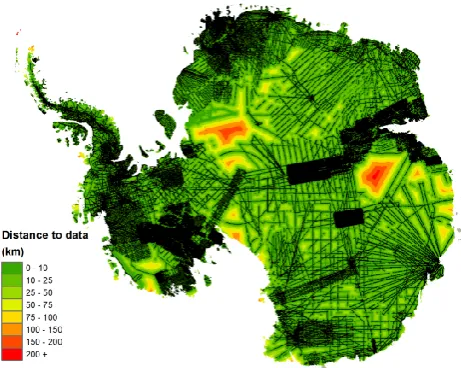
Figure 3, Primary data coverage (black lines) and nearness to ice thickness data. 904
905
906 Fig. 3. Primary data coverage (black lines) and nearness to ice thick-ness data.
grounded bed). The number of cells within 20 km of mea-sured ice thickness is now 83 %. There are still, however, large areas where no data exist and many more where the data density is poor. Figure 3 shows the distribution of ice thickness measurements over grounded ice, with colours of unsampled cells showing the distance to the nearest data. This highlights two particular areas, between Recovery and Support Force glaciers and in Princess Elizabeth Land (see Fig. 4 for locations mentioned in the text), where direct surements of ice-thickness are still entirely absent. Here mea-surements are urgently needed to reduce uncertainty in bed topography and the calculated ice volumes. Several smaller areas in western Marie Byrd Land also have large data gaps (Fig. 3), while in Enderby Land, the existing data come from older surveys that produced low data-density and had poten-tially poor accuracy, resulting in relatively large cross-track errors in the gridded data.
For most of the ice sheet, we have assumed that changes in the ice thickness field through time were insignificant relative to the measurement uncertainty and so used measurements regardless of their acquisition date. Given that the vast ma-jority of data were collected in the last two decades, and the rates of thickness change across Antarctic are in most places low (Pritchard et al., 2009), this assumption is generally rea-sonable. However, in the lower 35 km of Pine Island Glacier, we excluded data from a recent (2011) survey because the rapid thinning of this glacier meant that the ice thickness had reduced by∼40 m or 3 % of the total thickness relative to more extensive earlier surveys.
3.2 Thickness of ice shelves
A single gridded dataset of ice thickness derived from satel-lite altimetry (Griggs and Bamber, 2011) provided full
cov-38 907
Figure 4, Places mentioned in the text. 908
909
910 Fig. 4. Places mentioned in the text.
380 P. Fretwell et al.: Improved ice bed, surface and thickness datasets for Antarctica
Table 1. Corrections applied to altimetry-derived ice shelf thickness
(Griggs and Bamber, 2011) to match direct measurements of ice thickness.
Correction to mean
Ice Shelf thickness applied
(m)
Vigridisen −62
17 East Ice Shelf −18
Fimbulisen −16
Quarisen, Ekstr¨omisen and Jelbartisen −30 Brunt Ice Shelf /Stancomb-Wills Ice Stream −4
Venable Ice Shelf −60
Pine Island Glacier (main shelf) −21 Pine Island Glacier (north) −21
Thwaites Ice Tongue −81
Crosson Ice Shelf −64
Dotson Ice Shelf −48
Getz Ice Shelf −48
Totten Glacier outer shelf −59 (north of 67◦S)
George VI Ice Shelf +80
(north of 71.5◦S)
George VI Ice Shelf (zone stretching +100 55 km southwest of 71.5◦S)
George VI Ice Shelf (zone stretching +60 from 55 km to 135 km southwest of 71.5◦S) George VI Ice Shelf (southernmost 35 km) +30
3.3 Gravity-derived ice thickness
For the two large areas lacking direct thickness data (be-tween Recovery and Support Force glaciers and in Princess Elizabeth Land), we used satellite gravity data as an indirect indication of ice thickness. Before radio echo sounding of ice thickness became routine, free-air gravity measurements were commonly used to aid interpolation between seismic ice thickness soundings (e.g., Bentley, 1964). The correla-tion of free-air gravity and topography continues to be used to provide regional bathymetric maps from satellite grav-ity data (Smith and Sandwell, 1997). Nowadays, the longer wavelength free-air gravity field of the entire Antarctic conti-nent has been derived from satellite gravity missions such as GRACE (Tapley et al., 2004) and GOCE (http://www.esa.int/ SPECIALS/GOCE/index.html). By inverting this long wave-length gravity field, we can place constraints on the regional scale subglacial topography.
Early workers estimated sub-ice topographic variation by assuming a linear gravity topography conversion factor (GTCF) of 13.5 m mGal−1, based on a Bouguer slab ap-proximation with rock and ice densities of 2670 kg m−3and 900 kg m−3, respectively (Kapitsa, 1964). Bentley (1964) noted that the true GTCF will be a complex function of dis-tance to bed, bed morphology, rock density and regional iso-static balance, and used sparse seismic soundings and associ-ated gravity measurements to calculate an empirical GTCF of
20 m mGal−1. Additionally, by considering the change in cal-culated gravity between seismic tie points, the effects of iso-static compensation on the result were minimised. We have extended this empirical technique to invert satellite gravity data for regional subglacial topography in the two areas de-scribed above.
Firstly, we compared down-sampled 20-km topography and GOCE 2010 satellite gravity data within windows of 300×300 km. We calculated the correlation between gravity and topography by fitting a first-order least squares polyno-mial through the windowed data. The slope of the polynopolyno-mial was taken as an empirically derived GTCF, while the inter-cept indicates a bias, most likely due to the degree of regional isostatic compensation. Assuming the GTCF and level of iso-static compensation vary on longer spatial wavelengths than does the subglacial topography, we extrapolate the resulting values to areas where the subglacial topography is not known using a tensioned spline gridding technique (tension 1), and 300-km cosine filter to smooth the resulting grids. We then inverted the regional subglacial topography by multiplying the satellite gravity field by the extrapolated empirical GTCF and adding the measured bias.
Results show GTCF values close to the theoretical ideal of 13.5 m mGal−1 over much of the Antarctic continent, with locally higher values, around 20 m mGal−1, associated with the elevated topography of the Transantarctic Mountains, as suggested by earlier authors. In the vicinity of Support Force Glacier, a series of linear basins 500 to 1000 m deep are in-dicated. The true basins in this area are likely to be narrower and deeper, as we describe in our discussion of uncertainty (see below). However, inversion of gravity data does provide a 1st-order approximation of the subglacial topography in this region. In the Bedmap2 thickness grid, we used gravity derived thickness in areas that were more than 50 km from direct ice-thickness measurements.
3.4 Synthetic ice thickness data
The first synthetic dataset was required to prevent rock out-crops (with isopleths of zero ice thickness) from overly skew-ing the ice thickness distribution in mountainous areas with few direct measurements. Here we applied a “thin-ice” model (similar to that applied in Bedmap1, Lythe et al., 2001). This model relies on the assumption that in mountainous areas where ice fills the valleys, there is a general correlation be-tween ice thickness and the distance from rock outcrops. In areas within 10 km of rock outcrop and greater than 10 km from radar data, we employed the thin ice model following the procedure laid out in Bedmap1. Identical regression co-efficients (y=223.98 Ln(x)−1108.4), originally calculated from bed data near rock outcrop in Prince Charles Land and Dronning Maud Land were applied. The following modifi-cations were made to the original thin ice model: (1) The vector data used to describe the rock outcrops was taken from an updated digital dataset (Scientific Committee on
P. Fretwell et al.: Improved ice bed, surface and thickness datasets for Antarctica 381
Antarctic Research, 2012); (2) We refined the modelled ice thickness by calibrating the rate at which thickness increases with distance for different mountain areas for which radar data were available. This change particularly affected moun-tainous coastal areas where uncalibrated ice thickness from the thin-ice model tended to be excessive.
The second synthetic dataset was required to define ma-jor glaciers passing through mountain ranges for which ice-thickness measurements are too sparse to ensure their exis-tence in the gridded product (cf., Lythe et al., 2001). The absence of such topographic troughs in the Bedmap2 prod-ucts would have severely limited the value to the ice-sheet modelling community. The synthetic glacier profiles are lin-ear interpolations, along the centre profile of the glacier, be-tween the nearest upstream and downstream data points, or a downstream data point at the grounding line calculated by hydrostatic equilibrium from the surface height. The spe-cific glaciers for which such data were included are shown in Fig. 2. These differ from those in Bedmap1 because some glaciers have since been surveyed and because we added new ones in mountainous areas of East Antarctica and the Antarc-tic Peninsula.
3.5 Gridding of ice-thickness
Various algorithms have previously been used to grid the topography of glaciated landscapes, but the morphology of such environments, when combined with the irregular, of-ten highly anisotropic distribution of ice thickness measure-ments (lines of densely sampled point measuremeasure-ments sep-arated by many kilometres) tends to produce characteristic gridding artefacts. These artefacts commonly include “bulls-eyes” around isolated points and “chaining” where survey tracks cross narrow linear features such as valleys. Bedmap1 employed an inverse-distance-weighting algorithm with an octal search. For Bedmap2, where the data volume has in-creased substantially, we completed a series of tests to select the most appropriate algorithm.
Specifically, we used a detailed, 90-m gridded Shuttle Radar Topography Mission (SRTM) DEM of the now ice-free glaciated landscape of the Scottish Highlands, mosaiced with GEBCO Antarctic bathymetry to produce a seamless DEM. We reproduced a typical sampling distribution by lay-ing over this DEM a sample of points from actual Bedmap2 survey lines from a section of the central Antarctic Penin-sula, complete with defined rock outcrops, thin-ice-modelled synthetic data and ice shelf thickness. We sampled the height of the Scotland DEM at the locations of the overlaid points and gridded this sample with the nearest neighbour, cubic spline, bilinear spline, kriging (with several different semi-variograms), triangular irregular network (tin) and Topogrid algorithms (available within ESRI Ltd, ArcGIS 9). For each sample, we constructed a 5-km bed model as if the survey points extracted from the Scotland DEM were measurements
from subglacial bed elevation. We compared the output grid with the original SRTM DEM resampled to 5 km (Table 2).
The best results were returned by the ArcGIS Topogrid routine, designed around the ANUDEM algorithm (Hutchin-son, 1988), which had a standard deviation of 66 m compared to 85 m and 86 m for spline-with-tension and IDW, respec-tively. Topogrid is an adapted thin plate spline with an iter-ative finite difference interpolation that imposes constraints upon the elements to prevent spurious sinks being formed in the output dataset (Hutchinson, 1989). It is routinely and widely used in bathymetric applications (Jakobsson et al., 2000) and digital cartography (e.g., British Antarctic Survey Misc series maps have all used this technique). There are a number of options available within the Topogrid function in ArcGIS: for our test and final grids we used no drainage en-forcement, set the primary data type to “spot” and, after ex-perimentation, left the maximum number of iterations and roughness penalty as the default as both these options had minimal effect on the final output.
4 Compilation of ice-surface elevation grid
To derive bed elevation from ice thickness over the grounded ice sheet requires a reliable grid of elevation for the ice sur-face and exposed rock outcrops. Several DEMs covering all (e.g., Bamber et al., 2009a) or part of Antarctica (Cook et al., 2012) are available, and these vary in quality, accuracy and consistency. We have combined several DEMs in order to exploit the strengths of each, which we determined from published sources (see Fig. 5). We quantitatively checked the resulting surface-elevation grid by comparison to airborne al-timetry and satellite laser alal-timetry (ICESat), and by com-paring the form of gridded elevation surfaces to the form of the surface shown by high-resolution visible satellite imagery (Haran et al., 2005; Bindschadler et al., 2008).
For much of the ice sheet, we used an extensive and consis-tent surface elevation model derived primarily from satellite radar altimetry (Bamber et al., 2003), which is highly accu-rate over areas of low surface slope, but less accuaccu-rate over areas of higher surface slope, and is not reliable in areas of mountainous terrain and widespread rock outcrop (Le Brocq et al., 2010).
In mountainous areas of West and East Antarctica within 10 km of rock outcrops, we use the Ohio State University DEM (OSU DEM) (Liu et al., 1999), which was based pri-marily on vector data from the Antarctic Digital Database (Scientific Committee on Antarctic Research, 2012), which in turn is based upon cartographic information. This DEM provides detailed elevation data over rock, but performs poorly over ice sheets and in some places has known posi-tional errors of>10 km.
382 P. Fretwell et al.: Improved ice bed, surface and thickness datasets for Antarctica
Table 2. Comparative analysis of the best results from a selection of gridding methods. Each method was tested for gridding accuracy against
a high-resolution digital elevation model of a previously glaciated landscape (the Scottish Highlands) using a sample of spot heights extracted on the highly irregular pattern of data collection provided by a sub-sample of the Bedmap2 flight-lines. These results show that Topogrid out-performed other gridding techniques in areas where data were present, and also had high accuracy over the grid as a whole.
Gridding algorithm min max mean std dev skew kurtosis 1st median 3rd
quartile quartile
Elevation difference between sampled spot heights and the grid of elevation derived from these spot heights
Topogrid −750 522 1.4952 97.224 −0.609 6.7704 −36 5 46
spline with tension −820 797 −5.801 113.6 −0.175 7.7277 −47 −2 38
IDW −820 744 −4.028 109.41 −0.15 7.8096 −42 −1 37
Rasterized TIN −796 689 −3.314 114.31 −0.239 7.2387 −46 −1 41
Elevation difference between the grid derived from sampled spot heights and the original high-resolution DEM
Topogrid −409 329 −0.587 66.256 −0.369 7.4475 −28 1 30
spline with tension −387 564 −3.537 85.376 0.349 6.7709 −43 −4 34
IDW −403 504 −3.244 86.051 0.142 5.8126 −42 −3 35
Rasterized TIN −202 349 −3.521 52.728 1.526 8.4427 −31 −12 13
39
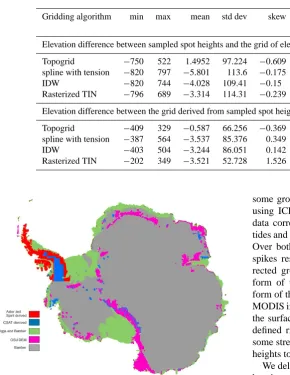
Figure 5, Coverage of datasets used in construction of the surface grid 911
912
913 Fig. 5. Coverage of datasets used in construction of the surface grid.
performs well in areas densely sampled by ICESat, but less well elsewhere. On the Antarctic Peninsula, we augmented this DEM with two photogrammetrically complied DEMs, from the SPIRIT project (SPOT satellite images) (Korona et al., 2009) and GDEM (from ASTER satellite images) (Ko-rona et al., 2009; Cook et al., 2012). Photogrammetrically compiled DEMs perform well on high-contrast surfaces, par-ticularly on rocky north facing slopes, but in flat, featureless areas the lack of contrast makes automated DEM production by photogrammetric techniques subject to larger errors and the two products tend to perform less well in flat icy terrain and in shadowed areas.
Over the ice shelves, we used the same satellite altimetry-derived DEM used in the ice-thickness compilation (Griggs and Bamber, 2011), edited to remove step-like artefacts near
some grounding lines, and where necessary, we filled gaps using ICESat (GLA12 release 28) satellite laser altimetry data corrected for saturation, cloud, ocean, earth and load tides and the inverse barometer effect (Pritchard et al., 2012). Over both ice shelves and ice sheet we removed pits and spikes resulting from occasional bad data points and cor-rected gross interpolation errors in topography where the form of the surface elevation failed to correspond to the form of the landscape visible in high-resolution Landsat and MODIS images (LIMA, MOA). In these areas, we re-gridded the surface using ICESat data and in some cases, manually defined ridge crests with linearly interpolated heights. On some stretches of coast, we added zero-value or interpolated heights to constrain poorly-sampled margins.
We deleted data in a 10-km no-data buffer between neigh-bouring datasets before gridding the multiple surface ele-vation datasets together (with ArcGIS Topogrid) to ensure smooth transitions between datasets and, in particular, across grounding zones. Thus, we created a seamless 1-km grid of ice surface elevation for the entire continent. Where possible, we checked the accuracy of this DEM relative to geoidally-referenced airborne altimetry data from the IceBridge mis-sion (Leuschen and Allen, 2012).
We tested for areas of known grounded ice along the coast where the combination of measured ice thickness and sur-face elevation, firn thickness and firn density (Ligtenberg et al., 2011) implied floating. We found small areas up to 10 km inland that failed this test but we did not enforce grounding here because the areas are small relative to the resolution of the gridded firn properties, because the grounding line posi-tion may be imperfectly known or may move across a range of positions, and because a grounding zone may be subject to bridging stresses and flow effects that prevent ice from reaching hydrostatic equilibrium.
P. Fretwell et al.: Improved ice bed, surface and thickness datasets for Antarctica 383
We also tested for discontinuity artefacts in the surface elevation and thickness grids by calculating the basal driv-ing stress from them and lookdriv-ing for abrupt changes asso-ciated with the boundaries of neighbouring datasets. Where necessary, we eliminated edge artefacts by allowing no-data buffers between the datasets used in the grid interpolation. In a small number of sites, possible artefacts remain, but these are difficult to verify or eliminate given the available data.
5 Derivation of subglacial and seabed elevation grid
Given the surface and ice-thickness grids described above it is conceptually simple to determine the bed elevation by subtraction. However, maintaining resolution in mountain-ous areas and creating a seamless topography incorporat-ing open ocean bathymetry, sub-ice cavities and sub-glacial bathymetry required a multi-step approach (Fig. 1).
5.1 Open ocean and coastal bathymetry
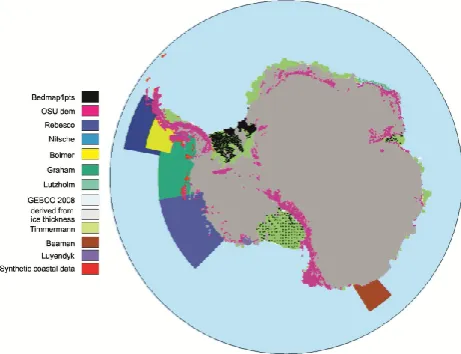
Bedmap2 extends to 60◦South, well beyond the Antarctic coastline, incorporating large areas of continental shelf and deep ocean bathymetry in the grid of bed topography. For the majority of these areas, we mosaiced together (into a 1 km grid) the GEBCO 2008 bathymetric compilation with several publicly available datasets that superseded the 2008 com-pilation (Fig. 6). A considerable body of even newer swath bathymetry survey data are now available and the substantial task of compiling and gridding these datasets is being under-taken by the International Bathymetric Chart of the Southern Ocean (IBCSO) Consortium.
5.2 Sub-ice shelf bathymetry
For the sub-ice-shelf bathymetry, we used data from a re-cent compilation (Timmerman et al., 2010), along with data in the Bedmap1 database. The sea-bed topography beneath ice shelves is, in many areas, poorly constrained. Although the most recent data compilations have been integrated into Bedmap2 many areas still require better data for effective modelling. Better data in these sub-shelf areas are impor-tant for our understanding of Holocene ice retreat and the retreat of the LGM Antarctic Ice Sheet. We tested for areas where ice-shelf thickness and sub-shelf bathymetry falsely indicated grounded ice, and where necessary, enforced flota-tion by lowering the (poorly sampled) sea bed. We did this by interpolating the thickness of the sub-ice-shelf water column between the point where cavity thickness declined to 100 m and the grounding line where cavity thickness is 0 m. This approach was required for Getz, Venable, Stange, Nivlisen, Shackleton, Totten and Moscow University ice shelves, for some of the thickest areas of the Filchner, Ronne, Ross, Amery ice shelves and for the ice shelves of Dronning Maud Land.
40 914
Figure 6, Coverage of bathymetry and rock outcrop datasets used in the construction of the bed elevation grid. 915
Datasets include a number of published grids including: Rebesco et al. 2006, Graham et al. 2010, Nitsche et al. 916
2007, Beaman 2010, Luyendyk et al. 2003, and Bolmer et al. 2004. 917
918
919 Fig. 6. Coverage of bathymetry and rock outcrop datasets used in the construction of the bed elevation grid. Datasets include a num-ber of published grids including: Rebesco et al. (2006), Graham et al. (2011), Nitsche et al. (2007), Beaman (2010), Luyendyk et al. (2003), and Bolmer et al. (2008).
5.3 The combined bed dataset
We converted the ice thickness grids at 5 km and 1 km resolu-tion to point datasets and in areas distant from rock outcrop, subtracted the resulting 5-km ice-thickness points directly from the 1-km ice surface elevation model to give bed height. In areas within 10 km of rock outcrop, the thin-ice-model produced a denser coverage of synthetic ice thicknesses, so in these areas, 1-km thickness points were subtracted from the 1-km ice surface. From this point coverage, areas of rock outcrop (which would result in negative or zero ice thick-ness) were removed and replaced by surface model heights. The three grids thus constructed (far from rock outcrop, near to rock outcrop and within areas identified as rock outcrop) were combined with points derived from the ocean and sub-ice-shelf bathymetry and gridded to produce one seamless 1 km grid of bed and sea-floor elevation.
6 Results
The three gridded outputs of surface, thickness and bed can be seen in Figs. 7, 8 and 9.
6.1 Uncertainty in the Bedmap2 grids
384 P. Fretwell et al.: Improved ice bed, surface and thickness datasets for Antarctica
41 920
Figure 7, Bedmap2 surface grid 921
922
923
924
Fig. 7. Bedmap2 surface grid.
42 925
Figure 8, Bedmap2 ice thickness grid 926
927
928
929
Fig. 8. Bedmap2 ice thickness grid.
thickness measurements, other constraints on ice thickness (ice shelf thickness from altimetry, gravity over ice sheets), synthetic data (thin-ice model, interpolated profiles), and the gridding and interpolation process.
6.2 Surface DEM
The surface DEMs used in the Bedmap2 surface elevation grid have published uncertainty estimates at their native
res-43 930
Figure 9, Bedmap2 bed elevation grid. Although difficult to see at this scale, the bed elevation in areas where 931
the main source of bed elevation data is gravimetric has inherited roughness from the surface grid. 932
933
934 Fig. 9. Bedmap2 bed elevation grid. Although difficult to see at this scale, the bed elevation in areas where the main source of bed ele-vation data is gravimetric has inherited roughness from the surface grid.
olutions (Table 3). Accounting for bias and random errors, we assign an estimated±30 m uncertainty to the Bedmap2 surface elevation grid, rising to±130 m over mountains.
6.3 Direct ice thickness measurements
Over the ice sheets, older radar data that were included in the Bedmap1 compilation were often collected without the advantage of modern GPS control, therefore, the positional accuracy was usually poorer than for more recent data. A rigorous quality control procedure was used in the original compilation so, although the spatial accuracy of these data may be poorer than more recent acquisitions, these data are taken as pre-checked and are included without further inves-tigation.
Cross-over analysis
We assessed radar survey cross-over differences on the full dataset prior to the final quality-control step to give a conser-vative estimate of measurement accuracy, and to give insights into the consistency of individual datasets and the unifor-mity between datasets. The cross-over procedure consisted of compiling the differences between independent measure-ments of ice thickness within a 50-m horizontal radius. We chose this since, for much of the ice sheet, it is close to the radius of the first Fresnel zone, which describes the circu-lar area of a flat ice-base and that contributes to the leading edge of a radar echo. Accounting for the refractive index of ice n, the first Fresnel zone Rf, is dependent on the radar
P. Fretwell et al.: Improved ice bed, surface and thickness datasets for Antarctica 385
Table 3. Digital elevation models used in compilation of the Bedmap2 surface grid.
Source Location (Fig. X) Uncertainty estimate
ASTER Antarctic Peninsula ±26 m, bias +3 m (Cook et al., 2012)
SPIRIT Antarctic Peninsula Within±6 m of ICESat elevations for 90 % of
the data in areas of good contrast (Korona et al., 2009) Satellite radar and laser altimetry Ice shelves away from ±15 m, bias 5 m
(Griggs and Bamber, 2011) grounding zone
Satellite radar and laser altimetry East and West Antarctic ice ±23 m, bias<1 m (Bamber et al., 2009a) sheet away from mountains
Satellite laser altimetry Interior Antarctic Peninsula, some Estimate ranges from±0.4 m, bias−0.4 m (relative to (Brenner et al., 2007) mountain and coastal areas airborne laser scanning) to±20 m, bias−24 m (relative
to radar altimeter DEM over steeper slopes)
OSU DEM (Liu et al., 1999) Mountain areas ±100 to 130 m
wavelengthλ, terrain clearanceH, and ice thicknessZ, as
Rf∼= r
λ
2(H+n×Z (1)
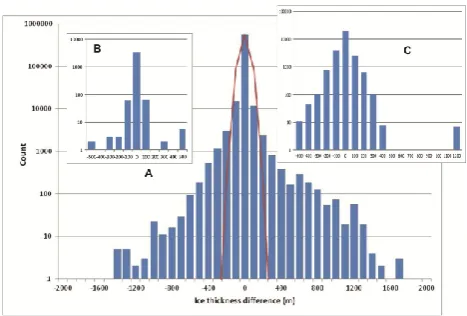
After disqualifying nearby soundings from the same mission, we identified a total of 600 973 crossover points. No account was taken of the direction of traverse or terrain clearance at the crossing points. The analysis produced a standard devi-ation of±51.2 m, and the distribution of differences in ice thickness is shown in Fig. 10. It should be noted, however, that the cross-over values have a highly non-Gaussian distri-bution with a significant fraction many times greater than the standard deviation, hence, an unusually large number (94 %) of the cross-over values lie within one standard deviation of zero. The quoted standard deviation is, therefore, a pes-simistic view of the vast majority of the crossovers, indeed, the median crossover difference is−1 m and the interquartile range is 5 m.
The spatial distribution of the majority of thickness cross-over differences (Fig. 10) gives insight into their cause, which will include: differences introduced by roughness of the basal terrain, differences between radar instrumen-tation and differences in institutional processing methodol-ogy. The spatial spread of the relatively small number of large thickness-differences (1200 locations with a difference greater than 500 m) provides a cautionary note for use of the gridded products. Some of these large differences appear to be due to the underlying topography whilst others appear to be caused by positional errors, and in particular from mis-sions before the advent of GPS. The possibility that occa-sional erroneous data have been included in the compilation cannot be excluded.
6.4 Other constraints on ice thickness
Over the ice shelves, the published precision in thickness is variable, but is∼100 m, with biases of−13 to +53 m (Griggs and Bamber, 2011). We have attempted to exclude areas most
44 935
936
Figure 10. Results of crossover analysis for direct ice-thickness measurements shown on a logarithmic scale. 937
Plot A represents the whole dataset, B, areas with a smooth bed (test sample taken from the Siple coast) and C, 938
areas with a rough bed (test sample taken from the Gamburtsev Subglacial Mopuntains). Standard deviation is 939
51.2 m for the whole dataset, 33.37 m for smooth bedded areas and 74.59 m for areas with a rough bed. The 940
Gaussian distribution with the same standard deviation is also shown, to demonstrate that there are more high-941
difference crossovers than would be expected for a normal distribution. 942
943
944
945
Fig. 10. Results of crossover analysis for direct ice-thickness
mea-surements shown on a logarithmic scale. (A) represents the whole dataset, (B) areas with a smooth bed (test sample taken from the Siple coast) and (C) areas with a rough bed (test sample taken from the Gamburtsev Subglacial Mountains). Standard deviation is 51.2 m for the whole dataset, 33.37 m for smooth bedded areas and 74.59 m for areas with a rough bed. The Gaussian distribution with the same standard deviation is also shown, to demonstrate that there are more high-difference crossovers than would be expected for a normal distribution.
prone to bias and to correct others using radar data, but in some places the uncertainty is likely to remain at∼150 m.
386 P. Fretwell et al.: Improved ice bed, surface and thickness datasets for Antarctica
biased towards deeper ice), the gravity estimates were 437 m too shallow (n=110 024, SD = 600 m). Given these find-ings, we estimate an uncertainty in ice thickness of±1000 m at any given point in the gravity-derived sections of the Bedmap2 grid.
6.5 Synthetic data
Thickness produced by the thin ice model is typically used in areas with relatively steep gradients of ice thickness and are constrained only at the zero-thickness isopleth. We esti-mate their uncertainties to be at least as large as those from interpolating radar measurements into unsampled areas over rough topography (discussed in following section), which are of order±300 m. We estimate a similar uncertainty for our linear interpolation of glacier longitudinal profiles.
6.6 Assessment of gridding and interpolation error
Data distribution in airborne radar surveys is highly anisotropic: across-track sampling may be 3 or 4 orders of magnitude lower than sampling along flight tracks. Er-rors arise in the measurements themselves and in fitting and gridding of a surface using point data, but the largest Bedmap2 uncertainties will inevitably exist where we ex-trapolate through unsampled areas, i.e., the extrapolation er-ror is additional to the measurement and gridding erer-ror. In Bedmap2, 34 % of cells have data within them and 80 % have data within 20 km, but the greatest distance from a grid cell to the nearest data point is∼230 km.
Here we assess the two error components associated with gridding:
1. the error arising from fitting a surface to point data and then gridding it;
2. the error that arises as the grid is interpolated into areas without measurements, for which a key question is: how does error increase with distance from the data? We measure these two error components by splitting well-sampled surveys into two separate datasets. We grid one set (D1) and, (a) measure how well the surface fits the data at the D1 data points; and (b) use the rest of the dataset (D2) to see how well the grid did when extrapolated beyond the data in D1. Step ‘a’ is similar to the jack-knifing approach used in Bedmap1 (where random 10 000 point samples were used, Lythe et al., 2001), but in step “b”, we look at both the statistics of the error and the dependence of error on dis-tance from data. This allows us to address the likely error in the majority of the Bedmap2 grid that is unsampled. We con-ducted this test in well-sampled areas over four characteristic subglacial landscape classes: “alpine”, “low relief”, “trough” and “mixed” (a region with a variety of landscape types). The alpine class was represented by the Gamburtsev Subglacial Mountains (Bell et al., 2011), the low relief class by the Siple Coast (Shabtaie and Bentley, 1987), the trough class by the
Carson Inlet (Vaughan et al., 2008), and the mixed landscape by an area in Wilkes land (Ferraccioli et al., 2009). Tables 4 and 5 show the results for each.
6.6.1 Errors in fitting a gridded (Topogrid) surface to ice thickness data
When we compared the gridded surfaces of thickness to the original data used in the gridding, we found median absolute errors ranging from ∼28 to 140 m (Table 4, col-umn 8), with the greatest average error in high-relief areas (Gamburtsev Subglacial Mountains). The examples from the Gamburtsev Subglacial Mountains and Carlson Inlet show greatest gridding errors where bed slopes are steepest, along trough flanks. This suggests that these errors arise from the simplification of a continuously and rapidly varying sur-face with mathematically defined curves, compounded by the representation of these curves with a regular, relatively low-resolution 5-km grid (i.e., generalisation and discretisa-tion). In extreme cases, these thickness errors exceed 1000 m. Where data are present in gridded cells, there is negligible bias in thickness (Table 5, columns 5 and 6). A conservative estimate of gridding error for the 34 % of cells with measure-ments is, therefore, approximately±140 m, but more typi-cally±50 m (Table 4 and 5).
6.6.2 Errors in extrapolation into unsampled areas
These tests show that absolute error in extrapolated grids generally increases over a distance of up to 20 km from data (at a rate of∼2 to 8 m km−1) with the median error ranging from∼100 to 260 m. Beyond 20 km, error appears largely uncorrelated with distance and the median ranges from∼130 to 300 m, with the largest errors occurring over high-relief landscapes. The maximum errors in these tests were ∼1800 m in cases where the extrapolation crossed deep, unsampled troughs.
In extrapolated areas, we have found biases of up to ∼80 m in these tests, but the biases may be either positive or negative. The larger biases are associated with a greater spread in the error data (Table 5). Figure 11 shows that the large bias (−65 m) results from extrapolation over an area of particularly high ground, i.e., it is dependent on bed topogra-phy. Given that the bias may be of either sign and depends on local topography, there does not appear to be bias inherent to the gridding and extrapolation technique. The implication is that if the sample size of signed extrapolation errors was in-creased over a varied landscape, the bias would tend to zero. Overall, these analyses suggest a conservative error estimate of±300 m for the 66 % of cells without data in Bedmap2, a more typical estimate being±200 m.
6.7 Mapping uncertainty
To map the distribution of the uncertainty described above, we defined three landscape classes (smooth, intermediate and
P. Fretwell et al.: Improved ice bed, surface and thickness datasets for Antarctica 387
Table 4. Summary of absolute error statistics. For Carlson Inlet, the full unsampled area is within 20 km of the gridding data.
Region Extrapolation Count Max Extrapolation Count Max Gridding error Count Max
error in first 20 km error in full in sampled
of unsampled area unsampled area area
(median, m) (median, m) (median, m)
Gamburtsev 262 66 684 1384 295 1 048 575 1732 142 1 304 572 1522
Mountains
Siple Coast 103 8719 1149 150 40 170 1177 28 35 214 1075
Carlson Inlet – – – 196 34 818 1511 65 115 002 1275
Wilkes Land 101 207 019 1478 131 536 135 1817 37 536 676 795
(100 km)
Wilkes Land 108 100 433 1228 221 825 874 1876 39 246 937 684
(300 km)
Table 5. Summary of signed error statistics (bias).
Region Signed extrapolation error Signed gridding error
in unsampled areas (m) in sampled areas (m)
Median Mean SD Median Mean
Gamburtsev Mtns −65 −74 422 −7 −13
Siple Coast 10 18 246 0 −5
Carlson Inlet 78 93 437 −7 −26
Wilkes Land (100 km) −6 −1 300 0 −2
Wilkes Land (300 km) 49 54 399 −1 −3
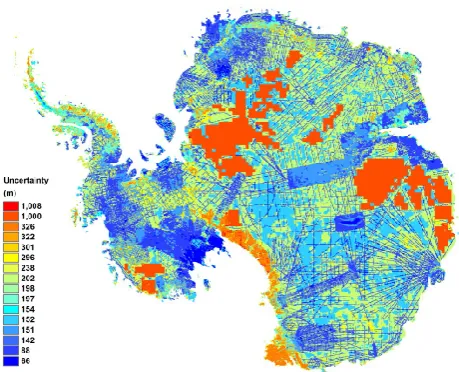
rough) based on the standard deviation of the grid of ice thickness over 50 km. The smooth class is typified by the thickness distribution on the Siple Coast, the rough is typi-fied by the Gamburtsev Subglacial Mountains. Cells in each of these classes have an uncertainty depending on whether or not they contain thickness measurements. For cells with data, we do not calculate uncertainty based on the standard deviation or standard error of ice thickness within a cell be-cause the within-cell sampling (number of samples and their distribution) is markedly inconsistent across the domain. For cells without data, our tests suggest that interpolation un-certainty has some dependency on distance from data over the first 5 to 20 km but this relationship is not well defined, hence, we assign a single, average value of uncertainty for all cells within a class that do not contain data. Additionally, we defined classes of gravity-derived thickness, altimetry-derived ice shelf thickness and synthetic data. The Bedmap2 ice thickness uncertainty classes (Fig. 11) and their associ-ated uncertainties (Fig. 12) are summarised in Table 6. The distribution of data and no-data cells is shown in Fig. 3.
7 Discussion
7.1 New features
The differences between Bedmap1, the most recently up-dated compilation (ALBMAP, Le Brocq et al., 2010), and
Bedmap2 are shown in Fig. 13. This visualisation shows that Bedmap2 contains substantial changes, with many areas be-ing remapped by more than ±500 m. Changes are particu-larly noticeable in East Antarctica, where new data have been included in Bedmap2, but less noticeable in West Antarctica, where most crucial new data were already incorporated into ALBMAP, although, even here, in western Marie Byrd Land new data have made a significant difference to the bed.
So while Bedmap1 and ALBMAP provided an overview of Antarctic subglacial topography and several publications since then have described detailed vignettes of the regional bed (e.g., Holt et al., 2006; Vaughan et al., 2006; Ross et al., 2012), the combined improvements in data density and spa-tial coverage in Bedmap2 now show a landscape of moun-tain chains, networks of valleys, basins and deeply-carved troughs over most of the continent.
388 P. Fretwell et al.: Improved ice bed, surface and thickness datasets for Antarctica
Table 6. Sources of uncertainty in Bedmap2 ice thickness uncertainty classes.
Uncertainty Cells with data Cells with data Cells without
class Gridding Overall uncertainty data Gridding
uncertainty (measurement and uncertainty
(±m) gridding,±m) (±m)
1 (smooth) 30 59 150
2 (intermediate) 65 83 200
3 (rough) 140 149 295
4 (gravity-derived) NA 1000 NA
5 (ice shelf) NA 150 NA
6 (synthetic) NA NA 300
45 946
Figure 11, Estimated uncertainty in ice thickness grid 947
948
949
Fig. 11. Estimated uncertainty in ice thickness grid.
Mountain ranges such as the Transantarctic Mountains and Gamburtsev Subglacial Mountains, and major valleys such as the Lambert Rift and the valleys that form the West Antarctic Rift System (cf., Eagles et al., 2009; Bingham et al., 2012) can be seen both in detail and in the context of the continent as a whole. Particularly striking is the continuity of the steep flank of the Transantarctic Mountains for over 3000 km from Victoria Land, along the margin of the Ross Ice Shelf, and through the Whitmore Mountains and Ellsworth Subglacial Highlands, to the Ellsworth Mountains. Notable also is a pos-sible continuation of the eastern Lambert Rift, which passes to the east of the Gamburtsev Subglacial Mountains (Ferrac-cioli et al., 2011) and south towards the Transantarctic Moun-tains.
A long, rather linear highland is now identifiable, running from close to the South Pole through East Antarctica roughly along on the 35◦E meridian. Its southern portion, Recov-ery Subglacial Highlands, was previously identified and dis-cussed in terms of its potential tectonic origin (Ferraccioli et al., 2011, though mistakenly named Resolution Subglacial Highlands in one figure), but its true scale is now clear;
46 950
Figure 12, Estimated uncertainty in bed elevation grid 951
952
953
954
955
956
Fig. 12. Estimated uncertainty in bed elevation grid.
around 700 km in length, it is up to 3000 m higher than the surrounding bed.
Over the continental shelves, Bedmap2 has relied heavily on existing compilations of bathymetric data discussed else-where (e.g., Nitsche et al., 2007; Graham et al., 2009; Tim-merman et al., 2010).
Beneath the grounded ice sheet, there remain two large areas where direct measurement of ice thickness, and con-sequently bed elevation, are absent: between Recovery and Support Force glaciers, and in Princess Elizabeth Land. Within these, the “poles of ignorance” are ∼230 km and ∼180 km, respectively, from the nearest direct ice-thickness measurements. Although we map these using satellite grav-ity data, this technique is incapable of resolving short-wavelengths in the bed topography and these regions re-main unrealistically smooth in the final ice-thickness and bed-elevation grids. While many areas would benefit from increased density of radar survey, even reconnaissance-level mapping of the bed in these regions would be invaluable.
P. Fretwell et al.: Improved ice bed, surface and thickness datasets for Antarctica 389
47 957
Figure 13, Difference between bed grids: A) shows difference between Bedmap2 and Bedmap1, and B show the 958
difference between Bedmap2 and the bed compilation of ALBMAP (Le Brocq et al., 2010). Red indicates areas 959
where the Bedmap2 bed elevation is higher than previous grids. 960
961
Fig. 13. Difference between bed grids: (A) shows difference between Bedmap2 and Bedmap1, and (B) shows the difference between
Bedmap2 and the bed compilation of ALBMAP (Le Brocq et al., 2010). Red indicates areas where the Bedmap2 bed elevation is higher than previous grids.
7.2 Statistics
Table 7 provides an overview of the key statistics derived from Bedmap2 data compared to Bedmap1. Both these sets of statistics were calculated from 5-km resolution grids. Cor-rect area values are critical to all of these figures, so all datasets were re-projected to Lambert Equal area projec-tion to ensure accurate representaprojec-tion of areas and volumes. This includes the data from the Bedmap1 compilation, which largely accounts for the difference to the original published values figures (Lythe et al., 2001).
Some of the main differences between Bedmap1 and Bedmap2 relate to the part of the ice sheet resting on a bed below present day sea-level. The area of ice sheet grounded below sea level is increased by 10 %. Similarly, the volume of ice sheet below sea level has increased by around 23 %, most of which is in East Antarctica. More than 73 % of the total area of the Antarctic ice sheet resting on a bed grounded below sea-level is in East Antarctica.
For Bedmap2, the calculation of total ice mass was im-proved both by the imim-proved description of the bed topog-raphy and the inclusion of a firn correction. We account for the volume of air contained within the firn in the near-surface layers of the ice using modelled firn depth and den-sity (Ligtenberg et al., 2011). We then calculated the mass of ice that could potentially contribute to sea-level rise. For parts of the ice sheet grounded on a bed above sea-level, this is simply the mass of ice lying between the ice-equivalent surface and the bed. For the part of the ice sheet grounded on a bed below sea-level, this is the mass of ice lying be-tween the ice-equivalent surface and the flotation level cal-culated assuming ice density 917 kg m−3, sea-water density
1030 kg m−3, and the GL04C geoid. Ice below the flotation level in the grounded ice sheet and in the ice shelves con-tributes to sea-level rise through its dilution effect on the ocean waters (Jenkins and Holland, 2007).
There is still substantial debate over the real potential for loss of ice in Antarctica to raise global sea level (e.g., Bam-ber et al., 2009b), and the second-order corrections required to evaluate the exact sea level change that would result from loss of ice in any particular area have been shown to be highly complex, involving as they do, crustal rebound, geoid mod-ification (e.g., Spada et al., 2013), and thermosteric modifi-cation of the oceans (e.g., Shepherd et al., 2010). However, this simple sea-level rise potential is nonetheless important in indicating the relative importance of Antarctica to sea-level change, and the degree to which our understanding of the subglacial landscape of Antarctica is convergent. Using data largely collected during the 1970s (Drewry et al., 1982), Drewry et al. (1992), estimated the potential sea-level contri-bution of the Antarctic ice sheets to be in the range of 60– 72 m; for Bedmap1 this value was 57 m (Lythe et al., 2001), and for Bedmap2 it is 58 m (Table 8). Here, however, the agreement between Bedmap1 and Bedmap2 arises from two roughly counter-balancing differences; while the volume of ice has increased between Bedmap1 and Bedmap2, this has been offset by inclusion of a firn correction and a lowering of the mean bed depth which has reduced the total potential contribution.
390 P. Fretwell et al.: Improved ice bed, surface and thickness datasets for Antarctica
Table 7. Statistical comparison of Bedmap2 and the Bedmap1.
Bedmap1 Bedmap2
Area including ice shelves (106km2) 13.987 13.924 Area excluding ice shelves (106km2) 12.351 12.295 Volume including ice shelves (106km3) 26.07 26.92 Volume excluding ice shelves (106km3) 25.34 26.54 Mean thickness including ice shelves (m) 1859 1937 Mean thickness excluding ice shelves (m) 2034 2126 Thickest ice Astrolabe Subglacial Basin (m) 4897 4897
Mean bed depth (m) 155.2 82.8
Deepest bed point was Bentley Subglacial −2496 −2870 Trough (m), now Byrd Glacier
Area below sea level (106km2) 5.01 5.50
% of total grounded area 40.6 44.7
Potential sea-level equivalent 57 m 58 m
AGAP campaign reported a bed depth of∼2870 m below sea level near the grounding line of Byrd Glacier. Similarly, airborne radar data collected during recent CRESIS surveys 2011 indicated that the Byrd Glacier could be considerably deeper (P. Gogineni, personal communication, 2012). How-ever, several other deep areas have also now been identified. For example, at the north end of Rutford Ice stream where the main mass of the ice stream turns sharply round the tip of the Ellsworth Mountains, the bed appears to reach more than 2.5 km below sea level. It is possible that a yet deeper subglacial bed exists either in one of these areas, or indeed, in an area yet to be identified. However, it can be said with confidence that the deepest surface of the continental crust on the planet lies somewhere beneath Antarctica.
7.3 Caveats and cautions
Care must be exercised when viewing the detail of the bed as in some places lack of measurements may result in mis-interpretation. When analysing the detailed bed topography, refer to the data coverage. As noted previously, all gridding algorithms produce artefacts, and where these were obvi-ous they have been manually removed or synthetic data have been added to the compilation to minimise their effect. Some examples still remain in the bed-elevation grid, such as in mountainous coastal areas where over-deepening may be in-troduced near sharp breaks in slope. Other characteristics of the gridding pattern include pock-marked surfaces where limited datasets have been over-interpreted by the gridding process, and areas where subtraction of the smooth surface of the gravity model from a more detailed surface DEM in-correctly give the bed the same textured appearance as the surface. In these particular cases, the artefacts have not been smoothed and are retained in the bed compilation.
While we have aimed to ensure that the gridded datasets are internally consistent and relatively smooth, the spatial derivative of the ice-thickness, surface-elevation and bed-elevation products have not been smoothed. For this reason,
Table 8. Potential contribution to global sea level rise (m).
Antarctica WAIS EAIS APIS
Total potential 58.3 4.3 53.3 0.2
contribution
Potential from ice grounded 3.4 19.2 0.1 with a bed below sea-level
care should be taken when differentiating the grids to calcu-late, for example, glaciological driving stress, balance fluxes or sub-glacial hydrological pathways, where local elevation or thickness artefacts may become significant.
In compiling the large ice thickness dataset used here, we are aware that surveys are not uniformly successful in map-ping ice thickness, and significant gaps still exist in data cov-erage. Along radio-echo flight lines, for example, the thickest areas of ice are often the least well sampled, presumably due to attenuation of the radar signal. Consequently, deep troughs with the thickest ice are prone to systematic underestimation of their thickness by an unknown amount.
8 Conclusions
The volume and distribution of ice in Antarctica are funda-mental factors in determining the future behaviour of the ice sheets and their potential contribution to sea-level rise. Fur-thermore, the detailed form of the subglacial landscape and seafloor hold a record of the tectonic and geomorphic pro-cesses that created the Antarctic continent. Bedmap2 brings together the collective efforts of an international commu-nity of surveyors, since the beginning of the scientific era in Antarctica, to map the ice sheets and underlying landscape with an unprecedented combination of detail and extent.
Compared with the original Bedmap1 database, the Bedmap2 compilation includes 83 new ice-thickness sur-veys, satellite gravity data and a greatly revised and im-proved series of surface elevation, bathymetric, rock-outcrop, grounding line and ice-extent datasets. The number of ice thickness cells with data has doubled and 83 % of the cells are now within 20 km of a thickness measurement. Relative to another recent assessment of ice thickness and topography (Le Brocq et al., 2010), we update ice thickness by more than ±500 m over large parts of East Antarctica and in Marie Byrd Land, West Antarctica. This improved mapping in many ar-eas now reveals the full scale of mountain ranges, valleys, basins and troughs, only fragments of which were previously indicated in local surveys.
Our data distribution grid highlights areas where data are still sparse or entirely absent, and we identify two poles of ignorance with no direct ice thickness measurements for several hundred kilometres. Our understanding of the
P. Fretwell et al.: Improved ice bed, surface and thickness datasets for Antarctica 391
Antarctic landscape would be greatly improved with even reconnaissance-level surveys in these areas.
In comparison to Bedmap1, the total volume of ice calculated from Bedmap2 has risen considerably (by 1.2×10⁶km3 or 4.6 %), but as the mean elevation of the bed has fallen significantly (by 72.6 m), resulting in a much greater volume of ice below sea-level (from 2.1×10⁶km3 to 2.6×10⁶km3), the total potential contribution of Antarc-tic ice to sea-level rise has only risen modestly (from 57 m to 58 m). However, the fact that more ice rests below sea-level means that on millennial timescales, increased volumes of ice are potentially vulnerable to ocean-driven loss. More analysis is required to quantify this risk, and the more im-mediate threat to coastal ice. The datasets of Bedmap2 pro-vide a key resource in assessing these risks. The data prod-ucts referred to here are available from: www.antarctica.ac. uk/bedmap2. This study should be cited as the source of these data products.
Supplementary material related to this article is
available online at: http://www.the-cryosphere.net/7/375/ 2013/tc-7-375-2013-supplement.pdf.
Acknowledgements. The authorship of this publication reflects
the institutes and individuals who have acquired data since the Bedmap1 compilation, however, many other scientists and support staff contributed to collecting and processing these data, and we are indebted to them all for their generosity in sharing their results. The many funding bodies, and specific grants that contributed to data acquisition are too numerous to be listed, but the compilation of Bedmap2 products was undertaken within the British Antarctic Survey’s programme, Polar Science for Planet Earth.
Edited by: I. M. Howat
References
Bamber, J. L., Baldwin, D. J., and Gogineni, S. P.: A new bedrock and surface elevation dataset for modelling the Greenland ice sheet, Ann. Glaciol., 37, 351-356, 2003.
Bamber, J. L., Gomez-Dans, J. L., and Griggs, J. A.: A new 1 km digital elevation model of the Antarctic derived from combined satellite radar and laser data –Part 1: Data and methods, The Cryosphere, 3, 101–111, doi:10.5194/tc-3-101-2009, 2009a. Bamber, J. L., Riva, R. E. M., Vermeersen, B. L. A., and LeBrocq,
A. M.: Reassessment of the Potential Sea-Level Rise from a Col-lapse of the West Antarctic Ice Sheet, Science, 324, 901–903, doi:10.1126/science.1169335, 2009b.
Beaman, R.J., O’Brien, P. E., Post, A. L., and De Santis, L. : A new high-resolution bathymetry model for the Terre Ad´elie and George V continental margin, East Antarctica, Antarctic Sci., 23, 95–103, doi:10.1017/S095410201000074X, 2010.
Bell, R. E., Ferraccioli, F., Creyts, T. T., Braaten, D., Corr, H., Das, I., Damaske, D., Frearson, N., Jordan, T., Rose, K., Studinger, M., and Wolovick, M.: Widespread Persistent Thickening of the East Antarctic Ice Sheet by Freezing from the Base, Science, 331, 1592–1595, doi:10.1126/science.1200109, 2011.
Bentley, C. R.: The structure of Antarctica and its ice cover, in: Research in Geophysics Vol. 2, Solid Earth and Interface Phe-nomena, edited by: Odishaw, H., MIT Press, Cambridge, Mass., 335–389, 1964.
Bindschadler, R., Vornberger, P., Fleming, A., Fox, A., Mullins, J. L., Binnie, D., Paulsen, S. J., Granneman, B., and Gorodetzky, D.: The Landsat Image Mosaic of Antarctica, Remote Sens. En-viron., 112, 4214–4226, 2008.
Bingham, R. G., Ferraccioli, F., King, E. C., Larter, R. D., Pritchard, H. D., Smith, A. M., and Vaughan, D. G.: Inland thinning of West Antarctic Ice Sheet steered along subglacial rifts, Nature, 487, 468–471, doi:10.1038/nature11292, 2012.
Bohlander, J. and Scambos, T.: Antarctic coastlines and grounding line derived from MODIS Mosaic of Antarctica (MOA), National Snow and Ice Data Center, Boulder, CO, USA, 2007.
Bolmer, S. T.: A note on the development of the bathymetry of the continental margin west of the Antarctic Peninsula from 658 to 718S and 658 to 788W. Deep-Sea Res. Pt. II, 55, 271–276, 2008 Brenner, A. C., DiMarzio, J. R., and Zwally, H. J.: Precision and accuracy of satellite radar and laser altimeter data over the conti-nental ice sheets, IEEE Trans. Geosci. Remote Sensing, 45, 321– 331, doi:10.1109/TGRS.2006.887172, 2007.
Cook, A. J., Murray, T., Luckman, A., Vaughan, D. G., and Bar-rand, N. E.: A new 100-m Digital Elevation Model of the Antarctic Peninsula derived from ASTER Global DEM: meth-ods and accuracy assessment, Earth Syst. Sci. Data, 4, 129–142, doi:10.5194/essd-4-129-2012, 2012.
DiMarzio, J., Brenner, A., Schutz, R., Shuman, C. A., and Zwally, H. J.: GLAS/ICESat 500 m laser altimetry digital elevation model of Antarctica: Digital media, National Snow and Ice Data Center, Boulder, CO, USA, 2007.
Drewry, D. J. and Jordan, S. R.: The bedrock surface of