R E S E A R C H
Open Access
TS-AMIR: a topology string alignment method for
intensive rapid protein structure comparison
Jafar Razmara
1*, Safaai Deris
1and Sepideh Parvizpour
2Abstract
Background:In structural biology, similarity analysis of protein structure is a crucial step in studying the
relationship between proteins. Despite the considerable number of techniques that have been explored within the past two decades, the development of new alternative methods is still an active research area due to the need for high performance tools.
Results:In this paper, we present TS-AMIR, a Topology String Alignment Method for Intensive Rapid comparison of protein structures. The proposed method works in two stages: In the first stage, the method generates a topology string based on the geometric details of secondary structure elements, and then, utilizes an n-gram modelling technique over entropy concept to capture similarities in these strings. This initial correspondence map between secondary structure elements is submitted to the second stage in order to obtain the alignment at the residue level. Applying the Kabsch method, a heuristic step-by-step algorithm is adopted in the second stage to align the residues, resulting in an optimal rotation matrix and minimized RMSD. The performance of the method was assessed in different information retrieval tests and the results were compared with those of CE and TM-align, representing two geometrical tools, and YAKUSA, 3D-BLAST and SARST as three representatives of linear encoding schemes. It is shown that the method obtains a high running speed similar to that of the linear encoding schemes. In addition, the method runs about 800 and 7200 times faster than TM-align and CE respectively, while maintaining a competitive accuracy with TM-align and CE.
Conclusions:The experimental results demonstrate that linear encoding techniques are capable of reaching the same high degree of accuracy as that achieved by geometrical methods, while generally running hundreds of times faster than conventional programs.
Background
Today, biologists are faced with rapidly growing amounts of unknown sequence and structure data related to protein databases. Taking advantage of effi-cient analysis tools, biologists are highly motivated to derive biological insights from these biomolecules. Sequence comparison tools are commonly used to determine the similarities between proteins with a high degree of similarity, whereas structure comparison methods are essentially utilized to highlight the evolu-tionary relationships among proteins. Additionally, scientists consider the biological role for these macro-molecules as being strongly dependent on their
3D-structure, which has attracted their interest to employ accurate and reliable structure comparison tools with respect to such molecules.
Considering the large amount of unknown data which exists in structural biology, efficient powerful tools are needed to investigate, analyze and classify the properties and functionalities of this data. Furthermore, several tools are available for structural analysis and comparison of biological data. The lack of a universal measurement standard for the evaluation of these methods has per-suaded biologists to use different tools and scoring func-tions in their inquiries. This diversity has provided facilities for biologists to extract their required informa-tion for query data more efficiently.
In the structure comparison problem, determining the structural alignment of a protein pair is a fundamental step. The simplest case of the problem occurs when an
* Correspondence: [email protected]
1
Faculty of Computer Science and Information Systems, Universiti Teknologi Malaysia 81310, Johor Bahru, Malaysia
Full list of author information is available at the end of the article
initial correspondence map between the residue pairs is provided by a sequence alignment procedure. However, providing this initial correspondence map is not possible for protein pairs with low sequence identity. Thus, the methods generally involve comparisons without any prior specified correspondence between residues. There-fore, there is a problem finding the optimal alignment of two structures in unbounded dimensions known as NP-hard [1]. Many algorithms have been developed using heuristic strategies to compare geometrical coordi-nates of the Ca backbone atoms in order to find the best optimal correspondence between residue pairs. The techniques include distance matrices comparison (DALI) [2], vector alignment of secondary structure alignment (VAST) [3], combinatorial extension (CE) [4], matching molecular models obtained from theory (MAMMOTH) [5], secondary structure matching (SSM) [6], dynamic programming on TMscorerotation matrix
(TM-align) [7], genetic algorithm for non-sequential gapped protein structure alignment (GANGSTA) [8] and many others ([9-12]). Several comprehensive reviews and evaluation of the methods have been reported in literatures ([13-15]).
In order to overcome the complexity of the structure comparison problem and the difficulties of searching a large structure database, existing methods commonly pro-ceed to represent protein structure in a summarized form. Recently, various methods have been explored to model a 3D-structure of protein in a linear 1D-sequence, in which known sequence alignment tools like FASTA [16], BLAST [17] or other language modelling techniques are employed to capture structural similarities among proteins. The methods include protein structure modelling in a set of topology strings (TOPSCAN) [18], hidden Markov model derived structural alphabet (SA-Search) [19], representing discrete internal angles of protein backbone as a sequence (YAKUSA) [20], kappa-alpha (,a) plot derived structural alphabet and BLOSUM-like substitution matrix (3D-BLAST) [21], Structural similarity search by Ramachan-dran codes (SARST) [22], structure-to-string translator and a hash table to store n-grams (Lajolla) [23] and pro-tein structure representation as a bag-of-words of back-bone fragments (FragBag) [24]. Linear encoding techniques adopted from these methods commonly reduce running time of the algorithms as they run hundreds of times faster than geometrical methods like CE [21,22]. Additionally, sequence-based schemes are more relevant to be extended for use in multiple structure alignment, fold recognition and genomic annotation studies [22]. However, 3D-structure conversion into 1D-sequence leads to lose some of the structural details of proteins. Conse-quently, these methods obtain lower alignment accuracy when compared to highly accurate geometrical search tools. Accordingly, it is a challenging task to develop an
algorithm with which the speed advantage of linear encod-ing techniques with regard to their competitive alignment accuracy can be gained.
Recently, a novel text modelling approach has been developed by this group [25] in which the structural comparison and alignment of biomolecules can be car-ried out. The algorithm summarizes protein 3D-struc-ture in a textual sequence and applies a cross-entropy concept over n-gram modelling in order to capture similarities between protein sequences. Considering the fruitful results of this method in terms of accuracy and running speed, an extension of the approach, hereby named TS-AMIR, is introduced to be used for second-ary structure modelling in a topology string with the ultimate goal of developing a structural protein align-ment tool. TS-AMIR is a simple and fast method with comparable accuracy to state of the art programs.
Methods
The TS-AMIR algorithm works in two stages. In the first stage, a correspondence map is made between sec-ondary structure elements of two compared structures using text modelling techniques. The procedure makes a topology string based on the geometry of the secondary structure elements of each structure followed by the application of the n-gram modelling technique to find the best matching condition between two structures. The second stage uses a heuristic step-by-step algorithm to make an alignment at the residue level by calculating a rotation matrix derived from applying the method sug-gested by Kabsch [26,27]. Detailed explanations of the method are described in the following sections.
Secondary structure modelling in a topology string
In order to reduce the complexity of the structure com-parison problem, the methods most commonly use a simplified representation of the protein backbone struc-ture. The secondary structure constitutes the backbone of a protein which is essentially made of highly regular substructures of a-helices and b-strands. Having sec-ondary structure elements (SSEs) of a protein extracted from its PDB file, TS-AMIR summarizes SSEs in a topology string based on the direction of each SSE vec-tor in 3D-space. To do this, each SSE is represented as a vector byrSSE=rb-re[28] where:
rb= (0.74ri+ri+1+ri+2+ 0.74ri+3)/3.48,
re= (0.74rj−3+rj−2+rj−1+ 0.74rj)/3.48 (1) for helices and
rb= (ri+ri+1)/2, re= (rj−1+rj)/2
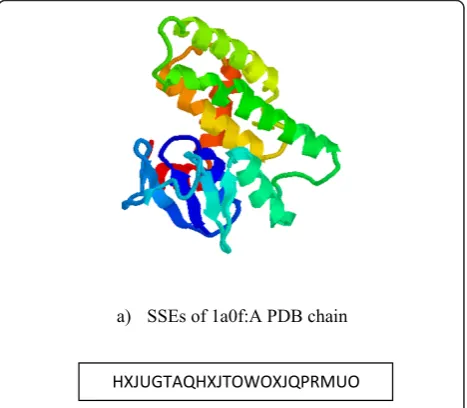
for strands (indicesi and j denote the first and last residues in each element). Then, each SSE vector is encoded to a letter within a string based on the sign of itsx, yandzcomponents as shown in Table 1. In addi-tion to the SSE vectors, the method also assumes inter-mediate vectors between the end and start points of two consecutive SSE vectors respectively. These inter-SSEs vectors, represented as dashed vectors in Figure 1, reflect the relative position of each SSE vector with respect to its previous and next SSE vectors in 3D-coor-dinates in the topology string. Accordingly, the spatial locations of secondary structure elements are modelled in the topology string in which each letter denotes an SSE vector or inter-SSEs vector. Figure 2 shows a typical example for secondary structure modelling in the topol-ogy string.
Text similarity measurement by n-gram modelling
Having secondary structure modelling done in a topol-ogy string, a language modelling technique can be used to compare the strings in order to achieve an initial match between two protein structures. Several kinds of language modelling techniques have already been used to capture similarities among biological sequences. Mar-kov chains are considered as the most fundamental approach used in language modelling and protein sequences similarity measurement [25,29]. In this model, the existence of a word wkat a locationk in an input text depends upon its n previous words wk-n,...,
wk-1. Due to the simplicity of the concept, the so called
n-gram modelling has been used most often in formal linguistics studies [29]. Moreover, entropy is a useful concept accounting for quantifying the information in a textual sequence and making a connection with prob-abilistic language modelling. As described by Bogan-Marta et al. [29], entropy estimation indicates how a specific protein sequence is well predicted by a given model. To compare two sequences, cross-entropy mea-sure is the relevant tool, where n-gram model is firstly made by counting the words of one sequence in the
training phase, and then, the predictability of the second sequence is measured in the recall phase via formula:
H(X,PM) =−
wn i
P(wni) log(2 +PM(wi+n|wni−1))
=−1
N
wn i
Count(wni) log(2 +PM(wi+n|wni−1))
(3)
where the variable X is in the form of n-gram repre-sented by wn
i ={wi,wi+1, ...,wi+n−1} ranging over all the
words of the first sequence. The summation runs over all the possible n-gram words wni , andNis the number of n-grams. The term P (wni ) results from the word count within the first sequence via Count(wn
i). More-over, the conditional probability in the summation
Table 1 Defined labels for secondary structure vectors
Vector type
Direction* Strand Helix Inter-SSEs
x2-x1> 0,y2-y1> 0,z2-z1> 0 A I Q
x2-x1> 0,y2-y1> 0,z2-z1< 0 B J R
x2-x1> 0,y2-y1< 0,z2-z1> 0 C K S
x2-x1> 0,y2-y1< 0,z2-z1< 0 D L T
x2-x1< 0,y2-y1> 0,z2-z1> 0 E M U
x2-x1< 0,y2-y1> 0,z2-z1< 0 F N V
x2-x1< 0,y2-y1< 0,z2-z1> 0 G O W
x2-x1< 0,y2-y1< 0,z2-z1< 0 H P X
* (x1, y1, z1) and (x2, y2, z2) denote start and end points of SSE vectors.
x z y
x2-x1>0, y2-y1<0, z2-z1<0
Figure 1 Secondary structure elements representation as vectors in 3D-space. Dashed vectors represent inter-SSEs vectors.
a) SSEs of 1a0f:A PDB chain
b) SSEs Topology string generated for 1a0f:A PDB chain HXJUGTAQHXJTOWOXJQPRMUO
relates the n-th element of an n-gram with the preced-ing n-1 elements, which can be computed by counting the words of the second sequence and having the model estimated:
P(wi+n|wni−1) =Count(wi+n)/Count(wni−1) (4)
Moreover, the term 2 is added to the logarithm func-tion in formula 3 in order to prevent loss of data when all the words are counted once and the conditional probability becomes zero.
The sequence comparison method models both sequences in the n-gram form, and also utilizes cross-entropy tool to measure their similarity via the formula:
D(sq,Si) =|H(Xq,PMi)−PS| (5)
where PSis the perfect score using the first sequence as reference and model sequences.SqandSialso denote
the first and second sequences respectively. As a result, the lower value ofD(Sq, Si) indicates the higher
similar-ity of the compared sequences. In order to cope with big differences in the length of two compared sequences, the technique considers the protein with lower length as the query protein.
The above introduced cross-entropy measure is used to compare the topology strings of two proteins result-ing in findresult-ing the initial overlap between two structures according to a task described below.
Secondary structure matching using topology string
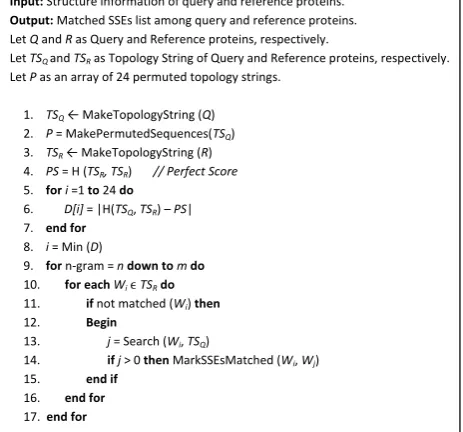
The 3D-coordinates of any pair of protein structures are available in an arbitrary relative orientation, in which the matched parts may not correspond in two struc-tures. Accordingly, the structure comparison methods need coordinates with independent representation of the structures making them comparable. In order to obtain an initial match between two structures, our method applies an algorithm with respect to the scheme intro-duced by Martin [18]. Figure 3 is the algorithm which has been developed for matching SSEs using topology strings. To this end, the topology string of the query protein is permuted by rotating its structure 90 degrees around the x, yandzaxes (line 2 in Figure 3). For each rotation around an axis, letters of the topology string are replaced according to Table 2. Therefore, 24 differ-ent secondary topology strings are created. Then, the above introduced cross-entropy measure is utilized to compare these 24 permuted topology strings of the query protein with the topology string of the reference protein, with which the most similar strings are chosen (lines 4-8 in Figure 3). In sequel, identical n-gram words of the two topology strings are marked as matched in an iterative procedure accounting for the decreasing size of n-grams starting fromm(chosen empirically 6) down
to the basic size of an n-gram (chosen at 3) (lines 9-17 in Figure 3). Figure 4 represents the SSE matching pro-cedure for two sample secondary topology strings.
In addition to the above procedure to match the iden-tical words of two topology strings, the method makes another effort to match SSEs with semi-adjacent vectors, where they are different in the sign of only one of thex, y and z components. This can be done by making a group of semi-adjacent letters for each defined letter in Table 1. Table 3 represents this grouping scheme for the letters of strand type of SSEs. In this table, for example, the letter F is marked as semi-adjacent for the letters B, E and H. Similar groups of letters can be made for the helix and inter-SSE vectors.
Structure alignment at the residue level
The procedure introduced above for matching the SSEs provides the alignment map at the residue level. The map is submitted to a heuristic algorithm which utilizes the rotation matrix of Kabsch method [26,27] in an
Input:Structure information of query and reference proteins.
Output:Matched SSEs list among query and reference proteins. Let Q and R as Query and Reference proteins, respectively.
Let TSQ and TSR as Topology String of Query and Reference proteins, respectively. Let P as an array of 24 permuted topology strings.
1. TSQ← MakeTopologyString (Q) 2. P = MakePermutedSequences(TSQ) 3. TSR← MakeTopologyString (R) 4. PS =H (TSR, TSR) // Perfect Score 5. for i =1 to 24 do
6. D[i] =|H(TSQ, TSR)– PS| 7. end for
8. i = Min (D)
9. for n-gram = ndown tomdo
10. for eachWiԖTSRdo 11. if not matched (Wi) then 12. Begin
13. j = Search (Wi, TSQ)
14. ifj > 0 then MarkSSEsMatched (Wi, Wj) 15. end if
16. end for
17. end for
Figure 3The algorithm for secondary structure matching using topology strings.
Table 2 Permutations on SSEs direction labels based on 90 degree rotation around axes
Strand Helix Inter-SSEs
Old A B C D E F G
H
I J K L M N O P
Q R S T U V W X
Rotate 90° around x
B D A C F H E G
J L I K N P M O
R T Q S V X U W
Rotate 90° around y
E A G C F B H D
M I O K N J P L
U Q W S V R X T
Rotate 90° around z
E F A B G H C D
M N I J O P K L
iterative procedure over selected pairs of residues. The following steps are done until the convergence of the alignment is fulfilled:
1) For each pair of the matched SSEs, put the start and end residues as temporarily aligned pairs in the alignment list. Then, compute and apply the rotation matrix to achieve an initial overlap between two structures.
2) For each pair of the matched SSEs, find n neigh-boring residues (n is chosen 3 for strands and 4 for helices [6]) having minimum distance, put them in the alignment list, and then, extend the alignment to the ends of the elements.
3) For unaligned residues between the aligned resi-dues in the previous step, find contact pairs as defined by Krissinel and Henrick [6]. In this defini-tion, two atomsA andBof chains 1 and 2 are con-sidered as a contact pair if their distance is less than the distance between Aand any other residues of chain 2 and also the distance between B and any other residues of chain 1. Start with the shortest contacts, extend the alignment to the rest of the
residue pairs having a distance less than d0= 1.243
LN−15−1.8[30]. (d0 is a distance
parameter to normalize distances and make the score independent of the protein size where LN is
the length of the shorter protein).
4) Make and apply the rotation matrix based on the aligned pairs of residues in the alignment list. 5) Repeat steps 2, 3 and 4 until the rotation matrix converges.
In order to look for the next mapping residues in step 3, the method applies a recursive task considering a lin-ear gap penalty. Moreover, in this procedure, a pair of residues could not be aligned if they belong to different secondary structure types.
Obviously, the alignment quality depends on the con-tradictory requirements of obtaining a higher length of alignment and a lower RMSD. TMscore [30] is a
reason-able single measure to assess the alignment quality by making a balance between the alignment length and accuracy according to the following formula:
TMscore=Max
1
Lq
Ln
i=11
1 + ( di 1.243L
q−15−1.8
) 2
(6)
where Lnand Lqare the length of the alignment and
query protein respectively, and di is the distance
betweeni-th pair of aligned residues. As described by Zhang and Skolnick [7], TMscore always has a value
between [0,1] where the higher value is better. Accord-ingly, we used TMscore in order to investigate the
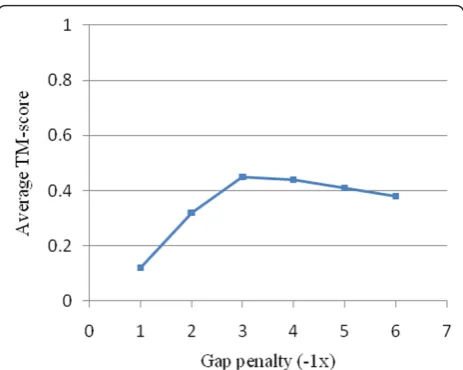
align-ment optimality, with which the optimal gap penalty is chosen. To this end, we used a randomly selected data-set of 1000 protein structures to test the alignment quality in different gap penalties based on evaluation of the TMscore.
Results
The above introduced algorithm, called TS-AMIR, was implemented in Microsoft Visual C++ using MS-Win-dows XP. This section reports the results of experiments in order to assess the performance of the method. The method was subjected to different datasets and its out-puts were compared with CE [4] and TM-align [7] representing two powerful geometrical methods and YAKUSA [20], 3D-BLAST [21] and SARST [22] as three well-known linear encoding methods.
Determination of optimal n-gram size
In order to determine the optimal size of n-gram in the SSEs sequence matching procedure and to balance its accuracy and sensitivity against computational efficiency, an accuracy index of similarity database search was adopted from Receiver Operating Characteristic (ROC)
KTPWAUFQC KTPWAUHQA
LRNXCWESD BUHXJSCWESHSA
Query protein
24 permuted
Topology strings Reference protein Topology String
1SAR:A 1 2 3
8
12
24
ISOUBVHRA MWPVARDQE NXLREQCUF
… LRNXCWESD … KTPWAUFQC … …
… … …
1I2F:A … 1GMR:B … …
BUHXJSCWESHSA
KTPWAUHQA
Figure 4An example for matching topology string of two reference proteins with 24 permuted topology strings of query protein.
Table 3 Semi-adjacent letters defined for Strand SSE vectors
A B C D E F G
H * * *
G * *
F * *
E *
D * *
C *
curves [31]. The index indicates true positive versus false positive rates in the ROC- curve for different initial sizes of the n-gram model. The goal is to obtain values where the true positive rates reach 1 or a very close value to 1, for a very small rate of the false positives. The experiment used a set of 90 proteins carefully selected from the SCOP database belonging to All Alpha, All Beta, Alpha and Beta and Alpha+Beta cate-gories with less than 40% sequence identity, having more than 7 SSEs [32]. Moreover, the SCOP classifica-tion database was considered to be the gold standard.
Table 4 shows the values of true positive versus false positive rates for different initial sizes of the n-gram adopted in the SSEs sequence matching procedure. As shown in this table, the method reaches to the optimal true positive rate in the case of 6-gram while its false positive rate is very low. Conducting large sizes of n-grams yields approximately the same accuracy where it increases the computational cost. Accordingly, the 6-gram model seems to be the optimal initial n-6-gram size for the SSEs sequence matching procedure. As men-tioned in the methods section, this procedure conducts a decreasing size of n-grams to match SSEs sequences.
Optimization of the alignment at the residue level
The procedure for the alignment at the residue level requires the optimization to choose an optimum gap penalty. This optimization is based on two contradictory criteria including the length of alignment and RMSD. Therefore, TMscorewas used as a balance between these
measures to evaluate the quality of the alignment in this experiment. The test uses a randomly selected set of 1000 protein structures from the PDB with less than 40% sequence identity. In order to choose the optimal gap penalty, all-against-all structural alignment was per-formed at the following gap penalty values {-1.0, -2.0, -3.0, -4.0, -5.0, -6.0}, and the TMscorewas calculated for
each alignment.
Figure 5 shows the average TMscoreobtained at
differ-ent gap penalty values. In this figure, a higher TMscore
value indicates a higher degree of precision and/or length in the alignment. As shown in the figure, increas-ing the negative gap penalty yields a higher TMscoreon
varying gap penalties ranging from -1.0 to -3.0. Based on the figure, the optimal gap penalty value is -3, where for the higher values, the TMscore decreases slightly.
Indeed, the high gap penalty values prevent the align-ment from extending along the protein structure, and yet the low value yields numerous gaps in the alignment with a low biological significance. Accordingly, the value of -3.0 seems to be the optimal gap penalty value in our experiment.
Additionally, we used the above dataset to test the optimality of the alignment procedure. The experiment was run by choosing different initial sets of fragments to make and apply a rotation matrix based on the align-ment procedure. There are only 58 (≈6%) items with an alternative choice for initial fragment with a difference less than 0.01. Accordingly, the procedure is deemed sufficient based on the fast convergence of the rotation matrix after 3-4 repetitions.
Benchmark study
The benchmark study was performed using a set of 200 non-homologous protein chains collected from the PDB by Zhang and Skolnick [7] with a pair wise sequence identity of less than 30%. The structures in the dataset are subject to comparison in an all-against-all approach by TS-AMIR and the results are compared with those of the CE, TM-align and 3D-BLAST programs. The results of CE and TM-align were taken from the literature [7]. A summary of the alignment results is represented in Table 5 including the averages over all 200 × 199 pro-tein pairs.
The table shows the alignment accuracy by RMSD, the length of alignment, and coverage, which is the fraction of the aligned residues in the target protein. The results produced by CE are included in this table as a basic reference method to evaluate other alignment tools. As seen from the table, TS-AMIR has the largest length of alignment (91.4) and coverage (46.6%) where its Table 4 Accuracy index adopted from Receiver Operating
Characteristic (ROC) curve
3-gram 4-gram 5-gram 6-gram
TPR* 0.437 0.523 0.852 0.982
FPR* 0.129 0.103 0.053 0.024
* True Positive Rate (TPR) and False Positive Rate (FPR)
accuracy in terms of RMSD (6.17) is ranked second, less than CE and 3D-BLAST. Moreover, TM-align is the best in terms of RMSD (4.99) where it obtains the sec-ond rank in the length of alignment (87.4) and coverage (42.0%). Furthermore, comparing the average TMscorein
Table 5 TM-align has the best rank (0.253) followed by TS-AMIR (0.237) with a low difference and 3D-BLAST (0.172).
Most of the structures collected in the dataset belong to different folds with low TMscore values. In order to
significantly compare the ability of the methods to match the most similar structure to a given target pro-tein, the averages over only the highest TMscore match
for each target protein are computed in Table 6. In this table, TS-AMIR has the best rank in terms of coverage (74.7%) and the second rank in terms of TMscore
(0.502), while positioned lower than TM-align (0.510) showing a slight difference with the first rank.
Evaluation of retrieval effectiveness
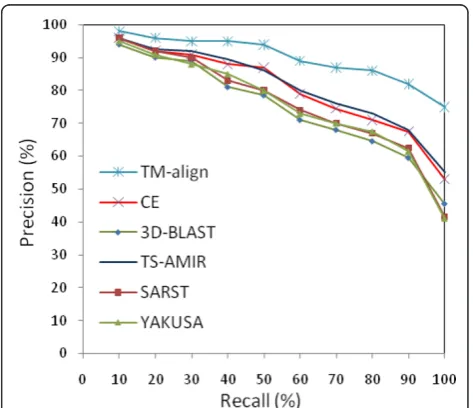
The retrieval effectiveness of the schemes was investi-gated using Aung and Tan collected dataset [33] of 34,055 proteins from ASTRAL SCOP 1.59 along with the subset of 108 query proteins belonging to four major SCOP categories, All-Alpha, All-Beta, Alpha/Beta and Alpha+Beta. The efficiency of the methods was evaluated using the precisionand recall parameters as two commonly used measures of information retrieval assessments. The parameters are determined as follows:
Precision=m/n (7)
Recall=m/N (8)
wheremis the number of correct retrievals from the same SCOP family, nis the total number of retrieved proteins, and Ndenotes the total number of relevant proteins within the same SCOP family. The experiment uses the above dataset to search 108 query proteins, and the precision and recall values are evaluated for each method. The average precision-recall values calculated for the six different schemes are shown in Figure 6. The results of the methods except for TM-align and TS-AMIR were taken from the literature [22]. According to the figure, TM-align is in the first rank in terms of accuracy. In the second rank, TS-AMIR and CE are competitively accurate, although TS-AMIR obtains slightly better accuracy in the higher percentages. More-over, three linear encoding schemes obtain generally lower accuracy than TS-AMIR.
The performance of the schemes in terms of running speed was also measured and compared in Table 7 where all the experiments were done on a 3.2 GHz CPU. As shown in Table 7 SARST obtains the best run-ning time of the search within the database of 34,055 proteins. 3D-BLAST and TS-AMIR are in the second rank with approximately the same running speed, which is more than 7200, 800 and 3 times faster than CE, TM-align and YAKUSA, respectively.
Retrieval effectiveness on structural categories
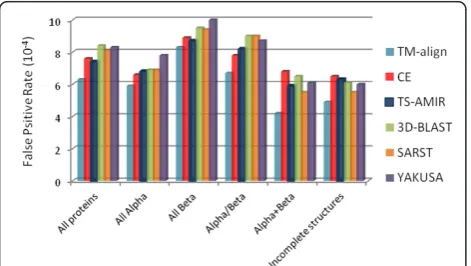
The performance of the methods was evaluated in the determination of structural categories of each query structure from the above 108 proteins. To this end, the false positive rate was computed as a measure of the Table 5 Alignment results summary for 200
non-homologous proteins averaged over all structure pairs
Length of alignment Coverage RMSD
(Å)
TMscore
CE 64.3 34.7% 6.52 0.169
TM-Align 87.4 42.0% 4.99 0.253
3D-BLAST 65.7 36.2% 6.69 0.172
TS-AMIR 91.4 46.6% 6.17 0.237
- The results of CE and TM-Align were taken from [7].
- Coverage denotes fraction of residues aligned within the target protein. - Length of alignment denotes number of aligned residues
Table 6 Alignment results summary for the same dataset in table 5 averaged over the most similar pairs
Length of alignment Coverage RMSD
(Å)
TMscore
CE 128.8 61.4% 3.95 0.441
TM-Align 166.2 73.1% 4.45 0.510
3D-BLAST 131.4 63.1% 4.32 0.454
TS-AMIR 168.9 74.7% 4.48 0.502
- The results of CE and TM-Align were taken from [7].
probability of irrelevant retrieval, where the lower rate indicates a higher degree of efficiency in the retrieval assessment.
The average false positive rates were computed for four categories of the SCOP database after the retrieval of 80 proteins for each query structure. Figure 7 shows the results for the six schemes where the results except for TM-align and TS-AMIR were taken from the litera-ture [22]. Based on the results in this figure, TS-AMIR yields false positives approximately similar to CE, but lower than those of SARST, YAKUSA and 3D-BLAST. TM-align obtains the best performance in this assessment.
Furthermore, a similar experiment was carried out using proteins with missing residues, known as incom-plete structures [33], which constitute about one-fifth of the query proteins. The results in the last part of Figure 7 illustrate that TM-align is the best among the meth-ods with considerably low false positives. Moreover, CE and TS-AMIR generate slightly more false positives for the incomplete structures than SARST, YAKUSA and 3D-BLAST. In general, the low efficiency of linear encoding methods is due to the weakness of these meth-ods in converting structural details of incomplete back-bone coordinates [19]. However, the ability of TS-AMIR to improve this efficiency is limited due to the
incompatibility of the employed strategy in the align-ment procedure at the residue level, as the missing resi-dues are not taken into consideration.
Retrieval effectiveness on low sequence identity
The efficiency of the above six methods were examined for homology searching in the low sequence identity. The experiment uses the dataset of 24,337 proteins from ASTRAL SCOP 1.69 collected by Lo et al. [22]. A subset of 83 query proteins belonging to the four main SCOP categories with certain features such as having the sequence identity of less than 10%, without missing residues and having at least two family members in the dataset, were selected and subtracted from the dataset (additional details about the dataset are available at Lo et al. [22]).
The above dataset was utilized to perform an informa-tion retrieval experiment on a subset of query proteins. As shown in Figure 8, the methods display decreasing precision with decreasing sequence identity. TM-align obtains the highest precision in this test. Moreover, CE and TS-AMIR are competitively accurate for the sequence identities higher than 40%. However, the accu-racy of TS-AMIR is lower than that of CE when sequence identities fell below 30%. Obviously, TM-align and CE as geometric methods are more precise than sequence-based methods. However, TS-AMIR improves this precision by focusing on the geometry of the struc-tures in the alignment procedure at the residue level.
Discussion In general
The main objective in this study was to develop a rapid protein structure alignment tool by combining two fruit-ful strategies: geometry-based approach and linear encoding approach. Indeed, TS-AMIR gains the advan-tages of two different strategies. In the first stage, it uses a linear encoded form of protein secondary structure to Table 7 Average running time of the methods to search
in a database of 34,055 proteins (in seconds)
Method Average time per query Average time per comparison
CE 82789.20 2.43
TM-align 9273.41 0.272
YAKUSA 35.60 0.00105
TS-AMIR 11.47 0.000337
3D-BLAST 9.07 0.000266
SARST 0.34 0.00000998
- Except for TM-align and TS-AMIR, the Results were taken from literature [22]. - The experiments were done on a 3.2 GHz CPU.
Figure 7 Retrieval effectiveness on different structural
reach an initial correspondence map. Linear encoding schemes offer the advantage of fast running speeds. In the second stage, the method utilizes an iterative algo-rithm to create a rotation matrix using the geometry of aligned residues. Geometrical schemes obtain high per-formance in terms of accuracy. Accordingly, the method combines the above two schemes to achieve high run-ning speeds as well as a high degree of precision.
TS-AMIR has been developed with some key features demonstrating its preference and competence. First of all, the method uses a simplified representation of the secondary structure elements in a topology string in order to match the backbone of two structures. This has a complexity reduction advantage to a one-dimensional problem where it requires a string matching procedure based on language modelling techniques. Moreover, the method adopts the n-gram modelling technique from computational linguistics, making it superior to the other formal language models to capture similarities in the topology strings. As another feature, this representa-tion makes the method free from any parameter setting by the user. Classical structure alignment techniques such as dynamic programming often require a set of optional parameters to reach the best possible match. Moreover, at the residue level, the method applies the Kabsch method to generate the rotation matrix as an efficient well-known solution for the optimal alignment of two structures in an iterative heuristic procedure. The alignment is converged after 3-4 iterations. Conse-quently, the method obtains a comparable performance with other state of the art programs.
Secondary structure encoding in a 1D topology string provides several advantages in structural analysis and alignment of proteins. Firstly, it facilitates the represen-tation of protein backbone structure in a summarized 1D-sequence making an economic pre-calculated data-base of the structural information. Secondly, the search algorithm to determine the initial overlap between two structures is sped up by choosing an efficient sequence alignment technique to match these strings. Thirdly, classifying the proteins into structural categories within large databases can be done efficiently. Finally, the scheme can be used to simplify computationally com-plex structure analysis tools by rapidly filtering out irre-levant structures.
On running speed
As mentioned above, TS-AMIR adopts two relatively simple strategies from both linear encoding and geome-try-based schemes to be used in secondary structure matching and residue level alignment respectively. Therefore, TS-AMIR obtains a competitive running speed in comparison with the other rapid structure alignment techniques.
Comparing the running time of the methods to search for each query protein shows that TS-AMIR runs 3 times faster than YAKUSA, approximately as fast as 3D-BLAST, and more than 30 times slower than SARST method. The lower speed of TS-AMIR against SARST seems to be due to utilizing the iterative procedure for the alignment at the residue level by TS-AMIR in order to make and apply the rotation matrix. However, TS-AMIR is more precise compared to SARST in the infor-mation retrieval assessments. Considering the high speed of linear encoding schemes, they are mostly devel-oped as a search tools to run queries in the large struc-ture databases. Therefore, they ignore giving highly accurate results in favour of reaching a high running speed. TS-AMIR improves the low accuracy of the linear encoding approaches by using a geometry-based techni-que for the alignment at the residue level.
On alignment accuracy
Although TS-AMIR did not yield a highly accurate alignment like TM-align, it has shown a competitive accuracy with CE which is known to be a highly accu-rate method. Moreover, TS-AMIR outperforms the other linear encoding methods such as YAKUSA, 3D-BLAST and SARST in terms of accuracy.
Looking at the results of the benchmark test, it is clearly visible that TS-AMIR obtains high alignment quality in terms of TMscore after TM-align. The high
efficiency of the method is yielded by the high length of alignment with a relatively low RMSD. This is due to the strategy of the method for the alignment of residues in an iterative step-by-step algorithm. The method first looks for small fragments within matched SSEs to make an initial alignment, and then extends the alignment to the rest of the residues by considering a penalty for each gap. The allowed gaps between the aligned residues provide an opportunity to superpose large and signifi-cant coverage between the two structures. Moreover, the algorithm clears the alignment list for each repeti-tion, and looks again for the alignment. This helps the algorithm to determine a more accurate alignment after applying the rotation matrix at the end of each repeti-tion. Due to the convergence of the rotation matrix after 3-4 attempts, these iterations do not critically increase the running time of the algorithm.
distantly related structures. TS-AMIR uses a reasonable strategy for encoding the geometry of SSEs in a topology string by assuming inter-SSE vectors reflecting the rela-tive position of two consecurela-tive SSEs to the string. Moreover, the algorithm for matching two topology strings of compared proteins chooses a decreasing size of the n-gram model starting from 6 as an empirically chosen parameter. Therefore, topological relationships between the SSEs are effectively considered in the SSEs matching procedure. However, methods using the sec-ondary structure to find primarily an initial overlap between two structures often perform poorly when the secondary structure of an input query is not strongly provided. TS-AMIR also needs well-defined secondary structure details of the query proteins in order to yield highly accurate alignment results.
On information retrieval
The results of assessments for information retrieval make evident that geometry-based methods are pre-ferred to linear encoding methods. Taking advantage of both schemes, TS-AMIR shows improved accuracy in the assessments similar to that of CE, but better than those of other linear encoding programs.
Nevertheless, based on the experimental results, the method displays occasional weakness in the retrieval of relevant structures. After subjecting the method to sev-eral irrelevant retrievals, it was illustrated that the weak-ness is due to the repetition of common SSE subsequences shared by different proteins within the whole structure. In fact, TS-AMIR uses n-gram model-ling to match the subsequences of SSEs topology strings. Therefore, the method occasionally falls in ambiguity for matching the n-grams, which is in accordance with its multiple occurrences along the topology string, thus leading to the applied heuristic’s failure in making deci-sion. However, by setting a relevant n-gram size in the SSEs matching procedure, these irrelevant retrievals are minimized.
Additionally, TS-AMIR achieves a fair performance on retrieval of structural categories among the methods where it produces low false positives for different SCOP categories. This is conceptual due to the adoption of an efficient strategy for matching SSEs based on the topol-ogy strings. It was expected that the method would pro-duce more false positives due to repetition of alpha helices along with the protein chain as the most abun-dant regular element of secondary structure. Therefore, the probability of irrelevant matching between SSEs is increased. However, the method overcomes this expecta-tion and yields fair results by choosing the appropriate decreasing sizes of n-gram as mentioned in the methods section.
Conclusion and future work
We have developed a rapid protein structure alignment tool called TS-AMIR, a Topology String Alignment Method for Intensive Rapid Protein Structure Compari-son, which is a combination of a linear encoding scheme in the first stage and a geometry based technique in the second stage. In terms of speed, the experimental results demonstrate the high performance of the method as it performs as well as linear encoding schemes. In addi-tion, the method obtains results as highly accurate as the geometry based approaches. This high efficiency results from the simple and efficient techniques which are employed by the method.
Further studies will focus on the application of the approach for non-sequential structural alignment of pro-teins, which needs to neglect connectivity of the poly-peptide chains. Considering the flexibility of the strategy applied by TS-AMIR for the superposition of the sec-ondary structure elements by topology strings, the approach seems to be relevant for use in the detection of non-sequential structural analogies in the proteins. Moreover, recent studies to fuse theoretical concepts from computational linguistics in structural biology motivate the researchers to conduct further studies in this area.
Acknowledgements
The authors thank the Centre for Information and Communication Technology at Universiti Teknologi Malaysia for providing the facility and service of high performance computing. We also would like to thank Malaysian Ministry of Science, Technology, and Innovation (MOSTI) and Malaysian Genome Institute (MGI) for supporting this research by Fundamental Research Grant Scheme (grant number: 73744).
Author details
1Faculty of Computer Science and Information Systems, Universiti Teknologi
Malaysia 81310, Johor Bahru, Malaysia.2Faculty of Bioscience and
Bioengineering, Universiti Teknologi Malaysia 81310, Johor Bahru, Malaysia.
Authors’contributions
JR carried out the design and development of the algorithm, performed the experiments and their statistical analysis, and drafted the manuscript. SD carried out the design and supervision of the study. SP participated in data collection and analysis, and helped to draft the manuscript. All authors read and approved the final manuscript.
Competing interests
The authors declare that they have no competing interests.
Received: 13 December 2011 Accepted: 15 February 2012 Published: 15 February 2012
References
1. Shibuya T, Jansson J, Sadakane K:Linear-time protein 3-D structure searching with insertions and deletions.Algorithms for Molecular Biology 2010,5:7.
2. Holm L, Sander C:Protein structure comparison by alignment of distance matrices.Journal of Molecular Biology1993,233:123-138.
4. Shindyalov I, Bourne P:Protein structure alignment by incremental combinatorial extension (CE) of the optimal path.Protein Engineering 1998,11:739-47.
5. Ortiz AR, Strauss CE, Olmea O:MAMMOTH (matching molecular models obtained from theory): an automated method for model comparison.
Protein Science2002,11:2606-2621.
6. Krissinel E, Henrick K:Secondary-structure matching (SSM), a new tool for fast protein structure alignment in three dimensions.Acta
Crystallographica Section D: Biological Crystallography2004,60:2256-2268.
7. Zhang Y, Skolnick J:TM-align: a protein structure alignment algorithm based on the TM-score.Nucleic Acid Research2005,33:2302-2309. 8. Kolbeck B, May P, Schmidt-Goenner T, Steinke T, Knapp EW:Connectivity
independent protein-structure alignment: a hierarchical approach.BMC
Bioinformatics2006,7, doi:10.1186/1471-2105-7-510.
9. Kawabata T:MATRAS: a program for protein 3D structure comparison.
Nucleic Acids Research2003,31:3367-3369.
10. Sierk ML, Kleywegt GJ:DEJAVU All Over Again: Finding and analyzing Protein Structure Similarities.Structure2004,12:2103-2111.
11. Mosca R, Schneider T:RAPIDO: a web server for the alignment of protein structures in the presence of conformational changes.Nucleic Acids
Research2008, ,36 Web Server:W42-W46.
12. Salem S, Zaki MJ, Bystroff C:FlexSnap: Flexible Non-sequential Protein Structure Alignment.Algorithms for Molecular Biology2010,5:12. 13. Mayr G, Domingues F, Lackner P:Comparative analysis of protein
structure alignments.BMC Structural Biology2007,7:50, doi: 10.1186/1472-6807-7-50.
14. Kolodny R, Koehl P, Levitt M:Comprehensive evaluation of protein structure alignment methods: scoring by geometric measures.Journal of
Molecular biology2005,346:1173-1188.
15. Novotny M, Madsen D, Kleywegt GJ:Evaluation of protein fold comparison servers.Proteins: Structure, Function, and bioinformatics2004, 54:260-270.
16. Pearson WR:Rapid and sensitive sequence comparison with FASTP and FASTA.Methods in enzymology1990,183:63-98.
17. Altschul SF, Madden TL, Schaffer AA, Zhang J, Zhang Z, Miller W, Lipman DJ:Gapped BLAST and PSI-BLAST: a new generation of protein database search programs.Nucleic Acids Research1997,25:3389-3402. 18. Martin ACR:The ups and downs of protein topology; rapid comparison
of protein structure.Protein Engineering2000,13:829-837.
19. Guyon F, Camproux AC, Hochez J, Tuffery P:SA-Search: a web tool for protein structure mining based on a structural alphabet.Nucleic Acids
Research2004,32:W545-W548.
20. Carpentier M, Brouillet S, Pothier J:YAKUSA: a fast structural database scanning method.Proteins2005,61:137-151.
21. Tung CH, Huang JW, Yang JM:Kappa-alpha plot derived structural alphabet and BLOSUM-like substitution matrix for rapid search of protein structure database.Genome Biology2007,8:R31.
22. Lo WC, Huang PJ, Chang CH, Lyu PC:Protein structural similarity search by Ramachandran codes.BMC Bioinformatics2007,8:307.
23. Bauer RA, Rother K, Moor P, Reinert K, Steike T, Bujnicki JM, Preissner R:Fast structural alignment of biomolecules using hash table, n-gram and string descriptors.Algorithms2009,2:692-709.
24. Budowski-Tal I, Nov Y, Kolodny R:FragBag, an accurate representation of protein structure, retrieves structural neighbors from the entire PDB quickly and accurately.PNAS2010,107:3481-3486.
25. Razmara J, Deris SB:A novel text modelling approach for structural comparison and alignment of biomolecules.WSEAS Transactions on
Computers2010,9:675-685.
26. Kabsch W:A solution for the best rotation to relate two sets of vectors.
Acta Crystallographica Section A: Crystal Physics, Diffraction, Theoretical and
General Crystallography1976,32:922-923.
27. Kabsch W:A discussion of the solution for the best rotation to relate two sets of vectors.Acta Crystallographica Section A: Crystal Physics,
Diffraction, Theoretical and General Crystallography1978,34:827-828.
28. Singh AP, Brutlag DL:Hierarchical protein structure superposition using both secondary structure and atomic representations.Proceedings of
International Conference on Intelligent Systems in Molecular Biology1997,
5:284-293.
29. Bogan-Marta A, Hategan A, Pitas I:Language engineering and information theoretic methods in protein sequence similarity studies.Studies in
Computational Intelligence2008,85:151-183.
30. Zhang Y, Skolnick J:Scoring function for automated assessment of protein structure template quality.Proteins2004,57:702-710. 31. Liao L, Noble W:Combining pairwise sequence similarity and support
vector machines for remote protein homology detection.Journal of
Computational Biology2003,10:857-868.
32. Chionh CH, Huang Z, Tan KL, Yao Z:Augmenting SSEs with structural properties for rapid protein structure comparison.Proceedings of 3rd IEEE
Symposium on BIBE2003.
33. Aung Z, Tan KL:Rapid 3D protein structure database searching using information retrieval techniques.Bioinformatics2004,20:1045-1052.
doi:10.1186/1748-7188-7-4
Cite this article as:Razmaraet al.:TS-AMIR: a topology string alignment method for intensive rapid protein structure comparison.Algorithms for Molecular Biology20127:4.
Submit your next manuscript to BioMed Central and take full advantage of:
• Convenient online submission
• Thorough peer review
• No space constraints or color figure charges
• Immediate publication on acceptance
• Inclusion in PubMed, CAS, Scopus and Google Scholar
• Research which is freely available for redistribution