Open Access
Commentary
The role of CDK in the initiation step of DNA replication in
eukaryotes
Seiji Tanaka
1,2,4, Yon-Soo Tak
3and Hiroyuki Araki*
1,2,4Address: 1Division of Microbial Genetics, National Institute of Genetics, Research Organization of Information and Systems, Mishima, Shizuoka, Japan, 2Department of Genetics, SOKENDAI, Mishima, Shizuoka, Japan, 3Department of Biological Sciences, KAIST, Daejeon, Korea and 4CREST, Kawaguchi, Saitama, Japan
Email: Seiji Tanaka - [email protected]; Yon-Soo Tak - [email protected]; Hiroyuki Araki* - [email protected] * Corresponding author
Abstract
Cyclin-dependent kinases (CDKs) regulate the progression of the cell cycle in eukaryotes. One of the major roles of CDK is to promote chromosomal DNA replication. However, how CDKs promote DNA replication has been a long-standing question, because all the essential CDK substrates in DNA replication have not been identified yet. Recently Sld2 and Sld3 were identified as essential substrates of CDKs in the initiation step of DNA replication in budding yeast. Moreover, bypass of their phosphorylations is sufficient to promote DNA replication. Phosphorylation of Sld2 and Sld3 by CDKs enhances the formation of complex(es) with a BRCT (BRCA1 C-Terminal)-containing replication protein, Dpb11. We further propose that multiple phosphorylation by CDKs controls this process in budding yeast. Even though Sld3 orthologues in multicellular eukaryotes have not been identified, similar complex formation and, therefore, a similar mechanism of initiation control might be employed in eukaryotes.
Background
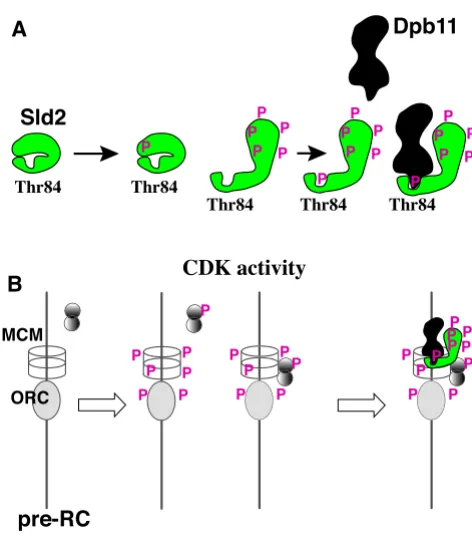
It has been known for a long time that CDK activity is required for DNA replication in eukaryotes. This concept was established by the early 1990s. For example, CDK-containing fractions activated the replication of SV40 virus in cellular extracts [1] ; Immunodepletion of CDKs prevented the initiation of DNA replication in vitro in Xenopus egg extracts [2]; and finally, CDK or cyclin mutants cannot promote DNA replication in yeasts [3,4]. From that time the hunt for CDK targets became to a major issue in the research of DNA replication. We and others recently revealed that phosphorylation of two rep-lication proteins, Sld2 and Sld3, is essential and minimal requirement for CDK-dependent activation of the initia-tion of DNA replicainitia-tion in budding yeast (Fig. 1) [5,6]. We also proposed that highly regulated phosphorylation
of Sld2 helps fine-tuning of the initiation (Fig. 2) [7]. In this review, we will summarize recent findings and envi-sion future direction of these studies.
Chromosomal DNA replication in eukaryotes initiates from multiple replication origins. Activities of individual origins are regulated as follows: The six-subunit origin rec-ognition complex (Orc) binds to replication origins throughout the cell cycle in yeast cells, and the putative replicative helicase Mcm (Mcm2-7 complex) is recruited onto Orc-bound origins with the aid of Cdc6 and Cdt1 to form the pre-replicative complex (pre-RC), from late M to G1 phase when CDK activity is low. Once both CDK and Dbf4-dependent protein kinase (DDK/Cdc7), another protein kinase essential for DNA replication, are activated, many replication proteins including replicative DNA Published: 5 June 2007
Cell Division 2007, 2:16 doi:10.1186/1747-1028-2-16
Received: 26 May 2007 Accepted: 5 June 2007
This article is available from: http://www.celldiv.com/content/2/1/16
© 2007 Tanaka et al; licensee BioMed Central Ltd.
polymerases, α, δ and ε are loaded onto the pre-RC formed origins. Then origin DNA is unwound and replica-tion forks are formed to synthesize DNA (see reviews; [8,9]). For DNA replication after the initiation, both CDK and DDK are dispensable [2,10,11], our unpublished results].
CDK-targets at the initiation step of DNA
replication
We previously showed that budding-yeast Sld2 is an essential CDK target for DNA replication [12]. The sld2 mutation was originally isolated as one of sld (syntheti-cally lethal with dpb11-1) [13]. The Sld2 protein has a cluster of 11 CDK phosphorylation motifs (Ser/Thr-Pro). At one of these motifs, phosphorylation of Thr84 pro-motes an essential complex formation between Sld2 and another replication protein, Dpb11, while Thr84-phos-phorylation requires other phosThr84-phos-phorylations in Sld2 (see below) [7]. Dpb11 has two pairs of tandem BRCT (BRCA1 C-Terminal) domains, which is known as a phosphopep-tide-binding domain [14,15]. C-terminal pair of BRCT domains in Dpb11 binds to phosphoThr84-Sld2 [7].
Dpb11 and Sld2 associate with replication origins when Cdk1 (Cdc28 in budding yeast) is activated [16], our unpublished results]. However, phosphorylation of Sld2 alone does not promote initiation of DNA replication. A phosphomimetic form of Sld2 constructed by substituting aspartic acid for serine or threonine residue in CDK phos-phorylation motif could support cell growth but Cdk1 was still required for initiation [6]. This strongly suggests the existence of other targets of S-phase CDK at the initia-tion step of DNA replicainitia-tion.
Regulatory model of the interaction between Dpb11 and Sld2 phosphorylated by CDK
Figure 2
Regulatory model of the interaction between Dpb11 and Sld2 phosphorylated by CDK. (A) The phosphorylation level of Sld2 is proportional to the level of CDK activity. How-ever, phosphorylation of Thr84 in Sld2 requires prior phos-phorylation of other CDK phosphos-phorylation motifs. When CDK activity increases beyond threshold, Sld2 may change its conformation by multiple phosphorylations and then CDK phosphorylates Thr84. When Thr84 is phosphorylated, Sld2 forms a complex with Dpb11 to initiate DNA replication. (B) The pre-replicative complex (pre-RC) essential for the initia-tion of chromosomal DNA replicainitia-tion is formed at replica-tion origins from late M phase to G1 phase when CDK activity is low. When CDK activity increases at G1/S phase boundary, the pre-RC components are phosphorylated and inactivated for further formation of the pre-RC before Thr84 of Sld2 is phosphorylated. Some other proteins are also phosphorylated and may bind to origins before Thr84-phos-phorylation. Thus, inactivation of the pre-RC formation and preceding origin association of some replication proteins are ensured by this mechanism.
P P P P P P P P P P P P P P P P P
Dpb11
Sld2
P P P P P P P P P P P P P P P P P P P P P P P Ppre-RC
ORC MCM PCDK activity
Thr84 Thr84Thr84 Thr84 Thr84
A
B
A model for CDK-regulated initiation of chromosome DNA replication
Figure 1
A model for CDK-regulated initiation of chromosome DNA replication. Pre-replicative complexes are formed at origins of DNA replication in G1 (top). When S-CDK is activated, it phosphorylates Sld2 and Sld3. These phosphorylations pro-mote complex formation between Sld2 and Sld3 and Dpb11. This reaction triggers the initiation of DNA replication.
2P P P P P 45 3 P P C N P P 45
345 GINS
Actually, we and others found another essential CDK tar-get, Sld3 [5,6]. The sld3 mutation was also isolated by the 'sld' screening [13]. Of 12 CDK phosphorylation motifs in Sld3, phosphorylations at Thr600 and Ser622 are crucial for binding Sld3 to N-terminal pair of tandem BRCT domains in Dpb11. Simultaneous alanine substitutions (Sld3-2A) and any combination of aspartic acid and glutamic acid substitutions for these residues confer cell lethality and defects of DNA replication, suggesting that phosphorylations of Thr600 and Ser622 are essential for cell growth and DNA replication and aspartic acid and glutamic acid residues do not mimic a phosphorylated residue at these sites. However, there are three ways to restore growth of sld3-2A mutant cells. First, multicopy DPB11 suppresses lethality caused by sld3-2A [6]. Overex-pression of binding partners often suppresses a mutation occurring in the other subunit. This is the case for Dpb11 and Sld3. Second, the JET1-1 mutation (Jumping Essenti-ality of CDK with sld2(Two)-11D to initiate DNA replica-tion) restores the growth defect [6]. JET1-1 was isolated as a mutation, which induces untimely DNA replication when the phosphomimetic Sld2 (Sld2-11D) was expressed. The JET1-1 mutation occurred in the CDC45 gene, whose product binds to Sld3. However, Cdc45 itself is not a target of Cdk1 in the initiation, because disruption of all the CDK phosphorylation motifs in Cdc45 does not show any defect in DNA replication nor cell growth. Jet1-1 seems to enhance the interaction between Sld3 and Dpb11 through the interaction between Cdc45 and Sld3 [6]. Third, the fusion protein between Sld3-2A and C-ter-minal half of Dpb11 (SD fusion) can replace Sld3 and Dpb11 simultaneously because N-terminal pair of Dpb11 functions as the binding site to Sld3 and SD fusion func-tions as Sld3-Dpb11 complex[5]. These results imply that phosphorylation-dependent interaction between Dpb11 and Sld3 is CDK-regulated essential step for the initiation of DNA replication.
Phosphorylation of Sld2 and Sld3 is sufficient for
the initiation of DNA replication
We combined JET1-1, multicopy DPB11 and the sld2-D mutation while Zegerman and Diffley combined the SD fusion and the sld2-D mutation [5,6]. In any case, the combinatory strains initiated DNA synthesis even when lacking S-phase CDK activities. DNA synthesis observed in the absence of CDK activity reflects DNA replication by several criteria. In normal DNA replication, two protein kinases, CDK and DDK, activate DNA replication. Both combinatory strains require DDK activity to initiate DNA synthesis, indicating that the cells only bypass CDK requirement in the initiation. Furthermore, semi-conserv-ative DNA synthesis initiates from known replication ori-gins in a pre-RC-dependent manner with proper replication fork complex, CMG (Cdc45-Mcm-GINS) in JET1-1 sld2-D mutant cells lacking CDK activity (DNA
synthesis in SD fusion strain has not been characterized in detail). In any combinatory strains, DNA replication induced in G1 cells is not efficient as that in CDK-driven DNA replication. Nonetheless, these data strongly suggest that phosphorylation of Sld2 and Sld3 by Cdk1 are the minimal requirement for the initiation of DNA replica-tion although we cannot rule out the formal possibility that the SD fusion and JET1 bypass not only Sld3 phos-phorylation but also other phosphos-phorylations.
CDK-regulated DNA replication
While phosphorylation-dependent interactions between Sld2, Sld3 and Dpb11 appear to be essential to initiate DNA replication, how these interactions facilitate initia-tion is still obscure. A novel complex, pre-Loading Com-plex (pre-LC) containing Polε, GINS, Dpb11 and Sld2 was detected in the cells treated with a cross-linking reagent and this complex formation depends on CDK but not DDK nor pre-RC (our unpublished results). On the other hand, Sld3, together with Cdc45, associates with pre-RC-formed early-firing origins even in G1 phase [17]. Thus, when Cdk1 is activated, Sld3 on origins is phosphorylated and binds to Dpb11, which might be a component of the pre-LC (Fig. 1). While we do not know whether Dpb11 binds to Sld2 and Sld3 in a sequential or random manner, and whether a single Dpb11 molecule binds to Sld3 and Sld2 simultaneously, these interaction may contribute to association between proteins bound to Sld2, Sld3 and Dpb11, such as GINS, Cdc45 and Mcm. Recent studies have identified complexes containing Cdc45, Mcm and GINS in Xenopus, budding yeast, and Drosophila, which are suggested to work at replication forks [18-20]. Moreo-ver, the CMG complex composed of these three factors from Drosophila shows helicase activity, suggesting that it works as a replicative helicase [19]. Thus, we suggest CDK-phosphorylation dependent interactions between Dpb11, Sld2 and Sld3 may play a role in the formation of CMG complex.
Fine-tuning by multisite phosphorylation
The phosphorylation-dependent interaction between Dpb11, Sld2 and Sld3 may be an essential mechanistic requirement to promote the initiation of DNA replication. It is also conceivable that these interactions monitor cel-lular CDK activity to couple DNA replication with other cell cycle events. We will discuss the interaction between Dpb11 and Sld2 from our viewpoint.
phosphor-ylation of Thr84 occurs later than other phosphorphosphor-ylations sites and consequently multisite phosphorylation set a high threshold for CDK activity to form complex between Dpb11 and Sld2. Conversion of the CDK phosphoryla-tion motif, Thr84-Pro, to PIKK (PI3 kinase related kinase)
phosphorylation motif, Thr84-Gln, results in
phosphor-ylation of Thr84 by DNA-dependent protein kinase, one of PIKK, and this phosphorylation depends on pre-phos-phorylation by CDK. We thus argue that phospre-phos-phorylation renders Thr84 accessible to DNA-dependent kinase in the Thr-Gln construct and to Cdk1 in the original construct, probably by phosphorylation-dependent conformational change (Fig. 2).
The high threshold of CDK activity may prevent prema-ture replication. When Cdk1 is activated and DNA replica-tion initiates, the pre-RC is converted to post-replicative complex (post-RC) composed of Orc at the replication origins. Active Cdk1 phosphorylates the pre-RC compo-nents and inhibits reassembly of pre-RC to prevent reini-tiation (reviewed by [21]). The high threshold of CDK activity for Thr84 phosphorylation ensures complete phosphorylation of the pre-RC components before DNA replication initiates.
The Sld3 protein has 12 CDK phosphorylation motifs. Two of them, Thr600 and Ser622, are responsible for CDK phosphorylation-dependent interaction between Dpb11 and Sld3 [5,6]. Simultaneous alanine substitution at all the CDK phosphorylation motifs except Thr600 and
Ser622 does not affect cell growth, suggesting that phos-phorylation of Sld3 does not affect phosphos-phorylation of Thr600 and Ser622, unlike in Sld2. On the other hand, efficient binding of Sld3 to N-terminal pair of BRCT domains in Dpb11 requires simultaneous phosphoryla-tions of Thr600 and Ser622, which may require high activ-ity of Cdk1. Further investigation will reveal the precise regulation of phosphorylation-dependent interaction between Sld3 and Dpb11 and how Sld2 and Sld3 bind to Dpb11, for example sequential or random.
Regulation of initiation in other organisms
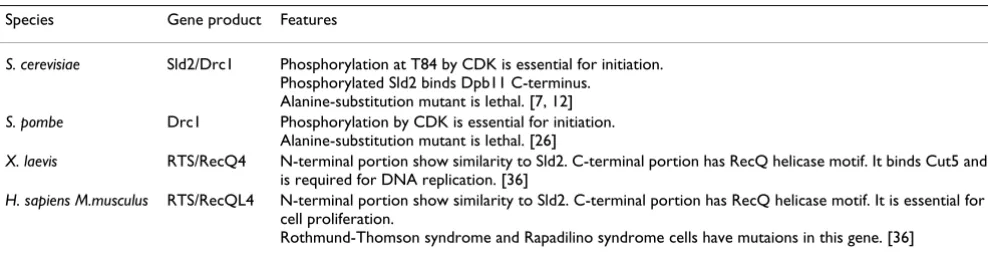
Because regulation of DNA replication as well as the cell cycle seems to be well conserved throughout eukaryotes, the molecular mechanisms of the initiation of DNA repli-cation regulated by CDK might be conserved. Ortho-logues of Sld2, Sld3 and Dpb11 are found in yeast and fungi while in other organisms they seem to differ signifi-cantly (Tables 1, 2 and 3). In animal cells, TopBP1/Cut5/ Mus101 (Table 1) is thought as a counterpart of Dpb11 because they have seven or eight BRCT domains in ani-mals and is required for DNA replication (reviewed in [22]). Moreover, TopBP1/Cut5/Mus101 binds to Xeno-pus RecQL4 (Table 2), which has a limited homology to Sld2 and is required for DNA replication, while phospho-rylation-dependent interaction has not been observed [23]. Sld3 seems to be most diverse, because we cannot find a protein similar to Sld3 except in yeast and fungi (Table 3) [24]. We believe that functional homologue of Sld3 exists and functions in DNA replication. Plant cellsTable 2: Sld2 orthologues
Species Gene product Features
S. cerevisiae Sld2/Drc1 Phosphorylation at T84 by CDK is essential for initiation. Phosphorylated Sld2 binds Dpb11 C-terminus.
Alanine-substitution mutant is lethal. [7, 12]
S. pombe Drc1 Phosphorylation by CDK is essential for initiation. Alanine-substitution mutant is lethal. [26]
X. laevis RTS/RecQ4 N-terminal portion show similarity to Sld2. C-terminal portion has RecQ helicase motif. It binds Cut5 and is required for DNA replication. [36]
H. sapiens M.musculus RTS/RecQL4 N-terminal portion show similarity to Sld2. C-terminal portion has RecQ helicase motif. It is essential for cell proliferation.
Rothmund-Thomson syndrome and Rapadilino syndrome cells have mutaions in this gene. [36]
Table 1: Dpb11 orthologues
Species Gene product Features
S. cerevisiae Dpb11 4x BRCT. N-terminal and C-terminal pair binds phosphorylated Sld3 and phosphorylated Sld2, respectively. [6, 12, 14]
S. pombe Cut5/Rad4 4x BRCT. N-terminal pair is shown to bind Drc1. [25, 26]
C. elegans Mus101 6x BRCT. Required for DNA replication. MMS sensitibity by RNAi feeding. SUMO modification? [27]
D. melanogaster Mus101 7x BRCT. Involvement in DNA replication is suggested. [28, 29]
X. laevis Cut5/Mus101 8x BRCT. Functions in DNA replication and DNA replication or damage checkpoints. [30–32]
have small number of multiple BRCT-containing proteins and we cannot identify Dpb11, Sld2 and Sld3 homo-logues although they have a conserved replication machinery, such as pre-RC, Cdc45, GINS and DNA polymerases, and CDKs. This evidence suggests that plant cells employ phosphorylation-dependent interaction dif-ferent from BRCT phosphopeptide domains.
Conclusion
In budding yeast Cdk1 promotes chromosomal DNA rep-lication by phosphorylating two reprep-lication proteins, Sld2 and Sld3. Phosphorylated form of Sld2 and Sld3 bind to BRCT-containing protein, Dpb11 and these interactions are essential for initiating DNA replication. Bypassing these phosphorylation-dependent interactions by various ways promotes DNA replication in the absence of CDK activity. Thus, we conclude that CDK-dependent phos-phorylations of Sld2 and Sld3 and consequently their interactions with Dpb11 are minimal requirements for CDK-dependent activation of the initiation of DNA repli-cation. Furthermore, multiple phosphorylation of Sld2, at least, contributes to fine-tuning of this step. Although Dpb11, Sld2 and Sld3 are not well conserved in multi-cel-lular organisms, CDK may regulate the initiation step of DNA replication in a similar manner, that is, phosphor-ylation-dependent interactions of replication proteins.
Competing interests
The author(s) declare that they have no competing inter-ests.
Authors' contributions
All the authors wrote the manuscript and H.A. organized it.
Acknowledgements
The study was partly supported by grants to H.A and S. T. from Ministry of Education, Culture, Sports, Science and Technology, Japan.
References
1. D'Urso G, Marraccino RL, Marshak DR, Roberts JM: Cell cycle con-trol of DNA replication by a homologue from human cells of the p34cdc2 protein kinase. Science 1990, 250(4982):786-791. 2. Blow JJ, Nurse P: A cdc2-like protein is involved in the initiation
of DNA replication in Xenopus egg extracts. Cell 1990,
62(5):855-862.
3. Hartwell LH, Culotti J, Pringle JR, Reid BJ: Genetic control of the cell division cycle in yeast. Science 1974, 183(120):46-51. 4. Schwob E, Nasmyth K: CLB5 and CLB6, a new pair of B cyclins
involved in DNA replication in Saccharomyces cerevisiae.
Genes Dev 1993, 7(7A):1160-1175.
5. Zegerman P, Diffley JF: Phosphorylation of Sld2 and Sld3 by cyc-lin-dependent kinases promotes DNA replication in budding yeast. Nature 2007, 445(7125):281-285.
6. Tanaka S, Umemori T, Hirai K, Muramatsu S, Kamimura Y, Araki H:
CDK-dependent phosphorylation of Sld2 and Sld3 initiates DNA replication in budding yeast. Nature 2007,
445(7125):328-332.
7. Tak YS, Tanaka Y, Endo S, Kamimura Y, Araki H: A CDK-catalysed regulatory phosphorylation for formation of the DNA repli-cation complex Sld2-Dpb11. Embo J 2006, 25(9):1987-1996. 8. Diffley JF: Regulation of early events in chromosome
replica-tion. Curr Biol 2004, 14(18):R778-86.
9. Bell SP, Dutta A: DNA replication in eukaryotic cells. Annu Rev Biochem 2002, 71:333-374.
10. Bousset K, Diffley JF: The Cdc7 protein kinase is required for origin firing during S phase. Genes Dev 1998, 12(4):480-490. 11. Donaldson AD, Fangman WL, Brewer BJ: Cdc7 is required
throughout the yeast S phase to activate replication origins.
Genes Dev 1998, 12(4):491-501.
12. Masumoto H, Muramatsu S, Kamimura Y, Araki H: S-Cdk-depend-ent phosphorylation of Sld2 essS-Cdk-depend-ential for chromosomal DNA replication in budding yeast. Nature 2002, 415(6872651-655 [http://www.nature.com/nature/journal/v415/n6872/full/
nature713.html].
13. Kamimura Y, Masumoto H, Sugino A, Araki H: Sld2, which inter-acts with Dpb11 in Saccharomyces cerevisiae, is required for chromosomal DNA replication. Mol Cell Biol 1998,
18(10):6102-6109.
14. Araki H, Leem SH, Phongdara A, Sugino A: Dpb11, which interacts with DNA polymerase II(epsilon) in Saccharomyces cerevi-siae, has a dual role in S-phase progression and at a cell cycle checkpoint. Proc Natl Acad Sci U S A 1995, 92(25):11791-11795. 15. Glover JN, Williams RS, Lee MS: Interactions between BRCT
repeats and phosphoproteins: tangled up in two. Trends Bio-chem Sci 2004, 29(11):579-585.
16. Masumoto H, Sugino A, Araki H: Dpb11 controls the association between DNA polymerases alpha and epsilon and the auton-omously replicating sequence region of budding yeast. Mol Cell Biol 2000, 20(8):2809-2817.
17. Kamimura Y, Tak YS, Sugino A, Araki H: Sld3, which interacts with Cdc45 (Sld4), functions for chromosomal DNA replica-tion in Saccharomyces cerevisiae. Embo J 2001, 20(82097-2107 [http://www.nature.com/emboj/journal/v20/n8/full/7593709a.html]. 18. Pacek M, Tutter AV, Kubota Y, Takisawa H, Walter JC: Localization
of MCM2-7, Cdc45, and GINS to the site of DNA unwinding during eukaryotic DNA replication. Mol Cell 2006,
21(4):581-587.
19. Moyer SE, Lewis PW, Botchan MR: Isolation of the Cdc45/Mcm2-7/GINS (CMG) complex, a candidate for the eukaryotic DNA replication fork helicase. Proc Natl Acad Sci U S A 2006,
103(27):10236-10241.
20. Gambus A, Jones RC, Sanchez-Diaz A, Kanemaki M, van Deursen F, Edmondson RD, Labib K: GINS maintains association of Cdc45 with MCM in replisome progression complexes at eukaryo-tic DNA replication forks. Nat Cell Biol 2006, 8(4358-366 [http:// www.nature.com/ncb/journal/v8/n4/full/ncb1382.html].
21. Arias EE, Walter JC: Strength in numbers: preventing rerepli-cation via multiple mechanisms in eukaryotic cells. Genes Dev
2007, 21(5):497-518.
22. Garcia V, Furuya K, Carr AM: Identification and functional anal-ysis of TopBP1 and its homologs. DNA Repair (Amst) 2005,
4(11):1227-1239.
23. Matsuno K, Kumano M, Kubota Y, Hashimoto Y, Takisawa H: The N-terminal noncatalytic region of Xenopus RecQ4 is required Table 3: Sld3 orthologues
Species Gene product Features
S. cerevisiae Sld3 Binds to Cdc45, GINS and Dpb11. Phosphorylation at T600 and S622 by CDK is essential for initiation. Phosphorylated Sld3 binds Dpb11 N-terminus. Alanine-substitution mutant is lethal. [5, 6]
Publish with BioMed Central and every scientist can read your work free of charge
"BioMed Central will be the most significant development for disseminating the results of biomedical researc h in our lifetime."
Sir Paul Nurse, Cancer Research UK
Your research papers will be:
available free of charge to the entire biomedical community
peer reviewed and published immediately upon acceptance
cited in PubMed and archived on PubMed Central
yours — you keep the copyright
Submit your manuscript here:
http://www.biomedcentral.com/info/publishing_adv.asp
BioMedcentral
for chromatin binding of DNA polymerase alpha in the initi-ation of DNA repliciniti-ation. Mol Cell Biol 2006, 26(13):4843-4852. 24. Nakajima R, Masukata H: SpSld3 is required for loading and
maintenance of SpCdc45 on chromatin in DNA replication in fission yeast. Mol Biol Cell 2002, 13(5):1462-1472.
25. Saka Y, Fantes P, Yanagida M: Coupling of DNA replication and mitosis by fission yeast rad4/cut5. J Cell Sci Suppl 1994, 18:57-61. 26. Noguchi E, Shanahan P, Noguchi C, Russell P: CDK phosphoryla-tion of Drc1 regulates DNA replicaphosphoryla-tion in fission yeast. Curr Biol 2002, 12(7):599-605.
27. Holway AH, Hung C, Michael WM: Systematic, RNA-interfer-ence-mediated identification of mus-101 modifier genes in Caenorhabditis elegans. Genetics 2005, 169(3):1451-1460. 28. Boyd JB, Golino MD, Nguyen TD, Green MM: Isolation and
char-acterization of X-linked mutants of Drosophila mela-nogaster which are sensitive to mutagens. Genetics 1976,
84(3):485-506.
29. Yamamoto RR, Axton JM, Yamamoto Y, Saunders RD, Glover DM, Henderson DS: The Drosophila mus101 gene, which links DNA repair, replication and condensation of heterochroma-tin in mitosis, encodes a protein with seven BRCA1 C-termi-nus domains. Genetics 2000, 156(2):711-721.
30. Van Hatten RA, Tutter AV, Holway AH, Khederian AM, Walter JC, Michael WM: The Xenopus Xmus101 protein is required for the recruitment of Cdc45 to origins of DNA replication. J Cell Biol 2002, 159(4):541-547.
31. Parrilla-Castellar ER, Karnitz LM: Cut5 is required for the binding of Atr and DNA polymerase alpha to genotoxin-damaged chromatin. J Biol Chem 2003, 278(46):45507-45511.
32. Hashimoto Y, Takisawa H: Xenopus Cut5 is essential for a CDK-dependent process in the initiation of DNA replication. Embo J 2003, 22(102526-2535 [http://www.nature.com/emboj/journal/v22/ n10/full/7590649a.html].
33. Yamane K, Kawabata M, Tsuruo T: A topoisomerase-II-binding protein with eight repeating regions similar to DNA-repair enzymes and to a cell-cycle regulator. Eur J Biochem
1997, 250(3):794-799.
34. Makiniemi M, Hillukkala T, Tuusa J, Reini K, Vaara M, Huang D, Pos-piech H, Majuri I, Westerling T, Makela TP, Syvaoja JE: BRCT domain-containing protein TopBP1 functions in DNA repli-cation and damage response. J Biol Chem 2001,
276(32):30399-30406.
35. Jeon Y, Lee KY, Ko MJ, Lee YS, Kang S, Hwang DS: Human TopBP1 Participates in Cyclin E/CDK2 Activation and Preinitiation Complex Assembly during G1/S Transition. J Biol Chem 2007,
282(20):14882-14890.