R E S E A R C H A R T I C L E
Open Access
Does individual learning styles influence the
choice to use a web-based ECG learning
programme in a blended learning setting?
Mikael Nilsson
1*, Jan Östergren
1, Uno Fors
2, Anette Rickenlund
3, Lennart Jorfeldt
3, Kenneth Caidahl
3and
Gunilla Bolinder
1Abstract
Background:The compressed curriculum in modern knowledge-intensive medicine demands useful tools to achieve approved learning aims in a limited space of time. Web-based learning can be used in different ways to enhance learning. Little is however known regarding its optimal utilisation. Our aim was to investigate if the individual learning styles of medical students influence the choice to use a web-based ECG learning programme in a blended learning setting.
Methods:The programme, with three types of modules (learning content, self-assessment questions and
interactive ECG interpretation training), was offered on a voluntary basis during a face to face ECG learning course for undergraduate medical students. The Index of Learning Styles (ILS) and a general questionnaire including questions about computer and Internet usage, preferred future speciality and prior experience of E-learning were used to explore different factors related to the choice of using the programme or not.
Results:93 (76%) out of 123 students answered the ILS instrument and 91 the general questionnaire. 55 students (59%) were defined as users of the web-based ECG-interpretation programme. Cronbach’s alpha was analysed with coefficients above 0.7 in all of the four dimensions of ILS. There were no significant differences with regard to learning styles, as assessed by ILS, between the user and non-user groups; Active/Reflective; Visual/Verbal; Sensing/ Intuitive; and Sequential/Global (p = 0.56-0.96). Neither did gender, prior experience of E-learning or preference for future speciality differ between groups.
Conclusion:Among medical students, neither learning styles according to ILS, nor a number of other
characteristics seem to influence the choice to use a web-based ECG programme. This finding was consistent also when the usage of the different modules in the programme were considered. Thus, the findings suggest that web-based learning may attract a broad variety of medical students.
Background
The time available to teach the medical curriculum is shortening due to expanding knowledge, and incorpora-tion of new educaincorpora-tional modules aiming to a broader com-petence [1]. The electrocardiogram (ECG) remains an indispensable tool in the practice of clinical medicine [2].
Understanding ECG and training its interpretation is a continuing challenge for both students and medical
professionals [2,3]. However, the optimal way to learn and train ECG interpretation needs to be studied [4]. Pedagogical strategies for teaching ECG and what learn-ing media to use vary from dance [5] on one extreme, to computer assisted learning (CAL)[6].
We have constructed and started to evaluate a web-based ECG learning programme designed for undergradu-ate medical students. In an initial study, the medical stu-dents ranked the Web-based ECG-interpretation programme as a useful instrument to learn ECG, and per-formance in a diagnostic test improved with use of the programme [7]. Our experience tells us that approximately * Correspondence: [email protected]
1
Department of Medicine, Karolinska University Hospital Solna, Karolinska Institutet, 171 76, Stockholm, Sweden
Full list of author information is available at the end of the article
60% of the students use the programme when offered to them without cost, and thus about 40% do not.
We do not know why some students prefer to learn ECG on the web, while others do not.
However, another study on first year medical students showed that 69-84% of the participants preferred to learn from a book rather than from a web-based Learning Management System [8]. Link and Martz have pointed out that E-Learning must be appropriate to the students’ level of computer expertise in order not to become a source of frustration [9].
It is still not known why students choose to use online learning materials or not.
The aim of this study was to investigate whether indivi-dual learning styles or other characteristics affect the stu-dents’ choice to use the web-based ECG learning programme.
Methods
The study was approved by the local ethics committee at the Karolinska Institutet (KI).123 medical students attend-ing the traditional ECG-trainattend-ing course (lectures and seminars) at two educational sites at the Karolinska Uni-versity hospital were offered to use the web-based ECG learning programme as an additional learning method. Due to a change in the medical education curriculum at KI the students of this population had reached two differ-ent semesters, the fourth and fifth, at the two sites studied (Solna and Huddinge respectively). However, all students had the same course objectives. In the beginning of the course the students received a short introduction to the web-based ECG learning programme, and were free to use the programme in whatever way and to the extent that they wished at any time during the course. The traditional ECG training includes compulsory lectures and seminars of about ten hours. All students have previously partici-pated in another course on the electrophysiology behind the ECG, but had not been given any training in the inter-pretation of ECGs.
The ECG learning program
The development and structure of the web-based ECG-interpretation programme have been described earlier [7]. In summary, the programme is designed to be able to serve as a complement to the standard ECG education, or to be used as a“stand-alone”tool for self-regulated learn-ing. The system contains three types of modules: Learning content (text, pictures and animation); self-assessment questions, and an interactive ECG interpretation training section. The programme is easily accessed via the learning management system used by KI (Ping Pong™). The log-in credentials are the same as to access the e-mail system at KI, thus facilitating the access to the system. User activity
in terms of accessed modules and time spent in the differ-ent modules was automatically logged by Ping Pong.
Learning styles
Learning styles can be defined as characteristic preferences for alternative ways of taking in and processing informa-tion [10]. There are several instruments constructed to assess learning style [11]. In this study we used the Index of Learning Styles (ILS) by Felder and Silverman [12,13]. The reasons for this choice were several, including that the instrument is scientifically accepted and relatively well studied [14-17]. The ILS instrument is also seen as time efficient with 44 questions and it is free of charge in a non commercialised setting. Further on, studies have found ILS to be acceptable in terms of reliability and validity [18-20].
The ILS provides a separate score for each of four dimensions (active-reflective, visual-verbal, sensing-intui-tive, and sequential-global). The scores in each dimension range from +11 to -11 in steps of 2. For a detailed descrip-tion of ILS and the four dimensions we refer to the origi-nal article by Felder & Silverman [13].
The instrument was translated into Swedish after approval from Dr Felder. The translation was controlled by two reviewers (JÖ and UF) who translated the ques-tions backwards from Swedish to English and was com-pared with the original instrument which led to small adjustments in the Swedish version to attain congruence.
At the end of the ECG-training course the students were asked to fill in the ILS instrument and a general question-naire. The latter included questions about computer and Internet usage in general, as well as a ranking of the peda-gogic value of the three different learning modules of the ECG programme (learning content, self assessment, inter-pretation training), preference for future medical speciality and estimation of prior experience of E-learning.
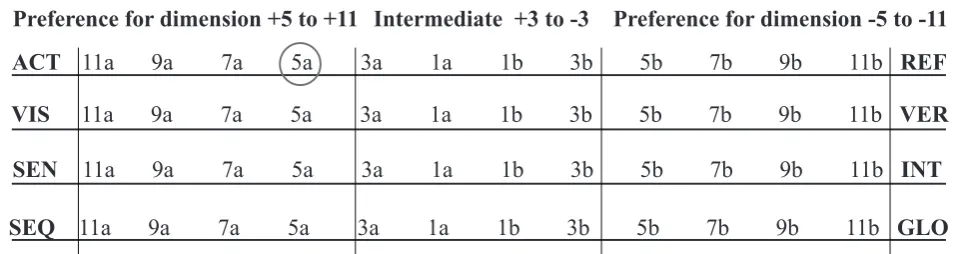
In their original classification Felder and Silverman used three categories to define a learning style in each of the four dimensions. 1-3 +/-, indicates a fairly well balanced style on that scale. 5-7 +/-, indicates a moderate prefer-ence for one dimension of the scale suggesting that the student will learn more easily in a teaching environment which favours that dimension. 9-11+/-, implies a very strong preference for one dimension of the scale. The stu-dent at the extreme of the scale may have a real difficulty learning in an environment which does not support that preference [12].
We used a modification of this approach which has been previously used [21].
preference for the respective learning style in that dimen-sion, as depicted in Figure 1.
User activity
To facilitate the analysis of the user activities of the ECG-system, an active“user”was defined as a student who had been logged on for at least 30 minutes to the system.
Statistical analysis
To analyse categorical data the Chi square test was used. If the number of students was less then five in a group Fish-er’s exact test was used. Numerical data where analysed using Mann-Whitney U-test. We used SPSS 17.0 for the statistical analysis above. Cronbach’s alpha was calculated for each dimension of the ILS using SAS®System 9.1. The level of statistical significance was set to p < 0.05.
Results
General findings
All students in the study had computer access at home. In the user group 98%, and in the nonuser group 92% visited internet sites daily. Ninety-three (76%) out of the 123 stu-dents answered the Index of Learning Styles instrument and 91 (74%) the general questionnaire. 55 (59%) out of 93 students were defined as users of the web-based ECG-sys-tem. User activity, as measured by total time, is displayed in Figure 2.
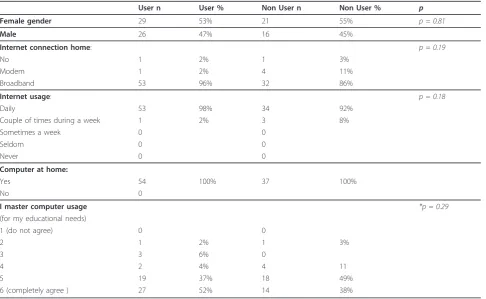
There was no significant difference in demographic characteristics or learning styles between the students at the two participating sites. Therefore, all students were gathered as one single group in the analyses performed. Background characteristics of the total study population are summarized in Table 1 where it can be seen that none of the demographic variables influenced the level of use.
Learning styles and level of usage
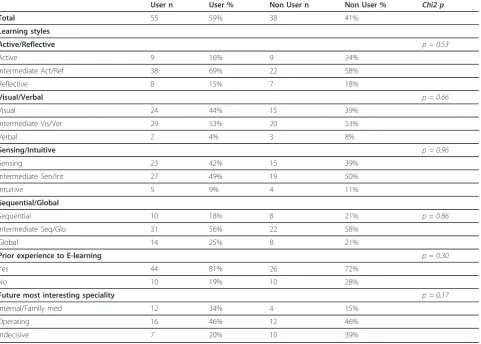
There were no significant differences between the user and non-user groups according to learning styles: Active/
Reflective p = 0.53. Visual/Verbal p = 0.66. Sensing/Intui-tive p = 0.96 Sequential/Global p = 0.86. Nor were there any differences when the result was analysed in relation to usage of the three types of modules (learning content, self-assessment questions and interactive ECG interpreta-tion). These results are summarized in Table 2.
Moreover, there were no significant differences between the user and non-user groups according to prior experience of E-learning and future preferred choice of speciality.
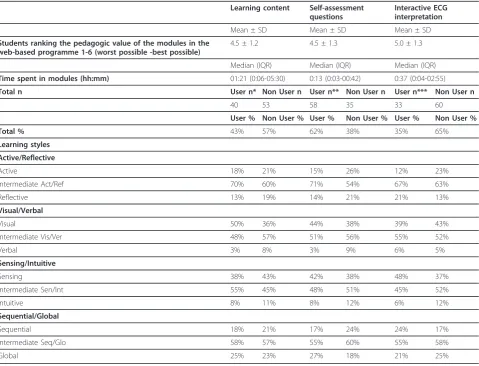
A further analysis of the data revealed that learning styles did not influence the level of usage of the three different components of the ECG, system (Learning con-tent, Self -assessment questions and Interactive ECG interpretation). The results of this analysis is shown in Table 3.
Cronbach’s alpha was analysed according to learning styles with the following scores: Active/Reflective 0.77, Visual/Verbal 0.84, Sensing/Intuitive 0.86, Sequential/ Global 0.81.
Ranking of the educational benefits
The users were asked to rank the educational benefits of the learning modules based on a six-graded scale (1-poor to 6 - very useful). On average the students ranked
“Learning content”4.5 (SD 1.2), “Self-assessment ques-tions”4.6 (SD 1.1), and “Interactive ECG interpretation training”5.0 (SD 1.3).
User definition
In order to test if our definition of users could have affected the results we analysed the influence of differ-ent cut off levels used to define a user (30, 60 or120 minutes). The results did not differ depending on user definition; Active/Reflective p = 0.53-0.76-0.93, Visual/ Verbal p = 0.66-1.0-0.74, Sensing/Intuitive p = 0.96-0.79-0.82, Sequential/Global p = 0.86-0.30-0.32 (p for 30-60-120 minutes respectively).
ACT
11a 9a 7a 5a 3a 1a 1b 3b 5b 7b 9b 11b
REF
VIS
11a 9a 7a 5a 3a 1a 1b 3b 5b 7b 9b 11b
VER
SEN
11a 9a 7a 5a 3a 1a 1b 3b 5b 7b 9b 11b
INT
SEQ
11a 9a 7a 5a 3a 1a 1b 3b 5b 7b 9b 11b
GLO
Preference for dimension +5 to +11
Intermediate +3 to -3
Preference for dimension -5 to -11
Discussion
Two reviews have investigated learning styles with spe-cial focus on health science education. Romanelli stres-ses the lack of a conceptual framework for both learning style theory and measurement and conclude that faculty members should make concentrated efforts to teach in a multi style fashion [14]. Cook concludes that further research in web-based learning could clarify the feasibil-ity and effectiveness of assessing and adapting to learn-ing [15]. Others have criticized the use of learnlearn-ing styles as predictors of learning preferences with the argument that there are more important factors involved in the learning process. Some work has been done since Cooks review was published, but there are only a few papers relevant for medical web-based education [16,21-23]. Further, the findings of these studies were not consistent and it is thus still not known why students prefer to use online learning materials or not.
In this study we found no evidence supporting that stu-dents’learning styles, according to ILS, influence the choice to use the web-based ECG-interpretation pro-gramme or not in a blended learning setting. This result is in accordance with those of Cook et al who found no association between ILS scores and different web-based
format preferences in medical residents [11]. However, other studies indicate other possibilities. For example, McNulty, studying medical students, collected entry logs for two different web-based applications (a discussion forum and a tutorial). It was found that students with
“Sensing”preference tended to use the web-based appli-cations to a larger extent than the ones with an“ Intui-tive”preference. Further, differences in the usage of web-based applications for the“Perceiving/Judging” dimen-sion in the instrument were also found. Another learning style instrument, the Mayers-Briggs type indicator (MBTI) was used in that study, but an association between the sensing dimension in MBTI and ILS has been described suggesting that these two learning styles indices bear a close resemblance to each other for this dimension.
Even when using one specific instrument, different types of format in the evaluating questionnaires (i e forced-choice preference or Likert scale) may influence the ability to compare the results between studies. Using a self report survey Brown et al came to the conclusion that the learning styles of health science students, as measured by the ILS, can be used, although to a limited extent, as a predictor of students’attitudes towards
E-0 1 2 3 4 5 6 7 8 9 10 11 12 13 14 15 16
0:01-0:29
0:30-0:59
1:00-1:29
1:30-1:59
2:00-2:29
2:30-2:59
3:00-3:29
3:30-3:59
4:00-4:29
4:30-4:59
5:00-5:29
5:30-5:59
6:00-6:29
6:30-6:59
7:00-7:29
7:30-7:59
>8:00
Figure 2
Number of students
Time interval in h:mm
learning. Both Brown and Cook primarily used indirect measures assessed on an Online Learning Environment Survey (OLES) and an end of course questionnaire using a scale ranging from 1-6 as preference. Thus, they did not use recorded activity in the programme as a denominator, as was done in the present study.
An indirect measure, asking students forced-choice preference items, was used by Johnson & Johnson. They found a statistical difference for college students in the active -reflective dimension. Active students preferred face-to-face study groups rather than online study groups, but online quizzes rather than pencil and paper quizzes. However, Johnson & Johnson used the individual result in the four ILS dimensions as a continuous variable and compared the group average instead of the more commonly used scored categorisation [24]. Their approach lend support by the finding of Cook, that up to one third of learners change style classification although the mean score change is not large [19].
Blended learning can be defined in a broader way as a combination of face-to face instruction and computer-mediated instruction [25].
However the blend can be of different categories and using a blended learning approach could mean that the web-based component of the course needs to have a
specific instructional design to match the personal learn-ing style of the individual student [25].
In this study we have defined the blended learning set-ting as the voluntary opportunity for a student to use web-based learning as a complement to the traditional teaching.
However, in the setting of a self-directed stand-alone web-based course learning styles might have affected the usage differently. A study using ILS found a difference between a self-directed version and a collaborative version of an online course [26]. In that study significant associa-tions between students’learning styles and success in dis-tance education were found, suggesting a relationship between learning style and ability to respond to web-based learning.
The inconsistency in research results regarding learning styles and their relation to different studying preferences could also relate to differences between studied groups of students (e g different academic level). The Swedish admission system for medical studies is mainly based on high grades and on expected high theoretical academic performance. It might be assumed that these students have a high capacity to adapt their studies to different learning situations. This may affect the ability to generalize our results to other groups of students.
Table 1
User n User % Non User n Non User % p
Female gender 29 53% 21 55% p = 0.81
Male 26 47% 16 45%
Internet connection home: p = 0.19
No 1 2% 1 3%
Modem 1 2% 4 11%
Broadband 53 96% 32 86%
Internet usage: p = 0.18
Daily 53 98% 34 92%
Couple of times during a week 1 2% 3 8%
Sometimes a week 0 0
Seldom 0 0
Never 0 0
Computer at home:
Yes 54 100% 37 100%
No 0
I master computer usage *p = 0.29
(for my educational needs)
1 (do not agree) 0 0
2 1 2% 1 3%
3 3 6% 0
4 2 4% 4 11
5 19 37% 18 49%
6 (completely agree ) 27 52% 14 38%
The concept of learning styles in pedagogical research has been criticised from different perspectives. Massa and Mayer state that there are instruments that cor-rectly distinguish between verbalizers and visualizers. However, data do not provide support for the idea that different instructional methods should be used for these groups [27]. Others have reviewed the field and con-clude that an impact of learning style theory on teaching and learning efficiency is unproven by current empirical work [11]. However the same authors also recognise that the learning styles theories may still be of impor-tance to pedagogy; personalized education and students’ self-awareness (learning to learn).
The results of Cronbach’s alpha analysis with a coeffi-cients above 0.7 in all of four dimensions is comparable to others, and indicate that the Swedish translation of the ILS is usable in this study.
One potential bias of our study could be that the defi-nition of a user could be incorrect. To test for this we performed a sensitivity analysis using three different
user time cut-offs with the same result. Thus it is not likely that the definition of users have influenced our results.
Another potential limitation is the sample size. The pre-study power analysis used data from a pilot pre-study measur-ing mean usage time of the web-base course accordmeasur-ing to learning styles which indicated a need for 8 persons in each group. Based upon this we calculated that a sample size of 60-100 persons was needed to achieve a power of 80% to detect a difference in usage time according to learning style at the p < 0.05 level. A post-hoc analysis with the achieved dichotomous data indicated that 12 per-sons were needed in each group to achieve 80% power to detect a 50% relative difference in learning style between users and non-users.
In order to preserve statistical power the four dimen-sions of learning styles were each divided into three categories of learning style (according to Cooke) instead of five (as described by Felder). This modification increased the number of students in each group with a
Table 2
User n User % Non User n Non User % Chi2 p
Total 55 59% 38 41%
Learning styles
Active/Reflective p = 0.53
Active 9 16% 9 24%
Intermediate Act/Ref 38 69% 22 58%
Reflective 8 15% 7 18%
Visual/Verbal p = 0.66
Visual 24 44% 15 39%
Intermediate Vis/Ver 29 53% 20 53%
Verbal 2 4% 3 8%
Sensing/Intuitive p = 0.96
Sensing 23 42% 15 39%
Intermediate Sen/Int 27 49% 19 50%
Intuitive 5 9% 4 11%
Sequential/Global
Sequential 10 18% 8 21% p = 0.86
Intermediate Seq/Glo 31 56% 22 58%
Global 14 25% 8 21%
Prior experience to E-learning p = 0.30
Yes 44 81% 26 72%
No 10 19% 10 28%
Future most interesting speciality p = 0.17
Internal/Family med 12 34% 4 15%
Operating 16 46% 12 46%
Indecisive 7 20% 10 39%
Table 2 show the result compared the user and non user group divided into learning style. The user was defined as a student who logged on for at least 30 minutes to the system. P value for Chi2
preference for a certain learning style and should thus if anything enhance the possibility to find differences with the actual sample size.
Out of the 123 students, 76% answered the ILS instru-ment and 73% the general questionnaire. A fairly good proportion of the students thus participated in the study. In the studied group 59% were defined as users. Using data from Ping Pong the number of users of the web-based ECG learning programme among the group not answering the ILS-instrument was only 10. Thus, we believe that possible differences between participants and non-participants in the survey did not affect the results of our study to a substantial degree.
Other factors than learning style may influence the choice to use the web-based ECG learning programme or not. Our experience from discussions with students is that time seems to be an important factor. To spend time to learn to use a fairly new medium, not knowing the
effectiveness, may be an obstacle in applying web-based learning. Time for studies without computers exist in dif-ferent environments, for example on the bus, in bed or in non-computerised areas within the university. The social situation of individual students could affect the time to spend on the Internet as a medium.
Conclusion
Among medical students, neither learning styles according to ILS, nor a number of other characteristics seem to influence the choice to use a web-based ECG programme.
In consistency with the results from Cook and Mayer this study supports the conclusion that medical educa-tors need not presently take learning styles into account for instructional adaptations of web based learning. Our results support web-based learning as a suitable alterna-tive learning tool for most medical students, regardless of learning style or other characteristics.
Table 3
Learning content Self-assessment questions
Interactive ECG interpretation
Mean ± SD Mean ± SD Mean ± SD
Students ranking the pedagogic value of the modules in the web-based programme 1-6 (worst possible -best possible)
4.5 ± 1.2 4.5 ± 1.3 5.0 ± 1.3
Median (IQR) Median (IQR) Median (IQR)
Time spent in modules (hh:mm) 01:21 (0:06-05:30) 0:13 (0:03-00:42) 0:37 (0:04-02:55)
Total n User n* Non User n User n** Non User n User n*** Non User n
40 53 58 35 33 60
User % Non User % User % Non User % User % Non User %
Total % 43% 57% 62% 38% 35% 65%
Learning styles
Active/Reflective
Active 18% 21% 15% 26% 12% 23%
Intermediate Act/Ref 70% 60% 71% 54% 67% 63%
Reflective 13% 19% 14% 21% 21% 13%
Visual/Verbal
Visual 50% 36% 44% 38% 39% 43%
Intermediate Vis/Ver 48% 57% 51% 56% 55% 52%
Verbal 3% 8% 3% 9% 6% 5%
Sensing/Intuitive
Sensing 38% 43% 42% 38% 48% 37%
Intermediate Sen/Int 55% 45% 48% 51% 45% 52%
Intuitive 8% 11% 8% 12% 6% 12%
Sequential/Global
Sequential 18% 21% 17% 24% 24% 17%
Intermediate Seq/Glo 58% 57% 55% 60% 55% 58%
Global 25% 23% 27% 18% 21% 25%
Author details
1Department of Medicine, Karolinska University Hospital Solna, Karolinska Institutet, 171 76, Stockholm, Sweden.2Department of Computer and Systems Science (DSV), Stockholm University, Forum 100 S-164 40 Kista, Sweden.3Department of Molecular Medicine and Surgery, Karolinska University Hospital Solna, Karolinska Institutet, 171 76, Stockholm, Sweden.
Authors’contributions
All authors participated in designing the study on the initiative of MN, who managed all practical parts of the study and drafted the manuscript. GB UF and JÖ participated in finalising the manuscript. AR, LJ and KC had minor comments and approved the final manuscript.
Competing interests
MN is a shareholder in the company which has developed the web-based ECG-interpretation programme. There are no other conflicts of interest in relation to this manuscript.
Received: 7 May 2011 Accepted: 16 January 2012 Published: 16 January 2012
References
1. Dent JA, Harden RM:A practical guide for medical teachers.3 edition. Edinburgh; New York: Elsevier Churchill Livingstone; 2009.
2. Auseon AJ, Schaal SF, Kolibash AJ Jr, Nagel R, Lucey CR, Lewis RP:Methods of teaching and evaluating electrocardiogram interpretation skills among cardiology fellowship programs in the United States.J Electrocardiol2009,42(4):339-344.
3. Lessard Y, Sinteff JP, Siregar P, Julen N, Hannouche F, Rio S, Le Beux P:An ECG analysis interactive training system for understanding arrhythmias. Stud Health Technol Inform2009,150:931-935.
4. Salerno SM, Alguire PC, Waxman HS:Training and competency evaluation for interpretation of 12-lead electrocardiograms: recommendations from the American College of Physicians.Ann Intern Med2003,138(9):747-750. 5. Schultz KK, Brackbill ML:Teaching electrocardiogram basics using dance
and movement.Am J Pharm Educ2009,73(4):70.
6. Fincher RE, Abdulla AM, Sridharan MR, Houghton JL, Henke JS: Computer-assisted learning compared with weekly seminars for teaching fundamental electrocardiography to junior medical students.South Med J1988,81(10):1291-1294.
7. Nilsson M, Bolinder G, Held C, Johansson BL, Fors U, Ostergren J:Evaluation of a web-based ECG-interpretation programme for undergraduate medical students.BMC Med Educ2008,8:25.
8. Masiello I, Ramberg R, Lonka K:Attitudes to the Application of a Web-Based Learning System in a Microbiology Course.Computers and Education2005.
9. Link T, Marz R:Computer literacy and attitudes towards e-learning among first year medical students.BMC Medical Education2006,6(34). 10. TA Litzinger SHL, JC Wise, RM Felder:A Psychometric Study of the Index
of Learning Styles.J Engr Education2007,96(4):309-319.
11. Hall EaM D:Is there a role for learning styles in personalised education and training?International Journal of Lifelong Education2005,24(3):243-255. 12. Index of Learning Styles web page.[http://www4.ncsu.edu/unity/lockers/
users/f/felder/public/Learning_Styles.html].
13. Felder RM, Silverman LK:Learning and Teaching Styles in Engineering Education.Engr Education1988,78(7):674-681.
14. Romanelli F, Bird E, Ryan M:Learning styles: a review of theory, application, and best practices.Am J Pharm Educ2009,73(1):9. 15. Cook DA:Learning and cognitive styles in web-based learning: theory,
evidence, and application.Acad Med2005,80(3):266-278.
16. Cook DA, Thompson WG, Thomas KG, Thomas MR:Lack of interaction between sensing-intuitive learning styles and problem-first versus information-first instruction: a randomized crossover trial.Adv Health Sci Educ Theory Pract2009,14(1):79-90.
17. Sabry K, Baldwin LP:Web-based learning interaction and learning styles. British Journal of Educational Technology2003,34(4):443-454.
18. Felder RM, Spurlin JE:Applications, Reliability, and Validity of the Index of Learning Styles.Intl Journal of Engineering Education2005,21(1):103-112. 19. Cook DA:Reliability and validity of scores from the index of learning
styles.Acad Med2005,80(10 Suppl):S97-101.
20. Cook DA, Smith AJ:Validity of index of learning styles scores: multitrait-multimethod comparison with three cognitive/learning style instruments.Med Educ2006,40(9):900-907.
21. Cook DA, Thompson WG, Thomas KG, Thomas MR, Pankratz VS:Impact of self-assessment questions and learning styles in Web-based learning: a randomized, controlled, crossover trial.Acad Med2006,81(3):231-238. 22. McNulty JA, Espiritu B, Halsey M, Mendez M:Personality preference
influences medical student use of specific computer-aided instruction (CAI).BMC Med Educ2006,6:7.
23. Brown T,et al:Are learning style preferences of health science students predictive of their attitudes towards e-learning?Australasian Journal of Educational Technology2009,25(4):524-543.
24. Johnson G, Johnson J:Learning Style and Preference for Online Learning Support: Individual Quizzes versus Study Groups.InProceedings of World Conference on Educational Multimedia, Hypermedia and Telecommunications: 2006; Chesapeake, VAEdited by: PPB 2006, 1861-1868.
25. Bonk CJ, Graham CR:The handbook of blended learning: global perspectives, local designs.1 edition. San Francisco, Calif.: Pfeiffer; [Chichester: John Wiley, distributor]; 2006.
26. Battalio J:Success in Distance Education: Do Learning Styles and Multiple Formats Matter?American Journal of Distance Education; 2009:23:71-87.
27. Massa LJ, Mayer RE:Testing the ATI hypothesis: Should multimedia instruction accommodate verbalizer-visualizer cognitive style?Learning and Individual Differences2006,16(4):321-335.
Pre-publication history
The pre-publication history for this paper can be accessed here: http://www.biomedcentral.com/1472-6920/12/5/prepub
doi:10.1186/1472-6920-12-5
Cite this article as:Nilssonet al.:Does individual learning styles influence the choice to use a web-based ECG learning programme in a blended learning setting?BMC Medical Education201212:5.
Submit your next manuscript to BioMed Central and take full advantage of:
• Convenient online submission
• Thorough peer review
• No space constraints or color figure charges
• Immediate publication on acceptance
• Inclusion in PubMed, CAS, Scopus and Google Scholar
• Research which is freely available for redistribution