2107
Solar Powered Window Type Air Conditioner
Using Inverter Technology
Patricio G. Cabading, Philip G. Cabading, Elmer B. Dollera, Dann D. Lusterio, Justinne D. Rosete
Abstract: This paper is about the study on energy conservation for window type air conditioner. Due to the sky rocketing price of electric energy available in the Philippines, energy conservation is an ideal alternative scheme in order to reduce the operating cost of energy consuming devices. Air conditioning energy sector consumes around 37% of the Philippine energy mix in residential and commercial buildings in the Philippines. With this situation, much of the energy can be saved if air conditioning system uses solar energy coupled with the inverter technology. The Inverter technology (DC) is the latest evolution of technology concerning the electro motors of the compressors. An inverter is used to control the speed of the compressor motor, so as to continuously regulate the flow of refrigerant to the evaporator when there is a lower demand for the room cooling system. With a lower mass flow rate of refrigerant of the system, energy consumption of the air conditioning system will significantly reduce without sacrificing the indoor temperature of the room. The DC Inverter units have a variable-frequency drive that comprises an adjustable electrical inverter used to control the speed of the electromotor. The drive converts the incoming AC current to DC and then through a modulation in an electrical inverter produces current of desired frequency. This study deals with the performance evaluation of a 0.75 horsepower inverter window type air-conditioning unit in Xavier University Campus. By supplying the correct amount of DC/AC voltage, the performance of the system remains the same. The data of the experimental rig, through a data logger, were gathered from 1 o’clock in the afternoon to 5 o’clock in the evening. The COP and EER of the solar-powered air conditioning system were calculated based on the result of the data recorded from the experimental rig. The COP of the system is 4.77 & the EER is 16.25 for the whole system during the test period. The average temperature recorded by the data logger in the controlled room is 19.5 oC dry bulb and 14.5 oC wet bulb temperatures, which are more than enough for the minimum requirement in the comfort air conditioning system.
Index Terms: cooling load capacity, energy efficiency ratio, inverter technology, refrigeration load, window type air-conditioner.
—————————— ——————————
1.
INTRODUCTION
THE heat energy is a very expensive commodity and waste heat recovery system is very important component in a successful industrial operation for the modern world[1]. Many technology are focused on the waste recovery system of wasted energy available on an engineering system. Energy recovery system is very expensive especially when the energy available for recovery is quite small like a household window type air conditioner. Waste energy is another form of energy with a lower form[2]. Another way to conserve energy is to use alternative source of energy, like energy from the sun, as a substitute from the electrical grid supplied by the local electric utilities. Warming of the climate system is unequivocal, as is now evident from observations of increases in global norm air and sea temperatures, widespread melting of snow and ice, and rising global average sea stratum, so in line with the heating of the earth, science comes up with the idea of making this as an advantage of making a technology that can harness the heat. This is where solar energy comes in abundance that later made solar panels to collect the heat from the sun. Solar power is the transformation of sunlight energy into electric energy, either directly using photovoltaic (PV), or
indirectly using intense or concentrated solar power (CSP). Concentrated solar power systems use lenses or mirrors[3] and tracking systems to center a large area of sunlight into a small ray of light[4].Photovoltaic convert light into electric current using the photoelectric gist.
Air conditioning can be as high as 25-40% of a household’s annual energy costs (Daily Consumer, 2013). This is just a brief review of how costly is one air conditioning unit can be during operation. That’s why having alternatives like using renewable energy can be a big help and have a bigger difference to the cost of usage problem. Solar-powered air conditioning unit is an air conditioning innovation where solar panels are installed to supply power to the motor instead of plugging it to the main electric grids. There are a number of reasons why solar air conditioning is better than the other form of technology. The more intense the sun's solar radiation, the higher the ambient temperature of the vicinity, so the further we need to have an air conditioning unit[5]. This is the best state of harmony between machine and nature. The machines mostly utilize environmental friendly source of energy. Instead of using power from the grid lines, we may use the solar heat to power up the system. Solar machines have few moving parts and a long life if the system is designed correctly. The electricity grid is also relieved with a lower demand during summer, since the mass operation of electrical -conditioners in summer occasionally lead to severe strain on the electricity grid. In using solar panel, we can insure safe and efficient operations. Furthermore, noise emissions are significantly lower since most of the machines work only inside the air conditioning unit. In the fabricated experimental rig, it is necessary to have an air conditioning unit with tetraflouroethane as refrigerant[6], an inverter kit, a battery system, solar panels and solar charging controller. The initial costs of the solar-powered airconditioner may be higher than a brand new conventional air conditioning unit, which is plug directly to the grid source, but with the increase in life span of the system would be more profitable and it can definitely save power consumption during the operation of the air conditioning unit. This paper is about the study on energy conservation in ————————————————
Patricio G. Cabading, is a laboratory technician of Mechanical Engineering Laboratory Complex of Xavier University, Cagayan de Oro City, Philippines. E-mail: [email protected]
Philip G. Cabading, is a graduate of Bachelor of Science in Mechanical Engineering of Xavier University, Cagayan de Oro City, Philippines. E-mail: [email protected]
Elmer B. Dollera, is a professor of Xavier University, Cagayan de Oro City, Philippines. E-mail: [email protected]
Dann D. Lusterio, is a graduate of Bachelor of Science in Mechanical Engineering of Xavier University, Cagayan de Oro City, Philippines. Email: [email protected]
2108 window type air conditioner using the inverter technology. The
inverter technology(DC) is the latest evolution of technology concerning the electro motors of the compressors. An inverter is used to control the speed of the compressor motor, so as to continuously regulate the flow of the refrigerant when there is less demand for cooling[7]. The DC inverter units have a variable-frequency drive that comprises an adjustable electrical inverter to control the speed of the electromotor, which means the compressor and the cooling output of the system. The drive converts the incoming AC current to DC and then, through a modulation in an electrical inverter produces current of desired frequency. A microcontroller can monitor changes in room air temperature and adjust accordingly the speed of the compressor[8]. The inverter air conditioning units have higher efficiency in comparison with the traditional air conditioners. It has an extended life of their parts and the sharp fluctuations in the load are eliminated. This makes the inverter AC units quieter, with lower operating cost and with lesser breakdown maintenance cost. The inverter AC units might be more expensive than the constant speed air conditioners, but this is balanced by lower energy bills. The payback period is approximately less than two years depending on the usage. Nowadays, some buildings are running on solar-powered air-conditioning system, and the main reason, is to conserve the electrical energy. The current problems faced by solar air-conditioning system are;
1.The overall thermal energy conversion efficiency is relatively low, and from an economical point of view, solar cooling and refrigeration are not competitive with the conventional systems.
2.The existing solar air-conditioning system is not competitive with electricity driven or gas- fired air-conditioning system because of their high investment and installation cost. The investment cost can only be reduced if the performance is improved with lower investment cost eventually. The improvements can be made, such as the reduction of the solar collector area, with higher efficiency energy collector.
3.The solar air-conditioning system is highly dependent upon solar parameters such as solar insolation incident on a horizontal surface, solar radiation incident on an equator-pointed tilted surface, and daylight hours. Besides that, air temperature, wind speed, and cloud are factors that effects on solar air-conditioning system.
The main objective of this study is the performance evaluation of a 0.75hp inverter air-conditioning experimental rig with the following specific objectives:
1. To supply the right amount of DC/AC voltage to run the system.
2. To determine the Energy Efficiency Ratio & Coefficient of Performance of the whole system running from 1 o’clock in the afternoon to 5 o’clock in the evening.
3. To determine the minimum available temperature in a given controlled room in using the solar-powered air conditioner.
4. To compare the effectiveness and the running operation between the ideal and actual rating.
5. To determine the difference in temperature, pressure and mass flow rate between the solar-powered and grid supplied window type air conditioner.
6 To determine the payback period and the return on investment for the solar-powered window type air conditioner.
1.1Conceptual Framework
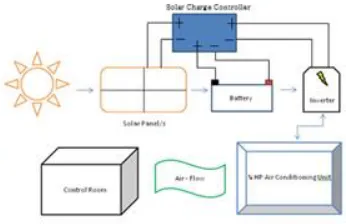
The 0.75hp air- conditioning unit is powered by solar energy.
Fig. 1. Conceptual framework
As the solar panels are set in, to absorb heat from the sun using photovoltaic effects, the system starts to operate. The energy gathered by the solar panel will pass through the solar charge controller which regulates a constant 12V stored in the battery system. Then from the battery, it is connected to the inverter, to convert 12V/DC direct current into 220V/AC alternating current, in which it is the required input of our 0.75hp air- conditioning unit. This concept follows the AC/DC machinery set-up in Fig. 1.
1.2 Significance of the study
This study is to promote renewable energy, utilizing the suns’ ray of light, collecting the solar energy using the solar panels and charging the battery system. Using the inverter technology, the converted DC to AC power supply is then connected to the 0.75hp air-conditioning unit as the main system, making the system dependent to solar energy and being a cost–efficient energy consuming device.
1.3 Scope and Limitation
This study concentrates on solar energy application. A 0.75hp air-conditioning unit is being powered by a solar panel which stores energy to the battery through a solar charging controller. The inverter, which is connected to a battery, will supply the power to the 0.75hp air-conditioning unit following the concept of the direct current (DC) to alternating current (AC) machinery. The alternating current will now be used as the main electric source of the 0.75hp air conditioning unit.The limitation of the study is the consistency of the 0.75hp air-conditioning unit that can operate from 1 o’clock in the afternoon to 5 o’clock in the evening during a typical hot day. It also limits the use of battery system which can be charged for nine(9) hours, considering the battery has a limited storage capacity, and it can only run the system for a shorter period of time. For the data gathering purposes, a data logger is connected to the system to record the thermodynamic parameters at an interval of thirty(30) seconds for a duration of 1 hour[10].
2 METHODOLOGY
2109 and the controlled room. In designing the system, the authors
undergo a series of analysis in putting the positions of the systems in an open field, and how it must be in position in order to get the desired target solar incident value. Given the specifications of the 0.75hp air conditioning unit, the Coefficient of Performance (COP) can be calculated using the equation, COP = (H1 – H4) / (H2 – H1). A room air conditioner's
efficiency is measured by the energy efficiency ratio (EER). The EER is the ratio of the cooling capacity (in British thermal units [Btu] per hour) to the power input (in watts). The higher the EER rating, the more efficient the air conditioner. In line with the 0.75hp air conditioning unit, the system performance must also be determined in considering the right temperature (condenser & evaporator), and the voltage of each system are recorded using the data logger. The position of each system shall be analyzed in which location it must be placed, the dependent variables like; temperature vs. time and relative humidity vs. time must also be considered.The data gathered, will be implemented to the design and be used as a guiding procedure in fabricating the whole system. This system will undergo a series of test which includes the running operation of the 0.75hp air- conditioning unit using based from the solar source and based from the local grid source.
2.1 Research design
To make this study successful, the authors must follow a step by step process to collect data relevant for this study. First, the authors must gather data on how to run the unit by utilizing the solar heat from the sun as its energy source. The equipment needed to run the unit are fabricated and assembled. In order for the data collected satisfies the system, the authors created a simple conceptual framework which serves as a guide to run the solar powered air-conditioning system.
The flow of the research is shown in Fig. 2.
Fig. 2. Research design
2.2 Data gathering
Looking for a topic to be studied is not an easy task. The authors must be able to come up with a design that is economically wise and at the same time environmentally friendly and by using renewable energy as a source to fight against global warming. During day time the sun is at its maximum temperature, people used an air-conditioning unit at home to keep themselves cool against the radiant heat of the sun and because of that, the authors were able to come up with an idea to conduct an experiment using the solar heat of the sun as its main source of energy in running the air conditioning unit. A simple data logger is assembled and calibrated. This data logger, connected to a laptop computer, will record the temperature, pressure, humidity ratio and the mass flow rate of the refrigerant during the experimental period. The data are recorded in the computer at an interval of
thirty(30) seconds for a duration of sixty(60) minutes or an hour[12].
2.3 Material used
After acquiring all the important information, the researchers are now ready to propose a design. The authors’ task is to design a simple controlled room with a dimension of 12ft x 6ft x 4ft. The required material should also be specified. After that; the authors computed its cooling load, considering the following parameters: first is the heat load of the wall, next is the number of lights in the confined space, followed by the sensible and latent heat of infiltration, and lastly, the sensible and latent heat of the occupants. Once all of this was calculated, the authors determined the amount of tons of refrigeration needed to cool and maintain the temperature and humidity of the controlled room.
3 EXPERIMENTAL
3.1 Fabrication
Once the air conditioning unit was selected, the authors started the fabrication of the experimental rig.
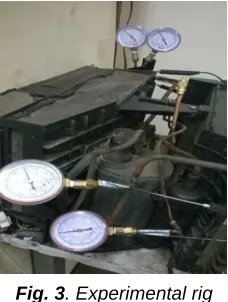
Fig. 3. Experimental rig
First, remove the casing of the unit in order to locate the two(2) high side and two (2)low side pressure and temperature sensors[9]. Once located, a pressure gauge needs to be installed on each side. This is a requirement in the experimental rig in order to determine the amount of pressure of the refrigerant that flows through the system when conducting an experiment must be constant as shown in Fig.3. Next, connect a multi testers on each side of the pressure regime in order to determine the real time temperature during the data gathering[13].
3.2 Carpentry
2110
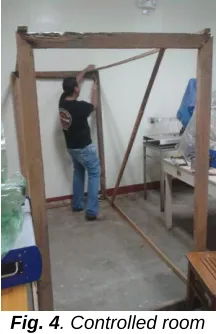
Fig. 4. Controlled room
The authors cut the wood for the approximate measurement of the room foundations. It started at the bottom, then slowly to its four pillars, then at the top, and lastly, its bracings to harden the foundation. Once the foundation is hard enough, the door and plywood were installed. An insulator was also installed inside the room to ensure no leakage of air conditioned air during the experiment.
3.3 Installation
Once carpentry is completed, the equipment is now ready for installation. The air-conditioning unit was placed at the side of the room. To stabilize the voltage flow, the equipment was connected to a solar charger because the solar panel cannot supply energy at a constant of 12volts (V). A battery system is also connected to the solar charger to receive a constant flow of 12volts (V) from the solar panel. The solar charger transmits the current to the inverter and convert it from direct current to alternating current, supplying the needed power to the air-conditioning unit and cools the controlled room with the required air flow as shown in Fig.5.
3.4 Pilot test
By accomplishing the process mentioned above, the authors were now ready to conduct the data gathering in the fabricated experimental rig. The experiment ran for about two (2) hours at an interval of thirty(30) seconds for a duration of 60 minutes[10]. Three(3) persons are required to perform these tasks and must be done at the same time. The First person is tasked to record the inside condition of the controlled room, the second person is to record its outside condition, and lastly the third person is to record the temperature and pressure of the four(4) sides in the unit. This is to ensure the validity of the data recorded by the data logger as shown in Fig.6.
Fig. 6. Battery system
3.5 Data analysis
The authors then graphed its individual data to examine the behavior of the controlled condition room at a given time. Among the data collected, there are several conditions to be considered; and those were the conditions that are way beyond to our desired design condition in the controlled room. It then calculates the COP and the EER[11].
4 RESULT AND DISCUSSION
The following data are taken from the data logger validated with the manual recording of the authors.
4.1 To maintain the right amount of DC/AC voltage to run the system.
Fig. 7. Tabulated result
The amount of DC/ AC voltage was determined at the end of the testing for two(2) hours of working on grid-sourced and two(2) hours on solar-powered air conditioner as shown in Fig.7. Investing a lot of solar panels will give a longer time of operation especially during night time. With more solar panels and higher storing capacity of the battery system will give a greater energy storage and a longer operation time.
4.2 Determination of the Coefficient of Performance & Energy Efficiency Ratio for the whole system, running from 1 o’clock in the afternoon to 5 o’clock in the evening. To determine the Coefficient of Performance, the equation, COP = (H1 – H4) / (H2 – H1), will be evaluated and the value of
COP = 4.77. The EER is the ratio of the cooling capacity (in
2111 British thermal units [Btu] per hour) to the power input (in
watts). The higher the EER rating, the more efficient the air conditioner, and it this study, the value of EER = 16.25. This value of 16.25 is high enough compared with the conventional window type air conditioner available in the market.
4.3 To determine the minimum available temperature in a given controlled room.
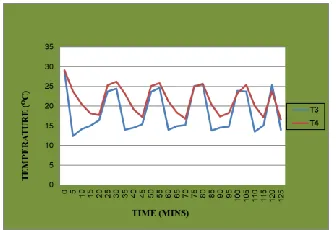
The minimum available temperature of the controlled room inside condition is 19.5 oC dry bulb and 14.5 oC wet bulb temperature. These inside condition is more than enough for the comfort zone temperature requirement in air conditioned space which ranges from 20 oC to 26 oC[5].
Fig. 8. Dry bulb and wet bulb temperature
4.4 To compare the effectiveness and the running operation between the ideal and actual norm standard Grid-sourced window type air conditioner is very effective in the operation because of the reliable and constant supply of electric power. But this type of power supply is very expensive compared to the solar-powered air-conditioning system with inverter technology. Though, solar-powered window type air-conditioner requires additional investment for solar panels and inverter gadgets, but in the long run, operation becomes cheaper because there is no cost for the energy supplied through the solar panels.
Fig. 9. Effectiveness of the ideal and actual operation
4.5 To determine the difference in temperature, pressure and mass flow rate between the solar-powered and grid-supplied window type air conditioner.
The operation of the compressor with and without the inverter technology remains the same because both are equipped with the controlled room thermostat. In this manner, the room temperature and humidity are the same. But because of the presence of the inverter controller, the refrigerant’s flow rate can be reduced for the solar-powered air conditioning unit thereby reducing the amount of energy required by the system.
4.6 To determine the payback period and the return on
investment for the solar-powered air conditioner.
For a motor rating of 0.75hp solar-powered air conditioner and operating eight(8) hours a day, it consumed 4.476 KW-hr. The local electric utility charges PhP 12.07 per KW-hr, and in one year, this amount would be PhP 19,719.24. This amount represents the savings from the local electric grid supplied by the local electric utility and substituted by sun’s energy. The total investment incurred for the solar-powered air conditioner amounted to PhP 39,255.50. So that the payback period is 2 years or 24 months. The return on investment is 50.23%, which is a sound investment for the solar-powered airconditioning system. The service life of a solar-powered airconditioning system is around ten(10) years without any mechanical troubles. Service life of ten(10) years with maintenance free cooling operation from solar energy.
5 CONCLUSION AND RECOMMENDATION
Based on the data gathered, it indicates that solar-powered air conditioning system can operate but with a lesser duration because of the capacity of the battery system being used. The EER and COP were computed after the temperatures and data were measured. The minimum inside temperature of our room was 19.5 degrees Celsius and 14.5 oCelsius. The difference of the solar-powered and the grid-powered air conditioner was that the solar-powered air conditioner has lesser time of operation due the limitation on the capacity of the battery. And for the payback period of actual costing, the money invested would be attained after two(2) years. The return on investment within two(2) years would be 50.23 %. The existing solar-powered air-conditioning system is very competitive with grid-sourced electric supply or gas- fired air-conditioning system because of the free cost of solar energy. For better payback and return on investment, more solar panels and bigger pure sine wave inverter are needed to have longer time of operation.ACKNOWLEDGMENT
The authors wish to thank the family and friends who supported this study emotionally and financially. The authors would like to acknowledge the following persons who give a lot of technical suggestions that made this study a success; Engr. Cyril G. Fabrea, Engr. Rogelio C. Golez, Jr., Engr. Percival T. Abadilla, Engr. Mark Lee Candole, Engr. Shane Cabaraban, Engr. Dondanon Bajarla, Engr. Jolou Miraflor, Engr. Clark Gozon, Engr. Euljun B. Salarda, Mr. Johanne L. Timbal, Mr. Johny A. Daculan, and Mr. Karl Ravena. And finally, the authors would like to acknowledge the Almighty God, who always give spiritual and material guidance through the experimentation stage and to the Blessed Virgin Mary, who showers spiritual blessings and enlightenment for the completion of the study with competence, commitment, and conscience.
REFERENCES
[1] J. F. Miraflor, E. B. Dollera, R. C. Golez Jr., N. G. Ipanag, Y. G. Melliza, R. J. A. Cañeda, ―An Experimental Study of the Waste Heat Recovery for the Absorption Type Transport Airconditioning System‖, Global Scientific Journal(GSJ), ISSN: 2320-9186, Volume 7, Issue 9, Pages 177-183, Sept. 2019
2112 [3] E.B. Dollera, M. C. F. Rey, A. R. De Jesus, J. M. Piloton,
R. R. Salem, Jr., ―Water Desalination System using Parabolic Trough with Varying Glass Thickness‖, International Journal of Engineering and Advanced Technology(IJEAT), ISSN: 2249-8958, Volume 9, Issue 1, Pages 6-11, October 2019.
[4] E. B. Dollera, N. T. Corbita,Jr., M. J. S. Quitiol, J. S. Tagno-ay, J. M. Trazona, ―XU Solar Furnace for Recycled Plastic Lumbers,‖ International Journal of Scientific and Technology Research (IJSTR), ISSN:2277-8616(Online), Volume-8 Issue-10, Page No. 877-885, October 2019. [5] W. F. Stoker and J. W. Jones, ―Refrigeration and
Airconditioning,‖ 2nd edition. New York, McGraw Hill, 1982.
[6] E.B.Dollera, and E.P. Villanueva, ―A study of the Heat Transfer Coefficient of a Mini Channel Evaporator with R-134a as Refrigerant‖, IOP Conference Series: Materials Science and Engineering. Volume 88 012027, 2014. [7] E. B. Dollera, E.P.Villanueva, L. L. Pabilona, K. J. A. Dotdot, G.
B. Dollera, Jr., ―Temperature Distribution in Mini Channel Heat Exchanger for the development of a Portable Vaccine Carrier,‖ International Journal of Recent Technology and Engineering(IJRTE), ISSN:2277-3878(Online), Volume-8 Issue-4, Page No. 222-226, November 2019.
[8] E. B. Dollera, E. P.Villanueva, L.L.Pabillona, and R, C. Golez Jr., ―Lockhart-Martinelle Correlation of Refrigerant R-134a Pressure Drop in Minichannel Evaporators‖, Australian Journal for Basic & Applied Sciences, ISSN:1991-8178, Volume-9 Issue-37, Pages 28-34, Special Issue 2015.
[9] E.B.Dollera, R.C. Golez Jr., N.G. Ipanag, G.B. Dollera Jr., K. I. D. Liwanag, K.J. A. Dotdot, R.D.Z. Bagayas, and F. E. Joring ―Comparative study of pressure drop on a micro expansion device for the development of a mini vaccine carrier‖, Global Scientific Journals, ISSN: 2320-9186, Vol-7 Issue-8, Pages 613-623, Aug. 2019.
[10] E. B. Dollera, R. C. Golez Jr., S. D. R. C. Ty, J. P. F. S. Gaston, J. V. Balo, ―Development of XU Plastic Shredder for Cost Effective Means of Minimizing Polyethylene Terephthalate Plastic Waste Volume‖, International Journal
of Innovative Technology and Exploring
Engineering(IJITEE), ISSN: 2278-3075, Volume 8, Issue 12, Pages 2821-2825, October 2019.
[11] ASHRAE, :―Handbook of Refrigeration‖, SI Version, Atlanta, GA, American Society of Heating, Refrigerating, and Air-Conditioning Engineers, Inc., 1985.
[12] L. L. Pabilona, E. P. Villanueva, and E. B. Dollera, ―An Experimental and Simulation Study of Heat Transfer Coefficient of the Mini Channel Condenser for Refrigeration System‖, Australian Journal for Basic & Applied Sciences, ISSN: 1991-8178, Volume 9 Issue37, Pages 6-14, Special 2015.