Pharmacogenomics and Personalized Medicine 2018:11 139–146
Pharmacogenomics and Personalized Medicine
Dove
press
submit your manuscript | www.dovepress.com 139
O r i g i n a l r e s e a r c h
open access to scientific and medical research
Open Access Full Text Article
Qualitative user evaluation of a revised
pharmacogenetic educational toolkit
rachel Mills susanne B haga
Duke center for applied genomics and Precision Medicine, Duke University Medical center, Durham, nc, Usa
Introduction: Pharmacogenetic (PGx) testing is a leading application for personalized and precision medicine; however, there are barriers, including limited provider and patient under-standing, which affect its uptake. There is a need for tools that can enhance the patient and provider experience with testing and promoting the shared and informed decision-making.
Materials and methods: In this study, we sought to gather additional feedback on a PGx toolkit comprised of four educational tools that had been previously evaluated through an online survey by pharmacists. Specifically, we conducted semi-structured interviews with pharmacists and members of the public regarding their understanding and utility of the toolkit and its individual components.
Results: Participants found three of the four toolkit components, a test information sheet, flipbook, and results sheet, to be useful and important. The fourth component, results card, was viewed less favorably. Participants differed in their preference for medical jargon and detailed results nomenclature (namely star * alleles).
Conclusion: User input during the development of educational materials is essential for opti-mizing utilization, effectiveness, and comprehension.
Keywords: pharmacogenetic testing, pharmacogenomics, patient education, community pharmacist
Introduction
Pharmacogenetic (PGx) testing is one of the leading applications for personalized and precision medicine practices having the greatest number of early adopters.1 However,
questions of clinical utility and optimum delivery models, as well as barriers such as limited provider knowledge and limitations in clinical decision support systems have inhibited universal adoption of PGx testing.2–6 Research and clinical efforts have begun to
address some of these barriers to implementation,7–10 but additional support is needed,
par-ticularly regarding patient understanding and informed decision-making for PGx testing. Although the delivery model (and health providers involved) for PGx testing may vary depending on the clinical circumstances, pharmacists will likely play an instrumental role in the delivery and/or implementation of PGx test results.11–13 Our
own work and others have demonstrated that community pharmacies may be well-suited to provide the PGx testing services.14,15 Specifically, community pharmacists
are well-informed about the drug interactions, often provide clinical care services,16–19
and are experienced in counseling patients about medications.20–23 Provision of
PGx services in community pharmacies is feasible, particularly when offered as part of medication therapy management.24 Although we anticipate that community
pharmacies are an appropriate setting for implementation of PGx services, there
correspondence: rachel Mills
Duke center for applied genomics and Precision Medicine, Duke University Medical center, 304 research Drive, Box 90141, Durham, nc, Usa Tel +1 919 684 2569 email [email protected]
Journal name: Pharmacogenomics and Personalized Medicine Article Designation: Original Research
Year: 2018 Volume: 11
Running head verso: Mills and Haga
Running head recto: Evaluation of PGx educational toolkit DOI: http://dx.doi.org/10.2147/PGPM.S169648
Pharmacogenomics and Personalized Medicine downloaded from https://www.dovepress.com/ by 118.70.13.36 on 26-Aug-2020
For personal use only.
Dovepress Mills and haga
is a need for pharmacist-facing support tools25 as well as
tools to enhance the patient experience with PGx testing. Pharmacy school curricula include instructions on PGx,26–30
and a number of continuing education opportunities are available,28,31,32 but pharmacist knowledge of PGx is still
limited.32,33 Furthermore, some pharmacists may struggle
to identify patients who have low health literacy and may need additional educational support to promote informed decision-making about PGx testing.34,35
As previously reported, we developed a suite of edu-cational tools (“toolkit”) to support providers, particularly community pharmacists, when discussing about PGx testing and results with their patients.36 The toolkit comprised of
a single-page test information sheet (TIS), an educational flipbook, a single-page results report, and a wallet-sized results card. The toolkit components were reviewed by 380 community pharmacists in North Carolina and were revised based on their feedback. In this paper, we present the second round of qualitative evaluations for understandability and perceived utility by both pharmacists and members of the public of an updated version of the toolkit components.
Materials and methods
Toolkit components and revision
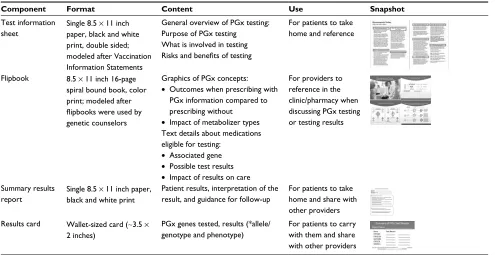
Four educational tools are included in the toolkit: a Test Information Sheet (TIS), a “Flipbook” Guide to PGx Test-ing, a Result Summary Handout, and a Results Wallet card
(Table 1). All the components have been previously described in detail and revised based on the feedback from an initial assessment.36 Following the assessment, we aimed to improve
the toolkit by using more patient-friendly language, improv-ing esthetics of the components, and utilizimprov-ing more graphics. In summary, we revised language in the TIS and Flipbook to improve readability, we completely recreated the Flipbook to improve its design and incorporate new graphics and illustra-tions, and we made minor adjustments to the design of the results card. The revised toolkit components are publicly available via the Community Pharmacists Pharmacogenetics Network (CPPN; https://www.rxpgx.com/patient-resources).
semi-structured interviews
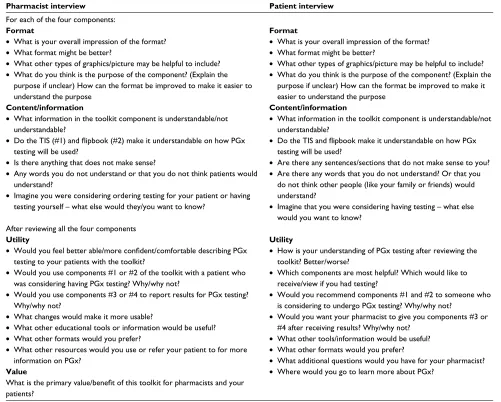
For gathering in-depth feedback regarding each toolkit compo-nent, we conducted semi-structured interviews with pharma-cists and members of the public. All interviews were conducted by one investigator (RM) using an interview guide to ensure consistency (Table 2). The interview guide consisted of 15 questions about the format, content, and utility of each tool. Pharmacists were also asked about the likelihood of using one or more components in their pharmacy to discuss PGx testing with patients. “Think aloud” techniques, a standard method in cognitive interviewing,37 were used to elicit participants’
preferences and educational needs. Participants were also encouraged to circle confusing terms on a printed copy of the handouts. Suggestions for improvement were also elicited.
Table 1 Details of revised toolkit components
Component Format Content Use Snapshot
Test information sheet
single 8.5 × 11 inch paper, black and white print, double sided; modeled after Vaccination information statements
general overview of Pgx testing: Purpose of Pgx testing What is involved in testing
Risks and benefits of testing
For patients to take home and reference
Flipbook 8.5 × 11 inch 16-page spiral bound book, color print; modeled after
flipbooks were used by
genetic counselors
graphics of Pgx concepts:
• Outcomes when prescribing with Pgx information compared to prescribing without
• impact of metabolizer types Text details about medications eligible for testing:
• associated gene
• Possible test results
• impact of results on care
For providers to reference in the clinic/pharmacy when discussing Pgx testing or testing results
summary results report
single 8.5 × 11 inch paper, black and white print
Patient results, interpretation of the result, and guidance for follow-up
For patients to take home and share with other providers results card Wallet-sized card (~3.5 ×
2 inches)
Pgx genes tested, results (*allele/ genotype and phenotype)
For patients to carry with them and share with other providers
Abbreviation: Pgx, pharmacogenetics.
Pharmacogenomics and Personalized Medicine downloaded from https://www.dovepress.com/ by 118.70.13.36 on 26-Aug-2020
Dovepress evaluation of Pgx educational toolkit
All interviews were audio-recorded, transcribed, and coded by themes as previously described.36 The study was approved
by the Duke University Health System Institutional Review Board (IRB) (Pro00069061), and all participants provided written informed consent prior to participating in the interview.
Participants
Individuals from the public were recruited to provide feed-back from the patient perspective. The study was advertised via Craigslist postings and flyers posted in and around Duke Hospital (Durham, NC). Four individuals participated: one male and three females. Pharmacist participants were recruited via CPPN. Two pharmacists, one male and one female, agreed to participate. Neither of the pharmacists participated in the initial study. Additional demographic Table 2 Qualitative interview guide
Pharmacist interview Patient interview
For each of the four components:
Format
• What is your overall impression of the format?
• What format might be better?
• What other types of graphics/picture may be helpful to include?
• What do you think is the purpose of the component? (explain the purpose if unclear) how can the format be improved to make it easier to understand the purpose
Format
• What is your overall impression of the format?
• What format might be better?
• What other types of graphics/picture may be helpful to include?
• What do you think is the purpose of the component? (explain the purpose if unclear) how can the format be improved to make it easier to understand the purpose
Content/information
• What information in the toolkit component is understandable/not understandable?
• Do the TIS (#1) and flipbook (#2) make it understandable on how PGx
testing will be used?
• is there anything that does not make sense?
• any words you do not understand or that you do not think patients would understand?
• imagine you were considering ordering testing for your patient or having testing yourself – what else would they/you want to know?
Content/information
• What information in the toolkit component is understandable/not understandable?
• Do the TIS and flipbook make it understandable on how PGx
testing will be used?
• are there any sentences/sections that do not make sense to you?
• are there any words that you do not understand? Or that you do not think other people (like your family or friends) would understand?
• imagine that you were considering having testing – what else would you want to know?
after reviewing all the four components
Utility
• Would you feel better able/more confident/comfortable describing PGx
testing to your patients with the toolkit?
• Would you use components #1 or #2 of the toolkit with a patient who was considering having Pgx testing? Why/why not?
• Would you use components #3 or #4 to report results for Pgx testing? Why/why not?
• What changes would make it more usable?
• What other educational tools or information would be useful?
• What other formats would you prefer?
• What other resources would you use or refer your patient to for more information on Pgx?
Utility
• how is your understanding of Pgx testing after reviewing the toolkit? Better/worse?
• Which components are most helpful? Which would like to receive/view if you had testing?
• Would you recommend components #1 and #2 to someone who is considering to undergo Pgx testing? Why/why not?
• Would you want your pharmacist to give you components #3 or #4 after receiving results? Why/why not?
• What other tools/information would be useful?
• What other formats would you prefer?
• What additional questions would you have for your pharmacist?
• Where would you go to learn more about Pgx?
Value
What is the primary value/benefit of this toolkit for pharmacists and your
patients?
Abbreviations: PGx, pharmacogenetics; TIS, test information sheet; component #1, test information sheet; component #2, flipbook; component #3, summary results
report; component #4, results card.
data were not collected from the participants to protect their privacy due to the small sample size.
Results
Tis
Overall, reviewers found the TIS useful and believed it would be an important resource to refer to after discussing testing with a provider. One pharmacist indicated that he would feel more confident or comfortable offering PGx testing to patients because he would have written information to “back up” a conversation about testing. Another pharmacist said, “It’s good for communicating with the patients and provides another avenue to talk to the patient. In those cases, it is serv-ing its purpose.” Both pharmacists indicated they would use the TIS for all patients offered PGx testing.
Pharmacogenomics and Personalized Medicine downloaded from https://www.dovepress.com/ by 118.70.13.36 on 26-Aug-2020
Dovepress Mills and haga
The text and content were positively reviewed by three patients and one pharmacist participant. With respect to the language and reading level (currently at an eighth grade read-ing level), one patient participant indicated, “It’s readable. Not too technical;” and a pharmacist participant said, “I thought it was simple enough language that I think anyone could understand.” However, one patient suggested making the text more concise, saying “I think it’s too much information … there’s too much overall. Everything could be shorter.” This participant, who self-identified as Spanish-speaking, indicated that if translated, the information would likely not fit into the single-page format. One pharmacist expressed concern about the inclusion of terminology like the word “pharmacogenetics” or “variation.” Two participants (one patient, one pharmacist) appreciated the inclusion of a list of online resources to view for additional information about pharmacogenetics and testing.
In order to enable usability of the TIS for a variety of testing platforms and laboratories, some details about the test, such as price and turn-around-time were intentionally left blank. However, participants indicated their desire for more specific details. In particular, specifying cost was very important to most participants (three patients and one phar-macist). As originally worded, the TIS indicated that “these tests usually cost a few hundred dollars.” The participants then expressed that it is also important to include additional information such as the range, maximum possible amount, or insurance coverage.
Participants also suggested that including information about risks is also important.
I need to know yes or no if there are risks. I don’t see any-thing that says yes or no. It just gives laws that protect you. Are there any risks?
With respect to the Genetic Information Nondiscrimination Act (GINA) (included in the Risks section), a participant indicated that it was confusing and that it was “jarring” to “talk about the law.” Another participant indicated it was important to include the information about GINA and its protections as well as the potential effects of testing will have on future prescriptions, “especially when it comes to money and insurance.”
The format of the TIS was generally viewed favorably. One patient praised the layout by saying, “This is good because you’ve got it set up with headings and then the facts;” a pharmacist participant said, “I like the format; I like the … sections so right away you can see what you need to know… It is a fine format that would be familiar to patients.” One
patient participant did request that the font size be increased to make it easier to read.
Flipbook
Like the TIS, feedback regarding the usefulness of the flip-book was generally positive. Three participants including two patients and one pharmacist indicated that although it was a useful resource, it probably would not be necessary for all patients. One patient participant said, “A patient with a science background may not need all of this, but people with less education or who are older might need something with graphics.” Two participants indicated that although the flipbook was helpful, it would still be important for a provider to explain the concepts.
This is a little complicated … [but] if the doctor is going to go over it with you and you’re not just reading it, it is probably okay.
A number of suggestions were made on ways to improve the content and layout of the flipbook. As with the TIS, some participants expressed concern about potentially confusing terminology. Two patient participants felt the term “metabo-lize” needed a better definition, with one pointing out the risk of confusing it with “metabolism of food.” One also worried that some patients may not be familiar with the term “enzyme.” Although considered confusing, participants still felt the proper medical terms should be used; two partici-pants suggested including a glossary or reference sheet to define the less-familiar terms. Two participants felt the term “adverse response” should be replaced with “side effects” because “most people have heard that; it’s what’s written in the brochure that comes with the medicine.”
Participant response was mixed regarding inclusion of details about genotype, specifically star (*) alleles. Two patient participants indicated inclusion of genotype information was not useful; however, another stated that he “wants to know everything [because] the more [information] you give, the more knowledge patients have to decide whether or not to take this drug.” One of the pharmacist participants thought the allelic information should not be included at all.
Participants made additional design requests such as increasing font sizes, turning some text that was written verti-cally, and minimizing the use of the color red since it seemed “bad” or stigmatizing. Three participants commented on the cover of the flipbook, which was a collage design including graphics of a DNA double helix, a medication bottle, and a patient. Specifically, they felt that some patients would be unfamiliar with the double helix and might get confused. A
Pharmacogenomics and Personalized Medicine downloaded from https://www.dovepress.com/ by 118.70.13.36 on 26-Aug-2020
Dovepress evaluation of Pgx educational toolkit
patient and pharmacist recommended replacing the cover with a picture of a patient talking to a pharmacist.
One patient participant requested making the flipbook available digitally, perhaps as a video or a digital book.
I think I’d like it as a video. Because if you get too much information at the doctor’s office it can cause your mind to like freeze. But if you go back home and sit down to watch it and is like ‘oh this is what he actually means’ then if the patient or the doctor has a question they can go to a video.
A pharmacist participant agreed with the suggestion, stating that paperless versions of these types of resources would be beneficial, and they would like to review this resource with patients on a computer screen or a tablet.
summary results report
Overall, the participants liked the simplicity of the results report. We specifically asked about their perception on the clarity of the form, since the results report included all pos-sible test results as metabolizer type, primarily for ease of use, so that the provider could check/circle the specific result and corresponding impact on care. Three patients stated that it was clear and they would have no difficulty understanding the result. One pharmacist agreed that it was clear and under-standable, whereas the other felt like it may be confusing but could provide an additional talking point to ensure that the pharmacist takes time to review the results with the patient instead of just handing them the result.
Few recommendations were made on ways to improve the results report. One patient preferred having the star (*) allele included, rather than only including the phenotype (ie, poor metabolizer, reduced uptake, etc). One pharmacist suggested changing the “impact on care” box because it might appear as if the pharmacist preferred one drug to another. Instead of specifying the drug change, a more general statement was suggested as, “A change to your medication may be required. Please discuss with your doctor during your next visit.”
results card
Compared to the other toolkit components, the results card was the resource that participants felt was the least likely to be used. One patient participant was unsure of the purpose of the card.
This information isn’t going to be in your medical records? Why do I need a card? ... I don’t get it, having to have an extra thing in your pocket … I just don’t want to carry a card.
A pharmacist expressed similar sentiments saying, “I really don’t see anybody carrying a PGx test card with them and handing it out … So I don’t think this is as useful, because let’s face it, how many things do you have in your wallet? How many more things do you want to carry around? ... it’s just too much.”
One patient who felt the results card was useful suggested including only the gene name and star (*) allele result since the “pharmacist and doctor is supposed to know what that means and the patient may not need to know.” The participant indicated that reducing the amount of text by eliminating the interpretation would enable the text size to be increased on the card. A pharmacist shared a similar opinion, stating, “I would include [alleles] because this is not something they’d show to their friends, but to their doctor or pharmacist.” That pharmacist also preferred to remove the interpretation of metabolizer type.
Participants suggested alternative options for storing results, such as saving as an image on their smartphone.
revisions to the toolkit
Based on the feedback received, a number of changes were made to the toolkit before being finalized for use in a trial assessing the delivery of PGx in community pharmacies (NIH 5R01GM081416; NCT02937545). Specifically, the wording in the TIS was made more concise to reduce the amount of text. Subsequently, we were able to enlarge the text, address-ing a suggestion by one of the participants. The original TIS presented to participants was 737 words in length, and the revised version was 700 words. The reading level was main-tained at about an eighth grade reading level. Throughout the text, the term “genetic variations” was replaced with the term “genetic differences.” Significant changes were made to the section on risks of testing in response to comments from the participant who felt that the question was not answered understandably. Finally, the statement “Only your healthcare provider can approve changes to your prescription. You should continue taking your medication as currently prescribed until you discuss results with your provider” was reformatted to stand out from the other text as pharmacists deemed it an important statement.
A number of changes were also made to the flipbook. For example, the cover page, which had previously been a collage of graphics, was replaced with a photo of a phar-macist talking to patient. Throughout the flipbook, the term “adverse response” was replaced with “side effect,” which was deemed a more understandable term. In addition, based on comments from multiple participants, use of the color
Pharmacogenomics and Personalized Medicine downloaded from https://www.dovepress.com/ by 118.70.13.36 on 26-Aug-2020
Dovepress Mills and haga
red was minimized, as it was perceived as having a nega-tive value. For the drug-specific pages, the star alleles were removed and possible results were described as metabolizer or activity type.
The only revision made to the results report was to the “Impact on Care” section. The statement about results indi-cating a potential need for a drug or dose change was made more general to say: “The test results suggest that switching to a new drug may be needed. Please talk to your doctor before making any changes to your medication.” Minimal changes were made to the results card with only a revision to the description of PGx testing from “A pharmaco-genetic test looks at genes that affect how the body responds to and uses medicine” to “A pharmacogenetic test looks for variants in genes that affect how to body responds to and uses medicine.”
Discussion
Patient education will be a key component for the successful introduction and implementation of PGx testing at its early stage. Patient input or participatory design for the develop-ment of educational materials is essential to optimize utiliza-tion, effectiveness, and comprehension. This follow-up study included public input and validated our initial assessment of our PGx testing toolkit,36 particularly regarding the positive
perceived usefulness and importance of the TIS, flipbook, and results sheet.
There was consistency in many themes between patients and pharmacists, including the usefulness of the toolkit components, the ease of their use, and the design of the components. One area of diverging opinions was on the use of medical terminology and level of descriptive detail. Users’ reading level is one of the major challenges in developing any type of educational materials.38–41 The pharmacist
par-ticipants expressed concern that the language, including the term “pharmacogenetics,” was too complicated and should be replaced. Although patient participants identified some confusing language, they believed that it was important to use proper medical terminology. We acknowledge that the read-ing level of the toolkit components, currently at the eighth grade level, is greater than the recommended 4th–6th grade reading level range for patient education materials, which may account for some of the comments.42 Other studies
examining patient-facing materials have similarly reported mixed responses regarding the use of medical terminology43
to more general language.44,45 Though some patients may
prefer inclusion of medical terminology, minimizing its use can improve patient understanding.46 As suggested by our
participants and others,47 a hybrid approach where medical
terminology is included with a definition or glossary may be an appropriate solution to these conflicting findings and promote comprehension.
Despite the limited enthusiasm for the patient card, “pharmacogenetic ID cards” have been utilized by other researchers, laboratories, and healthcare systems. For exam-ple, Bangkok’s Ramathibodi Hospital was one of the first to utilize a PGx results card by providing a plastic wallet card following HLA testing in order to indicate patients at risk of Stevens–Johnson syndrome and toxic epidermal necrolysis.48
In a clinical trial that included provision of a results card and explored the impact of HLA testing, treatment outcomes were improved when physicians modified treatment based on test results.48,49 In Estonia, a pilot program for personalized
medi-cine allows residents to access medical information using a national identity card;50 however, an electronic “smartcard”
is issued to Estonian residents, rather than a basic results card similar to that examined for this research and used in Tai-wan. Other “smart” technologies such as a two-dimensional barcode (QR code) that stores PGx information and links to decision support services using a Medication Safety Code system51,52 has been well-received by physicians and
phar-macists.53 Use of results cards may also be beneficial in care
settings that lack the ability to integrate PGx information into electronic health records or clinical decision support systems. However, to our knowledge, there has been limited exploration of patients’ attitudes about or utilization of the cards. Differences in culture, portability of health records, public trust of health providers, and availability of electronic medical records likely to affect the patient and provider attitudes about this toolkit component.
There are some limitations in the current study that must be considered. Due to the small population size and recruitment limited to individuals from Durham, NC, and surrounding areas, the findings of these interviews may not be applicable to other populations. In addition, none of the participants have undergone PGx testing or used it in their pharmacy settings; therefore, all feedback was based on par-ticipant expectations rather than their actual experience using the toolkit components. This limitation will be addressed by assessments of toolkit usage in an ongoing trial of PGx testing in community pharmacies (NCT02937545).
Conclusion
Facilitating patient engagement and comprehension about PGx testing will be essential for the foreseeable future as more and more providers offer these tests. Since the conclu-sion of this assessment, we have made additional reviconclu-sions
Pharmacogenomics and Personalized Medicine downloaded from https://www.dovepress.com/ by 118.70.13.36 on 26-Aug-2020
Dovepress evaluation of Pgx educational toolkit
to the toolkit components, which include removing some of the medical jargon and genetic nomenclature, and replacing it with general or common terminology. Continued evaluation of educational tools in a practice-based setting will be impor-tant to capture the utility of tools in actual patient–provider discussions, with a wider diversity of patients and providers, time pressures, and competing tasks. We anticipate further development and transition to digital formats in the future.
Disclosure
RM is contracted with telehealth company PWNHealth, NY, USA to provide genetic counseling services for patients undergoing genetic testing, including PGx testing. The authors report no other conflicts of interest in this work.
References
1. Hess GP, Fonseca E, Scott R, Fagerness J. Pharmacogenomic and pharmacogenetic-guided therapy as a tool in precision medicine: cur-rent state and factors impacting acceptance by stakeholders. Genet Res (Camb). 2015;97:e13.
2. Manolio TA, Chisholm RL, Ozenberger B, et al. Implementing genomic medicine in the clinic: the future is here. Genet Med. 2013;15(4):258–267.
3. Shuldiner AR, Relling MV, Peterson JF, et al. The Pharmacogenomics Research Network Translational Pharmacogenetics Program: overcom-ing challenges of real-world implementation. Clin Pharmacol Ther. 2013;94(2):207–210.
4. Luzum JA, Pakyz RE, Elsey AR, et al. The Pharmacogenomics Research Network Translational Pharmacogenetics Program: Outcomes and Met-rics of Pharmacogenetic Implementations Across Diverse Healthcare Systems. Clin Pharmacol Ther. 2017;102(3):502–510.
5. Tonk ECM, Gurwitz D, Maitland-van der Zee AH, Janssens ACJW. Assessment of pharmacogenetic tests: presenting measures of clinical validity and potential population impact in association studies. Phar-macogenomics J. 2017;17(4):386–392.
6. Peterson JF, Bowton E, Field JR, et al. Electronic health record design and implementation for pharmacogenomics: a local perspective. Genet Med. 2013;15(10):833–841.
7. Haga SB, Moaddeb J. Comparison of delivery strategies for pharmacoge-netic testing services. Pharmacogenet Genomics. 2014;24(3):139–145. 8. Lemke AA, Hutten Selkirk CG, Glaser NS, et al. Primary care physician experiences with integrated pharmacogenomic testing in a community health system. Per Med. 2017;14(5):389–400.
9. O’Donnell PH, Wadhwa N, Danahey K, et al. Pharmacogenomics-based point-of-care clinical decision support significantly alters drug prescribing. Clin Pharmacol Ther. 2017;102(5):859–869.
10. Freimuth RR, Formea CM, Hoffman JM, Matey E, Peterson JF, Boyce RD. Implementing genomic clinical decision support for drug-based precision medicine. CPT Pharmacometrics Syst Pharmacol. 2017;6(3):153–155.
11. Arnall JR, Petro R, Patel JN, Kennedy L. A clinical pharmacy pilot within a Precision Medicine Program for cancer patients and review of related pharmacist clinical practice. J Oncol Pharm Pract. 2017 Epub Jan 1.
12. Johnson JA. Pharmacists should jump onto the clinical pharmacogenet-ics train. Am J Health Syst Pharm. 2016;73(23):2013–2016. 13. Johnson SG, Shaw PB, Delate T, et al. Feasibility of clinical
pharma-cist-led CYP2C19 genotyping for patients receiving non-emergent cardiac catheterization in an integrated health system. Pharm Pract. 2017;15(2):946.
14. Padgett L, O’Connor S, Roederer M, Mcleod H, Ferreri S. Pharma-cogenomics in a community pharmacy: ACT now. J Am Pharm Assoc. 20112011;51(2):189–193.
15. Moaddeb J, Mills R, Haga SB. Community pharmacists’ experience with pharmacogenetic testing. J Am Pharm Assoc. 2015;55(6):587–594. 16. Christensen DB, Farris KB. Pharmaceutical care in community
pharmacies: practice and research in the US. Ann Pharmacother. 2006;40(7–8):1400–1406.
17. Schmit CD, Penn MS. Expanding state laws and a growing role for pharmacists in vaccination services. J Am Pharm Assoc. 2017;57(6):661–669.
18. Bennett M, Goode JV. Recognition of community-based pharmacist practitioners: essential health care providers. J Am Pharm Assoc. 2016;56(5):580–583.
19. Peacock G, Kidd R, Rahman A. Patient care services in independent community pharmacies: a descriptive report. J Am Pharm Assoc. 2007;47(6):762–771.
20. Debenito JM, Billups SJ, Tran TS, Price LC. Impact of a clinical pharmacy anemia management service on adherence to monitoring guidelines, clinical outcomes, and medication utilization. J Manag Care Spec Pharm. 2014;20(7):715–720.
21. Rudd KM, Dier JG. Comparison of two different models of anticoagula-tion management services with usual medical care. Pharmacotherapy. 2010;30(4):330–338.
22. van Boven JF, Stuurman-Bieze AG, Hiddink EG, Postma MJ, Vegter S. Medication monitoring and optimization: a targeted pharmacist program for effective and cost-effective improvement of chronic therapy adher-ence. J Manag Care Spec Pharm. 2014;20(8):786–792.
23. Yamada K, Nabeshima T. Pharmacist-managed clinics for patient edu-cation and counseling in Japan: current status and future perspectives.
J Pharm Health Care Sci. 2015;1:2.
24. Ferreri SP, Greco AJ, Michaels NM, et al. Implementation of a phar-macogenomics service in a community pharmacy. J Am Pharm Assoc. 2014;54(2):172–180.
25. Romagnoli KM, Boyce RD, Empey PE, Adams S, Hochheiser H. Bringing clinical pharmacogenomics information to pharmacists: a qualitative study of information needs and resource requirements. Int J Med Inform. 2016;86:54–61.
26. Accreditation Council for Pharmacy Education. Accreditation Standards and Key Elements for the Professional Program in Pharmacy Leading to the Doctor of Pharmacy Degree; 2015. Available from: https://www.acpe-accredit.org/pdf/Standards2016FINAL.pdf. Accessed February 9, 2018. 27. Frick A, Benton CS, Scolaro KL, et al. Transitioning pharmacogenomics
into the clinical setting: training future pharmacists. Front Pharmacol. 2016;7:241.
28. Weitzel KW, Aquilante CL, Johnson S, Kisor DF, Empey PE. Educa-tional strategies to enable expansion of pharmacogenomics-based care.
Am J Health Syst Pharm. 2016;73(23):1986–1998.
29. Lee KC, Hudmon KS, Ma JD, Kuo GM. Evaluation of a shared phar-macogenomics curriculum for pharmacy students. Pharmacogenomics. 2015;16(4):315–322.
30. Adams SM, Anderson KB, Coons JC, et al. Advancing pharmacogenom-ics education in the core PharmD curriculum through student personal genomic testing. Am J Pharm Educ. 2016;80(1):3.
31. Kuo GM, Lee KC, Ma JD. Implementation and outcomes of a live con-tinuing education program on pharmacogenomics. Pharmacogenomics. 2013;14(8):885–895.
32. Formea CM, Nicholson WT, Mccullough KB, et al. Development and evaluation of a pharmacogenomics educational program for pharma-cists. Am J Pharm Educ. 2013;77(1):10.
33. Mccullough KB, Formea CM, Berg KD, et al. Assessment of the phar-macogenomics educational needs of pharmacists. Am J Pharm Educ. 2011;75(3):51.
34. Praska JL, Kripalani S, Seright AL, Jacobson TA. Identifying and assist-ing low-literacy patients with medication use: a survey of community pharmacies. Ann Pharmacother. 2005;39(9):1441–1445.
Pharmacogenomics and Personalized Medicine downloaded from https://www.dovepress.com/ by 118.70.13.36 on 26-Aug-2020
Dovepress
Pharmacogenomics and Personalized Medicine
Publish your work in this journal
Submit your manuscript here: https://www.dovepress.com/pharmacogenomics-and-personalized-medicine-journal
Pharmacogenomics and Personalized Medicine is an international, peer-reviewed, open access journal characterizing the influence of genotype on pharmacology leading to the development of personalized treatment programs and individualized drug selection for improved safety, efficacy and sustainability. This journal is indexed on the American Chemical
Society’s Chemical Abstracts Service (CAS). The manuscript manage-ment system is completely online and includes a very quick and fair peer-review system, which is all easy to use. Visit http://www.dovepress. com/testimonials.php to read real quotes from published authors.
Dove
press
Mills and haga
35. Schwartzberg JG, Cowett A, Vangeest J, Wolf MS. Communication tech-niques for patients with low health literacy: a survey of physicians, nurses, and pharmacists. Am J Health Behav. 2007;31(Suppl 1):S96–S104. 36. Haga SB, Mills R, Moaddeb J. Evaluation of a pharmacogenetic
educational toolkit for community pharmacists. Pharmacogenomics. 2016;17(14):1491–1502.
37. Beatty PC, Willis GB. Research synthesis: the practice of cognitive interviewing. Public Opin Q. 2007;71(2):287–311.
38. Hill-Briggs F, Smith AS. Evaluation of diabetes and cardiovascular disease print patient education materials for use with low-health literate populations. Diabetes Care. 2008;31(4):667–671.
39. Huang G, Fang CH, Agarwal N, Bhagat N, Eloy JA, Langer PD. Assess-ment of online patient education materials from major ophthalmologic associations. JAMA Ophthalmol. 2015;133(4):449–454.
40. Morony S, Flynn M, Mccaffery KJ, Jansen J, Webster AC. Readability of written materials for CKD patients: a systematic review. Am J Kidney Dis. 2015;65(6):842–850.
41. Patel SK, Gordon EJ, Wong CA, Grobman WA, Goucher H, Toledo P. Readability, content, and quality assessment of web-based patient education materials addressing neuraxial labor analgesia. Anesth Analg. 2015;121(5):1295–1300.
42. NIH. How to Write Easy-to-Read Health Materials; 2013. Available from: http://www.nlm.nih.gov/medlineplus/etr.html. Accessed June 19, 2018.
43. Murphy D, Sawczyn KK, Quinn GP. Using a patient-centered approach to develop a fertility preservation brochure for pediatric oncology patients: a pilot study. J Pediatr Adolesc Gynecol. 2012;25(2):114–121. 44. Mccomish JF, Groh CJ, Moldenhauer JA. Development of a doula
intervention for postpartum depressive symptoms: participants’ recom-mendations. J Child Adolesc Psychiatr Nurs. 2013;26(1):3–15.
45. Parra-Medina D, Wilcox S, Thompson-Robinson M, Sargent R, Will JC. A replicable process for redesigning ethnically relevant educational materials. J Womens Health. 2004;13(5):579–588.
46. Wernick M, Hale P, Anticich N, et al. A randomised crossover trial of minimising medical terminology in secondary care correspondence in patients with chronic health conditions: impact on understanding and patient reported outcomes. Intern Med J. 2016;46(5):596–601. 47. Regal P. A hybrid of conventional medical terminology and
patient-friendly terminology. Intern Med J. 2016;46(11):1350.
48. Sukasem C, Chantratita W. A success story in pharmacogenom-ics: genetic ID card for SJS/TEN. Pharmacogenomics. 2016;17(5): 455–458.
49. Bushyakanist A, Puangpetch A, Sukasem C, Kiertiburanakul S. The use of pharmacogenetics in clinical practice for the treatment of indi-viduals with HIV infection in Thailand. Pharmgenomics Pers Med. 2015;8:163–170.
50. Manolio TA, Abramowicz M, Al-Mulla F, et al. Global implemen-tation of genomic medicine: We are not alone. Sci Transl Med. 2015;7(290):290ps13.
51. Samwald M, Freimuth RR. Making data on essential pharmacogenes available for every patient everywhere: the Medicine Safety Code initiative. Pharmacogenomics. 2013;14(13):1529–1531.
52. Samwald M, Adlassnig KP. Pharmacogenomics in the pocket of every patient? A prototype based on quick response codes. J Am Med Inform Assoc. 2013;20(3):409–412.
53. Blagec K, Romagnoli KM, Boyce RD, Samwald M. Examining per-ceptions of the usefulness and usability of a mobile-based system for pharmacogenomics clinical decision support: a mixed methods study.
Peer J. 2016;4:e1671.
Pharmacogenomics and Personalized Medicine downloaded from https://www.dovepress.com/ by 118.70.13.36 on 26-Aug-2020