
5648
Introducing System Dynamics and Analytical
Hierarchy Process Based Software for Selecting
the Best Transportation System in Mines
Hossein Abbaspour, Carsten Drebenstedt
Abstract: Selecting the proper transportation system in mines is one of the extremely challenging issues, which the mine managers and designers are confronting with. This situation can be more complex when the number of factors involving in the selection process increases, which consequently demands a more complicated design and analysis to fulfill all those aspects. Although there are various research to address this demand, there is no study that considers simultaneously all the technical, economic, environmental, safety and social point of views. Additionally, the lack of software that makes it easy for users to dealing with the process of making a decision is deeply felt. Accordingly, in this research, TEcESaS Indexes software, which is developed and designed in Venapp of Vensim software that is based on the system dynamics modelling as well as Sustainability Index software, which is coded in Java programming language and is based on the analytical hierarchy process and working by the outputs of TEcESaS Indexes software, are introduced. The results show that the Truck-Shovel system should be used in the first four years of the project by a deterministic and group decision-making approach. However, in the stochastic modeling, the Fully Mobile In-Pit Crushing and Conveying (FMIPCC) system should be utilized along with the mine’s life.
Key words: Multiple criteria analysis, Analytical hierarchy process, System dynamics, Stochastics, Mine. —————————— ——————————
INTRODUCTION
1
The transportation system in any mining project is one of the most significant parts of it, especially in technical and economic issues. It must be able to transfer the planned amount of ore/waste while the whole stream of mining should not be interrupted as well as covering the technical challenges [1] and the costs imposed on the project. Additionally, it should be designed and selected in a way that produces the lowest environmental impact and highest safety during its operation. Accordingly, selecting the best transportation system that considers all these factors is one of the challenging points in any mining project. The two most well-known transportation systems that are commonly used in the mining projects are Truck-Shovel and In-Pit Crushing and Conveying (IPCC) systems. While the former is considered as the conventional transportation system and is frequently utilized in mines mainly because of its lower capital cost and higher flexibility, the latter can be counted as an alternative for the conventional transportation system. Accordingly, selecting the best transportation system for any mining project is one of the most challenging and complex processes that managers and engineers are facing. This will need a thorough understanding not only about the technical and economic effects of the transportation system but also other factors such as environmental, safety and social issues. In spite of numerous works about the technical and economic aspects of the transportation system in mines e.g. Truck-Shovel system [2], [3], [4], [5], [6], [7], [8], [9], [10], [11] and IPCC systems [12], [13], [14], [15], [16], [17], [18], [19], [20], [21], [22], [23], [24], [25], the works about the environmental, safety and social aspects are few [26], [27], [28], [29], [30]. Additionally, there is
not an integrated system that can evaluate all of these factors simultaneously and select the best transportation systems. The lack of software that can ease this process is still a remaining challenging issue.
TECESAS
INDEXES
SOFTWARE
2
This section introduced software called “TEcESaS Indexes”, which is produced through the Venapp tool of Vensim software. This software, which works based on system dynamics modeling, is used to model the technical, economic, environmental, safety and social factors related to the transportation systems including Truck-Shovel and IPCCs. For more details about the definition and calculation of these factors, interested readers are referred to the works done in the literature [31], [32], [33]. This software is completely explained in the Mendeley Dataset with DOI 10.17632/b75sdckjg2.2.
SELECTING
THE
BEST
TRANSPORTATION
3
SYSTEM
BY
THE
ANALYTICAL
HIERARCHY
PROCESS
(AHP)
Analytical Hierarchy Process (AHP), which is one of the multiple criteria analysis methods, is based on measuring the pairwise comparisons defined by the experts' judgments [34]. In this method, the main goal is to define the priorities between different quantities [35]. This method can be categorized in the field of decision analysis, operation research or both [35]. In the following sub-sections, it is tried that the steps of the AHP for this study to be explained. Nevertheless, interested readers are referred to the related references for additional information [35], [36]. Furthermore, a short description of the AHP steps is provided in Appendix 1.
3.1.Developing the model
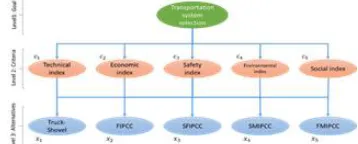
The first step in the AHP analysis is determining the hierarchy for making a decision [37]. For this study, which is selecting the best transportation system, the hierarchy can be defined as Fig. 1.
————————————————
Ph.D. candidate at the Institute of Mining and Special Civil Engineering, Freiberg University of Mining and Technology, Germany, [email protected]
5649 Fig. 1. Decision hierarchy for selecting the best transportation
system
As can be seen in this figure, the hierarchy of the problem is defined in three different levels:
- Level 1: goal, which determines the outcome of the model. - Level 2: criteria, which the decision is made based on them ( { }).
-Level 3: alternatives, which specified different transportation systems ( { }).
Generally, decision-makers need to weight each of the alternatives and finally, select the one with the maximum value. Accordingly, a weight factor of { } will be generated in which estimates the score of alternative
[35]. Whenever is bigger than , the is preferred to .
3.2.Steps of selecting the best transportation system by the AHP
This section presents four steps that are taken in this study for selecting the best transportation system.
Step 1: Pairwise comparison matrix
The pairwise comparison matrix A will be as follows:
(
)
(1)
By substituting (6) into (1), matrix A will be constituted based on the relative weights ((2) and (3)).
( )
( )
(2)
(
)
(3)
Step 2: Priorities (weights) for the criteria
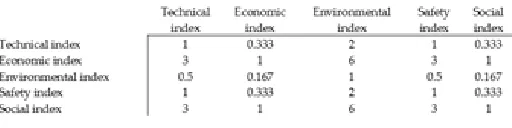
In the second step, a priority matrix from the criteria should be constructed. This matrix is based on the personal judgment of engineers, experts, etc., which determine the relative preference of any couple of criteria. The geometric mean method was applied to constructing the priority vector (Table 1). The consistency index of this matrix will be calculated and the expert will be warned to modify the priorities to reach a
consistent level. These calculations cannot proceed unless the consistency index to be met.
Step 3: Local priorities (preferences) for the alternatives This step determines which alternative is preferable concerning each criterion. In other words, it must be determined which one of the transportation systems are preferable based on the TEcESaS Indexes. The content of this matrix (input) comes from the output resulted from the TEcESaS Indexes software. The components of this matrix are resulted by dividing their TEcESaS Indexes in a comparable way. As an example, the components and local priorities in the technical index for different transportation systems are shown in Table 2. In contrast with the priorities vector for criteria that are defined by the user or expert, the local priorities for alternatives result from the comparison of criteria indexes, which is an output from the TEcESaS Indexes software. Hence, the consistency problem may happen and need to find a way of resolving this issue. Accordingly, for resolving the inconsistency in priorities matrix, the following equation was tested [38], which is based on the reconstructing the pairwise comparison matrix based on the normalized priority vector :
( ) (4)
TABLE 1
PRIORITY VECTOR FOR THE CRITERIA
By constituting all the local priorities for different alternatives and criteria, the final matrix including would be as
Table 3.
Step 4: Overall priorities (model synthesis)
In this step, an overall priority will be defined by considering both priorities (weights) and local priorities (preferences) that are added to one table by inserting priorities as the first row in the local priorities matrix (
Table 4). By multiplying priorities in local priorities, and summing the components of each resulted row, the overall priorities will be calculated Table 5.)
SUSTAINABILITY
INDEX
SOFTWARE
4
5650 provided in the Mendeley Dataset with DOI
10.17632/kxkcmvdgw7.2.
TABLE 2
LOCAL PRIORITY VECTOR FOR THE ALTERNATIVES (TECHNICAL INDEX)
TABLE 3
LOCAL PRIORITIES MATRIX FOR DIFFERENT ALTERNATIVES AND CRITERIA
TABLE 4
PRIORITIES AND LOCAL PRIORITIES
TABLE 5 OVERALL PRIORITIES
CASE
STUDY
5
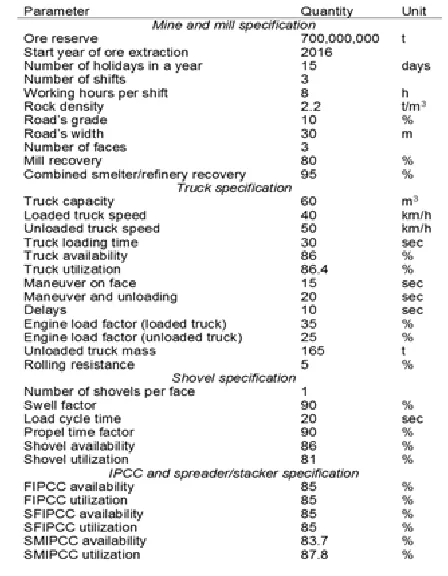
In order to implement the constructed TEcESaS Indexes software and Sustainability Index software, a hypothetical open pit copper mine was considered. All the technical, economic, environmental, safety and social specifications of this hypothetical mines are illustrated in
Table 6 to
Table 9. They are used as inputs in the TEcESaS Indexes software to simulate the model. In
Table 6, the technical specifications are merely considered for ore, in which the transportation system selection is performed for the ore reserve. In
Table 7, the copper price is based on the average yearly price from January 1996 to December 2015. For running the model, the production and relocation plan for all the transportation systems is assumed in Table 10. Although the production plan of the transportation systems could differ from one to another [15], [39], [40], in this case and for the sake of comparability, an identical production plan for all of them is considered. Nevertheless, the TEcESaS Indexes software has this ability to accept any kind of production plan as its input. Users can modify the Excel file “ProductionRelocation.xlsx”, attached to the TEcESaS Indexes software, in order to import their own production and relocation plan.
TABLE 6
TECHNICAL SPECIFICATIONS OF THE HYPOTHETICAL COPPER MINE
RESULTS
AND
DISCUSSION
6
All the indexes for different transportation systems as well as their relative parameters can be determined through TEcESaS Indexes software. However, this would not be solely enough, but it needs the best one during the mine’s life to be specified. Accordingly, Sustainability Index software, which is developed in Java programming language and works based on the AHP process and inputs from TEcESaS Indexes software, is provided. Finally, the best transportation system in two modes of deterministic and stochastic group decision-making is calculated. In both modes, the experts’ evaluation matrix is filled by 10 hypothetical experts shown in
Table 11. According to this matrix, the final pairwise comparison will be as
5651 TABLE 7
ECONOMIC SPECIFICATIONS OF THE HYPOTHETICAL COPPER MINE
TABLE 8
ENVIRONMENTAL SPECIFICATIONS OF THE HYPOTHETICAL COPPER MINE
TABLE 9
SAFETY AND SOCIAL SPECIFICATIONS OF THE HYPOTHETICAL COPPER MINE
6.1.Best transportation system by group decision-making (deterministic mode)
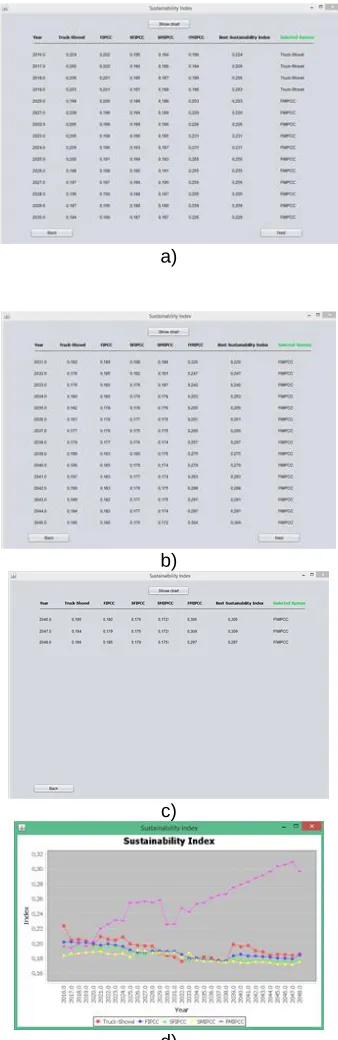
Fig. 2 shows that from the start of the project until 2019, the Truck-Shovel system is the best transportation system with the highest sustainability index. However, by progressing the project, its sustainability decreased such that from 2019 to the end of the project, FMIPCC is determined as the selected transpiration system for the project. As it can be seen in Fig. 2d, its trend is increasing during the project while the other transportation alternatives are decreasing. This can be claimed although the FMIPCC is not recommended in the short term, it considerably shows a better sustainability index
in the long term. However, this is naturally dependent on the inputs and the comparison matrix defined in this case. In the deterministic mode, all the inputs are considered as fixed throughout the simulation and any uncertainty on them is not considered. However, the real situation is not working in this way and there would be definitely a degree of uncertainty. Accordingly, running the model in these situations will provide a better envision about selecting the best transportation system.
TABLE 10
PRODUCTION AND RELOCATION PLAN FOR THE HYPOTHETICAL COPPER MINE
TABLE 11
EXPERTS’ EVALUATION MATRIX IN THE GROUP DECISION-MAKING
TABLE 12
COMPARISON MATRIX FOR GROUP DECISION-MAKING (10 EXPERTS)
6.2.Best transportation system by group decision-making (stochastic mode)
5652 Table 13 and based on the specified distribution was
performed. In contrast with the deterministic mode, which these constants were fixed throughout the simulation in TEcESaS Indexes software, in the stochastic mode, the results were calculated after 10000 simulations based on the defined distributions for the inputs (
Table 13). The result shows that the FMIPCC, which has the highest probability (79%-92%) among the other transportation alternatives, should be selected as the best transportation system throughout the mine’s life (Fig. 3). At the second rank, the Truck-Shovel system was placed with a probability between 6%-21%. Moreover, in the third place stood the FIPCC system with a probability of 0%-6%.
a)
b)
c)
d)
Fig. 2. The result of the selected transportation system by group decision-making mode
TABLE 13
CONSTANTS AND THEIR DISTRIBUTION IN STOCHASTIC MODE
a)
5653 c)
Fig. 3. The best transportation system in the stochastic mode
CONCLUSION
7
Selecting the appropriate transportation system for any mining project is one of the most sophisticated and debating issues that any manager, designer and, engineer is confronting. Furthermore, this process needs a lot of effort to consider all the factors involving the selection of the transpiration system, which results in a massive and complicated problem. Unlike numerous works are performed about the conventional transpiration systems (Truck-Shovel) and IPCC systems, there is still not a selection tool that can suggest the best transportation system by considering all the technical, economic, environmental, safety and social factors. This paper introduced two software developed based on the system dynamics modeling and the analytical hierarchy process (AHP) through Venapp and Java programming language respectively. By running these software based on a hypothetical copper mine in deterministic and stochastic modes, it was shown that while in the former the best transportation system is Truck-Shovel from the start of the project until 2019, but in the latter, the FMIPCC with the highest probability rather than others was selected as the best transportation system.
ACKNOWLEDGMENT
8
This work was supported by the Friedrich-Naumann-Stiftung für die Freiheit.
REFERENCES
9
[1] B. AZARFAR, S. AHMADVAND, J. SATTARVAND AND B. ABBASI, "STABILITY ANALYSIS OF ROCK STRUCTURE IN LARGE SLOPES AND OPEN-PIT MINE: NUMERICAL AND EXPERIMENTAL FAULT MODELING," ROCK MECHANICS AND ROCK ENGINEERING, VOL. 52, PP. 4889-4905, 2019.
[2] H. ABBASPOUR AND A. MAGHAMINIK, "EQUIPMENTS REPLACEMENT DECISION IN MINES BASED ON DECISION TREE ALGORITHM," IN SCIENTIFIC REPORTS ON RESOURCE ISSUES, FREIBERG, GERMANY, 2016.
[3] S. DINDARLOO, M. OSANLOO AND S. FRIMPONG, "A STOCHASTIC SIMULATION FRAMEWORK FOR TRUCK AND SHOVEL SELECTION AND SIZING IN OPEN PIT MINES," THE JOURNAL OF THE SOUTHERN AFRICAN INSTITUTE OF MINING AND METALLURGY, VOL. 115, PP. 209-2019, 2015.
[4] R. PRASAD CHOUDHARY, "OPTIMIZATION OF LOAD-HAUL-DUMP MINING SYSTEM BY OEE AND MATCH FACTOR FOR SURFACE MINING," INTERNATIONAL JOURNAL OF APPLIED ENGINEERING AND TECHNOLOGY, VOL. 5, NO. 2, PP. 96-102, 2015.
[5] Y. CHANG, H. REN AND S. WANG, "MODELLING AND
OPTIMIZING AN OPEN-PIT TRUCK SCHEDULING PROBLEM," DISCRETE DYNAMICS IN NATURE AND SOCIETY, VOL. 2015, PP. 1-9, 2015.
[6] E. SIAMI-IRDEMOOSA AND S. R. DINDARLOO, "PREDICTION OF FUEL CONSUMPTION OF MINING DUMP TRUCKS: A NEURAL NETWORKS APPROACH," APPLIED ENERGY, PP. 77-84, 2015. [7] E. TORKAMANI, LINKAGE OF TRUCK-AND-SHOVEL
OPERATIONS TO SHORT-TERM MINE PLANS USING DISCRETE EVENT SIMULATION, EDMONTON, ALBERTA: UNIVERSITY OF ALBERTA, 2013.
[8] J. M. SEPÚLVEDA AND F. M. CÓRDOVA, "MODELING AND OPTIMIZATION OF VEHICLE OPERATIONS IN UNDERGROUND COPPER MINING," REM REVISTA ESCOLA DE MINAS, VOL. 64, NO. 3, PP. 365-371, 2011.
[9] S. NEL, M. KIZIL AND P. KNIGHTS, "IMPROVING TRUCK-SHOVEL MATCHING," IN 35TH APCOM SYMPOSIUM, WOLLONGOG, NSW, 2011.
[10] S. ERCELEBI AND A. BASCETIN, "OPTIMIZATION OF SHOVEL-TRUCK SYSTEM FOR SURFACE MINING," THE JOURNAL OF THE SOUTHERN AFRICAN INSTITUTE OF MINING AND METALLURGY, VOL. 109, PP. 433-439, 2009.
[11] H. AYKUL, E. YALCIN, I. EDIZ, D. DIXON-HARDY AND H. AKCAKOCA, "EQUIPMENT SELECTION FOR HIGH SELECTIVE EXCAVATION SURFACE COAL MINING," THE JOURNAL OF THE SOUTHERN AFRICAN INSTITUTE OF MINING AND METALLURGY, VOL. 107, PP. 195-210, 2007.
[12] E. HAY, M. NEHRING, P. KNIGHTS AND M. S. KIZIL, "ULTIMATE PIT LIMIT DETERMINATION FOR SEMI MOBILE IN-PIT CRUSHING AND CONVEYING SYSTEM: A CASE STUDY," INTERNATIONAL JOURNAL OF MINING, RECLAMATION AND ENVIRONMENT, 2019.
[13] C. M. DE ALMEIDA, T. DE CASTRO NEVES, C. ARROYO AND P. CAMPOS, "PROCEEDINGS OF THE 27TH INTERNATIONAL SYMPOSIUM ON MINE PLANNING AND EQUIPMENT SELECTION - MPES 2018," IN TRUCK-AND-LOADER VERSUS CONVEYOR BELT SYSTEM: AN ENVIRONMENTAL AND ECONOMIC COMPARISON, CHAM, SWITZERLAND, SPRINGER, 2019, PP. 307-318.
[14] H. ABBASPOUR, C. DREBENSTEDT, M. PARICHEH AND R. RITTER, "OPTIMUM LOCATION AND RELOCATION PLAN OF SEMI-MOBILE IN-PIT CRUSHING AND CONVEYING SYSTEMS IN OPEN-PIT MINES BY TRANSPORTATION PROBLEM," INTERNATIONAL JOURNAL OF MINING, RECLAMATION AND ENVIRONMENT, PP. 1-21, 2018.
[15] E. HAY, ULTIMATE PIT LIMIT DETERMINATION FOR FULLY MOBILE IN-PIT CRUSHING AND CONVEYING SYSTEMS, QUEENSLAND: THE UNIVERSITY OF QUEENSLAND, 2018. [16] C. A. J. BUILES, A MIXED-INTEGER PROGRAMMING MODEL FOR
AN IN-PIT CRUSHER CONVEYOR LOCATION PROBLEM, MONTREAL, CANADA: UNIVERITE DE MONTREAL, ECOLE POLYTECHNIC DE MONTREAL, 2017.
[17] I. DZAKPATA, P. KNIGHTS, M. S. KIZIL, M. NEHRING AND S. M. AMINOSSADATI, "TRUCK AND SHOVEL VERSUS IN-PIT CONVEYOR SYSTEMS: A COMPARISON OF THE VALUABLE OPERATING TIME," IN COAL OPERATORS' CONFERENCE, UNIVERSITY OF WOLLONGONG, 2016.
[18] M. DEAN, P. KNIGHTS, M. S. KIZIL AND M. NEHRING, "SELECTION AND PLANNING OF FULLY MOBILE IN-PIT CRUSHER AND CONVEYOR SYSTEMS FOR DEEP OPEN PIT METALLIFEROUS APPLICATIONS," IN THIRD INTERNATIONAL FUTURE MINING CONFERENCE, NSW, SYDNEY, 2015.
[19] M. JOHNSON, "IMPACT OF IN-PIT CRUSHING AND CONVEYING ON PIT SHELL OPTIMIZATION," DESWIK MINING CONSULTANTS, AUSTRALIA, 2014.
5654 [21] B. MCCARTHY, "EVALUATING THE LACK OF FLEXIBILITY
AGAINST THE BENEFITS OF IN-PIT CRUSHING AND CONVEYING," IN OPTIMIZING MINE OPERATIONS CONFERENCE, TORONTO, 2013.
[22] T. ATCHISON AND D. MORRISON, "IN-PIT CRUSHING AND CONVEYING BENCH OPERATIONS," IN IRON ORE CONFERENCE, PERT, WA, AUSTRALIA, 2011.
[23] P. MORRISS, "KEY PRODUCTION DRIVERS IN IN-PIT CRUSHING AND CONVEYING (IPCC) STUDIES," THE SOUTHERN AFRICAN INSTITUTE OF MINING AND METALLURGY, PP. 23-34, 2008.
[24] G. KONAK, "SELECTION OF THE OPTIMUM IN-PIT CRUSHER LOCATION FOR AN AGGREGATE PRODUCER," THE JOURNAL OF THE SOUTHERN AFRICAN, PP. 161-166, 2007.
[25] Y. CHANGZHI, "IN-PIT CRUSHING AND CONVEYING SYSTEM IN DEXIN PIT COPPER HAULAGE OPTIMIZATION FOR ORE TRANSPORT," IN FIFTH LARGE OPEN PIT MINING CONFERENCE, KALGOORLIE, 2003.
[26] K. AWUAH-OFFEI, D. CHECKEL AND H. ASKARI-NASAB, "EVALUATION OF BELT CONVEYOR AND TRUCK HAULAGE SYSTEMS IN AN OPEN PIT MINE USING LIFE CYCLE ASSESSMENT," CIM BULLETIN, VOL. 4, 2009.
[27] J. HILL, "AN ASSESSMENT OF THE EFFECTIVENESS OF SAFETY INTERVENTIONS IN THE FIELD OF BULK MATERIAL HANDLING," IN INTERNATIONAL MATERIALS HANDLING CONFERENCE, PRETORIA, 2011.
[28] V. KECOJEVIC AND D. KOMLJENOVIC, "HAUL TRUCK FUEL CONSUMPTION AND CO2 EMISSION UNDER VARIOUS ENGINE LOAD CONDITIONS," MININIG ENGINEERING, PP. 44-48, 2010. [29] T. NORGATE AND N. HAQUE, "THE GREENHOUSE GAS IMPACT
OF IPCC AND ORE-SORTING TECHNOLOGIES," MINERALS ENGINEERING, PP. 13-21, 2013.
[30] V. RAAZ AND U. MENTGES, "COMPARISON OF ENERGY EFFICIENCY AND CO2 EMISSIONS FOR TRUCKS HAULAGE VS IN-PIT CRUSHING AND CONVEYING OF MATERIALS: CALCULATION METHODS AND CASE STUDIES," IN SME ANNUAL MEETING, DENVER, 2011.
[31] H. ABBASPOUR AND C. DREBENSTEDT, "DETERMINATION OF TRANSITION TIME FROM TRUCK-SHOVEL TO AN IPCC SYSTEM CONSIDERING ECONOMIC VIEWPOINT BY SYSTEM DYNAMICS MODELLING," IN PROCEEDINGS OF THE 28TH INTERNATIONAL SYMPOSIUM ON MINE PLANNING AND EQUIPMENT SELECTION— MPES 2019, PERTH, WESTERN AUSTRALIA, SPRINGER, 2020, PP. 289-295.
[32] H. ABBASPOUR AND C. DREBENSTEDT, "ENVIRONMENTAL COMPARISON OF DIFFERENT TRANSPORTATION SYSTEMS— TRUCK-SHOVEL AND IPCCS—IN OPEN-PIT MINES BY SYSTEM DYNAMIC MODELING," IN PROCEEDINGS OF THE 28TH INTERNATIONAL SYMPOSIUM ON MINE PLANNING AND EQUIPMENT SELECTION— MPES 2018, SANTIAGO, CHILE, SPRINGER, 2019, PP. 287-305.
[33] H. ABBASPOUR, C. DREBENSTEDT AND S. R. DINDARLOO, "EVALUATION OF SAFETY AND SOCIAL INDEXES IN THE SELECTION OF TRANSPORTATION SYSTEM ALTERNATIVES (TRUCK-SHOVEL AND IPCCS) IN OPEN PIT MINES," SAFETY SCIENCE, VOL. 108, PP. 1-12, 2018.
[34] T. L. SAATY , "DECISION MAKING WITH THE ANALYTIC HIERARCHY PROCESS," INTERNATIONAL JOURNAL OF SERVICES SCIENCE, VOL. 1, PP. 83-98, 2008.
[35] M. BRUNELLI, INTRODUCTION TO THE ANALYTIC HIERARCHY PROCES, SPRINGERBRIEFS IN OPERATIONS RESEARCH, 2015. [36] T. L. SAATY, DECISION MAKING FOR LEADERS: THE ANALYTIC HIERARCHY PROCESS FOR DECISIONS IN A COMPLEX WORLD, PITTSBURGH: RWS, 2012.
[37] E. MU AND M. PEREYRA-ROJAS, PRACTICAL DESIGN MAKING USING SUPER DECISIONS V3; AN INTRODUCTION TO THE ANALYTICAL HIERARCHY PROCESS, PITTSBURGH, PA, USA: SPRINGERBRIEFS IN OPERATIONS RESEARCH, 2018, PP. 7-22. [38] S. JAREK, "REMOVING INCONSISTENCY IN PAIRWISE
COMPARISON MATRIX IN THE AHP," MULTIPLE CRITERIA DECISION MAKING, VOL. 11, PP. 63-76, 2016.
[39] M. SAMAVATI, D. ESSAM, M. NEHRING AND R. SARKER, "OPEN-PIT MINE PRODUCTION PLANNING AND SCHEDULING: A RESEARCH AGENDA," IN DATA AND DECISION SCIENCES IN ACTION, AUSTRALIA, SPRINGER INTERNATIONAL PUBLISHING AG, 2018, PP. 221-226.
[40] M. NEHRING, P. KNIGHTS, M. KIZIL AND E. HAY, "A COMPARISON OF STRATEGIC MINE PLANNING APPROACHES FOR IN-PIT CRUSHING AND CONVEYING, AND TRUCK/SHOVEL SYSTEMS," INTERNATIONAL JOURNAL OF MINING SCIENCE AND TECHNOLOGY, VOL. 28, PP. 205-214, 2018.
[41] T. L. SAATY, THEORY AND APPLICATIONS OF THE ANALYTIC NETWORK PROCESS: DECISION MAKING WITH BENEFITS, OPPORTUNITIES, COSTS, AND RISKS, PITTSBURG: RWS, 2005. [42] M. ALEXANDER, "DECISION-MAKING USING THE ANALYTIC
HIERARCHY PROCESS (AHP) AND SAS/IML," IN SESUG, 2012. [43] T. L. SAATY, "DECISION-MAKING WITH THE AHP: WHY IS THE
PRINCIPAL EIGENVECTOR NECESSARY," EUROPEAN JOURNAL OF OPERATIONAL RESEARCH, VOL. 145, PP. 85-91, 2003.
5655
APPENDIX 1:STEPS IN THE ANALYTICAL HIERARCHY PROCESS (AHP)
PAIRWISE COMPARISON MATRIX
In the pairwise process, it is possible to score different alternatives in relation with each other. It is easier than rating each alternative an individual score. A pairwise comparison matrix, , is defined as follows:
(
) (5)
By substituting in matrix A based on the Saaty’s theory [41], the relation between two weights will be as follows:
(6)
( )
(7)
To form the comparison matrix, relative weights can be scaled through numbers that are described in
Table 14.
TABLE 14
RELATIVE WEIGHTS OF COMPARISON MATRIX [42]
PRIORITY VECTORS
Generally explaining, a priority vector is a “numerical ranking of the alternatives that indicates an order of preference among them” [43]. Although there are different methods that a priority vector can be determined, the most important of them are:
Eigenvector method
In this method, priority vector should be the principal eigenvector of the comparison matrix. If consider matrix A (5), which is multiplied by weights (w), the following equation will be resulted:
( )
( ) (
) (8)
Vector w can be concluded from any pairwise comparison matrix A by solving the following equation:
{
(9)
where λmax is the maximum eigenvalue of A and [35].
Geometric mean method
Based on this method, each component of w is a result of the geometric mean of the elements on the respective row, which is divided by a normalized term [35]. Accordingly, will be determined by the following equation:
(∏
) ∑ (∏
)
⁄ (10)
Least square method
For obtaining priority vector, the following optimization problem should be solved:
∑ ∑ ( )
∑
(11)
Normalized column method
In this method, all the columns should be normalized, in which each component in the comparison matrix should be divided by the sum of the components in its column. Priority vector will be obtained by calculating the arithmetic mean of each row (12).
∑ ( ∑
∑
)
(12)
CONSISTENCY INDEX AND CONSISTENCY RATIO
Generally, consistency determines that “each direct comparison is exactly confirmed by all indirect
comparisons ” [35]. The consistency index (CI) proposed by Saaty [44] is as the following equation:
(13)
Consistency ratio (CR), which is a rescaled form of CI, obtains through dividing CI by a real number RIn (random index). RIn is “an estimation of the average CI obtained from a large enough set of randomly generated matrices of size n” [35].
(14)
RIn differs based on the matrix order, in which a matrix with higher order, will have a bigger RIn (
Table 15).
TABLE 15 VALUES OF RIN[35]
![TABLE RELATIVE WEIGHTS OF COMPARISON MATRIX 14 [42]](https://thumb-us.123doks.com/thumbv2/123dok_us/8641968.1431676/8.612.66.272.367.457/table-relative-weights-comparison-matrix.webp)
