Developing a Strategy for School Improvement
Parveen (PhD Scholar Sarhad University Peshawar, Khyber Pakhtoon khawa)
Mohammad Iqbal (Head of the depart, Sarhad University Peshawar, Khyber Pakhtoon khawa)
Jehangir Shah (PhD scholar Institute of Education and Research University of Peshawar, Khyber Pakhtoon khawa)
81 Developing a Strategy for School Improvement
Abstract
Author (s)
Parveen
PhD Scholar Sarhad University Peshawar, Khyber Pakhtoon khawa. Mohammad Iqbal
Head of the depart, Sarhad University Peshawar, Khyber Pakhtoon khawa .
Jehangir Shah
PhD scholar Institute of Education and Research University of Peshawar, Khyber Pakhtoon khawa.
The study investigates low rate of literacy, low standards, wastage in the shape of large number of failures at each level of education, low level of achievement, non-availability of leadership, disinterested teachers and complete lack of administrative skills at Federal and Provincial levels coupled with extremely low investment in education. On the other hand, a set of brilliant students and a handful of devoted teachers have been the hope for an improved system. (Farooq, 1994) The study was descriptive in nature which attempted to develop a strategy for school improvement at the secondary level of girls’ high schools in Peshawar city Khyber Pakhtunkhawa . The main objectives of the study included situational analysis to find out causes that hampered school improvement and to develop a viable strategy for school improvement.The undermention are of the key questions which were examined in the study:
1. What is the current status of quality of education in government girls’ high schools?
2. What are the factors that lead to deterioration of quality of education at the secondary level?
3. What strategy should be adopted for school improvement at the secondary level?
82 Introduction
According to National Education Policy (1998-2002) stated that education is a basic Human Right. It is the commitment of the Government to provide free secondary education to the citizens. Accordingly, promotion of education has always been a matter of concern for our policy makers. However, the results of all these efforts are both encouraging and disappointing. In reality, the system of education has advanced timidly notwithstanding the ambitious proposals by various governments.
Hence, on the eve of 21st century, universalizing basic education still would be struggling with serious problems which are inherent in the system such as drop-outs, mass failure of students at different levels, and low quality of teaching. The problems plaguing our educational system are muti-dimensional like population explosion, lack of resources, non-participation of private sector, scarcity of qualified man-power, inconsistency in the policies of various régimes, political instability, inefficient educational management system, wastage of resources, and poor implementation of policies/programmes etc. Resultantly, as we stand on the threshold of twenty first century, the scenario is not very bright. (National Education Policy (1998-2010, P-1)
National Education Policy (2008) Draft stated that the foregoing analysis reveals that Pakistan has made progress on a number of education indicators in recent years .Notwithstanding the progress, education in Pakistan suffers from two key deficiencies at all levels of education, access to educational opportunities remains low and the quality of education is weak. (P.16)
The depressing situation which warranted its formulation was that the system of education despite its several time expansions had not been able to develop an educational system which could took cognizance of the challenges of almost convulsive changes, engaging mankind all over the world. Keeping in view
these weaknesses and aspirations of the nation to develop as a productive and co-operative society, the fabric of education was intended to be re-examined the priorities were to be reshuffled, the parameters of the policy were to be re–stated and the strategies were to be revised so as to make a capable educational system. The present system of education is ineffective and impractical and needs complete overhauling from top to bottom. (Rizwanullah, 2007, PP 24,25)
The focus of the study was on the development of school improvement strategy that could improve the quality of education at secondary level. There are still many tasks, which require immediate attention, but the most important is to improve quality of education. There is a general feelingthat the quality of education has deteriorated rapidly and the present system has not responded to a large number of inputs made for raising the quality (National Education Policy (1998-2010, P-94)
According to the National Educational Policy (1992-2002) public instruction has deteriorated rapidly. This is particularly so in sciences, mathematics and languages. It has been suggested that quality aspect has been compromised because of expansion of educational institutions. The system has not responded to a large number of inputs made for raising the quality of public instruction. In general inadequate admission standards, poor quality of teachers, unmotivated learners, overcrowded classrooms, badly written textbooks, impoverished physical facilities especially the science laboratories etc are identified as areas of concern for quality aspects of public instruction at the secondary level education. The study reviewed relevant documents and literature on the issue of quality improvement (P.23)
83 strategies may be pooled together to bring
about positive change at school level. There should be emphasis on product as well as process.Siddiqui (2007,Pp 123,124)
In “Research Matters Bulletin” (1994) school improvement is defined as “a systematic, sustained effort aimed at change in learning conditions and other related internal ultimate aim of accomplishing educational goals more effectively”. (P.1)
Strategy is actually a long-term plan of action designed to achieve a particular goal, most often “winning”. Strategies are used to make the problem or problems easier to understand and solve. Strategy is about a choice, which affects outcomes. It outlines the basic steps that an institution plans to take to reach an objective or set of objectives. In other words, it outlines how management intends to achieve its objectives. The school improvement strategy in the study aimed at finding out gaps for remedial solution and developing a viable framework for school improvement. (Wikipedia, the free encylopedia).
Methodology of the Study
Descriptive research design was employed which attempted to develop a strategy for improvement of girls’ high school in Peshawar City Khyber Pakhtunkhawa., (check list)& completion type of questionnaire was used for collecting data. The questionnaire was distributed among teachers, students, parents & people belonging to different professions in Peshawar. Random sampling was made in Peshawar city, in KPK, Pakistan.
The instruments of the study were initially tested on subjects not included in the sample of the study. A few ambiguities were detected and removed. The questionnaire was slightly changed in the light of the given suggestions.
The population of the study included 16 government girls’ secondary schools. Of those 16 headmistresses, 16 senior teachers and all the 04 district education officers in Peshawar city. The simple random type of sample of the study included 08 (50%) government girls’ high schools, 08(50%) headmistresses,
08(50%) senior teachers and 04(100%) district education officers.
The primary data were collected through interviews with the headmistresses and district level education officers. An open-ended questionnaire was administered to senior teachers. The secondary data were collected from checklist, school record and a study of documents. The data were given quantitative and qualitative treatment.
The quantitative data were analyzed with the help of tables and graphs and converted into percentages for interpretation. The qualitative data were placed under different categories and discussed for drawing inferences.
. Objectives
To make an analysis of the existing situation about school improvement.
To review relevant research in local and global perspective and find out how others were achieving excellence in schools.
To find out the gaps in the efforts for quality improvement in girl’s high school.
To formulate a strategy for school improvement at secondary level in Peshawar city.
Results & Discussions
84 respondent viewed that non-availability of
scholarships to girl students was the major cause for poor quality of education while 03 (75%) respondents considered that lack of transport facility was great cause of low quality of education in government girls’ high schools. Figure – 1 further made the data meaningful.
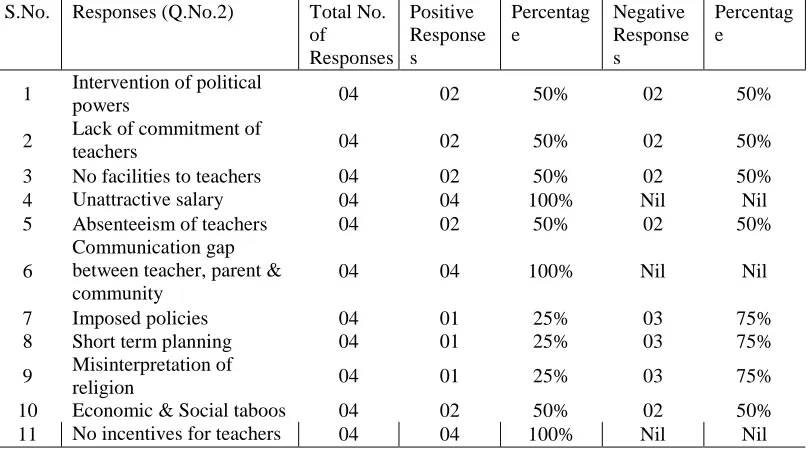
The responses of district level education officers provided clue to the factors of deterioration of quality of education. It revealed that 02 (50%) respondents opined that because of political intervention it was not possible to raise the quality of education while 02 (50%) subjects were of the opinion that one of the major factor was the lack of commitment of teachers towards their profession. Similarly 04 (100%) educational officers were of the view that unattractive salary of teachers was the main factor. Another 02 (50%) stated that absenteeism of teachers was the main factor while other 04 (100%) subjects were of the opinion that it was because of communication gap between teacher, parents and community. Parents never bothered to visit the schools. Another 01 (25%) respondents were of the view that imposed policies, short term planning, misinterpretation of religion were the major causes of deterioration in the schools. Another 02 (50%) subjects pointed out that economic and social taboo were the main causes of low quality of education in school. Similarly 04 (100%) officers thought that lack of incentives to the teachers were the main cause. The graphic presentation in Figure –3 further elaborated the data.
Conclusion
The conclusions drawn from the analysis of data revealed that the current status of quality of educations in schools was not satisfactory. The study disclosed that poor implementation of the educational policies; pressures on principals during admissions, overcrowded classes, lack of school community relationship and students’ interest in education, political interference, poor basic and physical facilities, untrained teachers, lack of facilities to teachers, unattractive salaries, and lack of
commitment of teachers towards their profession were main causes of deterioration.
The success of school improvement strategy totally depends on collaborative effort made by principals, teachers, parents and community because all of them are the building blocks of the educational system. In order to develop successful strategy it is important to understand the current status of organization, to know about the weak points and to frame the objectives to which the stake holders subscribe. Principals can play effective role in any institution. Therefore, proposed strategy lays emphasis on leadership skills. Principal’s efforts can make difference in school improvement strategy. Next important is the involvement of teachers in building relationships with parents and community as well as in developmental process.
There is also a need to hold frequent meetings with parents to seek out individual problems of students for improving their learning outcomes. The role of EDOs is also important in school improvement efforts. Therefore, their interventions were considered necessary to be included in the strategy.
Recommendations
85 Table No-1 Responses of the District Level Education Officers Regarding the Current Status of
Quality of Education in Government Girls’ Secondary Schools S.No Responses (Q.No.1) Total No.
of
Responses
Positive Respons e
Percentag e
Negativ e Respons e
Percenta ge
1 Lack of basic &
physical facilities 04 04 100% Nil Nil
2 Lack of commitment of
teachers 04 04 100% Nil Nil
3 Improper utilization of
funds 04 02 50% 02 50%
4 Imbalance between
teacher student ratio 04 04 100% Nil Nil
5 Lack of science teachers 04 01 25% 03 75%
6
Non- availability of scholarships to girl students
04 01 25% 03 75%
7 No transport facility for
teachers and students 04 03 75% 01 25%
Responses of the district Level Education Officer Regarding the Current Status of Quality of Education in Government Girls’
Secondary Schools
0% 20% 40% 60% 80% 100% 120%
Lack of basic & physical facilities
Improper utilization of
funds
Lack of science teachers
No transport facility for teachers and
students
Pe
rc
en
ta
ge
Pos itive Percentage Negative Percentage
Figure-1
Responses of the District Level Education Officers Regarding Factors Leading to Deterioration of Quality of Education at the Secondary Level
0% 20% 40% 60% 80% 100% 120%
Intervention of political pow ers
Unattractive salary
Imposed policies Economic & Social taboos
P
er
ce
n
ta
g
e
Positive Percentage Negative Percentage
86 Table No-2 Responses of the District Level Education Officers Regarding Factors Leading to Deterioration of Quality of Education at the Secondary Level
S.No. Responses (Q.No.2) Total No. of
Responses
Positive Response s
Percentag e
Negative Response s
Percentag e
1 Intervention of political
powers 04 02 50% 02 50%
2 Lack of commitment of
teachers 04 02 50% 02 50%
3 No facilities to teachers 04 02 50% 02 50%
4 Unattractive salary 04 04 100% Nil Nil
5 Absenteeism of teachers 04 02 50% 02 50%
6
Communication gap between teacher, parent & community
04 04 100% Nil Nil
7 Imposed policies 04 01 25% 03 75%
8 Short term planning 04 01 25% 03 75%
9 Misinterpretation of
religion 04 01 25% 03 75%
10 Economic & Social taboos 04 02 50% 02 50%
11 No incentives for teachers 04 04 100% Nil Nil
References
Farooq, R.A. (1994) Education System in Pakistan. Asia Society for Promotion of Innovations and Reforms in Education. Islamabad: Pakistan, P-3. Government of Pakistan. (1992-2002) National Education Policy, Islamabad: Ministry of Education, P-23. Government of Pakistan (1998-2010). National Education Policy, Islamabad: Ministry of Education, P-1. Government of Pakistan. (2008). Draft National Education Policy, (2008). Islamabad: Ministry of Education, P-16. Office of the
Statistical Assistant to D.C.O Swabi.
Rizwanullah (2007) Research Thesis Causes of Low standard of Education in District Swabi. Pakistan Study Centre University of Peshawar, PP-24,25.
87 Figure#3 –
SUGGESTED IMPLEMENTABLE
STRATEGY
A clear understanding of current status of organization
Setting objectives of the organization
Improving leadership skills of a principal
Professional emotional and administrative support to subordinates
Laying the foundation involving teacher in building relationship
Arrangements to discuss problems of individual children Active involvement and support of
the family school and community
How to improve learning outcome of
students
Planning for Proper Utilization of Available Resources
Measures for School Improvement
Frequent Visits by of EDOs
Enhancing and sustaining teacher