A Community – Based Modification Intervention to Reduce Anger among Secondary School Students Living in the Five Local Government Areas of Oyo State, Nigeria
A.O. Busari (Federal College of Education (Special) Oyo, Oyo State )
152 Author(s)
A.O. Busari
Federal College Of Education (Special) Oyo, Oyo State
E-mail:[email protected]
Keywords: Behaviour modification, Anger, Reduction
A Community – Based Modification Intervention to Reduce Anger among Secondary School Students Living in the Five Local Government Areas of Oyo State, Nigeria
Abstract
This study investigates behaviour modification intervention programme in the reduction of anger among secondary school students from five local government areas of Oyo State. Intensity of Angry Feeling Scale (IAFS) developed by the researcher was the measuring instrument used to collect the data. The participants of the study comprised of 600 final year students randomly drawn from 10 secondary schools located in 5 Local Government Area of Oyo State. Two hypotheses were tested for significance at 0.05 alpha level using t-test statistical tool. Result clearly showed that gender difference was significant when compared anger reduction level of male and female subjects after the treatment. When compared treated and untreated group, it was discovered that youths differ significantly on their level of anger reduction. It can be deduced that behaviour modification Intervention was an effective mediator in the reduction of anger level in youths. The youths exposed to Community-based Behaviour Modification Intervention exhibited high level of reduction in their anger level than the control group.
Introduction
Anger is a completely normal usually healthy, human emotion. But when it gets out of control and turns destructive, it can lead to problems at work, in individual‟s personal relationships and in the overall quality of individual‟s life. (Barkely, Edwards, Laneri, Flectcher and Metevia 2001). Anger is “an emotional state that varies in intensity from mild irritation to intense fury and rage according to Charles Spielberger (1997). Like other emotions, anger is accompanied by physiological and biological changes. When an individual get angry, the heart rate and blood pressure goes up as do the levels of energy, hormones, adrenaline, and nonadrenaline.
Anger can be caused by both external and internal events. Anger can be directed at a specific person (such as coworker, spouse, supervisor etc) or event (a traffic jam, a cancelled flight), anger could be caused by worrying or brooding about one‟s personal problems. Memories of traumatic or enraging events can also trigger angry feelings (Eddy and Chamberlain, 2000). The instinctive, natural way to express anger is to respond aggressively. Anger is a natural, adaptive response to threats, it inspires powerful, often
aggressive, feelings and behaviours which allow us to fight and to defend ourselves when we are attacked. A certain amount of anger, therefore is necessary to our survival (Jackson, 2002).
People use a variety of both conscious and unconscious processes to deal with their angry feelings. The three mains approaches are expressing, suppressing and calming. Expressing angry feelings in an assertive – not aggressive – manner is the healthiest way to express anger. To do this, an individual have to learn how to make clear what their needs are, and how to get them met, without hurting others (Kellner and Bry,
1999).
Anger can be suppressed, and then153 that seems perpetually cynical and hostile. People
who are constantly putting others down, criticizing everything and making cynical comments haven‟t learned how to constructively express their anger such individual are not likely to have many successful relationships. (Coyle 2001)
An individual can calm down inside. This means not just controlling outward behaviour, but also controlling internal responses, taking steps to lower heart rate, calm down and let the feelings subside (Hovell, Blumberg, Liles, Powell, Morrison Duran Sipan, Burkham and Kellely 2001). The goal of this study therefore is to use behavior modification intervention programme to reduce emotional feelings and the physiological arousal that anger causes. It is impossible to get rid of, or avoid the things or the people that enrages an individual, nor can they be changed, but an individual can learn to control his/her reactions.
Statement of Problem
Some people really are more “hotheaded” than others are; they get angry more easily and more intensely than the average person does. There are also those who do not show their anger in loud spectacular ways but are chronically irritable and grumpy. Easily angered people do not always curse or throw things, but sometimes withdraw socially, sulk, or get physically ill.
People who are easily angered generally have what some psychologists call a low tolerance for frustration, they should not be subjected to frustration, inconvenience, or annoyance. Causes of anger may be genetic or physiological.
There is avoidance that some children are born irritable, touchy, and easily angered, and that these signs are present from a very early age. Another may be socio-cultural. Anger is often regarded as negative; it could be all right to express anxiety, depression, or other emotions but not to express anger. Research has also found that family background plays a role. Typically, people who are easily angered come from families that are disruptive, chaotic, and not skilled at emotional communication. On the basis of this therefore, this study examined the effectiveness of Community-based Behaviour Modification Intervention as a mediator in the reduction of anger level of youths.
Materials and Methods
Hypotheses
The following null hypotheses were formulated and tested at 0.05 level of significance.
(i) There is no significance difference in the reduction of anger level of subjects exposed to the Behaviour Modification Intervention programme and those in the Control group.
(ii) There is no significance difference in the reduction of anger level of males and females treated with Behaviour Modification Intervention Programme. (iii) There is no significant difference in the
reduction of anger level of participants with intact parents and those with separated parents exposed to treatments. (iv) There is no significant difference in the
reduction of anger level of participants who are first born and later born exposed to treatment.
(v) There is no significant difference in the reduction of anger level of participants from literate and illiterate background exposed to treatment.
Study Design and Individuals
The Quasi-experimental design using the pretest, posttest control 2 x 2 factorial matrix was used in the study. The study‟s participants were 600 final year secondary school students randomly drawn from 10 secondary schools from 5 Local Governments Area of Oyo State. This number consists of 460 (76.67%) males and 140 (23.33%) females. The age range was between 15 and 19 and had a mean age of 17. 90(15%) of the participants were from separated parents ( father and mother not living together) while 510(85%) were from intact family 72(12%) were first borns while 518(88%) were other borns. 468(78%) were from literate backgrounds while 132(22%) were from illiterate backgrounds 316(52.7%) were Christians and 284(47.3%) were muslims.
Ethics
Instrument
154 Feeling Scale (IAFS). The IAFS is a self-report
instrument which measures the degree of awareness of angry feelings in an individual subjects. The instrument had two section: section A sought for demographic information such as the age, sex, parents‟ educational background, position in the family and whether parents are living together or not. Section B consists of 20- items on intensity of angry feelings which were drawn from relevant literature. The instrument follow the 5 – point Likert Scale ranging from (Strongly Agree 1) to (strongly disagree 5). The IAFS initially had items which was presented for expert screening and correction which was certified both for content and face validity. Using test- retest format and subject to Cronbach alpha, the IAFS had 0.69 reliability coefficient.
Procedure
Subjects who were screened in angry feeling behaviour completed the Intensity of Angry Feeling Scale (IAFS) prior to treatment. This was done to ascertain the participants‟ manifestation of signs of angry feelings necessary for the commencement of treatment as the pre-assessment data. The subjects in the control group (non-treatment group) however completed the IAFS during the first week prior the commencement of the treatment programme.
Anger Level
The participants were asked to identify the kind of emotions that irritates them and that usually triggers angry feelings in them. Each day during the week, prior to the start of the programme and during the last week of the prgramme, the participant‟s regularly charted their anger level. Both experimental and the control group subjects rated their anger level in a 1 – 5 scale with 1 strongly agree, the least angry feeling they have ever felt, and 5 being the most angry feeling they have ever felt. Experimental group subjects also rated their anger level for one hour, six weeks after completion of the training programme.
Treatment
The subject participated in six one-hour sessions programme which met once in a week for six consecutive weeks. The programme consists of six basic components, presentation of conceptual framework, techniques for prevention and
reduction of angry feelings and emotions, relaxation training, cognitive restructuring training, problem solving technique training and rehearsal and application phase.
During the first session participants introduced themselves to each other, and definition of anger, causes of anger and effects of anger on youths and their families were discussed. Each participant was then asked to identify specific emotional feelings experienced which makes them become angry. Situations identified include being corrected for a minor – mistake, teachers unduly favouring some students, tests, examinations, assignments, negative comments from teachers and peers, parents financial incapability, etc participants were given an overview of the Behaviour Modification Intervention to be taught during the next session and were told that in order for the techniques to be of help to them, daily practice between sessions was necessary. The second session witnessed training in cognitive restructuring. Subjects were taught how to replace their exaggerated and overly dramatic thoughts with more rational ones. For instance, instead of the subjects saying to him/herself, „oh, it is awful, it is terrible, everything‟s ruined, he/she can tell him/herself,” its frustrating and its understandable that he/she is upset about it, but it‟s not the end of the world and getting angry is not going to fix it anyhow”. The subjects were taught that logic defeats anger, because anger, even when it‟s justified can quickly become irrational. As part of their cognitive restructuring, they were taught to become aware of their demanding nature and translate their expectations into desires. During the third session participants were presented with relaxation training including deep muscle relaxation and breathing. Participants were instructed in simple relaxation tools such as deep breathing and relaxing imagery to calm down angry feelings.
155 the sense that it helps an individual to edge off
his/her fury. The post-test questionnaires was then administered.
Data Analysis
In this study, two null hypotheses were tested for significance at 0.05 alpha level. These were tested for significance using t-test statistical tool.
Results
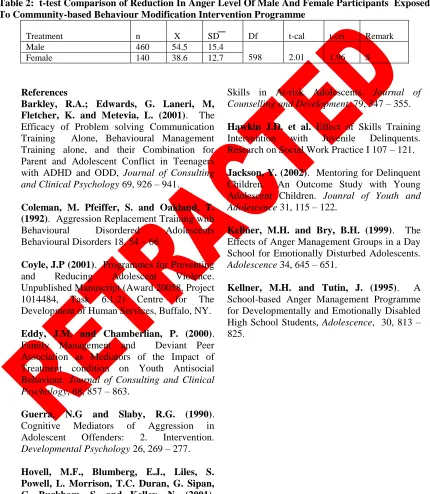
The results of analysis are presented in the tables below. To test the first hypothesis which states that there is no significant difference in prevention and reduction of angry feelings of subjects exposed to the Community-based Behaviour Modification Intervention and those In the Control group, t-test statistical analysis was carried out on subjects‟ level of anger. In table 1 anger level were measured in treatment and in the control group. The result revealed that there is a significant difference in the reduction of anger level of subjects exposed to Behaviour Modification Intervention and the control group (X = 55.3, X 88.2, t cal = 5.1 and t cri =1.96 thus rejecting the null hypothesis). To test hypothesis two which postulates that there is no significant difference in the reduction of anger level of male and female subjects, t-test statistical analysis was employed on the participants‟ level of anger. Table 2, present the result of the analysis conducted on the reduction of anger level of subjects exposed to treatment based on gender. The table indicates that there was a significant difference in the reduction of anger level of subjects who are male and female (X = 54.5, X 38.6, t cal = 2.01 while t cri= 1.96 ). The result of this null hypothesis earlier set.
Discussion
The result of the first hypothesis which compared the reduction in the anger level of treatment and the control groups was found to differ significantly. The findings of this hypothesis shows that Behaviour Modification Intervention programme was effective in reducing the anger level of the participants. This corroborates the findings of Kellner Tutin (1995) that anger can be suppressed, and then converted or redirected. According to them this happens when an individual hold his/her anger, stop thinking about
it and focus on something positive. The findings of the study also support that of Kellner and Bry(1999) who asserted that people use a variety of both conscious and unconscious processes to deal with their angry feelings. They itemized three main approaches such as: expressing, suppressing and calming. They opined that expressing angry feelings in an assertive- not aggressive manner is the healthiest way to express anger. They concluded that to do this, an individual have to learn to clear what their needs are, how to get them met without hurting others. Hence the result of this current research findings is not accidental considering the various contents of Behaviour Modification Programme taught the participants. The result of the second hypothesis shows that youths especially male and female differ significantly in their responses to angry feelings. The result indicated that female subjects exposed to Behaviour Modification Intervention programme had their anger level reduced compared to their male counterparts. This finding agrees with that of who found that males and females differ in their intensity of angry feelings. This again may be due to the femine nature of females which allows them to express their angry feelings in an assertive not aggressive manner. On the other hand the masculine disposition of the males makes it natural to respond to anger aggressively. It thus follow that unexpressed anger of males creates other problems which can lead to pathological expressions of anger, such as passive- aggressive behavior or a personality that seems perpetually cynical and hostile.
Conclusion
156 Table 1: t-test comparison of Reduction in Of Anger Level Of Participants’ Exposed to Community-based Behaviour Modification Intervention Programme And The Control Group.
Treatment N X SD Df t-cal t-cri Remark
Behaviour Modification Intervention
380 55.3 16.1 598 5.1 1.96 S
Control 220 88.2 28.2
Table 2: t-test Comparison of Reduction In Anger Level Of Male And Female Participants Exposed To Community-based Behaviour Modification Intervention Programme
Treatment n X SD Df t-cal t-cri Remark
Male 460 54.5 15.4
598 2.01 1.96 S
Female 140 38.6 12.7
References
Barkley, R.A.; Edwards, G. Laneri, M, Fletcher, K. and Metevia, L. (2001). The Efficacy of Problem solving Communication Training Alone, Behavioural Management Training alone, and their Combination for Parent and Adolescent Conflict in Teenagers with ADHD and ODD, Journal of Consulting
and Clinical Psychology 69, 926 – 941.
Coleman, M. Pfeiffer, S. and Oakland, T. (1992). Aggression Replacement Training with Behavioural Disordered Adolescents Behavioural Disorders 18, 54 – 66.
Coyle, J.P (2001). Programmes for Preventing and Reducing Adolescent Violence. Unpublished Manuscript (Award 20058, Project 1014484, Task 6.1.2) Centre for The Development of Human Services, Buffalo, NY.
Eddy, J.M. and Chamberlian, P. (2000). Family Management and Deviant Peer Association as Mediators of the Impact of Treatment condition on Youth Antisocial Behaviour. Journal of Consulting and Clinical
Psychology, 68, 857 – 863.
Guerra, N.G and Slaby, R.G. (1990). Cognitive Mediators of Aggression in Adolescent Offenders: 2. Intervention.
Developmental Psychology 26, 269 – 277.
Hovell, M.F., Blumberg, E.J., Liles, S. Powell, L. Morrison, T.C. Duran, G. Sipan, C. Burkham, S. and Kelley, N. (2001). Training AIDS and Anger Prevention social
Skills in At-risk Adolescents. Journal of
Counselling and Development, 79, 347 – 355.
Hawkin J.D. et al. Effect of Skills Training Intervention with Juvenile Delinquents. Research on Social Work Practice I 107 – 121.
Jackson, Y. (2002). Mentoring for Delinquent Children. An Outcome Study with Young Adolescent Children. Jounral of Youth and
Adolescence 31, 115 – 122.
Kellner, M.H. and Bry, B.H. (1999). The Effects of Anger Management Groups in a Day School for Emotionally Disturbed Adolescents.
Adolescence 34, 645 – 651.