Open Access Journal of Urology
Dovepress
O r i g i n A L r e s e A r C h
open access to scientific and medical research
Open Access Full Text Article
Characterization of overactive bladder in women
in a primary care setting
Wellman W Cheung1
Dorota Borawski2
Ovadia Abulafia2
Miriam T Vincent3
Miriam harel1
Martin h Bluth4
1Department of Urology, 2Department of Obstetrics
and gynecology, 3Department
of Family Practice, sUnY Downstate Medical Center, Brooklyn, new York;
4Department of Pathology,
Wayne state University/Detroit Medical Center, Detroit, Mi, UsA
Correspondence: Wellman W Cheung sUnY Downstate Medical Center, Departments of Urology and Obstetrics/gynecology, 450 Clarkson Avenue, Brooklyn, nY 11230, UsA
Tel +1 718 853 2828 Fax +1 718 975 0040
email [email protected]
Background: Overactive bladder (OAB) represents a disorder with overall increasing prevalence in the American population. However, gender-specific characteristics of OAB and how it relates to the general practitioner are not well described. We sought to determine the distribution and characteristics of OAB in women in a primary care setting.
Methods: Self-administered questionnaires were distributed to patients visiting a family medicine outpatient center. The modified questionnaire included eight questions on evidence of lower urinary tract symptoms (LUTS, OAB-validated 8-question screener [OAB-V8]), two questions on stress urinary incontinence, and one question on incomplete emptying. The questionnaire included demographic characteristics and relevant medical and surgical history. Body mass index was calculated based on weight and height. Chi-square test and risk ratio analysis were used to analyze the relationship between OAB and other independent variables.
Results: Of 1025 questionnaires administered, 386 were completed. Patients ranged from 16 to 97 years, the majority were African American (78.2%), and 49.7% were premenopausal while 50.3% were postmenopausal. OAB was present in 46.4% of premenopausal women and 41.7% of postmenopausal women. OAB was significantly associated with overweight status (body mass index 25.0–29.9, P = 0.042) and obesity (body mass index $30, P , 0.001). Overall, obese women were twice as likely to have OAB (relative risk = 1.99, 1.31–3.04) than women with normal weight. OAB was not shown to correlate with race, cigarette use, history of hysterectomy, or parity.
Conclusion: OAB was evident in 44% of all female patients surveyed, which is much higher than previously reported estimates. In addition, overweight women were more likely to have OAB. Increased awareness of OAB in the primary care setting should be considered for women’s general health.
Keywords: overactive bladder, incontinence, women, primary care
Introduction
According to the International Continence Society, overactive bladder (OAB) is characterized by urinary urgency, with or without urge incontinence, usually with fre-quency and nocturia, in the absence of causative infection or pathological conditions, and represents a spectrum of disorders with a range of presentations and management options.1–7 According to a population-based survey of 16,776 men and women aged
40 years and older conducted by Milsom et al 5 in six countries, by telephone or direct
interview, the prevalence of OAB in Europe has been estimated to be 15.6% in men and 17.4% in women. The National Overactive BLadder Evaluation survey (NOBLE), in which 11,740 Americans agreed to participate, found the overall prevalence of OAB to be 16.9% in women and 16.0% in men.2 OAB negatively affects quality of life and
Research and Reports in Urology downloaded from https://www.dovepress.com/ by 118.70.13.36 on 27-Aug-2020
For personal use only.
Number of times this article has been viewed
This article was published in the following Dove Press journal: Open Access Journal of Urology
Dovepress
Cheung et al
carries a large psychosocial and economic burden,1–3 because
such increased awareness of OAB is important for appropriate intervention towards quality of life improvement. However, gender-specific awareness in a general physicians practice is not well described, and the disorder may be underdiagnosed.4
We sought to determine the prevalence and characteristics of OAB in women in a primary care setting.
Methods
Over a three-month period, 1025 self-administered question-naires on urinary symptoms were distributed to patients over 16 years of age who visited a family medicine outpatient center while waiting to be seen by their primary care physician.6 In
total, 525 patients agreed to participate in this study, of which 386 (73.5%) were women. This study was granted exemption by the Institutional Review Board of the relevant institution.
The modified questionnaire included eight questions on evidence of lower urinary tract symptoms (LUTS) using the Overactive Bladder-Validated 8-question screener [OAB-V8],6,8 two questions on stress urinary incontinence,
and one question on incomplete emptying of the bladder after urination. Responses were answered on a 6-point symptom bother scale ranging from 0 (not at all) to 5 (a great deal). An additional question was asked about the effect of urinary symptoms on quality of life, with answers ranging from 0 (delighted) to 6 (terrible). The questionnaire also included data on demographic characteristics and relevant medical and surgical history. Patient weight and height were measured for calculating body mass index (kg/m2).
Primary care physicians then reviewed the questionnaire with their patients at the end of the visit, and reported on exit clinical diagnoses, whether they detected any urinary symptoms, whether the symptoms were detected before or after reviewing the questionnaire, and whether they would treat or refer the patient to a specialist. These questions were similar to those used in a study to assess physician awareness of urinary symptoms.5
Patients were considered to have OAB if their OAB-V8 score was $8.8 Positive OAB-V8 scores were categorized
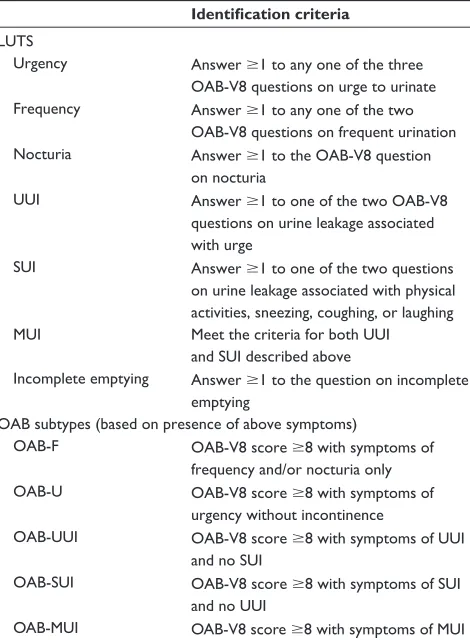
into three levels of severity, ie, 8–10, 11–13, and $14. The presence of specific LUTS was then analyzed. The criteria for LUTS and OAB subtypes are shown in Table 1. Patients who did not complete the OAB-V8 and stress urinary inconti-nence questions were excluded from the study. Patients were categorized into age groups of ,25, 25–34, 35–44, 45–54, 55–64, 65–74, and $75 years. Women were considered to be premenopausal if they were younger than 55 years of age and postmenopausal if older than 55 years.
Table 1 Criteria for lower urinary tract symptoms and overactive bladder subtypes
Identification criteria
LUTs
Urgency Answer $1 to any one of the three OAB-V8 questions on urge to urinate Frequency Answer $1 to any one of the two
OAB-V8 questions on frequent urination nocturia Answer $1 to the OAB-V8 question
on nocturia
UUi Answer $1 to one of the two OAB-V8 questions on urine leakage associated with urge
sUi Answer $1 to one of the two questions on urine leakage associated with physical activities, sneezing, coughing, or laughing MUi Meet the criteria for both UUi
and sUi described above
incomplete emptying Answer $1 to the question on incomplete emptying
OAB subtypes (based on presence of above symptoms)
OAB-F OAB-V8 score $8 with symptoms of frequency and/or nocturia only OAB-U OAB-V8 score $8 with symptoms of
urgency without incontinence
OAB-UUi OAB-V8 score $8 with symptoms of UUi and no sUi
OAB-sUi OAB-V8 score $8 with symptoms of sUi and no UUi
OAB-MUi OAB-V8 score $8 with symptoms of MUi Abbreviations: OAB, overactive bladder; LUTs, lower urinary tract symptoms; UUi, urge urinary incontinence; MUi, mixed urinary incontinence; sUi, stress urinary incontinence; OAB-V8, overactive bladder validated 8-question screener; F, frequency alone; U, urgency without incontinence.
statistical analysis
The Chi-square test was used to determine statistically signifi-cant differences between the premenopausal and postmeno-pausal groups. To determine the relationship between OAB prevalence and other factors (race, body mass index, parity, history of smoking, and history of hysterectomy), covariates were first evaluated using the Chi-square test. Statistically significant (P , 0.05) covariates then underwent risk ratio (RR) analysis. Patients were excluded if they did not report on the variable to be analyzed. Results are presented as RR and 95% confidence interval (CI). All statistical analyses were performed using SPSS software (v.14.0 for Windows; SPSS Inc, Chicago, IL).
Results
Nineteen patients were excluded from the study due to incomplete answers on the OAB-V8 and stress urinary incontinence questionnaires, yielding a final group of 386 women in the current analysis. Table 2 reports the
Research and Reports in Urology downloaded from https://www.dovepress.com/ by 118.70.13.36 on 27-Aug-2020
Dovepress Overactive bladder in women in primary care
Table 2 Characteristics of participants
Characteristic, n (%) Premenopause (n = 192) Postmenopause (n = 194) Total (n = 386)
Age, years
,25 23 (12.0) – – 23 (6.0)
25–34 50 (26.0) – – 50 (13.0)
35–44 46 (24.0) – – 46 (11.9)
45–54 73 (38.0) – – 73 (18.9)
55–64 – – 72 (37.1) 72 (18.7)
65–74 – – 79 (40.7) 79 (20.5)
$75 – – 43 (22.2) 43 (11.1)
race
Black 157 (81.8) 145 (74.7) 302 (78.2)
hispanic 18 (9.4) 20 (10.3) 38 (9.8)
White 3 (1.6) 3 (1.5) 6 (1.6)
Other/not stated 14 (7.3) 26 (13.4) 40 (10.4)
education
Less than high school 4 (2.1) 17 (8.8) 21 (5.4)
high school graduate 58 (30.2) 73 (37.6) 131 (33.9)
some college/college graduate 66 (34.4) 18 (9.3) 84 (21.8)
graduate school 18 (9.4) 9 (4.6) 27 (7.0)
not stated 46 (24.0) 77 (39.7) 123 (31.9)
Body mass index, kg/m2
,25.0 36 (18.8) 31 (16.0) 67 (17.4)
25.0–29.9 45 (23.4) 62 (32.0) 107 (27.7)
$30 79 (41.1) 74 (38.1) 153 (39.6)
not stated 32 (16.7) 27 (13.9) 59 (15.3)
history of smoking
Yes 57 (29.7) 53 (27.3) 110 (28.5)
no 135 (70.3) 141 (72.7) 276 (71.5)
Parity
,2 63 (32.8) 29 (14.9) 92 (23.8)
2–4 87 (45.3) 86 (44.3) 173 (44.8)
$5 35 (18.2) 66 (34.0) 101 (26.2)
Previous surgical history
Bladder surgery 4 (2.1) 10 (5.2) 14 (3.6)
Urinary leakage surgery 1 (0.5) 2 (1.0) 3 (0.8)
hysterectomy 13 (6.8) 63 (32.5) 76 (19.7)
OAB status
normal 103 (53.6) 113 (58.2) 216 (56.0)
OAB with Ui 75 (39.1) 65 (33.5) 140 (36.3)
OAB without Ui 14 (7.3) 16 (8.2) 30 (7.8)
Abbreviations: OAB, overactive bladder; Ui, urinary incontinence; BMi, body mass index.
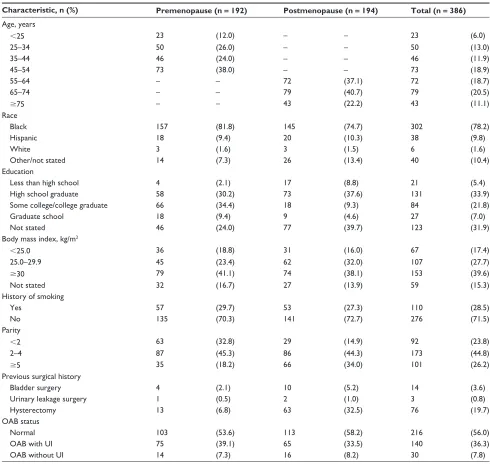
characteristics of the women studied, including age, ethnicity, education, body mass index, parity, smoking, prior surgical history, and OAB status. Patients ranged from 16 to 97 years, the majority were African American (78.2%), and 49.7% of all the women were premenopausal and 50.3% were postmenopausal.
Age-specific distribution of OAB and OAB subtypes are shown in Figures 1 and 2. Evidence of general OAB did not vary much with age (Figure 1). However the prevalence of OAB with urgency subtype (OAB-U) was greatest (16%) in the 45–54-year age group (Figure 2), whereas OAB subtypes including those with urge urinary incontinence
and mixed urinary incontinence were #5% among all age groups. As shown in Table 2, OAB was present in 46.4% of premenopausal women (± urinary incontinence) and 41.7% of postmenopausal women.
Of the women surveyed, 216 women did not meet a diagnosis of OAB, of whom 103 were premenopausal and 113 postmenopausal. Among the premenopausal women without OAB, LUTS reported were frequency (57.3%), nocturia (48.5%), and urgency (22.3%), whereas for postmenopausal women, urinary frequency was reported in 63.7%, nocturia in 58.4%, and urgency was present in 23.0% (Table 3). Urge urinary incontinence was present in 38.5% of
Research and Reports in Urology downloaded from https://www.dovepress.com/ by 118.70.13.36 on 27-Aug-2020
Dovepress
Cheung et al
postmenopausal women and stress urinary incontinence was present in 22.1% (data not shown, P . 0.05).
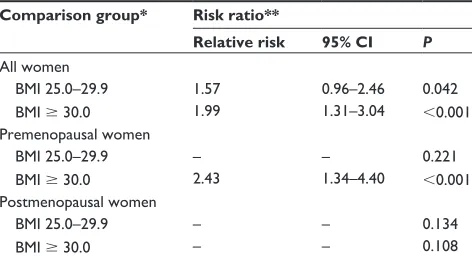
OAB was significantly associated with overweight (body mass index 25.0–29.9) in women (P = 0.042) and obesity (body mass index $30, P , 0.001, Table 4). However, when menopause status was controlled, this association was only found in obese premenopausal women (P , 0.001), who had a greater than two-fold increased risk for OAB (RR = 2.43, 1.34–4.40). Overall, obese women were twice as likely to have OAB (RR = 1.99, 1.31–3.04) than women of normal weight (P , 0.001).
Interestingly, OAB was significantly associated with incomplete bladder emptying (P , 0.001) and with stress urinary incontinence (P , 0.001) in both pre- and postmeno-pausal women; OAB was not shown to vary with race, cigarette use, history of hysterectomy, or parity in women (data not shown).
Discussion
In this study, we found an OAB distribution among women in a primary care setting that is more than double that reported
in a recent US population-based study.2 Unlike the previous
population-based studies,2,7 in which responses regarding
LUTS were elicited from noninstitutionalized individuals through telephone interviews, our questionnaire relies on self-report by primary care outpatients and review by primary care physicians at the conclusion of the visit. Thus, our data collection method resembles an office-based primary care physician study,5 which had an OAB prevalence estimate
that was highest (26.5%) and more closely resembles our results. In the studies cited above, OAB was defined based on the presence and/or frequency of specific LUTS, while in our study, OAB criteria are based on scoring on a symptom bother scale. Furthermore, the populations in the previously cited studies were predominantly white, while our patient population was mostly African American. These differences may contribute to the discrepancy in OAB prevalence found in our study compared with the prevalence previously reported.
We find that OAB with incontinence is more common than OAB without incontinence in both pre- and postmenopausal women. Most studies on female urinary incontinence have reported stress urinary incontinence as being more common than urge urinary incontinence,5 especially in younger
women,9,10 while mixed urinary incontinence was the major
0 20 40 60 80 100
65–74 ¥75
Age (years)
Percent (%)
<25 25–34 35–44 45–54 55–64
Figure 1 Distribution of overactive bladder by age.
0 2 4 6 8 10 12 14 16 18
Age (years)
OAB-U
OAB-UUI OAB-MUI
P
er
ce
n
t
(%
)
65–74 > = 75 <25 25–34 35–44 45–54 55–64
Figure 2 Distribution of overactive bladder subtypes by age.
Table 3 Distribution of lower urinary tract in women without overactive bladder by menopausal status
n (%) Premenopause (n = 103)
Postmenopause (n = 113)
symptoms
Frequency 59 (57.3) 72 (63.7)
nocturia 50 (48.5) 66 (58.4)
Urgency 23 (22.3) 26 (23.0)
Table 4 relative risk for overactive bladder by body mass index category
Comparison group* Risk ratio**
Relative risk 95% CI P All women
BMi 25.0–29.9 1.57 0.96–2.46 0.042
BMi $ 30.0 1.99 1.31–3.04 ,0.001
Premenopausal women
BMi 25.0–29.9 – – 0.221
BMi $ 30.0 2.43 1.34–4.40 ,0.001
Postmenopausal women
BMi 25.0–29.9 – – 0.134
BMi $ 30.0 – – 0.108
Notes: *Women in the corresponding age group with BMi , 25 served as the reference group; **risk ratio was calculated only when P , 0.05; risk ratio = prevalence of overactive bladder in women with comparison BMi/prevalence of overactive bladder in women with reference BMi of ,25.
Abbreviations: BMI, body mass index; CI, confidence interval.
Research and Reports in Urology downloaded from https://www.dovepress.com/ by 118.70.13.36 on 27-Aug-2020
Dovepress Overactive bladder in women in primary care
presentation overall.5,9,10 We find that most women with OAB
have OAB-mixed urinary incontinence, whereas urge urinary incontinence and OAB-urge urinary incontinence are more prevalent than stress urinary incontinence and OAB-stress urinary incontinence in women with OAB. These findings are supported by others11,12 who have reported black women
to have lower rates of stress urinary incontinence but higher rates of urge urinary incontinence than white women. The significant association between OAB and stress urinary incontinence we found is also supported.10
We find a significant association between OAB and incomplete emptying of the bladder in both pre- and post-menopausal women which could be related to a variety of factors.13–16 Although bladder outlet obstruction leading to
incomplete emptying is commonly seen in benign prostatic hyperplasia in older men,15 the relationship between OAB
and incomplete emptying in women may involve mechanisms other than obstruction.13
Obesity as a risk factor for OAB2,10 and urinary
incontinence9,14,17 have been previously reported. The risk
for OAB we found for all obese women (1.99) is similar to that reported by Stewart et al2 (2.2) in obese women with
OAB-urge urinary incontinence. However, contrary to earlier reports,2,5,7 we do not find OAB prevalence to increase with
advancing age in women. We also do not find any significant association between OAB and smoking, although some stud-ies have demonstrated that smoking may be a risk factor for urinary incontinence.14,17 Additionally, we do not find any
significant association between OAB and hysterectomy in pre- or postmenopausal women. However, some previous studies have demonstrated that hysterectomy increased the risk for urge urinary incontinence18 but not stress urinary
incontinence.18,19 Hysterectomy is thought to contribute to
urinary incontinence through pelvic nerves or pelvic floor damage.
When interpreting the results of this study, several limitations should be considered. Language barriers, patient trust concerns, and cultural differences pose challenges in implementing a questionnaire-based study. Furthermore, women may report precipitancy (an impending feeling of incontinence) with stress urinary incontinence, which might be interpreted as urgency and this would be exacerbated in obese women, for simple biomechanical reasons. Nonethe-less, measures were taken to ensure that questionnaires were distributed to all eligible patients who visited the clinic in an effort to minimize overestimation of response. However, a self-selection bias may be present, given that patients with LUTS may be more inclined to complete the questionnaire
than those without any symptoms. Because the majority of our participants were African American, it is difficult to draw any conclusions about racial differences in the prevalence of OAB.
Conclusion
OAB was evident in 44% of all female patients in our study, which is a number much higher than previously reported estimates. Increasing the awareness of OAB among primary care physicians, and adopting clinical tools, such as a reliable and valid screening questionnaire, may aid in increasing the detection and treatment of OAB.
Disclosure
The authors report no conflicts of interest in this work.
References
1. Abrams P, Kelleher CJ, Kerr LA, Rogers RG. Overactive bladder significantly affects quality of life. Am J Manage Care. 2000;6: S580–S590.
2. Stewart WF, Van Rooyen JB, Cundiff GW, et al. Prevalence and burden of overactive bladder in the United States. World J Urol. 2003;20: 327–336.
3. Hu TW, Wagner TH, Bentkover JD, et al. Estimated economic costs of overactive bladder in the United States. Urology. 2003;61: 1123–1128.
4. Abrams P, Cardozo L, Fall M. The standardization of terminology of lower urinary tract function: Report from the standardization sub-committee of the International Continence Society. Neurourol Urodyn. 2002;21:167–178.
5. Goepel M, Hoffmann JA, Piro M, Rubben H, Michel MC. Prevalence and physician awareness of symptoms of urinary bladder dysfunction. Eur Urol. 2002;41:234–239.
6. Cheung WW, Blank W, Borawski D, Tran W, Bluth MH. Prevalence of overactive bladder, its under-diagnosis, and risk factors in a male urologic veterans population. Int J Med Sci. 2010;7:391–394. 7. Milsom I, Abrams, P, Cardozo L, Roberts RG, Thu˝roff JW, Wein AJ.
How wide-spread are the symptoms of an overactive bladder and how are they managed? A population-based prevalence study. BJU Int. 2001; 87:760–766.
8. Coyne K, Margolis M, Zyczynski T, Elinoff V, Roberts RG. Validation of an OAB Screener in a primary care patient population in the US. Presented at the International Continence Society and IUCA 2004 Scientific Programme. Paris, France, August 25–27, 2004.
9. Melville JL, Katon W, Delaney K, Newton K. Urinary incontinence in US women: A population-based study. Arch Intern Med. 2005;165: 537–542.
10. Teleman PM, Lidfelt J, Nerbrand C, Samsioe G, Mattiasson A; WHILA study group. Overactive bladder: Prevalence, risk factors and relation to stress incontinence in middle-aged women. BJOG. 2004;111:600–604. 11. Thom DH, Van den Eeden SK, Ragins AI, et al. Differences in
prevalence of urinary incontinence by race/ethnicity. J Urol. 2006;175: 259–264.
12. Brown JS, Grady D, Ouslander JG, Herzog AR, Varner RE, Posner SF. Prevalence of urinary incontinence and associated risk factors in postmenopausal women. Heart & Estrogen/Progestin Replacement Study (HERS) Research Group. Obstet Gynecol. 1999;94:66–70. 13. Grodstein F, Fretts R, Lifford K, Resnick N, Curhan G. Association of
age, race, and obstetric history with urinary symptoms among women in the Nurses’ Health Study. Am J Obstet Gynecol. 2003;189:428–434.
Research and Reports in Urology downloaded from https://www.dovepress.com/ by 118.70.13.36 on 27-Aug-2020
Open Access Journal of Urology
Publish your work in this journal
Submit your manuscript here: http://www.dovepress.com/open-access-journal-of-urology-journal The Open Access Journal of Urology is an international, peer-reviewed, open access journal publishing original research, reports, editorials, reviews and commentaries on all aspects of adult and pediatric urology in the clinic and laboratory including the following topics: Pathology, pathophysiology of urological disease; Investigation and treatment of
urological disease; Pharmacology of drugs used for the treatment of urological disease. The manuscript management system is completely online and includes a very quick and fair peer-review system, which is all easy to use. Visit http://www.dovepress.com/testimonials.php to read real quotes from published authors.
Dovepress
Dovepress
Cheung et al
14. Sampselle CM, Harlow SD, Skurnick J, Brubaker L, Bondarenko I. Urinary incontinence predictors and life impact in ethnically diverse perimenopausal women. Obstet Gynecol, 2002;100:1230–1238. 15. Knutson T, Edlund C, Fall M, Dahlstrand C. BPH with coexisiting
overactive bladder dysfunction – an everyday urological dilemma. Neurourol Urodyn. 2001;20:237–247.
16. Mostwin JL. Pathophysiology: The varieties of bladder overactivity. Urology. 2002;60:22–26.
17. Hannestad YS, Rortveit G, Daltveit AK, Hunskaar S. Are smoking and other lifestyle factors associated with female urinary incontinence? The Norwegian EPINCONT study. BJOG. 2003;110:247–254.
18. van der Vaart CH, van der Bom JG, de Leeuw JR, Roovers JP, Heintz AP. The contribution of hysterectomy to the occurrence of urge and stress urinary incontinence symptoms. BJOG. 2002;109:149–154. 19. de Tayrac R, Chevalier N, Chauveaud-Lambling A, Gervaise A,
Fernandez H. Risk of urge and stress urinary incontinence at long-term follow-up after vaginal hysterectomy. Am J Obstet Gynecol. 2004;191: 90–94.
Research and Reports in Urology downloaded from https://www.dovepress.com/ by 118.70.13.36 on 27-Aug-2020