Aumbs: Aadhaar And Unique Multimodal Based
Biometric System For E-Voting Using Ianfis
Method
K.Kanimozhi, Dr.K.Thangadurai.Abstract: A vote is one of the basic human rights of any person in a democratic nation. By exercising the right to vote, individuals appoint the best leader to guide them. In order to exercise this independence, virtually all election programs include previous measures: electoral identification and recognition, voting and recording of ballots, counting of votes, and posting of election results. During the voting system, which is central to the e-voting system, voter identification and security are required. Therefore, the need to design a secure e-voting system is very important. A secure electronic voting system that uses a unique ID number, ie aadhaar amount. Creating a set of metrics to identify unusual customer habits by recognizing their client and cognitive characteristics is a significant problem. In this work, additional security is used to replace these problems with the Aadhaar Multi-Model Biometric Range with Cognitive Characteristic Detection. When participating in elections, election recognition can be done using multimodal biometric models such as the head, iris, finger, palm print, finger nerve, ear, and seal. If the voter's biometric data matches the Aadhaar database, the individual is allowed to place their ballot. Coupling is done using the proposed new classification system, the Advanced Adaptive Neuro-Fuzzy Inference System (IANFIS). Recommended Plan is a highly electronic, technology based and guaranteed program.
Index Terms: Aadhaar, biometric, electronic voting machine, physiological and behavioral characteristics, adaptive neuro-fuzzy inference system. —————————— ——————————
1
INTRODUCTION
INDIAN citizens or voters are allowed to exercise their freedom to report specific issues, areas of legislation, citizens' proposals, constitutional amendments, recalls and / or their state and political authorities by casting their votes. The Internet voting system is, therefore, the answer to this flawed referendum from the election date and date given to the applicant to vote. The primary issue is the security of the electronic voting system. In Internet ballot mode, maintain the strict privacy and integrity of the ballot selected and authorized before the ballot is issued. The transfer of votes is also considered. Once the voting period is released and the ballots are automatically sorted, the results are automatically calculated. Authentication is the primary issue in the online voting system, with only the authorized person voting for a competitor. Only the authorized individual can vote. Some techniques, such as a personal identification number (PIN), confidential text or evidence of customer identification, may authorize a person. Customer can attach all authorized information. The primary system then allows that voter to verify all authorizations. The biometric authentication method verifies authentication. In this section, the unique Internet voting system is explored using biometric authentication depending on the secure Internet voting system and the user-friendly program. The technique of biometric identification verifies authenticity. In this section, a separate Internet voting system technique using biometric authentication based on a secure Internet voting system and a user-friendly program is examined. In [2], a new secure authentication for Internet voting system using biometric function andsteganography was proposed. At the time of registration, the voter is told to register the password. Using timestamps and hashing, the password is converted into a secret email. Using steganography, this hidden text is placed in an image. [3] Recommended minimally-based method for creating a polling system implemented using a combination of hardware and software. The Minutia-based algorithm uses two fingerprint authentications to make the program more secure. The recommended scheme seeks to develop a more accurate, versatile portable FMR frequency program. Some articles focusing on the Internet voting system are also being researched, which illustrates how the online system can help reduce time, increase user volume and increase security. [4] In a GSM based voting system, a single fingerprint scanner is used to register and authenticate a specific customer. But the problem with this project is that it is limited to a specific region, so this project is not versatile. Fault frequency, which means it has a very small FRR. Two fingerprint images were used to create a new template that could be stored in a database [5] studied in the Minutia-based algorithm. This is seen in both results of the program, which means that the FRR rate is very low, i.e. 0.4%. Minutia locations are obtained from the image of the fingerprint considering the location and contact marks. The first reference points are selected, the alignment domain is selected from the second fingerprint and placed in the sample database. Fingerprint images are attached to the sample in the database during the authentication phase, and if transferred, the client will be authenticated. The software package used to create different course and web based websites is proposed in Moodle [6]. A new thing, namely fingerprint matching, is used for student registration to access the website. Fingerprint image is used as authentication on the login screen to read certain classes. It was found that using fingerprint biometric authentication is safer than a password based program. In fact, the model provides the functionality required by the voter to check whether the selected candidate / party has reached his / her ballot. Nonetheless, a person may vote in ________________________________________
K.Kanimozhi , Government Arts College, Karur, India, PH-9787214488. E-mail: [email protected]
4765 his or her allotted constituency or elsewhere from where he
/ she wishes. [5] In the proposed scheme, the ordering of ballots will be streamlined, thereby saving an enormous moment and allowing the election commissioner of any country to announce the decision within a very short time. [6] Recommendation is one of the most important techniques for comparing fingerprints. In this method, the fingerprint picture is split into two more stocks using cryptography and then compression is implemented to compress the picture in the data base. For a particular user, one part of the shares is stored in the database and another is given to the user. If both accounts suit, the customer becomes authenticated. In[7] the suggested latent fingerprint pairing method is usually used in some smudgy and broken fingerprint pictures that are not authenticated using distinct methods. Hough convert is used to improve the robustness and distortion of the fingerprint picture. Two kinds of techniques are used in this method for manual testing and instant testing to obtain the minutiae locations. In smudgy fingerprint image, the latent fingerprint matching technique is found to be more productive than normal. It therefore generates very small precision while using ordinary fingerprint pictures. In [10] suggested showed a socially clever and easily implementable I (internet polling) structure specifically for India provided the Adhoc network. Initially, the essential elements of cognitive radio development and Adhoc order provided cognitive radio technologies are described. The concept of the intelligent I system is then suggested and how it can be performed in the suburban region where web services are not easily available, but can be rendered available using Cognitive Radio technology studied as portion of delicate components. A fresh polling scheme for India was suggested in [ 11]. The suggested scheme is the mixture of the present operating scheme and the use of the AADHAAR database. The voter's information, i.e. the voter identification code listed on the voting ticket supplied by India's Election Commission and AADHAAR information, are retained. At the moment of registering, this recorded information is used and the electoral profile will be modified. In[ 12] respondents to comprehend mass digital preparedness in adopting biometric methods. The studies reacted positively by describing the urgent need to implement interlinked omnipresent facilities that could be created more powerful, safe and seamless with the use of biometric authentication mechanisms. In [13] supplied the design alternative through multimodal biometrics that helps enhance safety, eradicate fraud, and provide high-level authentication by connecting to the Aadhaar card database. Compared to the current EVM scheme, high precision will be accomplished by merging picture and fingerprint recognition technologies. Provide a easy and safe voting system in India in [14]. Because it is app-based, it is safer than the internet voting system. This scheme utilizes fingerprint for distinctive recognition and Aadhaar information are retrieved depending on fingerprint information. This document gives meaning to senior citizens, disabled people, nurses, troops and refugees. To reduce these complaints, many of the studies are in the study to figure out the lawful elector. Due to absence of picture accuracy in identity cards or other factors such as hardware issues in EVM 'S, incorrect ballots are counted.
1. This research offers the visual alternative through multimodal biometrics that helps improve safety and offers high-level authentication by connecting to the Aadhaar card database. The work's primary input is as follows:
2. 2. Physical (Face, Iris, Finger, Palm Print, Finger Vein, Ear, and Signature) are used in this model and shown in fig.1.
3. 3. The first is pre-processing block, such as noise elimination, detection, and normalization of ROI, and standardization of contrast.
4. 4. Preprocessing is performed using the median filter, then normalization of the image size and standardization of the comparison using the Hybrid DCT ratio and CLAHE engine (DCT-CLAHE)
5. 5. Extraction of features using Improved Invariant Feature Transform (ISIFT) technique
6. Use the Improved Adaptive Neuro-Fuzzy Inference System (IANFIS) to fuse the class level used for matrix development and electoral identification function.
2
PROPOSED
VOTING
PROCESS
THROUGH
MULTIMODAL
BIOMETRICS
Multi-model biometrics was the combination of two or more features, palm and palm, finger or nose, etc. This kind of biometric fusion can be performed at different phases, such as after checking the features or extracting the features, etc. These types of fusions can result in high-level security which cannot be changed by every intruders [12]. And also helps to enhance the effectiveness of biometrics techniques. In the current situation, the polling procedure is brought out using the EVM's S machine [15] but these EVM's S are also attracted to the scrutiny of the intruders arising in the electoral system being dysfunctional. To eradicate this problem, the use of the unimodal system was created by authenticating the electorate's fingerprint, but unfortunately the impostors are also tampering with the fingerprint templates.
Face Iris & Ear Palm
Finger Signature Finger vein
Fig.1. Input Multimodal Biometrics
Fig.2. Multimodal Based Electronic Voting System
2.1 Image Processing
Enrolled fingerprint, finger vein, nose, iris, palm print, ear, and profile pictures were pre-processed using some image processing techniques such as binarization, thinning, minutiae removal, and region of interest (ROI) extraction, etc. The pre-processing phase of all the pictures described in depth below:
Face: There are four techniques for preprocessing steps: image tracking & cropping, resizing, removing sound, and normalizing [15].
Fingerprint: It involves normalization, position assessment, picture improvement, binarization and method thinning as portion of pre-processing. It introduces the enhanced O'Gorman filter to improve the image that is degraded and harmed due to skin and image variation demands as well as the gradient-based orientation evaluation method to eliminate inconsistency in ridge orientation. The technique of adaptive threasholding is being used to binarize the image. The famous Zhang – Suen technique is being enhanced to enhance the thinning phase [6].
Palm Print: Palm print picture is preprocessed using binarization, morphological procedure, reference point identification, row removal, ROI removal, bottom-hat processing.
Finger vein: In finger vein pictures, the picture contains undesirable areas (picture context) and the precious region (eye region). The precious region is called ROI, and ROI extraction is the process of locating and extracting the finger region from the recorded picture and removing the backdrop image [17]. The aim of thinning is to eliminate the size distinctions of the paper by creating the picture one pixel thick. Thinning was implemented to define the worldwide characteristics of items and decrease the initial
picture to a more compact depiction. It utilizes a thinning method Stentiford algorithm.
Iris: The method involves preprocessing of the eye picture, location of eye boundaries and segmentation of the eye, normalization and consistency of the scar. In this iris preprocessing solid low-contrast iris segmentation, pictures are made to reduce mislocalization mistakes of fundamental curve-fitting algorithms [19 ].
Ear: Preprocessing and normalization of the ear picture is performed and very significant measures are taken to extract the eye feature [20].
Signature: Preprocessing takes place in two steps such as Color inversion, Filtering and Binarization [ 21, 22].
The above-processed pictures of fingerprint, finger vein, nose, iris, palm print, nose and stamp using image processing techniques to enhance the image quality and render it appropriate for another method that is the removal and fusion characteristic.
Image Enhancement by DWT-CLAHE algorithm
A fresh technique centered on the use of DWT-CLAHE is used in this chapter. First, offer our suggested DWT-CLAHE the primary measures. To render it more understandable, in the suggested technique, e further clarifies the DWT and weighting procedure. CLAHE is a standard technique for improving the local quality of an picture, but it presents issues of over-enhancement and noise improvement in some parts of the picture image. A novel image enhancement technique called DWT-CLAHE is suggested to resolve these issues, which mixes CLAHE with DWT.
Step 1: Using Haar Wavelet, decompose the initial multimodal biometric images by N-level DWT into low-frequency and high-low-frequency components. The hair wavelet is easy and thus suitable for hardware implementation. The choice of parameter N is then discussed in detail.
Step 2: Use CLAHE to improve low-frequency inputs and maintain the high-frequency scores intact.
Step 3: Reconstruct the picture of the fresh numbers by reverse DWT. Finally, bring the rebuilt and initial pictures weighted median. The initially suggested weighting coefficient properly enhances the areas with distinct luminance and thus efficiently decreases over-enhancement.
Step 4:Using CLAHE-DWT method, the loud picture is decomposed. Thresholding applies to the decomposed picture. Perform IDWT after thresholding to acquire a rebuilt picture.
2.2 Feature Extraction using ISIFT
In the multimodal biometric system, SIFT is an efficient matching algorithm that has been efficiently used to immediately match multimodal biometric images. However, the feature extraction supplier is still a important defect in Input Multimodel
Biometrics
Preprocessing Block Noise elimination, ROI detection, normalization,
and contrast normalization
Feature Extraction using ISIFT
Feature Vector creation using Adaptive rank level
fusion
A voter with personal details
AADHAR Database
Voter ID generatio
n
Matching using
IANFIS
Casting the vote
Rejected
4767 the algorithm. Despite the high computational complexity,
it can be partially controlled in removing characteristics from multimodal biometric images. To decrease computational complexity while improving efficiency, this study limits feature extraction operators in SIFT as well as key-point extraction operators to a certain quantity to generate an efficient way to match multimodal biometric images. The main feature of this method is to bring benefit of a specific strategy to select the greatest important places. After extracting the primary places and generating their descriptors, the respective technique starts to regard the Mahalanobis distance between the descriptors as a multilevel technique using a single-to-many procedure as accomplished. Then the accuracy of the initial matching pairs is checked using the least-squares model to find the matching match. Finally, the two multimodal biometric images are paired by determining the parameters of a part transformation function.Practical results obtained by presenting the method for separating multimodal biometric images demonstrate the elevated efficiency of the suggested method compared to the conventional SIFT algorithm. In the suggested method, a consistent feature is considered to be compared with another feature for which the scope is less than certain deductions (in this system 0.79) from one scope to the next closest function. This will reduce the quantity of incorrect matches. For incorrect matches, there will be a variety of other near features due to the present high-dimensional features. On the other side, if there is a right alignment, owing to the unique character of the SIFT descriptor, it is impossible to discover other characteristics. The first stage in key point removal is to build a scale space. The room of the framework is a showcase of picture models at distinct scales. The picture must be converted with the Gaussian matrix with the variable matrix to generate the Gaussian pictures in scale room for any interval. Therefore, the Gaussian image L(x, y,π) is created by converting the image I(x, y) with the Gaussian kernel G(x, y,π) shown below.
Where denotes the Convolution agent and π represent a scale with an original significance of 1.6 reiterated progressively using K at distinct octave concentrations. Then, DoG images are calculated based on the difference in scale space between the two adjacent Gaussian images (the scale of the smaller Gaussian image is considered as the scale of the DoG image).The octave Gaussian image is selected with the value twice the initial scale, the dimension is halved by re-sampling and is considered to be the primary image for the next octave. To generate a stable condition, the temporal scale of each pixel in the center concentration of DoG images in each octave is compared with the 8 neighboring pixels for the DoG image location and 9 neighboring pixels for each center and lower DoG image. If it is an intense phase (maximum or minimum), it is selected as the primary phase. The quantity of scale levels in each unit (i.e. the quantity of primary places screened to be acquired) is a parameter that impacts the quantity of primary products acquired. According to Lowe, 6 and 5 respectively are considered the number of Gaussian images in each octave and the quantity of DoG images. It is calculated as follows in the suggested algorithm:
This shift allows the amount of Gaussian pictures per octave 4 instead of 6, thus reducing the runtime of the SIFT. In fact, the suggested method considers the quantity of major points fixed as 50 points for each image with a higher rating than others. This ultimately increases the velocity of the algorithm. The amount of octaves in the scale space also differs based on the volume of the picture deemed to be 3 after trying distinct values. The scale factor of each level is calculated as:
Where SF l is the scale factor for octave O level l. Finally, the main spots between the two pictures are chosen using the Mahalanobis distance[23 ]. The step-by-step algorithm is provided as follows:
Step 1: Load the biometric picture multimodal.
Step 2: Preprocess multimodal biometric images as in section 2.1.
Step 3: Apply DOG.
Step 4: Calculate the descriptors of the image using ISIFT. Step 5: Repeat 1–4 steps for a multimodal biometric image stored in the database.
Step 6: Calculate Mahalanobis distance between the descriptors of the test image and database image.
Step 7: Check whether the calculated value is more than the previously stored value; if yes, replace the previously stored value with the current calculated value.
Step 8: Go to Step to repeat the same procedure for the next image stored in the database to retrieve the image with a similar Mahalanobis distance value.
2.3 Adaptive Rank Level Fusion
suggested in[25] and is used in this job to combine data submitted by various domain specialists depending on the rank-level fusion inclusion technique.
Improved ANFIS
ANFIS Network Structure Development of fuzzy logic and cellular network-enabled artificial intelligence to accomplish very important progress over the past ten years. The hypothesis and the results of scholarly practice have shown that these two kinds of ideas can fuse. ANFIS is one of the products relying on a mix of the two ideas. ANFIS uses the first-order Sugeno blurred inference model suggested by Takagi, Sugeno, and Kang in 1985. The objective is to develop the method of systematization of the fuzzy rule produced from input-output data compilation. The fuzzy inference model of Sugeno is the vibrant feature model of misalignment, and the complicated system can be readily demonstrated. The fluzzy inference system is also the well-known fluzzy regular base system, the fluzzy model, the fluzzy associated memory or the fluzzy control, the fluzzy inference system is composed of the fluzzy IF-THEN rule collection and the language table subjection degree function its extrapolation mechanism is called the fuzzy inference. And the IF portion is the basis of the blurred inference system, the result is the THEN component. Suppose the first-order Sugeno blurred inference model consists of linear IF-THEN principle:
Rule 1: IF is and is THEN
Rule 2: IF is and is THEN
ANFIS adjusts the hypothesis parameter and the outcome parameter in the fuzzy inference system using the mixing algorithm of erroneous anti-propagation and the least square method and can produce the IF-THEN rule automatically. Its main feature is to optimize the fuzzy rule after studies into the comprehensive selection of sample to help the handling ability of the neur and teach. Then ANFIS is to produce the subjection degree function of the language variable and manufacturing function of each policy in fuzzy rule, allowing the system itself to develop towards self-learning, self-organizing and self-adapting behavior. Jang proposed a sort of adaptive neuro-fuzzy inference system and his function is the same with the first-order Sugeno fuzzy inference system. Based on natural understanding, ANFIS has discovered the identification in the composition and operate of a blurred inference system. The scheme consists of 5 parts, as shown in Fig.3.
Fig.3.The network structure of ANFIS
1) The node in the first phase is the squareness node, which speaks with the node feature (the parameter can be changed):
In the formula: x1x2 is the node input (the feature vector), Ai (Bi−2) is the language variable related to the node function, O1,i is the subjection degree function of the fuzzy set AA = Ai, Bi−2, like Gauss form function, Clock form function and so on.
2) The node in the second layer is indicated with M, multiply the input feature value, and its output is:
3) The node in the third layer is indicated with N, the ratio of and the sum of all regular value is (the of the th rule that calculates with th node):
4) Each node in the fourth layer is the self- adapting node, and its output is:
5) The single-node in the fifth layer is a fixed node, the total output of all input signal is calculated
The Network Parameter Adjustment of ANFIS:
Because there is the linear part and the misalignment part in the output computation in the ANFIS network, we usually use one type of mix algorithm to carry on the training for all the parameters. That is, we still use the erroneous back-propagation (BP) method to the assumption full parameters of the blurred inference system, but for the assessment of incomplete parameters, we change the parameter using the least square method of linearity. In each iteration, the entry stream transmits to the fourth phase together with the ANFIS network; at this moment, we set the assumption parameters and modify the conclusion parameters using the least-squares technique. Then the message transmits to the input surface (the third level) together with the ANFIS network, the mistake vector acquired transmits along the inverse path of the ANFIS network, adjusts the temporary parameters of the assumption, thus obtaining the optimum general level of the decision parameters[ 25,26]. The parameter adjustment method is finished until the inlet mistake or practice moments fulfill the initial setting value. Training and Checking: Training and reviewing data kits the methodology by which event vectors from input / output data pairs on which the FIS was not presented are given for the approved FIS model to verify how well the FIS model predicts the relative data set return numbers. When ANFIS introduces monitoring data and also prepares data, the FIS model is selected for sanctuary parameters associated with the error of the foundation testing information model. If the information is unlikely to be collected in a larger amount, then this data will surely contain all the necessary officer features for the process of collecting information to be checked or testing designs is made simpler. In the preparation of policy, the model error for the review data collection tends to decrease as the training occurs to the stage where over fitting begins, and then the model blunder for the evaluation data all of a
x
y
x
x
∑ f
w
w w
4769 sudden increment. The last result of the flexible neural
system decides whether the person vote is combined or not.
3 EXPERIMENTAL
RESULTS
AND
DISCUSSIONS
The achievement of the suggested IANFIS-based e-voting is assessed in this chapter and the performance outcomes are contrasted with current Aadhaar with the biometric-based e-voting system and Aadhaar with the multimodal biometric-based e-voting system. Performance is evaluated depending on precision, f-measurement, and SSIM. The AADHAAR database in real time is regarded as a backend. The performance assessment for the suggested multimodal e-voting system relying on IANFIS is shown in figure 5-7. The numbers below show that the suggested scheme has achieved stronger efficiency in terms of precision, F-measurement, and SSIM.
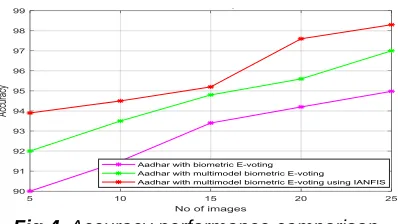
3.1 Accuracy Performance Comparison Results
Fig.4. Accuracy performance comparison
Fig.4 shows the results of the correlation between the proposed IANFIS-based multimodal biometric e-voting and existing Aadhaar with the biometric-based e-voting scheme and Aadhaar with the multimodal biometric-based e-voting scheme. The suggested technique can achieve a elevated precision level relative to current techniques from the estimate. It is an efficient method to authenticate the elector with the elevated precision rate of 98.3 times at the image size of 25. When the precision of the current Aadhaar with the biometric-based e-voting system and Aadhaar with the multimodal biometric-based e-voting system offering elevated outcomes that are 3,084 usd and 1,32 usd smaller than the suggested e-voting system. The reason is that the IANFIS has the capability of adaptation, and rapid learning capacity. Through the results, it can be seen that the proposed work is much better than the existing method of Aadhaar based E-voting. The corresponding numerical values of accuracy results are shown in Table.1.
Methods Accuracy Values
Aadhaar with biometric E-voting
9 0
9 1.5
9 3.4
9 4.2
9 4.98 Aadhaar with multimodal
biometric E-voting
9 2
9 3.5
9 4.8
9 5.6
9 7 Aadhaar with multimodal
biometric E-voting using IANFIS 9 3.9
9 4.5
9 5.2
9 7.6
9 8.3
Table.1.Accuracy Comparison of Existing and Proposed
Method
3.2 F-measure comparison results
Fig.5.F-measure performance comparison
Fig.5 shows that the results of the F-measure comparison between the proposed IANFIS-based e-voting and the existing Aadhaar with the biometric-based e-voting scheme and Aadhaar with the multimodal biometric-based e-voting scheme. The proposed method has a high f-measure value of 100 at the rate of image size of 25. From the outcomes, it is well recognized that the IANFIS proposal obtains elevated f-measurement showing good recognition of authenticated voter. The cause is that the suggested system is focused on great removal of features that enhance teaching effectiveness. Comparing the f-measurement rate between the existing Aadhaar with the biometric-based e-voting scheme and Aadhaar with the multimodal biometric-based e-voting scheme providing lower rates and 4,444 percent and 1,96 percent lower than the proposed method respectively indicating that the proposed work may provide better detection results than the existing Aadhaar-based e-voting scheme method. The corresponding numerical values of f-measure results are shown in Table.2.
Methods F-measure Values
Aadhaar with biometric E-voting
9 1
9 3.5
9 4
9 5
9 5.98
Aadhaar with multimodal biometric E-voting 94
9 5.5
9 6.8
9 7.6
9 8
Aadhaar with multimodal biometric E-voting using IANFIS
9 6.2
9 7.3
9 8.9
9 9.3
1 00
Table.2.F-measure Comparison of Existing and
Fig.6. SSIM Performance Comparison
Fig.6 shows that the results of the MSE comparison between the proposed IANFIS-based e-voting and existing Aadhaar with a biometric-based e-voting scheme and Aadhaar with a multimodal biometric-based e-voting scheme. The suggested technique has small MSE rates. It is well established from the outcomes that the suggested technique obtains a large SSIM score showing the excellent identification frequency. Because the suggested system has the efficient phase of image enhancement that decreases noise. The suggested technique has an SSIM frequency of 0.96 at a picture width of 25. When comparison the SSIM level between the current Aadhaar with the biometric-based e-voting system and Aadhaar with the multimodal biometric-based e-voting system, high SSIM tracking findings are 2.74 ##fold lower than and 0.84 half lower than the proposed method respectively.
Methods SSIM Values
Aadhaar with biometric E-voting
0. 91
0. 915
0. 9
0. 92
0. 925
Aadhaar with multimodal biometric E-voting
0. 93
0. 92
0. 925
0. 94
0. 95
Aadhaar with multimodal biometric E-voting using IANFIS
0. 932
0. 93
0. 94
0. 945
0. 96
Table.3.SSIM Comparison of Existing and Proposed
Method
4
CONCLUSION
AND
FUTURE
WORK
A fresh e-voting scheme with IANFIS offers authenticated multimodal biometrics for each qualified elector. Voting checking and audit paths can also be accomplished with the AADHAR database. The suggested e-voting scheme tends to eliminate manual mistakes and perform an efficient and qualitative polling method that will not require the existence of illegal ballots or inappropriate incorporation of voters. It offers robustness, accessibility,
enhanced polling velocity and precision, polling in a neighboring place, etc. It offers the crowded electorates with a cozy place to count their precious ballot. The proportion of the voter would also improve, thus promoting the democratic process. With the use of this suggested scheme, many of the problems encountered in the current voting system are required to be addressed in order to provide ease of mind to both the electorate and the applicant for office. In the future, the authentication method can be further enhanced by sophisticated pattern analysis of appearance-based and cognitive biometrics coding models can be included when reaching the office. This will also decrease the energy consumption and also increase safety. This scheme can also be created as an implementation so that the elector can register their ballot after the polling agents have properly authenticated it and thus the voting method becomes quicker and more secure.
7 REFERENCES
[1] Agarwal, Himanshu, and G. N. Pandey. "Online voting system for India based on AADHAAR ID." In 2013 Eleventh International Conference on ICT and Knowledge Engineering, pp. 1-4. IEEE, 2013.
[2] Khairnar, Smita B., P. Sanyasi Naidu, and Reena Kharat. "Secure authentication for online voting system." In 2016 International Conference on Computing Communication Control and automation (ICCUBEA), pp. 1-4. IEEE, 2016.
[3] Divan, Talib A., and Veena A. Gulhane. "Development of Online Voting System using Minutiae based Algorithm." International Journal of Scientific & Engineering Research 6, no. 4 (2015).
[4] Sreenath Sreenath.M, Sukumar.P, Naganarasaiah Goud.K, P.Sivakalyani & V.Phani Kumar, ―GSM based electronic voting machine using touch screen,‖ IOSR Journal of Electronics and Communication Engineering, June 2014.
[5] Sheng Li and Alex C. Kot ―Fingerprint Combination for Privacy Protection,‖ IEEE Transactions on Information Forensics and Security, February 2013.
[6] Rosario Gil, Mohamed Tawfik, Alberto Pesquera Martín & Sergio Martín, ―Fingerprint Verification System in Tests in Moodle,‖ IEEE Journal of Latin-american Learning Technologies, February 2013. [7] H. Agarwal and G. N. Pandey, "A Secure E-Election
System," 2014 International Conference on Information Science & Applications (ICISA), IEEE, Seoul, 2014, pp. 1-4.
[8] Rajeswari Mukeshi & V.J.Subashini, ―Fingerprint Based Authentication System Using Threshold Visual Cryptographic Technique,‖ IEEE-International Conference On Advances In Engineering, Science And Management, March 2012 .
[9] Paulino & Jianjang Feng, ―Latent Fingerprint Matching Using Descriptor-Based Hough Transform,‖ IEEE Transactions on Information Forensics and Security, March 2013.
4771 [11] Warghade S.S., Karthikeyan B. Voting System for
India. In: Thalmann D., Subhashini N., Mohanaprasad K., Murugan M. (eds) Intelligent Embedded Systems. Lecture Notes in Electrical Engineering, vol 492. Springer, Singapore, (2018).
[12] Chatterjee, Parag, and Asoke Nath. "Biometric authentication for UID-based smart and ubiquitous services in india." In 2015 Fifth International Conference on Communication Systems and Network Technologies, pp. 662-667. IEEE, 2015.
[13] Vidyasree, P., S. Viswanadha Raju, and G. Madhavi. "Desisting the Fraud in India's Voting Process through Multi Modalbiometrics." In 2016 IEEE 6th International Conference on Advanced Computing (IACC), pp. 488-491. IEEE, 2016.
[14] Madhuri, B., M. G. Adarsha, K. R. Pradhyumna, and B. M. Prajwal. "Secured Smart Voting System using Aadhar." In 2017 2nd International Conference On Emerging Computation and Information Technologies (ICECIT), pp. 1-3. IEEE, 2017.
[15] Pitaloka, Diah Anggraeni, Ajeng Wulandari, T. Basaruddin, and Dewi Yanti Liliana. "Enhancing CNN with preprocessing stage in automatic emotion recognition." Procedia computer science 116 (2017): 523-529.
[16] Patel, Meghna B., Satyen M. Parikh, and Ashok R. Patel. "Performance Improvement in Preprocessing Phase of Fingerprint Recognition." In Information and Communication Technology for Intelligent Systems, pp. 521-530. Springer, Singapore, 2019.
[17] Li, Cong, Fu Liu, and Yongzhong Zhang. "A principal palm-line extraction method for palmprint images based on diversity and contrast." In 2010 3rd International Congress on Image and Signal Processing, vol. 4, pp. 1772-1777. IEEE, 2010.
[18] Brindha, S. Finger Vein Recognition. Int. J. Renew. Energy Technol. 2017, 4, 1298–1300
[19] Badejo, Joke A., Aderemi A. Atayero, and Tunji S. Ibiyemi. "A robust preprocessing algorithm for iris segmentation from low contrast eye images." In 2016 Future Technologies Conference (FTC), pp. 567-576. IEEE, 2016.
[20] Khobragade, Shubhangi, Dheeraj Dilip Mor, and Aman Chhabra. "A method of ear feature extraction for ear biometrics using MATLAB." In 2015 Annual IEEE India Conference (INDICON), pp. 1-5. IEEE, 2015.
[21] Impedovo, Donato, Giuseppe Pirlo, and Mario Russo. "Recent advances in offline signature identification." In 2014 14th International Conference on Frontiers in Handwriting Recognition, pp. 639-642. IEEE, 2014. [22] Karouni, Ali, Bassam Daya, and Samia Bahlak. "Offline
signature recognition using neural networks approach." Procedia Computer Science 3 (2011): 155-161. [23] De Maesschalck, Roy, Delphine Jouan-Rimbaud, and
Désiré L. Massart. "The mahalanobis distance." Chemometrics and intelligent laboratory systems 50, no. 1 (2000): 1-18.
[24] A. Ross, K. Nandakumar, and A. K. Jain, Handbook of Multibiometrics. New York: Springer-Verlag, 2006. [25] Monwar, Md Maruf, and Marina L. Gavrilova.
"Multimodal biometric system using rank-level fusion approach." IEEE Transactions on Systems, Man, and
Cybernetics, Part B (Cybernetics) 39, no. 4 (2009): 867-878.
[26] Yangxu Li, Yan Zhao, and Huiwen Deng, ―Business market forecasting based on adaptive neural-fuzzy inference system,‖ Journal chongqing technol business university, vol. 21, no. 5, pp. 453-455, 2004.