www.orientjchem.org
An International Open Free Access, Peer Reviewed Research Journal
2017, Vol. 33, No. (3): Pg.1140-1145
Technology Basis and Thermodynamic Analysis of an Acid
Decomposition Process of Phosphorus Slime
ULzHALgAS NAzARBEk
1, UILESBEk BESTEREkOv
1, SAULE NAzARBEkOvA
2,
AIDAR BOLYSBEk
1and gALYA kAMBAROvA
11Department of “Chemical technology of inorganic substances”, 2Department of “Chemistry”, M.Auezov South Kazakhstan State University,
5 Tauke-khan ave., Shymkent, 160000, Kazakhstan *Corresponding author E-mail: [email protected]
http://dx.doi.org/10.13005/ojc/330311
(Received: April 13, 2017; Accepted: May 09, 2017)
ABSTRACT
The given article contains the research results connected with the development of a technology of acid decomposition of phosphorus slime. As opposed to a known technology of manufacturing super phosphate, we have applied a double super phosphate production technology as a basis. Slime raw material is fed to both stages of acid decomposition; the first stage is sulphuric acid decomposition, and the second stage – phosphoric acid one. The basic chemistry of two step processing of phosphorus slime is described. Thermodynamic analyzes of the described reactions are given. According to the thermodynamic analysis the Law’s of phosphorus slime decomposition were found. As a result the end product after phosphoric-acid decomposition contains basically Ca(H2PO4)2, an insignificant quantity of CaHPO4, water-soluble magnesium and potassium phosphates and also the insoluble residue
(SiO2). According to the thermodynamic analysis, the decomposition regularities of phosphorus slime were revealed. The ∆G0 values of sulfuric and phosphoric acids decomposition of phosphorus slime at the temperature of 600 ° C were compared.
keywords: phosphoric slime, sulphuric and phosphoric acids, processing, super phosphate, thermodynamic analysis
INTRODUCTION
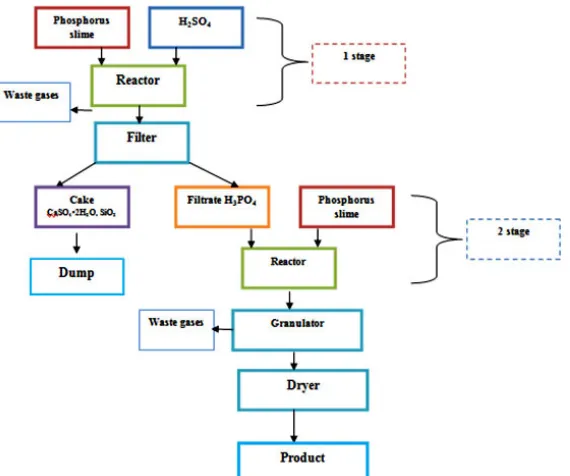
The given article contains the research results connected with the development of a technology of acid decomposition of phosphorus slime. As opposed to a known technology of manufacturing superphosphate1-2, we have applied a double super phosphate production technology as
a basis. Slime raw material is fed to both stages of acid decomposition; the first stage is sulphuric acid decomposition, and the second stage – phosphoric acid one.
MATERIALS AND METHODS
Chemism of the first stage of the decomposition process (obtaining phosphoric acid) of phosphorus slime is described by known reactions:
phosphate:
Ca5(PO4)3F + 5H2SO4 + 10H2O = 3H3PO4 + 5CaSO4 · 2H2O + HF ...(1)
impurities
CaCO3 + H2SO4 + H2O = CaSO4 · 2H2O + CO2 ...(2)
MgCO3+ H2SO4 + H2O =MgSO4 + CO2+ 2H2O. ...(3)
K2O + H2SO4 = K2SO4 + H2O. ...(4)
The researches have shown, that main products of the first stage of sulphuric acid decomposition of phosphorus slime are a phosphoric acid solution with concentration of 14-17 % of P2O5 and a cake – the sediment containing mainly calcium sulphate and insoluble impurities (SiO2). Thus, in the soft dihydrate regime (60 0C, formation of calcium sulphate dihydrate) a weak phosphoric acid is formed,
which is fed to the second (phosphoric acid) stage of decomposition of a new portion of phosphorus slime for the purpose of obtaining a calcium-phosphate product according to the reactions:
phosphate
Ca5(PO4)3F + 7H3PO4 + 5H2O = 5Ca(H2PO4)2
·H2O + HF. ...(5)
impurities
CaCO3 + 2H3PO4 = Ca(H2PO4)2·H2O + CO2. ...(6)
MgCO3+ 2H3PO4 = Mg (H2PO4)2 ·H2O + CO2. ...(7)
K2O + H3PO4 = K2HPO4 + H2O.
...(8)
At this stage potassium with phosphoric acid forms KH2PO4, which by entering in the exchange interaction with Ca(H2PO4)2 can turn into a more acid salt – KH2PO4, and the phosphate anion liberated reacts with a calcium ion and forms almost insoluble CaHPO4in accordance with the reaction:
K2HPO4 + Ca(H2PO4)2= 2KH2PO4 + CaHPO4. ...(9)
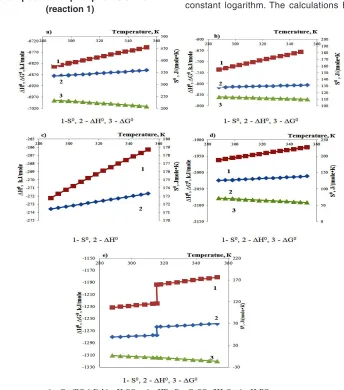
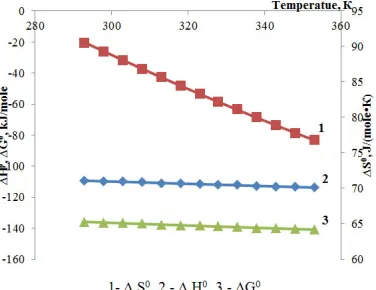
Fig. 2 : Temperature effect on thermodynamic characteristics of the sulphuric acid decomposition of phosphorus slime
(reaction 1)
Fig. 3: Temperature effect on thermodynamiccharacteristics of the substances in the reaction 1
As a result the end product after phosphoric-acid decomposition contains basically Ca(H2PO4)2, an insignificant quantity of CaHPO4, water-soluble magnesium and potassium phosphates and also the insoluble residue (SiO2)3-4.
RESULTS
fulfilled using a multifunctional software package HSC-5.1. This software program is widely applied in European universities; it has been developed by a Finnish metallurgical company Outokumpu. The program database contains information about more than 17000 substances5.
The process thermodynamic parameters have been determined in a temperature interval of 290-353K. The calculated thermodynamic characteristics depending on temperature and foreign component composition for the guess reactions of synthesis of phosphorus- and potassium-containing mineral fertilizers are represented in figures 2-12.
Two groups of chemical reactions have been studied: the first group includes the reactions of
phosphoric acid and impurities formation (reactions 1-4); the second group – formation of mono calcium phosphate and impurities (reaction 5-9).
T h e d a t a ( f i g . 2 ) a r e ev i d e n c e o f thermodynamic feasibility of the sulphuric acid decomposition of phosphorus slime in the investigated temperature are according to the reaction 1. The enthalpy and entropy jumps at 313K are caused by the phase changes which are taking place in the considered system.
F o r e s t a b l i s h m e n t o f t h e j u m p (change) nature for dependences ∆H0 =f(T) and
∆S0 =f(T) we have determined temperature influence on ∆H0 and ∆S0 of all the reacting substances of reaction 1 according to figure3
Fig. 4: Temperature effect on thermodynamic characteristics of the sulphuric acid decomposition of calcium carbonate
(reaction 2)
Fig. 6: Temperature effect on thermodynamic characteristics of the sulphuric acid decomposition of potassium oxide (reaction 4)
Fig. 5: Temperature effect on thermodynamic characteristics of the sulphuric acid decomposition of magnesium carbonate
(reaction 3)
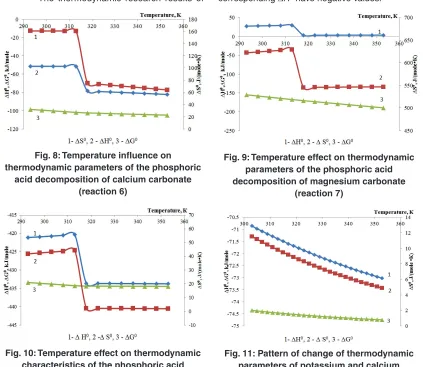
Fig. 7: Temperature influence on thermodynamic parameters of the phosphoric
Fig. 8: Temperature influence on thermodynamic parameters of the phosphoric
acid decomposition of calcium carbonate (reaction 6)
Fig. 10: Temperature effect on thermodynamic characteristics of the phosphoric acid decomposition of foreign potassium oxide
As follows from the figure 3, the observed change on the curves is connected with phosphoric acid properties. In this case there are first-type phase transitions.
The figures4 and 5 represent the thermodynamic research results of decomposition of calcium and magnesium carbonates by sulfuric acid according to the reactions 2 and 3.
Apparently the changes of thermodynamic parameters of sulphuric acid decomposition of impurity calcium and magnesium carbonates contained in the phosphorus slime have identical nature. Values of ∆G0 in the investigated temperature range are in a negative area; it proves thermodynamic probability of the reactions 2-3.
The thermodynamic research results of
potassium oxide sulphuric-acid decomposition in accordance with the reactions 4 are represented in fig.6.
As follows from this figure, Gibbs energy in the considered temperature interval has negative values, and it testifies to thermodynamic probability of the reaction 46.
Judging by comparison of the ∆G0 values for the first reaction group we can say that from the thermodynamic point of view the probability of these reactions (at temperature 333K) changes in the following sequence: K2O>Ca5(PO4)3F>CaCO3> MgCO3.
At the same time all the reactions of the given group are exothermal because of corresponding ∆H0 have negative values.
Fig. 9: Temperature effect on thermodynamic parameters of the phosphoric acid decomposition of magnesium carbonate
(reaction 7)
Fig. 11: Pattern of change of thermodynamic parameters of potassium and calcium
A dependence of ther modynamic parameters of the phosphoric acid decomposition of phosphorus slime (in accordance with the reaction 5) on temperature is represented in fig.7.
The results confirm thermodynamic probability of the reaction of phosphoric acid decomposition of the phosphate part of phosphorus slime in the investigated temperature area.
The observed jumps of enthalpy and entropy at 313K are caused by the first-type phase change, which occur in the phosphoric acid structure.
Figures 8 and 9 represent results of the thermodynamic research of calcium and magnesium carbonates decomposition by phosphoric acid (reactions 6 and 7).
As follows from the figures 8 and 9, the changes of thermodynamic parameters of processes of phosphoric acid decomposition of foreign components contained in the phosphorus slime – calcium and magnesium carbonates – have
the same nature. Values of ∆G0 for the reactions 6-7 in the investigated temperature range are in a negative area; it proves thermodynamic probability of the given reactions.
Results of the thermodynamic research of the processes proceeding according to the reactions 8 and 9 are represented in fig.10-11.
As follows from the data of the figures 10 and 11, the reactions 8 and 9 in the considered temperature conditions are realizable7.
Proceeding from the received ∆G0 values it is possible to conclude, that the basic substances of the second reaction group react with phosphoric acid in the following sequence: K2O>MgCO3> Ca5(PO4)3F >CaCO3.
Thus, it has been established, that from the thermodynamic point of view the reactions 1 and 5 of acid decomposition of the phosphate part of phosphorus slime and the reactions 2, 3, 4, 6, 7, 8 and 9 describing the impurity components decomposition are probable.
REFERENCES
1 Pozin M.E. Technology of mineral fertilizers: a textbook for institutions of higher education. – 6 ed., revised. – Leningrad: Chemistry, 1989,
352
2 N a z a r b e k U. b . , b e s t e r e k o v U. b . , Petropavlovsky I.A., Nazarbekova S.P., Pochitalkina I.A.,European Conference on Innovations in Technical and Natural Sciences. Vienna, 2015, 114-123.
3 Kopylyovb.A. Wet-process phosphoric acid technology.–Leningrad: Chemistry,1981,
224
4 Kopylov V.A. Manufacture of double
superphosphate. – Ìoscow: Chemistry,
1976,192
5 Roine A. OutokumpuHSC Chemistry for windows Chemical reaction and Equilibrium soft with extensive thermo chemical data base. - NY, 2002 //http://www.outotec.com 6 besterekov U.b. Theoretical foundation of
inorganic substance technology. Shymkent,,
2014, 178