Automatic Supervision And Fault Detection In PV
System By Wireless Sensors With Interfacing By
Labview Program
Yousra M Abbas, Dr. Wagdy R. Anis, Dr. Ismail M. HafezAbstract: In this work a wireless monitoring system are designed for automatic detection, localization fault in photovoltaic system. In order to avoid the use of modeling and simulation of the PV system we detected the fault by monitoring the output of each individual photovoltaic panel connected in the system by Arduino and transmit this data wirelessly to laptop then interface it by LabVIEW program which made comparison between this data and the measured data taking from reference module at the same condition. The proposed method is very simple, but effective detecting and diagnosing the main faults of a PV system and was experimentally validated and has demonstrated its effectiveness in the detection and diagnosing of main faults present in the DC side of PV system.
Index Terms: Photovoltaic (PV) system, Fault Detection, Wireless, Arduino, LabVIEW.
————————————————————
1
I
NTRODUCTIONConstitute waste resulting from the use of traditional elements to produce energy serious pollution to the environment in addition to the exposure of these elements of the force so it was necessary to search for alternative energy with sustainable and few adverse effects. Due to the fact that the sun most important source of clean, renewable energy has taken the largest share of research and applications to exploit its energy in the production of electric energy and the scientists succeeded in using solar cells "made from simple raw materials found abundantly in nature "It is what is known as "photovoltaic cell" These cells are grouped by electric Set to form the so-called photovoltaic panel, which are also assembled to create a photovoltaic field with high electric productivity. Due to the presence of these fields in the open and over large areas it is exposed to many malfunctions, which takes a great time to discover and repair, lead to reduce the production energy of these fields. Photovoltaic system converts solar energy into electrical DC energy, and to become this energy ready for consumer use had to be converted into AC energy and already is done by the Inverter. So we can, consider that the system consists of two main sides, one side before the inverter that's DC side and other side after the inverter that's AC side. The theme of this search for faults that occur in the DC side,
Where failures are common in this side because there are a large number of electric cables and PV panel in the system and exposed to the derating factor such as cloud, high temperature, winds, storms, snow, humidity, rain etc.,[1] also perhaps exposed to rodent and bird droppings which stand above the panel, these factors lead to a repetition of cut cables and connections Electrical occurs open circuit fault or partial shadow on the surface of the panel. [2] Hence, the trend has been to design a system that works to detect open circuit fault and partial shadow fault and locate the occurrence carefully. So we present, a complete package, designed in LabVIEW software to detect and diagnose these faults by relative comparison between individual photovoltaic module's output (volt (Vpv) and current (Ipv)) was connected together in the system and reference module's output (volt (Vrf) and current (Irf)) under the same solar radiation and temperature condition.
2
M
ODELS
YSTEMD
ESCRIPTIONIn this work installed small model similar to the photovoltaic system, which is actually used, was taking into account that there are Multiple photovoltaic panels are connected in series to increase the voltage, but the current remains the same [3]. This is called the string and then connects these strings in parallel to increase current, to obtain the power required. This model has been implemented by four photovoltaic modules, each module's output power is 3 watts (Vmp=9volt, Imp=0.33 amp, Voc=10.5volt, Isc=0.34amp) has been split them into two parallels string Np=2 and each string contains two modules in series Ns=2 as shown in Fig 1. So the total voltage of the PV model system would be 9 × 2 = 18 Volt, and the current would be 0.33× 2 = 0.66 amps [4] bringing total power from model is 12 watts under STC.
________________________
Wagdy R Anis Professor, department of Electronics and Communication Engineering, Faculty of Engineering Ain Shams University, Cairo, Egypt. E-mail:
Ismail M. Hafez Professor, department of Electronics and Communication Engineering, Faculty of Engineering Ain Shams University, Cairo, Egypt. E-mail:
Fig1. Layout of photovoltaic model.
3
T
HEC
ONFIGURATION OFF
AULTD
IAGNOSISS
YSTEM.
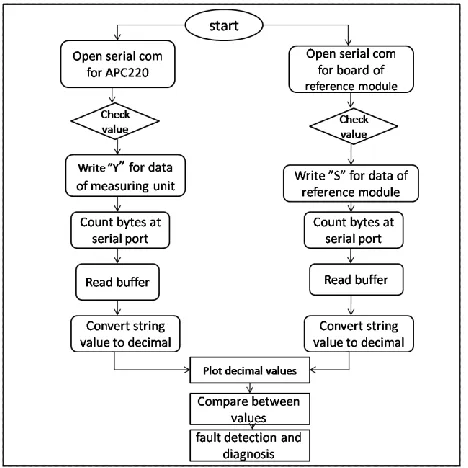
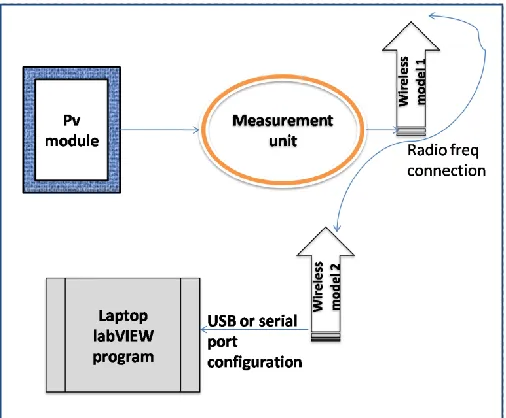
The fault diagnosis method of the system consists of several stages, the first stage is to obtain the electrical measurement of individual modules by measurement unit, then the next stage is the establishment of a wireless module to transmit and receive measured data from the measurement unit to, laptop, finally a LabVIEW program is integrated with wireless module serial communication to receive and analyze the measured data as shown in Fig 2.
3.1 Measurement unit
In measurement unit was used only one Arduino UNO board have several Analog to digital converter input and uniform ground [5] to measure the voltage and current of each individual module in the model system. Initially to measure the voltage of individual module we would connect the negative terminal of the module to the ground of Arduino and the positive terminal of the module to the input of the A/D converter in Arduino , for separate modules that work perfectly fine, but our modules are in series so the positive terminal of the first module is connected to the input of A/D converter and the negative terminal of the first module is connected to the Arduino's ground, but with second module we run into a problem because we can't connect the second module's positive terminal A/D converter input because it's connected to the first module's negative terminal . If we connected the negative terminal of both modules to the Arduino's ground, we would be shorting out of the second module. So we solve, this problem by using relays to measure each module individually by connecting the first module's positive terminal to normally open of relay1 and A/D converter input of Arduino to relay1's common and the first module's negative terminal to normally open of relay2 and Arduino's ground to relay2's common. When relays are activated normally open is connected with common then the first module's voltage is measured, and we do the same with second module and so on as shown in Fig 3.
Fig 3. Layout of measurement unit.
𝑉𝑜𝑢𝑡 = × 𝑉𝑖𝑛 (1)
Fig 4. Voltage divider [6]
That's about measuring the volt; the next step is about measuring the current. Since, in series modules, the current flows through each of the module is the same, so we measure the output current from the string not from individual modules. ACS 712 current sensor used to measure current from strings. The current is measured by passing a current through a current sensor; the output of the sensor is an analog voltage output signal that varies linearly with the measured current [7] as shown in Fig 5.
Fig 5. Current sensor datasheet. [7]
3.2 Transmission and receiving unit
To transmit measured data wirelessly in this project we are going to use two APC 220-43 modules one of them connected to measurement unit (Arduino UNO board) to transmit measured data from it shown in Fig 6, and the other module with USB converter connected to laptop shown in Fig 7. The APC 220-43 is highly integrated-duplex, it has a line of sight distance up to 1000 meters at 9600 pbs what is suitable for our project, The APC modules are small only 37.5mm x 18.3mm x 7.0mm and its power consumption is low transmitting at 20mw. It's communicating between the 418MHz to 455MHz which can be used freely without licenses in a lot of counties. [8]
Fig 6. Connect APC220 to MCU. [8]
Fig 7. Connect APC220 to PC via RS232-TTL converter. [8]
3.3 LabVIEW program
Fig 8. Flowchart of LabVIEW program.
4
F
AULTD
IAGNOSISI
NL
ABV
IEWAs we mentioned before that the method to detect and analyze fault is based on comparison between the measured volt and current of individual module, and the measured volt and current of reference module. This comparison is done by the LabVIEW program. The comparison has been designed within the program shown in following flowchart in Fig 9. and LabVIEW block diagram, Fig 10. We can identify the open circuit fault easily if an event was the measured voltage of the individual module is equal to zero, according to the design of which has been implemented in the unit of measurement. But to detect the partial shadow fault, so we make a comparison between the voltage and current of the individual module and reference module. If a shortage in individual module's voltage is found a greater than 30 % from the voltage of reference module and a shortage in the individual module's current was found a greater than 50 % from the current of reference module this fault will be defined as a partial shadow fault. But if the increase in individual module's voltage is found a greater than 20 % from the voltage of reference module and a shortage in the individual module current is found a greater than 50 % from the current of reference module this fault is defined as an open string fault.
Fig9. Flowchart of the fault diagnosis procedure in LabVIEW.
Fig 10. LabVIEW block diagram of fault diagnosis procedure.
5
E
XPERIMENTALR
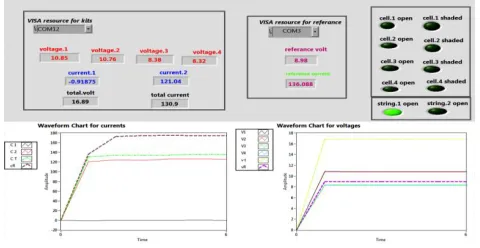
ESULTThen the experiment was run with no fault detecting Fig12. in the experiment three types of faults at different places in the model system was detected and diagnosed as follow.
Fig 12. No fault detection in model system.
5.1 Open Circuit Fault
In this work the modules were connected together by the measurement unit therefore, we can consider that the condition of not connected cable of the module to measurement unit as the open circuit fault in module, so we can detect open circuit fault if the module's volt is equal zero and no current follow in the string of this module. First, the Pv2 module was not connected to measurement unit and thus open circuit fault in this module had been detected, as shown in Fig 13. The voltage of Pv2 module was zero and there wasn't current through its string too. Also, we can note that the voltage of Pv1 module which was connected in series with Pv2 module equaled to open circuit volt.
Fig 13. Open circuit fault was detected in Pv2.
Another open circuit fault was detected in Pv1 and Pv3 modules Fig 14, the voltage of Pv1 and Pv3 was zero. Since the two open circuit modules were in two different strings, then there are no current passes through these two strings.
Fig 14. Open circuit fault was detected in Pv1 and Pv3.
Also open circuit fault was detected in Pv1, Pv3 and Pv4 modules Fig 15. The voltage of these modules was zero and there are no current passes through its strings.
Fig 15. Open circuit fault was detected in Pv1, Pv3 and Pv4.
5.2 Partial Shadow Fault
Fig 16. Partial shadow fault was detected in Pv1.
The same method was done with Pv4 module. and the partial shadow fault was detected in this module Fig 17.
Fig 17. Partial shadow fault was detected in Pv4.
5.3 string fault
This fault is achieved by cutting the connection between the string and the load. So the connection between string1 and the load was cut to make open string fault, and has already been detected open string fault in string1 Fig 18. The Pv1 and Pv2 module's voltage in this string is open circuit volt and there is no current passes through this string.
Fig 18. Open string fault was detected in string1.
Fig 19. Open string fault was detected in string2.
6 C
ONCLUSIONThe system was designed for detecting open circuit, partial shadow and open string faults. A small model was installed similar to the photovoltaic system which actually used. The fault diagnosis method of the system starts with obtaining the electrical measurement of individual modules in the model system and the reference module then transmits these data to the laptop, finally the LabVIEW program analyzes received data and makes a comparison to discover if the fault occurs. The main aim of this project was reached, the three fault types were detected in different locations and real time graph for volt and current at each fault was displayed by LabVIEW program.
7
R
EFERENCES[1] Bihter Yerli1, Mustafa K. Kaymak1, Ercan İzgi2, Ahmet Öztopal1, Ahmet D. Şahin1, Effect of Derating Factors on Photovoltaics under Climatic Conditions of Istanbul,” World Academy of Science, Engineering and Technology International Journal of Electrical, Robotics, Electronics and Communications Engineering, Vol.4 No.8, 2010.
[2] M. Chouder A Rabhi, A El Hajjaji, “Comprehensive Modulation and Classification of Faults and Analysis Their Effect in DC Side of Photovoltaic System,” Energy and Power Engineering, vol. 5, pp. 230- 236, 2013.
[3] W. Achim, R. Mauricio, M. David, M. Stefan, R. Nils and J. Ulrike, "MONITORING OF PHOTOVOLTAIC SYSTEMS: GOOD PRACTICES AND SYSTEMATIC ANALYSIS," 4 10 2013. [Online]. Available:
http://www.ise.fraunhofer.de/de/veroeffentlichungen/ konferenzbeitraege/konferenzbeitraege-2013/28th-eupvsec/woyte.pdf. [Accessed 4 03 2014].
[5] MrLndr, "The Arduino UNO Anatomy," 9 08 2011. [Online].Available:http://arduinoarts.com/2011/08/the -arduino-uno-anatomy/.[Accessed2405 2014].
[6] https://en.wikipedia.org/wiki/Voltage_divider.
[7] http://www.alldatasheet.com/view.jsp?Searchword= ACS712
[8] https://www.dfrobot.com/wiki/index.php/APC220_Ra dio_Data_Module(SKU:TEL0005)
![Fig 7. Connect APC220 to PC via RS232-TTL converter. [8]](https://thumb-us.123doks.com/thumbv2/123dok_us/9000496.1437779/3.612.350.560.69.247/fig-connect-apc-pc-rs-ttl-converter.webp)