by
DAVID STUART EDWARDS
A thesis submitted to the Department of Economic, Administrative and Policy Studies in Education
in conformity with the requirements for the degree of Doctor of Philosophy in
Educational Administration
University of London Institute of Education July, 1985
The purpose of the thesis is to analyse the function fulfilled by the Youth Opportunities Programme (1978-1983) in its wider political, economic and historical context. There are three main sections to the work.
The first establishes the context from which the Youth Opportun-ities Programme (YOP) emerged. This includes: an analysis of the origins and early development of the Manpower Services Commission
(MSC); an historical account of government policy and special measures for the relief of unemployment; and a description of the circumstances and manner in which these elements came together in the development of the MSC's special measures policy, leading to the launch of YOP in April 1978. It is concluded that the initial role of the programme was essentially that of a palliative in the context of the Labour Government's social contract relationship with the trade union movement rather than being a positive element in the MSC's development of a comprehensive manpower policy.
The second section is concerned with the actual development and performance of the programme in relation to its original object-ives. This includes national level analyses in terms of both quantitative and qualitative objectives, and the conclusions of a case study conducted in the Portsmouth Travel-to-Work Area.
The third section examines the significance of the divergences revealed between objectives and results, both in the context of contemporary political and economic developments, and also in a wider historical context which includes the initial progress made by YOP's successor, the Youth Training Scheme (YTS). It is
ACKNOWLEDGEMENTS
I would like to take this opportunity to express my gratitude to the following people: Dr Tessa Blackstone and Professor Mark Blaug for undertaking the supervision of this thesis; Steve Butters and Paul Richardson for the help and encouragement which they gave me in their capacity as Research Officers on the Education Training and the Youth Opportunities Programme Project to which my studentship
Acknowledgements . . . 2
Contents 3
Tables and Figures 5
Introduction 7
1. The Manpower Services Commission: Origins and Early
Development . . . 14
1. The Creation of the MSC 14
2. The MSC and Active Manpower Policy... 18
3.
4.
The MSC, Corporatism and 'Hiving Off'
Towards a Comprehensive Manpower Policy
2. Unemployment and government Policy: A History of
34
46
Special Measures . . . 58
3. The Manpower Services Commission and Special Measures 88
1. Pre-YOP Special Measures
2.
3.
The Holland Report
Special Measures in Historical Context
4. The Development and Performance of the Youth
88
110
136
Opportunities Programme: Part I Quantity... 149
1. The Growth of Unemployment
2. The Quantitative Development of YOP
149
154
3. Criteria for the Measurement of YOP's Performance 168
4. The Undertakings 170
5. Employability... 191
5. The Development and Performance of the Youth
Opportunities Programme: Part II Quality... 211
1. Quality Improvement and Training Content . . . 211
2. The Initial Approach to Quality Improvement and its Measurement
3. Off-the-job Training
4. The Training of Sponsors' Staff
5. Monitoring
6. Substitution and Displacement
7. Research and Development
8. Quality or Collapse
9. The New Training Initiative
10. Towards a Comprehensive Training Scheme
Introduction
1. Relevance
2. Quality of Content
294
299
303
3. Labour Market Interference . . . 307
4. Quality Improvement Initiatives
5. Implications for YTS
7. The Significance of the Youth Opportunities Programme
313
317
in its Contemporary Political and Economic Environment 322
1. Summary Assessment of YOP 322
2. The Changed Political and Economic Environment ... 329
3. Thatcherism and the MSC 336
4. Thatcherism and the Role of YOP as a Palliative ... 340
5. The Alternative Economic Role of YOP 345
6. The Significance of the 1979 General Election . . . . 351
7. The Question of Government Intent
8. Trade Union Involvement and the Survival of Corporatism
9. YTS as YOP's Redemption
8. The Youth Opportunities Programme in its Wider
357
361
375
Historical Context . . . 381
1. The First Year of YTS 381
2. The Demise of the MSC's Original Interpretation
of an Active Manpower Policy . . . 392
3. The Development of a Monetarist Active Manpower
Policy . . . 407
4. The Impasse for the MSC 5. Alternatives for the Future
413
415
6. Implications for the Historical Judgement of YOP 430
Concl~sion 438
Appendix: YOP in the Portsmouth Travel-to-Work Area .. 446
I Introduction
II The Local Programme
Bibliography
Cirriculum Vitae
446
480
618
Table 1
Table 2 Table 3
The Original Plan of the Youth Opportunities Programme
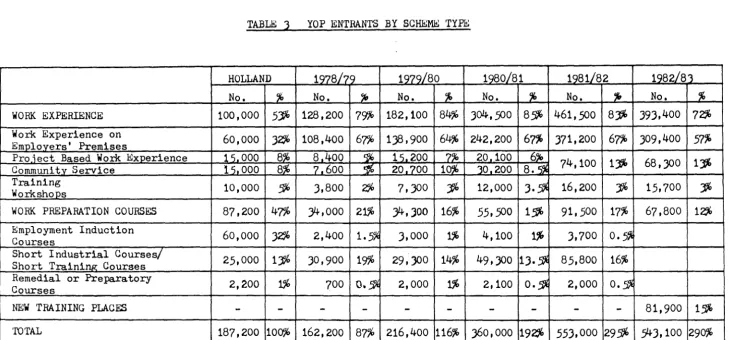
Expenditure on YOP 1978-79 to 1982-83 YOP Entrants by Scheme Type
122 155 160 Table 4 Gross Unit Costs of Special Programmes ... 165 Table 5
Table 6
The Results of The School Leaver Undertaking. 172 School Leaver Unemployment as a Percentage of
Total Unemployment in Great Britian - Annual
Averages 1971-1982 . . . 176 Table 7 The Results of the Undertaking to Long-Term
Unemployed Young People . . . . Table 8a Young People under 19 Unemployed for over a
Year
8b As a Percentage of Total Unemployment in
177
Great Britain of over a Year's Duration ... 182 Table 9 The Results of the Undertaking to the 'Other'
16 and 17 Year Olds . . . . Table lOa Young People under 18 Unemployed for over
Six Months
lOb As a Percentage of Total Unemployment in
187
Great Britain of Over Six Months' Duration 189
Table 11 Work Experience Trainees Receiving Off-the-job
Training . . . 218 Table 12 Industrial Analysis of Employees in Employment:
Great Britian and Portsmouth TWA . . . 457 Table 13 Destinations of those reaching the Minimum
School Leaving Age in the Portsmouth Travel-to-Work Area 1976-82 . ....•... . . . 462 Table 14 Industrial Analysis of Employment known to have
been entered by School and College Leavers during Year ended 30th September, 1982 - South
East Hampshire . . . 465 Table 15 Hampshire School and College Leavers, 1982
Entrants to Employment as a Percentage of
Table 16
Table 17
1977 Entrants . . . 466 Composition of YOP/Special Measures Provision
in Hampshire and South East Hampshire,
1977-1982 . . . • . . . • • . . . • . . 475 Occupational Distribution of WEEP Places - Both Filled and Unfilled - in South East Hampshire:
Figure 1
Figure 2
Figure 3
Figure 4
Figure 5
Total Unemployment in Great Britain 1977-1983. 152
Unemployment among 16-18 Year Olds:
Quarterly 1977-1982 . . . 153
Unemployment among School Leavers:
Quarterly 1977-1982 . • . . . 153
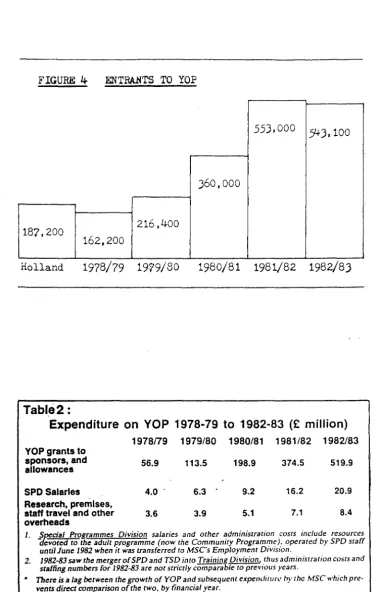
Entrants to YOP 155
National Follow-ups of Work Experience Trainees Entering Schemes, September 1978 - December 1981 193
Figure 6 National 1 in 6 Follow-ups of TSD Trainees
Leaving Schemes, January 1980 - September 1982 195
Figure 7 Young People as a Proportion of Total Unemploy-ment 1978-1983 . . . • . . . 200
Figure 8 Annual Rates of Unemployment, Great Britain and Portsmouth TWA . . . . . . • . . . . . . . . . . . . . . . 450
Figure 9 The Portsmouth Travel-to-Work Area 453
Figure 10 Monthly Totals of Young People Registered at
Careers Offices in South East Hampshire, 1974-83 468
Figure 11 Young People Participating in Special Measures
in Hampshire and South East Hampshire, 1976-83 469
Figure 12 Young People Registered as Unemployed or Participating in Special Measures, Portsmouth
TWA, 1976-1983 . . . 470
Figure 13 Analysis of the Destinations of Young People Completing YOP in South East Hampshire,
INTRODUCTION
In the 1950s and 1960s the process of transition from school to work was relatively unproblematical for most young people. There may have been a lack of training available, but there were plenty of jobs to choose from. For those young people without many qualifications, and who were not undertaking an apprenticeship, it was common practice to tryout a number of jobs in rapid
succession before settling down into what would be a more long term career. This was made possible by the conditions of effective full employment which had prevailed since the end of the Second World War.
In the 1970s unemployment went out of control Young people were disproportionately affected, and the transition from school to work became an issue of major public concern. The need was seen for increased state intervention and the main responsibility for this was given to a newly-created governmental agency, the Manpower Services Commission(M.S.C.).
In October 1976 the MSC published a review document entitled Towards a Comprehensive Manpower Policy. This constituted the first attempt on the part of the Commission since its formation in 1974 to produce a strategic overview of its policy, role, and structure, in relation to a projection into the future of current economic and labour market trends. The policy recommendation that derived from the analysis of current youth unemployment trends was as follows:
The outcome of this statement was that a working party was set up with a brief to study all the existing measures to help unemployed young people, and to report on the feasibility of
securing the above-stated objectives. In May 1977 the working party published its report under the title of Young People and Work
(usually referred to as the Holland Report). It consisted of
detailed proposals for the establishment ofa new Youth Opportunities Programme (Y.O.P), packaged in the optimistic rhetoric of anew deal for young people:
"The time has now come to turn a major problem and cost into an opportunity and a benefit.
*********************
We hope that the programme we propose can provide as many opportunities as are likely to be needed. It offers each young person an effective bridge to permanent employment and encourages and helps him or her to cross at the
earliest available moment. Moreover, the programme is designed to bring young people the kind of help they most need in the form they want it. It thus aims to demonstrate by deeds rather than words that society cares about them, and, through them, about its own future". (2)
YOP was launched on 1st April 1978. Five years later, when the programme was closed to new entrants, it had catered for over 1.8 million young people. Yet, despite this massive quantitative achievement which was far beyond anything originally anticipated by the authors of the Holland Report, the credibility of the
programme had to a large extent been exhausted by this stage. Under extremely difficult circumstances, it had succeeded in providing as many opportunities as were needed, at least as defined in terms of its principal undertaking to unemployed school leavers. Yet, increasingly, it had failed to provide an effective bridge into. permanent employment. Moreover, it had not lived up to original expectations in terms of training content and the general quality of provision. Doubts had emerged about its overall impact on the youth labour market, and widespread complaints had been made of
permanent jobs. At the end of the five years, despite YOP taking up to 300,000 young people off the labour market at anyone time, youth unemployment remained as much a problem, if not more, than it was at the start.
YOP began to lose credibility from its second year onwards, and by mid-way through the third year a point of crisis had been reached. The only way in which the programme was able to continue, and to complete its five year lifespan, was on the basis of the promise that it was leading to something very different and much better. This was to be the Youth Training Scheme (Y.T.S.).
The equivalent of the Holland Report for YTS was a document called the Youth Task Group Report which was published in April 1982.
This made clear from the beginning that the new scheme being proposed was not to be just another temporary special programme for the
young unemployed. Thus the opening paragraph stated:
"This report is about providing a permanent bridge between school and work. It is not about youth unemployment. What we propose will improve the prospects of young people to get and keep jobs but we have not been concerned with temporary measures".
(3 )
The permanent bridge was to be based upon the comprehensive
provision of an integrated and high quality programme of training, education and.work experience for all young people leaving school, whether employed or unemployed. Yet, whatever the intended
differences in terms of content, the style of presentation involved the same rhetoric of the historic new deal for young people which had originally been applied to YOP. The report concluded:
'The government has created a major opportunity for
Since its replacement by YTS in April 1983, YOP's reputation has not improved in hindsight. If anything, it has deteriorated still further. Those who were previously responsible for the programme, and who fought hard to sustain its credibility, no longer have any reason to defend YOP. Their interest now lies in emphasising the extent of the difference between YOP and YTS, and drawing attention to the failings of the former is one way of attempting to boost the reputation of the latter. What were previously regarded as momentous achievements of YOP have largely been forgotten, and after one year of YTS almost everybody seems to refer back to the 'now discredited youth Opportunities Programme'. Yet, the two entities cannot be completely separated in this way. In many important respects YOP led directly to YTS, and in certain ways YTS appears to have reproduced the fundamental characteristics of YOP. Ultimately, any historical judgement of the meaning and achievements of the youth Opportunities Programme must include some assessment of the establishment of the youth Training Scheme and its eventual outcome.
The object of this thesis is both to detail the events which have just been sketched and to analyse them in a wider historical,
political, and economic context. The description of the development and performance of the youth Opportunities Programme includes not only an account from a national level perspective, but also a
detailed case study of a particular local labour market, the Portsmouth Travel-to-Work Area. An important characteristic of YOP was its
diversified mode of administration which was intended to enhance the programme's capacity to adapt to the individual needs of different local labour markets. As a result, there were certain aspects of its performance that could only be adequately assessed at a local level. Yet, obviously, there are certain limitations to the extent that generalisations can be drawn from a single case study. For this reason, the main account of the local research
has been reproduced in the form of an extended appendix. Nevertheless, it has been possible to set this account in the context of the
into the main text. Besides this, the local case study has provided much illustrative material which not only stands on its own in the context of the appendix, but which has informed and enriched the main analysis in many ways that are nttexplicitly stated.
The main purpose of the detailed accounts which are given of the development and performance of YOP is to compare the actual
achievements of the programme with what it was originally intended to do. This includes a concern with certain effects which might be regarded as unintended consequences. The analysis of the differ-ences which emerged between stated objectives and actual
results takes place within a wider context which includes both the history of manpower policies and special measures for the unemployed, as well as the immediate and changing political and economic conditions under which YOP developed.
The starting point of the thesis is with the establishment of the historical aspect of this wider context. Thus, Chapter 1 is concerned with the origins and early development of the Manpower Services Commission, and Chapter 2 with the history of special measures for the unemployed. These two themes 'are then brought together in Chapter 3 with an account of the growing involvement of the Manpower Services Commission with special measures for the unemployed leading up to its launch of the Youth Opportunities Programme. The same chapter also introduces the immediate political and economic context within which these events took place, and
provides a systematic analysis of the original objectives set out by the Holland Report. The next two chapters detail the development and performance of YOP at a national level in relation
Youth Training Scheme. The significance of this for the
historical judgement of YOP is then analysed in terms of the themes
of manpower policy and special measures for the unemployed.
Finally in this chapter, there is a brief consideration of
alter-natives for the future. The thesis ends with a formal summary
of conclusions. The account of the local case study forms a
separate appendix.
Clearly, a wide range of ground is covered: from the 19th Century
Poor Law to the introduction of the Youth Training Scheme, from the
broad principles of economic policy to the experience of an
individual 16 year old serving behind the counter of a small fishing
tackle shop in Portsmouth. This indicates the extent of the
implications of a programme such as YOP; yet by no means all
angles have been covered. In particular, the educational implications
of the programme have only been briefly touched upon. Generally,
in attempting to cover such a wide area, it has been necessary
to be very selective. A number of narrow lines have been drawn
across from one boundary to another in an attempt to show the links
between aspects of particular interest. The course of these lines
has been determined by the central objective of answering two
relatively straight forward questions; what were the actual effects
of the Youth Opportunities Programme, both intended and unintended,
and what was their wider historical, political and economic
Footnotes
1. MSC, Towards a Comprehensive Manpower Policy, October 1976 para.4.21.
2. MSC, Young People and Work May 1977, p.7. 3. MSC, Youth Task Group Report. April 1982,
para.l.l.
CHAPTER 1 THE MANPOWER SERVICES COMMISSION ORIGINS AND EARLY DEVELOPMENT
1. The Creation of the MSC
The Manpower Services Commission began its operations in January 1974, its statutory basis having been established in the 1973 Employment and Training Act. At the time of its formation, the Commission was considered to be an important innovation: (1) at a specific level, in the organisation and management of British manpower services; at a more general level, in the conventional pattern of operation and responsibility of British government and public administration. First, it brought together under the same co-ordinating structure both employment and training services which had previously existed separately within the Department of Employment and had since been in the process of being 'hived off' as independent agencies. Secondly, it gave to those who use these services - employers and employees - a direct collective respons-ibility for their management, thus combining representative and operational functions in the same organisation. (2)
The representative aspect of the new body was constituted in its 'tripartite' composition. The actual Commission, in its most
limited sense, was to consist of ten people selected on the following basis: three members nominated by organisations representing
The responsibility of the Commission for the management of manpower services was defined as follows by Section 2 of the 1973 Act:
"it shall be the duty of the Commission to make such arrangements as it considers appropriate for the purpose of assisting persons to select, train for, obtain and
retain employment .... and to obtain suitable emp loy ees ... "(3)
This responsibility had previously been directly in the hands of the Secretary of State. Under the new legislation, the Secretary of State still retained an overall responsibility and was still expected to answer to Parliament for the execution of this responsibility, but the day-to-day management of the services involved was to be left to the Commission and its two agencies. Thus the relationship of the Commission to central government was to be that of a semi-autonomous body, or what might loosely be referred to as a 'quango' '(4) As such, it was also to act as a form of clearing house for labour market information and to have a major role in the formulation of manpower policy. Thus, provision was made for an annual programme and budget, plus a medium term five year rolling programme, to be presented by the Commission each year. These would be subject to the approval of the Secretary of State, who was also empowered to issue directions of his own. Furthermore, the Treasury was to retain control over the funding of the Commission, which was to be by means of a 'grant-in-aid' through the Department of Employment.
Thus, the MSC came into existence as a semi-autonomous tripartite body, combining representative and operational functions in its role of supervising and co-ordinating the management of employ-ment and training services. As such, it constituted a radically. new kind of organisation. Yet, despite the significance of
the innovation involved, the MSC's creation was the result of what was in a certain sense a last minute decision, and consequently
Originally, it had been intended by the Conservative Government then in power that the two Agencies being hived off from the Department of Employment should remain separate. In 1971 People and Jobs, the consultative document that presented the Government's plans for the modernisation and hiving off of the employment services, had suggested that some form of general council on manpower services should be set up on a tripartite basis, in order to facilitate the co-ordination of employment services with the other manpower services. However, this was only to be an advisory council, and it was not considered
practical at the time to invest such a body with executive powers as well. The idea of such a general advisory council on manpower services was repeated in Training For The Future, the consultative document concerned with the reorganisation and hiving off of
training services that was released in 1972. This general council, it was proposed, would replace the existing Central Training Council, a tripartite advisory body whose role was restricted to manpower issues concerned with training.
During the process of consultation that followed the publication of these two documents, a consensus was built up around the opinion that a mere advisory council would be inadequate for the important task of co-ordinating employment and training policies. What was needed instead was some kind of labour board based on the Swedish model, capable of exercising executive powers on its own behalf in the pursuit of an active and coherent manpower policy. This had been along held view of the TUC, (6) and the CBI was likewise prepared to give the idea its support. But the Conservative Government was initially reluctant to give up its opinion that the granting of executive powers to such a body would be impractical, (7) and thus it continued with its plans to develop the employment and training services as wholly separate agencies. Nevertheless, in response to a joint statement from the TUCand the CBI pressing for the establishment of a National Manpower Board, the Secretary of State agreed to extend the process of consultation; eventually the Government relented, and then
The consensus that existed between both sides of industry on this matter ensured that when these proposals were announced in
Parl-iament by the Tory Secretary of State, Maurice Macmillan, no major obstacles were placed in their way. Indeed, the main area of dispute between the political parties was over who had thought of the idea first. Both Government and Opposition claimed that they had been discussing the creation of such a body for a number of years; the Secretary of State sought credit for being the first person to have acted upon these discussions. (9) Likewise, when these proposals were translated into the legislative form of the Employment and Training Bill, although there was disagr-eement over the measures included to curtail the levying powers of the Industrial Training Boards, there was broad cross-party agreement on the sections concerned with the establishment of the MSC. What argument there was concerned the extension and further detailing of the powers and responsibilities that were being granted. For example, in the course of debate Labour MPs called for the Commission to be given a special and explicit responsibility for the unemployed in the 16 to 19 age group. (10) Also the
TUC would have liked there to have been a more strongly intervent-ionist role defined for the Commission in the legislation and, in particular, for there to have been some explicit allocation of responsibility for job creation to the new bodY.(ll) However, Government spokesmen argued that the broad and general definition of duties under Section 2 of the Bill gave sufficient scope
to the Commission. (12)
2. The MSC and Active Manpower Policy
The major trend that needs to be explained within manpower policy is the development of what is generally referred to as an 'active manpower policy'. This, in its turn, can best be understood within the context of a brief history of the develop-ment of manpower services in this country.
The history of the two services that were brought together under the umbrella of the MSC can be traced back to the first quarter of the twentieth century. (13) The origins of the Public Employment Service can be found in the 1909 Labour Exchanges Act which
resulted in the establishment of a National Exchange system under the Board of Trade. It was originally envisaged by those
such a$ Beveridge , who had been responsible for pressing for this
legislation, that a national system of labour exchanges would be able to make an important contribution to the efficiency of the operation of the labour market. However, soon after the system was established, the exchanges were made responsible for the administration of the new national social insurance, and as a result, their role in employment placement was rapidly relegated to one of secondary importance. (14)
The subordination of the original purpose of the employment services was to continue for the next half century, despite the great extensions of government direction of manpower that took place temporarily during each of thetwo world wars. In particular, the mass unemployment of the 1920s and 1930s forced further
emphasis to be put upon the insurance work of the exchanges, at the expense of the~r employment and placement functions. (15) This situation has often been described within the literature on
manpower policy in terms of social objectives being given priority over economic objectives; social objectives being understood to be primarily concerned with the welfare of individuals, economic objectives to be primarily concerned with the efficient use of labour resources, and the growth and welfare of the economy. (16)
have applied to the development of government training services, at least up until the early 1960s. The prevalent view was that .it was primarily industry's responsibility to meet its own
training needs, and consequently government provisions were reserved for exceptional circumstances, notably those arising during or immediately after war, and for special categories, such as the disabled. (17) Thus it was during the first World War that the Government first undertook the provision of
vocational training, when instructional factories were established to provide skill training for the war disabled. After the war, the provision of these facilities was extended to those of the able-bodied who had missed their normal induction into industry because of their military service, but this was only ever seen as a short-term measure to assist resettlement. However, the 1920s did see the use, at least on a small-scale, of government
training provisions as a measure for the relief of mass unemployment. In 1925, for example, the first Government Training Centre was
established for the benefit of young unemployed men between the ages of 18 and 25 who had not previously had the opportunity to learn a skilled trade. But such measures were never of a
significant scale in comparison with the problem of mass unemploy-ment that was being faced,and once again, in accordance with the distinction made above, their purpose was primarily social
-the bringing of some form of relief to certain unemployed individ-uals·(18)
The meaning of an active manpower policy can now be explained by way of contrast with the predominant pre-Second World War pattern of provision that has been described above. An active manpower policy implies that, beyond and in addition to any social purposes they may serve, manpower services are to be used to make an
In 1944 the war-time Coalition Government issued the famous White Paper on Employment Policy that opened with the words:
"The Government accept as one of their primary aims and responsibilities the maintenance of a high and stable level of employment after the war." (19)
This formal acknowledgement of the Government's responsibility to maintain a high level of employment was of great significance: it marked the public commitment of members of both major political parties never to return to the mass unemployment that had been tolerated or thought inevitable during the inter-war period. The rest of the document proceeded to detail the main features of the economic policy that would be necessary for the pursuit of this commitment, within the more general aim of national economic efficiency and growth.
The primary long-term policy for the achievement of a high and stable level of employment was to be that of demand management. This was to involve the use of monetary and fiscal policy on the part of the Government to ensure the maintenance of a high level of aggregate demand for goods and services. Thus, whenever the danger of a slump in demand appeared, the Government was to take various forms of prompt action to stimulate public and private expenditure in both capital investment and consumption. (20)
However, Government adherence to such a policy of demand management was not regarded as a sufficient condition for the maintenance of high levels of employment. A number of other conditions were referred to by the White Paper. First, it was pointed out that it would not be enough to maintain domestic demand at a high level: the demand for exports would also have to be expanded, and the foreign balance of trade kept in equilibrium. The
Governement's role in this respect would be to collaborate with other national governments in order to secure conditions favourable for the expansion of international trade. It would then be
industry's responsibility to take advantage of these conditions by competing efficiently.
A second condition for the success of demand management policy, emphasised as necessary by the White Paper, was the maintenance of a reasonably stable level of prices and wages. This, it was said, would require co-operation and moderation from both workers and employers to hold down wages and profits in line with
productivity and thereby avoid the disruptive effects of inflation. (22)
The third condition mentioned by the White Paper was "a sufficient mobility of workers between occupations and localities". (23) Even if the general level of demand were kept high, patches of
unemployment, localised within particular industries and areas, might develop as a result of elements of mismatch within the labour market. These could not be remedied directly by means of demand management; and, indeed, if a solution was sought in a further raising of the level of demand, it would only create severe labour shortages elsewhere, and thus give rise to inflat-ionary pressures. Thus, beyond the need for workers to be ready to adapt to changing circumstances, the White Paper envisaged as necessary certain Government measures designed "to bring men to the work and the work to men". (24) It is here that the potential for an active manpower policy role can be identified within the more general strategy that was articulated. However, little was said in the White Paper to encourage the development of such a policy.
The primary means of overcoming problems of regional mismatch was to be a regional policy of encouraging the development and
diversification of industry within those areas which were known to be particularly vulnerable to unemployment.
the White Paper made no attempt to reappraise their role within the context of the new employment policy, and no new emphasis was given to the development of their placement function as a means of reducing friction in the operation of the labour market.
With regard to the role fo the training services, (27) it was proposed that the Government should provide training facilities
in order to help tackle the problem of occupational mismatch, but the main responsibility for training employees was to remain with their employers. All that was undertaken, was that the Government would continue to provide training schemes after the immediate postwar need for resettlement had passed, if this were deemed necessary in order to retrain workers being laid off by declining industries so as to fit them for jobs in expanding industries. As it happened, from 1946 onwards the training facilities used for resettlement were rapidly rundown, and the training services returned to their traditionally limited social policy objectives, largely concerned with providing for the disabled. (28)
In the transitional period of reconstruction immediately following the end of the war, it was not envisaged by the White Paper that it would be necessary to employ a macro-economic policy of demand management in order to secure a high level of employment. (29) During this period, large numbersof men and women were to be demobilised from the armed forces or released from military
they were then to continue after the more short-term measures of direct Government intervention had been removed, and were
subsequently to become an adjunct of the longer term policy of demand management. (30)
In the first twenty years that followed the war, both major political parties when in Government by and large upheld the commitment undertaken in the White Paper, and gave priority
to the maintenance of a high level of employment in their economic policies. Furthermore, in the years that followed the initial period of upheaval at the end of the war, the technique of demand management appeared to work remarkably well, at least if judged by the levels of employment achieved. Thus between 1948 and 1966 unemployment averaged only 1.7% and almost never exceeded 3%.(31)
However, by the middle of the 1950s, concern was beginning to be felt about the rate of inflation that appeared to be associated with the success of full employment policy. Between 1946 and
1955 price levels rose by about 50%'(32)a modest increase by modern standards, but at the time it was considered to be a sufficiently serious problem to demand a Government response. Thus in 1956 the Conservative Government published a White Paper entitled The Economic Implications of Full Employment. In the 1944 White Paper, the importance of price stability had been noted as a
would be lost in the long run; but this was not inevitable. The solution sought by the White Paper lay in mutual restraint and co-operation between management and labour: self-restraint "in making wage claims and fixing profit margins and prices, so that total money income rises no faster than total output"; (36)and co-operation in maintaining good industrial relations and increasing productivity, so as to raise the total level of output.
The tendency of opposition between stable prices and full employ-ment drawn attention to by the 1956 White Paper was subsequently given a more precise academic formulation in what became known as the 'Phillips curve'. In an influential article published in November 1958, (37)A.W. Phillips claimed to be able to prove from available statistical evidence that the rate of change of money wage rates in the United Kingdom between 1861 and 1957 could be explained by the level of unemployment and the rate of change of unemployment, except in or immediately after those years in which there was a rapid rise in import prices. Furthermore, he gave the relationship between the rate of change of money wage rates and the level of unemployment a precise quantitative value, in the form of of an equation representing the curve that he had derived from plotting the two relevant sets of statistics on a graph.(38) The implication was that for any given level of unemployment there was a corresponding 'natural' rate of wage inflation. Thus, in theory, it was possible to specify a level of unemployment at which inflation would be eliminated, so long as there was not the disturbance of a rapid rise of import prices. Phillips in fact suggested that a 5~% rate of unemployment would be associated with the level of aggregate demand necessary to keep wage levels stable, and that a 2~% rate of unemployment would be sufficient for product prices to be stabilised, assuming a 2% per annum increase in productivity. (39)
supply, as would have to be the case for the maintenance of full employment, then the price of labour would be bound to rise. As we have seen, the tactic of the 1956 White Paper to escape the inevitable incompatibility between full employment and stable prices that is implied here, was to appeal to both trade unions and businessmen for self-restraint in forgoing any bargaining or price-setting advantages that the Government's maintenance of high levels of demand might give them.
Over the years that followed the publication of the White Paper, Governments tried to apply various forms of prices and incomes restraint, both voluntary and statutory. All proved to be unpop-ular and difficult to administer, and the problem of inflation remained unsolved. The development of an active manpower policy that started in the 1960s can be understood as an attempt to find an alternative or additional means of altering the terms of the relationship that was thought to hold good in the form of the Phillips curve. (41)
The case for developing the role of the manpower services as an active adjunct of economic policy was put explicitly in these terms by the Organisation For Economic Co-operation and Development (O.E. C.D.), which, during the 1960s, was lobbying internationally for the adoption of an active manpower policy as a new instrument of economic management. (42) The argument took the following form. The difficulties being encountered in the administration of an incomes policy did not mean that the relationship between unempl-oyment and inflation implied by the Phillips curve was unavoidable. Much of the inflation taken account of by Phillips in plotting his curve was in fact 'unnecessary'. It was not the inevitable
result of the level of demand required to sustain a given level of employment, but rather the product of the inflationary pressures allowed to build up around particular labour shortages and
achieved independently of the application of an incomes policy. What was required then was that supply and demand should be matched more evenly across every area of the labour market: the instruments of an active manpower policy were seen as capable of providing the mechanism by which this could be done.
First, the employment services could add to the general fluidity and efficiency of the operation of the labour market. This could be achieved through the further development of the placement function, which had originally been considered their primary function, but had since been pushed into the background by their responsibility for the administration of unemployment benefit. Secondly, the training services could be developed to playa more active role in overcoming the various problems of occupational mismatch in the labour market. And thirdly, working in
conjunction with the two primary manpower services on matters affecting the location of jobs and labour, regional policy could be used more directly to counter mismatch of a geographical nature.
If these three elements of an active manpower policy could be
applied successfully in conjunction with each other, it was believed that it would be possible to run the economy at a lower level of aggregate demand without thereby creating more unemployment. However, it was not only the level of demand that was a matter of concern, the degree of fluctuation was also perceived as an
was to be honoured, and so the cycle would soon have to be started up again with some new form of reflation. In the short term, the rapid repetition of this cyclical pattern might enable the avoidance of the unacceptable extremes of unemployment and
inflation, but in the long run, it was a wasteful and inadequate way of maintaining the kind of sustained economic growth on which all the postwar economic policy objectives were ultimately
premissed.
Once again a solution appeared to be offered by the elements of an active manpower policy that were listed above, since again the underlying problem was identified as being the inefficiency and imbalancffiof the labour market. (43) Thus it was thought that cyclical 'overheating' was another result of labour shortages and bottlenecks which acted as the foci of inflationary pressures and, at the same time, blocked the growth of domestic output that was necessary to maintain the balance of foreign trade during a period of demand reflation. Consequently, an active manpower policy aimed at. removing elements of both structural mismatch and frictional drag from the labour market could be
expected, not only to mitigate the underlying inflationary tendency of the economy, but also to smooth its cyclical pattern of growth. Furthermore, the timing of the implementation of this policy, in particular its training element, could be directly integrated into a counter-cyclical strategy of demand management. Thus, the time to step up investment in training programmes would be on the downswing of the cycle, when demand was low. At this point, such spending would contribute as an element of the reflationary
policy necessary to lift the economy out of its slump and, at the same time, bring direct relief to some of those finding themselves unemployed during the lull in demand. Then, when the economy moved back into a phase of growth, there would be a supply of newly trained labour available to cover the areas where labour shortages were likely to occur, thus removing one of the major obstacles to sustained and non-inflationary economic growth.
to 'fine-tune' the policy of demand management that had been adopted by the 1944 White Paper in pursuit of its commitment to full
employment. Since the beginning of the 1950s, demand management, implemented primarily by means of monetary and fiscal controls, had proved an unwieldy and insensitive mechanism for steering the economy: it had given rise to unnecessary tension between the twin objectives of full employment and stable prices, and had encouraged the erratic cycle of 'stop-go'. The development of an active economic role for manpower policy, it was hoped, would make it possible to run the economy at a lower level of aggregate demand without thereby creating more unemployment, and thus help to achieve sustained economic growth without the wasteful
fluctuations of 'stop-go'.
The extent to which these ideas were new should not be exaggerated. It will be remembered that the potential role for an active
manpower policy had been adumbrated in the 1944 White Paper. Now, in the 1960s, what had been outlined in 1944 was in effect being reactivated in a new and more explicit form. This was necessary because, in the intervening years, the potential contribution of the manpower services to broader economic policy had in practice been neglected.
Following the intense activity of the postwar demobilisation period, both the employment and training services were rapidly rundown, and continued to decline until the early 1960s'(44) A strongly interventionist role was necessary for the employment service during demobilisation, but thereafter controls were relaxed and eventually removed when the Control of Engagements Order was revoked in 1950. For a brief period in the early 50s some attempt was made to ensure that all vacancies were notified
1946. By 1948 this number had been reduced by 75%, and thereafter it continued to decline, so that by 1962 there only existed 10% ,of the places there had been in 1946. Finally, some effort was
put into regional policy during this period, but the measures taken to encourage capital'investment in development areas had little success in reducing the regional disparities between levels of employment. (45)
The early 1960s saw a new interest being taken in the role of planning in the promotion of economic growth. This was marked by the setting-up of the National Economic Development Council in 1962, and its publication, a year later, of a report entitled Conditions Favourable to Faster Growth. (46) This document placed a new emphasis on various aspects of manpower policy, in particular training and regional development. It is from this period and context that it is possible to trace the development - all be it unsystematic - of the different elements of an active manpower policy.
1962/3 proved to be the turning point for the Government provision of training, the expansion that took place thereafter being
indicative of the adoption of a new role beyond the limited
'social' objectives that had been characteristic of the programmes of the 1950s. (47) Thus, between 1962 and 1971 the numbers being catered for in Government Training Centres increased fourfold. Also an important step forward with regard to the regulation of training carried out in industry was made by the 1964 Industrial Training Act. This involved the establishment of the Industrial Training Boards (I.T.Bs),tripartite regulatory bodies, each with responsibility for maintaining and improving the quality and quantity of training provided within a particular sector of
industry, and each empowered to administer a grant lev~ system to ensure the equitable distribution of training costs between
individual concerns.
attitude reflecting the growing influence of the idea of an
active manpower policy. Indicative of this attitudinal change was an article, entitled 'Changing role for the Employment Service' , that was published in the Labour Gazette in 1966.(48) Here it was argued that the main emphasis of the work of the service should be moved away from the administration of unemployment benefit, and put back onto the employment placement function. Some minor reforms in line with this change of emphasis were announced at the time, but the main importance of this restatement of what was the original objective of the employment service was to be
in preparing the ground for the more radical reforms that were to follow in theearly 1970s.
The impact of the development of the concept of an active manpower policy can also be detected in the new emphasis that was given to regional policy during the 1960s. This not only involved a
sizeable increase in the amount spent by Government on regional development, but also the introduction of new mechanisms to ensure that more of this spending was directly linked to the creation of jobs. Previously ~egional policy had been predominantly concerned with the encouragement of capital intensive investment in the development areas. The Regional Employment Premium, which was introduced in 1967, sought to stimulate the creation of employment by the more direct means of subsidising the wage costs of employers in the specified areas. (49)
Three other measures that illustrate the development of manpower planning during the 1960s should be mentioned: redundancy payments, earnings-related unemployment benefit, and the Selective Employment Tax, all of which were introduced between 1965 and 1966 in
earnings-related benefits, it was hoped, would make workers more willing to accept losing their jobs and having to look for new forms of employment. The Selective Employment Tax was designed to encourage employment in the manufacturing industries in pref-erence to the service industries, working on the questionable assumption that the former would make a greater contribution to economic growth. In so far as these measures had any notice-able effects, research carried out at the time showed that they were more successful in the negative function of shaking out labour, than in the positive function of redeploying it more productively elsewhere'(50) Thus, while in a certain sense they represented an advance in manpower planning techniques, at the same time, they
highlighted the need for a greater degree of co-ordination of policy.
The consultative documents previously referred to, People and Jobs (1971) and Training for the Future (1972), can now be understood in terms of the requirements of the further development of an
active manpower policy, as can the criticisms that were made of them which led up to the MSC being superimposed over the two separate agencies. People and Jobs, as well as proposing that the Employment Services Agency should be hived off from the Department of Employ-ment, recommended that the administration of the employment and benefit services should be separated at the local level. This, it was hoped, would allow the employment service to develop and expand its active placement function, unencumbered by the image and responsibility associated with the dole office. Further to this end, the new employment service was to be relocated in modern-style self-service Job Centres which were to be separate and
distinct from the old benefit offices.
Training for the Future contained two other main proposals besides that for the establishment of a separate Training Services Agency. The first of these was for the expansion and diversification of Government provided training through the introduction of the
of TOPS clearly represented a positive step forward in the development of the instruments of an active manpower policy, the abolition of the ITBs'power to raise a training levy was viewed by some, particularly those associated with the labour movement, as a retrograde step .(51) Under the pressure of their criticisms, the Government did eventually compromise, and only curtailed the ITBs' use of the levy rather than eliminating it altogether. However, this does still illustrate an important point about the concept of an active manpower policy. The object of such a policy was never to supplant the normal workings of the labour market, but rather, with the minimal amount of intervention necessary, to remove any irregularities or blockages that might interfere with the efficiency of its normal operation. It was then always a doctrine of limited intervention, and this will be seen later to be a feature of the philosophy of. the MSe, the organisation that was given responsibility for the development of a comprehensive manpower policy.
Apart from the criticisms that were made of the proposal to abolish the ITB training levy, the main criticism of the two documents was that, while they made an important contribution to the separate development of two of the primary instruments necessary for the implementation of an active manpower policy, they failed to
establish an adequate institutional structure for the co-ordination of their usage in such a policy. (52) The idea of some form of national manpower commission had emerged from the debate about active manpower policy that took place during the 1960s. Probably the fir?t reference to the need for such a body in this country was made in a report called 'Perspectives in Manpower Planning' which was published in 1967 by the Edinburgh Group of the Institute of Personnel Management. (53) There it was proposed that an
a co-ordinating commisson was put powerfully by the influential labour market expert, Santosh Mukherjee. (54)
In a Political and Economic Planning (P.EP.)broadsheet entitled Making Labour Markets Work, Mukherjee compared the Swedish and British systems of manpower policy administration. One of the main conclusions of his analysis was that the comparative success of the Swedish system relied on the co-ordinating role played by an autonomous agency called the Labour Market Board. If Britain was serious about implementing an active manpower policy, it would be necessary to create some equivalent institutional framework. Reforming the employment and training services was not enough, the co-ordination of an active manpower policy required that they should be given an organisational unity.
3. The MSC, Corporatism and 'Hiving Off'
Beyond the specific trend of the development of an active manpower policy, it is possible to identify two broader trends
within the institutional organisation of politics and administration that were influential in determining the form that the MSC
eventually took. The first of these was a trend in the development of functional representation within political structures that
is generally labelled as 'corporatism'. The second was a trend of administrative reform associated with the process of 'hiving off'. As will become apparent, there was some connection between these two trends, in so far as the latter could be viewed as a means of enabling the furtherance of the former.
Within modern political analysis corporatism is a contested and ambiguous term. (56) It is not my intention in this context to get caught up in the complex wrangle that has been carried on between various schools of political thought over the precise meaning and correct usage of the concept. Nevertheless, given the confusion that presently exists, it will be necessary at least to explain how I intend the term to be understood in the account that follows.
the relationship between the state and invididual would be hierachically mediated through functionally based sectoral organisations fulfilling both representative and administrative functions.
These ideas subsequently became associated with fascist ideology, and in this context were put into practice as a means by which it was attempted to enforce totalitarian state control over society. Understandably, this association with fascism left corporatism
discredited as a political doctrine in the postwar era. Nevertheless, since the Second World War, there have been certain characteristic developments in the political structures of 'liberal democracies' that, although not explicitly put forward in corporatist terms by their adherents, have borne a sufficient resemblance to the original ideas of corporatism for various political commentators to have revived the term as a means of description and analysis.
Broadly speaking, the characteristic feature of these develop-ments to which the label corporatism has been applied has been the incorporation of representatives of management and labour within the institutional framework of the state as a strategy associated with the extension of the scope of state intervention in the economy. Unlike in the context of fascism, this has taken place voluntarily, typically through the establishment of various forms of tripartite body, operating at first mainly in an advisory capacity, but subsequently becoming directly involved in the
policy-making process. (58) Thus, in most so-called liberal democ-racies, a political process based on the establishment of consensus between the state and representatives of the major functional
sectional interests within society has grown up alongside the more traditional liberal democratic institutions based on geog-raphical parliamentary representation.
constitute a comprehensive new system, or are they only partial and dependent developments? If they do constitute a new system, on what plane of analysis is it to be classified - a new system of interest mediation, a new state form, or new mode of economic production ( a post-capitalist society?) ? And if not a new system, how do such developments fit in with, and how do they moderate, the nature of existing systems atthese different levels? (59)
As already indicated, these are not questions that I intend to attempt to answer in this context. My object is rather merely to place the origins of the Manpower Services Commission within the trend of developments that has formed the descriptive core of the modern analysis of corporatism in Britain. My use of the term corporatism will therefore be restricted to the minimal descriptive reference outlined above, leaving open for the moment any questions of wider analytical significance.
The origins of corporatist tendencies in British political life have been traced back as far as the extension of state intervention
in the economy that was necessitated by the First World War. (60) Throughout the economic depression, mass unemployment and industrial conflict of the twenties and thirties various forms of tripartite consultation continued to operate, and were indeed further consol-idated. Examples of particular relevance to this account were the National Advisory Councils for Juvenile Employment which were ~established in November 1927 by the Minister of Labour, and on
direct government intervention in the economy, these various tripartite advisory bodies were kept intact, and new ones such as the National Investment Council and the Economic Planning Board were formed by the Labour Government. (63) Between 1948 and 1950 a wages policy was maintained on the basis of voluntary restraint on the part of the unions. (64) However, in general from 1947 onwards, with the adoption of Keynesian macro-economic policies of demand management, the mechanisms for more detailed state intervention in the running of the economy were largely abandoned'(65)and consequently plans made for the extension of tripartite development councils into each sector of industry were passed over largely unimp lemented.(66) Thus, the withdrawal of the state from active intervention in the labour market that has been described as dating from this same period was one aspect of a more general retreat from detailed state intervention, with W1ichwas associated a temporary halt in the growth of corporatist political structures.
The significance of the 1956 White Paper in calling attention to certain inherent problems, notably the stimulation of inflationary pressures, associated with the unmediated implementation of a macro-economic policy of demand management has already been
referred to in the account of the d~elopment of an active manpower policy. It will be remembered that a solution was sought to these problems in co-operation between management and labour, both in the restraint of incomes, and in the improvement of industrial relations and productivity. In this exhortation for co-operation can be understood the stimulus for the new growth of corporatist institutions that took place during the 1960s in the areas of incomes policy, industrial relations and economic planning, including manpower policy. (67)
from the angle of the development of corporatism, what needs to be understood is that both these approaches, incomes policy and active manpower policy, involved an extension of state intervention at the micro-economic level in an attempt to supplement and rectify the operation of Keynesian demand management at the macro-economic level. Keynesian policy, although itself constituting an exten-sion of state intervention, was essentially a means of indirect manipulation rather than of direct control. The various correct-ives being considered from the late fifties onwards all required a more direct and detailed form of state intervention. However, the simple unilateral imposition of the necessary micro-economic controls by the state was not generally considered to be an acceptable means of procedure in peace-time (and in so far as it was subsequently attempted, in statutory incomes policy for
example, it was to prove more trouble than it was worth to enforce). Hence, there was a need to develop new political structures through which the requisite degree of intervention and control could
be achieved on the basis of co-operation and consensus rather than coercion.
Thus,it is possible to understand the development of corporatism during this period in terms of the same search for a way out of the apparent contradiction between full employment and stable prices that provided the motive force for the development of active manpower policy: (68) in this sense they can be thought of as parallel developments. Yet, in another sense they were
developments on different planes, active manpower policy being concerned with a particular area of policy, corporatism being a more generalised form of policy-making, and thus they were capable of coming together as form and content in the same instit-utions.