O R I G I N A L R E S E A R C H
Interprofessional Medication Self-Management
Program for Older Underserved Adults
This article was published in the following Dove Press journal: Patient Preference and Adherence
Jennifer Kim1–3
Sharon Powers 1,2
Christopher Rice4
Paige Cawley3
1Cone Health Internal Medicine,
Greensboro, NC 27401, USA; 2Greensboro Area Health Education
Center, Greensboro, NC 27401, USA; 3University of North Carolina Eshelman
School of Pharmacy, Chapel Hill, NC 27599-7355, USA;4Augusta University, Medical College of Georgia, Augusta, GA 30912, USA
Introduction:Older adults have complex medication self-management challenges that can contribute to poor disease control.
Methods: In 2016, an interprofessional medication self-management program was imple-mented in an internal medicine primary care residency clinic caring for a large proportion of indigent patients. This was a 1-year, quasi-experimental, pre–post study approved by the Institutional Review Board to evaluate the impact of this program on hypertension and diabetes control in older adults. Patients aged 60 years or older with both systolic blood pressure > 140 mm Hg and A1C > 7.5% were included in the study; patients who did not have these characteristics were excluded. Interprofessional team members (nurses, certified medical assistants, pharmacist, dietician, social worker, and nurse technician) obtained 6-month medication fill histories from pharmacies and provided findings to physicians prior to patient appointments. During patient appointments, medication self-management interventions were performed such as motivational interviewing and regimen simplification. Members contacted patients by phone after each appointment for ongoing medication self-management support.
Results:Of 50 patients, the mean age was 67 years, 78% were female, 88% were black, the mean baseline systolic blood pressure was 159.8 mm Hg, and A1C was 9.7%. The 1-year mean systolic blood pressure was significantly reduced [151.5 mm Hg vs 141.8 mm Hg, −9.7 mm Hg difference, 95% confidence interval (CI)−6.19 to−13.19, P < 0.001], and the 1-year mean A1C was significantly reduced (9.6% vs 8.6%,−1.0% difference, 95% CI−0.49 to −1.39, P < 0.001) after implementation. Compared to baseline, the mean systolic blood pressure and A1C were significantly lower at each follow-up visit.
Conclusion: This interprofessional medication self-management initiative improved systo-lic blood pressure and A1C in underserved older adults in an internal medicine residency clinic.
Keywords:geriatrics, internal medicine, interprofessional, hypertension, diabetes
Introduction
In the United States (U.S.), approximately 70% of individuals aged≥65 years have hypertension,1and almost 30% have diabetes.2Moreover, the percentages of older adults with both conditions has increased significantly, from 9.4% to 15.2% (p < 0.05), comparing 2009–2010 to 1999–2000.3 About 40% of older adults with hypertension have uncontrolled blood pressure; similarly, about 40% of older adults with diabetes have uncontrolled blood glucose.4
Medication non-adherence leads to adverse health outcomes,5 accounting for approximately 50–80% of treatment failures and contributing to $100–300 billion Correspondence: Jennifer Kim
1200 North Elm Street, Greensboro, NC, USA
Tel +1 336-832-7885 Email [email protected]
Patient Preference and Adherence
Dove
press
open access to scientific and medical research
Open Access Full Text Article
Patient Preference and Adherence downloaded from https://www.dovepress.com/ by 118.70.13.36 on 26-Aug-2020
in avoidable health-care costs annually in the US.6Up to half of older adults with chronic illness are taking medica-tions incorrectly.7In older patients, adverse outcomes from medication non-adherence lead to increases in clinic and emergency department visits, as well as hospitalizations.5,8 Older patients present with complex medication adherence challenges, including, but not limited to cost, polyphar-macy, fear of adverse effects, cognitive decline, and phy-sical barriers (eg, vision abnormalities, pill dysphagia, decreased manual dexterity).8,9 Therefore, health systems are evolving to incorporate nurses, pharmacists, and other team members to focus on interventions that enhance medication self-management in older adults.7 However, literature is lacking regarding implementation strategies for team-based medication self-management support in older patients.
One 36-month study was conducted to evaluate a pharmaceutical care program conducted at the Public Primary Health Care Unit in Brazil.10,11The pharmaceutical care program involved an interdisciplinary team composed of 5 general practitioners, 4 clinical pharmacists, and 2 nurses. Activities consisted of individual patient follow-up every 6 months, in addition to group education activities every 6 months. Of 194 study patients (97 patients in the pharmaceutical care program and 97 patients in usual care), the mean age was 65 years, about 62% were male, and about 68% were black. At baseline compared to 36 months later, significant reductions resulted for mean systolic blood pres-sure (156.7 mm Hg vs 133.7 mm Hg; P < 0.001), diastolic blood pressure (106.6 mm Hg vs 91.6 mm Hg; P < 0.001), fasting glucose (135.1 mg/dL vs 107.9 mg/dL; P < 0.001), glycated hemoglobin (A1C) (7.7% vs 7.0%, P < 0.001), and other cardiovascular risk markers.10Additionally, the num-ber of patients reaching adequate blood pressure values improved from baseline in the pharmaceutical care program (26.8% vs 86.6%; P < 0.001), and the same was seen for fasting blood glucose (29.9% vs 70.1%; P < 0.001) and A1C (3.3% vs 63.3%; P < 0.001).11The purpose of this study is to evaluate the impact of an interprofessional medication self-management support program on blood pressure and A1C in older patients with both uncontrolled hypertension and uncontrolled diabetes in an internal medicine residency clinic.
Background
In 2016, a geriatrics committee was developed at the clinic to improve care for older adults. This was spurred by four clinic
nurses who completed the Nurses Improving Care for Healthsystem Elders Geriatrics Resource Nurse course,12in addition to other staff having interest in geriatrics care. Members of the committee included two physicians, six nurses, a certified medical assistant, a nurse technician, a pharmacist, a social worker, and a diabetes educator. As their first quality initiative, the committee developed an interprofessional medication self-management program.
Methods
Medication Self-Management Program
The medication self-management program was implemen-ted at the internal medicine residency primary care clinic which provides care for adult patients regardless offi nan-cial status. More than 50% of patients in this clinic are estimated to be indigent. To identify patients for the pro-gram, the clinical pharmacist generated reports from the electronic medical record (EMR), using the criteria: age≥ 60 years, systolic blood pressure > 140 mm Hg, and A1C > 7.5%. These reports were generated monthly during a 1-year timeframe.For the medication self-management program, each geriatrics committee member was assigned patients who had been identified in the EMR report. Committee mem-bers called pharmacies by phone to request 6-month fill histories, then reviewed the refill histories. If discrepancies betweenfill histories and medication records in the EMR were identified, the team member called the patient to clarify how medications were being taken. Next, the team members providedfindings to the primary care pro-vided (PCP) prior to each patient appointment, either in-person or using electronic messages in the EMR.
During the patient appointment, PCPs assessed patient medication self-management using motivational interview-ing and engaged patients in settinterview-ing goals for hypertension and diabetes management. Geriatrics committee members worked together with PCPs and patients to devise and implement interventions to help meet these goals. Examples of interventions included referrals to pharmacies that offer adherence services such as blister packaging or home delivery, de-prescribing, reducing medication cost, reinforcing medication education, refilling outdated medi-cations, changing prescriptions from 30-day to 90-day supplies, and adding therapy to help meet disease state goals. Other interventions involved the clinical pharmacist for follow up, or the social worker or dietician as needed for further support in the home or transportation to
Patient Preference and Adherence downloaded from https://www.dovepress.com/ by 118.70.13.36 on 26-Aug-2020
pharmacy or clinic visits, lifestyle and nutrition education, and health coaching.
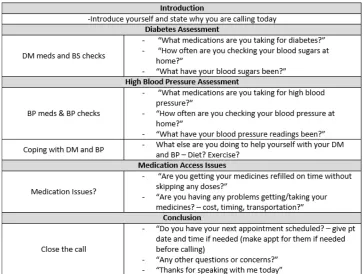
Following the PCP visit, geriatrics committee members contacted assigned patients by phone to evaluate medication adherence, provide medication education, and encourage self-management behaviors (eg, monitoring home blood pressure and glucose). For each phone call, geriatrics com-mittee members utilized a script to direct the conversation
(Figure 1), documented a telephone note in the EMR, and
routed the note to the PCP with any further intervention recommendations. Follow-up phone calls occurred monthly until patients progressed towards their disease state goals, then every 3, 6, or 12 months. Committee members met monthly to discuss improvements using plan-do-study-act methodology and review patient cases.
Design
This was an Institutional Review Board approved, quasi-experimental, pre–post study comparing data from 1 year before implementation to 1 year after implementation of the interprofessional medication self-management program. For data collection, only values measured in the study clinic were recorded. Before the study, clinic staff were trained on cor-rectly obtaining readings using electronic blood pressure monitors and weight scales. Clinic laboratory staff used
a consistent process for A1C testing (point-of-care test, DCA Vantage®Analyzer by Siemens). The primary outcome was the mean of all blood pressure and A1C values from each PCP visit during 1 year before implementation compared to the mean of all values 1 year after implementation. Secondary outcomes included blood pressure and A1C changes from baseline to each follow-up, adverse effects, and pre–post number of chronic medications. Paired t-tests were used to analyze pre–post data, and descriptive statistics were used for other data.
Results
Fifty patients met inclusion criteria, and all 50 were enrolled in the study, with a mean age of 67 years; 78% were female, 88% were black, 18% were smokers, 41% had a cardiovascular disease diagnosis, and 22% had chronic kidney disease. The mean systolic blood pressure at baseline was 159.8 mm Hg, the mean diastolic was 75.0 mm Hg, and the mean A1C was 9.7% (Table 1).
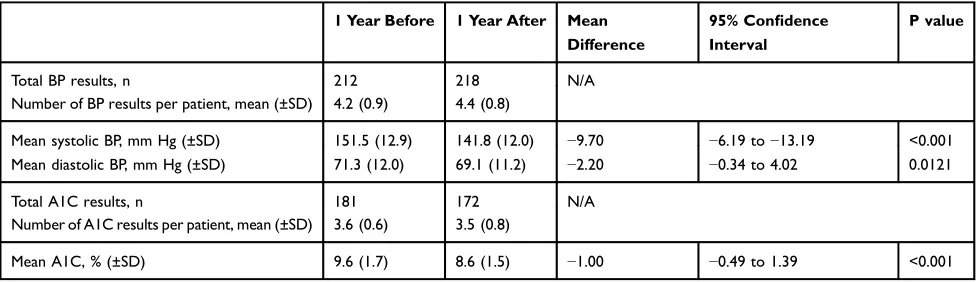
The 1-year mean systolic blood pressures were signifi -cantly reduced after implementation [151.5 mm Hg vs 141.8 mm Hg, −9.7 mm Hg difference, 95% confidence interval (CI) −6.19 to −13.19, P < 0.001] (Table 2). Likewise, the 1-year mean A1C was reduced significantly (9.6% vs 8.6%,−1.0% difference, 95% CI−0.49 to−1.39,
Figure 1Patient follow-up telephone call script.
Patient Preference and Adherence downloaded from https://www.dovepress.com/ by 118.70.13.36 on 26-Aug-2020
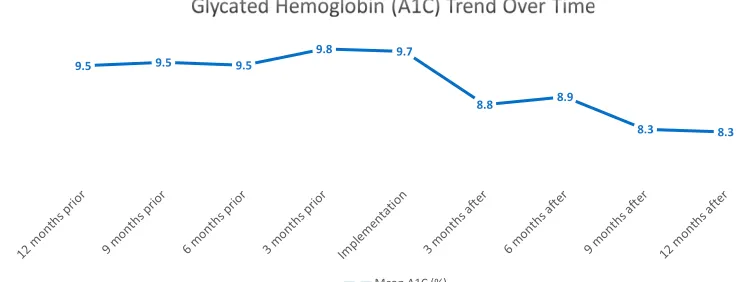
P < 0.001). Compared to baseline (Table 3), the mean systolic blood pressure was significantly lower at each follow-up visit (Figure 2), and the same trend was seen for A1C (Table 4, Figure 3). Diastolic blood pressure significantly improved at each follow-up, except for the 3-month (Table 3). Two
patients experienced low blood pressure (90s/60s mm Hg) with dizziness, and 1 patient had asymptomatic low blood glucose (70 mg/dL). None of these patients experienced severe symptoms, and no further treatment other than de-prescribing was required. No patients in our study experi-enced severe adverse events. Although blood pressure and A1C were reduced, the mean number of medications was the same at 1 year (8.26 vs 8.36, 95% CI −0.50 to 0.30, P = 0.6166).
Discussion
Significant improvements in systolic blood pressure and A1C were observed and sustained following implementation of the interprofessional medication self-management support program. Of note, we utilized the Eighth Joint National Committee in addition to the American Diabetes Association guidelines to determine goals for blood pressure (<140/90 mm Hg) and A1C (<7.0–8.5%).13,14 Ultimately, blood pressure and A1C goals were chosen using a combination of these national guidelines, patient-specific medical history, and PCP decision-making. Since the time of this research, the American College of Cardiology and
Table 1Patient Characteristics
Patients, n 50
Mean age, years (± SD) 67.1 (5.0)
Females, n (%) 39 (78.0)
Males, n (%) 11 (22.0)
Black or African American, n (%) 44 (88.0) Other race or ethnicity, n (%) 4 (8.0)
White or Caucasian, n (%) 2 (4.0)
Mean systolic blood pressure, mm Hg (±SD) 159.8 (22.2) Mean diastolic blood pressure, mm Hg (±SD) 75.0 (17.2) Mean hemoglobin A1C, % (±SD) 9.7 (2.1) Mean baseline weight, kg (±SD) 90.8 (23.5) Mean body mass index, kg/m2(±SD) 33.5 (7.0)
Smokers, n (%) 9 (18.0)
Cardiovascular disease, n (%) 22 (41.0) Chronic kidney disease, n (%) 12 (22.0) Number of chronic medications, mean (±SD) 8.26 (2.67)
Table 2Blood Pressure (BP) and Glycated Hemoglobin (A1C) Pre–Post Implementation
1 Year Before 1 Year After Mean
Difference
95% Confidence Interval
P value
Total BP results, n 212 218 N/A
Number of BP results per patient, mean (±SD) 4.2 (0.9) 4.4 (0.8)
Mean systolic BP, mm Hg (±SD) 151.5 (12.9) 141.8 (12.0) −9.70 −6.19 to−13.19 <0.001 Mean diastolic BP, mm Hg (±SD) 71.3 (12.0) 69.1 (11.2) −2.20 −0.34 to 4.02 0.0121
Total A1C results, n 181 172 N/A
Number of A1C results per patient, mean (±SD) 3.6 (0.6) 3.5 (0.8)
Mean A1C, % (±SD) 9.6 (1.7) 8.6 (1.5) −1.00 −0.49 to 1.39 <0.001
Table 3Blood Pressure (BP) at Baseline and Each Follow-Up Visit
Baseline 1-Month 3-Month 6-Month 9-Month 12-Month
Patients per visit, n 50 36 44 48 43 46
Mean systolic BP, mm Hg (±SD) 159.8 (22.2) 139.4 (18.0) 144.3 (25.0) 144.9 (22.5) 141.0 (16.3) 140.9 (15.0)
Mean differencea, mm Hg N/A −20.40 −15.50 −14.90 −18.80 −18.90
P valuea N/A < 0.001 0.0003 <0.001 <0.001 <0.001
95% CI N/A −14.64 to−28.81 −7.41 to−22.95 −7.91 to−22.63 −12.89 to−25.89 −12.54 to−26.85 Mean diastolic BP, mm Hg (±SD) 74.8 (17.4) 68.1 (15.0) 71.3 (14.8) 69.9 (12.1) 67.8 (12.8) 67.4 (13.5)
Mean differencea, mm Hg N/A −6.7 −3.5 −4.9 −7 −7.4
P valuea N/A <0.001 0.2513 0.0133 0.0023 0.003
95% CI N/A −3.89 to−13.14 −1.50 to 5.59 −1.16 to−9.43 −2.53 to−10.87 −2.89 to−13.23
Note:a
Compared to baseline.
Abbreviation:CI, confidence interval.
Patient Preference and Adherence downloaded from https://www.dovepress.com/ by 118.70.13.36 on 26-Aug-2020
American Heart Association Task Force introduced a recommended systolic blood pressure goal of <130 mm Hg in patients aged 65 or older who are noninstitutionalized, ambulatory and community-dwelling. Additionally, this new set of guidelines recommends treating diabetes patients to a goal blood pressure of <130/80 mm Hg.15
In residency clinics, patients experience a higher fre-quency of PCP turnover due to residents graduating and new PCP assignments every 1–3 years. This is a challenge to patient–physician relationships and continuity of care. The outreach by staff helps to improve continuity and can become influential in efforts to sustain the patients’ self-management support system. Patient assignments to team members included consideration of any existing relation-ship staff already had with patients identified for the study. Clinical improvements may wane over time, reinforcing our observations that ongoing support is needed to sustain positive outcomes long term.8
It is also essential to maintain a blame-free environ-ment when addressing medication adherence.6Using moti-vational interviewing and empathetic listening, we devised patient-centered solutions to medication self-management. Patient feedback at office visits and during phone call coaching discussions indicated that the personal connec-tion enhanced their trust in the coaching recommendaconnec-tions
and subsequently the impact of the interventions. Patient responses reflected that they were willing to participate in their own self-management because their physician’s office team “cared.”
Initially, for thefirst post-visit 1-month follow-up, each team member called 8–10 patients every month. As the study progressed and the patient follow-up intervals increased, each member had fewer patient calls to make monthly. The monthly call reduction based on actual patient “successes”reinforced staff engagement not only because the call frequency volume decreased but also because they, like the patients, could see the resulting A1C and/or systolic blood pressure improvements.
National medication adherence quality initiatives uti-lize prescription claims data to track adherence outcomes.16 In the aforementioned study evaluating a pharmaceutical care program for older adults, medica-tion adherence using the Morisky–Green test was found to be significantly better for patients in the pharmaceutical care program (50.5% of adherent patients at baseline, 83.5% after 36 months; P < 0.001).11 Using dispense history, adherence improved from 52.6% to 83.5% (P < 0.001). In the usual care group, no significant improve-ments were seen with clinical outcomes or adherence. For our study, we did not have direct access to prescription 151.6 153.1 149.8
147.6
155.3
159.8
139.4
144.3 144.9
141.0 140.9
12 months prior 9 months prior 6 months prior 3 months prior 1 month prior Baseline 1 month after 3 months after 6 months after 9 months after 12 months after
Mean Systolic Blood Pressure (mm Hg)
Figure 2Systolic blood pressure trend.
Table 4Hemoglobin (A1C) at Baseline and Each Follow-Up Visit
Baseline 3-Month 6-Month 9-Month 12-Month
Patients per visit, n 50 40 47 44 43
Mean A1C, % (±SD) 9.7 (2.1) 8.8 (2.0) 8.9 (2.1) 8.3 (1.5) 8.3 (1.7)
Mean differencea, % N/A −0.90 −0.80 −1.40 −1.40
P valuea N/A < 0.001 0.0024 < 0.001 < 0.001
95% CI N/A −0.39 to−1.33 −0.40 to−1.32 −0.82 to−1.96 −0.62 to−2.02
Note:a
Compared to baseline.
Abbreviation:CI, confidence interval.
Patient Preference and Adherence downloaded from https://www.dovepress.com/ by 118.70.13.36 on 26-Aug-2020
claims data. Our medication self-management program was non-funded and required team members to dedicate time out of their regular schedules, limiting the ability to track adherence. Instead, we deduced that patients with both uncontrolled hypertension and uncontrolled diabetes likely have medication adherence challenges, and we elected to measure clinical outcomes. More team mem-bers or time allocated may expand capabilities. Contacting pharmacies for medication refill history can be time intensive. By the end of our study, our EMR platform gained the ability to capture refill data, improv-ing efficiency.
Many patients in our clinic are indigent or havefinancial, literacy, other access barriers, which adds to the vulnerability of this older population. In the US, significant healthcare disparities exist for vulnerable populations, leading to worse outcomes.17These patients may face stigmas or challenges to care such asfinancial barriers, having low health literacy, or being under- or uninsured. Since we did not depend on payer data for our intervention, we provided the medication self-management service to patients regardless of insurance or
financial status, minimizing healthcare disparities.
All 50 patients who met inclusion criteria were enrolled and followed for 1 year. Population numbers were not exactly 50 at every follow-up interval for various reasons. Patients may not be due for follow-up appoint-ments at the exact intervals expected for research, consid-ering that the study was conducted in a clinical setting rather than a research environment. Additionally, patients may have cancelled or not shown for their appointments. If a patient cancelled or did not show for an appointment, team members re-scheduled the appointment. Also, patients who improved toward clinical goals required less frequent follow-up as time progressed.
The number of medications did not change signifi -cantly, likely due to our focus on adherence to currently prescribed medications. In some cases, therapy was de-escalated. This suggests that working with patients to adhere tofirst-line therapies can obviate the need to inten-sify therapy to achieve disease state goals. We did not quantify interventions due to the wide variety of scenarios encountered. For instance, discussing timing of when med-ications were taken during the day, travel contingencies to taking medications, switching to combination medications for regimen simplicity, customizing dietary interventions, and including family members and caregivers into home care illustrate the variety of interventions performed. Other clinic settings may have more feasible environments and methods for tracking numbers and types of interventions.
Medications should be titrated cautiously for patients who have a history of non-adherence. Patients may inad-vertently risk overtreatment (hypotension or hypoglyce-mia) when going from not regularly taking medications to adhering to multiple medications as prescribed. It is possible that evaluating lifestyle during follow-up calls made an impact on our outcomes. However, lifestyle man-agement services in our clinic did not change during the time of the study.Figures 2and3illustrate the association between this quality initiative and blood pressure and A1C improvements. There were no other new hypertension or diabetes quality initiatives implemented during the time of our study. Improvements in blood pressure and A1C beyond those achieved in our study should be explored using non-pharmacologic approaches.
In general, systolic blood pressure reductions of the mag-nitude seen in our study can reduce the risk of death from stroke and ischemic heart disease by about 50%.18In diabetic patients, this magnitude of blood pressure reduction is
9.5 9.5 9.5 9.8 9.7
8.8 8.9
8.3 8.3
Mean A1C (%)
Figure 3Glycated hemoglobin (A1C) trend.
Patient Preference and Adherence downloaded from https://www.dovepress.com/ by 118.70.13.36 on 26-Aug-2020
associated with a reduced risk of all-cause mortality by 50% and cardiovascular mortality by 70%.19Similarly, each 1% reduction in A1C can reduce the risk of diabetes-related death by 21%, myocardial infarction by 14%, and microvas-cular complications by 37%.20Studies are needed to evaluate the impact of these initiatives on cardiovascular outcomes.
Conclusions
An interprofessional medication self-management program in an internal medicine primary care residency clinic improved blood pressure and glucose for underserved older patients with both uncontrolled hypertension and uncontrolled diabetes.
Af
fi
liated Institutional Review Board
This study received expedited review approval from Cone Health Institutional Review Board. Patient consent was waived due to the quality improvement process utilized, minimal risk involved with patients included in the study, de-identification of data, and secure data management, in compliance with the Declaration of Helsinki.
Disclosure
The authors report no conflicts of interest in this work.
References
1. Ritchey M, Chang A, Powers C, et al. Vital signs: disparities in antihypertensive medication nonadherence among medicare part
D beneficiaries – United States. MMWR Morb Mortal Wkly Rep.
2014;65:967–976. doi:10.15585/mmwr.mm6536e1
2. National Committee for Quality Assurance. Comprehensive diabetes
care. Report Cards.2017. Available from:
http://www.ncqa.org/report-cards/health-plans/state-of-health-care-quality/2017-table-of-contents /diabetes-care. Accessed April 4, 2020.
3. Freid VM, Berstein AB, Bush MA. Multiple chronic conditions among adults aged 45 and over: trends over the past 10 years.Centers Dis Control Prev Nat Center Health Stat.2012. Available from:https://www.cdc.gov/ nchs/data/databriefs/db100.pdf. Accessed April 4, 2020.
4. Kalyani RR, Golden SH, Cefalu WT. Diabetes and aging: unique
considerations and goals of care. Diabetes Care. 2017;40
(4):440–443. doi:10.2337/dci17-0005
5. Lee JK, Grace KA, Taylor AJ. Effect of a pharmacy care program on medication adherence and persistence, blood pressure, and low-density
lipoprotein cholesterol: a randomized controlled trial.JAMA.2016;296
(21):2563–2571. doi:10.1001/jama.296.21.joc60162
6. Brown MT, Bussell JK. Medication adherence: WHO cares?Mayo
Clin Proc.2011;86(4):304–314. doi:10.4065/mcp.2010.0575 7. Marek KD, Stetzer F, Adams SJ, Kelly L. Cost utility analysis of a
home-based nurse care coordination program.Nursing Eco.2018;36
(2):83–87.
8. Vik SA, Maxwell CJ, Hogan DB. Measurement, correlates, and
health outcomes of medication adherence among seniors. Ann
Pharmacother.2004;38:303–312. doi:10.1345/aph.1D252
9. Sleeper RB. Challenges in geriatric care. In: Fundamentals of
Geriatric Pharmacotherapy [edited by Lisa C. Hutchins], 2nd ed.
Bethesda, MC: ASHP Publications;2015:15.
10. Obreli-Neto PR, Marusic S, de Lyra Junior DP, et al. Effect of a 36-month pharmaceutical care program on coronary heart disease risk
in elderly diabetic and hypertensive patients.J Pharm Pharmaceut
Sci.2011;14(2):249–263. doi:10.18433/J3259Q
11. Obreli-Neto PR, Guidoni CM, de Oliveira Baldoni A, et al. Effect of a 36-month pharmaceutical care program on pharmacotherapy
adher-ence in elderly diabetic and hypertensive patients.Int J Clin Pharm.
2011;33:642–649. doi:10.1007/s11096-011-9518-x
12. Nurses Improving Care for Healthsystem Elders (NICHE). 2018.
Available from: http://www.nicheprogram.org/. Accessed April 4,
2020.
13. James PA, Oparil S, Carter BL, et al. 2014 evidence-based guideline for the management of high blood pressure in adults report from the panel members appointed to the eighth Joint National Committee
(JNC 8).JAMA.2014;311(5):E1–E14.
14. American Diabetes Association Standards of Medical Care in
Diabetes. Older adults.Diabetes Care.2016; 39 (Suppl. 1): S81–S85.
15. Whelton PK, Carey RM, Aronow WS, et al. 2017 ACC/AHA/AAPA/ ABC/ACPM/AGS/APhA/ASH/ASPC/NMA/PCNA guideline for the prevention, detection, evaluation, and management of high blood pressure in adults: a report of the American College of Cardiology/ American Heart Association Task Force on Clinical Practice
Guidelines.J Am Coll Cardiol.2018;71:e127–e248. doi:10.1016/j.
jacc.2017.11.006
16. Pharmacy Quality Alliance. Update on medication quality measures
in medicare part D plan star ratings-2018. PQA Measures. 2018.
Available from: http://pqaalliance.org/measures/cms.asp. Accessed
April 4, 2020.
17. Joszt L. Five vulnerable populations in healthcare.Am J Manag Care.
2018. Available from:https://www.ajmc.com/newsroom/5-vulner
able-populations-in-healthcare. Accessed April 04, 2019.
18. Lewington S, Clarke R, Qizilbash N, Peto R, Collins R. Age-specific
relevance of usual blood pressure to vascular mortality: a meta-analysis of individual data for one million adults in 61 prospec-tive studies.Lancet.2002;360:1903–1913.
19. Tuomilehto J, Rastenyte D, Birkenhäger WH, et al. Effects of calcium-channel blockade in older patients with diabetes and systolic
hypertension. N Engl J Med. 1999;340(9):677–684. doi:10.1056/
NEJM199903043400902
20. Stratton IM, Adler AI, Neil AW, et al. Association of glycaemia with macrovascular and microvascular complications of type 2 diabetes
(UKPDS 35): prospective observational study. BMJ. 2000;321:
405–412. doi:10.1136/bmj.321.7258.405
Patient Preference and Adherence
Dove
press
Publish your work in this journal
Patient Preference and Adherence is an international, peer-reviewed, open access journal that focuses on the growing importance of patient preference and adherence throughout the therapeutic conti-nuum. Patient satisfaction, acceptability, quality of life, compliance, persistence and their role in developing new therapeutic modalities and compounds to optimize clinical outcomes for existing disease
states are major areas of interest for the journal. This journal has been accepted for indexing on PubMed Central. The manuscript management system is completely online and includes a very quick and fair peer-review system, which is all easy to use. Visit http:// www.dovepress.com/testimonials.php to read real quotes from pub-lished authors.
Submit your manuscript here:https://www.dovepress.com/patient-preference-and-adherence-journal
Patient Preference and Adherence downloaded from https://www.dovepress.com/ by 118.70.13.36 on 26-Aug-2020