Licensed under Creative Common Page 668
http://ijecm.co.uk/
ISSN 2348 0386
PUBLIC RELATIONS AS A MEASURE OF CHECKING
ENVIRONMENTAL POLLUTION IN NIGERIA
Anatsui, Tina. C.
Department of Mass Communication, Babcock University, Iisan- Remo, Ogun State, Nigeria [email protected]
Ojunita, Law
Department of Mass Communication, Babcock University, Iisan- Remo, Ogun State, Nigeria
Abstract
This paper emphasizes on the environmental pollution and its consequences on human lives. It
also draws attention to the many unfortunate consequences that arise from human and
corporate neglect on the abuse of the environment. It advocates that man is
environment-dependent and there is need for man to be environment conscious through effective Public
relations. The study made use of quantitative data analysis and as well as empirical secondary
data. Employing purposive sample technique, for eliciting information from those who are
knowledgeable on the research questions asked. The finding of the study proved that Public
relations is inevitable for effective grassroots mobilization on environmental issues in Nigeria,
which calls for an urgent need to create awareness and knowledge about environment and to
challenge the people to become engaged in and takes responsibility of the environmental
problems of the society. It also recommends a guide-dog approach of journalism to
environmental issues, problems and challenges in Nigeria.
Keywords: Public relations, Pollution, Environment, Environmental management, Corporate
Licensed under Creative Common Page 669 INTRODUCTION
Walter Lipman, [1922], propounded the ‘Agenda-setting theory’ which argues that the Mass Media creates images of events in our minds and that policy-makers should be cognizant of those ‘pictures in people’s heads. Cohen, [1963] also notes that the press may not be successful most of the times in telling people what to think, but is stunningly successful in telling people what to think about. Thus the Media shape not direct opinions about a topic but rather the very topics that were seen as important enough to have opinions about.
For example, individuals watching the news on television or reading Newspaper would agree that environmental pollution, for instance: Niger Delta and Oil Companies, AIDS. Post Amnesty programme, etc are important issues of the day. The theory implies that the Mass Media pre-determine what issues are regarded as important at a given time in a given society.
It also ascribes to the Media, not only the power to determine what we are actua1ly thinking, but it does ascribe to them the power to determine what we are thinking about. The elements involved in this theory include: the quantity or frequency of reporting of such issues, the prominence given to the reports through headline display, pictures and layout in newspapers or timing on radio and television. Therefore, agenda-setting is the process whereby the news Media would lead the public into assigning relative importance to various issues which could be environmental issues and its causes and consequences.
Nigeria as a case study has no State –supported welfare system, instead most people rely on their extended families in difficult times and in old age. Medical care is provided for government and commercia1 enterprises, but it is wanting among the rest of the population. Despite several attempts at reform, many Nigerians still lack access to primary health care, largely because the greater majority of treatment centers are located in large cities. Facilities are often under staffed and under equipped. The result has been an infant mortality rate of 99 per 1,000 births and a life expectancy of 47 years, [UNESCO.2006].
The 1991 and 2006 Census Reports show that human activities accounts for the major cause of these pollution or problems, and it occurs ‘through four ways namely: Over exploitation, over-grazing, deforestation and poor irrigation practices, and these factors are influenced by other variables such as changes in population, climate and socio-economic condition.
Licensed under Creative Common Page 670 Environmental pollution is a human activity and it should be communicated as such. Unless all and sundry get involved. The involvement must result in a change of attitudes and practices; they must identify their health needs based on an understanding of the causes and consequences of environmental pollution on their health and national development and the ways to mitigate its effects.
The issues of environmental degradation, conservation, protection, sanitation and management, is now a serious issue that occupies the centre-stage in the corporate growth and survival policies of most business and non-business organizations. This global trend or focus on the environment can be traced to the United Nations Conference on the Environment held in Stockholm, Sweden in 1972. It draws attention to the many unfortunate consequences that arise from human and corporate neglect on the abuse of the environment. It also warned that the environment can no longer be taken for granted. That deliberate, concrete action should be taken by individuals and corporate organizations to conserve, protect, renew and maintain a healthy environment for continued human survival, growth and sustainable development.
For instance, a developing country like Nigeria has established the Federal Environmental Protection Agency [FEPA] and other related environmental sanitation or conservation organization to redirect individuals, groups and corporate entities towards the attainment and sustenance of a healthy environment in the country at all levels.
These organizations set guidelines, monitor and check actions or inaction related to environmental preservation or protection. Also various laws had enacted to empower them to carry out these functions as to promote healthy environmental habits among individuals and corporate organizations in the country. Currently more attention is geared towards the Oil and Petrochemical industry in Nigeria. Most of the operations of the companies that belong to this industry affect the environment in one way or the other.
All these strategies and policies can not successfully achieve this objective without total involvement of Public Relations as communication process, an adjunct of Mass Media for the successful creation of environmental consciousness and preservation in Nigeria.
Statement of the problem
Licensed under Creative Common Page 671 Adegoroye, [1997:12-14], asserts that “environmental problems manifest in various forms and dimensions, and their effects are felt locally, nationally, continentally and globally. He further opines that every state in Nigeria across the ecological zones suffer from one form of environmental degradation or the other such as: erosion due to drought and desertification, gully erosion, flooding, sewage problems, deforestation, agro-chemicals, bush burning, oil pollution, gas flaring and mining waste lands, industrial pollution, vehicle pollution, noise pollution and toxic waste dumping are very common.
Cancer and Malaria are the leading causes of death in Nigeria, and is likely to remain so due to environmental pollutions such as: Oil spills, toxic waste, industrial and vehicle emission, epidemics etc. The Nigerian government for instance, has been unable to halt preventable illnesses such as: measles, whooping cough, polio, cerebrospinal meningitis, and diarrhea, [Alfred, & Joseph, 2006] as result of problem of pollution in Nigeria.Public relations is under-utilized in the dissemination of environmental issues in Nigeria. The effective public relations is urgently needed to communicate these ills and its consequences to the masses for better mobilization, understanding and cooperation
Purpose of the Study
To draw attention to the many unfortunate consequences of human and corporate neglect on the abuse of the environment in Nigeria.
To ensure deliberate and concrete action is taken by individuals and corporate organizations to conserve, protect and maintain a healthy environment for continue human survival, growth and sustainable development.
Urgent need for more precise, organized and effective Public relations efforts in communicating environmental issues, problems and challenges in Nigeria.
The inevitability of Public relations as measure of checking environmental pollution in Nigeria
CONCEPTS ANALYSIS, DEFINITION AND EXPLANATION
Communication Process Theory
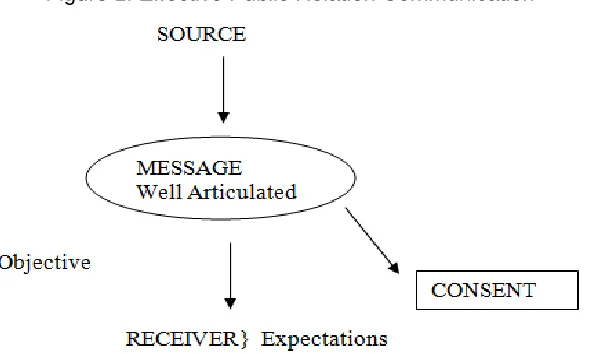
Licensed under Creative Common Page 672 Figure 1. Effective Public Relation Communication
Source: Kunle Oshodi-Glover [2004] ABC of Public Relations: Francisgraphix Ltd. Pp 74
The figure above indicates that the source has a message with an intended objective. Kunle [2005:74], asserts that the message from the source should be well articulated so that the receiver or audience who has expectations concerning an issue of importance can develop consent. The audience affected by the set objective must be identified, analyzed and classified according to their interest. People cannot be carried along without their consent because the support for any given cause must emanate from understanding which marries the articulation of the message with expectation
Since a public relations is social science which introduces the human factor into management, it has the responsibility of teaching us how to predict and control the reactions of individual or groups to a given situation or stimulus. Psychologists refer to this as Stimulus-Response Theory [SRT]. Therefore, there is an urgent need for more precise, organized and effective Public Relations efforts in managing the environment for national growth and sustainability
What is a Public Relations?
Licensed under Creative Common Page 673 Nwosu, [2004], states that Pubic Relation’ is the profession that influences public opinion or attitude in such a positive direction, understanding and acceptance. It establishes a two-way communication to ensure mutual understanding, or resolve conflicts of interest between individuals, organizations and their publics.
In these definitions a common observation and perhaps the prescriptions of Public relations relevant to this work include influencing public opinion or attitude in a positive direction. It is not only to communicate or to enlighten, but to gain the necessary goodwill and understanding for a proper business climate.
What makes Public Relations Inevitable?
Sam Black [2000:1], opines that the purpose of public relations practice is to establish a two-way communication channel seeking common ground or areas of mutual interest and to establish understanding based on truth, knowledge and adequate information.
Public Relations principles recognize that a pro-active approach is the best philosophy for addressing issues that lead to conflict or crisis. Supporting this view, Akinyemi, [1993:99], contends that “the best tool for managing crisis is making sure that crises do not arise by using the regular Public relations strategy of a planned and sustained programme of communication”.
Nkwocha, [199:192], advises that it is profitable to employ “Crisis Management” rather than management of crisis, which means taking appropriate measures to prevent crisis before it occurs. Therefore, pollution itself is crisis that needs proactive approach to mitigate it effects.
Public Relations as a communication process is mostly needed when the issue of campaign needs aggressive mobilization. Therefore, the PR practitioners are specialized, skilled, trained and professionally capable to handle the issue of environmental problems in Nigeria. Public Relations has the capability and ability in creating conscious awareness in the minds of the populace. They can employ: Agenda Setting theory strategy, effective two-way communication and persuasion as means for effective mobilization and to internalize certain issues in the people’s minds.
Licensed under Creative Common Page 674 Public Relations practitioners play a more strategic role in deliberate strategic formulation by getting involved in decisions on what needs to be communicated about, and secondly, pointing out the consequences of communicating certain strategic positions/goals/priorities and thereby making suggestion on how it could be handled more effectively.
Public Relations “educates” and “enlightens” the public to accept ideas which could be local and national mobilization. Since a Public Relations is a social science which introduces the human factor into management, it has the responsibility of teaching how to predict and control the reactions of individuals or groups to a given situation or stimulus. Psychologists refer to this as Stimulus-Response Theory [SRT]. Public Relations is about communication; about persuading people to accept ideas and taking action along a specific line, and also about creating a conducive environment for growth and development.
Salu [1993: 70], asserts that wherever man exists, communication must take place and the communication must be planned. It must be orderly to be effective and it helps understanding and cooperation. It is to be understood that the aim of Public Relations in any country is to ensure that all concerned [internal and external publics] have a better understanding of the institution’s policies and the “modus operandi” of executing such policies.
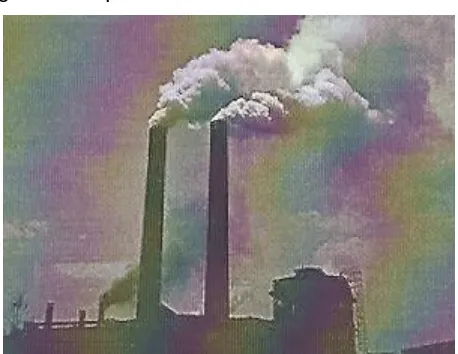
The landmark case of consciousness in environmental journalism in Nigeria was the dumping of toxic waste in KOKO, DELTAState in 1988, and the pandemonium in Lagos in March 2006, due to sudden change in the atmospheric condition of the weather. The way and manner the mass media reported the case confirmed the indispensable the media is in upholding and building a sane environment. The example below authenticates the subject matter of the study.
Figure 2: Air pollution from World War II Production
Licensed under Creative Common Page 675 This is the period when pollution began to draw public attention in the United States between the mid-1950s and early 1970s; it is through the effort of Mass Media that the Congress passed the Noise Control Act, the Clean Air Act, the Clean Water Act and the National Environmental Policy Act, [www.Wikipedia.com]. The illustrations enable one to understand the power of public relations in communicating issues of national interest, as to provoke government into action and public discussion.
What is Environment?
Oxford Advanced Learner’s dictionary [2001], defines environment as the conditions that affect the behavior and development of somebody or something. Environmental is connected with the natural conditions in which people, animals and plants live.
Pollution is the introduction of contaminants into the environment that cause instability, disorder, harm or discomfort to the physical systems or living organisms. Pollution can take the form of chemical substances, or energy such as noise, heat, or light energy. The elements of pollution can be foreign substances or energies when naturally occurring. They are considered contaminants when they exceed natural levels. It is often classed as point source or non-point source pollution [www.Wikipedia.com].
Major Forms of Pollution
Pollution in Nigeria is of various forms according to Adeyinka, Bankole, and Solomon, [2005]: These include:
Sheet erosion, gully erosion, coastal marine erosion and land subsidence which occur particularly in the coastal areas.
Flooding occurs in Nigeria in three main forms; coastal flooding, river flooding and urban flooding
Air pollution from spills, oil well blowout, oil ballast discharges and improper disposal of drilling mud from petroleum prospecting and so.
Public Relations Proactive Strategies for Checking Environmental Pollution
Effective Communication
Licensed under Creative Common Page 676 thoughtful planning, the Public Relations practitioner is better prepared to encounter environmental problems and issues with a measure of calm and success. Tools for pro-active management are: information, knowledge and communication [IKC].
A massive educational and enlightenment campaign
This is aimed at informing, educating and sensitizing the public[s] on the impact of environmental pollution, causes of environmental degradation, and devastating activities on the environment and its effect on human existence. Using Public Relations strategic communication which is faced with the challenges of unraveling and simplifying the complexity of environmental issues to ensure sound understanding among the stakeholders, using skills of innovation, creativity, adaptability, imagination and decision making.
Identification and Prioritization of Environmental Issues
It involves the bottom-up planning process that consists of carrying entire stakeholders along. The stakeholders are those whose interest are affected, those who possess relevant information and expertise, and those who control relevant implementation instruments.
All the stakeholders should be invited to join in the planning process. Stakeholders include private individuals, Informal organizations, state government, institutional organizations, local government, professional bodies, and international agencies. These are also incorporated to focus on several major environmental issues, providing a forum for discussing of future development, so that there would be effective collaboration through public meetings, consultation and working sessions.
Mobilization of Working Group Members
The Working Group should be established to address the prioritized environmental issues. UNCHS, [1996], a working Group [WG] is an international and cross-sectional group established to address any environmental issue of concern. They are to be seen as a forum where ideas are generated, resources are mobilized for project implementation and a platform for information sharing.
An Independent Monitoring Committee
Licensed under Creative Common Page 677 Evaluation
An evaluative criteria and or standards have to be established from onset: An evaluative committee comprising of experts and credible individuals for a periodic review of the success and to find way forward.
METHODOLOGY
The population of the study comprised of 50 lecturers of School of Basic and Allied Sciences of Babcock University, irrespective of age, gender, ethnic and religion. Respondents were selected using convenience sampling. The study adopted quantitative data analysis, and employed purposive sample technique, due to the fact that the respondents are knowledgeable on the topic of the study. In the presentation and analysis of data collected, the study employed frequency distribution tables and simple percentages. It also uses primary and empirical secondary data.
The likert three scale method of data analysis was used to analyze the data. This technique is a psychometric scale commonly used in information and mostly in the distribution of questionnaires. It has to do with the sum of responses ranging from: A (Agree), U (Undecided), D (Disagree) found in the three point scale, whereby, the respondent of the questionnaire may not be certain about a statement and thus is un-decisive and may tick the space undecided. In analysis of likert’s three point scale, a process of coding of the data has to be done. This is to enhance a swift and easier interpretation of data.
3 2 1
A UD D
Licensed under Creative Common Page 678 ANALYSIS AND FINDINGS
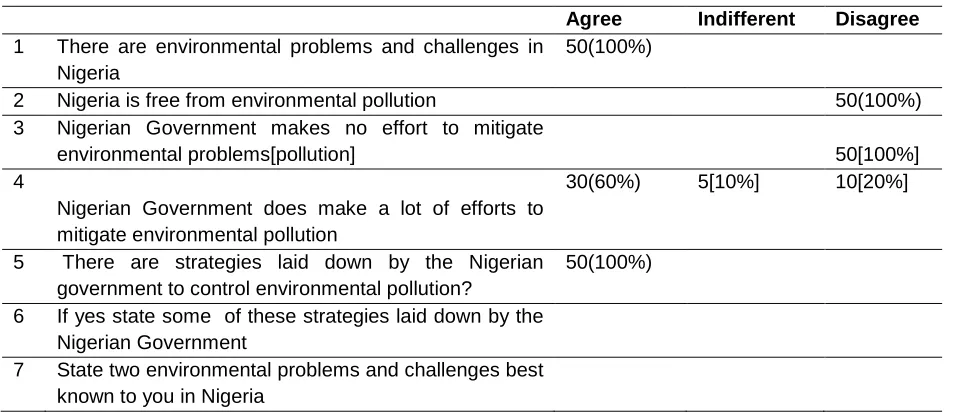
Table 1: Responses on Questionnaire for School of Basic and Applied Sciences
Agree Indifferent Disagree
1 There are environmental problems and challenges in Nigeria
50(100%)
2 Nigeria is free from environmental pollution 50(100%)
3 Nigerian Government makes no effort to mitigate
environmental problems[pollution] 50[100%]
4
Nigerian Government does make a lot of efforts to mitigate environmental pollution
30(60%) 5[10%] 10[20%]
5 There are strategies laid down by the Nigerian government to control environmental pollution?
50(100%)
6 If yes state some of these strategies laid down by the Nigerian Government
7 State two environmental problems and challenges best known to you in Nigeria
Tables 1, in item 1, the 50 respondents representing 100%, were of the opinion that there are environmental problems and challenges in Nigeria. Therefore, the study has proved beyond reasonable doubt that there are environmental problems and challenges in Nigeria. In support of item 1 above, item 2 proves that Nigeria is not free from environmental pollution, in which 50 respondents representing 100% disagreed that Nigeria is free from environmental pollution. While, item 3, all the respondents disagreed that Nigerian Government makes no efforts to control or militate the pollution in Nigeria. While, in item 4 proves that Nigerian Government is making effort to militate or if possible to eradicate the environmental pollution for human and national development, though there were mix feelings regard to that question.
While, in item 6 above, the respondents revealed the following efforts or strategies laid down by Nigerian Government to militate the environmental pollution. Some of the laid down strategies are:
National Environmental Sanitations
Recycling of Waste in Lagos Western Part of Nigeria
Reduction in Gas Flaring by Nigeria Liquidized Natural Gas Ltd.
Establishment of Environmental Protection Agency
Local and State Government Environmental Commission
Vehicle Waste Control and Proper Disposal of Waste
Federal Road Safety Commission
Licensed under Creative Common Page 679 In item 7 above, the respondents exposed some of the environmental problems and challenges best known to them such as:
Indiscriminate waste disposal- smelling in littering and blocking drainages
Oil spillage in Southern part of Nig.
Air pollution caused by local individual generators [smoke]
Water pollution caused by oil mining in southern part of Nig.
Air pollution from industries
Global warming or excessive heat
Erosion and flooding
Indiscriminate sewage disposal
Gully erosion in the Eastern part of Nig.
Environmental pollution thru gas emission from industries using generators and vehicles
Deforestation- uncontrolled cutting of trees without planting back and desert encroachment and so on.
The study also authenticates that the majority of environmental pollution in Nigeria is man-made, as a result of the action or inaction of man’s abuse and neglect in the environment. Census Report [2006] asserts that about 80% of industries in Nigeria discharge liquids, solid and gaseous wastes directly into the environment without adequate treatment that meet the basic standards. Nigerian industries also lack waste treatment facilities, so the solid wastes are most times disposed of in environmentally insecure dumpsites
CONCLUSION AND RECOMMENDATIONS
The paper exposes the inevitability of Public Relations for a successful and effective grassroots mobilization in Nigeria, especially on the environmental issues. For any organization or nation that strives to succeed both in stability, profitability and growth must embrace the proactive principles of Public relations approach as measure of checking environmental pollution for national development and sustainability.
This study recommends a replacement of the watch-dog role of Mass Media to that of a Guide-dog role. The basis for this recommendation is that the Mass Media watch dog role has been interpreted to meddlesomeness by both the government and the governed [Tejumaiye, 2004].
Licensed under Creative Common Page 680 ensuring that the society in which we live is made better for all. Guide dogging not only gives the people news and information but also help them do their jobs as citizens. It does not watch the environment, but also actually challenge the people to engage and take ownership of the problems of the society. The purpose is not to position the people as spectators, but as active participants in the societal problems and successes in solving those problems.
REFERENCES
Anatsui, C.C. [2007]: Public Relations Approach: Lagos: Published Colloquium Series of Babcock University
Adeyinka, M.A. & Bankole, P.O. [2005]: “Environmental Statistics, DakarSenegal: Situation of Federal Republic of Nigeria”
Gambol, S.A. [1979; An Agricultural Atlas of Nigeria, Ibandon: Oxford University Press.
Ajibade, 0. [2003], ‘Communication, Environmental Protection Campaign and Sustainable Development in Nigeria, Lagos: Unilag Communication Review, vol 4, no 1
CCD [1997] United Nation’s Convention to Combat Desertification in Countries Experiencing Serious Drought and /or Desertification.
Chambers, R. [2000]: Challenging the Profession: London: Frontiers For Rural Development, Internal Technology Publications
Census Report [2006] retrieved http://en.wikipedia.org/wiki/Pollution
Gari, L. [2002]: “ArabicTreatises on Environmental Pollution up to the End of the Thirteenth Century’, Environment and History 8[4], PP.475-1996.
Kunle, O. [2005] ABC of Public Relations Practitioners’ Companion, Lagos: Francisgraphix Limited. Nelson, P. [1994]: Ten practical Tips for Environmental Reporting, Center for Foreign Journalists Worldwide Fund for Nature; 11690- A Sunrise Valley DriveRestonVA22091
Nkwoacha, J. [1991]: Effective Media Relations Issues and Strategies, Lagos: Zoom Lens Publishers.
Nwosu, I.E. [2004]: Public Relations Management Principles, Issues, Applications, Enugu: Dominican Publishers
Mcquail, D. [2000]: Mcquail’s mass communication theory. London: Sage publication.
Mogu, V.C. [2008]. Paper presented at ACCE conference, Abrake-DeltaState: [unpublished work]. Onabajo, O. [2002], Elements of Rural Broadcasting. Lagos: Gabi Concept Limited.
Sharimakin, A. [2008]. Paper presented EBAN conference at Babcock University [Unpublished work] limited
Salu, A. [1993]. Understanding Public Relations, Task back publishers, Retrieved fromhttp://www.saching.com
World English Dictionary [2007]. North America Edition. Microsoft Corporation. Develop for Microsoft by Bloomsburg Publishing PLC