Licensed under Creative Common Page 360
http://ijecm.co.uk/
ISSN 2348 0386
STRATEGY CONTROL AND ORGANIZATION SOCIAL
PERFORMANCE: A CONCEPTUAL REVIEW
Charles Ondoro
Maseno University, Kenya
Abstract
It is argued that strategy control is responsible for favourable strategy implementation
outcomes. This paper aims at examining literature on strategic control and organization social
performance and expose literature gap and; propose an integrated conceptual framework for
strategic control and organization social performance. The study is anchored on control theory
and adopts library review approach. It explores, synthesizes and critiques literature on the
subject of strategic control and organization social performance. From the integrated review the
study develops a conceptual framework, exposes literature gap and recommends further
literature exploration and field studies by researchers.
Keywords: Strategic Control, Strategic Activities, Strategic Outcomes, Progress Tracking,
Intervention Mechanisms, Organization Social Performance
INTRODUCTION
Wheelen and Hunger (2015) defines strategic control as the process used by firms to control
the formation and execution of strategic plans. They contend that it is a specialized form of
management control which differs from other forms of management control in respect of its
need to handle uncertainty and ambiguity at various points in the control process. It focuses on
achievement of future goals rather than the evaluation of past performance. The point for
strategic control is not to bring to light past errors but to identify needed corrections so as to
steer the firm in the desired direction (Pearce and Robinson, 2009). A good strategic control can
ensure a top most position for the weakest firm among other superior competitors. A related
Licensed under Creative Common Page 361 to work: if either is too great the process will either be ineffective or be ignored by the
organization.
Gavetti and Ocasio (2015) further argue that strategic control necessarily comprise a
small set of standard elements, the absence of any one of which makes strategic control
impossible to achieve. Ketchen and Short (2016) agrees and advances four elements. One of
the elements is the articulation of the strategic outcomes being sought. The second is the
description of the strategic activities to be carried out in pursuit of the required outcomes. Third
is the definition of a method to track progress made against these two elements. This is usually
done through monitoring of a small number of performance measures and associated target
values. The last element is the identification of an effective intervention mechanism that would allow observers, usually the organisation’s managers, to change, correct or adjust the
organisation's activities when targets are not achieved.
These elements imply an active involvement by senior managers in the determination of
the strategic activities pursued by the component parts of an organisation, and this has led
some to observe that strategic control is most effective in organisations that focus on a single
market or area of activity. In organisations undertaking a mix of diverse / unrelated activities
simpler forms of financial control are more common and perhaps more effective (Johnson and
Scholes, 2008)
Gavetti and Ocasio (2015 ) posit that Strategic control allows you to step back and look
at the big picture and make sure all the pieces are correctly aligned. Past and recent research
studies have made it clear that there is an increased internal and external uncertainty due to
emerging opportunities and threats, lack of awareness of needs and of the facilities related
issues and environment and lack of direction. Many organizations spend most of their time
realizing and reacting to unexpected changes and problems instead of anticipating and
preparing for them.
Empirical evidence on the subject of strategic control is lacking. Field results are rather
general. A study by Pelihan (2007) for example, delved into the role of management control
systems in strategy implementation. Mpoke and Njeru (2015) studied effect of strategic
management processes on the organizational performance of selected government research
institutions Njagi and Kombo(2014) did strategy implementation and performance while Maroa
and Muturi (2015) studied strategic management practices and performance. Anichebe and Agu
(2013) did look at strategy Formulation and Implementation. Kibachia, Iravo and Luvanda(2014)
looked at challenges in strategic planning process. Junqueira et al. (2015) looked at effect of
Licensed under Creative Common Page 362 Further studies have been conducted around strategic control. Muthini (2013) studied strategic
alignment and organizational performance. Abok (2014) investigated factors affecting
implementation of strategic plans. Sev and Anghahar (2014) investigated factors that are
responsible for organizational growth. Kairu (2013) examined strategic responses, strategic
alliances and operational performance. Okwachi, Gakure and Ragui (2013) examined
managerial practices and implementation of strategic plans, Uzel (2015) looked at strategic
management drivers and performance. Kinyumu (2013) capacity planning and growth; Li,
Guohui and Eppler (2008) reviewed the factors for strategy implementation.
More evidence has been adduced from studies on strategy, planning and
implementation. Opano (2013) examined strategic planning and implementation practices.
Chege, Wachira and Mwenda (2015) analyzed leadership styles and implementation of strategic
plans. Andrews, et al. (2009) examined strategy formulation, strategy content and organizational
performance. Bassa (2015) investigated strategic planning and strategy implementation. Studies have not been focused on the subject but rather general. Djordjević and Drucker (2014)
did a study focused on generation and evaluation of alternative strategies, as well as selecting
strategies to pursue. Emeka, Ejim and Amaka(2015) investigated the Effect of Strategy
formulation on organizational performance. Njagi and Kombo (2014) on the other hand investigated effect of strategy implementation on performance of commercial banks. Ng’ang’a
(2013), on the other hand studied operation strategy and performance in the hotel industry
among hotels in Nairobi, Kenya.
Objective of the Study
The paper purposes to
1. examine literature on strategic control and organization social performance and expose
literature gap
2. propose an integrated conceptual framework for strategic control and organization social
performance
Justification of the Study
This paper provides an opportunity for researchers to develop critical understanding of strategic
control and its interactions with organization social performance. Researchers may benefit from
Licensed under Creative Common Page 363 Scope of the Study
The study explores literature on the subject of strategic control and organization social
performance spread across 10 years. It emphasizes empirical evidence around the subject to
expose the current understanding and application. The literature is drawn from different parts of
the world with a majority from Africa and specifically Kenya.
LITERATURE REVIEW
Theory of the Study
This study is anchored on Control Theory. Control Theory originated with Wiener’s (1948), but
had been around dating back to Plato. Initially this theory was applied to physical systems;
however, it can also be applied to human behavior. In order for the control theory to be
applicable to humans, it was necessary to show that there are direct similarities between both
the concepts associated with machines and the concepts which we can associate with humans
(PSUWC, 2016). The theory appears simplistic but its application is actually quite complex. In
the late 1950's and early 1960's problems were emerging in the field of engineering and
economics that were not covered in any existing theories (Kalman, 2016). Eventually, these
other theories were adjusted and the new idea of the Control Theory emerged. Control Theory
relates to business in streamlining or optimizing processes. While Control Theory is based in
mathematics, it can be applied to organizations by using surveys or determining when
performance-relevant information registers the sensor determining the control (Sanderlands,
Glynn, Larson, 1991). The basic idea is that people seek feedback and then set goals based
on that feedback. Control theory anchors propositions on this study as it explains that processes
and outcomes should confirm intentions. In strategic control, strategy implementation is
evaluated against plans.
Concept Strategy Control
Strategic control is a term used to describe the process used by organizations to control the
formation and execution of strategic plans; it is a specialised form of management control, and
differs from other forms of management control (in particular from operational control) in
respects of its need to handle uncertainty and ambiguity at various points in the control process (Djordjević and Drucker, 2014). Strategic control is also focused on the achievement of future
goals, rather than the evaluation of past performance. The point is not to bring to light past
errors but to identify needed corrections to steer the corporation in the desired direction. And
Licensed under Creative Common Page 364 against the goals or plans that were established at some time in the past (Pearce and Robinson,
2009).
Wheelen and Hunger (2015) explain that strategic control processes are at their
core cybernetic in nature: using one or more 'closed loop' controls to ensure that any observed
deviations from expected activity or outcomes are highlighted to managers who can then
intervene to correct / adjust the organisation's future activities. Various authors have proposed
that all strategic control systems necessarily comprise a small set of standard elements, the
absence of any one of which makes strategic control impossible to achieve (Gavetti and Ocasio,
2015). The four elements proposed are: the articulation of the strategic outcomes being sought,
the description of the strategic activities to be carried out (attached to specific managed
resources) in pursuit of the required outcomes, the definition of a method to track
progress made against these two elements (usually via the monitoring of a small number of
performance measures and associated target values) and the identification of an effective
intervention mechanism that would allow observers (usually the organisation’s managers) to
change / correct / adjust the organisation's activities when targets are not achieved (Ketchen
and Short,2016).
These elements imply an active involvement by senior managers in the determination of
the strategic activities pursued by the component parts of an organisation, and this has led
some to observe that strategic control is most effective in organisations that focus on a single
market or area of activity. In organisations undertaking a mix of diverse / unrelated activities
simpler forms of financial control are more common and perhaps more effective (Johnson and
Scholes, 2008) It is argued that the main benefits of strategic control to organizations are three
(Gavetti and Ocasio, 2015 ).
Concept of Social Performance
Social performance is about making an organization's social mission a reality, whatever that mission is. Social performance is defined as the effective translation of an institution’s mission
into practice in line with accepted social values (Govetti and Ocasio, 2016). Social
performance refers to effectiveness in achieving stated social goals and creation of value for
stakeholders. Through social performance an organization promotes legal, economic, ethical
and discretionary ideals. Some of the activities that exemplify social performance include
providing services to greater numbers of poor and excluded people, improving the quality and
appropriateness of goods and services already being offered, increasing revenue generated by
the organization to increase shareholder value, building employees sense of empowerment,
Licensed under Creative Common Page 365 immediate environment, conserving the physical environment, remitting government taxes
timely and engaging in timely consummation of trade credit obligations. Social performance
activities also stretch to cover openness to inspection of books of account by shareholders and
bearing product liability.
According to Wheelen and Hunger (2015), in order to achieve strong social
performance, an organization must manage its social performance as carefully and deliberately
as it manages its financial performance. Ondoro (2015) argues that the traditional measures of
performance such as balanced score card are not adequate. Today organization performance
and performance measures must include environmental, social and governance performance.
Empirical Review
A number of studies have been carried out around the subject of strategy. Researches have
focused on strategic planning and strategy formulation. For example, Emeka, Ejim and Amaka
(2015) investigated the Effect of Strategy formulation on organizational performance. They
focused on Innoson Manufacturing Company Ltd Emene, Enugu using survey research. Ng’ang’a (2013), studied operation strategy and performance in the hotel industry: a study of
hotels in Nairobi, Kenya. The purpose of the study was to establish the influence of an
operations management on performance in the hotel industry in Nairobi, Kenya. The objectives
of the study were to determine the operation strategies adopted by hotels in Kenya; to
investigate if the operations strategy is dependent on star classification and to establish the
relationship between operations strategy and performance in the hotel industry in Kenya.
Pelihan (2007) examined, implications of management control systems (MCS) in the
formulation, implementation and monitoring of strategies. The aim of this study is to examine the
relationship between the use of MCS and the implementation of organisational strategy. More
specifically, the study investigates the relationship between MCS and strategy in a particular
company. Njagi and Kombo(2014) aimed to determine the effect of strategy implementation on
performance of commercial banks in Kenya. The specific objectives of the study were to
determine the effect of operationalization of strategy on performance of the banks and to
determine the effect of institutionalization of strategy on performance of the banks.
Mpoke and Njeru(2015) sought to determine the effects of strategic management
processes, and more specifically, the influence of strategy formulation, effects of strategy
controls and impact of strategy implementation on organizational performance of selected
government research institutions. Junqueira et al (2015) investigated the effect of generic
Licensed under Creative Common Page 366 large and medium-sized companies located in Espírito Santo, using Contingency Theory as the
theoretical framework.
Maroa and Muturi (2015) studied the influence of strategic management practices on the
performance of Floriculture Firms in Kenya. The focus was carried out in Kiambu County in
central Kenya. Anichebe and Agu (2013) studied of the effects of strategy Formulation and
Implementation in Business Organizations in Enugu State. The focus was Anammco, Emene.
Enugu. The study was carried out to assess the extent of application and workability of
formulated strategies in the organization.
Njagi and Kombo(2014) did a study to determine the effect of strategy implementation
on performance of commercial banks in Kenya. The specific objectives of the study were to
determine the effect of operationalization of strategy on performance of the banks and to
determine the effect of institutionalization of strategy on performance of the banks. Kibachia,
Iravo and Luvanda(2014) A common challenge faced by all organizations, whether private or
public, is how to successfully they manage strategic planning process for attainment of
organizational objectives. Some researchers have noted that organizations fail to implement up
to 70 per cent of their strategic plans. This study sought to determine the challenges faced by
the Kenya Bureau of Standard in its efforts to implement its strategic plans. Specifically, the
study tried to find out how organization structure, leadership style, top management, staff
involvement and organizational change affect implementation of strategic plans in the
Organization. It also tried to identify the role of funds in strategic plan implementation.
Muthini (2013) purposed to establish the effect of strategic alignment on organizational
performance at Kenya Revenue Authority. The research design was a case study aimed at
establishing the effect of strategic alignment on performance at Kenya Revenue Authority. Kairu
(2013) established the effect of strategic responses such as ICT development, staff training,
customer relationship management and strategic alliances on operational performance of Kenya
Revenue Authority. The research design used for this study was descriptive survey design.
Okwachi, Gakure and Ragui (2013) sought to investigate how managerial practices
affect the implementation of strategic plans by SMEs in Nairobi County in Kenya. The study
endeavored to establish the influence of managerial practices on implementation. Sev and
Anghahar (2014) sought to establish the factors that are responsible to organizational growth
level in Dangote group of companies. Four (4) companies from Dangote conglomerate quoted
on the Nigerian Stock Exchange market namely; Dangote Cement Plc, Dangote Flour Plc,
Dangote Sugar Refinery Company Plc and National Salt Company of Nigeria Plc were surveyed
with a population size of 5060. The sample size survey was 371. 209 respondents from
Licensed under Creative Common Page 367 from Dangote Sugar Refinery Company Plc and 39 respondents from National Salt Company
Plc using judgmental and convenience sampling technique.
Djordjević and Drucker (2014) focused on generation and evaluation of alternative
strategies, as well as selecting strategies to pursue. It introduces concepts that can help
strategists generate feasible alternatives, evaluate those alternatives, and choose a specific
course of action. Uzel (2015) examined the effect of strategic management drivers on the
performance of hotels in Kenyan coast. The general objective of the study was to establish the
influence of strategic management drivers on the performance of hotels in Kenyan Coast. The
strategic management drivers selected for the study and which formed the specific objectives of
the study were to determine the effect of customer relationship management, strategic planning,
strategic competitive positioning, Information Communication Technology and organizational learning on the performance of the hotel industry in Kenya’s Coast.
Opano (2013) sought to ascertain strategic planning and implementation practices at the
Kisii county government in Kenya. The researcher collected qualitative data from the County
secretary, Deputy Speaker, County Development Officer (CDO) and county executives.
Ongonge (2013) sought determine how strategic planning has assisted Action Aid Kenya (AAK)
to improve in performance of its programmes. This study was conducted as a case study of
Action Aid Kenya.
Kinyumu (2013) assessed the impact of Supply chain and capacity planning in the growth of SME’s in Kisumu County, to determine how Logistics and inventory control impact on the growth of SME’s in Kisumu County, to ascertain the impact operational structure and production in the growth of SME’s in Kisumu County and to establish the role of information communication and technology in the growth of SME’s in Kisumu County. Chege, Wachira and
Mwenda (2015) sought to analyze the effect of leadership styles on implementation of strategic
plans in Small and Medium Enterprises (SMEs). Specifically the study: analyzed the effect of
autocratic leadership style, assessed the effect of democratic leadership style and evaluated the
effect of laissez faire leadership style on implementation of strategic plans in SMEs.
Bassa (2015) purposed to investigate the practice of strategic planning and strategy
implementation in public universities of Ethiopia. Data were collected through questionnaires
from staff members (from both academic and administrative) and students; and through
interviews from the management team members (Vice Presidents and Directors) of three
selected public universities. Mpoke and Njeru (2015) sought to determine the effects of strategic
management processes, and more specifically, the influence of strategy formulation, effects of
strategy controls and impact of strategy implementation on organizational performance of
Licensed under Creative Common Page 368 RESEARCH APPROACH
The paper applies library review approach. It explores both theoretical and empirical literature. It
covers literature spanning a decade. It presents, synthesizes and critiques literature in order to
draw current understanding of interaction of strategic control and organization social
performance and proposes a conceptual framework. It also exposes literature gap through
literature synthesis and critique
Literature Synthesis
Theoretical evidence on the subject of strategic control is clear. It spells out the elements of
strategic control and argues the expected interaction of strategic control and organization
performance, in this case as determined through social performance. On the other hand, empirical evidence around the subject is broad and general. Whereas Djordjević and Drucker
(2014) focused on generation and evaluation of alternative strategies, as well as selecting
strategies to pursue, Uzel (2015) examined the effect of strategic management drivers on the
performance of hotels in Kenyan coast and Kinyumu (2013) assessed the impact of Supply chain and capacity planning in the growth of SME’s in Kisumu County. Opano (2013) sought to
ascertain strategic planning and implementation practices at the Kisii county government in
Kenya close to effort by Muchira (2013) who assessed the relationship between strategy
implementation and performance in commercial banks in Kenya. While Chege, Wachira and
Mwenda (2015) sought to analyze the effect of leadership styles on implementation of strategic
plans in Small and Medium Enterprises (SMEs), Andrews, et al. (2009) tested the independent
effects of strategy formulation and strategy content on organizational performance. Mpoke and
Njeru (2015) were broader.
It is also observed that Whereas Junqueira et al. (2015) looked at effect of strategic
choices and management control systems on organizational performance. Muthini (2013)
studied strategic alignment and organizational performance and Emeka, Ejim and Amaka
(2015) investigated the Effect of Strategy formulation on organizational performance and
focused on Innoson Manufacturing Company Ltd Emene, Enugu using survey research, These
works are similar to those by Per and Klause (2013) who also investigated the relationship
between Strategic Planning and Company Performances in Chinese companies. Njagi and
Kombo(2014) also did a similar study by determining the effect of strategy implementation on
performance of commercial banks in Kenya. Close to this was the work of Maroa and Muturi
(2015) who studied the influence of strategic management practices on the performance of
Licensed under Creative Common Page 369 Further, Kanini (2012) investigated strategic planning practices and performance of state
corporations in Kenya while Anichebe and Agu (2013) who studied of the effects of strategy
Formulation and Implementation in Business Organizations in Enugu State focusing on
Anammco, Emene. Enugu. Kibachia, Iravo and Luvanda (2014) looked at the common
challenge faced by all organizations, whether private or public, is how to successfully they
manage strategic planning process for attainment of organizational objectives. On the other
hand, Muthini (2013) purposed to establish the effect of strategic alignment on organizational
performance at Kenya Revenue Authority while Sev and Anghahar (2014) sought to establish
the factors that are responsible to organizational growth level in Dangote group of companies.
Kairu (2013) added a lone voice. He established the effect of strategic responses such as ICT
development, staff training, customer relationship management and strategic alliances on
operational performance of Kenya Revenue Authority while Okwachi, Gakure and Ragui (2013)
sought to investigate how managerial practices affect the implementation of strategic plans by
SMEs in Nairobi County in Kenya.
STUDY OUTCOMES
Literature Gap
Empirical evidence presents good coverage of the subject of strategy and its interactions with
other organizational aspects. There is considerable effort in the direction of strategy planning
and implementation. Others touch on managerial control. They do not focus on strategic control
yet according to Wheelen and Hunger (2015) a number of benefits accrue from strategic
control including improved performance in efficiency and effectiveness. The studies delved on a
number of areas of strategy. They are deficient of investigations on strategy control particularly
description of strategic control activities to be carried out in pursuit of strategic outcomes. It is
therefore unknown what interaction strategic control activities have with organization
performance.
Proposed Conceptual Framework
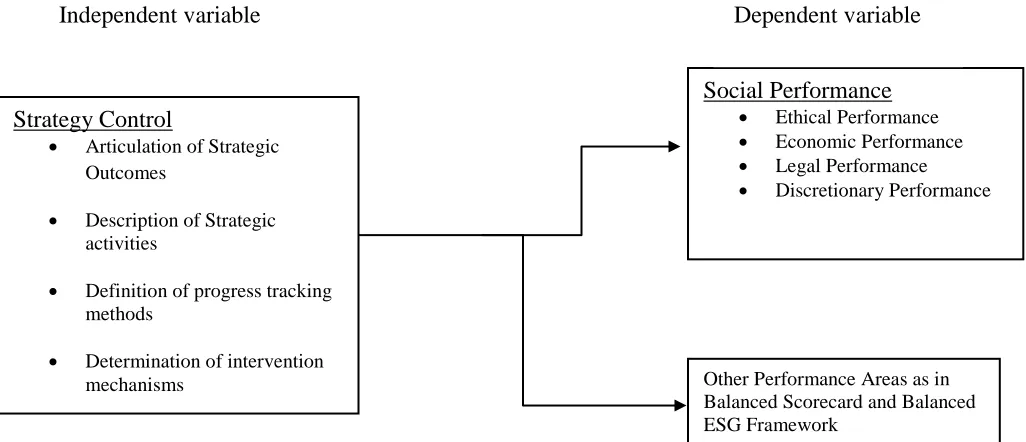
In the conceptual framework above, strategy control which indicated by articulation of strategic
outcomes, description of strategic activities, definition of progress tracking methods and
determination of intervention mechanisms is expected to have influence on social performance
which is indicated by ethical, legal, economic and discretionary performance. It is also observed
that strategic control may lead to other areas of performance as exemplified in Balanced
Licensed under Creative Common Page 370 Figure 1: Expected Relationship between Strategy Control and Social Performance
-
Source: Adapted from Ondoro (2015) and Ketchen and Short (2016)
CONCLUSIVE REMARKS
Empirical Evidence is unspecific and lacking on the relationship between strategic control and
organization social performance. Current knowledge developed from practice is therefore
unconfirmed and building on theory such as Theory of Control is a challenge.
There is need for more literature review to expose further empirical evidence on this
important subject of strategic control and its interaction with aspects of organization
performance especially social performance. It is recommended that researchers mount studies
on this relationship.
REFERENCES
Agu, O.A. & Anichebe N.A. (2013). Impact of strategy formulation and implementation in ailing organisations. European Journal of Business and Management, 5, (20), 232-241.
Chevalier-Roignant, B. and Trigeorgis, L. (2011). Competitive strategy: Options and games. New Jersey, Prentice Hall
Gavetti, G. & Ocasio W. (2015 ). Cognition and strategy: Advances in strategic management, volume 32. Emerald Group Publishing Limited.
Johnson,G., Scholes, K. & Whittington, R.(2009). Fundamentals of strategy,1st Edition, New Jersey, Financial Times/Prentice Hall.
Junqueira, E., Dutra, E. V., Filho, H. Z., & Gonzaga, R. P.(2015). The effect of strategic choices and management control systems on organizational performance. XXXIX ANPAD Conference (EnANPAD), Belo Horizonte, MG, Brazil, September 2015.
Strategy Control
Articulation of Strategic
Outcomes
Description of Strategic
activities
Definition of progress tracking
methods
Determination of intervention
mechanisms
Social Performance
Ethical Performance
Economic Performance
Legal Performance
Discretionary Performance
Other Performance Areas as in Balanced Scorecard and Balanced ESG Framework
Licensed under Creative Common Page 371 Kairu, M.M.(2014). Effect of strategic responses on Kenya Revenue Authority operational performance. ir-library.ku.ac.ke/bitstream
Kibachia,J., Iravo, M., & Luvanda A. (2014). A survey of risk factors in the strategic planning process of parastatals in Kenya. European Journal of Business and Innovation Research,.2(3), 51-67.
Maroa, J.G.& Muturi, W.(2015). Influence of strategic management practices on performance of floriculture firms in Kenya: A survey of Kiambu County, Kenya. International Journal of Economics Commerce and Management, 3 (7), 497-506.
Mpoke S & Njeru A. (2015). Effect of strategic management processes on the organizational performance of selected government research institutions in Kenya. African Journal of Health Sciences, 28(1), 22-31. Mule, J. (2014, November, 20th). Increasing the level of satisfaction with county governments. Transparency International Kenya
Muthini, M.J. (2012). The effect of strategic alignment as a source of performance at Kenya Revenue Authority. erepository.uonbi.ac.ke/bitstream
Ng’ang’a , A. W.(2013) . Operation strategy and performance in the hotel industry: a study of hotels in Nairobi, Kenya. http://erepository.uonbi.ac.ke/bitstream/handle
Njagi, L., & Kombo, H. (2014). Effect of strategy implementation on performance of commercial banks in Kenya. European Journal of Business and Management, 6(13), 62-71.
Ondoro (2015) measuring organization performance” from Balanced Scorecard to Balanced ESG Framework. International Journal of Economics, Commerce and Management III( 11), 715-725
Opano, J. O. (2013). Strategic planning and implementation practices at the Kisii county government in Kenya. http://erepository.uonbi.ac.ke:8080/xmlui
Pearce, J.A. and R.B. Robinson, Jr, (2009). Strategic management: Formulation, implementation and control. New Jersey, Prentice Hall.
Uzel, J.M.M. (2015) Effect of strategic management drivers on the performance of the Hotel Industry in Kenyan Coast. ir.jkuat.ac.ke/bitstream
Wheelen T. L. & Hunger, J.D. (2015). Concepts in strategies management and business policy – 14th edition, New Jersey, Prentice Hall