The effects of chiropractic care
on a patient with chronic constipation
Monika Rédly, Hons BSc (Kin), DC*
Objective and rationale: To report the effect of weekly chiropractic adjustments on a patient with reported chronic constipation.
Design architecture:case report.
Outcome measures: The outcome measures assessed were a reduction in the diagnostic criteria of
constipation, the patient’s overall sense of well being rated on a Global Well-Being Scale and the frequency of low back pain.
Method:The patient completed all required intake forms according to the H.K. Lee Outpatient clinic protocol at CMCC, and a questionnaire regarding bowel habits. A senior intern performed a complete history and spinal examination and the patient was treated for two months. Throughout the two months the patient completed the bowel habit questionnaire at each visit and at a follow up appointment one month later.
Results: Results support a decline in constipation according to the requisite criteria, resolution of low back pain, and a Global Well-Being scale score of over 9/10.
Conclusion: It appears that chiropractic treatment may have a role in the improvement of chronic constipation.
(JCCA 2001; 45(3):185–191)
K E YW O R D S: constipation, treatment.
Objectif et raison d’être : Rendre compte de l’effet des adjustements hebdomadaires chiropratiques pratiqués sur un patient qui souffre de constipation chronique.
Présentation: Exposé de cas.
Indicateurs de résultats: La réduction des critères diagnostiques de la constipation, le sentiment de bien-être général du patient, mesuré selon une échelle du bien-être, et la fréquence des douleurs lombaires sont les indicateurs de résultats observés.
Méthode: Le patient a rempli toutes les fiches de renseignements conformément au protocole du service de consultations externes H.K. Lee du Canadian Memo-rial Chiropractic College (CMCC), ainsi qu’un question-naire portant sur les troubles du transit intestinal. Un interne confirmé a procédé à une observation médicale ainsi qu’à un examen de la colonne vertébrale, et on a traité le patient pendant deux mois. Durant cette période, le patient a rempli le questionnaire sur les troubles du transit à chacune de ses visites ainsi que lors d’un rendez-vous de suivi un mois plus tard.
Résultats: Les résultats soutiennent un déclin de la constipation selon les critères établis, la résolution des douleurs lombaires et une code de 9 sur 10 sur l’échelle du bien-être.
Conclusion: Il semble qu’un traitement chiropratique puisse jouer un rôle dans l’amélioration de l’état du patient qui souffre de constipation chronique.
(JACC 2001; 45(3):185–191)
M O T S C L É S : constipation, traitement.
* Requests for reprints to: Dr. Monika Rédly, 105 Citation Drive, Willowdale, Ontario M2K 1S9. Tel.: 416-225-2993. E-mail: [email protected]
Introduction
The incidence of constipation is well documented as a common complaint in the United States, particularly among the elderly.1–5 People who are chronically
consti-pated not only find the problem very annoying, but they also tend to have a diminished perception of their quality of life.1,2 This is a very important aspect to assess,
particu-larly to a holistic practitioner such as a chiropractor. To date it is not known whether fibre or laxatives improve quality of life or general well-being of the patient with chronic constipation.2
The literature shows that there is ambiguity as to the definition of constipation. Patients tend to identify consti-pation on the basis of symptoms, whereas health profes-sionals tend to consider bowel frequency.1,2,5 The accepted
criteria for defining constipation from a health profes-sional standpoint consists of less than 3 stools per week more than 25% of the time, and one or more of the follow-ing: straining at defecation, sensation of incomplete evacuation, passage of pelletlike bowel movements at least 25% of the time.3,5,6
If underlying causes, such as diet or organic disease (endocrine, cancer etc.), have been excluded, it is difficult to determine the exact cause of constipation.2–5 It has been
suggested that motility disorders may result from an aber-rant colonic transit time and pelvic floor dysfunction.1,3,5,6
The sympathetic innervation to the bowel is well docu-mented.7–9 Some studies also propose visceral neuropathy,
neurotransmitter abnormalities, and impaired motor activ-ity as culprits in a decreased colonic transit time.9 Though
the article is old, Korr presented a remarkable theory as to how a subluxation (somatic joint dysfunction), can lead to aberrant neuronal activity and hence a state of neural hy-peractivity or “facilitation”.10 According to Korr, when
there exists a “disturbance” in an intervertebral, costover-tebral or other joint, “involving such functional distur-bances as muscle spasm … torsion or other deformation of the capsule … then the affected proprioceptors will fire equally persistent and discordant barrages of impulses”. The impulses enter the spinal cord and lead to a change in the central excitatory state at that level, producing the fa-cilitated segment. The affected portions of the cord “can-not participate appropriately in the vertical patterns in which they are ordinarily involved, resulting in faulty, dis-arrayed patterns”. Korr draws the comparison (albeit dated) to a telephone line that as a result of the disturbance
becomes a “party line” and may affect other unintended, yet associated areas such as viscera.10 More recent
litera-ture appears to support Korr’s theory, such as the paper by Budgell in which he states “recent neuroscience research supports a neurophysiologic rationale for the concept that aberrant stimulation of spinal or paraspinal structures may lead to segmentally organized reflex responses of the auto-nomic nervous system, which in turn may alter visceral function”.11
As the chiropractic adjustment, a high velocity low am-plitude thrust (HVLAT), is theorised to directly influence the nervous system, it is possible that HVLAT could, via the nervous system, have a visceral effect in humans. Somatovisceral reflexes and somatogastrointestinal re-flexes have been studied and are well documented.12 It has
been shown in animals that gastrointestinal effects can be produced from sympathetic nerve stimulation.13,14 The
ar-ticle written by Akio Sato15 discusses the effects of
nox-ious and innocuous stimulation of somatic afferents in experimental animals leading to changes in sympathetic activity and thus effector organ function. Literature also suggests that pathologic conditions in the spine at the lower thoracic and thoracolumbar segments (which inner-vate the upper GI tract) may be a source of some cases of functional abdominal pain.16 The study by Jorgensen and
Fossgreen17 on patients with abdominal pain without
or-ganic abnormality revealed that 75% of the 39 patients studied had back pain, suggesting the existence of a con-nection between abdominal pain and back pain. They theo-rised viscerosomatic or somatovisceral reflexes as the possible pathophysiologic mechanism.17
A literature search yielded only two reported cases of chiropractic treatment for chronic constipation. The first, a case of a seven month old child suffering from chronic constipation since birth whose bowel function normalized after full spine diversified and cranial adjusting three times over two weeks.18 The other was a five year old with
con-stipation for over one year. She was adjusted by hand using the Grostic procedure and symptoms initially resolved af-ter three adjustments over a period of three weeks; further treatment on two successive days was administered at a later date after the patient had a fall.19 No chiropractic
literature exists to date with respect to adults with chronic constipation.
consti-pation. The outcome measures assessed were the change in the factors (previously described) that diagnostically define constipation, the patient’s overall sense of well be-ing, as well as frequency of low back pain.
Methods and materials
The design of the study was in the form of a case report. The subject was a 64-year-old caucasian female of normal weight who was seen by a senior intern of the CMCC. All paper work routinely required by the H.K. Lee Outpatient Clinic at CMCC was completed, including informed con-sent. On the advice of a chiropractic student, the patient presented with the complaint of chronic constipation. A complete history and spinal examination was rendered. Her medical history was unremarkable and at her last visit to her medical doctor she was pronounced to be in good health. She did complain of poor circulation, dry skin and coarse hair, as well as brittle nails but tests performed by her medical doctor were reportedly within the normal range for thyroid function. She reported having constipa-tion as long as she could remember since childhood and recalls that her father suffered similarly, never having found effective treatment. Her symptoms consisted of fluctuating bowel frequency ranging from zero to three times a week at times, and occasionally more than three times a week, however, all bowel movements were accom-panied by straining and the sense of incomplete evacua-tion. Stool size was reported as generally being small and pellet-like. She reported that she must have a breakfast of a bowl of “All-Bran” cereal and a glass of prune juice every morning to maintain her present bowel function. She has tried many other “remedies” ranging from dietary supple-ments to drinks such as Metamucil but none have worked as well as her present breakfast. She has also been advised many times about the importance of a high fibre diet, what foods she should and should not consume, as well as the importance of drinking a lot of water, all of which she follows. At the time of questioning, the patient denied any back pain but during the initial examination realized that her back was tender to palpation. She reported having a few episodes of back pain in the past 10 years of her life, but these lasted only a short time (two weeks at most) and completely resolved. She did see a medical doctor on two occasions who “lifted her leg and pushed down on her low back in a quick movement” that caused a cracking sound in her back and relieved the pain. Other than the few episodes
of back pain she did not have any troubles with her back since childhood. She reported having a mild scoliosis as a young child. She was treated aggressively with massage, physical therapy and slept in a plaster bed-cast. With that treatment the scoliosis resolved. Her constipation is wors-ened by travel, and she has previously experienced as long as two weeks without a bowel movement during a holiday. She has had exhaustive medical work-ups (i.e. colon-oscopy, barium enema) and no organic etiology for her constipation was found. She has been taking calcium and Vitamin D supplements for a few years but has not noted any change in bowel function since beginning supplemen-tation.
In order to confirm chronic constipation the patient completed a questionnaire and was found to fulfill the cri-teria previously discussed. The patient was asked to con-tinue with her normal daily habits, such as diet and exercise, and not add anything new (i.e. vitamins or sup-plements), so that the only intervention would be chiro-practic treatment.
On each visit several outcome measures were collected. These were: general sense of well being as reported on a Global Well-Being Scale,1,2,19 bowel frequency per week,
effort with bowel movements (straining), consistency and size of stool3,5,6 and frequency of back pain. Each visit
consisted of diversified adjustment (HVLAT) throughout the lumbar spine as indicated by segmental findings. The main adjustments performed were lumbar rolls and either spinous push or pull. (The patient initially was adjusted cervically on a few occasions but was uncomfortable with the cervical adjustments and they were discontinued promptly.) A follow-up appointment was made approxi-mately one month after the date of the last visit. At this time, the patient was re-examined and completed the bowel habit questionnaire one last time.
The data collected from the patient questionnaires were presented in tabular and graph form to chart the patient’s progress over time on each outcome measure.
Results
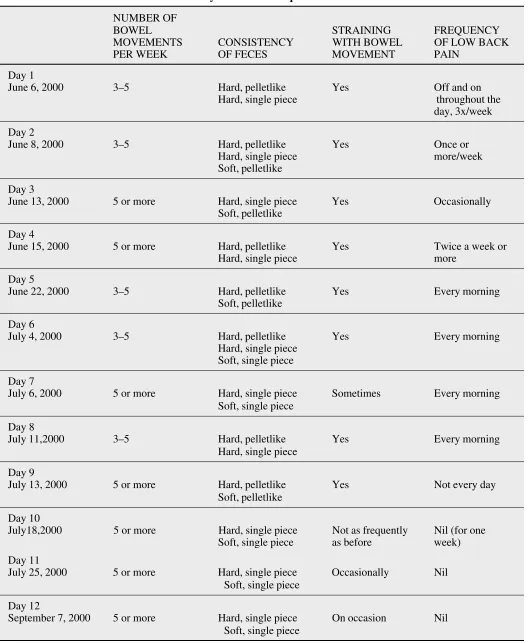
of the fifth week and consistently thereafter, the patient was having 5 or more bowel movements per week. The consistency of the feces changed, becoming progressively softer and more “normal” and after the tenth treatment the consistency stabilized, being hard and soft single pieces. Straining was a consistent problem reported by the patient in the history, and by the end of the course of treatments the patient reported only occasionally having to strain. The results appear to support a decline in constipation accord-ing to the requisite criteria.
Frequency of low back pain was also assessed. The pa-tient initially reported back pain three times per week, off and on throughout the day. The frequency of back pain increased over the first four weeks and then was reduced to no back pain at all by the end of the study. The patient continued to be free from back pain over a month after treatment was terminated.
The Global Well-Being scale showed a gradual, pro-gressive increase in well being, with the patient almost
feeling “the best [she] could possibly feel” by the end of treatment (see Figure 1). This was maintained up to the follow up appointment.
Discussion
Table 1 gives a general indication of the degree of consti-pation experienced by the patient throughout the study pe-riod. The level of constipation was measured by three variables: number of bowel movements per week, consist-ency of feces, and straining with bowel movement. The patient was quite constipated initially, as is indicated by only three to five bowel movements per week, hard pelletlike and hard single piece feces, and the straining involved with bowel movements. (It should be clarified that when the patient stated three to five bowel movements per week, the bowel movements consisted of a very small one, twice a day. This amounted to three to five per week, however, this obviously is not considered to be a normal bowel movement and hence the diagnosis of chronic
con-Figure 1
Graph of Results of Global Well-Being for the Duration of Treatment.
0
1
2
3
4
5
6
7
8
9
10
Day
MOVEMENTS CONSISTENCY WITH BOWEL OF LOW BACK PER WEEK OF FECES MOVEMENT PAIN
Day 1
June 6, 2000 3–5 Hard, pelletlike Yes Off and on Hard, single piece throughout the
day, 3x/week Day 2
June 8, 2000 3–5 Hard, pelletlike Yes Once or Hard, single piece more/week Soft, pelletlike
Day 3
June 13, 2000 5 or more Hard, single piece Yes Occasionally Soft, pelletlike
Day 4
June 15, 2000 5 or more Hard, pelletlike Yes Twice a week or Hard, single piece more
Day 5
June 22, 2000 3–5 Hard, pelletlike Yes Every morning Soft, pelletlike
Day 6
July 4, 2000 3–5 Hard, pelletlike Yes Every morning Hard, single piece
Soft, single piece Day 7
July 6, 2000 5 or more Hard, single piece Sometimes Every morning Soft, single piece
Day 8
July 11,2000 3–5 Hard, pelletlike Yes Every morning Hard, single piece
Day 9
July 13, 2000 5 or more Hard, pelletlike Yes Not every day Soft, pelletlike
Day 10
July18,2000 5 or more Hard, single piece Not as frequently Nil (for one Soft, single piece as before week) Day 11
July 25, 2000 5 or more Hard, single piece Occasionally Nil Soft, single piece
Day 12
stipation still applies.) By the completion of the study, the patient reported five or more bowel movements per week with both hard and soft single pieces of feces. Straining only occurred on occasion. These results are encouraging and appear to support the results found in the two other studies in the literature17,18 on the amelioration of
consti-pation with chiropractic adjustive therapy.
Although not of primary concern in this study, fre-quency of back pain was recorded. At the outset of the study, the patient reported having back pain three times per week. This then increased to a daily occurrence of back pain in the morning, however, by the end of the study (the last two weeks and again at the follow up), the patient had no back pain whatsoever.
The most interesting results were with respect to the global sense of well-being. As demonstrated graphically in Figure 1, the patient concluded the study feeling at almost a ten out of ten, however, this may have been contributed to by other life events (see subsequent discussion). Al-though this is a subjective measurement, it is definitely extremely relevant to the patient as this impacts daily life.1,2 How the patient feels is undeniably important to the
general functioning of the body. If a person is tense, upset or nervous, this is known to manifest in many people as gastrointestinal complaints. For this reason, it is particu-larly important for the constipated person to be as relaxed and content as possible. Future studies may attempt to incorporate this as an outcome measure by the use of a questionnaire that addresses emotional state and/or by the use of biofeedback techniques to assist in relaxation.
There are many factors in the present case report that were uncontrolled and could have confounded the results. Although the patient was told not to change anything in her lifestyle (particularly diet and exercise), it is difficult to say with certainty that lifestyle had no effect on the ob-served results. The patient was a high school guidance counsellor and school ended the Friday prior to the July 4th appointment (see Table 1). This most certainly could have affected global sense of well-being, as could any other events that may have occurred around that time or throughout the course of treatment. (It should be noted, however, that the patient enjoyed her work as a guidance counsellor.) Natural history can essentially be excluded as having an effect due to the longstanding nature of the com-plaint. As in all chiropractor/patient interactions, the pla-cebo effect must not be dismissed as a contributing factor
to the improvement of symptoms. Perhaps the fact that a new approach was being taken to address the patient’s problem led to a more hopeful and positive state of mind, and hence contributed to the improvement. For these rea-sons the author is hesitant in attributing improvement of well-being to chiropractic treatment alone.
As discussed in the introduction, when organic pathol-ogy is excluded, the possibility of a neurogenic origin of constipation exists.1,3,5,6,10 Although the patient did not
seek treatment due to low back pain, it is possible that she was experiencing constipation as a somatovisceral re-sponse to back pain or somatic dysfunction in the spine. Contrarily, the back pain may have been a viscerosomatic response to bowel dysfunction. Presently no cause-effect statement can be made as no solid scientific proof exists to definitively or causally link constipation and somatic dys-function. In light of this though, the positive results ob-tained in the present study appear to support the theory of spinal adjustive influence on the nervous system and hence the apparent amelioration of idiopathic constipation.
Conclusion
In conclusion, it appears that chiropractic treatment may have a role in the improvement of chronic constipation. As this report is a trial based on findings in one person, it is unwise to generalize the results to a broader population; however, it does call attention to the matter and brings to light the necessity to perform a more rigorous and control-led study in order to adequately assess the efficacy of chi-ropractic treatment for patients with chronic, idiopathic constipation.
Acknowledgements
The author would like to express her thanks to the patient, Dr. P. Diakow, Carol Hagino, Dr. T. Lamon, and Milada Redly and for their help and guidance.
References
1 Schaefer D, Cheskin L. Constipation in the elderly. Am Fam Physician 1998; 58(4):907–914.
2 Tramonte, S, Brand M, Mulrow C, Amat M, O’Keefe M, Ramirez G. The treatment of chronic constipation in adults: A systematic overview. J Gen Int Med 1997; 12:15–24.
4 Orr W, Johnson P, Yates C. Chronic constipation: a clinical conundrum. J Am Ger Soc 1997; 45:652–653. 5 Browning S. Constipation, diarrhea, and irritable bowel
syndrome. Primary Care 1999; 26(1):113–139.
6 Meshkinpour H, Selod S, Movahedi H, Nami N, James N, Wilson A. Effects of regular exercise in management of chronic idiopathic constipation. Digestive Diseases and Sciences 1998; 43(11):2379–2383.
7 Gray H. Gray’s Anatomy. 30th ed. Lea & Febiger, 1985. 8 Moore K. Clinically Oriented Anatomy. 3rd ed. Baltimore.
Williams & Wilkins, 1992:27–31, 168–209.
9 Gatterman M. Foundations of Chiropractic Subluxation. St. Louis. Mosby-Year Book Inc., 1995:235–265. 10 Korr I. The spinal cord as organiser of disease processes:
some preliminary perspectives. J Am Osteop Assoc 1976; 76:35–45.
11 Budgell B. Reflex effects of vertebral subluxations: the autonomic nervous system. J Manipulative Physiol Ther 2000; 23(2):104–106.
12 Glia A, Lindberg G, Nilsson H, Mihocsa L, Akerlund J. Constipation assessed on the basis of colorectal
physiology. Scan J Gastroenterology 1998; 33(12):1273–1279.
13 Haldeman S. Principles and Practice of Chiropractic, 2nd edition. Norwalk: Appleton & Lange, 1992:94–98. 14 Sato A, Teru N. Change in duodenal motility produced by
noxious mechanical stimulation of the skin of rats. Neuroscience Letters 1976; 2:189–193.
15 Sato A, The reflex effects of spinal somatic nerve stimulation on visceral function. J Manipulative Physiol Thera 1992; 15(1):57–61.
16 Sato A. Somatovisceral reflexes. J Manip Physiol Thera 1995;18(9):597–602.
17 Jorgensen L, Fossgreen J. Back pain and spinal pathology in patients with functional upper abdominal pain. Scan J Gastroenterology 1990; 25(12):1235–1241.
18 Hewitt E. Chiropractic treatment of a 7-month-old with chronic constipation: a case report. Chiropractic Technique 1993; 5(3):101–103.
19 Eriksen K. Effects of upper cervical correction on chronic constipation. Chiropractic Research Jl 1994; 3(1):19–22. 20 Hawk C, Dusio M, Wallace H, Bernard T, Rexroth C. A study of the reliability, validity, and responsiveness of a self-administered instrument to measure global well-being. Palmer J Res 1995; 2(1):15–22.