Harpenden, Herts, AL5 2JQ
Telephone: +44 (0)1582 763133
Web: http://www.rothamsted.ac.uk/
Rothamsted Research is a Company Limited by Guarantee Registered Office: as above. Registered in England No. 2393175. Registered Charity No. 802038. VAT No. 197 4201 51.
Rothamsted Repository Download
A - Papers appearing in refereed journals
Ren, F., Sun, N., Xu, M., Zhang, X., Wu, L. and Xu, M. 2019. Changes in
soil microbial biomass with manure application in cropping systems: A
meta-analysis. Soil & Tillage Research. 194, p. 104291.
The publisher's version can be accessed at:
•
https://dx.doi.org/10.1016/j.still.2019.06.008
The output can be accessed at:
https://repository.rothamsted.ac.uk/item/96w53/changes-in-soil-microbial-biomass-with-manure-application-in-cropping-systems-a-meta-analysis
.
© 18 June 2019, Please contact [email protected] for copyright queries.
Contents lists available atScienceDirect
Soil & Tillage Research
journal homepage:www.elsevier.com/locate/still
Changes in soil microbial biomass with manure application in cropping
systems: A meta-analysis
Fengling Ren
a,1, Nan Sun
a,1, Meng Xu
b, Xubo Zhang
b,⁎, Lianhai Wu
c, Minggang Xu
a,⁎aInstitute of Agricultural Resources and Regional Planning, Chinese Academy of Agricultural Sciences/National Engineering Laboratory for Improving Quality of Arable Land, Beijing, 100081, China
bKey Laboratory of Ecosystem Network Observation and Modeling, Institute of Geographic Sciences and Natural Resources Research, Chinese Academy of Sciences, Beijing, 100101, China
cSustainable Soils and Grassland Systems Department, Rothamsted Research, North Wyke, Devon, Okehampton, EX20 2SB, UK
A R T I C L E I N F O
Keywords: Microbial biomass Manure Mineral fertilizer Chinese cropland Meta-analysis
A B S T R A C T
Soil microbial biomass carbon (SMBC) and nitrogen (SMBN) are important indices of soil bio-fertility. While intensively managed cropping systems can reduce microbial biomass, application of manure is a potential way to rebuilt microbial biomass and improve soil functions. However, the responses of SMBC and SMBN to manure application relative to mineral fertilizers (NPK) in Chinese cropping systems remains unclear. We conducted a meta-analysis based on 103 peer-reviewed publications with 1448 paired observations to identify the degree to which climate types, soil properties and agricultural managements regulate the responses of microbial biomass to manure amendment relative to NPK. The results indicated that manure application increased SMBC, SMBN, SMBC/soil organic carbon (SOC) and SMBN/soil total nitrogen (TN) by 40%, 55%, 16% and 21%, respectively, across all the observations compared to NPK. SMBC/SMBN under manure amendment (6.58 in average) was lower than that in NPK (7.86 in average). Manure-related factors, e.g. manure types, duration of application, manure-C and N input rates, were the strongest regulators of the response of microbial biomass. Soil properties and climates also contributed to considerable degrees of variation in microbial biomass response based on variance partitioning analysis (VPA). Results of the random forest (RF) models showed that manure type, ap-plication rate (manure-C and N input) as well as soil initial properties (SOC, TN and clay contents) were likely the predominant factors controlling the response of microbial biomass to manure application. Our study in-dicates that manure application can be an effective way to restore the loss of microbial biomass due to intensive application of NPK, yet variations in response are determined by specific manure type, application rate, as well as local conditions of climate and inherent soil properties.
1. Introduction
In order to meet the challenge of feeding 22% of the global popu-lation with only 7% of its arable land area, mineral fertilizers have been intensively applied in agricultural system for decades in China, which is now the largest consumer of mineral fertilizers in the world (Liu and Diamond, 2005;Zhang et al., 2015). Although the grain yield has been highly elevated by application of mineral fertilizers, there are growing evidences that unlimited application of mineral fertilizers has incurred substantial environmental risks, including severe disruption of soil physical properties (Idkowiak, 2004), increase in greenhouse gas emissions (Zhang et al., 2013) and nutrient run-off(Miao et al., 2011), and disturbance in soil microbial community (Postma-Blaauw et al.,
2010; Qiu et al., 2016). In consequence, in 2015, the Ministry of Agriculture and Rural Affairs of the People’s Republic of China has announced a‘Zero Increase Action Plan’for the utilization of mineral fertilizer by 2020 across the nation (Liu et al., 2015). Implement of alternative management to replace mineral fertilizer is hence necessary to accomplish yield demand meanwhile mitigate environmental costs.
Soil microbes are crucial component in a large number of important ecosystem processes, including decomposition (Gessner et al., 2010), nutrient acquisition (Perelo and Munch, 2005; Perelo et al., 2006a,b), carbon (C) and nitrogen (N) cycling (Manzoni and Porporato, 2009) as well as soil formation (Rillig and Mummey, 2006) and C sequestration (Six et al., 2006). Soil microbial biomass, often measured as microbial biomass carbon (SMBC) and nitrogen (SMBN), is a key indicator of soil
https://doi.org/10.1016/j.still.2019.06.008
Received 3 January 2019; Received in revised form 29 April 2019; Accepted 9 June 2019 ⁎Corresponding author.
E-mail addresses:[email protected](X. Zhang),[email protected](M. Xu).
1These authors contributed equally to this work.
Soil & Tillage Research 194 (2019) 104291
Available online 18 June 2019
0167-1987/ © 2019 Elsevier B.V. All rights reserved.
biological traits (Acosta-Martinez et al., 2008;Xu et al., 2008). Declines in microbial biomass in arable soils relative to unmanaged ecosystems are often observed because of the decreases in plant C input and hence C availability in agricultural systems (Fierer et al., 2009). Excess ap-plication of mineral fertilizer can further introduce negative effect on soil microbial biomass due to soil acidification, changes in community composition, and various chemical interactions (Treseder, 2008;Maly et al., 2009). A 12–48% decrease in SMBC and SMBN by mineral fer-tilizer application related to no ferfer-tilizer or the initial values of the experiments has been reported (Bittman et al., 2005;Maly et al., 2009;
Qiu et al., 2016). In addition, recent meta-analyses have suggested that the decrease in SMBC and SMBN resulted from increased mineral N inputs ranged from 5.8% to 20% in unmanaged ecosystems (Treseder, 2008;Liu and Greaver, 2010;Lu et al., 2011). In contrast to conven-tional mineral fertilizer, organic amendments such as manure can in-crease C availability for soil microbes by delivering high rate of exo-genous C into soil, which can be beneficial for enhancing microbial biomass compared with mineral fertilizer application only (Jangid et al., 2008;Neufeld et al., 2017).Pan et al. (2009)demonstrated that manure application increased SMBC and SMBN by 13% and 49% compared with application of mineral fertilizer. Therefore, manure amendment could be an alternative solution for the problems of ex-cessive application of mineral fertilizer meanwhile improving soil bio-fertility and maintaining grain yield (Li et al., 2015;Pan et al., 2009). Although c.a. 4.6 billion tons of manure is produced from livestock sector each year, only a small proportion were applied to arablefields due to high labor costs of collecting, transporting and applying manure to cropland, disconnection and lack of appropriate storage and handling facilities (Niu and Ju, 2017;Ma et al., 2010;Ju et al., 2005). Given the key role of soil microbes in regulating multiple ecosystem processes and the potential of manure to rebuilt microbial biomass and associated ecosystem functions, it is of great importance to better understand the magnitude of microbial biomass responses to manure. Previous study has suggested that after 10 years organic amendment soil microbial biomass could be recovered to a near pre-cultivation level (Wu et al., 2004), but responses of microbial biomass can be specific depending on other management practice, manure type and abiotic factors such as soil properties and climate (Liang et al., 2011;Zhen et al., 2014;Deng et al., 2006;Gunapala and Scow, 1998;Jangid et al., 2008). There are also considerable uncertainties in the magnitude of microbial biomass responses to manure relative to mineral fertilizer under various en-vironmental and management conditions. Up to now, there is however no systematic synthesis of the independent single researches to compare the effect of manure application on SMBC and SMBN with mineral fertilizers that encompassing a range of agronomic managements, soil types and climate conditions in China (Liang et al., 2011;Zhen et al., 2014;Kallenbach and Grandy, 2011;Sun et al., 2014). It is therefore pivotal to understand the relationships between the effect of manure application on microbial biomass and various management and en-vironmental factors in order to improve microbial biomass and restore functions in intensive agricultural systems that are routinely fertilized with mineral fertilizers at a national scale.
Thus, in the present study, we performed a comprehensive meta-analysis to integrate previously published results on SMBC and SMBN responses to manure amendment relative to agricultural systems that receive only mineral fertilizers. Comprehensive information of man-agement and environmental conditions that have potential influence on microbial biomass were extracted to characterize how SMBC and SMBN changes after manure application across major crop systems in China. These variables were further categorized into three explanatory factors, i.e. soil factors, farming practices and climate, and their contributions to the variations in SMBC and SMBN responses to manure were parti-tioned by variance partitioning analysis (VPA). Furthermore, a random forest (RF) model was used to gain a mechanistic understanding of the drivers of the variations in SMBC and SMBN responses to manure ap-plication. Altogether the present study aimed to provide a predictive
and mechanistic understanding of the relative improvement in micro-bial biomass by manure application across major intensively managed cultivation systems in China.
2. Materials and methods
2.1. Data collection
To fully cover the research on microbial biomass in Chinese soils, our meta-analysis was based on peer-reviewed articles published be-tween 1990 and September 2017 using the online database Web of Science (http://apps.webofknowledge.com/) and the China Knowledge Resource Integrated Database (http://www.cnki.net/) for studies that published in Chinese. Manure from different sources has processing methods from fresh manure to compost and different nutrient contents. In this study, we considered the following sources: swine (SW), sheep (SP), poultry (PL), cattle (CT), horse (HS) and farmyard manure (FYM). SOC and N content in SW is medium but it is higher in SP (http://www. cnoa.com/). PL has a low C/N ratio and high N and cellulose con-centrations (Mubarak et al., 2010) and the PL typically has high levels of NH4+and NO3−(Wang et al., 2004;Bernal et al., 2009). Organic
matter is more stable in CT (Velthof et al., 2000). And CT has a medium C/N ratio, high dry matter, organic N contents and low NH4+(Lupwayi et al., 2005). HS has high cellulose content (http://www.cnoa.com/). Generally, FYM is a mixture of human and animal waste and household garbage and so its nutrient content varies from year to year and the nutritional composition and physicochemical properties of farmyard manure are poor (Liu et al., 2010). Keywords that used in the literature retrieval weremanurewith its sources, SMBC, SMBN, SOC and TN. Crop types covered wheat, maize, rice, soybean and oilseed rape with dif-ferent crop rotation patterns (wheat-maize, wheat-rice, wheat-soybean, wheat-rape, rice-rape, rice-rice, maize, wheat, soybean, rice-rice-wheat, etc.). The following criteria were used to select publications: 1) all published results should be based onfield experiments with a minimum of three replications for each treatment, and 2) at least two types of treatments must be involved: (a) balanced application of mineral N, phosphorus (P) and potassium (K) fertilizers (NPK) and (b) manure amendment alone (M) or combined with mineral fertilizers (NPKM). We found a total of 103 publications that met the above criteria. We focused on the dependent variables of SMBC, SMBN, SMBC/SOC and SMBN/TN (focused variables). Because samples should be independent in a meta-analysis, only thefinal observed values of the focused vari-ables at one site were used if repeated measurements happened (Gurevitch and Hedges, 1999; Tian et al., 2015). Within these pub-lications we obtained 410 pairs of observations reported on SMBC, 332 pairs on SMBN, 394 pairs on SMBC/SOC and 315 pairs on SMBN/TN to use for the meta-analysis.
1890). The division of soil texture was based on the Chinese soil texture classification (Xiong and Chen, 1986).
2.2. Meta- analysis
The natural logarithm of the response ratio (RR) was used as the effect size of this meta-analysis which can reflect the size of the mag-nitude of the focused variable in the investigated treatment (NPKM or M) compared to a reference treatment (NPK) (Nony et al., 1995) and calculated byHedges et al. (1999):
=
RR ln( ¯ ¯ )x xt c (1)
where the subscript oftandcrepresents the investigated treatment and the reference treatment, respectively; andx¯is a mean of variablex.
The percentages of change in SMBC, SMBN, SMBC/SOC and SMBN/ TN from manure relative to NPK were calculated by (eRR++-1)×100%
(Luo et al., 2006), where RR++is the weighted response ratio and
calculated (Hedges et al., 1999):
= ∑ ∑ ∑ ∑ ++ = = = = RR w RR w i m j ki ij ij i m j ki ij 1 1
1 1 (2)
wheremis the number of the level for a given variable,kiis the number
of comparisons between manure and mineral fertilizers at theith level, RRijis the RR for theith level and thejth pair, andWijis the weighting
factor for theith level and thekith pair and expressed as:
= w v 1 ij (3) wherevis a variance:
= + v SD n x SD n x ¯ ¯ t t t c c c 2 2 2 2 (4) wherentandncare number of samples in the treatment and the
re-ference, andSDtandSDcare standard deviation of the treatment and
the reference, respectively, which are extracted from the publications. If only the standard error (SE) for the treatment and the reference was given in a paper, thenSDwas calculated:
=
SD SE n (5)
The standard error ofRR++was calculated by:
= ∑ ∑ ++ = = S RR w
( ) 1
i m
j ki
ij
1 1 (6)
Therefore, the 95% confidence interval (CI) of (RR++) was given:
= ++± ++
CI RR S RR
95% 1.96 ( ) (7)
If 95% CI for a given focused variable does not overlap with zero, the treatment was considered to represent a significant increase (the overall mean response ratio > 0) or decrease (the overall mean re-sponse rati < 0) compared to NPK (P< 0.05). If it overlaps with zero, the treatment was considered to have no significant impact on that variable compared to the reference (P> 0.05) (Aloe and Weiss, 2015).
The METAWIN 2.1 software was employed for meta-analysis (Rosenberg et al., 1997). Firstly, we calculated an overall response ratio for all the paired observations (reference and treatment). Then, the ratios were calculated at each level for each categorical variable. Fur-ther, between-group heterogeneity (Qb) was examined for a given
fo-cused variable (Table 1) to assess the manure effects among the levels of a given variable using the chi-square test. Categorical variable that associated with significant (the value atP< 0.05) and largeQbvalues
are considered to have a better ability to predict variation in the overall response ratio relative to other variables in the analysis.
2.3. Statistical analysis
2.3.1. Variance partitioning analysis (VPA)
VPA was used to analyze the contribution of farming practices, soil factors, climatic conditions and their interactions to the focused vari-ables. Farming practices consisted of total C and N input from manure, manure types, practice duration and land use type. Climatic conditions included the mean annual temperature (MAT) and the mean annual precipitation (MAP) for each site, which were collected from the nearest meteorological station (http://data.cma.cn/). Soil factors in-cluded contents of SOC and TN, total phosphorus (TP), total potassium (TK), available N (AN), available P (AP) and available K (AK), pH, soil clay content, soil bulk density (BD) and soil C/N ratio. Collinearity among these variables was diagnosed by SPSS before VPA analysis (Liang et al., 2016). The analyses were conducted using the vegan package in R program (R version 3.2.2, 2015).
2.3.2. Random Forest model
Over the last two decades the use of RF model has received in-creasing attention due to the ensemble classification and regression
Table 1
A list of variables and the levels of each variable tested for significance as predictors in SMBC, SMBN, SMBC/SOC and SMBN/TN response in the meta-analysis.
Variable group explanation
Climate STM Subtropical monsoon climate NTM Temperate monsoon climate NTC Temperate continental climate Type of manure SW Swine manure, composted and
uncomposted
SP Sheep manure, composted and uncomposted
PL Poultry manure, composted and uncomposted
FYM Farm yard manure composted and uncomposted
CT Cattle manure, compost and uncomposted
HS Horse manure, compost and uncomposted
Experimental > 30 The number of years manure input duration 25–30
15–25 5–15
< 5
Land use type P Paddy soil U-P Upland-paddy soil
U Upland soil
N rate > 200 Rate of manure-N input (kg N ha−1yr−1) 100–200
< 100
C rate > 4000 Rate of manure-C input (kg C ha−1yr−1) 2000–4000
< 2000
TN > 2.0 (rich) Soil nitrogen content in surface soil (0–20 cm)
1.5-2.0 (medium) g kg−1 0.75–1.5 (less)
< 0.75 (poor)
SOC > 20 (rich) Soil carbon content in surface soil (0–20 cm)
12–20 (medium) g kg−1 6–12 (less)
< 6 (poor)
Soil texture Sandy Sand content > 50%; Clay content < 30% Loam Sand content20–50%; Clay
content < 30% Clay Sand content < 20%; Clay
content > 30% Soil pH > 8 (alkaline
soils)
Soil pH in surface soil (0–20 cm) 6–8 (neutral soils)
analysis (Belgiu et al., 2016). This algorithm generates a lot of trees but eventually gives a single prediction with low bias and low variance (Breiman, 2002;Liaw and Wiener, 2002). The RF classifier is composed of combination of tree classifiers where each classifier is generated using random vectors that are independent of the input vector sam-pling, and each tree votes the most popular projective units to classify the input vectors (Breiman, 2002). The result drawn from the algorithm is considered as more accurate than any of the individual classifiers making up the ensemble (Dietterich, 2002). In our study, wefirst se-lected the factors that are significantly related to SMBC and SMBN changes after manure application compared to NPK from the con-tribution factors that used in VPA analysis by SPSS. Then we employed these dataset (sites) and conducted the RF model to explore the sig-nificantly related controlling factors for SMBC and SMBN changes in the cropland in China. There are three important parameters needed for producing forest trees: the number of trees to be generated in the forest (ntree), the number of variables to be selected and tested for the best split when growing the trees (mtry) and the minimal number of ob-servations at the terminal nodes of the trees. We set 1,000 for ntree according to previous published article (Colditz, 2015; Reese et al., 2014) as a higher number will result in more stable estimates of vari-able importance (Grimm et al., 2008). The mtry was usually the square root of the number of input variables (Gislason et al., 2006). The third parameter was the minimal observation numbers at the terminal nodes of the trees (nodesize) and in our study the value was set to 5 for re-gression RF. The RF uses the bootstrap repeated sampling method and the out-of-bag data (OOB) as a test sample for RF. The Mean Square Error (MSEOOB) was used to estimate OOB predictions accuracy (Liaw and Wiener, 2002). Differences between observed and predicted value were calculated with the mean percentage error (MPE), root mean square error of prediction (RMSEP), and R2 to verify the RF model (Liaw and Wiener, 2002; Wiesmeier et al., 2011). The MSE, MPE, RMSEP and R2were calculated as follows:
=∑= z −z n MSE i 1( ˆ )
n
i i00B 2
(8)
=∑= pred −obs n
MPE i 1( )
n
i i
(9)
= ∑= obs −pred n
RMSEP i 1( )
n
i i 2
(10)
∑
= −
−
=
ˆ
obs pred
obs obs
R 1- ( )
( )
i 1
n i i
i
2 2
2 (11)
wherezˆi00Bis the average of all OOB predictions, obsiis theith value of
the measured dataset, prediis the predicted by RF models for theith
value of measured dataset,
ˆ
obs is the average of the measured dataset. The RF models were conducted using the “RandomForest” packages (Liaw and Wiener, 2002) in R program (R version 3.2.2, 2015).3. Results
3.1. Distribution of SMBC, SMBN, SMBC/SOC and SMBN/TN
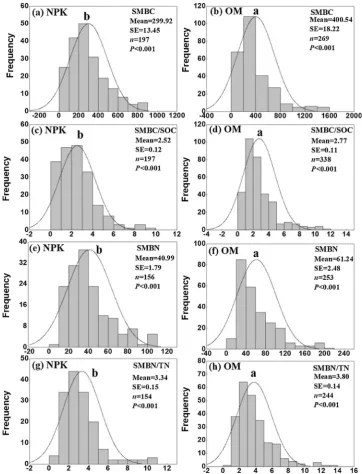
The normal distributions for content of SMBC and SMBN and ratio of SMBC/SOC and SMBN/TN were shown in Fig. 1 (at P< 0.001 level). With manure application, mean contents of SMBC (400.54 ± 18.21 mg kg−1; mean ± 95% CI, thereafter) and SMBN (61.24 ± 2.48 mg kg−1) were both significantly higher compared to
that in NPK application (299.92 ± 13.45 mg kg−1 for SMBC, and
40.99 ± 1.79 mg kg−1 for SMBN). Meanwhile, manure application significantly increased the mean ratios of SMBC/SOC (2.77 ± 0.11%) and SMBN/TN (3.80 ± 0.14%) compared to that in NPK application (2.52 ± 0.12% for SMBC/SOC, and 3.34 ± 0.15% for SMBN/TN).
3.2. Relationship between SMBC, SMBN and manure-C and N
There were significant correlations between SMBC and SMBN for manure and NPK applications (Appendix S2.). The average of SMBC/ SMBN ratio was 6.6 for manure application and 7.9 for NPK. SMBC content was positively correlated with annual manure-C input (R2= 0.05, n= 197) and manure-N input (R2= 0.02, n= 298;
Appendix S3.). Similarly, SMBN content also had significant correla-tions with annual manure-C input (R2= 0.12,n= 129) and manure-N
input (R2= 0.11,n= 222).
3.3. Variations in SMBC and SMBC/SOC response to manure application
Manure brought an overall 40% increase in SMBC compared to the treatments with NPK application only (Fig. 2). All but two of the ten variables (SOC and soil pH) described inTable 1significantly affected the variation in the response of SMBC to manure amendment (Table 2). The variable that contributed the most to the variation in this SMBC response was manure type. Application of cattle manure (CT) had the strongest influence on SMBC with a 69% increase, whereas application of farmyard manure (FYM) exerted no significant effect (7.4%) (Fig. 2). Other types of manure had similar effect on SMBC responses (35–43%). The response of SMBC to manure amendment generally increased with increasing experimental duration as well as manure-C and N input. Among all climate types, SMBC was less responsive to manure addition in subtropical monsoon climate (STM; 29%) than in other climate types (45–50%). SMBC in upland cultivated soil was more responsive to manure application (48%) compared to other land-use types (22–33%). The increase in SMBC under manure addition was higher in soils with moderate TN content (1.50–2.00 g kg−1) than in soils with low or high
TN content. The response of SMBC to manure was comparatively less in soils with clay content > 30% (32%) than in soils with less clay content (32–50%). Overall manure amendment increased SMBC/SOC by 16% compared to NPK application (Fig. 3). All ten variables significantly affected the variation in SMBC/SOC response to manure amendment (Table 2). Most types of manure that applied increased SMBC/SOC by 18–27%, whereas FYM application resulted in non-significant decrease in SMBC/SOC (-8%). Manure application that lasted for more than 30 years had a significantly larger effect on SMBC/SOC (34%) compared to others with less experimental duration (11–18%). The effect of manure application on SMBC/SOC increased with manure-C and N input, but this increase was significant only when manure-C and N input was greater than 4000 kg C ha−1 yr−1 (50%) and 200 kg N ha−1 yr−1
(40%) with a minimum of a three-year experimental duration. The largest positive effect of manure application on SMBC/SOC was ob-served in NTM (25%) among all climate types. The increase in SMBC/ SOC by manure was greater where the contents of soil TN and SOC were high. SMBC/SOC was most responsive to manure application in loamy soils (24%) and where soil pH < 8 (18–21%).
3.4. Variations in SMBN and SMBN/TN response to manure application
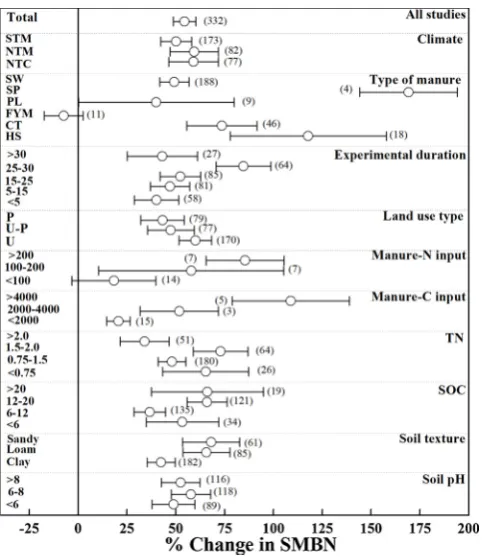
greater where SOC content was higher than 12 g kg−1(65–66%). SMBN
was less responsive to manure application in clay soils (43%) than in loamy and sandy soils (66% and 68%).
Compared to NPK, manure application provided an overall increase in SMBN/TN by 21% (Fig. 5). Four variables related to manure practice and two of soil variables (TN content and soil texture) significantly affected the variation in the response of SMBN/TN to manure amend-ment (Table 2). SMBN/TN was significantly increased by application of HS (85%), CT (27%) and swine manure (SW; 19%), while the others had no significant influence. Inputs of manure-C and N input that were greater than 4000 kg C ha−1yr−1and 200 kg N ha−1yr−1resulted in significant increases in SMBN/TN by 108% and 84%, respectively. The increase in SMBN/TN by manure application was the greatest in soil with moderate TN content (39% at 1.5–2.0 g kg−1) and in loamy soils
(39%) among all soil types.
3.5. Controlling Factors of the variations in SMBC and SMBN response to manure application
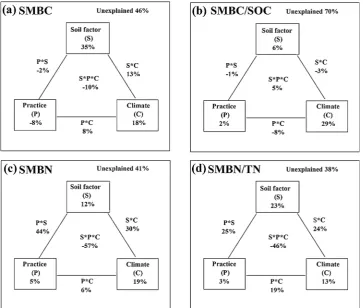
Results from the variable partitioning analysis showed that 54, 30, 59 and 62% of the variation in the responses of SMBC, SMBC/SOC, SMBN and SMBN/TN, respectively, to manure amendment relative to NPK application could be explained by soil factors, climates, farming practices and their interactions (Fig. 6). Soil factors contributed the most (35%) to the variance in the response of SMBC to manure appli-cation, followed by climate (18%) and their interaction (13%), whereas the variation in SMBC/SOC response was mainly explained by climate (29%). The variation in SMBN response to manure can be explained by soil factors (12%), climate (19%), and interactions between soil factors and climate (30%) and between farming practices and soil factors (44%). Soil factors and climate explained 23% and 13% of the variance in SMBN/TN response to manure application, and the interactions of
Fig. 1.Normal distribution of SMBC (a and b; x: mg kg−1), SMBC/SOC (c and d), SMBN (e and f; x: mg kg−1) and SMBN/TN (g and h). The (a), (c), (e) and (g)
three categorized factors also accounted for a considerable amount of the variance in SMBN/TN.
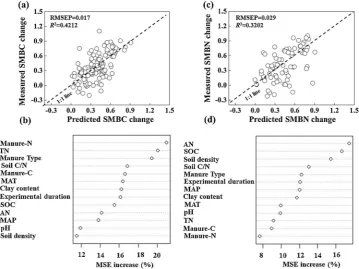
The independent variables that used in our RF models overall ex-plained 42% and 32% of the variances in the responses of SMBC (RMSEP = 0.017) and SMBN (RMSEP = 0.029) to manure application relative to NPK application across major croplands in China (Fig. 7a and b). According to the amplitude of increase in MSE, manure-N input, soil TN content and manure were the most important factors affecting the variation in SMBC response (Fig. 7c), whereas the controlling factors for the variation in SMBN response all related to initial soil properties, i.e. available N (AN) and SOC content, and bulk density (Fig. 7d). Besides, the effect of manure-related factors, manure-N input for example, was more significant on variation in SMBC than in SMBN (21% vs. 8%).
Fig. 2.Percent changes in soil microbial biomass carbon (SMBC) under dif-ferent categories. Open circles with error bars denote the overall mean response ratio and 95% CI, respectively. The 95% CI that do not go across the zero line mean significant difference between treatment and reference (P< 0.05). The value in parentheses represent independent sample size.
Table 2
Between-group variability (Qb) among observations (n) indicating their
po-tential as predictor variables of SMBC, SMBN, SMBC/SOC and SMBN/TN re-sponse to manure application compared to mineral fertilized agriculturalfields.
Categorical SMBC SMBN SMBC/SOC
variables n Qb n Qb n Qb n Qb
All studies 410 332 394 315
Climate 410 27.10** 332 2.45 392 17.39** 315 0.89
Manure type 352 58.73** 276 62.41** 337 20.88** 266 34.33**
Experimental duration
402 34.79** 315 34.15** 380 14.50** 309 13.43**
Land use 409 38.20** 326 7.08 390 7.45* 311 3.75
N rate 36 47.99** 28 12.80** 40 9.18* 25 22.43**
C rate 35 12.71** 23 37.58** 35 11.20** 23 37.55**
TN 361 20.18** 321 22.14** 343 10.24* 309 13.13**
SOC 403 6.63 309 23.11** 388 8.90* 301 4.39
Soil texture 409 19.32** 328 18.51** 394 16.05** 311 16.01**
Soil pH 409 1.58 323 1.58 394 11.66** 311 0.66
* P < 0.05. ** P < 0.01.
Fig. 3.Percent changes in SMBC/SOC under different categories. Open circles with error bars denote the overall mean response ratio and 95% CI, respec-tively. The 95% CI that do not go across the zero line mean significant diff er-ence between treatment and referer-ence (P< 0.05). The value in parentheses represent independent sample size.
4. Discussion
4.1. Overall response of soil microbial biomass to manure application
Numerous studies have reported that in agricultural systems appli-cation of manure usually resulted in an increase in soil microbial bio-mass, even though the response of microbial biomass can be highly variable depending on soil types, management practices and climate conditions (Esperschuetz et al., 2007;Lentendu et al., 2014;Linderman and Davis, 2004;Parham et al., 2002;Plaza et al., 2004). In the present study, we analyzed a total of 1448 comparisons between manure and mineral fertilizers and found that manure application overall increased both SMBC and SMBN by 40% and 55%, respectively, across major cultivation systems in China (Figs. 2 and 4). This increase in microbial biomass was higher compared to a globally increase in SMBC by 36% and SMBN by 27% (Kallenbach and Grandy, 2011), suggesting that manure amendment can be more beneficial for microbial communities to recover from long-term and intensively application of mineral ferti-lizers in conventional agricultural systems of China. Despite the fact that manure is rich in readily available C, N and other macro- and micro-nutrients that microorganisms require for their growth and ac-tivities (Feikea et al., 2009;Gupta et al., 1992), there are also various effects of manure that microbes can profit from. For instance, manure application can maintain soil moisture and ease rapid changes in soil temperature (Naeini and Cook, 2000), which helps to provide a stable environment for soil microbes to growth.
Although there was convincingly positive effect of manure appli-cation on microbial biomass relative to mineral fertilizer, the mean SMBC of treatments with manure amendment (400.54 ± 18.21 mg C kg−1) is still not comparable to that in unmanaged ecosystems, e.g.
670.1 ± 27.9 mg C kg−1in grassland soils in China (Zhao et al., 2017). This suggests that other agricultural disturbances such as tillage may restrain the potential recovery in microbial biomass by manure appli-cation (Stark et al., 2007). Nonetheless, even a small increase in
Fig. 5.Percent changes in SMBN/TN under different categories. Open circles with error bars denote the overall mean response ratio and 95% CI, respec-tively. The 95% CI that do not go across the zero line mean significant diff er-ence between treatment and referer-ence (P< 0.05). The value in parentheses represent independent sample size.
microbial biomass can have significant improvement in belowground C and N cycling as well as associated soil functions. We found that the ratio of SMBC to SOC was significantly increased in treatments with manure application by 16% compared to that with only mineral ferti-lizers (Fig. 3). SMBC/SOC ratio could reflect the efficiency of the con-version of exogenous C input into microbial biomass C (Anderson and Domsch, 1989; Sparling, 1992) and consequently microbial residues, which are considered as the primary C-containing constituents con-tributing to the stable SOC pool (Liang et al., 2017). Therefore, appli-cation of manure instead of mineral fertilizer alone has a great potential in improving both bio-fertility and C sequestration for major agri-cultural systems in China.
4.2. Driving factors of microbial biomass responses to manure application
We found that the responses of microbial biomass to manure inputs are highly complex due to variations in factors related to climate con-dition, management practices and initial soil environment. Results from the VPA analysis suggested that both climate and soil factors imposed considerable degrees of constraint on microbial biomass responses to manure application, whereas the contribution of farming practices did not reach a significant level (Fig. 6). However, manure-related factors were proved crucial for microbial biomass, especially SMBC responses to manure application (Fig. 7). It is possible that the magnitude of the effect of manure-related factors was counteracted by land-use type, which was also included as the farming practice factor but with rela-tively smaller influence (Table 2). In addition, the effect of farming practices could be overshadowed by soil and climatic factors, e.g. air temperatures and precipitation, due to their primary control on the accumulation of both above- and belowground biomass and hence microbiological processes (Li et al., 2014; Moore and Lobell, 2015), which would consequently constrain the response of microbial biomass to manure application.
4.2.1. Farming practices
Manure-related factors, especially manure type and application rate
(C and N input), imposed the greatest impact on the magnitude of how microbial biomass responses to manure application relative to mineral fertilizer (Table 2;Fig. 7). Application of cattle manure resulted in the greatest increase in SMBC (68%) among all type of manure, which was in consistent with a recent global meta-analysis (Kallenbach and Grandy, 2011). Whereas application of farmyard manure did not lead to significant responses in both SMBC and SMBN as was previously ob-served (Carpenter-Boggs et al., 2000;Parham et al., 2003). The diver-gence in the response of microbial biomass to different manure that applied could be closely related to the bio-chemical composition of manure. In general, manure that comprises of larger proportion of low molecular weight C such as sugar and water-soluble C are easier for microbes to utilize than those with high contents of water-insoluble C (e.g. cellulose) or lignin (Valenzuela-Solano and Crohn, 2006). The relative high polyphenols content and C/N ratio in farmyard manure (Ghoshal and Singh, 1995) makes it a low-quality source for microbes to profit from. In addition to C availability, different N forms that manure contained can also lead to the variation in the response of microbial biomass to manure application. For example, contents of NH4+and NO3−were typically higher in poultry manure compared to
cattle manure (Zhou et al., 2013). Application of poultry manure can therefore result in high NH4+-N concentration in soils, which may
cause cyto-toxicity in microbes, suppress enzyme activities, and de-crease C use efficiency (Lorenz, 2006;Geisseler and Horwath, 2010). These all could attenuate the positive effect of poultry manure appli-cation on soil microbes, leading to a less increase in SMBC compared to cattle manure across China or at a global scale (Kallenbach and Grandy, 2011).
In addition to manure type, the duration of manure application also imposed a significant impact on the variation in the response of mi-crobial biomass (Table 2). We found that the magnitude of positive effect from manure application on SMBC was greatest where the practice lasted for more than 30 years (Fig. 2), which was similar with previous studies that reported the longer the practice lasted, the greater impact manure had on SMBC and SMBN (Bossio et al., 1998;Lundquist et al., 1999). Long-term application of manure can help to rebuilt soil
environment that is favorable for microbes by improving soil pH, sub-stantial supply of soil available C and N, and creating well-ventilated conditions beneficial for rapid decomposition of manure and crop re-sidues that will provide energy for the turnover of soil microbes (Ellmer et al., 2015;Haynes and Naidu, 1998;Zhou et al., 2017a).
Land-use type, as a well-known factor influencing microbial com-munity (Jangid et al., 2008), had significant impact on the variation in the response of microbial biomass to manure application (Table 2), yet its impact was relatively weak compared to that of manure-related factors. Our results indicated that SMBC and SMBN are relatively re-sponsive to manure application in upland soils among all land use types. Cropping systems and land management practices can be diverse under different land use types, which could affect the amount and quality of C that returned to soils (Wardle, 1992;Jangid et al., 2011), the decomposition rate of crop residues and manure (Singh et al., 2007), and the utilization of N by microbes (Baijukya et al., 2006;
Kushwaha et al., 2000). In addition, land use types can differentially affect edaphic properties such as soil texture, soil C and N availability, pH and microclimate, which can influence physical and metabolic niche diversity in soils (Lauber et al., 2008), thereby resulting in different composition of microbial communities. Besides, manure amendment may enhance soil aggregation in upland soils and thus improve aerobic metabolism (Fenchel and Finlay, 1995), which is more efficient in converting soluble C into microbial biomass compared to anaerobic metabolism (Picek et al., 2000).
4.2.2. Climate types
The response of SMBC to manure application was distinct among different regions of China with varying climatic conditions (Table 2,
Fig. 4). Previous studies on geographic distribution of microbial bio-mass suggested that aboveground productivity contributes a great proportion to the variation in SMBC among different biomes (Wardle, 1992;Fierer et al., 2009). In agricultural systems, however, application of fertilizers and irrigation, as well as controlled crop management, can artificially regulate productivity to similar levels (Kallenbach and Grandy, 2011). Therefor the regional variation in the response of mi-crobial biomass to manure application might be related to direct
in-fluence of climate on microbial growth rate instead of plant pro-ductivity. Higher temperature and larger amount of precipitation may generally create favorable conditions that are more conducive to the growth of soil microbes. Previous studies also concluded that soil water content was one of the major determinants of soil microbial community composition (Drenovsky et al., 2004). We accordingly anticipated a strong positive response of microbial biomass in region with subtropical monsoon climate (STM), because the higher topsoil temperature and moisture content in STM could increase the availability of C and N and thus improve the growth of microbial biomass (Zhou et al., 2017b). However, our results showed that SMBC was less responsive to manure application in STM compared to higher latitude regions with cooler temperature (Fig. 4). It is possible that under the subtropical cropping systems where climate is not the limiting factor, growth of microbes can be constrained by other factors such as higher turnover rates of both newly entered C and the standing microbial biomass (Zech et al., 1997;
Santruckova et al., 2000) and enrichment in iron oxide (Bond-Lamberty and Thomson, 2010;Keener et al., 2000).
4.2.3. Soil factors
We found that the response of microbial biomass to manure appli-cation was closely related to the initial levels of SOC, TN and clay content in soils (Table 2;Fig. 7). SOC and TN contents are often con-sidered important indicators of substrate availability and stoichiometry that could directly affect SMBC and SMBN (Li et al., 2015). As such, our results showed that the response of microbial biomass to manure ad-dition was comparatively lower in soils with relatively low SOC con-centration. Soils with higher clay content typically have stronger che-mical protection on labile C, limiting its accessibility for microbes to
utilize (Six et al., 2000). In accordance, we found that in clay soil the increases in SMBC and SMBN were below the overall mean (Fig. 2 and 4), indicating that the effect of manure application on microbial bio-mass relative to mineral fertilizers was depressed by high clay content (> 30%) in soil. Previous studies also suggested C sources in newly added manure were better protected from attacking by microorganisms in clay soils than in sandy or loamy soils (Franzluebbers et al., 1996;
Gul et al., 2015;Hassink, 1994). In addition, soils with high clay con-tent can have higher exchange capacity, which could lead to a slow decomposition of the added manure (Thomsen et al., 2001) and hence limited effect on the increase of microbial biomass.
Assessing the response of microbial biomass to manure application in major cropping systems across China are difficult because the area is in particular large with intensive human activities. Although we chose the factors that could be more relevant to the variation in SMBC and SMBN responses to manure application, the explanatory power of random forest model was not high. There are many factors that may affect the degree of explanation, such as method of manure stacking and application, farmer’s cultivation habits and experiences, as well as sampling time of the studies. In addition, different crop types have distinctive root exudates which can affect the SMBC and SMBN and land-use type with different crop types could best predict shift in mi-crobial community composition (Lauber et al., 2008). Thus, better as-sessment of the effect of manure application on microbial biomass across major cropping systems of China requires for more detailed studies related to agricultural management method in the future.
5. Conclusion
In the present study, we conducted a meta-analysis to investigate the response of microbial biomass to manure application relative to mineral fertilizers across major cropping systems in China. Our results show that there are substantial increases in SMBC (40%), SMBC/SOC (16%), SMBN (55%) and SMBN/TN (21%) after manure amendment compared to those with mineral fertilizer application. The variation in the response of microbial biomass to manure application is mainly at-tributed to manure-related factors as well as local climate conditions and inherent soil properties. Among the chosen variables, manure type had the strongest impact on SMBC, with greatest response in systems receiving cattle manure but insignificant response in systems receiving farmyard manure. Soils with relatively low SOC and TN content, and high clay content can constrain the positive effect of manure applica-tion on microbial biomass. While there are certain challenges in managing manure input, e.g. maintaining crop yield and reducing en-vironmental risks, implement of manure application can compensate some of the negative effect of intensively fertilized systems by im-proving soil microbial biomass and associated ecosystem functions.
Acknowledgements
This study was supported by the National Key Research and Development Program of China (2017YFC0503805) and the National Natural Science Foundation of China (41620104006 and 41701333). L. Wu was supported by the BBSRC-funded Soil to Nutrition strategic programme (BBS/E/C/000I0330).
Appendix A. Supplementary data
Supplementary material related to this article can be found, in the online version, at doi:https://doi.org/10.1016/j.still.2019.06.008.
References
Aloe, A.M., Weiss, B., 2015. Applied meta-analysis with r. Psychometrika 80, 562–564.
Anderson, T.H., Domsch, K.H., 1989. Ratio of microbial biomass carbon to total organic carbon in arable soils. Soil Biol. Biochem. 22, 251–255.
Baijukya, F.P., Ridder, N., Giller, K.E., 2006. Nitrogen release from decomposing residues of leguminous cover crops and their effect on maize yield on depleted soils of Bukoba District. Tanzania. Plant and Soil 279, 77–93.
Belgiu, M., Lucian, Drăguţ., 2016. Random forest in remote sensing: a review of appli-cations and future directions. ISPRS J. Photogramm. 114, 24–31.
Bemmelen, J.M.V., 1890. Über die Bestimmung des Wassers, des Humus, des Schwefels, der in den colloïdalen Silikaten gebundenen Kieselsäure, des Mangans usw im Ackerboden. Die Landwirthschaftlichen Versuchs-Stationen 37, 279–290.
Bernal, M.P., Alburquerque, J.A., Moral, R., 2009. Composting of animal manures and chemical criteria for compost maturity assessment: a review. Bioresour. Technol. Rep. 100, 5444–5453.
Bittman, S., Forge, T.A., Kowalenko, C.G., 2005. Responses of the bacterial and fungal biomass in a grassland soil to multi-year applications of dairy manure slurry and fertilizer. Soil Biol. Biochem. 37 (4), 613–623.
Bond-Lamberty, B., Thomson, A., 2010. A global database of soil respiration data. Biogeosciences Discuss. 7, 1915–1926.
Bossio, D.A., Scow, K.M., Gunapala, N., Graham, K.J., 1998. Determinants of soil mi-crobial communities: effects of agricultural management, season, and soil type on phospholipid fatty acid profiles. Microbial Ecol. 36, 1–12.
Breiman, L., 2002. Manual on setting up, using, and understanding random forests Vol. 3.1. pp. 18–19.
Carpenter-Boggs, L., Kennedy, A.C., Reganold, J.P., 2000. Organic and biodynamic management: effects on soil biology. Soil Sci. Soc. Am. J. 64, 1651–1659.
Colditz, R., 2015. An evaluation of different training sample allocation schemes for dis-crete and continuous land cover classification using decision tree-based algorithms. Remote Sens. (Basel) 7, 9655–9681.
Deng, S.P., Parham, J.A., Hattey, J.A., Babu, D., 2006. Effects of manure compost ap-plication on soil microbial community diversity and soil microenvironments in a temperate cropland in China. Agric., Ecosyst. Environ. Appl. Soil Ecol. 33, 258–268.
Dietterich, T.G., 2002. Machine learning for sequential data: a review. Joint IAPR International Workshop on Structural.
Drenovsky, R.E., Vo, D., Graham, K.J., 2004. Soil water content and organic carbon availability are major determinants of soil microbial community composition. Microb. Ecol. 48, 424–434.
Ellmer, F., Peschke, H., Köhn, W., Chmielewski, F.M., Baumecker, M., 2015. Tillage and fertilizing effects on sandy soils. Review and selected results of long‐term experiments at Humboldt‐University Berlin. J. Plant Nutr. Soil Sci. (1999) 163, 267–272.
Esperschuetz, J., Gattinger, A., Mader, P., Schloter, M., Fliessbach, A., 2007. Response of soil microbial biomass and community structures to conventional and organic farming systems under identical crop rotations. FEMS Microbiol. Ecol. 61, 26–37.
Feikea, D., Nicholase, B., Dalew, J., Cheng, W., 2009. Does accelerated soil organic matter decomposition in the presence of plants increase plant N availability. Soil Biol. Biochem. 41, 1080–1087.
Fenchel, T., Finlay, B.J., 1995. Ecology and Evolution in Anoxic Worlds: Oxford Series in Ecology and Evolution. Oxford Science Publications. Bioscience, pp. 46.
Fierer, N., Jackson, R.B., 2006. The diversity and biogeography of soil bacterial com-munities. P. Nat. A. Sci. USA. 103, 626–631.
Fierer, N., Strickland, M.S., Liptzin, D., Bradford, M.A., Cleveland, C.C., 2009. Global patterns in belowground communities. Ecol. Lett. 12, 1238–1249.
Franzluebbers, A.J., Haney, R.L., Hons, F.M., Zuberer, D.A., 1996. Active fractions of organic matter in soils with different textures. Soil Biol. Biochem. 28, 1367–1372.
Geisseler, D., Horwath, W.R., 2010. Relationship between carbon and nitrogen avail-ability and extracellular enzyme activities in soil. Pedobiologia 53, 87–98.
Gessner, M.O., Swan, C.M., Dang, C.K., Mckie, B.G., Bardgett, R.D., 2010. Diversity meets decomposition. Trends Ecol. Evol. (Amst.) 25, 372–380.
Gislason, P.O., Benediktsson, J.A., Sveinsson, J.R., 2006. Random forests for land cover classification. Pattern Recogn. Lett. 27, 294–300.
Ghoshal, N., Singh, K.P., 1995. Effects of farmyard manure and inorganic fertilizer on the dynamics of soil microbial biomass in a tropical dryland agroecosystem. Biol. Fert. Soils 19, 231–238.
Grimm, R., Behrens, T., Elsenbeer, H., 2008. Soil organic carbon concentrations and stocks on Barro Colorado Island-Digital soil mapping using Random Forests analysis. Geoderma 146, 102–113.
Gul, S., Whalen, J.K., Thomas, B.W., Sachdeva, V., Deng, H., 2015. Physico-chemineral properties and microbial responses in biochar-amended soils: mechanisms and future directions. Agric., Ecosyst. Environ., Appl. Soil Ecol. 206, 46–59.
Gunapala, N., Scow, K.M., 1998. Dynamics of soil microbial biomass and activity in conventional and organic farming systems. Soil Biol. Biochem. 30, 805–816.
Gupta, A., Narwal, R., Antil, R., Dev, S., 1992. Sustainingsoil fertility with organic-C, N, P and K by using farmyard manure and fertilizer-N in a semiarid zone: a long-term study. Arid Soil Res. Rehabil. 6, 243–251.
Gurevitch, J., Hedges, L.V., 1999. Statistical issues in ecological meta-analyses. Ecol. 80, 1142–1149.
Hassink, J., 1994. Effect of soil texture on the size of the microbial biomass and on the amount of c and n mineralized per unit of microbial biomass in dutch grassland soils. Soil Biol. Biochem. 26, 1573–1581.
Haynes, R.J., Naidu, R., 1998. Influence of lime, fertilizer and manure applications on soil organic matter content and soil physical conditions: a review. Nutr. Cycl. Agroecosys 51, 123–137.
Hedges, L.V., Gurevitch, J., Curtis, P.S., 1999. The meta-analysis of response ratios in experimental ecology. Ecol. 80, 1150–1156.
Idkowiak, M., 2004. The effect of tillage system and nitrogen fertilization on changes in physical properties of the soil for winter triticale. J. Bacteriol. 181, 5852–5854.
Jangid, K., Williams, M.A., Franzluebbers, A.J., Schmidt, T.M., Coleman, D.C., Whitman, W.B., 2011. Land-use history has a stronger impact on soil microbial community composition than aboveground vegetation and soil properties. Soil Biol. Biochem. 43, 2184–2193.
Jangid, K., Williams, M.A., Franzluebbers, A.J., Sanderlin, J.S., Reeves, J.H., Jenkins, M.B., Endale, D.M., Coleman, D.C., Whitman, W.B., 2008. Relative impacts of land-use, management intensity and fertilization upon soil microbial community structure in agricultural systems. Soil Biol. Biochem. 40, 2843–2853.
Ju, X., Zhang, F., Bao, X., Römheld, V., Roelcke, M., 2005. Utilization and management of organic wastes in Chinese agriculture: past, present and perspectives. Sci. China, Ser. B, Chem. Life Sci. Earth Sci. 48, 965–979.
Kallenbach, C., Grandy, A.S., 2011. Controls over soil microbial biomass responses to carbon amendments in agricultural systems: a meta-analysis. Agric., Ecosyst. Environ., Appl. Soil Ecol. 144, 241–252.
Keener, H.M., Dick, W.A., Hoitink, H.J., Power, J.F., Kashmanian, R.M., Sims, J.T., Wright, R.J., Dawson, M.D., Bezdicek, D., 2000. Composting and beneficial utiliza-tion of composted by-product materials. Soil Sci. Soc. Am. J. 10, 315–342.
Kushwaha, C.P., Tripathi, S.K., Singh, K.P., 2000. Variations in soil microbial biomass and N availability due to residue and tillage management in a dryland rice agroeco-system. Soil Till. Res. 56, 153–166.
Lauber, C.L., Strickland, M.S., Bradford, M.A., Fierer, N., 2008. The influence of soil properties on the structure of bacterial and fungal communities across land-use types. Soil Biol. Biochem. 40, 2407–2415.
Lentendu, G., Wubet, T., Chatzinotas, A., Wilhelm, C., Buscot, F., Schlegel, M., 2014. Effects of long-term differential fertilization on eukaryotic microbial communities in an arable soil: a multiple barcoding approach. Mol. Ecol. 23, 3341–3355.
Li, J., Cooper, J.M., Lin, Z., 2015. Soil microbial community structure and function are significantly affected by long-term organic and mineral fertilization regimes in the North China Plain. Agric., Ecosyst. Environ., Appl. Soil Ecol. 96, 75–87.
Li, J.W., Luo, Y.Q., Natali, S., Schuur, E.G., Xia, J.Y., Kowalczyk, E., Wang, Y.P., 2014. Modeling permafrost thaw and ecosystem carbon cycle under annual and seasonal warming at an Arctic tundra site in Alaska. J. Geophys Res-Biogeo. 119, 1129–1146.
Liang, B., Yang, X.Y., He, X.H., Zhou, J.B., 2011. Effects of 17-year fertilization on soil microbial biomass C and N and soluble organic C and N in loessial soil during maize growth. Biol. Fert. Soils 47, 121–128.
Liang, C., Schimel, J.P., Jastrow, J.D., 2017. The importance of anabolism in microbial control over soil carbon storage. Nat. Microbiol. 2, 17105.
Liang, F., Li, J., Yang, X., Huang, S., Cai, Z., Gao, H., 2016. Three-decade long fertiliza-tion-induced soil organic carbon sequestration depends on edaphic characteristics in six typical croplands. Sci. Rep. 6, 30350.
Liaw, A., Wiener, M., 2002. Classification and regression by RandomForest. R News. 23.
Linderman, R.G., Davis, E.A., 2004. Evaluation of commercial inorganic and organic fertilizer effects on arbuscular mycorrhizae formed by Glomus intraradices. Horttechnology 14, 196–202.
Liu, E., Yan, C., Mei, X., 2010. Long-term effect of chemical fertilizer, straw, and manure on soil chemical and biological properties in northwest China. Geoderma. 158 (3-4), 0–180.
Liu, J., Diamond, J., 2005. China’s environment in a globalizing world. Nature 435, 1179–1186.
Liu, X., Vitousek, P., Chang, Y., Zhang, W., Matson, P., Zhang, F., 2015. Evidence for a historic change occurring in China. Environ. Sci. Technol. 50, 505–506.
Liu, L., Greaver, T.L., 2010. A global perspective on belowground carbon dynamics under nitrogen enrichment. Ecol. Lett. 13, 819–828.
Lorenz, M.C., 2006. A marriage of old and new: chemostats and microarrays identify a new model system for ammonium toxicity. PLoS Biol. 4, e388.
Lu, M., Yang, Y.H., Luo, Y.Q., Fang, C.M., Zhou, X.H., Chen, J.K., Yang, X., Li, B., 2011. Responses of ecosystem nitrogen cycle to nitrogen addition: a meta-analysis. New Phytol. 189, 1040–1050.
Lundquist, E.J., Scow, K.M., Jackson, L.E., Uesugi, S.L., Johnson, C.R., 1999. Rapid re-sponse of soil microbial communities from conventional, low input, and organic farming systems to a wet/dry cycle. Soil Biol. Biochem. 31, 1661–1675.
Luo, Y.Q., Hui, D.F., Zhang, D.Q., 2006. Elevated CO2stimulates net accumulations of
carbon and nitrogen in land ecosystems: a meta-analysis. Ecol. 87, 53–63.
Lupwayi, N.Z., Lea, T., Beaudoin, J.L., 2005. Soil microbial biomass, functional diversity and crop yields following application of cattle manure, hog manure and inorganic fertilizers. Can. J. Soil Sci. 85 (2), 193–201.
Ma, L., Ma, W.Q., Zhang, F.S., 2010. Modeling nutrientflows in the food chain of China. J. Environ. Qual. 39, 1279–1289.
Maly, S., Kralovec, J., Hampel, D., 2009. Effects of long-term mineral fertilization on microbial biomass, microbial activity, and the presence of r- and K-strategists in soil. Biol. Fert. Soils 45, 753–760.
Manzoni, S., Porporato, A., 2009. Soil carbon and nitrogen mineralization: theory and models across scales. Soil Biol. Biochem. 41, 1355–1379.
Maul, J., Drinkwater, L., 2010. Short-term plant species impact on microbial community structure in soils with long-term agricultural history. Plant Soil 330, 369–382.
Miao, Y., Stewart, B.A., Zhang, F.S., 2011. Long-term experiments for sustainable nutrient management in China. A review. Agron. Sustainable Dev. 31, 397–414.
Moore, F.C., Lobell, D.B., 2015. Thefingerprint of climate trends on European crop yields. P. Natl. Acad. Sci. USA. 112, 2670–2675.
Mubarak, A.R., Gali, E.A.M., Mohamed, A.G., Steffens, D., Awadelkarim, A.H., 2010. Nitrogen mineralization fromfive manures as influenced by chemical composition and soil type. Commun. Soil Sci. Plant Anal. 41, 1903–1920.
Muller, T., Hoper, H., 2004. Soil organic matter turnover as a function of the soil clay content: consequences for model applications. Soil Biol. Biochem. 36, 877–888.
215–221.
Neufeld, K.R., Grayston, S.J., Bittman, S., Krzic, M., Hunt, D.E., Smukler, S.M., 2017. Long-term alternative dairy manure management approaches enhance microbial biomass and activity in perennial forage grass. Biol. Fertil. Soils 53, 613–626.
Niu, X.S., Ju, X.T., 2017. Organic fertilizer resources and utilization in China. Am. J. Plant Nutr. Fertil. Technol. 23, 1462–1479 (in Chinese with English abstract).
Nony, P., Boissel, J.P., Lievre, M., Cucherat, M., Haugh, M.C., Dayoub, G., 1995. Introduction to metaanalysis methods. Rev. Med. Interne 16, 536–546.
NSCO, 1979. National Soil Census Office, The Second National Soil Census Interim Technical Regulations. Agricultural Press.
Pan, G.X., Zhou, P., Li, Z.P., 2009. Combined inorganic/organic fertilization enhances N efficiency and increases rice productivity through organic carbon accumulation in a rice paddy from the Tai Lake region. China. Agr. Ecosyst. Environ. 131, 274–280.
Parham, J.A., Deng, S.P., Da, H.N., Sun, H.Y., Raun, W.R., 2003. Long-term cattle manure application in soil. II. Effect on soil microbial populations and community structure. Biol. Fert. Soils 38, 209–215.
Parham, J.A., Deng, S.P., Raun, W.R., Johnson, G.V., 2002. Long-term cattle manure application in soil. I. Effect on soil phosphorus levels, microbial biomass C, and de-hydrogenase and phosphatase activities. Biol. Fert. Soils 35, 328–337.
Perelo, L.W., Munch, J.C., 2005. Microbial immobilisation and turnover of13C labelled
substrates in two arable soils underfield and laboratory conditions. Soil Biol. Biochem. 37, 2263–2272.
Perelo, L.W., Jimenez, M., Munch, J.C., 2006b. Microbial immobilisation and turnover of (15)N labelled substrates in two arable soils underfield and laboratory conditions. Soil Biol. Biochem. 38, 912–922.
Picek, T., Simek, M., Santruckova, H., 2000. Microbial responses tofluctuation of soil aeration status and redox conditions. Biol. Fert. Soils 31, 315–322.
Plaza, C., Hernandez, D., Garcia-Gil, J.C., Polo, A., 2004. Microbial activity in pig slurry-amended soils under semiarid conditions. Soil Biol. Biochem. 36, 1577–1585.
Postma-Blaauw, M.B., Goede, R.M., Bloem, J., Faber, J.H., Brussaard, L., 2010. Soil biota community structure and abundance under agricultural intensification and ex-tensification. Ecol. 91, 460–473.
Qiu, S., Gao, H., Zhu, P., Hou, Y., Zhao, S., Rong, X., Zhang, Y., He, P., Christie, P., Zhou, W., 2016. Changes in soil carbon and nitrogen pools in a Mollisol after long-term fallow or application of cmineral fertilizers, straw or manures. Soil Till. Res. 163, 255–265.
Reese, H., Nyström, M., Nordkvist, K., Olsson, H., 2014. Combining airborne laser scan-ning data and optical satellite data for classification of alpine vegetation. Can. J. Soil Sci. 92, 19–38.
Rillig, M.C., Mummey, D.L., 2006. Mycorrhizas and soil structure. New Phytol. 171, 41–53.
Rosenberg, M.S., Adams, D.C., Gurevitch, J., 1997. Metawin: statistical software for meta-analysis with resampling tests. Q. Rev. Biol. 73, 126–128.
Santruckova, H., Elhottová, D., Loiseau, P., 2000. The effect of elevated ambient CO2and
temperature increase on rhizosphere of perennial ryegrass (Lolium perenne L.). Rost Vyroba. 46, 397–403.
Singh, S., Ghoshal, N., Singh, K.P., 2007. Synchronizing nitrogen availability through application of organic inputs of varying resource quality in a tropical dryland agroecosystem. Agric., Ecosyst. Environ., Appl. Soil Ecol. 36, 164–175.
Six, J., Elliott, E.T., Paustian, K., 2000. Soil macroaggregate turnover and microaggregate formation: a mechanism for C sequestration under no-tillage agriculture. Soil Biol. Biochem. 32, 2099–2103.
Six, J., Frey, S.D., Thiet, R.K., Batten, K.M., 2006. Bacterial and fungal contributions to carbon sequestration in agroecosystems. Soil Sci. Soc. Am. J. 70, 555–569.
Sparling, G.P., 1992. Ratio of microbial biomass carbon to soil organic carbon as a sen-sitive indicator of changes in soil organic matter. Aust. J. Soil Res. 30, 195–207.
Stark, C., Condron, L.M., Stewart, A., Di, H.J., O’Callaghan, M., 2007. Influence of organic
and mineral amendments on microbial soil properties and processes. Agric., Ecosyst. Environ., Appl. Soil Ecol. 35, 79–93.
Sun, J., Zhang, Q., Zhou, J., Wei, Q., 2014. Pyrosequencing technology reveals the impact of different manure doses on the bacterial community in apple rhizosphere soil. Agric., Ecosyst. Environ., Appl. Soil Ecol. 78, 28–36.
Thomsen, I.K., Olesen, J.E., Schjonning, P., Jensen, B., Christensen, B.T., 2001. Net mi-neralization of soil N and 15N-ryegrass residues in differently textured soils of similar mineralogical composition. Soil Biol. Biochem. 33, 277–285.
Tian, K., Zhao, Y., Xu, X., Hai, N., Huang, B., Deng, W., 2015. Effects of long-term fer-tilization and residue management on soil organic carbon changes in paddy soils of China: a meta-analysis. Agric., Ecosyst. Environ., Appl. Soil Ecol. 204, 40–50.
Treseder, K.K., 2008. Nitrogen additions and microbial biomass: a meta-analysis of eco-system studies. Ecol. Lett. 11, 1111–1120.
Valenzuela-Solano, C., Crohn, D.M., 2006. Are decomposition and N release from organic mulches determined mainly by their chemical composition? Soil Biol. Biochem. 38, 377–384.
Velthof, G.L., Bannink, A., Oenema, O., Spoelstra, S.F., 2000. Relationships between animal nutrition and manure quality-a literature review on C, N, P and S compounds. Alterra-Rapport 063, Alterra, Green World Research, Wageningen. pp. 44. Available at: http://edepot.wur.nl/28901.
Wang, P., Changa, C.M., Watson, M.E., Dick, W.A., Chen, Y., Hoitink, H.A.J., 2004. Maturity indices for composted dairy and pig manures. Soil Biol. Biochem. 36, 767–776.
Wardle, D.A., 1992. A Comparative assessment of factors which influence microbial biomass carbon and nitrogen levels in soil. Biol. Rev. 67, 321–358.
Wiesmeier, M., Barthold, F., Blank, B., 2011. Digital mapping of soil organic matter stocks using Random Forest modeling in a semi-arid steppe ecosystem. Plant Soil 340, 7–24.
Wu, T.Y., Schoenau, J.J., Li, F.M., Qian, P.Y., Malhi, S.S., Shi, Y.C., Xu, F.L., 2004. Influence of cultivation and fertilization on total organic carbon and carbon fractions in soils from the Loess Plateau of China. Soil Till. Res. 77, 59–68.
Xiong, Y., Chen, J., 1986. Chinese Soil, 2nd ed..
Xu, Q.F., Jiang, P.K., Xu, Z.H., 2008. Soil microbial functional diversity under intensively managed bamboo plantations in southern China. Int. J. Soil Sediment Water 8, 177–183.
Zech, W., Senesi, N., Guggenberger, G., 1997. Factors controlling humification and mi-neralization of soil organic matter in the tropics. Geoderma 79, 117–161.
Zhang, W., Liu, K., Wang, J., Shao, X., Xu, M., Li, J., Wang, X., Murphy, D.V., 2015. Relative contribution of maize and external manure amendment to soil carbon se-questration in a long-term intensive maize cropping system. Sci. Rep-UK. 5, 10791.
Zhang, W.F., Dou, Z.X., He, P., Ju, X.T., 2013. New technologies reduce greenhousegas emissions from nitrogenous fertilizer in China. Proc. Natl. Acad. Sci. U.S.A. 110, 8375–8380.
Zhao, H., Sun, J., Xu, X., 2017. Stoichiometry of soil microbial biomass carbon and mi-crobial biomass nitrogen in China’s temperate and alpine grasslands. European J. Soil Biol. 83, 1–8.
Zhen, Z., Liu, H., Wang, N., Guo, L., Meng, J., Ding, N., Wu, G., Jiang, G., 2014. Effects of manure compost application on soil microbial community diversity and soil micro-environments in a temperate cropland in China. PLoS One 9, e108555.
Zhou, B., Zhu, Z.G., Zhou, J.B., Chen, Z.J., 2013. Contents of nutrients and heavy metals in the different livestock and poultry manure. Chin. J. Soil Sci. 44, 714–718.
Zhou, H., Zhang, D., Wang, P., Liu, X., Cheng, K., Li, L., Zheng, J., Zhang, X., Zheng, J., Crowley, D., 2017a. Changes in microbial biomass and the metabolic quotient with biochar addition to agricultural soils: a Meta-analysis. Agric., Ecosyst. Environ., Appl. Soil Ecol. 239, 80–89.
Zhou, M., Zhu, B., Wang, S., Zhu, X., Vereecken, H., Brüggemann, N., 2017b. Stimulation of N2O emission by manure application to agricultural soils may largely offset carbon