1
This is the Accepted Manuscript of an article published by American Society of Civil Engineers (ASCE) in Journal of Construction Engineering and Management on 08 May
2017 (date of online publication), available online: http://dx.doi.org/10.1061/(ASCE)CO.1943-7862.0001337
Citation: Çıdık, M. S., Boyd, D. and Thurairajah, N. (2017) Innovative capability of building information modeling in construction design. Journal of Construction Engineering and Management, 143(8).
Note: Page numbers were not assigned to the article published in the journal at the time of deposition of the manuscript to the repository. Please use the link above to see the page numbers assigned to the published article and download the complete citation from the publisher’s website.
Innovative Capability of Building Information Modeling in Construction Design
Mustafa Selçuk Çıdık1, David Boyd2 & Niraj Thurairajah2
Abstract
The construction industry has long been urged to innovate, but innovation has been elusive because of the inherent social and organizational complexity of construction. Therefore, developing insight into the practice of innovating is needed to better understand and perform innovation in construction. Focusing on the practice of innovating requires exploring the enabling capability of solutions for practitioners to establish novel ways of doing things for improvement, referred to as ‘innovative capability.’ Building information modeling (BIM) has been promoted as an enabler of innovation in construction design because of its data management capabilities and the opportunities for interdisciplinary work based on them. Nevertheless, previous work presents divergent results exploring what BIM technologies can do for people and what people can actually do in BIM-enabled design practices, which presents confusion about the innovative capability of BIM. This paper aims to establish the basis of this confusion as a necessary step in developing more realistic ways of assessing and exploiting this capability. A conceptual continuum is proposed based on the functionalist/technology-centered and nonfunctionalist/human-functionalist/technology-centered perspectives on BIM to consider divergent arguments about its innovative capability; this continuum is used to analyze empirical findings from BIM-enabled design practices. The analyses suggest that individuals use BIM but are confused about its innovative capability because they adopt different views of BIM depending on their job and perspective. Given this, innovation is held back by the unexpressed differences between the views of BIM adopted by various practitioners who have to work together. It is argued that recognizing these differences, and working toward their reconciliation, is the way forward in establishing and exploiting the innovative capability of BIM.
Keywords: Information technologies, Innovation, Building information modeling (BIM), Change, Practice
2 Introduction
It has been argued that the construction industry underperforms and fails to deliver optimum value (e.g. Latham 1994; Fernie et al. 2006); and the lack of communication and coordination among various stakeholders has been seen as a major reason of this (Tam 1999; Deraman et al. 2012; Grilo et al. 2013). Consequently, the need for innovation to improve communication and coordination has been a recurrent theme (Poirier et al. 2016). However, the construction industry and its projects exhibit social and organisational complexity which makes innovation difficult to define, implement, and use (Harty 2005; 2008). This suggests that ‘practice’ is the locus of innovation in construction. Therefore, developing an insight into the practice of innovating is necessary in order to produce knowledge on innovation that has practical application. Many Building Information Modelling (BIM) related publications (e.g. Wong and Fan 2013; Oh et al. 2015) assume that innovation in construction is mainly about developing ideas for doing things differently. However, in practice, innovation also critically requires successful mobilisation of various actors for the establishment of novel courses of actions. Therefore, this paper asserts that the innovation potential of any proposed solution must be understood practically; and so it introduces the idea of innovative capability which is the capability of a proposed solution to enable practitioners to establish novel ways of doing things (i.e. innovate) for improvement.
3
On the one hand, there has been a strong emphasis on the technological novelties presented under the umbrella term of ‘BIM’. BIM technologies allow three-dimensional (3D) visualisation of design, and inclusion of rich, non-geometric data in models. Moreover, there are applications such as design analysis, design-error checks, and so on, which are able to exploit the data embedded in the models (e.g. Steel et al. 2012). Therefore, it has been argued that capabilities of BIM technologies present opportunities for enhanced collaboration and distributed project development (Grilo and Jardim-Goncalves 2010; Singh et al. 2011; Azhar et al. 2012; Oh et al. 2015). Consequently, the data storage and management capabilities of BIM technologies have been associated with potential innovations in construction design to enable improvements (Wong and Fan 2013; Elmualim and Gilder 2014; Abrishami et al. 2014). Hence, arguments that highlight the capabilities of BIM technologies focus on what these technologies could enable the practitioners to do differently (i.e. innovate) for improvement.
4
These two different perspectives on BIM suggest different ways of assessing the potential of BIM and driving BIM-enabled innovation. Technology-centred arguments promote an ‘utopian’ perspective on BIM as outlined by Miettinen and Paavola (2014). This perspective is
based mainly on technological capabilities, and sees people as the reason behind the unrealised innovation. On the other hand, innovation requires contributions from practitioners (Slaughter 1998; Shelton et al. 2016) who have different needs in design projects, but are asked to work in a rigidly-linked technological (i.e. BIM) environment (Harty 2005; Murphy 2014). This makes BIM-enabled innovation dependent on peculiar human practices. Consequently, there is confusion about the innovation BIM could practically enable; that is the innovative capability of BIM in construction design. Recent international surveys have revealed that the construction industry does not have a clear understanding of the benefits of BIM (Elmualim and Gilder 2014), and design firms are not clear about what BIM is (NBS 2016). Moreover, Gustafsson et al. (2015) reported that even in the same company there is little agreement regarding the goals of BIM, and the responsibilities of those whose primary role is working with BIM technologies.
5
of emphasising or neglecting them, is the way forward in establishing and exploiting the innovative capability of BIM effectively.
Polarised Perspectives
Information Technology (IT) Perspectives
By its nature, the IT world is dominated by a technological perspective on problems. Some of the BIM policy documents (e.g. BIM Industry Working Group 2011), and some scholars (e.g. Shen et al. 2010) adopt this perspective and identify technological integration of the information as the key driver to produce improvement. Objectification of the word 'information' assumes that the same information has the same meaning and implications for different actors using it (BSI 2007; Mutis and Issa 2012). This perspective on information directly affects how problems in the world are viewed, by reducing them to structured and objective information problems (Gleick 2011). Although definitions of information have been well discussed, the way in which these are used depends on the perspective adopted for its conceptualisation. Thus the engineering-system-centred perspective sees IT as the driver of change, and people are subsumed into the technology.
6
behaviour and events to search for trans-situational propositions about the nature of use of information systems.
“… [The traditional perspective] asks what … observable sociological dimensions of people’s lives predict this use. It is concerned with whether people are aware of these systems and like them or dislike them. It asks many ‘what’ questions - e.g., what people use what systems, and what services do people use” (Dervin and Nilan 1986: 16).
In contrast, according to Dervin and Nilan (1986), the alternative perspective posits information as something constructed by its users, human beings. This perspective claims that human beings are constantly and freely constructing the information within system constraints and in relation to the situational context, as they search to make sense of their practice.
“… [The alternative perspective] focuses on understanding information use in
particular situations and is concerned with what leads up to and what follows intersections with systems. It focuses on the user. It examines the system only as seen by the user. It asks many ‘how questions’ - e.g., how do people define needs in different situations, how do they present these needs to systems, and how do they make use of what systems offer” (Dervin and Nilan 1986: 16).
Organisational Perspectives
7
The technology-centred perspective on business process modelling adopts a simplistic view consisting of general input-process-output streams with clear start and end points. Lindsay et al. (2003) have argued that this approach is most suitable for production-line-like, standardisable and automatable business processes. Many authors claim that the kind of activity analysis which is done to model production processes is not appropriate for modelling office workflow, coordination processes, and decision-making processes (i.e. goal-oriented processes) (e.g. Lindsay et al. 2003; Kueng 2005). Thus the technological view is criticised for overlooking many hard-to-model important aspects of real-life practices (Melao and Pidd 2000; Lindsay et al. 2003).
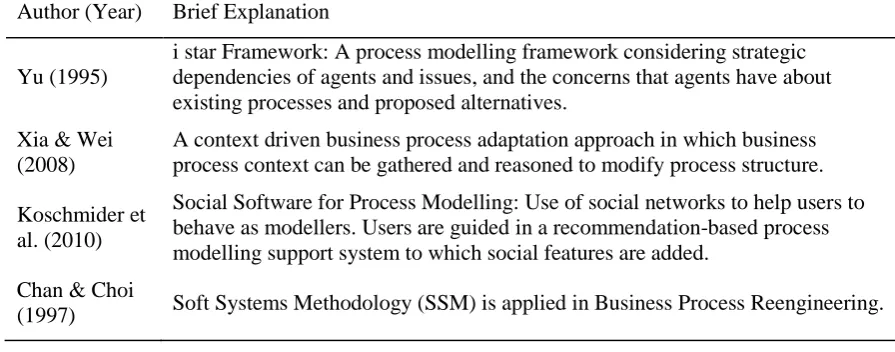
Process modelling methods that incorporate social aspects of practices aim to address this shortcoming, and are therefore inclined to a human-centred perspective on process modelling (see Table 1). These human-centred process modelling approaches show that deterministic technology-centred modelling limits business practices, and fails to assist innovation and creative improvisation (Brown and Duguid 2000a; 2000b). Lee (2005) argues for achieving a balance between the use of systematic business process modelling for optimisation and the use of human-driven improvised problem-solving in practices. This is because while the modelled processes assume predictable environments, rely on explicit knowledge and emphasise the routine ways that tasks are organised; problem-solving practices are concerned with responding to changing unpredictable environments, rely on improvisation based on tacit knowledge and emphasise getting things done within the context of unique situations (Brown and Duguid 2000b).
People Perspectives
8
Eastman et al. 2008; Azhar et al. 2012); a view that is challenged by Brown and Duguid (2000a), and Brewer and Gajendran (2012). People live and work within organisational social settings, and this leads to an explanation of behaviour set by organisational cultures. Culture is a disputed concept (Wright 1994) but can be taken as an explanation of how people within organisations create, shape and are affected by shared (common) cognitive, affective and behavioural patterns. The centrality of organisational culture to organisational life is emphasised by several authors (e.g. Smircich 1983; Alvesson 2002).
Smircich’s (1983) work focuses on two extreme views on organisational culture: functional
and non-functional, which provides the argument for the differences adopted in this paper. The functional perspective emphasises prediction, generalisability, causality, and control. It sees culture as a variable among many others, and as something an organisation ‘has’. Hence it assumes that culture can be consciously managed to improve performance due to its causal nature. Consequently, the functional perspective reduces culture to limited aspects that are perceived from an organisational performance point of view (Smircich 1983; Gajendran et al. 2012).
In contrast, a non-functional perspective attempts to explain the context in addition to the observable human behaviour, thus, culture is seen as something an organisation ‘is’. This view sees the informal aspects of organisations as important, and attempt to explore these aspects to produce improvement in organisations (Smircich 1983; Gajendran et al. 2012).
Methodology
9
project. This means that a static understanding of the innovative capability of BIM is inappropriate. Hence, it is difficult to capture, and make generalisations about the innovative capability of BIM in the face of the changing social and material particularities of design projects. Although the fixed features of BIM technologies are certainly significant in the organisation of design process; in practice, practitioners also spend substantial amount of time interacting with each other through the modes of interaction that do not involve BIM technologies (e.g. meetings, telephone conversations, e-mails). Consequently, the innovative capability of BIM in design can be argued to be a dynamic notion which is a joint outcome of fixed technological capabilities and the evolving sociality around them.
This research takes a critical realist position (Ackroyd and Fleetwood 2000; Mingers 2008) as being the most suitable for the practical task of exploring the innovative capability of BIM through the two polarised perspectives (technological and human-centred) on BIM. Critical realism sees the physical world and technology as real but recognises that human views and actions of those are socially constructed. The selected approach presumes that, ontologically, building information models (models) exist independently (i.e. independent from its users) and have the power of affecting the practice (i.e. the situations) in which they take place with their users. At the same time, it allows the research to capture how different perspectives and needs about working with models are differently constructed by various users, and in turn cause changes in the reality (i.e. materiality) of the model.
10
years ago. The interviews were conducted with people having different roles (one associate partner, two mechanical engineers, two energy modelling engineers, one structural engineer and one acoustic engineer) to capture various views on BIM in the firm. The interviews aimed to gain insight into the changes that occurred in these practitioners’ professional activities with the implementation of BIM and into their perceptions of BIM. These interviews were recorded and transcribed. The research also used empirical findings from the interdisciplinary coordination practices of a BIM-enabled educational building project in the UK which was then at its detailed design stage. In addition to observational data collected from five clash-detection and model coordination meetings, four open-ended interviews with meeting participants were conducted in order to gain more insight about the observational data. The organisations involved in the project did not allow the recording of the meetings but only attendance and interviews. Thus, data was recorded in field notes and the reflections on these were supported by the interviews.
11
accounted for rather than being over-simplified in order to understand and enable innovation in construction.
BIM in Practice
In this section, the findings are presented as three vignettes which provide empirical evidence for the three emerged themes about BIM-enabled innovation in practice. The first vignette is based on data collected from the multi-disciplinary engineering design firm, followed by the other two vignettes that are based on data collected from the design project. Overall, the three vignettes provide practical evidence of how the innovative capability of BIM was enacted or hindered in practice. Each vignette is followed by an analysis through the lens of polarised perspectives in order to reveal the relevance of technology- and human-centred arguments to the innovative capability of BIM.
Vignette 1 – Practical Strategies in Adopting BIM in the Engineering Design Firm
The engineering design firm provided design services in a variety of engineering disciplines but BIM technologies did not dominate any of their practices although they had been used to using proprietary design software packages. For example, the acoustic and energy modelling engineers did not interact with any collaborative BIM software. Both disciplines believed that the nature of inputs and outputs of their disciplines differed from other disciplines, and that there was no need to be integrated into a merged building information model. Besides, although the energy modelling engineers acknowledged that interoperability between the model and their proprietary (i.e. in-discipline) software could be useful, they stated that the accuracy of data entered by other parties would be doubtful and caution would be required in using this data.
12
interviewees saw and used BIM merely as a technological tool for design coordination. Even the disciplines interacting with the collaborative BIM software (i.e. mechanical and structural engineers) created their design solutions as they had traditionally done, and then transferred them to the models for clash-detection and drawing generation. The amount of the object attributes entered in the model (i.e. non-geometric data) were also not standardised and showed significant variations from one project to another.
The reasons for their approach to BIM merely as a design coordination tool were given as below:
The only perceived advantages of 3D modelling were early clash-detection and better
design coordination.
The amount of the detail required in 3D modelling was non-supportive in iteratively
developing the design in structural and mechanical engineering disciplines.
Drafting work could no longer be delegated to Computer Aided Design (CAD)
technicians because 3D modelling required decision making during modelling, thus increasing the workload of mechanical engineers. The time needed to embed all design information (i.e. geometric and non-geometric) into a model was not perceived as adding enough value.
The amount and type of information that contractors used had not changed. They did
not use 3D models and asked for two-dimensional (2D) drawings.
Senior engineers signed-off design documents but did not have BIM knowledge.
Software interoperability problems were not totally resolved at the time.
13
gave more power to people using BIM technologies in determining the scope of the BIM-related change. Although the interviewees knew that BIM technologies had the potential to enable new practices beyond design coordination, practical concerns played a critical role in determining the scope of change, and led the company to use BIM merely as a design coordination tool with minor changes in practices. Automatic clash-detection and 3D visualisation were the obvious, immediate benefits of BIM technologies even in cases where non-geometric data was not entered into the model. Hence these features were used in all projects. All interviewees also saw BIM as an important part of the future of the construction industry. Nevertheless, interviewees’ knowledge about the technological capabilities of BIM did not necessarily produce corresponding innovations, but was used rather differently for marketing purposes and the firm’s internal processes.
Analysis
14
The internal processes of the firm changed very little after the adoption of BIM, mainly due to practical concerns. All the interviewees were aware of the potential technological capabilities of BIM, which would be seen as a sufficient reason for innovation from a technology-centred perspective. However, the findings suggest that in practice the process change was very limited and the pragmatism of everyday practices played a more important role than technological capabilities of collaborative BIM software. For example, drafting efforts of CAD technicians were replaced by drafting efforts of mechanical engineers, and the design decisions began to be made at the time of modelling, thus enabling better-informed design decision-making for certain parts of the design. However, this was seen as not delivering enough value, especially considering the wider organisation of the work; for instance, considering the clients who were reluctant to pay more for the increased skilled effort, or the mechanical engineers who were struggling to do 3D modelling at early stages of their design.
BIM-15
enabled design development, their examples were very discipline-specific, which reflected the human-centred perspective. Moreover, although all interviewees agreed that the use of collaborative BIM software increased communication among various members of the design team, they also claimed that collaboration could not be said to be improved. As one of the interviewees stated, “sharing more [digital information] does not make a better team”.
Vignette 2 – Practical Adjustments to the Use of the Technological Capabilities in the Design
Project
16
the automated clash-detection alone in assuring a clash-free construction. They repeatedly warned the designers that delivering clash-managed models did not remove the designers’ responsibility for delivering a design that can be built without any clashes. They suggested that the designers also consider their traditional design coordination measures to ensure this.
In one of the model coordination and clash-detection meetings, the architectural model was criticised for having too many in-discipline clashes between the furniture and internal wall families which were both owned by the architect. The unexpectedly high number of clashes created a sense of disturbance in the team. The representative of the architect claimed that he was aware of these clashes, and these did not need to be picked up at that moment because the locations of most of the furniture were not finalised, and therefore his colleagues did not seek to model them clash-free. The design manager of the main contractor further criticised him saying that, he should not have exported unfinished worksets for clash-detection. The representative of the architect objected to this by saying that although clashes between furniture with internal walls were not relevant at that stage, he needed to check for the clashes between some of the fixed furniture with other disciplines’ objects. He further stated, in an upset fashion, that if there was an in-discipline clash on site due to their poor modelling, his company would be ready to pay for the extra cost. He then started to question the purposes of model-based design; whether it was to reach a clash-free model or clash-free construction. He criticised the critiques regarding the in-discipline clashes which he thought were normal to have at that stage of the design. As an answer to the architect’s statement, the design manager of the main
contractor stated that the model was not only a discipline-specific design document but would also be used for construction and operations, and therefore the targets and procedures in place needed to be followed to satisfy multiple requirements from digital models.
17
18
position here reflects a human-centred perspective on BIM by highlighting the necessity of accommodating various discipline-specific needs in design development.
Vignette 3 – Practical Compromises in BIM-enabled Practices in the Design Project
19
system for each change, and this made the CBIM even harder to use efficiently. Moreover, he argued that automated connections between different elements of the system were frequently wrong and unintentional in the CBIM. Although the design manager of the main contractor added that they did not need the closed system in the model; but just the geometry of MEP system which was enough for their coordination purposes, this was in contrast with the general expectation within the project that the CBIM was a full design development tool. At the end of the discussion, the modelling manager of the MEP sub-contractor told the architect in a calmer voice that they could not provide all the required items in the model in such a short time, but that they could adjust their modelling priorities to the needs of other stakeholders.
Later in the project, when the ceiling installation began, the design of suspended ceilings had to be re-documented in 2D drawings with a much finer level of detail and measurements from the site because the installation tolerances made the setting-out details in the model useless.
Analysis
This vignette shows another practical example of the co-presence of polarised perspectives leading to confusion and tension in practice as different perspectives were not explicitly acknowledged. The architect who had been using the collaborative BIM software for design development, adopted a technology-centred process as required by the modelling software. Therefore, his information needs were partly shaped by the process that was in line with the software’s working principles. However, information and processes were not universal, and
20
simply switched according to the specific needs of each project. Furthermore, the MEP installation team that put pressure on the MEP modelling team also assumed that if technology was capable of documenting detailed systems design, which automatically calculated the whole system, then this feature had to be used. However, the modelling manager of the MEP sub-contractor had a different relationship with the information and process, and obviously there were different cultures of designing between the architects and the MEP engineers. When these differences were discussed around deliverables, this built up tension and dissatisfaction that in the end led to scenes like the one described in Vignette 3. The ending of the event is rather ironic in its claim that the details in the model became irrelevant when the site installation started due to the scale of the tolerances on the construction site. This is yet another conflicting situation between the technology-centred perspective, which assumes that the digitally calculated and coordinated design would not need any intervention during site installations as all the information is in the model and ready to be used; and the human-centred perspective, which assumes that information is always subjective and therefore always only partially transferable.
Discussion
21
Consequently, understanding ‘innovation-as-practice’ becomes crucial to establish and exploit the innovative capability of BIM. The ‘novel duality to study technological innovation’ (i.e. technology- and human-centred perspectives on BIM) established in the paper enables this by facilitating the articulation of various perspectives in practice about what could and could not be done differently in BIM-enabled projects. Hence it is useful both for practitioners and researchers in considering technological innovation in construction. Ultimately, the analyses suggest that the inherent social and organisational complexity of the construction industry must be accounted for in considering the innovative capability of BIM. Thus ‘an over-simplification’ based on a single perspective must be avoided. These three points are discussed below in more detail.
Innovation-as-Practice
The analyses suggest that the adoption, and some commitment to the use of BIM technologies create ‘windows of opportunity’ for innovation in construction design practices. However, the enactment of innovation based on these windows of opportunity depends also on the practitioners’ perceptions and negotiations within the context of the continuously changing
design situations. This argument has two major implications. First, it implies that a technology-centred perspective is useful for noticing and articulating the windows of opportunity afforded by BIM technologies in design practices (and for appreciating the technological, process-related, and cultural conditions required to use these opportunities). Second, it implies that the translation of these windows of opportunity into innovations in practice (i.e. enacting innovations through these windows of opportunity) depends on the alignment of interests of various practitioners involved, thus revealing the need for a human-centred perspective.
22
Technology-centred perspective delineates the extent and the conditions of what can be done differently using the technology, thus outlining the windows of opportunity. On the other hand, human-centred perspective, which recognises the different needs of the people who work together, is required by practitioners so that novel courses of actions that make sense for the parties involved can be established around the windows of opportunity. This involves the mutual adjustment by practitioners in terms of how much each practitioner is willing to, or can, adjust his/her technological means, work processes and organisational culture.
This argument is in line with previous research which claimed that innovation depends on human agency, creativity and adaptation (Hodder 1998; Gann 2003); and that it is a historically-socially embedded process in which multi-faceted things are linked and made sense of within the particularities of changing situations (Bowley 1966; Hodder 1998; Elmualim and Gilder 2014). Previous research has provided valuable insight regarding the process of enacting technological innovation in practice by looking at, for example, the interactions among human and non-human entities (Harty 2005), and relationship-building between the practitioners in projects (Holmen et al. 2005). This paper advances this stream of research by arguing that the process of technological innovation must be understood practically as it relies on the reconciliation of various adopted perspectives in practices. Using the conceptual continuum based on human- and technology-centred perspectives facilitates this understanding as further discussed in the next section.
A Novel Duality to Study Technological Innovation
23
(e.g. Holmen et al. 2005), micro vs macro levels of organising (e.g. Moum et al. 2009), and exploration vs exploitation (e.g. Eriksson 2013; Davies and Brady 2016) in order to make better sense of and develop explanations about technological innovation in construction. The argument put forward in this paper provides another axis spanning technology- and human-centred perspectives to engage with technological innovation in construction. On the one hand, the technology-centred perspective reflects the openings of ‘windows of opportunity’ based on the capabilities of the technology. On the other hand, the human-centred perspective accounts for the diversity and complexity within which the technology is operated. This new axis (technology-centred vs human-centred) to explore technological innovation, enhances previous categories, thus enabling richer explanations of technological innovation. For example, the duality established in this paper can be used as a hermeneutic tool to make sense of the struggles in practice-level micro interactions between individuals (as has been done in this paper), or can be used to make sense of biases at macro levels such as policies, standards and institutional narratives (i.e. dominant rhetoric). Similarly, it can provide nuanced understandings of what is being explored or exploited in the course of innovating (technology, organisational processes/practices, cultural tendencies/limits), and from which perspective (technology-centred or human-(technology-centred).
24
duality can assist the researchers, practitioners, policy developers and software developers in articulating what could be done differently, and the limits of these arguments in consideration with the other end of the established conceptual continuum. Consequently, establishing and driving the technological innovation relies on the reconciliation of technology-centred and human-centred perspectives. A tension is unavoidable, as it is always the case in dualities, but this tension can be seen and used as a driving force to assess the technological innovation realistically, rather than neglecting or rejecting the contrasting perspectives, and so to implement it successfully. Hence this paper contributes to a large variety of practices ranging from those of professional designers to software developers by providing a language and duality which allows to think and talk more effectively about the innovative capability of BIM.
Over-Simplification of a Complex Realm?
The currently dominant technology-centred perspective is insufficient to capture and drive the innovative capability of BIM. Construction projects are characterised with social and organisational complexity (Dubois and Gadde 2002; Harty 2005). The expectations that the technology alone can solve this complexity ignores the obvious fact that those who are supposed to use technology to tackle complexity are the ones who create it in the first place.
25
beyond the functionality of the details (Bertelsen 2004). Consequently, business improvements that only consider this reductionist view have limited effects.
Managers and problem-solvers should acknowledge the added complexity in the adoption of BIM and avoid having too many expectations from technology-centred approaches alone (Brown and Duguid 2000a). Instead, the practical reconciliation of technology-centred and human-centred perspectives on BIM is necessary to understand the challenges of BIM and to exploit its innovative capability. The complex nature of this area should be embraced as an important input in conceiving BIM-enabled innovation.
Conclusion
26
Consequently, in BIM-enabled projects, practitioners must open-up spaces for negotiation and develop suitable vocabulary to help them better communicate their diverging assumptions of what could (and could not) be done differently by using BIM technologies, and why. These negotiations must go beyond superficial arrangements around design documentation, and acknowledge the fundamental differences in the implicit assumptions made about BIM by various practitioners. This implies that the practitioners must be ready to face and work with tensions that arise when contrasting implicit assumptions coincide in practice. They should not reject certain perspectives but should work towards the resolution of tensions through negotiations. This requires more explicit ways of thinking and talking about various perspectives which this paper assists by establishing an understanding of innovation-as-practice, as well as a vocabulary based on technology- and human-centred perspectives on BIM. More studies are required to contribute to this effort so that the innovative capability of BIM in construction design can be assessed and exploited more effectively.
Data Availability Statement
The observational data generated and analysed during the study are included in the submitted article. The interview data generated and analysed during the study are available from the corresponding author by request.
References
Abrishami, S., Goulding, J.S., Pour-Rahimian, F., and Ganah, A. (2014). “Integration of BIM and generative design to exploit AEC conceptual design innovation.” Journal of Information Technology in Construction (ITcon), 19, 350-359.
Ackroyd, S., and Fleetwood, S. (2000). Realist perspectives on management and organisations, Routledge, London, UK.
27
Arayici, Y., Coates, P., Koskela, L., Kagioglou, M., Usher, C., and O'Reilly, K. (2011). “Technology adoption in the BIM implementation for lean architectural practice.” Automation
in Construction, 20(2), 189–195.
Azhar, S., Khalfan, M., and Maqsood, T. (2012). “Building information modeling (BIM): Now and beyond.” Australasian Journal of Construction Economics and Building, 12(4), 15-28.
Bertelsen, S. (2004). “Lean construction: Where are we and how to proceed?” Lean Construction Journal, 1(1), 46-69.
BIM Industry Working Group. (2011). “A report for the government construction client group.” <http://www.bimtaskgroup.org/wp-content/uploads/2012/03/BIS-BIM-strategy-Report.pdf> (January 14, 2017).
Bowley, M. (1966). The British building industry, Cambridge University Press, London, UK.
Brewer, G., and Gajendran, T. (2012). “Attitudes, behaviours and the transmission of cultural traits - Impacts on ICT/BIM use in a project team.” Construction Innovation, 12(2), 198-215.
Brown, J.S., and Duguid, P. (2000a). Social life of information. Harvard Business School Press, Boston, MA.
Brown, J.S., and Duguid, P. (2000b). “Balancing act: How to capture knowledge without killing it.” Harvard Business Review, May-June, 3-7.
BSI (British Standards Institution). (2007). BS ISO 12006-3:2007 - Building construction - Organization of information about construction works - Framework for object-oriented information.
28
Çıdık, M. S., Boyd, D., and Thurairajah, N. (2013). “Understanding the polarized perspectives
in BIM enabled projects.” In: S.D. Smith and D. D. Ahiaga-Dagbui, (eds.), Proc., 29th Annual ARCOM Conf., Association of Researchers in Construction Management, UK, 703-713. Davies, A., and Brady, T. (2016). “Explicating the dynamics of project capabilities.” International Journal of Project Management, 34(2), 314-327.
Deraman, R., Salleh, H., Beksin, A.M., Alashwal, A.M., Abdullahi, B.C., and Abdullah, A.A. (2012). “The roles of information and communication technology (ICT) systems in construction supply chain management and barriers to their implementation.” African Journal of Business Management, 6(7), 2403-2411.
Dervin, B., and Nilan, M. (1986). “Information needs and uses.” In: M.E. Williams, (ed.), Annual review of information science and technology, Vol. 21, 3-33. Knowledge Industry Publications, White Plains, NY.
Dossick, C.S., and Neff, G. (2010). “Organizational divisions in BIM-enabled commercial construction.” Journal of Construction Engineering and Management, 136(4), 459-467.
Dossick, C.S., and Neff, G. (2011). “Messy talk and clean technology: communication, problem-solving and collaboration using Building Information Modelling.” The Engineering Project Organization Journal, 1(2), 83-93.
Dubois, A., and Gadde, L.E. (2002). “The construction industry as a loosely coupled system: implications for productivity and innovation.” Construction Management and Economics, 20(7), 621-631.
Eastman, C., Teicholz, P., Sacks, R., and Liston, K. (2008). BIM handbook: A guide
to building information modeling for owners, managers, designers, engineers, and
29
Elmualim, A., and Gilder, J. (2014). “BIM: Innovation in design management, influence and challenges of implementation.” Architectural Engineering and Design Management, 10(3-4), 183-199.
Eriksson, P.E. (2013). “Exploration and exploitation in project-based organizations: Development and diffusion of knowledge at different organizational levels in construction companies.” International Journal of Project Management, 31(3), 333-341.
Ewenstein, B., and Whyte, J. (2009). “Knowledge practices in design: The role of visual representations as ‘epistemic objects'.” Organization Studies, 30(1), 7-30.
Fernie, S., Leiringer, R., and Thorpe, T. (2006). “Change in construction: A critical perspective.” Building Research & Information, 34(2), 91-103.
Gajendran, T., Brewer, G., Dainty, A., and Runeson, G. (2012). “A conceptual approach to studying the organisational culture of construction projects.” Australasian Journal of Construction Economics and Building, 12(2), 1-26.
Gann, D.M. (2003). “Guest editorial: Innovation in the built environment.” Construction Management and Economics, 21, 6553–6555.
Gleick, J. (2011). The information: A history, a theory, a flood. Fourth Estate, London, UK.
Grilo, A., and Jardim-Goncalves, R. (2010). “Value proposition on interoperability of BIM and collaborative working environments.” Automation in Construction, 19, 522–530.
30
Gu, N., and London, K. (2010). “Understanding and facilitating BIM adoption in the AEC industry.” Automation in Construction, 19(8), 988–99.
Gustafsson, M., Gluch, P., Gunnemark, S., Heinke, K., and Engström, D. (2015). “The role of VDC professionals in the construction industry.” Procedia Economics and Finance, 21, 478-485.
Harty, C. (2005). “Innovation in construction: A sociology of technology approach.” Building Research & Information, 33(6), 512-522.
Harty, C. (2008). “Implementing innovation in construction: contexts, relative boundedness and actor‐network theory.” Construction Management and Economics, 26(10), 1029-1041.
Hodder, I. (1998). “Creative thought: A long term perspective.” In: S. Mithen (ed..), Creativity in human evolution and prehistory, 61–77. Routledge, London, UK.
Holmen, E., Pedersen, A.C., and Torvatn, T. (2005). “Building relationships for technological innovation.” Journal of Business Research, 58(9), 1240-1250.
Koschmider, A., Song, M., and Reijers, H.A. (2010). “Social software for business process modeling.” Journal of Information Technology, 25(3), 308-322.
Koskela, L. and Vrijhoef, R. (2001). “Is the current theory of construction a hindrance to innovation?” Building Research & Information, 29(3), 197–207.
Kueng, P. (2005). “Expert view.” Business Process Management Journal, 11(6), 624-27.
Latham, M. (1994). Constructing the team. Her Majesty's Stationary Office, London, UK.
31
Lindsay, A., Downs, D., and Lunn, K. (2003). “Business processes—attempts to find a definition.” Information and Software Technology, 45, 1015–19.
Melao, N., and Pidd, M. (2000). “A conceptual framework for understanding business processes and business process modelling.” Information Systems Journal, 10, 105–129.
Miettinen, R., and Paavola, S. (2014). “Beyond the BIM utopia: Approaches to the development and implementation of building information modeling.” Automation in Construction, 43, 84-91.
Mingers, J. (2008). “Management knowledge and knowledge management: Realism and forms of truth.” Knowledge Management Research and Practice, 6(1), 62-76.
Moum, A., Koch, C., and Haugen, T. I. (2009). “What did you learn from practice today? Exploring experiences from a Danish R&D effort in digital construction.” Advanced Engineering Informatics, 23(3), 229-242.
Murphy, M. E. (2014). “Implementing innovation: A stakeholder competency-based approach for BIM.” Construction Innovation, 14(4), 433-452.
Mutis, I., and Issa, R.R.A. (2012). “Framework for semantic reconciliation of construction project information.” Journal of Information Technology in Construction (ITcon), 17, 1-24.
Neff, G., Fiore-Silfvast, B., and Dossick, C.S. (2010). “A case study of the failure of digital communication to cross knowledge boundaries in virtual construction.” Information, Communication & Society, 13(4), 556-573.
32
Oh, M., Lee, J., Hong, S. W., and Jeong, Y. (2015). “Integrated system for BIM-based collaborative design.” Automation in Construction, 58, 196-206.
Olatunji, O. A. (2011). “Modelling organizations’ structural adjustment to BIM adoption: A pilot study on estimating organizations.” Journal of Information Technology in Construction (ITcon), 16, 653-668.
Poirier, E., Forgues, D., and Staub-French, S. (2016). “Collaboration through innovation: implications for expertise in the AEC sector.” Construction Management and Economics, 1-21.
Shelton, J., Martek, I., and Chen, C. (2016). “Implementation of innovative technologies in small-scale construction firms: Five Australian case studies.” Engineering, Construction and Architectural Management, 23(2), 177-191.
Shen, W., Hao, Q., Mak, H., Neelamkavil, J., Xie, H., Dickinson, J., Thomas, R., Pardasani, A., and Xue, H. (2010). “Systems integration and collaboration in architecture, engineering, construction, and facilities management: A review.” Advanced Engineering Informatics, 24(2), 196-207.
Singh, V., Gu, N. and Wang, X. (2011). “A theoretical framework of a BIM-based multi-disciplinary collaboration platform.” Automation in Construction, 20(2), 134-144.
Slaughter, S. (1998). “Models of construction innovation.” Journal of Construction Engineering and Management, 124(3), 226-231.
Smircich, L. (1983). “Concepts of culture and organizational analysis.” Administrative Science Quarterly, 28(3), 339-358.
33
Tam, C. M. (1999). “Use of the internet to enhance construction communication: Total Information Transfer System.” International Journal of Project Management, 17(2), 107–111.
Theng, Y. L., and Sin, S. C. J. (2012). “Analysing the effects of individual characteristics and self-efficacy on users' preferences of system features for relevance judgment.” Information Research, 17(4), paper 536. <http://InformationR.net/ir/17-4/paper536.html> (Aug. 2, 2016). Wilson, T. D. (2000). “Human information behavior.” Informing Science, 3(2), 49-55.
Wong, K. D., and Fan, Q. (2013). “Building information modelling (BIM) for sustainable building design.” Facilities, 31(3/4), 138-157.
Wright, S. (1994). “Culture in anthropology and organisational studies.” In: S. Wright (ed.), Anthropology of organizations. Routledge, New York, NY.
Xia, Y., and Wei, J. (2008). “Context-driven business process adaptation for ad-hoc changes.” In: Proc., Int. Conf. e-Business Engineering, IEEE Computer Society, Los Alamitos, CA, 53-60.
34 Figures in the paper:
Fig. 1 Business process views vs. paradigms (reprinted from Melao & Pidd 2000; © 2000 Blackwell Science Ltd)
Tables in the paper:
Table 1. Examples of process modelling methods that incorporate social aspects of practices
Author (Year) Brief Explanation
Yu (1995)
i star Framework: A process modelling framework considering strategic dependencies of agents and issues, and the concerns that agents have about existing processes and proposed alternatives.
Xia & Wei (2008)
A context driven business process adaptation approach in which business process context can be gathered and reasoned to modify process structure.
Koschmider et al. (2010)
Social Software for Process Modelling: Use of social networks to help users to behave as modellers. Users are guided in a recommendation-based process modelling support system to which social features are added.
Chan & Choi