Human-Behaviour under Fire situations in High-Rise residential
Building
Michael Gerges, Mohammad Mayouf, Peter Rumley and David Moore
Scott Sutherland School of Architecture and Built Environment, Robert Gordon University, Aberdeen.
Abstract
Purpose- The purpose of this paper is to identify the challenges resulted from human-behaviour under fire situation in high-rise residential buildings to support the evacuation process.
Design/methodology/approach- Mixed research method approach was used using both quantitative and qualitative data. A literature review was initially conducted to identify different factors that influence human behaviour during a fire situation and identify various challenges faced during the evacuation. Both questionnaires and semi-structured interviews were conducted to investigate the challenges that occupants face during evacuation. A high-rise building in Egypt was used in collecting the primary evidence for this paper.
Findings- The paper has identified, based on the feedback from the interviews and questionnaires, three challenges that affect occupants’ decision during fire emergency in high-rise residential buildings. The first challenge is occupants’ knowledge and skills when dealing with fire emergencies. The second challenge is that occupants tend to rely on other routes than using the designated evacuation routes (only 33.87% of respondents) when escaping the building. The third challenge is that some occupants tend to ignore the fire alarm (74.17% of the respondents) and instead investigate whether the alarm is true or false.
Originality value- The paper draws many vital inputs, which can support decision-making for fire engineers, facility managers, building owners, and other construction stakeholders during the design phase for high-rise buildings to ensure occupants’ safety during fire emergency situations.
Keywords: High-Rise residential building, human-behaviour, evacuation, fire safety, Egypt, Panic
Introduction
With the world population growing and demand for space becoming more of an issue (Cheung et al., 2005). Practitioners and researchers believe that the development of high-rise buildings is one of the solutions to overcome the increase of population (Gifford, 2007; Cheung et al., 2005). Many of the recently constructed high-rise buildings, have great aesthetic appearance, and provide benefits such as allowing top floor residents unprecedented views alongside a reduction in noise when compared to low rise buildings. Designing and constructing such (high-rise buildings) structures can be challenging in many ways. On the one hand, there are structural challenges that include resisting fatigue loading, wind impact and foundation design and supply of logistics. On the other hand, there are design challenges, considered as essential priority for engineers/designers, which include fire safety and resistance to fire are an. There is no doubt that ongoing improvements in fire safety technology has developed at pace and the way fire safety is dealt with has evolved alongside the technology (Kuligowski and Hoskins, 2010).
In addition to calling upon experience, knowledge and initial cue, an individuals’ decision often depends on role assumed, personality, education and perceived threat. In many cases occupants tend to ignore the initial fire alarm due to the number of false alarms or alarm tests experienced previously. Kobes et. al. (2008) defines fire safety as essentially comprising “extinguishing a fire and the chance of quick and safe exit”. Occupants tend to be predictive, evacuating the building via the same route that they entered or the one they have ‘always used’. This familiarity often leads to the occupants using the shortest route which may not necessarily be the safest.
Although fire safety has been a buzz word for practitioners and researchers for a long period, the author considers there to have been limited research in the area of human-behaviour under a fire situation and more specifically in the Middle East. Studying human behaviour in such a context, will not just allow structural engineers in the Middle East to anticipate the reaction of humans and therefore reduce their exposure to fire risk, but will also help researchers understand human behaviour and recommend ways of improving how they may respond more effectively and safely in a fire situation.
Aim/objectives
The aim of this research is to investigate the behaviour of occupants under a fire situation through a case study conducted in Egypt. In achieving the aim, this research aims to satisfy the following objectives: to investigate fire safety issues and challenges arising in high-rise buildings; to identify human behavioural decisions whilst experiencing a fire situation, and to investigate the challenges that face occupants when evacuating a high-rise building.
Definition of High-Rise Building
Fire Safety in High-Rise building
In buildings, the primary aim of ensuring fire safety is the protection of human life (Zhang, 2008) with a secondary priority of the protection of property (Kincaid, 2012). In addition, he explains that fire safety can be broken down into two distinct areas, passive and active. Passive is related to the primary building structure and its fabric whereas active refers more to the secondary tools and systems installed during the fit-out stage. Kobes et al. (2010) defined fire safety as the prevention of fire, the limitation of spread of flame and smoke and the extinguishing of the fire to improve chance of successful fire evacuation.
According to Chow and Chow (2005), fire safety in buildings does not necessarily ensure a safe evacuation for building occupants. This is often dependent upon variables that may hinder an occupant’s ability to evacuate the building in an acceptable safe time. For example, in hospitals where patients are often confined to their beds, the evacuation process is often compromised and it may well be impossible to facilitate total evacuation (SRI, 2007). Therefore, as part of the fire safety assessment, it may be that partial evacuation to a place or area of safety on the same floor is more practicable. Kobes et al. (2010) recommend that when designing fire safety for a building, the following objectives need to be met to ensure as far as is reasonably practicable, the safety of the occupants: minimization of the spread of fire between different compartments, integrity of the structure to ensure minimum chance of collapse because of heat and the provision of firefighting facilities and equipment for initial response (Kobes et al., 2010).
There are many studies that studied fire safety within high-rise buildings. According to Sun et al. (2013), it was claimed that fire behaviour in high-rise building can be influenced by many features. These features are: complexity of building structures, materials used for external and internal finishes, and crowd evacuation. Cowland et al. (2013) have looked into building performance for 50 high-rise buildings where fire disasters have occurred. Their study has focused on various building characteristics: extraction time, smoke in stair, vertical fire spread (Oleszkiewics, 1991) and structural damage (Thomas, 1986; SFPE, 2012). They concluded that performance based design is essential to ensure fire safety for high-rise buildings.
Human Behaviour under Fire Situation
done previously in a similar situation. Kobes et al. (2010) identified several traits of human-behaviour during evacuation:
Cue validation - decisions will be taken during the evacuation process that are based on clues they receive, therefore cue validation is important
People ignore the fire alarm believing it to be a false alarm
The smell of something burning or visual observation of flames. Occupants tend to wait until they see things with their eyes, and then wait for other cues.
Occupants tend to evacuate the building via the main access route as they often believe it to be the shortest route and most familiar
Occupants will only use fire exist doors if they are open and clear passage is evident
People change direction depending on the direction of smoke and its effect on their breathing and vision.
It was found that many factors influence an occupant’s decision (Pires, 2005; O’Connor, 2005). Cordeiro et al. (2014) stated that an occupant’s behaviour depends on the physical (Isobe et al., 2004), psychic (Purser, 2000) and cognitive (Sime, 1995) characteristics of the building and its geometry. A study conducted by Cordeiro et al. (2014) investigated the behaviour of occupants in Portuguese buildings through a survey completed by 225 people and containing 14 questions. The results found that 43% of occupants were unsure as to what action they should take during a fire situation. Some respondents stated that they would knock on a neighbour’s door whilst others felt they must either investigate further, call building security, call the local fire station or contact friends. Some went as far to say they would completely ignore the call of the fire alarm whose sole intention is to prompt the occupants to evacuate immediately. 12% of occupants stated that they would evacuate a building only if they smelt or observed smoke. In a survey conducted by Proulx (2001) resulting in 500 respondents, only 25% stated that they would evacuate a building when hearing the fire alarm.
which are primarily for people with a disability which would render standard evacuation a hazard to both themselves and others.
In 468 completed surveys, Ronchi and Nilsson (2013) found that majority of people are only prepared to use the stairs for short distances especially if required to progress to a higher level. Perhaps the issue of using staircase during fire evacuation was raised when looking back at the evacuation studies (Averill et al., 2007; Proulx, 2007) conducted on WTC towers between 1993 and 2001. In addition, the queue waiting time for a lift affects the evacuation process causing congestion and often panic. Interestingly, 308 respondents stated that although they felt it would be safe to use the elevator they would probably choose not to as they felt it was a more unsafe option compared to the other routes available (Ronchi and Nilsson, 2013). They confirmed that they would only consider using the lift for evacuation if their floor height was excessive and there was little chance of the lift becoming overloaded.
Proulx (2001) identified that the first reaction of people involved in a fire situation is to panic. He defines panic as being frightened, scared, nervous or anxious but that it usually does not include the application of irrational behaviour. Proulx (2001) presented a list of factors that have an impact on human behaviour during an evacuation namely: profile knowledge, experience, condition at the time of the event, personality and role. Kobes et al. (2010) added some additional factors that often affect the behaviour of occupants during the evacuation process. For example, the size of a staircase, population density using the stairway, the simultaneous evacuation onto a stairwell from several floors, evacuees trying to join the downward flow of people on the staircase, the slowing of the flow due to small talk between evacuees, the use of cell phones to call loved ones, evacuee body mass, weight or height, the wearing of unsuitable footwear (tight shoes, high heels) and finally the counter flow of firefighters. It can be claimed that most studies on fire evacuations for high-rise buildings have focused on factors within specific contexts, which most (if not all) have been investigated after building’s completion. Also, majority the investigations of these factors were based on questionnaires, which perhaps ignored many of the soft factors such as culture, training, language and many others that are difficult to be determined.
Methodology
To achieve the primary aim of this paper, a mixed method approach using both quantitative and qualitative methods has been adopted. Both questionnaires and interviews were used as the primary research methods to gather data in this paper.
Questionnaire design
understanding and therefore achieve the most accurate results. Fellows and Liu (2015) explained that to ensure the questionnaire is written in a suitable format, a pilot test should be undertaken on a small sample. This will test whether the questions are intelligible, easy to answer, unambiguous and more importantly, are liable to achieve the required results and sample return.
The questionnaire is divided into three different sections. Part A identifies the occupant’s gender, education and age whilst also identifying their knowledge of and experience with fire. Part B explores what occupants would do in a fire situation and ranks various factors depending upon priority. Part C investigates whether occupants are aware of the evacuation plans and emergency procedure for their building and whether they understand what action an occupant should take during a fire situation. A likert scale of 1- highest priority, 2- priority, 3- neutral, 4- low priority, 5- not a priority will be used throughout the questionnaire with the researcher believing that a likert scale will be easy in use by respondents and not require too much effort in completion. A pilot study was conducted to improve and validate the questionnaire. Naoum (2007) stated that a pilot study provides a trial run for the questionnaire enabling many variables to be tested namely:
the test wording of the questions identification of ambiguous questions
test the technique of answering the questions
identify the timescale required for occupants to complete the questionnaire test the measurement scale
test the translation into Arabic
The draft questionnaire was collected back after being completed by six occupants of high-rise residential buildings. The wording of the questionnaire was changed to make it simpler and easy to read, as some occupants found it difficult to understand the question. The overall design of the questionnaire was to improve based on occupant’s comments.
Interviews
The use of interviews was deemed to be of advantage as they provide the opportunity to ask questions that are not targeted in the questionnaire. Brown and Edmunds (2011) stated that interviews should be done to obtain answers to broad research questions with face to face interviews usually providing the richest data. Interviews will be done in a safe and quite environment, and will be focused on the topic as open questions may possibly lead to digression.
prospective respondents were not comfortable with conducting the interview either because it reminded them of bad memories or that they felt they did not have enough fire experience or knowledge to answer the questions in detail. A total of six interviews were conducted with occupants who had experience of at least one fire situation in a high-rise building.
Data analysis
The questionnaire findings will be analysed using the Relative Importance Index formula. An Excel sheet was created to rank occupants’ responses.
Relative Importance Index (%)
¿5(n5)+4(n4)+3(n3)+2(n2)+n1 5(n1+n2+n3+n4+n5) ×100
With n1- Highest priority, n2- Priority, n3- Neutral, n4- Low priority, n5- Not a priority. Using Microsoft excel, the factors were ranked based on the grading occupants gave. A double check on the data input into Excel was undertaken to ensure that the data had been input correctly. For part A and part B of the questionnaire, an Excel spreadsheet will be used to present finding such as total age group, gender, knowledge, as well as displaying the responses to part C which are purely yes/no answers. The collected data will then be presented in charts and tables. As the interviews were recorded on paper, content analysis technique will be used to identify similarities and differences in response.
Results and Discussion
The process of distributing and collecting the questionnaires took approximately 4 days due to some occupants being either unavailable due to work commitments or being out of home/office. The questionnaire took on average 20 minutes to complete and multiple responses were achieved from some apartments due to multiple occupancy.
Total Questionnaires distributed: 107 Number of Returned Questionnaires: 62
The first part of the questionnaire (Part A) required a clear indication of the age, education, and gender of respondents, followed by their knowledge and experience, and finally asking whether they are a permanent resident of the building or just an occasional visitor. Figure 1 shows that of the 62 completed questionnaires, 57% of respondents were male and 43% female. Figure 2 identifies the percentage response rate by age whilst figure 3 the response rate based upon highest level of qualification attained. From the results, majority of the respondents (74%) had some form of formal education.
Male 57% Female
43%
Gender
21-25 14%
26-30 21%
31-45 42% 46-54
19% 55+
4%
Age
Figure 1 Gender of Respondents Figure 2 Age of Respondents
High School Certificate
21%
Degree 42%
Postgrad-uate De-gree (Msc,
PhD) 11%
Not Educated 16%
Other 10%
Education
Figure 3 Education of Respondents
it was found that 42% had prior experience (1 – 2 years past) of a fire situation and 7% had similar experience but much longer ago (5 years +). It is worth noting that 34% of respondents had no first-hand-knowledge knowledge or experience of a fire related incident Figure 4.
None 34%
1-2 years 42% 3-5 years
17%
Above 5 years 7%
Knowledge and Experience with Fire
Yes 91% No
9%
Are you a permanent resident of this building
Figure 4 Knowledge and experience of respondents
With fire
Yes 16%
No 84%
Have you had any fire training before
Figure 6 Fire training of respondents
Figure 5 shows that 91% of respondents were a permanent resident of the building either living in an apartment as part of a family unit or living alone. Majority of the respondents indicated that they had been resident in the building for more than a year. The remaining 9% stated that they were visiting family or friends at the time the questionnaire was
circulated. Regarding fire training, figure 6 identifies that the 84% had received no fire training before.
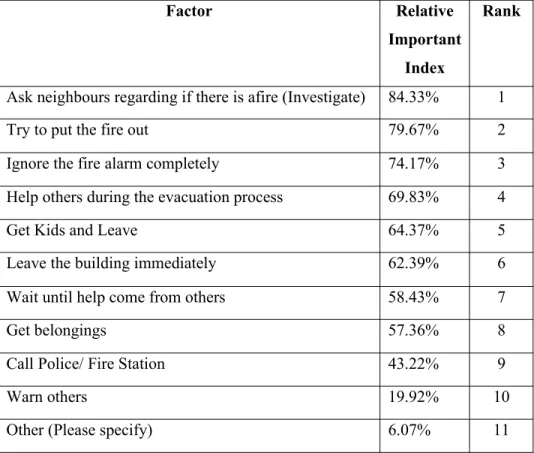
Through analysis of table 1, of the 11 ranked factors, the top four were: ask neighbours regarding if there is a fire (84.33%), try to put the fire off (79.67%), ignore the fire alarm completely (74.17%), and help others during the evacuation process (69.83%).
The researcher believes that whether an occupant investigates whether there is a fire situation or not, is mostly dependent upon either their prior learning or experience or their culture as some societies are more reluctant to open a door and seek confirmation. This can perhaps evidence the feedback gathered on the previous question ‘have you had any fire training before’ where 84% stated no. It is therefore clear that most the occupants are not sure what they need to do personally during a fire situation. Although 42% of respondents had some knowledge and experience of fire, ‘ignoring the fire alarm completely’ was ranked highly (3rd) with a relative importance index of 74.17%.
Table 1 Respondent’s answer to ‘what you do when you hear the fire alarm’
Factor Relative
Important Index
Rank
Ask neighbours regarding if there is afire (Investigate) 84.33% 1
Try to put the fire out 79.67% 2
Ignore the fire alarm completely 74.17% 3
Help others during the evacuation process 69.83% 4
Get Kids and Leave 64.37% 5
Leave the building immediately 62.39% 6
Wait until help come from others 58.43% 7
Get belongings 57.36% 8
Call Police/ Fire Station 43.22% 9
Warn others 19.92% 10
Respondents stated when completing the questionnaire that this was due to too many and too frequent fire alarm testing which in turn, made the occupants believe that hearing the fire alarm was once again likely to be a test rather than an actual emergency. Hence both ‘get the kids and leave’ (ranked 5th) or ‘leave the building immediately’ (6th) were not ranked highly probably due to the complacency of believing that every sounding of the alarm was a test. ‘Call Police/Fire station’ was a choice but scored low (43.22%) due to respondents stating that they usually only rang the Police or Fire departments to get the fire alarm silenced.
When comparing these results to those obtained through the Portuguese survey, similar but somewhat different findings are identified as 36% of occupants ‘investigated what was happening’, whilst ‘leave the place immediately’ was ranked second with 33% and ‘warn others’ came out third with 27%.
Interestingly, in this research warn others was ranked 10th with a relative importance index of 19.92% as occupants believed that there is often nothing serious enough to warrant neighbour notification. 6.07% choose other as their answer and stated that upon hearing the fire alarm they would try to find a way to turn it off, move as far away as possible from the sound and call building security to investigate what was happening. It is worth mentioning that age and/or gender influenced the chosen answer but the researcher does not believe that education was a significant variable. One interesting finding is that of those who indicated that they were educated to degree level or above, would vacate a building immediately upon hearing the alarm if they were unfamiliar with that buildings layout. This is completely the opposite to the course of action they would take if the building they were resident of had an alarm sounding. The majority, if not all respondents who are uneducated, stated that they would follow the landlord or other apartment residents indicating that they are ‘followers’ as they believe others will know better than them.
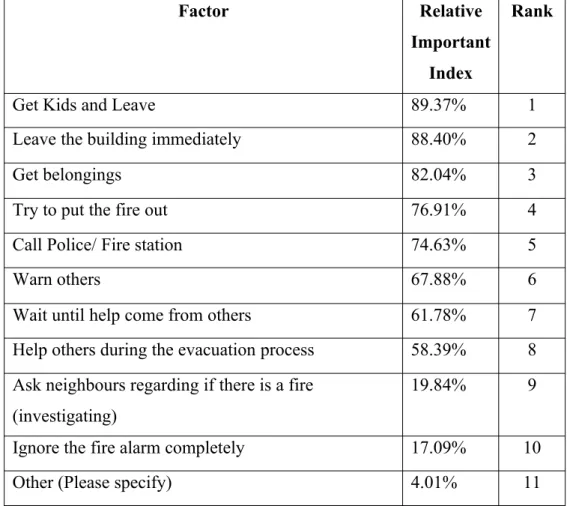
1st was ‘get kids and leave’ with a relative importance index of 89.37%, second ‘leave the building immediately’ with 88.40%, ‘Get belongings’ was ranked 3rd with a relative importance index of 82.04% and ‘try to put the fire out’ was ranked 4th with 76.91%. Respondents stated that seeing fire or smoke (rather than just hearing an alarm), would prompt them to believe that there was a more serious emergency. They felt that visually observing flame and smoke gave a clear indication that they and their family were in immediate danger. Therefore ‘Get kids and leave’ or ‘leave immediately’ were understandably ranked in the top 2 as occupants felt nothing they could do personally would affect the outcome of the fire.
Table 2 Respondent’s answers to what they would do when seeing smoke or flame
Factor Relative
Important Index
Rank
Get Kids and Leave 89.37% 1
Leave the building immediately 88.40% 2
Get belongings 82.04% 3
Try to put the fire out 76.91% 4
Call Police/ Fire station 74.63% 5
Warn others 67.88% 6
Wait until help come from others 61.78% 7
Help others during the evacuation process 58.39% 8 Ask neighbours regarding if there is a fire
(investigating)
19.84% 9
Ignore the fire alarm completely 17.09% 10
Other (Please specify) 4.01% 11
fire was ranked second with 26% while interestingly, 56% of respondents who had received fire training would choose to evacuate the building in another direction rather than tackle the fire however, it can be said that occupants believe that smoke poses more of a threat than fire since it affects a person’s breathing and visualisation. Of the 84% who had no to fire training their number one factor was to get the kids and leave. When questioned further, respondents stated that they would follow what other are doing during a panic situation.
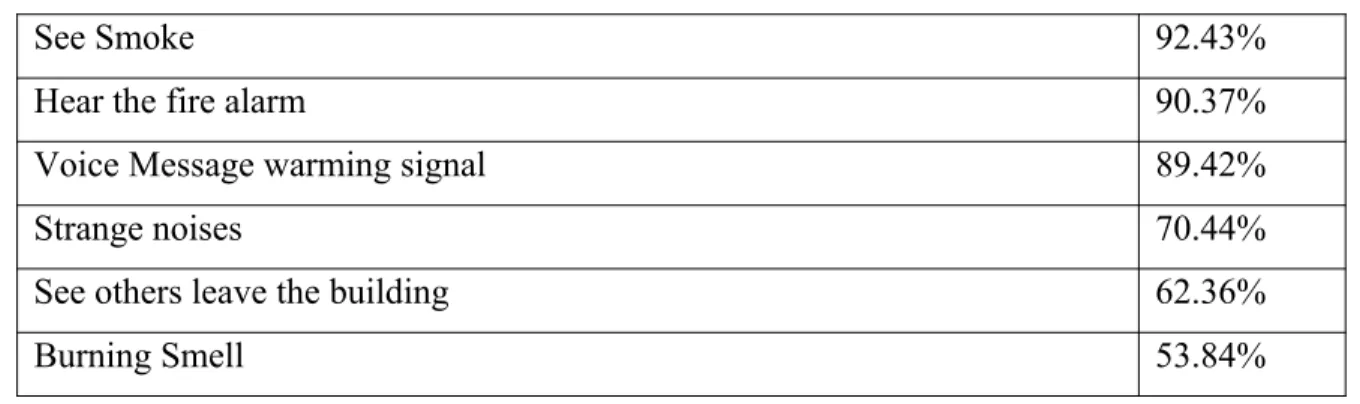
The questionnaire then went on to explore what motivated people the most to evacuate a building in a fire situation, the findings of which are shown in table 3.
Table 3 what factors motivate occupants the most to evacuate
See Smoke 92.43%
Hear the fire alarm 90.37%
Voice Message warming signal 89.42%
Strange noises 70.44%
See others leave the building 62.36%
Burning Smell 53.84%
The two deciding factors that would motivate individuals to evacuate were if they saw smoke and/or heard a fire alarm. Surprisingly, witnessing a burning smell was ranked the least with 53.84%. When asked about this, respondents stated that they were used to smelling burning in one form or another either emanating from the ground floor restaurant or the kitchens of neighbouring residential properties. Hearing the fire alarm was ranked second with 90.37%.
question in section B was to investigate from an occupant’s point of view what they believe would be the best escape route under a fire situation. Respondents were only allowed to choose one option table 4.
Using the escape stairs scored the highest with 33.87% followed by ‘if the fire continues to grow then I will evacuate immediately’ (20.965%). Not surprisingly, a reluctance to use the elevator in a crowded situation featured the lowest response at 6.45%.
Table 4 best method of escape from an occupant’s point of view
Use the escape stairs 33.87%
If the fire continues to grows then I will evacuate immediately 20.96% I will either go upwards or downwards away from the fire, until its put off 17.74% Wait for the fire fighters to direct me which direction I should be going 11.29% Use the elevator because it is easy and I am familiar with it 9.67% If it’s very crowded I will use the elevator 6.45%
Respondents believed that in a fire situation the elevator was not a safe option for escape as the cables would not offer enough resistance to the fire causing the elevator to fall. They were also worried that smoke would be able to penetrate the shaft and ultimately the elevator. Even though the elevators have been designed for emergency evacuation, occupants do not trust them and do not believe they would be safe to use in an emergency.
respondents believed compartmentalisation is a solution to many of the fires in high-rise building providing protection for some of the time the fire is raging. They stated that they would be willing to tackle the fire with equipment provided but understood that there would come a point where they would have to evacuate the building.
Use of the escape stairs was ranked first by occupants but 73% of occupants who had knowledge and experience of fire stated that it was usually very difficult to evacuate through the escape stairs for many reasons. Firstly, they had experienced many of the escape stairs being blocked by waste, rubbish or storage of construction materials restricting the free flow of evacuees. Secondly, the stairs were often felt to be too dark affecting sight and that the ground floor emergency exits door were often locked to stop non-residents from getting into the building. This was a major concern for respondents and they felt that the doors should be replaced with doors that can be opened from inside but not the outside, with a regular check to make sure the doors are working.
Part C of the questionnaire investigated occupants’ knowledge of emergency planning and emergency fire exits with the first three questions of this section being purely yes or no answers. As seen in figure 7, 73% of respondents indicated that they are aware where the fire exits are located since they had been resident in the building for more than a year. Unsurprisingly, 82% stated they had never been involved in a fire situation in a high-rise building figure 8 and 86% were aware of an evacuation plan for their building figure 9.
Yes 27%
No 73%
Do you know where are the emrgency exits
Yes 18%
No 82%
Were you involved before in a fire situation in a residential building
Yes 86% No
14%
Are you aware of any evacuation
plan
Figure 9 Respondents aware of evacuation plan
The responses to the first three questions indicate that although majority (82%) of respondents have not been involved in a fire in a high-rise building, more than 70% were aware of evacuation plans and/or know where are the emergency are located. Gender and age did not appear to affect the responses to these questions. Education did seem to affect the answers to these three questions as the only people who answered no to all three questions were uneducated people.
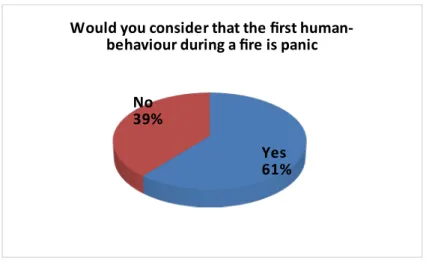
What is important and good to find was that all respondents who answered yes to these questions, had identified a safe evacuation route out of the building and knew where the fire fighting tools and equipment were located even though no one had shown them. In majority of cases, although they were aware of all these plans, tools and equipment, they had never had to use them. In fact, only 18% of respondents stated that this type of knowledge had helped them to evacuate on time. Finally, 61% of respondents believed that the first human behaviour during a fire was to panic figure 10.
showering, eating, getting changed, watching a movie, studying, relaxing with family, answering the phone, and cleaning.
Yes 61% No
39%
Would you consider that the first human-behaviour during a fire is panic
Figure 10 In fire is the first human behaviour that of panic
Six interviews were conducted with residents of the two high-rise buildings, four from building 1 and two from building two. The interview consisted of 4 questions and took roughly 20-35 minutes each to complete. All respondents indicated at the beginning of the interview that answering the questions would be to their best of knowledge, but that the answers could possibly change during a fire situation as decisions can change based on a number of factors. Interviews took place at each occupant’s apartment providing a quite environment and comfortable interview environment.
waiting occupants pressing the button at the other floors and which again, affected the evacuation process.
In question 2 of the interview, the researcher investigated what the interviewee understood to be the best point at which to commence the evacuation, what were the best actions to take and why they would take that course of action. Each interviewee had a different response but common words were evident such as “strong burning smell”, increased smoke, and observing firefighters outside. In most cases interviewees stated that if the fire was not growing fast, then they would gather belongings before evacuating. Interviewee 3 stated that she had experienced a fire in a high–rise building (26 storey). She was forced to travel upwards away from the fire, which was on the 14th floor, until help came. During this point in the interview the researcher noted that there were some other common actions that were becoming evident before evacuation would commence such as collecting car keys, grabbing a laptop, calling security to find out what was going on – all actions that would delay evacuation. Interviewee 5 and 6 believed that a serious fire is one that only occurs on the same floor as your apartment.
The third question in the interview investigated what interviewees had experienced during a fire evacuation process, either the challenges or issues in occupants’ behaviour or failings with the building itself. Crowd management was a common word stated more than once by interviewees. Based on experience, everyone involved in the evacuation went straight to the stairs all at the same time causing hold ups and crowd congestion. In addition, this was exasperated by the corridors being crammed with people all talking and shouting which increased the stress of occupants who believed that the fire would soon reach them. Screaming was often witnessed especially from females and children who were scared and not sure what they should do.
provided through speakers used by the firefights on the ground floor. The main challenge was felt to be that no one knew where the fire was so there was no guarantee that a corridor or exit stairway was going to be free from fire and smoke for a specific amount of time.
Interviewee 4 and 6 stated that older aged people and disabled people were a challenge to safely evacuate from the building. Firstly, the waiting time for the elevators and secondly the speed of the older age group (70+) as well as disabled occupants caused obstruction and hold ups in the passageways. It was noted by a few of the interviewees that not all high-rise buildings had a refuge point at each floor.
The final question in the interview was to ask the interviewees opinion on what they thought could be done to assist with an evacuation process thus reducing the time it takes to fully evacuate a building. Generally, the interviewees felt there had to be a way that occupants could get updated information during a fire situation. They felt it was important that all occupants had training on fire safety and evacuation of their building on a regular basis and that different evacuation routes should be utilised. Interviewees 2 and 5 felt that in order to ensure a safe evacuation all elevators have to be working during the fire evacuation and occupant awareness that the elevators were safe should be a priority. Evacuation stairs should not be blocked with any bin bags or other materials. Interviewee 3 stated that fire alarm testing should be reduced to once a week instead of twice a week to ensure people do not become complacent and ignore a real fire alarm. All interviewees felt that technology should become more present in the evacuation process, and general fire safety tools and equipment should be regularly checked. Interviewee 1 suggested that a system or smart phone application could be developed that would provide information regarding options of evacuation with distance and time involved.
Discussion and Conclusions
There should be regular checks on the fire safety tools in the building for example smoke detectors and sprinklers and from the interviews it was clear that crowd management and lack of information delivered to occupants during the evacuation stage were the biggest failings. The questionnaires and interviews provided different responses due to occupants’ experience of fire situation where their behaviour can change.
Fire response performance
From the questionnaire responses, it is evident that although 42% of respondents had a degree, 16% were not educated at all and it is these respondents who would be mostly affected by the evacuation process, as they were not aware of any fire safety, building regulations, or the safe use of fire equipment and tools. Majority of the respondents (42%) were between the ages of 31 and 45. The 55+ age group only represented 4% of respondents but through the interviews it was clear that older aged group demonstrated slower speed during the evacuation process. 91% of respondents were permanent residents of the building they occupied at the time with 84% never having had any sort of fire training. From part B of the questionnaire focused more on ranking factors depending on certain scenarios. When the fire alarm goes off, the top three factors ranked were asking neighbours (84.33%), make an attempt to put the fire out (79.67%) and ignore the fire alarm completely (74.17%). Among the important points to highlight is that of occupant behaviour when witnessing flame or smoke.
The questionnaire responses indicate that respondents ranked higher the factors associated with seeing flame/smoke compared to those linked to purely hearing the fire alarm as they believe the former indicate a more serious situation. The top three ranked factors were to get the kids and leave (89.37%), leave the building immediately (88.30%) and retrieve belongings (82.04%). Majority of the respondents have ranked seeing smoke as the highest priority factor that would motivate them the most to evacuate a building (92.43%), second was hearing the fire alarm (90.37%) and third was receiving a voice message warming signal (89.42%).
paper has emphasized the complexity of human feature, which perhaps extended the matrix proposed by Kobes et al. (2008) research. This paper showed that there should be some further considerations given towards training and overcoming cultural barriers. The paper has also showed that visual features such as smoke or flame are the primary triggers for evacuating the building. Although this may indicate that occupants can be aware of the surrounding, it raises a major concern in a high-rise building. In the same study conducted by Kobes et al. (2008), some of the fire features identified were fire growth rate and heat, and smoke yield and toxicity. A research conducted by Gann (2004) showed that these features have resulted in fatality during evacuations as some occupants may suffer from health problems and others are too sensitive to toxic chemicals. It can then be argued that involving fire fighters and building owners during the design phase of a high-rise building is important, as this will support indicating many of the cultural and behavioural challenges during a fire evacuation. More importantly, building occupants should be trained to face various scenarios when conducting an evacuation test, as this will support indicating their behaviours and raise the challenges faced during these tests.
Phenomenology of fire evacuations
Analysis of the finding shows that educated people tend to leave the building immediately when there is a fire compared to uneducated people who are more likely to undertake other tasks before evacuating. Based on the results it is fair to identify that education, knowledge, and age influence occupant’s behaviour under a fire situation. Part C of the questionnaire investigated an occupant’s knowledge of fire exits in their building and whether they had been involved in the creation of evacuation plans. 73% indicated they were not aware of any emergency exits, 82% indicated they had never been involved in a fire situation in a residential building and 61% indicated that they were not aware of the correct procedure in the use of fire extinguishers. Part C of the questionnaire also identified what occupants were doing immediately before the evacuation stage and found the following main activities: praying, sleeping, eating, getting change, watching movie, studying, relaxing with family, on the phone, cleaning.
elevator even though they are designed to be used in an evacuation as they believe them to be a dangerous option. Crowd management was also identified as a challenge as occupants cannot all evacuate in the same time and congestion can lead to panic and confusion. Delivery of information to occupants during the evacuation was a challenge but felt by the interviewees to be an essential facet in a safe evacuation. The study conducted by Kobes et al. (2010) has discussed the importance of ‘psychonomics’ during a fire evacuation from a building. ‘Psychonomics’ is concerned with exploring how humans process information before and during a situation occurs. The findings of this paper showed that human reaction is only triggered when a situation occurs. The support of advanced technologies in construction such as the use of Building Information Modelling (BIM) can potentially provide further awareness to how humans behave before an actual situation occurs. Some recent studies (Rüppel, and Schatz, 2011; Wang et al., 2015) have demonstrated the use of BIM in supporting fire safety management.
References:
Attia, S., Evrard, A. and Gratia, E. (2012). Development of benchmark models for the Egyptian residential buildings sector. Applied Energy, 94, pp. 270 – 284.
Averill, J. D., Mileti, D., Peacock, R., Kuligowski, E., Groner, N., Proulx, G., Reneke, P. and Nelson, H. (2007). Federal investigation of the evacuation of the world trade centre on September 11, 2001. Proceedings of the Third International Conference on Pedestrian and Evacuation Dynamics 2005. Springer, Berlin, Heidelberg.
Brown, G and Edmunds, S (2011), Doing Pedagogical research in Engineering. Leicestershire, England.
Bryan, J. L. (2002). A selected historical review of human behaviour in fire. Journal of Fire Protection. 28, p.8-20.
Buchanan, A. H. (2006). Structural design for fire safety. New York: John Wiley and Sons.
Cheung, C. K., Fuller, R. J. and Luther, M. B. (2005). Energy-efficient envelope design for high-rise apartments. Energy and Buildings. 37 (1), p37-48.
Cordeiro, E., Coelho, A. L., Rosaldo J. F. and Rossetti, J. A. (2014), Human Behaviour under Fire Situations – A case–study in the Portuguese Society. 4LIACC, Departamento de Engenharia Informática, Universidade do Porto Rua Roberto Frias, S/N, 4200-465 Porto, Portugal. 2 (4), p1-9.
Cordeiro, E., Coelho, A.L., Rossetti, R.J.F. and Almeida, J. (2011). Human Behaviour under Fire Situations - Portuguese Population. Proceedings, Fire and evacuation modelling technical conference, p1-11.
Cowland, A., Bittern, A., Abecassis-Empis, C. and Torero (2013). Fire safety design for tall buildings. Procedia Engineering. 62, p.169-181.
Edgar, C. L., Pang and Chow, W. K. (2011), Fire Safety Concerns on Existing Supertall Buildings and Proposed Upgrading in Hong Kong. International Journal on Engineering Performance-Based Fire Codes. 10 (2), p24-35.
Fellows, R. and Liu, A. (2015), Research Methods for Construction. Oxford, United Kingdom: Wiley Blackwell. p1-258.
Gann, R. G. (2004). Estimating data for incapacitation of people by fire smoke. Fire Technology. 40 (2), p.201-207.
Gifford, R. (2007). The Consequences of Living in High-Rise Buildings. Architectural Science Review. 50 (1), p2-17.
Isobe, M., Helbing, D. and Nagatani, T. (2004). Many-particle simulation of the evacuation process from a room without visibility. Physical Review. p. 69
Kavilkar, R. and Patil, S. (2014), Study of High Rise Residential Buildings in Indian Cities (A Case Study –Pune City). IACSIT International Journal of Engineering and Technology. 6 (1), p86-90.
Kincaid, S. (2012). An investigation into the fire safety management of historic buildings. Sheffield Hallam University Built Environment Research Transactions, 4 (1), pp. 24 – 37.
Kobes, M., Helsloot, I., ; Bauke de Vries and Post, J. G. (2010), Building safety and human behaviour in fire:A literature review. Fire Safety Journal. 45 (2), P1-11.
Kobes, M., Post, J., Helsloot, I. and De Vries, B. (2008), Fire risk of high-rise buildings based on human behavior in fires.
Kuligowski, E. D. and Hoskins, B. L. (2010), Occupant Behavior in a High-rise Office Building Fire. NIST Technical Note 1664., p1-25.
Naoum, S. G. (2007), Dissertation research and writing for construction students. 2nd ed. Butterworth-Heinemann, Oxford.
O’Connor, D. J. (2005). Integrating human behaviour factors into design. Journal of Fire Protection Engineering. 28, p. 8-20.
Oleszkiewicz, I. (1991). Vertical Separation of Windows Using Spandrel Walls and Horizontal Projections. Fire Technology. 25 (4), p.334-340.
Pires, T. T. (2005). An approach for modelling human cognitive behaviour in evacuation models. Fire Safety Journal. 40, p. 177-189.
Proulx, G. (2001). Occupants behaviour and evacuation. 9th International Fire Protect Symposium. 3 (2), pp219-232.
Proulx, G. (2007). High-rise office egress: the human factors. Proceedings of the Symposium on High-Rise Building Egress Stairs. New York.
Purser, D. A. (2003). Data benefits: fire prevention. Fire Engineers Journal. 21, p.21-24. Ronchi, E. and Nilsson, D. (2014). Assessment of Total Evacuation Systems for Tall Buildings. London: Springer.
Rüppel, U. and Schatz, K. (2011), Designing a BIM-based serious game for fire safety evacuation simulations. Advanced Engineering Informatics. 25 (1), p600-611.
Sime, J. D. (1995). Crowd psychology and engineering. Safety Science. 21, p. 1-14. Society of Fire Protection Engineers (2012). Guidelines for Designing Fire Safety in Very Tall Buildings. Public Review Draft.
Stirling Royal Infirmary (2007). Fire Instructions and Evacuation Procedures. Forth Valley: NHS.
Sun, J., Hu, L. and Zhang, Y. (2013). A review on research of fire dynamics in high-rise buildings. Theoretical & Applied Mechanics Letters. 3 (4), article 042001.
Thomas, P. H. (1986). Design Guide: Structural Fire Safety CIB W14 Workshop Report. Fire Safety Journal. 10 (2), p.77.
Wang, S., Wang, W., Wang, K. and Shih, S. (2015), Applying building information modeling to support fire safety management. Automation in Construction. 5 (2), p158-167.
Yatim, Y. M. (2009). PhD Thesis Fire Safety Models for High-Rise Residential Buildings in Malaysia. Heriott Watt university. , p1-293.
Zhang, Y. (2008). Analysis of fire characteristics on high-rise residential building. Shanxi