1 Personal values at work: a mixed-methods study of executives’ strategic decision-making
Abstract
The purpose of this behavioural strategy study is to investigate how seasoned executives enact their personal values in real-life organisational decision-making. The significance of this paper is linking the personal values of executives with actual leadership decisions they made. In focus groups, strategic leaders with an Outer Directed (OD) or Inner Directed (ID) values orientation were prompted to reflected on their decisions at work. Analysis of the coded transcripts revealed the four independent raters reliably categorized coding events according to a Maslovian coding framework, r=0.81 for ID transcripts and r=0.76 for OD transcripts. Further statistical analysis found significant differences between executives’ values orientation (ID or OD) and values decisions (ID or OD) demonstrating a consistent pattern of ID and OD decision-making. Qualitative analyses revealed that ID participants’ decisions were based on innovation, intrinsic value and inter-dependency, while OD participants’ decisions were based on effectiveness, performance and affective independence. Implications for researchers include advancing the efficacy of a behavioural strategy approach, support for Maslow’s motivational theory and decision-making being consistent with personal values in an organisational context. Implications for practioners include a predictable values-based pattern to managers’ decisions and the need for a personal values-based leadership-strategy match. Keywords:
2 Introduction
The study of executive decision-making has a long history in strategic management (Connor & Becker, 1994; Raissi, and Hakeem, 2017). Most of that history has been dominated by rational models reflective of economic theory. Powell, Lovallo, and Fox (2011) argue that analysis based on purely rational models and limited methodologies have impeded progress in understanding human behavior in organizations. Such limitations prompted Powell et al. (2011) to call for a behavior strategy approach. They note:
“The strategic context of strategic management involves organizationally situated managers, widespread uncertainty, and poorly defined problems with unknowable social and economic consequences. In the circumstances, we believe strategy research should increase its emphasis on executive judgement in the actual conditions of high-stakes, complex problem solving in organizations” (Powell et al., 2011, p.1377, emphasis in the original). This study offers unique insight into how personal values influence organizational decision-making by analyzing actual decisions made by executives in the course of their jobs.
The paper begins with a summary of research into personal values and organizational decision-making. Next, existing theoretical models and research methods are reviewed and gaps are identified. A mixed methods study is summarized. Executives’ reflections on actual decisions they made within their organizations are analyzed to determine the extent to which their decisions aligned with their personal values orientation as assessed beforehand on a Maslow-based values assessment instrument.
Theoretical background: Strategic leaders’ values and strategic choice
3 good deal of strategy research is based on models of rational thinking, which classify non-rational facets of decision-making as error (Powell, Lovallo, Fox, 2011; Loewenstein, 1996).
One variable that profoundly affects human decision-making is personal values. Definitions of personal values can be found throughout literature in psychology and business, but common among most is the idea that values constitute a framework or set of beliefs that guide one’s actions (Guth & Tagiuri, 1965; England, 1967; Kluckholn, 1962; Rokeach, 1968). As one team of research psychologists noted, “Indeed, it seems fair to say that whenever the phenomenon of interest involves choice, or preferences, values are likely to be a crucial, explanatory construct” (Mumford, Connelly, Helton, Doorn, & Osburn, 2002, p. 348). Unlike many dynamic variables that come into play during decision-making, personal values are relatively stable across contexts and irrespective of temporal events (Meglino & Ravlin, 1998; Rokeach, 1985). Conner & Becker (1975) argue that personal values may be a more stable factor than other psychological variables, and that personal values may supply “critical missing variance” in organizational decision-making (p. 558).
4 of personal values in decision-making is comparable across cultures (also see Whitely and England, 1997, and Schwartz, 1992).
---
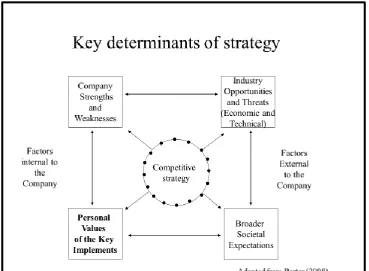
Insert Figure 1 about Here
---
Postman, Bruner, & McGinnies (1948) demonstrated that “personal values are demonstrable determinants of what the individual selects perceptually from his environment” (p. 143). Ismail (2016) notes: “Executive experience and personalities affect managers’ 1) field of vision (the directions they look and listen), selective perception (what they actually see and hear), and 3) and interpretation (how they attach meaning to what they see and hear)” (p. 29). Accordingly, even if managers based their decisions on reasoning alone, the factors they weigh and the relative importance of those factors will be determined by personal values. Finkelstein & Hambrick (1996) illustrated how personal values filter strategic leaders’ perceptions of the situations about which they make organizational decisions. They argue that personal values create perceptual selection bias, which influences executives’ interpretation of situations and events, which in turn influences decision-making (please see Figure 2). Their model builds on previous models of the relationship between values and behaviour (e.g. England, 1977)
---
Insert Figure 2 about here
5 Researching the Influence of Personal Values on Decision-Making
Mumford et al. (2002) summarize the two methodological approaches used across studies examining the influence of personal values on decision-making as: direct and indirect. Direct measures ask respondents to identify the extent to which they agree with value statements provided (see for example Rokeach, 1973, and Schwartz, 1994). Response options are typically ipsative, forcing respondents to choose between one or another option, each of which represents a particular values orientation. Through a series of such items, values orientations are rank ordered, revealing a response pattern that identifies respondents’ overall values orientation. The direct approach assumes that respondents are conscious of their values and that those values are well articulated in their own minds (Mumford et al., 2002). It also assumes that survey response options provide clear-cut alternatives. Braithwaite & Law (1985) interviewed subjects while they completed the Rokeach Values Survey (RVS). Several respondents found ipsative (forced-ranking) options to be interrelated, feedback that caused the authors to revise and add several items and calls into question how people answered such items when completing the instrument on their own (p. 253).
6 assessed 128 possible combinations of the job description) and advised that it would be useful to replicate results with actual rather than hypothetical job offers (p. 269).
Both direct and indirect methods of assessing strategic decision-making have relied upon hypothetical situations and/or pre-determined, force choice value rankings. While studies classify participants into statistically reliable categories, researchers have not assessed the criterion validity of those findings; that is, the extent to which the values orientations identified are actually invoked in real-world, organizational decision-making. Furthermore, both approaches assume that values are applied invariably. Yet, decision-making in life may be nuanced, shaped by facts and circumstances and necessary trade-offs, and broad considerations of potential outcomes. For example, Shaw & Higgins (1997) found that decision-making varied based on the value that participants placed on potential outcomes.
England (1967) distinguishes between intended values—those that are professed but not necessarily acted upon, and operative values—those that consistently guide behavior (p. 54), thus accounting for nuance and complexity in decision-making. In short, people with a dominant values orientation may make decisions at work that are reflective of alternative values orientations, based on a range of factors and possible consequences that are impossible to simulate in an ipsative approach. Both direct and indirect approaches raise questions about the criterion validity of such measures as they apply to real-life decision-making.
7 Therefore, this study explores whether executives’ actual, job-related decision-making aligns with their values orientations.
Method: Towards a Retrospective Assessment of Personal Values
Powell et al. (2011) urged strategy researchers to study the psychological underpinnings of organizational decision-making. They argue that multi-method studies have great potential for understanding the relationship between cognition, social context, and strategic management: “We believe methodological diversity will prove essential for improving our understanding of individual and social behavior in organizations” (p. 1371) …We see mixed-methods research as the future of behavioral strategy” (p. 1381).
8 no standards exist for inter-rater reliability for qualitative data, a reliability rating of r = .70 on open-coding of phenomenological data in naturalistic settings can be considered an acceptable cut-point (Marquez & McCall, 2005; Miles & Huberman, 1994). After coding events were reliably categorized, they were analysed statistically.
To explore the question of whether executives’ actual decision-making aligns with their values orientation, the study required 1) a framework by which to identify personal values, 2) seasoned executives, and 3) a means by which to prompt reflections on their strategic decision-making. Each of these components is reviewed below.
1. A Values Framework
Maslow’s (1987) hierarchy of human needs was used to categorise respondents’ values orientations. Maslow’s model has been criticized for being empirically weak (Wahba M.A. & Birdwell, L.G.), ethnocentric (Hofstede, G, 1984) and gendered (Linstead, S., 2000). The model has been found to be misrepresented in the literature (Koltko-Rivera, 2006; O’Connor and Yballe, 2007). Yet studies have validated the framework (Schwartz, 1983) and the model endures in the literature. While Maslow’s needs model has received much attention, the linkages he proposed between individuals’ needs and their values orientation (or systems) is less explored (Higgs & Lichtenstein, 2010).
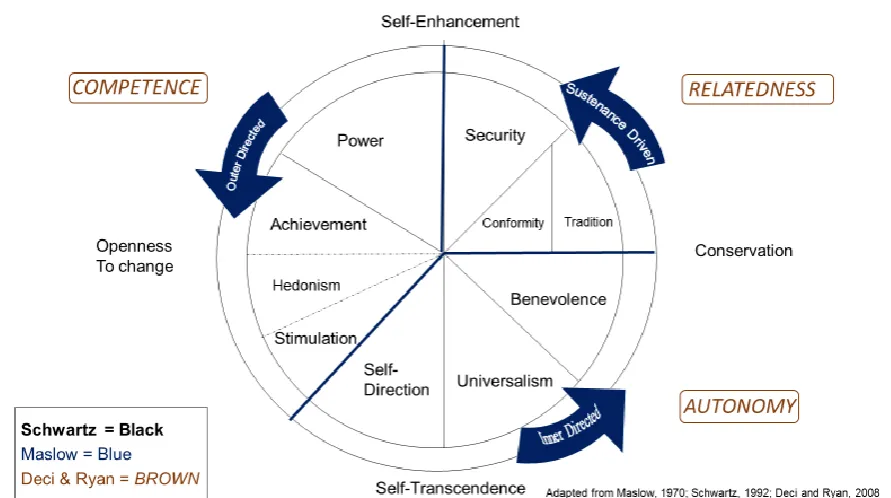
9 Maslow’s framework was chosen for several reasons. First, Maslow’s hierarchy of needs (1987) is a widely known model of human psychological development that has been adopted and adapted across disciplines (Koltco-Rivera, 2006; O’Connor & Yballe, 2007). Kahle, Sharron and Homer’s List of Values (1986) and SRI’s Values and Lifestyles (VALS; Mitchell, 1983) are based upon Maslow’s Inner- and Outer-Directed and Sustenance-Driven framework (Baker, 1996). Vinson, Munson, & Nakamishi (1977) conducted factor analyses that showed statistical reliability in eleven of Rokeach’s original 18 terminal and instrumental values. In Hambrick & Brandon’s (1988) hypothesised links between personal values and organisational outcomes, the value of novelty is related to Maslow’s Inner Directed value system; power and the need to have control over others is an aspect of the Outer Directed value system, and duty is linked to the Sustenance Driven value system. Schwartz (1992) reported convergence between Maslow’s hierarchy and four of eleven of the terminal and instrumental values on his instrument. Deci and Ryan’s (2008) Self Determination Theory of innate needs also corresponds to the Maslow’s framework. Empirical support for Maslow’s theory has been found by Higgs & Lichtenstein (2010) as well as by others (Williams & Page, 1989; Chulef, Read and Walsh, 2001). Figure 3 maps the Maslow’s Sustenance Driven, Outer Directed and Inner Directed framework to values frameworks of Schwartz (1992) and Deci and Ryan (2008).
---
Insert Figure 3 about here
---
10 and Pioneers (Inner Directed) uses Maslovian-based Values Modes to devise political strategy. Chip Conley, former CEO of the Joie de Vivre hotel chain, details how he turned around the chain using the insights from Maslovian theory (2007).
Third, using a personal values framework based on Maslow, participants’ values orientation could be quickly and effectively determined. While some values instruments contain 100 items or more, identifying participants’ values orientation according to the Maslow model can be quickly assessed using the Values Mode (VM), a proprietary survey instrument developed by Cultural Dynamics Strategy and Marketing Ltd (CDSM Ltd). The instrument, administered on-line, is a 10-item questionnaire that takes 5-7 minutes to complete. The VM has an extensive empirical history. In a study establishing convergent validity of executive values (Lichtenstein, 2005), a discriminant analysis using the factor scores of Kotey and Meredith’s (1997) 28-item List of Values scale (Cronbach α = .87) to predict VMs categorisation of Inner-Directed, Outer-Directed and Sustenance Driven categories resulted in 64% of respondents correctly classified.
2. A Sample of Seasoned Executives
The respondents for the study comprised 35 participants in an executive MBA program who volunteered to be part of research into ‘personal orientation’. All participants were employed full-time as middle and senior managers with a minimum of five years’ experience. All participants’ jobs entailed strategic leadership within their organizations. The average age of participants was 35 years old representing a variety of sectors including consulting, auditing and the public sector.
11 instrument, they were asked to participate in a focus group interview to discuss their professional perspectives ‘with like-minded colleagues.’
3. Prompting executives’ reflections on real-world decision-making.
Researchers created two focus groups by selecting nine ID participants in one focus group and nine OD participants in the other, based on VM results. As noted above, respondents were not aware of the values orientation they represented, or even that they were selected based on their values orientation. Had they been informed of their values orientation, their responses might have been contrived for social desirability or in accordance with the Hawthorne effect (McCarney, Warner, Iliffe, Van Helesen, Griffin, & Fisher, 2007). The authors hypothesized that the pattern of responses within each group would predominately reflect either an ID or OD values orientation (depending on the group’s composition).
12 Analysis
The raw data were organised into specific “coding events” throughout each group’s transcript, as described above. The analysis process was guided by an a priori coding informed by Lichtenstein and Dade, 2007. Coding followed the VM framework, with ID, OD, and SD each being divided into sub-categories as identified in the rubric. A “Not Applicable” (NA) code was created for those phrases that did not apply to any of the other categories. After training on the framework and coming up with decision rules, four researchers reviewed transcripts independently, applying the coding scheme to each coding event.
Findings
Data were analysed quantitatively and qualitatively (Cresswell, 2003). Results of each analysis are summarized below.
Quantitative Analyses
13 ---
Insert Table 1 about Here
---
The proportion of ID and OD comments were compared across the two focus groups using Chi-Square analysis, which is the standard technique for exploring differences in categorical variables. NA codes were eliminated because they were determined to be extraneous to this analysis. Chi-square analysis found statistically significant differences between the proportion of ID and OD comments in each set of transcripts (χ²=22.887, df=1, p<.000). ID transcripts had significantly more ID codes than OD transcripts, and OD transcripts had significantly more OD codes than ID transcripts did.
The finding of statistically significant differences between the proportion of ID and OD comments in each set of transcripts supports the proposition that strategic leaders’ choices reflect their values orientations. Moreover, these results suggest that differing values will result in differing strategy decisions. The next section examines the qualitative data.
Qualitative Analyses
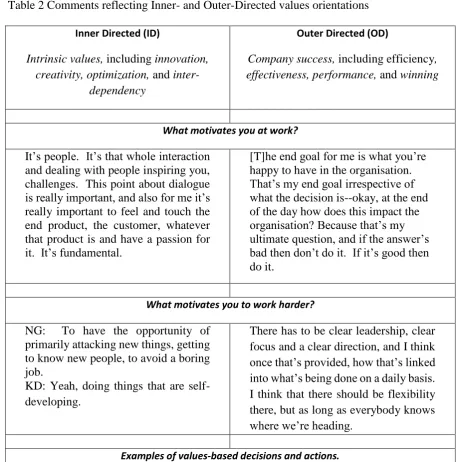
Distinct patterns of responses emerged across the two groups. Motives for action and strategic focus for ID respondents leaned towards intrinsic value, including innovation, creativity, optimization, and inter-dependency. OD respondents leaned toward company success, including efficiency, effectiveness, performance, and winning. Differences between the two values orientations are starkly reflected in Table 2.
14 Insert Table 2 about Here
---
For example, in Table 2, the ID manager in charge of successfully completing a project using a standard process, risks project failure and diminished company reputation on an untested product based solely on Inner Directed values related to innovation, doing things differently, and personal challenge. In contrast, the OD executive reflects on a case in which managers at the highest level planned on not following through on a promise to pay bonuses if the work unit hit its performance target. The work unit hit the target, but upper management resisted paying the promised bonuses. The respondent’s argument is not based on ethics and justice in standing by a promise made. Rather she expresses concern that the ramifications could result in decreased productivity that would reflect on her. For the Outer-Directed executive, decisions are based primarily on organisational outcomes as a reflection of self.
While patterns of decision-making based on values-orientation were largely consistent, they were not invariable. In the ID focus group, 26% of comments reflected OD values orientations and in the OD group, 17% of comments reflected an ID values orientation. Within a pattern of consistency application of one’s values orientation can vary based on context and projected consequences.
Discussion, limitations and further avenues for research
15 Analyses revealed nuance in the application of values in real-world situations. Although significant patterns emerged within the ID and OD groups, there were instances in which ID respondents reflected OD values, and OD respondents reflected ID values.
This study makes a new contribution to how personal values influence decision making by investigating how seasoned executives enact their personal values in real-life organisational decision-making. Powell et al. (2011) advocated for a behaviour strategy approach that integrates multiple disciplines and mixed methods, as this study has done:
“Behavioural strategy merges behavioural and social psychology with strategic management theory and practice. Behavioural strategy aims to bring realistic assumptions about human cognition, emotions, and social behaviour to the strategic management of organizations, and, thereby, to enrich strategy theory, empirical research, and real-world practice.” (Powell et al., p. 1371).
16 Limitations and Future research
As with any research, this study is subject to several limitations. The OD focus group comprised only two participants. This is a limited range of respondents contributing to coding events although still constitutes a focus group (Wilkinson and Kitzinger, 2008). A larger sample would have strengthened the findings by demonstrating a consistent pattern amongst more people having been identified with similar values. In addition, the study would have been strengthened had it included an SD group.
Future research
17 References
Badr, A.H., Gray, E.R., & Kedia, B.L. (1982), ‘Personal values and managerial decision-making: Evidence from two cultures’, Management International Review, Vol. 20, No. 3, pp. 65-73.
Baker, S. (1996), ‘Placing values research in a theoretical context’, in T. Elfring, H. Siggard Jensen, and A. Money, (eds.), Theory Building in the Business Sciences, Copenhagen: Handelshoyskolens Forlag.
Barnett, J.H. and Karson, M.J. (1987), ‘Personal values and business decisions: An exploratory investigation’, Journal of Business Ethics, Vol. 6, No. 5, pp. 371-382.
Braithwaite, V. A., & Law, H. G. (1985), ‘Structure of human values: Testing the adequacy of the Rokeach value survey’, Journal of Personality and Social Psychology: Personality Processes and Individual Differences, Vol. 49, No. 1, pp. 250-263.
Carey, M. A., & Asbury, J. E. (2016), Focus group research, New York: Routledge.
Chulef, A.S., Read, S.J. and Walsh, D.A. (2001), ‘A hierarchical taxonomy of human goals’, Motivation and Emotion, Vol. 25, No. 3, pp. 191-232.
Conley, C., (2007), Peak: How Great Companies Get Their Mojo from Maslow, John Wiley & Sons.
Connor, P.E. and Becker, B.W. (1975), ‘Values and the organization: Suggestions for research’, Academy of Management Journal, Vol. 18, No. 3, pp. 550-561.
Connor, P.E. and Becker B.W. (1994), ‘Personal values and management: What do we know and why don’t we know more?’, Journal of Management Inquiry, Vol. 3, No. 1, pp. 67-73 Connor P. E. and Becker, B. W. (2003), ‘Personal value systems and decision-making styles of public managers’, Public Personnel Management, Vol. 32, No. 1, pp. 155-180.
Cresswell, J.W. (2003), Research Design: Quantitative, Qualitative, and Mixed Methods Approaches, Second Edition, Thousand Oaks, CA: Sage Publications
Deci, E.L. and Ryan, R.M. (2008), ‘Facilitating optimal motivation and psychological well-being across life's domains’, Canadian Psychology/Psychologie canadienne, Vol. 49, No. 1, pp. 14-23.
Ebel, R. L. (1951), ‘Estimation of the reliability of ratings’, Psychometrika, Vol. 16, pp. 407-424.
England, G.W. (1967), ‘Personal value systems of American managers’, Academy of Management Journal’, Vol. 10, No. 1, pp. 53-68.
Finkelstein, S. & Hambrick, D. (1996), Strategic leadership: Top strategic leaders and their effects on organisations, St Paul, MN: West Publishing Company.
18 Hambrick, D C & Brandon, G L. (1988), ‘Executive values’, in: D. C. Hambrick (eds.), The executive effect: Concepts and methods for studying top managers, pp. 3–34, Greenwich, Connecticut: JAI Press.
Hambrick, D. C. & Mason, P. A. (1984), ‘Upper echelons: The organisation as a reflection of its top managers’, Academy of Management Review, Vol. 9, No. 2, pp. 193–206.
Higgs, M. and Lichtenstein, S. (2010), ‘Exploring the 'Jingle Fallacy': A study of personality and values’, Journal of General Management, Vol. 36, No. 1, pp. 43-61.
Hofstede, G. (1984), ‘The cultural relativity of the quality of life concept’, Academy of Management Review, Vol. 9, No. 3, pp. 389-398.
Ismail, H. (2016), ‘Preferences in business and corporate strategies: The role of personal values’, Contemporary Management Research, Vol. 12, No. 1, pp. 25-45.
Judge, T.A., and Bretz, R.D. (1992), ‘Effects of work values on job choice decisions’, Journal of Applied Psychology, Vol. 77, No. 3, pp. 261-271.
Kahle, L, Sharron, B. and Homer, P. (1986), ‘Alternative measurement approaches to consumer values: The list of values (LOV) and lifestyles (VALS)’, Journal of Consumer Research, Vol. 13, pp. 405-409.
Kluckhohn, C. (1962), ‘Values and Value Orientation in the Theory of Action’, in Parsons, T., Shills, E. (eds.), Toward a General Theory of Action, pp. 391-436, Transaction Publishers. Koltko-Rivera, M.E. (2006), ‘Rediscovering the later version of Maslow's hierarchy of needs: Self-transcendence and opportunities for theory, research, and unification’, Review of General Psychology, Vol. 10, No. 4, pp. 302-317.
Kotey, B. and Meredith, G.G. (1997), ‘Relationship among owner/manager personal values, business strategies, and enterprise performance’, Journal of Small Business Management, Vol. 35, No. 2, pp. 37-64.
Lichtenstein, S. (2005), Strategic co-alignment: Strategic, executive values and organisational goal orientation and their impact on performance, DBA Thesis, Henley Management College/Brunel University, Henley-on-Thames, UK.
Lichtenstein, S. and Dade, P. (2007), ‘The shareholder value chain: Vision, values and shareholder value’, Journal of General Management, Vol. 33, No. 1, pp. 15-31.
Linstead, S. (2000), ‘Comment: gender blindness or gender suppression? A comment on Fiona Wilson's research note’, Organization Studies, Vol. 21, No. 1, pp. 297-303.
Loewenstein, G. (1996), ‘Out of control: Visceral influences on behavior’, Organizational Behavior and Human Decision Processes, Vol. 65, No. 3, pp. 272-292.
19 McCarney, R., Warner, J., Iliffe, S., Van Haselen, R., Griffin, M., & Fisher, P. (2007), ‘The Hawthorne effect: A randomised, controlled trial’, BMC Medical Research Methodology, Vol. 7, No. 1, p. 30.
Meglino, B.M., and Ravlin, E.C. (1998), ‘Individual values in organizations: Concepts, controversies, and Research’, Journal of Management, Vol. 24, No. 3, pp. 351-389
Miles, M., & Huberman, A. (1994), ‘Qualitative Data Analysis’, London: Sage Publications. Mitchell, A. (1983), The Nine American Life Styles, New York: Warner.
Mumford, M.D., Connelly, M.S., Helton, W.B., Doorn, J.R., and Osburn, H.K. (2002), ‘Alternative approaches for measuring values: Direct and indirect assessments for performance prediction’, Journal of Vocational Behavior, Vol. 61, No. 2, pp. 348-373.
O'Connor, D. and Yballe, L. (2007), ‘Maslow revisited: Constructing a road map of human nature’, Journal of Management Education, Vol. 31, Nov. 6, pp.738-756.
Porter, M.E. (2008), Competitive Strategy: Techniques for analyzing industries and competitors, New York: Simon and Schuster.
Postman, L., Bruner, J. S., and McGinnies, E. (1948), ‘Personal values as selective factors in perception’, The Journal of Abnormal and Social Psychology, Vol. 43, No. 2, p. 142-154. Powell, T. C., Lovallo, D., & Fox, C. R. (2011), ‘Behavioral strategy’, Strategic Management Journal, Vol. 32, No. 13, pp. 1369-1386.
Raissi, N. and Hakeem, A. (2017), ‘How to determine the influencing cultural factors on the strategic decision-making process in the banking sector?’, Journal of Management and Strategy, Vol. 8, No. 1, p. 37.
Ravlin, E.C. and Maglino, B.M. (1989), ‘The transitivity of work values: Hierarchical preference ordering of socially desirable stimuli’, Organizational Behavior and Human Decision Processes, Vol. 44, pp. 494-508.
Rokeach, M. (1968), Beliefs, Attitudes, and Values, San Francisco, CA: Jossey-Bass
Rokeach, M. (1973), The Nature of Human Values, London: The Free Press, Collier MacMillan Publishers.
Rokeach, M. (1985), ‘Inducing change and stability in belief systems and personality structures’, Journal of Social Issues, Vol. 41, No. 1, pp.153-171
Rose, C. (2011), What makes people tick: The three hidden worlds of settlers, prospectors and pioneers, Matador.
Schwartz, H.S. (1983), ‘Maslow and the hierarchical enactment of organizational reality’, Human Relations, Vol. 36, No. 10, pp.933-955.)
20 Schwartz, S.H. (1994), ‘Are there universal aspects to the structure and content of Human Values?’, Journal of Social Issues, Vol. 50, No. 4, pp.19-45.
Shaw, J. and Higgins, E.T. (1997), ‘Expectancy and values effects: Regulatory focus as a determinant of magnitude and direction’, Journal of Personality and Social Psychology, Vol. 73, pp. 447-458.
Solomon, D. (2004), ‘The rating reliability calculator’, BMC Medical Research Methodology Vol 4, No. 1, p. 11.
Tinsley, H.E. & Weiss, David J. (2000), ‘Chapter 4, Inter-rater reliability and agreement’, in Tinsley, H.E., Howard, E.A. and Brown, S.D. (eds.), Handbook of Multivariate Statistics and Mathematical Modelling, pp. 95-124, London: Academic Press.
Vinson, J. D., Munson, M., and Nakanishi, M. (1977), ‘An investigation of the Rokeach value survey for consumer research applications", in: W. D. Perreault, Jr (eds.), Advances in Consumer Research, Vol. 4, pp. 247-252. Atlanta, GA: Association for Consumer Research. Wahba, M. A., & Bridwell, L. G. (1976), ‘Maslow reconsidered: A review of research on the need hierarchy theory’, Organizational Behavior and Human Performance, Vol. 15, No. 2, pp. 212-240.
Whitely, W. and England, G.W. (1977), ‘Managerial values as a reflection of culture and the process of industrialization’, Academy of Management Journal, Vol. 20, No. 3, pp. 439-453. Wilkinson, S. and Kitzinger, C. (2008), ‘Conversation analysis’, in Smith, J.A. (eds.), Qualitative Psychology: A Practical Guide to Research Methods, 2nd ed., pp. 54-71, London: SAGE.
21 Figures and tables
22 Figure 2 How Values Impact Strategy
Figure 3 Complementary Motivational Models
23 Table 1 Proportion of comment codes identified in ID and OD transcripts based on 3-rater agreement
Focus Group
Comment Type Total # Comments
reliably coded
ID OD SD NA
ID 50.7% 20.3% 0.0% 29.0% 69
OD 7.6% 75.8% 0.0% 16.7% 66
Table 2 Comments reflecting Inner- and Outer-Directed values orientations Inner Directed (ID)
Intrinsic values, including innovation, creativity, optimization, and
inter-dependency
Outer Directed (OD)
Company success, including efficiency, effectiveness, performance, and winning
What motivates you at work?
It’s people. It’s that whole interaction and dealing with people inspiring you, challenges. This point about dialogue is really important, and also for me it’s really important to feel and touch the end product, the customer, whatever that product is and have a passion for it. It’s fundamental.
[T]he end goal for me is what you’re happy to have in the organisation. That’s my end goal irrespective of what the decision is--okay, at the end of the day how does this impact the organisation? Because that’s my ultimate question, and if the answer’s bad then don’t do it. If it’s good then do it.
What motivates you to work harder?
NG: To have the opportunity of primarily attacking new things, getting to know new people, to avoid a boring job.
KD: Yeah, doing things that are self-developing.
There has to be clear leadership, clear focus and a clear direction, and I think once that’s provided, how that’s linked into what’s being done on a daily basis. I think that there should be flexibility there, but as long as everybody knows where we’re heading.
24 We had just started working with a
new product… It’s an IT product that’s been developed by people within my company, but I have reservations about how successful it will be, so I’m quite concerned that it won’t work. If it doesn’t work, then this will be a huge failure, for me personally as well as the company. But if it does work, it’s fantastic, a personal achievement.
25 Appendix 1 Sample focus group questions
• What gets you out of bed in the morning? What are the kinds of things that you want at work?
• How important is it to you that your boss gives you a template, giving you clear parameters in terms of this is what I want you to do, versus someone who is more ambiguous—go off in that general direction but it’s basically open?
• Think about a decision that you’ve made about something with sort of a long-term time frame to it—how did your own values affect that decision?