Dr Jane Thomas is a Senior Lecturer and Professional Lead for Public Health in the College of Nursing, Midwifery and Healthcare. She also works in practice as an NHS Consultant in Public Health.
Keywords: critical thinking, debates, empowerment, pedagogy, resolutions Pedagogy in Motion: drafting resolutions -- holding debates
This article discusses the value of student debates and motion-writing exercises across all disciplines, starting from a public health-perspective.
An exercise in reorganisation
The UK coalition government reorganised healthcare in England in 2012. It devolved decision-making on health services away from the Department of Health and created a new planning body, NHS England. The reorganisation was all-encompassing and it led to the NHS’s £100 billion+ budget being channelled through a variety of new organisations. One of the justifications for the changes was to ‘take politics out of the NHS’. However, an important group of NHS workers was moved directly into a more political working environment. Local public health teams were relocated from NHS Primary Care Trusts into local authorities. Local authorities are run by elected councils, of all political shades.
In councils, new staff are offered training on ‘working in a political environment’. And when public health teams joined councils in 2013, councillors were also given
briefings on the role of public health. Nevertheless, the duties of councils in England already covered many of the ‘wider determinants of health’, such as housing,
education, green spaces, leisure services and licensing. In fact, this was the main reason for putting public health under the control of councils, so staff could work more closely with colleagues on ‘upstream’ public health issues. Evaluation of the reorganisation of public health teams is still equivocal (Peckham et al, 2017). That said, a refocus on local democratic decision-making and its impact on the
determinants of health is much-needed. While much of the work of local authorities is undertaken by local government staff, elected members conduct council debates, and, prior to these debates, they submit motions, which, if passed, become
resolutions for action. Thus, for students to better understand the new public health organisational environment, teaching on resolutions and debates is germane. Further reasons for teaching using debate are discussed in the next section.
Debating learning
student-debating exercises have been used with good effect across all disciplines in higher education to teach critical thinking skills (for instance, Omelichev (2007)).
Cottrell (2011: 2) characterises critical thinking as “a complex process of deliberation which involves a wide range of skills and attitudes” and according to her, critical thinking includes nine elements, which she lists. All the areas can be highlighted to students in a debate exercise. The first skill listed, for instance, is “identifying other people’s positions, arguments and conclusions”. For our purposes, a working
definition of critical thinking, derived from Cottrell (2011), is the logical analysis of an issue, considering different perspectives and evidence. Academics have emphasised the need to support students in learning about critical thinking (HEA, 2104). ‘Debate’, which involves the assessment of evidence from different perspectives and
judgements, is a common denominator across various discussions on critical thinking (Moon, 2008: 33, 45; Paul, 1994: 183). For this reason, among others, debate exercises continue to be a well-established pedagogical tool. They are an effective starting point for teaching critical thinking.
A resolution to debate
However, resolution drafting is a key stage preceding debate. On this there is a paucity of academic literature. There is negligible published research on the use of motions and resolutions in society, and almost none on the education of drafters. Wallace, Watkins and Dixon-Terry’s (2010) article is a lone example of a text, from across a wide range of disciplines, that partly rectifies the omission of writing in this academic field. However, theirs is a short ‘how to’ tool for professionals and does not discuss student-focused pedagogical activity. ‘International relations’ pedagogical simulations sometimes include a resolution drafting element, but there is no focus on this in the academic literature (Gentry, 2016: 334). However, it is argued here that learning about resolution drafting, alongside debates, can also be beneficial. Educational theories indicate that teaching in stages, with ample opportunities for reflection, will increase the effectiveness of the teaching tool (Kolb, 2015: 68). Thus, providing motion-writing exercises, prior to debate, has some grounding in theory. These exercises are outlined in the next section.
Writing motions – a stage in debate
A ‘motion’, or ‘draft resolution’, means “a formal proposal put to a legislature or committee” and a resolution refers to “a firm decision and formal expression of opinion or intention agreed on by a legislative body [or committee]” (Concise Oxford English Dictionary, 2001). Wallace et al (2010) add that resolutions can also “inform, educate, create awareness, motivate, [and] initiate dialogue on issues”.
organisations. The last, for example, includes the World Health Organisation that passed resolution 65.8 in 2012 “…agreeing resolute action on the social
determinants of health …”. (WHO, 2012). The drafters included Professor Sir Michael Marmot, an international expert on inequalities in health.
Student engagement can be fostered by linking learning to their experiences. Students taking responsibility for initiating the content of resolutions are, in some respects, more immersed as participants in experiencing the whole debate process. In the teaching practice example referred to here, BSc Health Promotion and Public Health students at the University of West London drafted, in groups, resolutions on improving student health. (Resources from the exercises introduced in both 2016 and 2017, as well as evaluation methods and findings, are available from the author on request). The exercises gave lecturers a range of opportunities to link student experience to wider theory and practice. Previous discussions on ‘power’, for example, were reinforced. The control of agendas and restrictions on topics for debate, and a weak culture of resolution-writing, with most people lacking the skills to participate, was also provided as an example of a hidden form of control.
In our example, the students wrote resolutions on topics covering, for instance, promotion of stairs not lifts; availability of healthy foods; student loans; and aircraft noise. On a later date, following preparation of evidence, the students conducted a class debate on one of their motions: the expansion of London Heathrow Airport. Here we are focusing on a broad discussion concerning the extrinsic value of teaching motion-writing and not on the effectiveness of one example. Nevertheless, further analysis undertaken by the author quantified the extent to which written assignments, associated with the teaching referred to, demonstrate debate. This analysis covered essays written in the years before and after debating took place. In the post-intervention essays, an increase in debate, associated with critical thinking, was found (these data are available from the author, on request). Students also expressed positive views on the series of exercises, including the resolution-drafting aspect.
Debating motions – a discussion
It is intriguing that resolution drafting has not hitherto been discussed in the
pedagogical literature. Instructors who regularly engage students in active learning exercises may easily conceive how a motion-writing stage can be added to a
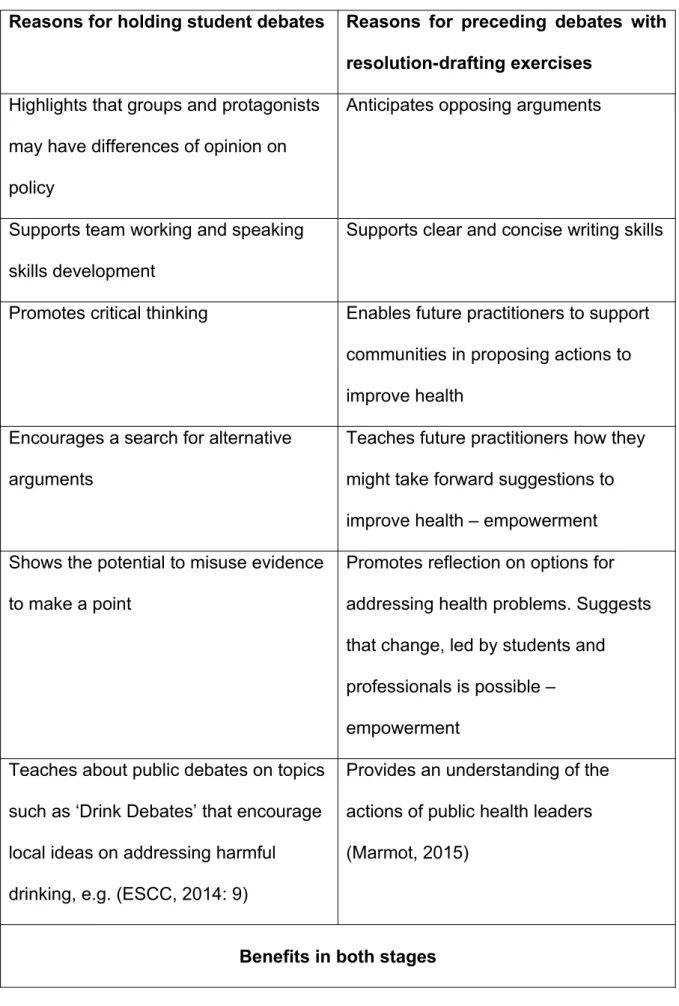
Table 1. The benefits of pedagogical debates and resolution-drafting exercises
Reasons for holding student debates Reasons for preceding debates with resolution-drafting exercises
Highlights that groups and protagonists may have differences of opinion on policy
Anticipates opposing arguments
Supports team working and speaking skills development
Supports clear and concise writing skills
Promotes critical thinking Enables future practitioners to support communities in proposing actions to improve health
Encourages a search for alternative arguments
Teaches future practitioners how they might take forward suggestions to improve health – empowerment Shows the potential to misuse evidence
to make a point
Promotes reflection on options for addressing health problems. Suggests that change, led by students and professionals is possible – empowerment
Teaches about public debates on topics such as ‘Drink Debates’ that encourage local ideas on addressing harmful drinking, e.g. (ESCC, 2014: 9)
Provides an understanding of the actions of public health leaders (Marmot, 2015)
Focuses on the need for evidence to back up arguments Provides experiential learning on democratic processes
Breaks teaching into stages, increasing opportunities for reflection and reinforce learning (Kolb, 2015). Progression from motion writing to debate supports
confidence building.
Provides an engaging and memorable learning environment Helps lecturers to make connections to questions of ‘power’ (Lukes,1974) Votes on motions can educate researchers, and others, about constituencies’ opinions, thus complementing research using opinion poll data and focus groups,
for instance
The opportunities for further research on both debates and resolutions are evident Stimulates creative thinking, reflecting public health being an art as well as a science (Naidoo & Wills, 2016: 61)
The complexity of the term ‘critical thinking’ was highlighted at the start. And the components of ‘debate’ were identified as core to critical thinking. While debate can help to teach critical thinking, the question as to whether resolution writing itself should be part of this learning experience, needs to be explored.
drafting resolutions also increased their understanding of ‘agenda-setting’, that is, state or private actors’ power to control what in society gets discussed (Lukes, 1974). So, learning was not just about students’ own direct personal empowerment, but it also supported their critical analysis of others’ power.
The lack of academic literature on resolutions has been highlighted in this paper. There is a lack of pedagogical literature and academic political science research, for instance, on analysis of resolution topics, trends, outcomes and organisational context, including training provision. The cause of this can be speculated on and some potential limitations might be:
• set exercises are too simplistic and not sufficiently challenging – they are explanatory
• students may go off the topic and come up with irrelevant issues
• it is not the perceived role of health promotion educators to seek to empower students and future professionals, only communities
• pressures on the curriculum and increasing class sizes have de-prioritised debate and therefore, associated motion-writing
• a lack of literature and experience among academics has meant that a culture of providing these exercises has not been developed
• a downturn in group participation has meant that lecturers have perceived students not to be interested in these procedures for achieving group
agreement. Although, there has been a recent upsurge in party membership in the UK, and memberships can fluctuate over time
• teaching may cause tensions over politically partisan issues, that is, differences of opinion over controversial political topics
• resolutions are too much associated with trade union and labour movement practices and not used sufficiently in professional organisations, charities and business organisations.
Health promotion and public health teaching covers concepts that are well known across the social sciences, such as, ‘nudge theory’, ‘locus of control’ and the ‘ladder of participation’ (Naidoo and Wills, for instance (2016: 67, 155, 173)). But students and staff may like to reflect on where ‘promoting skills in drafting resolutions’ fits into these models. Promotion of active decision-making via drafting and voting on
areas” (Naidoo and Wills, 2016: 67). The potential of further research in this area is evident. For example, office workers’ involvement in drafting and voting on motions to restrict presents of sweet foods at work might overcome problems with, on the one hand, control by more authoritarian means, or, alternatively, a laissez-faire approach that risks increasing obesity (Naidoo and Wills, 2016: 114).
Teaching students by facilitating an experience of the resolution writing process, prior to debate, is worthwhile if it is assumed that student empowerment and fostering a strong internal locus of control is valid. For instance, Wallace et al’s (2010) objective was “to empower and educate health professionals to initiate and follow through on the policy development process within any authoritative body”. A further justification is that students are also being taught, through active learning, to analyse the power of others, following Lukes, referred to above (1974). In addition, they might be better equipped to empower others. Nevertheless, the motion-writing aspect of debate has not been, at the time of writing, widely discussed as a
pedagogical exercise.
References
Cottrell, S. (2011) Critical Thinking Skills. Basingstoke: Palgrave Macmillan
Gentry, B. (2016) Group work in political science: how to get collaboration into the classroom. In: Ishiyama, J., Miller, W., and Simon, E. (Eds.) Teaching and Learning in Political Science and International Relations (pp. 327-339). Cheltenham: Edward Elgar Publishing
Higher Education Academy. (2014) Critical Thinking. York: HEA. Retrieved from https://www.heacademy.ac.uk/system/files/resources/critical_thinking.pdf
Kolb, D. (2015) Experiential Learning: experience as the source of learning and development. (2nd edition) New Jersey: Pearson
Lukes, S. (1974) Power: a radical view. London: Macmillan Press
Moon, J. (2008) Critical Thinking: An exploration of theory and practice. London: Routledge
Naidoo, J. and Wills, J. (2016) Foundations for Health Promotion. Amsterdam: Elsevier
Omelichev, M. (2007) Resolved: Academic Debate Should Be a Part of Political Science Curricula. Journal of Political Science Education, 3 (2)
Peckham, S. et al (2017) Views of public health leaders in English local authorities – changing perspectives following the transfer of responsibilities from the National Health Service to local government. Local Government Studies 43 (5): 842-863 Wallace, P. M., Watkins, D. C. and Dixon-Terry, E. (2010) Be It Resolved: Writing Resolutions to Influence Health Policy. Health Promotion Practice 11: 9-12