Review
Xerostomia: An Overview
Jeong-Seok Choi1, *
1 Department of Otorhinolaryngology-Head and Neck Surgery, Inha University College of Medicine, Incheon, Republic of
Korea.
Corresponding author: Jeong-Seok Choi, MD, PhD
Department of Otorhinolaryngology-Head and Neck Surgery, Inha University College of Medicine, 27, Inhang-ro, Jung-gu,
Incheon 22332, Republic of Korea
E-mail: [email protected]
Tel: 82-32-890-2438, Fax: 82-32-890-3580
Abstract: (1) Background: Xerostomia is a subjective symptom of dry mouth resulting from various causes, including side effects of medication, systemic disorders, radiation, and Sjögren’s syndrome. Recently, the number of patients afflicted with xerostomia has increased due to an increase in the elderly population and patients on medication.; (2) Methods: A systematic approach is required to determine the etiology and management of xerostomia. This review summarizes recent literatures on the diagnosis and management of xerostomia.; (3) Results: A patient with xerostomia experiences difficulty in chewing, swallowing, speaking, tasting, and maintaining oral hygiene. Xerostomia and hyposalivation are uncomfortable side-effects in many patients. Assessing the function of the salivary gland is essential for selecting an appropriate treatment, improving symptoms, and preventing oral complications. Also, a more systematic approach is required to differentiate the subjective symptoms of the patient from the objective hyposalivation.; and (4) Conclusions: Although there is no standardized treatment for xerostomia, doctors need to endeavor and adapt the various treatments of xerostomia, to unearth the optimal treatment required for the patient.
Keywords: Xerostomia; Dry mouth; Salivary hypofunction; Saliva
1. Introduction
Xerostomia generally refers to subjective symptoms of dry mouth. [1] Even with no reduction in salivary secretion, xerostomia occurs if the composition of saliva changes. [2] Generally, adults excrete 1 to 1.5 liters of saliva per day. Normally, saliva is secreted at 0.3 to 0.4 ml per minute without stimulus, and 1.5 to 2.0 ml per minute with stimulus.[3] Symptoms of dry mouth are usually seen in patients whose saliva secretion is reduced by more than 50%, and patients with xerostomia with decreased salivary secretion are usually diagnosed when saliva secretion is less than the sum of saliva absorbed from oral mucosa and saliva evaporated from the oral cavity.[4] However, hyposalivation is defined as saliva secretion less than 0.1 ml per minute without stimulus, or less than 0.5 to 0.7 ml per minute with stimulus.[3]
Patients with xerostomia may have difficulty in speaking and eating foods, and patients with reduced saliva may also suffer from symptoms such as dental cavities, bacterial infections, taste alterations, bad breath, or burning of the mouth. [5]
The elderly is further at an increased risk of systemic diseases such as aspiration pneumonia, due to oral hygiene deterioration and dysphagia. [6] The prevalence of xerostomia is 0.9-64.8%, [7] and approximately 30% of people over 65 years have xerostomia. [8] The prevalence of xerostomia is
nearly 100% in patients who have received radiation therapy for head and neck tumors, and those who suffer from Sjögren’s syndrome. [9, 10]
Many factors, including physiological dehydration, neurological or cognitive dysfunction,
nutritional disorders, and emotional changes such as depression, anxiety and stress, could result in xerostomia. One of the most common causes of xerostomia is medication. Anticoagulants,
antidepressants, antihypertensive agents, antiviral agents, and diabetic agents are common drugs causing xerostomia. Sjögren’s syndrome, radiation therapy in the head and neck region, systemic disease or salivary trauma and tumors, are other causative factors. [11]
In this paper, we present a systematic approach to diagnose the increasing incidence of xerostomia, and further introduce several known treatments.
2. Materials and Methods
Reviewing the article was conducted using a PubMed search from Jan 2015 to 31 Jul 2020. Search terminologies were utilized as below: (“xerostomia” OR “Dry Mouth” OR “Mouth Dryness” OR “Hyposalivation”). A total of 1775 articles were identified. Materials not written in English and for which full text was not obtained were excluded. After reading the titles and abstracts, articles that were not directly related to xerostomia were excluded, and 42 papers were finally selected and reviewed with priority on the materials of meta-analysis and well-organized clinical trial researches.
3. Diagnosis of xerostomia
A systematic approach is important for the diagnosis of xerostomia or hyposalivation. First, it is necessary to pay attention to the subjective symptoms of the patient and confirm them medically. The specific symptom/s of the patient may be important clues to predict xerostomia and
hyposalivation. Dryness of mouth when eating, the requirement of water when eating dry foods, and discomfort during swallowing, are likely to be accompanied by an actual decrease of salivation. However, even if there is no reduction of objective salivary secretion, xerostomia discomfort is known to occur in patients. [12] Other symptoms such as uncomfortable speech, change in taste, burning sensation in the mouth, and bad breath may also occur. Ascertaining the patient's detailed history and medication record is, therefore, a necessary procedure.
A questionnaire related to dry mouth was developed by various institutions to confirm xerostomia. Sreebny et al. reported that the comment "mouth always feels dry" is predictive of a decrease in saliva secretion, having a sensitivity of 93% and a specificity of 68%. [13] A very
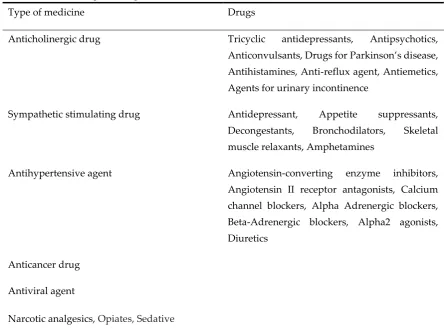
important factor that induces xerostomia and hyposalivation is medication (Table 1). The dosage of the drug is proportional to the extent of xerostomia and hyposalivation. [14] Psychiatric drugs, diabetic drugs, respiratory drugs, and antihypertensive drugs need to be assessed. [15] In addition, Sjögren’s syndrome, radiation therapy, hypertension, asthma, diabetes, hematologic disease, thyroid disease, rheumatic disease, and psychiatric history should also be confirmed.
Oral abnormalities are also known to bring about hyposalivation or xerostomia. Physical
examination, other than the oral cavity, is another necessary procedure. Osailan et al. reported that the sticky mucous membrane of the mouth, bubbly saliva, invisible saliva reservoir on the oral cavity, loss of the taste bud of the tongue, depressed gums, smooth mucosa of the palate, fissured tongue, and dirty secretion of saliva are helpful in diagnosing hyposalivation. However, no correlation has been reported between these findings and the patient symptoms. [16]
fasting of at least 2 hours to rule out other confounding variables. Generally, the saliva flow is measured in a sitting position. The saliva is collected by a commercially available apparatus or by cotton swab placed in the oral cavity. The cotton should be located on the floor of the mouth or opening of the salivary duct. The salivary flow test is measured by assessing the unstimulated and stimulated salivary flow rates (stimulation of saliva secretion is achieved through chewing, or citric acid and vitamin C). The amount of saliva secreted indicates the total weight of the saliva released during a specific time in hours. Since the specific gravity of saliva is 1, the weight can be directly converted into the volume, thereby enabling measurement of the amount of saliva secreted. The saliva flow rate is measured using a specially designed instrument, a pipette, and a paper patch. [17]
Salivary gland function is measured via salivary scintigraphy. After administration of 99mTechnetium pertechnetate, the amount absorbed into the salivary glands and the residual
amount in the salivary gland after secretion of saliva are measured to know the uptake rate and secretion rate, respectively. The function of the salivary gland can be confirmed by imaging studies such as magnetic resonance imaging or computer tomography. These methods are useful for observing salivary glandular abnormalities. Ultrasonography is also useful for non-invasive observation of the parenchyma of the salivary gland. Sialography, a useful method for monitoring the anatomy of salivary gland ducts and the appearance of tumors and stone, utilizes the injection of a radiopaque contrast into the opening of salivary gland ducts. Recent studies have employed MR Sialography, which has the advantage of confirming the pathologic status of salivary parenchyma and the abnormalities of the ducts, and also verifying the function of the salivary gland using saliva as the contrast agent. [18, 19] For diagnosis of the salivary gland in Sjögren’s syndrome, a biopsy of the minor salivary gland in the lips and a fine needle aspiration is performed.
Table 1. Various drugs causing xerostomia.
Type of medicine Drugs
Anticholinergic drug Tricyclic antidepressants, Antipsychotics, Anticonvulsants, Drugs for Parkinson’s disease, Antihistamines, Anti-reflux agent, Antiemetics, Agents for urinary incontinence
Sympathetic stimulating drug Antidepressant, Appetite suppressants, Decongestants, Bronchodilators, Skeletal
muscle relaxants, Amphetamines
Antihypertensive agent Angiotensin-converting enzyme inhibitors,
Angiotensin II receptor antagonists, Calcium channel blockers, Alpha Adrenergic blockers, Beta-Adrenergic blockers, Alpha2 agonists,
Diuretics
Anticancer drug
Antiviral agent
4. Treatment of xerostomia
Since there is no single therapeutic policy to relieve the symptoms of dry mouth, a step by step treatment with various methods is employed, to optimize selection of the most effective method (Table 2). The primary goal of various therapeutic strategies for treating xerostomia being studied is to reduce the symptoms and increase salivation for the patient. Some of the easiest methods are to use appropriate amounts of water, avoid toothpaste or food intake that worsen xerostomia, and use of chewing gum that induces saliva secretion. [20] Lubricants, saliva substitutes, and sialogogues are also helpful in alleviating symptoms.
Pilocarpine® and cevimeline® are FDA approved salivation stimulants. Pilocarpine® stimulates the parasympathetic nerves of muscarine, while cevimeline® promotes salivary stimulation due to its strong affinity for M3 muscarinic receptors. Pilocarpine® has been approved for the treatment of dry mouth with Sjögren’s syndrome and radiation therapy, and cevimeline® has approval for the treatment of Sjögren’s syndrome. The indicated dosage for pilocarpine® is 5 mg and cevimeline® is 30 mg, three times a day for at least three months. [21-23] Pilocarpine® may cause side effects such as increased sweating, enlargement of skin vessels, nausea and vomiting, diarrhea, hiccups, bronchial constriction, hypotension, tachycardia, increased urinary frequency, and visual field abnormalities. Pilocarpine® and cevimeline® are relatively contraindicated in patients with uncontrolled asthma, chronic lung disease, and beta-blockers, and should be used with caution in patients with acute gastric ulcers or uncontrolled hypertension. Pilocarpine® can also be
contraindicated in patients with glaucoma or iritis. Anethole trithione is a bile release promoter known to relieve the symptoms of oral dryness and promote salivation; however, more research is required for its extensive use. [24]
Drugs that are locally sprayed in the mouth are most commonly used for xerostomia patients. Many medications contain malic acid in topical spraying agents, which are effective in relieving the symptoms of dry mouth in patients using antidepressants or antihypertensive agents. [25, 26] Sugar-free gum not only increases the saliva secretion, but also plays an additional role in reducing the friction of the oral mucosa. Salivary stimulants and substitutes (as a gel, toothpaste, mouth rinse, and spray) are also commonly used drugs. Saliva substitutes mimic the saliva component without increasing the viscosity and altering the saliva secretion. These drugs include minerals such as fluoride, calcium and phosphorus, and carboxymethylcellulose, hydroxyethylcellulose, flavoring agents, and preservatives. [20] Oral sprays containing glycerol triester are also effective as salivary gland replacement agents, as are saliva substitutes including olive oil, betaine, and xylitol. [27] Fatty mucosal preservatives, natural mucins, and mucopolysaccharide-containing sprays are also used. Most of these saliva substitutes do not increase the secretion of saliva. [28]
Drugs that cause dry mouth can be reduced or replaced with other drugs. [29] However, such an alteration in therapy needs to be decided after consultation with the physician in charge of treating the disease. Another study indicates increasing the salivation through electrical stimulation of the oral cavity. [30] To stimulate saliva secretion, Saliwell Crown and the electrostimulating device GenNarino, as well as acupuncture were investigated. [31, 32]
Patients receiving radiation therapy in the head and neck area can consume drugs such as amifostine, a salivary cytoprotective agent, prior to irradiation. Recently, many efforts have been made to treat xerostomia with stem cells, growth factors, and natural antioxidant factors. [33-35]
the mouth are a common complication for xerostomia patients. A variety of antifungal agents made from rinses, ointments, candies, tablets, and mouthwashes can be used as a treatment. It is also important to treat the underlying diseases of patients, such as diabetes, renal failure, and
autoimmune diseases. These remedies alleviate the symptoms, prevent deterioration, improve oral conditions, improve salivary functions, and maintain a systemic disease.
Table 2. Managements of xerostomia
Category Treatment Effect
Lifestyle modification Supply of water, Restrictions of dry,
hard and acid food, Restrictions of caffeine and alcohol-containing
beverages
Systemic disease Management of multidisciplinary
underlying diseases, Control of drug dosage, Substitution of drug
Saliva stimulating agent Pilocarpine®, Cevimeline® Anethole trithione, Yohimbine,
Anticholinesterase physostigmine
Increased salivation
Salivating agents and lubricants
Artificial saliva, Rinse agent, Gel, spray, Toothpaste
Increase of saliva viscosity
Masticatory movement Sugar-free gum and candy Increased salivation and reduction of mucosal friction
Salivary stimulation Electrical stimulation, Acupuncture Alleviation of symptoms and increased salivation
Tooth decay prevention / prosthetic care
Use of fluorine, Disinfection of prostheses, Regular screening and
management
Intraoral device Night guard Increased salivation and
prevention of saliva evaporation
Prevention of bacterial and fungal infections
Use of antibiotics and antifungal agents
5. Conclusions
Xerostomia and hyposalivation are uncomfortable side-effects in many patients. This article
summarizes the diagnosis and treatment of xerostomia and hyposalivation. Assessing the function of the salivary gland is essential for selecting an appropriate treatment, improving symptoms, and
preventing oral complications. Also, a more systematic approach is required to differentiate the subjective symptoms of the patient from the objective hyposalivation. Although there is no
standardized treatment for xerostomia, doctors need to endeavor and adapt the various treatments of xerostomia, to unearth the optimal treatment required for the patient.
Author Contributions: JS Choi: Conception, Design, Data analysis/interpretation, Drafting and revising the article, Public responsibility. The author read and approved the final manuscript.
Funding: This research was supported by an INHA University Research Grant.
Conflicts of Interest: The authors declare no conflict of interest. The funders had no role in the design of the study; in the collection, analyses, or interpretation of data; in the writing of the manuscript, or in the decision to publish the results.
References
1. Hopcraft M.S.; Tan C. Xerostomia: an update for clinicians. Australian dental journal2010, 55, 238-244.
2. Van der Putten G.J.; Brand H.S.; Schols J.M.; de Baat C. The diagnostic suitability of a xerostomia
questionnaire and the association between xerostomia, hyposalivation and medication use in a group of
nursing home residents. Clinical oral investigations2011, 15, 185-192.
3. Pedersen A.M.; Bardow A.; Jensen S.B.; Nauntofte B. Saliva and gastrointestinal functions of taste,
mastication, swallowing and digestion. Oral diseases2002, 8, 117-129.
4. Dawes C. How much saliva is enough for avoidance of xerostomia? Caries research2004, 38, 236-240.
5. Villa A.; Polimeni A.; Strohmenger L.; Cicciu D.; Gherlone E.; Abati S. Dental patients' self-reports of
xerostomia and associated risk factors. Journal of the American Dental Association2011, 142, 811-816.
6. Terpenning M.S.; Taylor G.W.; Lopatin D.E.; Kerr C.K.; Dominguez B.L.; Loesche W.J. Aspiration
pneumonia: dental and oral risk factors in an older veteran population. Journal of the American Geriatrics
Society2001, 49, 557-563.
7. Orellana M.F.; Lagravere M.O.; Boychuk D.G.; Major P.W.; Flores-Mir C. Prevalence of xerostomia in
population-based samples: a systematic review. Journal of public health dentistry2006, 66, 152-158.
8. Ship J.A.; Pillemer S.R.; Baum B.J. Xerostomia and the geriatric patient. Journal of the American Geriatrics
Society2002, 50, 535-543.
9. Fox P.C. Autoimmune diseases and Sjogren's syndrome: an autoimmune exocrinopathy. Annals of the New
York Academy of Sciences2007, 1098, 15-21.
10. Shiboski C.H.; Hodgson T.A.; Ship J.A.; Schiodt M. Management of salivary hypofunction during and after
radiotherapy. Oral surgery, oral medicine, oral pathology, oral radiology, and endodontics2007, 103, S66 e1-19.
11. Napenas J.J.; Brennan M.T.; Fox P.C. Diagnosis and treatment of xerostomia (dry mouth). Odontology/the
Society of the Nippon Dental University2009, 97, 76-83.
12. Fox P.C.; Busch K.A.; Baum B.J. Subjective reports of xerostomia and objective measures of salivary gland
performance. Journal of the American Dental Association1987, 115, 581-584.
13. Sreebny L.M.; Valdini A. Xerostomia. Part I: Relationship to other oral symptoms and salivary gland
hypofunction. Oral surgery, oral medicine, and oral pathology 1988, 66, 451-458.
14. Singh M.L.; Papas A. Oral implications of polypharmacy in the elderly. Dental clinics of North America2014,
58, 783-796.
15. Smidt D.; Torpet L.A.; Nauntofte B.; Heegaard K.M.; Pedersen A.M. Associations between labial and whole
salivary flow rates, systemic diseases and medications in a sample of older people. Community dentistry and
oral epidemiology2010, 38, 422-435.
16. Osailan S.; Pramanik R.; Shirodaria S.; Challacombe S.J.; Proctor G.B. Investigating the relationship between
17. Eliasson L.; Carlen A. An update on minor salivary gland secretions. European journal of oral sciences2010,
118, 435-442.
18. Choi J.S.; Lim H.G.; Kim Y.M.; Lim M.K.; Lee H.Y.; Lim J.Y. Usefulness of Magnetic Resonance Sialography
for the Evaluation of Radioactive Iodine-Induced Sialadenitis. Annals of surgical oncology 2015, 22,
1007-1013.
19. Hwang J.H.; Ahn H.J.; Choi J.S.; Lee H.Y.; Lim J.Y. Usefulness of Magnetic Resonance Sialography for
Diagnosis of Idiopathic Chronic Sialadenitis. Korean J Otorhinolaryngol-Head Neck Surg2016, 59, 41-48
20. Visvanathan V.; Nix P. Managing the patient presenting with xerostomia: a review. International journal of
clinical practice2010, 64, 404-407.
21. Aframian D.J.; Helcer M.; Livni D.; Robinson S.D.; Markitziu A.; Nadler C. Pilocarpine treatment in a mixed
cohort of xerostomic patients. Oral diseases2007, 13, 88-92.
22. Braga M.A.; Tarzia O.; Bergamaschi C.C.; Santos F.A.; Andrade E.D.; Groppo F.C. Comparison of the effects
of pilocarpine and cevimeline on salivary flow. International journal of dental hygiene 2009, 7, 126-130.
23. Bernardi R.; Perin C.; Becker F.L.; Ramos G.Z.; Gheno G.Z.; Lopes L.R.; Pires M.; Barros H.M. Effect of
pilocarpine mouthwash on salivary flow. Brazilian journal of medical and biologicalresearch2002, 35, 105-110.
24. Hamada T, Nakane T, Kimura T, Arisawa K.; Yoneda K.; Yamamoto T.; Osaki T. Treatment of xerostomia
with the bile secretion-stimulating drug anethole trithione: a clinical trial. The American journal of the medical
sciences1999, 318, 146-151.
25. Gomez-Moreno G.; Guardia J.; Aguilar-Salvatierra A.; Cabrera-Ayala M.; Mate-Sanchez de-Val J.E.;
Calvo-Guirado J.L. Effectiveness of malic acid 1% in patients with xerostomia induced by antihypertensive drugs. Medicina oral, patologia oral y cirugia bucal2013, 18, e49-55.
26. Gomez-Moreno G.; Aguilar-Salvatierra A.; Guardia J.; Uribe-Marioni A.; Cabrera-Ayala M.; Delgado-Ruiz
R.A.; Calvo-Guirado J.L. The efficacy of a topical sialogogue spray containing 1% malic acid in patients
with antidepressant-induced dry mouth: a double-blind, randomized clinical trial. Depression and anxiety
2013, 30, 137-142.
27. Mouly S.J.; Orler J.B.; Tillet Y.; Coudert A.C.; Oberli F.; Preshaw P.; Bergmann J.F. Efficacy of a new oral
lubricant solution in the management of psychotropic drug-induced xerostomia: a randomized controlled
trial. Journal of clinical psychopharmacology2007, 27, 437-443.
28. Regelink G.; Vissink A.; Reintsema H.; Nauta J.M. Efficacy of a synthetic polymer saliva substitute in
reducing oral complaints of patients suffering from irradiation-induced xerostomia. Quintessence
international1998, 29, 383-388.
29. Azodo C.C.; Ezeja E.B.; Omoaregba J.O.; James B.O. Oral health of psychiatric patients: the nurse's
perspective. International journal of dental hygiene2012, 10, 245-249.
30. Strietzel F.P.; Lafaurie G.I.; Mendoza G.R.; Alajbeg I.; Pejda S.; Mantilla L.V.; Falcão D.P.; Leal S.C.; Bezerra
A.C.; et al. Efficacy and safety of an intraoral electrostimulation device for xerostomia relief: a multicenter,
randomized trial. Arthritis and rheumatism2011, 63, 180-190.
31. Alajbeg I.; Falcao D.P.; Tran S.D.; Martín-Granizo R.; Lafaurie G.I; Matranga D.; Pejda S.; Vuletić L.;
Mantilla R.; Leal S.C.; Bezerra A.C.; et al. Intraoral electrostimulator for xerostomia relief: a long-term,
multicenter, open-label, uncontrolled, clinical trial. Oral surgery, oral medicine, oral pathology and oral
radiology2012, 113, 773-781.
32. O'Sullivan E.M.; Higginson I.J. Clinical effectiveness and safety of acupuncture in the treatment of
irradiation-induced xerostomia in patients with head and neck cancer: a systematic review. Acupuncture in
medicine : journal of the British Medical Acupuncture Society2010, 28, 191-199.
33. An H.Y.; Shin H.S.; Choi J.S.; Kim H.J.; Lim J.Y.; Kim Y.M. Adipose Mesenchymal Stem Cell Secretome
Modulated in Hypoxia for Remodeling of Radiation-Induced Salivary Gland Damage. PloS one2015, 10,
e0141862.
34. Lim J.Y.; Ra J.C.; Shin I.S.; Jang Y.H.; An H.Y.; Choi J.S.; Kim W.C.; Kim Y.M. Systemic transplantation of
human adipose tissue-derived mesenchymal stem cells for the regeneration of irradiation-induced salivary
gland damage. PloS one2013, 8, e71167.
35. Noaparast Z.; Hosseinimehr S.J. Radioprotective agents for the prevention of side effects induced by