1 Measuring attitudes towards Global Learning among future educators in England
Phil Bamber, Liverpool Hope University (England); Andrea Bullivant, Liverpool World Centre (England) and Di Stead, Independent Primary Education Consultant (England)
Philip M. Bamber (corresponding author) is a Senior Lecturer in the Faculty of Education at Liverpool Hope University where he is also the founding Director of the Centre for International and Development Education. His research is concerned with transformative pedagogy, citizenship and values education. He is co-editor (with L. Bourke and J. Clarkson) of In Safe Hands: guiding principles for International Service-Learning (Stoke-on-Trent: Trentham, 2008).
Contact: Faculty of Education, Liverpool Hope University, Hope Park, Liverpool L16 9JD, UK; e-mail: [email protected]
Andrea Bullivant works for Liverpool World Centre, a Development Education Centre, which works with schools and teacher education to promote learning and action in relation to global and social justice issues. Andrea has collaborated with colleagues at LHU to co-author a number of papers and publications on Global Citizenship, Global Learning and Education for Sustainable Development.
2 Abstract
This paper reports upon a multi-agency approach to measuring attitudes towards Global Learning among future educators at a University in the North-West of England. This study provides a response to concerns that Global Learning research and evaluation of global education interventions tend to focus upon short term observable outcomes rather than longer term changes in behaviour, attitude and practice. It is based upon the assumption that Global Learning in Teacher Education must focus upon the development of who the educator is as a person, including their values, attitudes and associated dispositions. This paper will outline the process of constructing an attitude inventory, based upon Thurstone scaling, by a range of professionals working in local government, teacher education and non-government organisations that promote global education. It reports upon the use of this survey at the beginning, middle and end of a compulsory course completed by a cohort of 154 undergraduate students of Primary Teacher Education. The findings show positive changes in attitudes towards Global Learning among females and eradication of the most negative attitudes towards Global Learning during the course of study. Causal factors are suggested relating to cultural practice. The limitations of this particular tool for researching Global Learning are discussed alongside the insight gained from this collaborative process of evaluation.
Key words: measuring attitudes, teacher education, global learning Introduction
3 attitude inventory, based upon Thurstone scaling, by a multi-agency team. This included Development Education practitioners and consultants along with teacher education tutors both familiar and unfamiliar with Global Learning approaches. The findings and discussion section reports upon the use of the inventory by students in initial teacher education at three different time-points over the period of an academic year. Detailed here are the conclusions reached by the multi-agency team regarding the process of constructing an attitude inventory, the utility of this particular evaluation tool and their own understanding of Global Learning. Evaluating Global Learning and the role of attitudes
The paucity of research and evaluation into the impact of Global Learning has been attributed to the embryonic nature of work in this field. O’Loughlin and Wegimot (2007: 9), in their background paper on evaluation practice and policy in relation to global education and public awareness-raising on development issues across a range of European contexts, suggest that ‘evaluation in global education and development education is still very young and new, and its future looks very interesting and potentially fruitful’. In a more nuanced account, Bourn and Hunt (2011:7) cited a number of factors, including: its relatively marginal nature in education; short term funding of projects resulting in a tendency to focus on effectiveness and efficiency rather than impact; and a tendency to pursue practice rather than theory.
Support for research and evaluation has, however, been available to practitioners and researchers for some time. A major UK project, ‘Measuring Effectiveness in Development Education’ (McCollum and Bourn, 2001), highlighted an increased emphasis upon measuring learning outcomes. It also warned against a tendency to focus on short term observable outcomes, rather then longer term impacts affecting changes in behaviour and practice. This report therefore recommended that approaches to evaluation must ‘respond to understandings of attitudinal change and the relationship between processes and learning outcomes…’ (ibid, 2001: 19). Finding that the main objective for projects tended not to be changing attitudes but rather achievements such as ‘improving the capacity to deliver effective programmes…’ (ibid, 2001: 5), this report urged a focus upon linking specific programme objectives and broader Global Learning goals.
4 UK based non-government organisations to assess long term impacts, for instance in a toolkit for measuring attitudinal change in global citizenship (Allum et al, 2008). Nevertheless, in a case study of the Canadian ‘Signs of Change’ initiative, which explored the assessment of public engagement, O’Loughlin and Wegimot note particular difficulties and challenges included ‘defining, capturing and monitoring value change…’ given that it is long term and ‘difficult to predict how individuals will manifest their values’ (2007:31).
That researching broader values, beliefs and character associated with Global Learning is only now emerging belies the fact that related curriculum developments over the last half century (see for example Richardson, 1976 and Fisher and Hicks, 1985) have been underpinned by the premise that global education ‘should be affective as well as cognitive’ (Lister 1986, cited in Hicks, 2008:12). These pioneering initiatives used active and participatory teaching methods to explore the development of particular values and perspectives towards global issues. A significant contribution in this area was the work of Robert Hanvey (1976: 2) who explored the notion of ‘An Attainable Global Perspective’. Hanvey proposed five dimensions, which were subsequently adapted by Pike and Selby into five aims for global education in developing an ‘irreducible global perspective’:
• Systems consciousness • Perspective consciousness • Health of planet awareness
• Involvement consciousness and preparedness • Process-mindedness
(Pike and Selby, 1988: 34 - 5)
5 efficacy, globalcentrism, and interconnectedness. The utility and validity of such instruments must be carefully outlined by researchers, for example through reporting relevant contextual information. For instance, reporting on their own attempt to measure outcomes relating to global citizenship following a period of education abroad, Morais and Ogden highlight the potential for bias in surveys which rely solely upon self report (2011: 462).
Recent guidance on integrating a Global Dimension into formal education in the UK (DfES, 2005) draws upon earlier models (Richardson, 1976; Pike and Selby, 1988) with explicit focus on developing skills and attitudes as well as knowledge and understanding (DfES, 2005:1). The Australian government (Quittner, 2008) has also identified the following values and attitudes to be promoted in schools: a sense of community with people around the world; a recognition of shared responsibilities and a willingness to cooperate with others in fulfilling them; a positive attitude towards diversity and difference; an appreciation of and concern for the environment and a commitment to sustainable practices (ibid, 2008:6). Nevertheless, guidance in the UK and Australia remains much more specific on how to promote knowledge and understanding than on skills, values and attitudes and how this might lead to action.
6 evaluation in this field (Storrs, 2010: 18). A recent call for developing a research-based approach to teacher education in Global Learning highlighted how little is known about teachers’ values in relation to global education in particular (Scheunpflug, 2011: 37) and this therefore provides the focus for this study.
Attitudes towards Global Learning in teacher education
An international survey (Tye, 1999) found that only a small number of teacher education courses in the world promoted global education explicitly. In the UK, a number of initiatives have taken place since 2000 which sought to ‘embed’ a global perspective in teacher education (Barr, 2005). Supported by a positive political climate, as demonstrated by the Sustainable Schools initiative and duty placed upon schools to promote Community Cohesion, teachers have been encouraged to raise young people’s awareness of global issues such as poverty and climate change, and promoting opportunities for future action.
At the same time, substantial evidence has been collated in the UK to advocate for Global Learning in teacher education (DEA, 2008, 2009 and 2010). Research found that exposure to Global Learning improved secondary school student’s attitudes towards those from different backgrounds and the role they could play in making the world a better place (DEA, 2008). A survey presented as evidence to a national review of teacher education (DEA, 2009) found that although the vast majority (94%) of teachers agreed that schools should prepare pupils to deal with a fast-changing and globalised world, only 58% felt that the current school system actually does this. The report concluded that this may be due to teacher’s lack of confidence in teaching specific global issues, a finding echoed in earlier studies carried out by Robbins et al (2003) and Holden and Hicks (2007) on training teachers experiences of global education. Emergent evidence indicates that the promotion of Global Learning in teacher education does indeed increase the confidence of future educators in taking this forward in practice (Gadsby and Bullivant 2011a:4).
7 confidence to teach about global issues, there was considerable variation between sample groups, for example, secondary trainees were more confident than primary trainees. Factors such as subject specialism, prior experience of living or working abroad and contact with other cultures have also been found to positively influence confidence levels (Holden, 2003: 364; Thomas, 2001: 9).
In a study of ‘pre-service’ secondary teachers’ knowledge, skills and values of global education, Bliss and Horsley used a socio-cultural framework to explore the role of prior learning in subject discipline in student teachers’ responses to global education. They found that values reinforced previously in subject disciplines influenced student responses towards specific attitudes and values associated with a global perspective. For example, history focused on empathy and cultural awareness, whereas geography and other social science students focused on areas such as sustainability/environment and appreciate diversity, although geography was most ‘closely related to global education knowledge, skills and values’ overall (Bliss and Horsley, 2005:16 - 19). The findings of these studies reiterate the importance of understanding the context that frames any research in this area.
Context for this study
(i) Liverpool Hope University
8 The philosophy of education to which LHU subscribes has a holistic orientation as reflected in the University’s mission, which has stated that it strives to ‘provide well-rounded personal development...educating the whole person in mind, body and spirit’ (LHU, 2012) since Liverpool Hope University College was established in 1995 (Pye, 2009: 30). Furthermore the values to which LHU aspires, and which it states are integral to the fulfilment of this Mission, include that it ‘strives to be well-rounded, holistic, integrated, a team, a community of communities, collaborating in wider partnerships’ (LHU, 2012). This emphasises the importance of relationships, collegiality and working collaboratively.
A recent audit by the Universities watchdog identified ‘the ethos, culture and mission of the University’ as being a feature of best practice, concluding that the mission ‘is understood, acknowledged and appreciated by both staff and students and… clearly underpins the work of the institution’ (QAA, 2009: 4). This suggests that the mission and ethos of the institution are not simply ‘intended’ but also ‘experienced’ (McLaughlin, 2005: 313). This is validated by a recent inspection of initial teacher education at the institution that concluded, ‘Trainees demonstrate a strong moral purpose…and the strong sense of vocation embodied in the provider’s vision for the Hope Graduate’ (OFSTED, 2011:4). Furthermore, this report suggested LHU’s Mission and Values underpinned a ‘strong’ partnership with local schools and non-governmental organisations ‘where all have high levels of commitment to the Hope vision’ (OFSTED, 2011:4).
The marketisation of higher education in the UK has renewed focus on graduate employability. Rather than being a ‘view from nowhere’, this represents a particular philosophy of education. LHU has sought to balance the promotion of skills that are sought by employers alongside attributes that are important to life in a humane, educated democracy. An aspiration to be ‘market-informed, rather than market-driven’ (LHU, 2007: 4) is also reflected in the University’s website section on ‘what makes LHU different’:
We do not believe that education is just about equipping people for the world of work; we also educate students for the work of the world. We believe that only students educated within a global context can constructively, fairly and bravely make the changes the world needs.
9 The ‘work of the world’ reveals an aspiration to catalyse personal growth that makes social change possible. This is reflected in the visioning statement of the Faculty of Education which states ‘the guiding orientation of the Faculty is to develop educational thought and practices which promote education as a humanising influence on each person and on society locally, nationally and internationally’ (McGettrick, 2010: 2). This mission is exemplified through a series of initiatives that have sought to embed Global Learning within teacher education and are the focus for this study.
(ii)Wider Perspectives in Education
Wider Perspectives in Education (WPE) is a compulsory 30 credit module introduced into the third year of the BA Primary Teaching four year degree in September 2009. The authors of this paper played a critical role in establishing and validating this module within the undergraduate teacher education provision at Liverpool Hope. All three authors were responsible for delivering this course and providing support to tutors and students to maintain the profile of global learning within teacher education and promote meaningful connections between theory and practice. Previously, students completed a 7 week placement in schools as part of their third year of this degree. Instead, in 2009-10, students completed a 5 week school placement and 10 days of community engagement as part of this module. The overall aim of WPE is to provide students with a broader experience of education beyond traditional teaching practice or School Based Learning (SBL), develop their understanding of education for global citizenship with respect to their role as teachers, and promote a sense of themselves as active global citizens. At the same time WPE supports students as they seek to gain evidence of attaining the professional standards for teaching (DfE, 2012). Beyond this, it aims to consolidate and deepen their understanding of and disposition towards Global Learning. The module introduces them to global education policy and practice in the UK and students are encouraged to incorporate Global Learning methodologies within their teaching practice. In doing so it aims to transform student perspectives on the role of education and their own philosophy of teaching.
10 component is followed by a project planning phase. In recognizing and supporting the diversity of learning needs students are encouraged to organize their own project and pursue issues with which they are concerned. Examples include researching a police programme to promote community cohesion and monitoring the support offered by housing association trusts to adults with learning difficulties. One group of students worked closely with SOS Children, the international NGO, to produce educational materials that challenge approaches to educating about the global South that reinforce patronizing and charitable perspectives. Placements in diverse educational settings challenge student assumptions underpinning their own philosophy of education. They also reconsider educational issues beyond the school campus such as child poverty, sustainability, diversity, disability, racism and terrorism. At the end of the project students share their eclectic experiences through group presentations at a conference to celebrate their community engagement work.
Community engagement affords numerous opportunities for students in teacher education (Tellez, 2005) and is more widely practiced in the USA. Barr (2005) highlights the power of personal experience to encourage and educate advocates of Global Learning. Engagement with the other arouses curiosity and can stimulate and inspire learning. He suggests structured opportunities such as international exchanges and linking programmes (Barr 2005:12) are particularly successful in changing attitudes amongst teacher educators and their students to global education. This course team contest the commonly held view that immersion in local settings cannot provoke similar outcomes.
For this experience to be mutually transformative it is important students work in conjunction with the providers in the setting to develop a project which meets the educational needs of children in the setting or members of the local community. This also enables community engagement to be a critical learning experience as advocated by Rosenberger, who argued students need the opportunity to
choose needs or issues in the community that connect to the course content to dialogue with stakeholder in framing and defining the problem and action to engage in problem posing education around the social, political and
economic issues that arise in the community experience
11 This approach is supported by research that has found opportunities for participation and self efficacy play an important in changing attitudes of teachers towards global issues and multiculturalism (Scheunpflug, 2011: 38).
Methodology
This section seeks to outline the process whereby a group of multi-agency professionals working in various roles to support the particular context outlined above sought to measure the attitudes of future educators towards Global Learning. Although future funding for Development Education and Global Learning may be dependent upon more robust evaluation and measurement systems (Bourn, 2008) the process embarked upon here aimed to support staff in the Faculty of Education at LHU and their partners in ‘maintaining purpose and clarity around their mission, goals and objectives and to sustain them in the delivery of their desired outcomes’ (Storrs, 2010: 7). The team of twenty convened to construct this survey comprised tutors working on Initial Teacher Education courses, students, practising teachers, local authority educational consultants, employees of local NGO’s and a Professor of Education with expertise in evaluation of social and health interventions. No particular expertise in global education or Global Learning was required to be part of this group, and although some members did have this background this was not the case for the majority. The rationale for this was a belief that Global Learning interventions should permeate the curriculum (Bourn and Hunt, 2011) and work across phases (Gadsby and Bullivant, 2011b) to enable ‘deep critical engagement with issues of global injustice’ (Bracken and Bryan, 2010: 36). The project team attended a series of seminars that drew on various stimuli to provoke discussion around conceptions of global education and Global Learning and agreed upon the structure and methodology for the evaluation. This process enabled the diverse, multi-agency team to develop a shared understanding of characteristics of Global Learning pertinent to this setting. This demonstrates a useful strategy that engaged stakeholders in dialogue to co-create a ‘participative evaluation system’ (Storrs, 2010: 19).
12 taken. The attitude inventory constructed here aimed to measure feelings and dispositions towards Global Learning determined by self-report. Contextual detail has therefore been provided to qualify the utility and validity of the findings.
Measures of attitude are arrived at by inference. Although self-report approaches to measuring attitudes proliferate, this approach was decided to be most appropriate for this study. Direct participant observation through recording the behaviour of those whose attitude you are studying is impractical for studying large groups. Furthermore, such approaches fail to ascertain the magnitude or strength of an attitude and the observers’ perception needs to be accounted for. Similarly direct questioning via interview lacks subtlety and may be unsuitable when the focus for the study is in some way controversial.
The approach adopted here is redolent of Thurstone’s method of equal appearing intervals (Thurstone and Chave, 1929) that attempts to indicate rather precisely the difference between two respondents’ attitudes towards a particular entity, in this case, Global Learning. It involves a series of statements regarding Global Learning ranging from highly positive to highly negative with shades in between. Each statement has a value scale, not shown to the respondent. Respondents tick only the items with which they agree and leave the remainder blank. The scale values for the statements ticked are added together and divided by the number of statements ticked. This provides the respondent with a score for the inventory that indicates their overall feelings and action dispositions regarding, in this case, Global Learning.
Unlike the Likert scale where the respondent indicates his/her degree of agreement or disagreement for each of the items in the scale, the Thurstone scale involves the respondent checking only those items with which they agree. The Likert scale is ordinal and therefore can only state who has more or less of the attribute under study but not how much more or how much less. It does not give any indication of the magnitude of differences between respondents. Furthermore, unlike the construction of the Thurstone scale methodology, the Likert scale demands an item analysis to establish whether all items in the scale measure the same attitude (Edwards, 1957).
13 from extremely positive to extremely negative. The aim was to focus initially on statements of feelings towards Global Learning. These were designed to assume a certain level of conceptual understanding of ‘Global Learning’, as illustrated by the item ‘I am passionate about Global Learning’. The team then developed attitude statements towards different aspects of Global Learning, such as critical thinking, creativity and education for sustainability.
The second phase involved a small ‘Global Learning expert’ panel independently ascribing a value from 1 to 7 to each of these statements. For example, the ‘expert’ group ascribed a 1 if they felt that statement reflected a most negative attitude towards Global Learning, a 4 reflected a neutral stance towards Global Learning and so on. The expert group comprised of staff from Development Education Centre’s in the North West, NGO’s concerned with Global Learning and tutors at Liverpool Hope University with experience in this field. These ‘judges’ disregarded their own attitude towards the topic and considered instead only how favourable or unfavourable the statement is towards the attitude object. Each individual in this group ascribed values to the 150 + statements and this information was tabulated in a spreadsheet. The project team analysed this data for statements where there appeared to be strongest consensus regarding the ascribed values. Statements on which the ‘judges’ showed substantial disagreement were discarded as ambiguous. Some statements were abandoned by the judges as being irrelevant to the topic.
14 In choosing to investigate the impact of WPE, a compulsory component of a BA Primary Teaching degree, this study cannot be accused of a self-selection bias that would undermine the significance of any findings. For instance, recent study investigating differences in the individual characteristics between those students who participate and those who choose not to participate in a widely advertised and encouraged extra-curricular programme of global citizenship education (Bamber et al, 2012) found that these groups of students differ significantly in a number of important ways (for example, regarding conscientiousness, extraversion, openness; Machiavellianism, prosocial behaviour; self-esteem; skills relating to social action and tolerance and understanding and their concern regarding social problems). This study, with a longitudinal dimension, also provides a response to research that concluded most studies attempting to profile students involved in citizenship activities collect data either retrospectively and/or cross-sectionally (Cemalcilar, 2009).
Findings and discussion
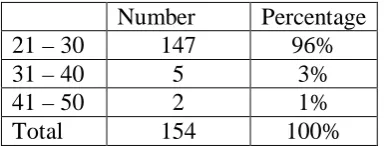
A total of 154 students training to become teachers participated in the study, 83% of a cohort of 184. Most were female (88%, Table 1) and most were in the age bracket 21 to 30 years (96%, Table 2). This reflects the fact that LHU has significantly more female than male students. This has gradually increased to 72.7% of full-time entrants in 2009-10 compared with 68.3% in 2004-05. In 2011-12, 89.5% of undergraduate teacher education students were female.
Table 1: Sample Gender
Table 2: Sample Age distribution
Number Percentage
FEMALES 135 88%
MALES 19 12%
Total 154 100%
Number Percentage
21 – 30 147 96%
31 – 40 5 3%
41 – 50 2 1%
15 Table 3: Total number of inventory completions at each time point
Time point
Time point (TP1) 17/89+17+14 +21= 141 Time point (TP2) 35/89+17+7+3= 116 Time point (TP3) 48/89+14+7+3= 113
Table 4: Number of students completing the inventory at different time points
Participants completed the inventory on 3 occasions (see Table 3 for further details): before the course started (time point 1); after the taught element of the course had been completed but before the community engagement project (time point 2); and at the end of the course after the community engagement project (time point 3):
Full data sets of three completed inventories were obtained from 89 students (see Table 4 for further details). In addition 38 completed inventories at 2 out of 3 time points and a further 27 students completed the inventory at one time point. The inventories were completed during the teaching sessions so that students who missed a class also missed a data collection time point. All data were included in the calculation of the averages for individual time points but only complete sets of inventories at 3 time points were compared in the analysis of change over time. This is consistent with an assumption that data were missing at random.
Students were generally positive in their attitude towards Global Learning. There was little variation in the mean inventory score for the group at time point 1 (5.50), time point 2 (5.39) and time point 3 (5.50). It was notable that most students started the course with a broadly
Time-points
1 & 2 & 3 89 1 & 2 17 1 & 3 14 2 & 3 7
1 only. 21
2 only 3
3 only 3
16 positive attitude towards the importance of global education, with the overwhelming majority (129 responses out of 141) agreeing with the statement “I think that it is really important for young people to know what’s going on in the world”. Similarly, only 4 students agreed with
the negatively framed statement, “I hate the whole idea of teaching about Global Learning”, and only one student agreed with “Having a global dimension to my education is totally pointless and would detract from my important learning”. None of the students marked these
statements at TP3 which is significant given a recent study where ‘only a small minority of students expressing apathy, scepticism or antagonism’ towards delivering Development Education, found that ‘disparaging comments appeared to have a disproportionately strong effect on teachers’ motivation and confidence’ (Bracken and Bryan, 2010: 35-36).
The responses to the two items with greatest weighting were investigated as they related most closely to the key objectives of WPE. One relates to the priority students intend to give Global Learning in their teaching and the other is about their enthusiasm for this educational approach. These were: S3 “Global education is absolutely essential for the development of myself and those I teach” which was weighted 6.85 and indicates the importance attached to
global education by students; and S13 “I am passionate about global education” which was weighted 6.85 and indicates the motivation of students to use global education.
17 students, as evaluated by this instrument at any one particular point in time.
Table 5: Agreement with S13 “I am passionate about global education” by gender at time points 1, 2 and 3.
Males agreeing with S13
Female agreeing with S13
TOTAL agreeing with S13
TP 1 6 13 19
TP 2 5 31 36
TP 3 6 39 45
In order to assess beyond levels of positivity towards a narrow conceptualisation of Global Learning, the team purposefully included statements that referred to ideas underpinning this educative approach. The finalised instrument therefore included the following statements related to critical and creative thinking as well as openness to different perspectives: S5 “Whilst creative thinking is important there are things which take a higher priority”, S8
“Young people should be aware of different perspectives” and S14 “Global learning is possibly one way to promote critical thinking”. It is of particular interest that there were no
significant variations of student responses to these three items across the three time points and by different age / gender grouping. Arguably, this reflects a failure of the WPE programme to engage students with these aspects of Global Learning.
The Thurstone Scaling methodology ensures an individual’s inventory score decreases when statements with a lower weighting than their existing score are ticked. In such cases a students inventory score decreases as they agree with more statements. Of the 127 students who completed the survey on more than 1 occasion, 62 agreed with more statements at subsequent time points while only 29 agreed with fewer statements at subsequent timepoints. Given that, on average, students were broadly positive towards Global Learning (with the mean score of 5 and above as outlined earlier), this had the effect of reducing the overall mean due to the weighting of the items in the inventory (see Table 6 for further details).
18 Agreed with more statements at a subsequent time point Agreed with the same number of statements at a subsequent timepoint Agreed with fewer statements at a subsequent timepoint TOTAL
Increase in individual inventory score
27 15 17 59
Same individual inventory score
0 8 0 9
Decrease in individual inventory score
35 13 12 60
TOTAL 62 36 29 121
The potential for a student’s inventory score to be reduced as they indicate agreement with more statements in a subsequent completion of the inventory is illustrated by a student who at TP1 ticked 4 statements, S1, (6.31), S6 (5.69), S8 (5.85), S14 (5.15), scoring a mean of 5.63. At TP3 she marked all the same statements and added S12: Whilst global perspectives in learning could be important the concept may need further clarification to be usefully applied
to the curriculum, (4. 23). Her inventory score therefore reduced to 5.35 at TP3. In
constructing the inventory, the project team gave S12 a weighting of 4.32. This score of greater than 4 (that would have meant neutral) indicated that the team understood this statement to represent a marginally positive attitude towards Global Learning.
19 information and learning takes place. Constructivist theory suggests that as a learner is exposed to more knowledge they can become more confused before they restructure their understanding and begin to acknowledge that their first ideas are too simplistic.
Conclusion
Although the results here showed an insignificant variation in the mean inventory score for 89 students who completed the survey across all three time points, analysis of responses to individual items revealed important findings. Investigation of responses to the items with the highest weighting and most relevance to the objectives of the WPE course indicated that students arrived at the course with strongly positive views about the importance of global education, which were reinforced and deepened during the WPE course. Although few students starting the course indicated a strong personal commitment to global education this increased significantly during the course, particularly amongst women students. This is consistent with the findings of earlier studies highlighted by Schuerholz-Lehr (2007) and Welch (1997) that identified gender differences in ‘world-mindedness’ suggesting this in an area of Global Learning research worthy of further exploration. This research therefore provides further insight into the conditions effective in changing teacher attitudes towards Global Learning although identifying attribution is clearly problematic.
In order to explicate implications for future research, this paper will conclude by suggesting a relationship between the ethos of the institution and collaborative approach developed as part of WPE in nurturing a positive attitude towards Global Learning. In exploring an ‘attainable global perspective’ Hanvey noted that such a perspective may consist of a combination of many elements present in varying degrees between individuals, in which case ‘the educational goal broadly seen may be to socialize significant collectivities of people so that the important elements of a global perspective may be a variable trait possessed in some form and degree by a population, with the precise character of that perspective determined by the specialized capacities, predispositions, and attitudes of the group's members’ (Hanvey, 1976: 2).
20 undergo change as well as they can contribute to change’ (Rogoff, 1998 cited in Bliss and Horsley, 2005:3). As highlighted earlier, the origins of the curriculum innovation investigated here lie in a series of initiatives to promote Global Learning across the Faculty of Education. It aims to transform student perspectives on the role of education and as such makes explicit connections with the distinct ethos of the institution, embodied in the idea of the community engagement projects which play a key role in influencing students’ positive attitudes towards the course and global education broadly (Bullivant and Gadsby, 2011a). This is enhanced by support from a module teaching team of ‘global learning champions’, a strong partnership with a local Development Education Centre and close collaboration with schools and community engagement project providers who all act to endorse the module’s aims, nurturing ‘a shared vision of developing practice ….vital for meaningfully connecting theory and practice’ (Ellis and Hogard, 2010:6). This illustrates a ‘community of learners’ of the sort envisaged by Rogoff, involving students as ‘active learners’ who are encouraged to lead projects, negotiate with teachers and other ‘more skilled partners’ (Rogoff et al, 1996 :388), and to contemplate possibilities for action for change. Bliss and Horsley draw upon transformative learning theory (Mezirow, 1978, 1991) to emphasise the ‘integrative’ nature of global learning concepts such as ‘environment’ and the way in which they may act to free people from ‘oppressive ideologies’, which for some students may result in a sense of liberation from the ‘constraints’ of their teacher training experience to date (1978, 1991, cited in Bliss and Horsley, 2005:3).
This highlights the importance not only of collaboration and partnership to Global Learning research and practice but also reiterates a need to focus upon individual change: the importance of who the educator is becoming as a person, including their values, virtues and associated dispositions. Given that character education is founded upon the Aristotelian principle that ‘character is formed in large part through habitual behaviour that eventually becomes internalized into virtues (character)’ (Berkowitz and Bier 2004: 80), this study points towards a congruence between this field and Global Learning research worthy of further investigation.
22 Appendix 1:
Weighting Statement
6.31 I think it’s really important for young people to know what’s going on in the world
1.00 Having a global dimension to my education is totally pointless and would detract from my important learning
6.85 Global learning is absolutely essential for the development of myself and those that I teach
2.00 Global learning is a low priority issue on the scale of what is important in my life and my work
3.08 Whilst creative thinking is important there are things which take a higher priority
5.69 Global education adds to pupil learning
4.00 I think global learning is significant but honestly don’t know if it is more or less important than Mathematics or English
5.38 Young people should be aware of different perspectives 2.08 Global learning is too complex to engage with
2.46 Incorporating global learning is beyond the role/scope of being a teacher 1.00 I hate the whole idea of teaching about global learning
4.23 Whilst global perspectives in learning could be important, the concept may need further clarification to be usefully applied to the curriculum
6.85 I am very passionate about global education
23 References:
Allum, L., Lowe, B and Robinson, L. (2008) How Do We Know It’s Working? A toolkit for measuring attitudinal change. Reading: Reading International Solidarity Centre.
Bamber, P., Bourke, L. and Lyons, M. (2012) Global Citizens: who are they? Education, Citizenship and Social Justice 7 (2) p. 161-174.
Barr, I (2005) In the Situation of Others. The Final Evaluation Report on the Department for International Development’s Initiative on Embedding the Global Dimension in Initial
Teacher Education in the UK 2001-2005. Unpublished report.
Berkowitz, M. W. and Bier, M. C. (2004). Research-based character education. The Annals of the American Academy, 591, 72–85.
Bliss, S and Horsley, M. (2005) Pre-service Secondary Teachers’ Prior Knowledge, Skills and Values of Global Education. Paper presented to Pacific Circle Consortium International Conference, University of Western Sydney, July 30, 2005
Bourn, D. (2008) Introduction in Bourn, D. (ed.) Development Education: Debates and dialogues, London: Institute of Education, 1-17.
Bourn, D. and Brown, K. (2011) Young People and International Development: Engagement and Learning. London: Development Education Research Centre. Accessed 4th April 2012 at http://www.ioe.ac.uk/EngagementAndLearning.pdf
Bourn, D. and Hunt F. (2011) Global Dimension In Secondary Schools. DERC Research Paper No. 1, London: IOE.
Bracken, M. and Bryan, A. (2010) The reflective practitioner model as a means of evaluating development education practice: post-primary teachers’ self reflections on ‘doing’ development education, Policy and Practice: A Development Education Review 11 p. 22-41. Bullivant, A and Gadsby, H (2011) Promoting Global Learning and Active Global Citizenship in Teacher Education: A Partnership Approach. Paper presented to UK ITE Network for ESD/GC annual conference, 8th June 2011, London South Bank University Cemalcilar Z (2009) Understanding individual characteristics of adolescents who volunteer. Personality and Individual Differences. 46 (4) p. 432–436.
Crick, B. (2002). A Note on What is and What is Not Active Citizenship Accessed April 4th 2012 at
http://archive.excellencegateway.org.uk/media/post16/files/033_bernardcrick_what_is_citize nship.pdf accessed April 2012
Darton, A. and Kirk, M. (2011) Finding Frames: New ways to engage the UK public in global poverty. London: BOND for international development. Accessed 20th April 2012 at http://findingframes.org/
24 Study on behalf of DEA. London: DEA. Accessed September 2012 at:
http://www.think-global.org.uk/resources/research.asp
DEA (2009) Teacher’s Attitudes to Global Learning: An Ipsos MORI Research Study on behalf of DEA. London: DEA. Accessed September 2012 at:
http://www.think-global.org.uk/resources/research.asp
DEA (2010) The Impact of Global Learning on Public Attitudes and Behaviours Towards International Development and Sustainability. Accessed September 2012 at:
http://www.think-global.org.uk/resources/research.asp
Deng, S., & Boatler, R. W. (1993). Worldmindedness among Canadian business students: Implications for curricula. Journal of Education for Business, 69(2), 94-98.
Department for Education (2012) Teachers’ Standards. London: DfE. Accessed May 2013 at https://www.education.gov.uk/publications/eOrderingDownload/teachers%20standards.pdf
Department for Education and Skills (DfES) (2005) Developing a Global Dimension in the School Curriculum. London: DfES.
Edwards, A.L. (1957) Techniques of attitude scale construction. New York: Appleton-Centruy-Crofts.
Ellis, R and Hogard, E (2010) Evaluation of Liverpool Hope University’s Active Global Learners’ Project. University of Chester: Social and Health Evaluation Unit
Fisher, S and Hicks, D. (1985) World Studies 8 – 13: A teacher’s handbook. Edinburgh: Oliver and Boyd
Gadsby,H and Bullivant,A (2011a) Promoting Global Learning and Active Global Citizenship in Initial Teacher Education: A partnership approach in Inman, S and Rogers, M (2011) Building Capacity for ESD/GC in Times of Change: Network proceedings. London South Bank University: Centre for Cross Curricular Initiatives
Gadsby, H. and Bullivant, A. (eds) (2011b) Global learning and sustainable development. London: Routledge.
Hanvey, R. (1976) An Attainable Global Perspective. New York: Centre for War/Peace Studies
Hett, E. J. (1993) The development of an instrument to measure global-mindedness (Doctoral dissertation, University of San Diego, 1993). Dissertation Abstracts International, 54, 3724.
25 Hosseinali, T. (1995). The relationship of globalmindedness to travel and living abroad experiences of university professors. Dissertation Abstracts International, 56(07), 2544. (UMI No. 9536034)
Johnson, L and Morris, P. (2010) Towards a Framework for Critical Citizenship Education, Curriculum Journal, 21 (1) p.77-96
Lister, I. (1986) Global and international approaches to political education, in: Harber, C (ed) Political Education in Britain. Lewes: Falmer Press, cited in Hicks, D. (2008) Ways of Seeing: The origins of global education in the UK. Background paper for UK ITE Network Inaugural Conference on Education for Sustainable Development/Global Citizenship. London, July 2008
Liverpool Hope University (LHU) (2007) Corporate Plan 2007-2011. Unpublished document. Accessed 4th April 2012 at
http://www.hope.ac.uk/secretarys-office/corporateplanning.html
Liverpool Hope University (LHU) (2011a) About Liverpool Hope University Accessed 12th July 2011 at http://www.hope.ac.uk/about-hope/about-liverpool-hope-university.html Liverpool Hope University (LHU) (2012) Liverpool Hope University Values. Accessed 4th
April at http://www.hope.ac.uk/about-hope/the-values-of-hope.html
McCollum, A. and Bourn, D. (2001) Measuring Effectiveness in Development Education. London: DEA
McGettrick, B. (2010) Faculty of Education, Liverpool Hope University, 2010-12 Strategic Map. Unpublished document.
McLaughlin, T. (2005) The educative importance of ethos. British Journal of Educational Studies, 53(3) p. 306-325.
McTighe Musil C (2009) Assessing Global Learning: Matching Good Intentions with Good Practice. Washington, D.C.: Association of American Colleges and Universities.
Mezirow, J (1978) Perspective Transformation. Adult Education, 28
Mezirow, J (1991) Transformation Theory and Cultural Context: A reply to Clark and Wilson. Adult Education Quarterly, 41(3), 188 - 192.
Morais, D. and Ogden, A. (2010) Initial Development and Validation of the Global Citizenship Scale. Journal of Studies in International Education, 15 (5) p. 445-466.
OFSTED (2011) Liverpool Hope University: Initial Teacher Education Report June 2011. Accessed 5th April 2012 at http://www.ofsted.gov.uk/inspection-reports/find-inspection-report/provider/ELS/70130
O’Loughlin, E. and Wegimot, L. (2007) Global Education, Public Awareness-raising and Campaigning on Development Issues: An overview of evaluation practice and policy. Background paper prepared for: Informal Expert’s Workshop. Development Communication, Advocacy and Education: Tips and tools for improving evaluation. Bonn, 19 – 20 March 2007. OECD: German Federal Ministry for Economic Cooperation and Development
26 Parker, W., Glenn, A., Mizoue, Y., Meriwether, C., & Gardner, W. (1997). Japanese and American preservice teachers’ attitudes toward global issues and relations.
Peabody Journal of Education, 72 (1) p. 187-202.
Pike, G and Selby, D. (1988) Global Teacher, Global Learner. London: Hodder and Stoughton
Pillay, G. (2011) Vice Chancellor’s address to graduands, their friends and families. Liverpool Metropolitan Cathedral, July 14th 2011.
Pye, K. (2009) A Brighter Hope: The Story of Liverpool Hope University. Liverpool: Liverpool Hope University Press.
Quality Assurance Agency (QAA) (2009) Institutional Audit: Liverpool Hope University. Accessed 4th April 2012
http://www.qaa.ac.uk/InstitutionReports/Reports/Documents/RG548LiverpoolHope.pdf Quittner, K (ed) (2008) Global Perspectives: A framework for global education in Australian schools. Carlton. South Victoria: Curriculum Corporation
Richardson, R. (1976) Learning for Change in World Society. London: World Studies Project.
Robbins, M., Francis, J., & Elliott, E. (2003) ‘Attitudes toward education for global citizenship among trainee teachers’ in Research in Education 69 (1) p. 93-98.
Rogoff, B. (1998) Cognition as a Collaborative Process. In Kuhn, D and Siegler, R. Handbook of Child Psychology. Cognition, Perception and Language pp679-7 44. New York: Wiley, cited in Rogoff, B, Matusov, E and White, C (1996) Models of Teaching and Learning: Participation in a Community of Learners in Olsen, D and Torrance, R (Eds) The Handbook of Education and Human Development (pp. 388 - 414). Oxford, UK: Blackwell
Rogoff, B, Matusov, E and White, C (1996) Models of Teaching and Learning: Participation in a Community of Learners in Olsen, D and Torrance, R (Eds) The Handbook of Education and Human Development (pp. 388 - 414). Oxford, UK: Blackwell
Rosenberger, C. (2000) Beyond empathy: Developing critical consciousness through service-learning in O’Grady, C, Integrating Service-Learning and Multicultural Education in Colleges and Universities, New Jersey: Lawrence Erlbaum, 23-44.
Sampson, D. & Smith, H. (1957). A scale to measure world-minded attitudes. Journal of Social Psychology, 45 (1) p. 99-106.
Schuerholz-Lehr, S (2007) Teaching for Global Literacy in Higher Education: How prepared are the educators? Journal of Studies in International Education, 11 (2) p 180 - 204
27 Storrs, G (2010) 'Evaluation in development education: Crossing borders' in Policy & Practice: A Development Education Review, Vol. 11, Autumn 2010, pp. 7-21, available: http://www.developmenteducationreview.com/issue11-focus1.
Tellez, K. (2000) Reconciling service-learning in O’Grady, Integrating Service-Learning and Multicultural Education in Colleges and Universities, New Jersey: Lawrence Erlbaum, pp 71-92.
Think Global. (2011) Evaluating Global Learning Outcomes: A guide to assessing progress in intercultural, environmental and development education projects. London: Think Global.
Thomas, G. (2001) Human Traffic: Skills, employers and international volunteering. London: DEMOS. Accessed January 2013 at http://www.demos.co.uk/files/humantraffic.pdf
Thurstone, L.L. and Chave, E.J. (1929) The Measurement of Attitude. Chicago: University of Chicago Press.
Tye, K. (1999) Global Education: A Worldwide Movement. Orange, CA: Independence Press