RVC OPEN ACCESS REPOSITORY – COPYRIGHT NOTICE
This is the author’s accepted manuscript of the following article:
Blasco-Costa, I., Cutmore, S. C., Miller, T. L. and Nolan, M. J. (2016) 'Molecular approaches to trematode systematics: ‘best practice’ and implications for future study', Systematic
Parasitology, 93(3), 295-306.
The final publication is available at Springer via http://dx.doi.org/10.1007/s11230-016-9631-2.
The full details of the published version of the article are as follows:
TITLE: Molecular approaches to trematode systematics: ‘best practice’ and implications for future study
AUTHORS: Isabel Blasco-Costa, Scott C. Cutmore, Terrence L. Miller, Matthew J. Nolan JOURNAL TITLE: Systematic Parasitology
VOLUME/EDITION: 93/3
Molecular approaches to trematode systematics: ‘best practice’ and
implications for future study
Isabel Blasco-Costa • Scott C. Cutmore • Terrence L. Miller • Matthew J. Nolan
Received: 13 November 2015 / Accepted: 9 January 2016
I. Blasco-Costa ()
Department of Invertebrates, Natural History Museum of Geneva, route de Malagnou 1, 1208
Geneva, Switzerland
e-mail: [email protected]
S. C. Cutmore
The University of Queensland, School of Biological Sciences, St Lucia, Queensland, 4072,
Australia
T. L. Miller
Fish Health Laboratory, Department of Fisheries, 3 Baron-Hay Court, South Perth, Western
Australia 6151, Australia
T. L. Miller
Centre for Sustainable Tropical Fisheries and Aquaculture, College of Marine and
Environmental Sciences, James Cook University, Cairns, Queensland, 4878, Australia
M. J. Nolan
Department of Pathology and Pathogen Biology, Royal Veterinary College, University of
London, Hatfield AL9 7TA, United Kingdom
Abstract To date, morphological analysis has been the cornerstone to trematode systematics.
However, since the late-1980s we have seen an increased integration of genetic data to overcome
advice regarding the ‘best molecular practice’ for trematode taxonomy and systematic studies, in
an attempt to help unify the field and provide a solid foundation to underpin future work.
Emphasis is placed on defining the study goals and recommendations are made regarding sample
preservation, extraction methods, and the submission of molecular vouchers. We advocate
generating sequence data from all parasite species/host species/geographic location combinations
and stress the importance of selecting two independently evolving loci (one ribosomal and one
mitochondrial marker). We recommend that loci should be chosen to provide genetic variation
suitable to address the question at hand and for which sufficient ‘useful’ comparative sequence
data already exist. Quality control of the molecular data via using proof-reading Taq polymerase,
sequencing PCR amplicons using both forward and reverse primers, ensuring that a minimum of
85% overlap exists when constructing consensus sequences, and checking electropherograms by
eye is stressed. We advise that all genetic results are best interpreted using a holistic biological
approach, which considers morphology, host identity, collection locality, and ecology. Finally,
we consider what advances next-generation sequencing holds for trematode taxonomy and
systematics.
Introduction
Morphological data have been the cornerstone to the study of the Trematoda Rudolphi, 1808 for
more than two centuries. Indeed, the morphological delineation of trematode species remains
highly effective, with thousands of recognised species successfully described by morphology
alone. However, the distinction between intraspecific phenotypic plasticity and interspecific
variation can become somewhat obscured in trematode genera which experience a larger degree
of morphological stasis or in taxa that belong to species-rich genera. Even more challenging
when using morphological data in isolation is the identification and matching of the life-cycle
stages, with larvae typically bearing little resemblance to adults and having few, indistinct
morphological features for diagnosis. The advent of the polymerase chain reaction (PCR) (Saiki
et al., 1988) and readily accessible DNA sequencing technologies have provided trematode
taxonomists with an independent source of data to help overcome the limitations associated with
morphological analyses. Indeed, since the late-1980s and early 1990s (e.g. Blair & McManus,
1989; Luton et al., 1992; Adlard et al., 1993), there has been a dramatic increase in the use of
molecular data in trematode taxonomy and systematics. Genetic data provide researchers with a
tremendous capacity to recognise species, illuminate phenotypic plasticity, link life-cycle stages,
can be inferred from morphological data alone (Nolan & Cribb, 2005). In 2010 a fundamental
paper was published, in which the authors provided an exceptional framework for the collection
and preservation of trematodes from fishes for morphological studies (Cribb & Bray, 2010).
Given the now routine use of molecular data in studies of trematodes, it is rather surprising that
there are not similar guidelines for ‘best molecular practice’. Despite a number of reviews on the
topic, which highlight theoretical and methodological issues or drawbacks of molecular
methodologies (see Nolan & Cribb, 2005; Olson & Tkach, 2005; Pérez-Ponce de León &
Nadler, 2010; Nadler & Pérez-Ponce de León, 2011; Poulin, 2011), there has been no attempt to
unify the discipline. Here, in an effort to coalesce molecular methods used in studies of
trematode taxa (i.e. species, genera, families), we carry out a bibliographic search of the leading
parasitology journals from 2011 to 2015 and summarise recent trends as they apply to the
Trematoda. We discuss several aspects of generating and employing molecular data in these
studies, emphasise best practises for such methodologies, and consider what advances
next-generation sequencing (NGS) holds for trematode systematics.
Species concepts applied to trematodes in the molecular age
Molecular data provide a study with independent information, which can help unravel
phenotypic plasticity and cryptic speciation among trematode taxa. Remarkably, however,
genetic data have still proven to be rather subjective, with authors interpreting genetic variation
in different ways. This is largely due to the fact that trematode taxonomists spend almost no time
discussing species concepts. Indeed, searching “Trematod*/Digenea*” + “species concept” in
PubMed (http://www.ncbi.nlm.nih.gov/pubmed) reveals a complete lack of reference to the
topic. This philosophy becomes important when we examine the more subtle boundaries of
where to recognise distinction between closely related and cryptic species. Outside of trematode
systematics, endless debate has surrounded species concepts and their implications for estimates
of biodiversity (e.g. Agapow et al., 2004; Poulin, 2011). Presently, the most widely accepted
model for parasitic helminths, including the Trematoda, is the Linnaean or morphological
species concept (see Mayden, 1997 for a review) where groups of individuals are classified
together based on distinctive morphological characters rather than genetic traits. Trematode
taxonomists employ the Linnaean concept as a surrogate of the biological species concept (Mayr,
1942), but to a large extent, they also use components of the biological species concept to
delineate species. For example, different forms living in sympatry are considered distinct
species concept (Rosen, 1979; Donoghue, 1985) is also applied, where a species may be
recognised as groups of individuals that form reciprocally monophyletic clades (e.g. Locke et al.,
2010; Miller et al., 2010; Cutmore et al., 2014; Zikmundová, et al. 2015). The most inclusive
conceptualisation considers species as "separately evolving metapopulation lineages" (De
Queiroz, 2007). This concept incorporates properties relevant in the Linnaean, biological, and
phylogenetic concepts as lines of evidence (operational criteria) for assessing the delineation of
species. This framework emphasises an integrative approach to taxonomy (Dayrat, 2005; Will et
al., 2005) rather than one based on singular criteria, and has already been successfully applied to
recognise many trematode species (e.g. Georgieva et al., 2013, Razo-Mendivil et al., 2013;
Georgieva et al., 2014 in association with Faltýnková et al., 2015; Blasco-Costa et al., 2014 in
association with Faltýnková et al., 2014; Herrmann et al., 2014; Diaz et al., 2015). This approach
is not completely new to parasite taxonomists, since ecological data (e.g. host specificity,
geographical distribution, life-cycles) have always been taken into account to distinguish taxa.
Rather the novelty lays on its conceptualisation as the sum of distinct lines of evidence. We
recommend the adoption of this model because it provides a holistic approach to studies of
trematode diversity.
Trends in trematode systematics
To better understand the use of molecular data in recent trematode taxonomic and systematic
investigations, we data-mined literature published in major parasitology journals (i.e. Acta
Parasitologica, Folia Parasitologica, Helminthologia, International Journal for Parasitology,
Journal of Helminthology, Journal of Parasitology, Parasitology, Parasitology International,
Parasitology Research, Systematic Parasitology, and Zootaxa). Each study was categorised by
the inclusion/exclusion of genetic data, the markers used, and the focus of the study
(taxonomy/systematics [i.e. studies that resulted in a taxonomic or systematic act], diversity [e.g.
barcoding studies or cryptic species detection without taxonomic actions], life-cycles, population
variation, species diagnosis (identification), and phylogenetic inference). Data were compiled
from 252 studies from 2011–2015 (May/July). This period was chosen as it coincides with the
last major reviews on molecular methods in parasite systematics (see Pérez-Ponce de León &
Nadler, 2010; Nadler & Pérez-Ponce de León, 2011; Poulin, 2011). Overall, three major trends
were detected.
declined and the proportion using one or two molecular markers has increased. The number of
studies using three or more markers has remained mostly constant (see Fig. 1).
(ii) Of the taxonomic/systematic investigations in the past five years, 45% did not use
genetic data (thus the Linnaean or biological species concepts were used to propose new taxa),
and around 20 and 15%, respectively, used data from one or two markers. In contrast, over 50%
of studies exploring taxon diversity and 35% of studies matching life-cycle stages used sequence
data from at least two markers. Studies inferring phylogenetic relationships predominantly used
data from one or two markers (see Fig. 2).
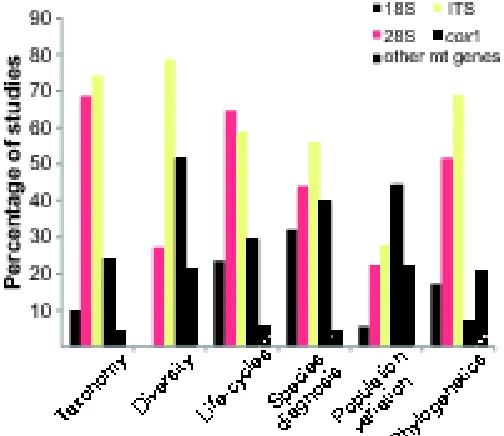
(iii) The ribosomal RNA (rRNA) gene (18S-ITS1-5.8S-ITS2-28S) was mainly targeted
(see Fig. 3), with the most variable markers (large subunit rDNA (LSU or 28S) and the internal
transcribed spacers (ITS1 and ITS2) preferred. Of the mitochondrial genes analysed, the
cytochrome c oxidase subunit 1 (cox1) was the most widely used, having higher relative
importance in studies of diversity, species diagnosis and population variation. Remarkably, most
taxonomy, diversity, life-cycle, and phylogenetic studies that generated mitochondrial DNA
(mtDNA) sequence data also produced rDNA sequence data (data not shown). Other markers
such as microsatellites (e.g. Reusch et al., 2004; Criscione et al., 2011) and ‘inter-simple
sequence repeats’ (e.g. Robles-Pérez et al., 2015) were mainly applied to assess population
variation and (rarely) to prospect for species diversity.
Clearly, the use of genetic data in trematode taxonomy and systematics has steadily
increased since 2012 with researchers strongly reliant on just a handful of markers. We therefore
consider it imperative to establish a steadfast framework for the use and integration of genetic
data into studies of trematode diversity. This will underpin and enhance future investigations by
ensuring that high quality data generated now can be reliably used in future studies.
‘Best molecular practice in trematode systematics’
Study design
First and foremost, having a defined question or hypothesis in mind and understanding the scale
of the study will help refine sampling strategy and focus the researcher on their choice of
marker(s). This notion may seem unusual in trematode taxonomy, as most of the thousands of
existing species were probably discovered as a consequence of a ‘pure chance’ finding (e.g.
Nolan & Cribb, 2006). However, redundant sampling, in which multiple specimens of each
The number of specimens sequenced is particularly important if cryptic species are suspected
(see Poulin, 2011). Generally, we recommend that three to five sequences of the most variable
marker be generated for each host-parasite-locality (HPL) combination being reported.
Sample preservation
Collection methods and fixation strategies for preserving specimens for both molecular and
morphological assessment have been discussed in-depth by Cribb & Bray (2010) and Justine et
al. (2012). When preserving specimens for future molecular investigation, we strongly
recommend using 95–100% ethanol. Concentrations < 90% may be sufficient to preserve
material when targeting rDNA and mtDNA with hundreds of copies per cell; however, it may
render samples unusable for future amplification of single copy markers or for the application of
novel DNA technologies that require well-preserved, high quality DNA. Alternatively, aqueous,
nontoxic, tissue storage reagents such as RNAlater® (Ambion ™, Austin, USA) provide the
opportunity to store samples at 4°C for weeks or at -20°C indefinitely, preserving both DNA and
RNA, without jeopardising the quality or quantity of the molecular material obtained after
subsequent isolation. Let us honour the advice of Dr. D. Timothy J. Littlewood (pers. comm., 30
Sept. 2015) "When you collect and fix material today, think of what you would like to do with it
tomorrow".
Voucher specimens
Typically, when specimens are abundant, total genomic DNA (gDNA) has been extracted from
whole individual worms and the subsequently generated sequence data submitted to a public
database such as the GenBank (http://www.ncbi.nlm.nih.gov/genbank/). This now standard
practice has led to the recommendation that a link between genetic data and morphological
vouchers be established. Definitions for different types of vouchers have been proposed by
Pleijel et al. (2008) and Astrin et al. (2013). We strongly recommend the deposition of
morphological vouchers, at least one hologenophore (i.e. a piece of the organism used for the
generation of molecular data, mounted in a preparation or preserved in a way that can be used for
morphological identification) and one paragenophore (i.e. an individual organism collected from
the same host, at the same time and place as the organism used for the generation of molecular
data, and identified by the author as belonging to the same taxon) for descriptions of new
95–100% ethanol or a fixative that allows gDNA preservation; and/or extracted gDNA) to
natural history collections that possess biobank repositories (e.g. DNA Bank Network,
http://www.dnabank-network.org/ or Global Genome Biodiversity Network, http://ggbn.org/).
Biobank repositories have policies to ensure the best curation and use of such vouchers. In
publications, clear reference should be made to accession and voucher numbers to provide a
connection for morphological vouchers from which sequences were generated (stating museum
collection codes, preservation status, etc.) and additional molecular vouchers deposited in
Biobank repositories. The deposition of morphological vouchers of the molecular samples
cross-referenced with molecular vouchers will permit future taxonomic verification and the generation
of new sequence data and/or the use of new molecular technologies for existing species. This
issue is pertinent even if morphological characterisation is not the goal of the study (e.g.
barcoding or molecular ecology studies), since GenBank is plagued by misidentified sequences
(Valkiūnas et al., 2008; Georgieva et al., 2014). The scientific community is just starting to
comprehend the importance of vouchering molecular samples. Despite this, authors are still
rather idiosyncratically reluctant to share their specimens or make data publicly available unless
specific journal policies enforce it. Thus, we urge authors, editors, and reviewers to consider the
deposition of morphological vouchers of molecular samples and cross-referenced molecular
vouchers a priority.
DNA extraction
A variety of methods are available for the extraction of high quality gDNA from single
specimens, specimen fragments, and even cercariae or eggs (Nolan & Cribb, 2004; Cribb et al.,
2011; O'Dwyer et al., 2014). If large numbers of samples are to be processed with little
downstream application, we recommend the use of quick and inexpensive methods, such as
Chelex and Proteinase K (e.g. Keeney et al., 2007) or guanidine thiocyanate lysis buffer (Tkach
& Pawlowski, 1999). However, if DNA purity is essential for downstream processing (e.g.
AFLP-PCR or NGS), classic phenol-chloroform (or similar) protocols (e.g. Sambrook & Russell,
2001) or commercial nucleic acid extraction kits should be used.
Choice of marker
The biggest issues when using molecular methods in trematode taxonomic studies are (i) which
consider ‘What are the disadvantages of the chosen gene(s)?’ As different genes evolve at
dissimilar rates, selecting the optimal genetic marker requires careful consideration of the aim of
the study. All genes accumulate mutations over time but some experience higher rates of genetic
change (i.e. those unconstrained by function), while others accumulate fewer mutations (i.e.
those encoding for particular biological functions). The challenge is to achieve a balance. A
chosen gene must exhibit sufficient variation to discriminate closely related taxa but not so much
as to hinder robust taxonomic/systematic/phylogenetic inferences. Typically, the most suitable
markers are selected based on prior knowledge for the family of trematodes being studied and
are those that exhibit > 70% but less than 100% similarity (Hillis & Dixon, 1991).
Ideally, molecular conclusions should be based on genetic data from independent loci.
Unfortunately, in the case of trematodes it is restricted to two truly independent loci since all
rDNA and all mtDNA markers are linked. The compromise between how many markers, from
how many HPL combinations, and how many individual specimens for lower-level systematic or
taxonomic studies [i.e. at the level of species (or within), intra-generic, or between closely
related genera] could be prioritised as follows:
(i) Sequences of the most variable marker (allowing to detect intraspecific
polymorphisms), Marker A, should be generated from three to five specimens from as many
HPL combinations as possible. The more replicates in a study, the greater the confidence in the
results. This is particularly important when the differences between/among species are few.
(ii) A second, more conserved gene (that displays interspecific variation only), Marker B,
should be sequenced from those individuals with the greatest degree of sequence divergence at
Marker A.
Studies focusing on higher-level systematics (at the suprageneric level) should prioritise
markers spanning variation from the lowest taxonomic unit (e.g. genus) to higher ones (e.g.
family) and obtain representative molecular data for all markers for each taxonomic unit
included in the study.
From the data-mined literature encompassing the last five years, the nuclear rRNA gene
and the mitochondrial cox1 gene were shown to be the most popular choices for the molecular
investigation of trematodes at low taxonomic levels, while rRNA gene (i.e. 28S and ITS)
dominated phylogenetic studies in general. The major attractions to rDNA are undoubtedly the
considerable volume of data already available in public databases for comparative purposes and
its easy amplification with 'universal' primers that have been employed for over 25 years. It is
clear to us that the more one or the same markers are used, the more valuable they become in
toto. Hence, if a new gene that perfectly distinguished species every time (with no issues of
abandon the makers that have been used to date? In our opinion, the answer is definitively no.
However, this new marker should undoubtedly augment the existing molecular ‘toolbox’ for
circumscribing trematode species.
Overall, we recommend the combined use of both ribosomal and mitochondrial genes,
with the specific choice based on (i) what gene markers are already available online for the
group in question; and (ii) what markers are informative to the specific questions being
investigated. We suggest exploring variation at the intraspecific level with a mitochondrial gene
and to use a nuclear variable region such as the ITS (the entire ITS1-5.8S-ITS2 region or a
transcribed spacer in isolation) or 28S for corroborating interspecific variation for taxonomic and
low level systematic studies. Unifying the choice of markers will be advantageous in two ways.
First, it increases the available sequence data for all trematode taxa sequenced in future studies.
Secondly, it is important that the existence of divergent lineages in a mitochondrial gene are
corroborated by divergence at a nuclear locus, to clarify whether those mtDNA lineages reflect
haplotype variation at the population level (especially if just few specimens of a species have
been sequenced from distant geographic locations) or that independent historical lineages should
be recognised as distinct species.
Ribosomal loci
Ribosomal RNA (rRNA) genes and the associated spacer regions consist of hundreds of
tandemly repeated copies in the nuclear genome of eukaryotic cells. This region is highly
informative for taxonomic investigations, because the entire repeat unit is thought to evolve in a
concerted fashion (but see point v in the sequencing section below). New variants arising by
random genetic drift or natural selection within a species become homogenised and fixed
(Morgan & Blair, 1995), making sequence data representing an individual characteristic of an
interbreeding group. This region is particularly useful in that it contains loci with differing rates
of evolution, making it possible to answer a variety of systematic questions (Nolan & Cribb,
2005).
The small subunit rRNA gene (SSU or 18S) is amongst the slowest evolving gene
regions in living organisms. We recommend its use to infer deep phylogenetic relationships (i.e.
between families and above) (Hillis & Davis, 1986). The 28S rRNA gene shows a faster rate of
evolution at the variable domains than 18S. However, it also possesses conserved regions,
similar to those of 18S (Hillis & Dixon, 1991). Although both markers were initially used to
define species/genus-level boundaries (e.g. Kaukas & Rollinson, 1997; León-Regagnon &
purpose (e.g. Hildebrand et al., 2015; Pérez-Ponce de León et al., 2015). The two internal
transcribed spacers, ITS1 and ITS2, have been extensively shown to be particularly effective,
either separately or in combination, in the taxonomic investigation of trematode species (see
Nolan & Cribb, 2005). Thus, we recommend the inclusion of at least one conserved region (18S
or 28S rDNA) and one spacer (ITS1, ITS2, or the entire ITS1-5.8S-ITS2 region) for all new
species descriptions. This will offer a comprehensive database for future delineative studies.
Mitochondrial loci
Mitochondrial DNA, located within each mitochondrial organelle of trematodes, is maternally
inherited and forms a double-stranded circular structure that includes two ribosomal (rrnS and
rrnL), 12 protein-coding (atp8 is absent), and 22 transfer RNA (trn) genes (Le et al., 2002; but
see Jannotti-Passos et al., 2001). The use of mtDNA markers holds several advantages over
nuclear ones. First, the rate of mutation is higher than that observed for nuclear genes (Brown et
al., 1979), which generates genetic variation at both population and species levels (Avise et al.,
1987). Secondly, intraspecific nucleotide polymorphism is considered to be effectively neutral
(Gerber et al., 2001). Thirdly, the effective population size (Ne) is one-quarter that of diploid
nuclear loci in allogamous species, or one-half in hermaphroditic species that may reproduce by
autogamy. Thus, haplotype frequencies can drift quickly, creating genetic differences between
populations in a short time (Criscione & Blouin, 2005; Criscione et al., 2005). Finally, due to the
absence of recombination, any two haplotypes in the population will ‘coalesce’ more rapidly into
the most common recent ancestor so that monophyly will be achieved faster than for nuclear
(autosomal) genes (Kingman, 1982a, b).
The cox1 is a highly variable protein-coding gene in bilaterians and is widely used for
molecular systematics of animals (Avise, 2000). Versatile primers, developed to amplify the
barcode region (c.600 nt) of metazoans (Folmer et al., 1994), have recently been redesigned for
trematodes (Moszczynska et al., 2009; Van Steenkiste et al., 2015) facilitating its use across a
range of trematode families. Alternative primers amplifying a larger fragment covering the same
region also exist for some trematode groups (e.g. Miura et al., 2005; Králová-Hromadová et al.,
2008; Herrmann et al., 2014). Similar to ITS of the rDNA, cox1 is less suited to large
phylogenetic reconstructions (especially if the barcoding fragment is used) or comparisons
among distantly related taxa because of the likelihood of encountering substitution saturation
(i.e. when multiple substitutions have occurred at the same nucleotide codon position, such that
it is not possible to accurately estimate sequence divergence).
including the nicotinamide adenine dinucleotide dehydrogenase subunit 1 (nad1) gene (e.g. Bray
et al., 1999, 2009; Detwiler et al., 2010; Curran et al., 2013; Georgieva et al., 2014; Selbach et
al., 2014), mitochondrial large subunit rRNA (rrnL or 16S rrn) gene (e.g. Li et al., 2010; Leung
et al., 2009; Herrmann et al., 2014) and cytochrome b (cytb) gene (e.g. Zhao et al., 2012). We
recommend these be used to complement the most widely used markers (e.g. ITS and cox1)
mentioned above, rather than in isolation, due to the current lack of comparative data from mt
markers in general for most trematode families.
Sequencing
Sanger sequencing, a method that selectively incorporates chain-terminating dideoxynucleotides
by Taq polymerase during in-vitro DNA replication (Sanger et al., 1977), remains the preferred
technology for most trematode studies using genetic data. Ensuring sequence quality is
imperative since it is impossible to control it after the data are published. Thus, for the
generation of reliable and publishable sequence data:
(i) Taq polymerase with ‘proof-reading’ activity should be chosen.
(ii) PCR amplicons must be sequenced using both forward and reverse primers.
(iii) Electropherograms must overlap by at least 85% when creating consensus sequences.
(iv) Electropherograms should be checked by eye. Automated base-calling programs can
incorporate miscalled/artifactual bases (e.g. ‘dye blobs’) or overlook bases.
(v) Presence of double peaks at certain nucleotide positions in electropherograms should
be reported in the sequences using the appropriate IUPAC code. Such individual or
intra-genomic sequence polymorphisms (e.g. in ribosomal gene regions), although generally not
anticipated, should not be dismissed as uninformative noise. Ideally, cloning the PCR product
and sequencing a minimum of 10 colonies containing the incorporated DNA fragment will
provide an indication of the most frequent sequence (and nucleotide at the variable positions)
among the various rDNA repeats in an individual. We suspect this phenomenon is more common
than generally reported but evidence of this exists for only a few trematode taxa (e.g. Mone et
al., 2012; Diaz et al., 2015).
As mentioned above, we advocate strongly for replication of sequencing for as many
HPL combinations as possible, which also provides extra ‘proof-reading’ checks for ensuring the
most reliable and highest quality DNA sequence data are published. In this context, we also
recommend that authors provide links to the electropherogram data used to generate the
published sequence data. Ideally, this will allow for detailed and transparent comparative
species complexes that basic alphanumeric sequence data alone cannot provide. While this may
not be practical in many circumstances, we suggest authors strive to make these data available to
the wider community through databases for these types of data such as BOLD
(www.barcodinglife.com) or as online supplementary data.
When Sanger sequencing mitochondrial genes, an added confounding factor may be the
amplification and sequencing of pseudogenes. The presence of nuclear mitochondrial paralogs
(pseudogenes or numts, an abbreviation for "nuclear mitochondrial DNA"; Richly & Leister,
2004) can be co-amplified with the mitochondrial locus, or even be the only sequence amplified
in some cases. If these are not recognised it can lead to an overestimation of the number of
species (Song et al., 2008). Pseudogene sequences can be discarded a posteriori by identifying
the presence of stop codons or an excess of non-synonymous mutations, but some numts may
remain undetected. The best solution is to avoid amplifying numts through methods such as
pre-PCR dilution (Calvignac et al., 2011).
Interpretation
DNA taxonomy should not be considered a substitute for morphology-based interpretations.
Rather, genetic sequence data are best utilised when augmenting total biological information (i.e.
host, locality, ecology, and morphology). Theoretically, distinguishing species in sympatry is
generally uncomplicated. However, it is in allopatry where smallish sequence differences turn up
that problems may occur. Our recommended approach to this is that if the differences in
allopatry are as great as those seen between comparable combinations of species in sympatry,
then specimens likely represent different species (e.g. Transversotrema polynesiae Cribb,
Adlard, Bray, Sasal & Cutmore, 2014; see Cribb et al., 2014). On the other hand, if the allopatric
differences are less than those seen in sympatry, then it is geographical (or inter-host) variation
(e.g. allopatric populations of Transversotrema gigantica Hunter, Ingram, Adlard, Bray & Cribb,
2010 off Heron and Ningaloo Islands; see Hunter et al., 2010). Unfortunately, there is no general
genetic yardstick (i.e. a set level of base differences) that can be used to delineate species. The
degree of genetic divergence will depend on the taxonomic group, the gene region analysed, and
the geographical relationships of the samples, to name just a few considerations. Thus, the
independent source of data that molecular information brings to an investigation should be
interpreted in a holistic biological and ecological context as it has (generally) since the
The next step
Revolutionary advances in NGS technologies offer opportunities to explore many aspects linked
to the fundamental biology of parasites on a scale that was previously unimaginable. Sequencing
whole mitochondrial genomes is possibly the next step beyond traditional DNA barcoding.
Comparative mitogenomic studies of closely related species may allow the discovery of more
informative mitochondrial genes and better diagnostic markers, and have the potential to provide
better nodal support for phylogenetic relationship inference. Recent studies on the phylogenetic
signal and genetic variability of mitochondrial genes for species of Diplostomum von Nordmann,
1832, Fasciola Linnaeus, 1758 and Schistosoma Weinland, 1858 suggest that cox1 is not the
most suitable marker for accurate species identification (Zarowlecki et al., 2007; Liu et al., 2014;
Brabec et al., 2015). Instead, cox3, nad4, nad5, or nad6 have been identified as better markers
for species diagnosis. Sequencing the mitochondrial genomes of key trematode taxa has the
potential to provide new insights into taxonomy, systematics and evolutionary history, not only
within selected families but also across the Trematoda as a whole.
Comparative nuclear genomics also offer the promise of finding additional independent
loci that may capture genetic variation at different scales to be used in combination with already
well-established ribosomal and mitochondrial genes. Introns of single-copy genes are ideal for
fine-scale studies (population or intraspecific level variation) since they have little structural
constraint whereas neighbouring exons are typically conserved, making it possible to design
PCR primers. Such markers, often called EPIC (exon-primed intron-crossing) can be defined
with increasing ease now that complete genome sequences are available for several trematode
species and other closely related platyhelminths. However, the expertise to make the most of
these new datasets may lie beyond the grasp of most trematode researchers. Moving forward
would require, perhaps more than ever, collaborative projects and consortiums between
geneticists, bioinformaticians, and parasitologists. Certainly, such combined efforts would
advance the field of molecular systematics in this group and provide stronger molecular tools
that may help compensate for the shortage of professional taxonomists (Brooks & Hoberg,
2001).
Acknowledgements We thank Associate Professor Thomas Cribb for organising the workshop
‘The biodiversity of trematodes of fishes’ at the 9th International Symposium on Fish Parasites
and sharing his opinion on this topic. We are also grateful to two anonymous reviewers and the
Compliance with ethical standards
Conflict of interest The authors declare that they have no conflict of interest.
Ethical approval This article does not contain any studies with animals performed by any of the
authors.
References
Adlard, R. D., Barker, S. C., Blair, D., & Cribb, T. H. (1993). Comparison of the second internal
transcribed spacer (ribosomal DNA) from populations and species of Fasciolidae
(Digenea). International Journal for Parasitology, 23, 423–425.
Agapow, P. M., Bininda-Emonds, O. R. P., Crandall, K. A., Gittleman, J. L., Mace, G. M. et al.
(2004). The impact of species concept on biodiversity studies. The Quarterly Review of
Biology, 79, 161–179.
Astrin, J. J., Zhou, X., & Misof, B. (2013). The importance of biobanking in molecular
taxonomy, with proposed definitions for vouchers in a molecular context. ZooKeys, 365,
67–70.
Avise, J. C. (2000). Phylogeography: the history and formation of species. London: Harvard
University Press, 464 pp.
Avise, J. C., Arnold, J., Ball, R. M., Bermingham, E., Lamb, T. et al. (1987). Intraspecific
phylogeography - The mitochondrial-DNA bridge between population genetics and
systematics. Annual Review of Ecology and Systematics, 18, 489–522.
Blair, D., & McManus, D. P. (1989). Restriction enzyme mapping of ribosomal DNA can
distinguish between fasciolid (liver fluke) species. Molecular and Biochemical
Parasitology, 36, 201–208.
Blasco-Costa, I., Faltýnková, A., Georgieva, S., Skirnisson, K., Scholz, T., & Kostadinova, A.
(2014). Fish pathogens near the Arctic Circle: molecular, morphological and ecological
evidence for unexpected diversity of Diplostomum (Digenea: diplostomidae) in Iceland.
Brabec, J., Kostadinova, A., Scholz, T., & Littlewood, D. T. J. (2015). Complete mitochondrial
genomes and nuclear ribosomal RNA operons of two species of Diplostomum
(Platyhelminthes: Trematoda): a molecular resource for taxonomy and molecular
epidemiology of important fish pathogens. Parasites & Vectors, 8, 336.
Bray, R. A., Littlewood, D. T. J., Herniou, E. A., Williams, B., & Henderson, R. E. (1999).
Digenean parasites of deep-sea teleosts: a review and case studies of intrageneric
phylogenies. Parasitology, 119, S125–S144.
Bray, R. A., Waeschenbach, A., Cribb, T. H., Weedall, G. D., Dyal , P., & Littlewood, D. T. J.
(2009). The phylogeny of the Lepocreadioidea (Platyhelminthes, Digenea) inferred from
nuclear and mitochondrial genes: Implications for their systematics and evolution. Acta
Parasitologica, 54, 310–329.
Brooks, D. R., & Hoberg, E. P. (2001). Parasite systematics in the 21st century: opportunities
and obstacles. Trends in Parasitology, 17, 273–275.
Brown, W. M., George, M., & Wilson, A. C. (1979). Rapid evolution of animal mitochondrial
DNA. Proceedings of the National Academy of Sciences of the United States of America,
76, 1967–1971.
Calvignac, S., Konecny, L., Malard, F., & Douady, C. J. (2011). Preventing the pollution of
mitochondrial datasets with nuclear mitochondrial paralogs (numts). Mitochondrion, 11,
246–254.
Cribb, T. H., & Bray, R. A. (2010). Gut wash, body soak, blender and heat-fixation: approaches
to the effective collection, fixation and preservation of trematodes of fishes. Systematic
Parasitology, 76, 1–7.
Cribb, T. H., Adlard, R. D., Bray, R. A., Sasal, P., & Cutmore, S. C. (2014). Biogeography of
tropical Indo-West Pacific parasites: a cryptic species of Transversotrema and evidence
for rarity of Transversotrematidae (Trematoda) in French Polynesia. Parasitology
International, 63, 285–294.
Cribb, T. H., Adlard, R. D., Hayward, C. J., Bott, N. J., Ellis, D. et al. (2011). The life cycle of
Cardicola forsteri (Trematoda: Aporocotylidae), a pathogen of ranched southern bluefin
tuna, Thunnus maccoyi. International Journal for Parasitology, 41, 861–870.
Criscione, C. D., & Blouin, M. S. (2005). Effective sizes of macroparasite populations: A
conceptual model. Trends in Parasitology, 21, 212–217.
Criscione, C. D., Poulin, R., & Blouin, M. S. (2005). Molecular ecology of parasites: Elucidating
Criscione, C. D., Vilas, R., Paniagua, E., & Blouin, M. S. (2011). More than meets the eye:
detecting cryptic microgeographic population structure in a parasite with a complex life
cycle. Molecular Ecology, 20, 2510–2524.
Curran, S. S., Tkach, V. V., & Overstreet, R. M. (2013). A new species of Homalometron
(Digenea: Apocreadiidae) from fishes in the northern gulf of Mexico. Journal of
Parasitology, 99, 93–101.
Cutmore, S. C., Miller, T. L., Bray, R. A. & Cribb, T. H. (2014). A new species of
Plectognathotrema Layman, 1930 (Trematoda: Zoogonidae) from an Australian
monacanthid, with a molecular assessment of the phylogenetic position of the genus.
Systematic Parasitology, 89, 237–246.
Dayrat, B. (2005). Towards integrative taxonomy. Biological Journal of the Linnean Society, 85,
407–415.
De Queiroz, K. (2007). Species concepts and species delimitation. Systematic Biology, 56, 879–
886.
Detwiler, J. T., Bos, D. H., & Minchella, D. J. (2010). Revealing the secret lives of cryptic
species: Examining the phylogenetic relationships of echinostome parasites in North
America. Molecular Phylogenetics and Evolution, 55, 611–620.
Diaz, P. E., Bray, R. A., Cutmore, S. C., Ward, S., & Cribb, T. H. (2015). A complex of species
related to Paradiscogaster glebulae (Digenea: Faustulidae) in chaetodontid fishes
(Teleostei: Perciformes) of the Great Barrier Reef. Parasitology International, 64, 421–
428.
Donoghue, M. J. (1985). A critique of the biological species concept and recommendations for a
phylogenetic alternative. Bryologist, 88, 172–181.
Faltýnková, A., Georgieva, S.,Kostadinova, A., Blasco-Costa, I., Scholz, T., & Skírnisson,K.
(2014). Diplostomum von Nordmann, 1832 (Digenea: Diplostomidae) in the sub-Arctic:
descriptions of the larval stages of six species discovered by morphological and
molecular analyses. Systematic Parasitology, 89, 195–213.
Faltýnková, A., Georgieva, S., Soldánová, M. &Kostadinova, A. (2015) A re-assessment of
species diversity within the ‘revolutum’ group of Echinostoma Rudolphi, 1809 (Digenea:
Echinostomatidae) in Europe. Systematic Parasitology, 90, 1–25.
Folmer, O., Black, M., Hoeh, W., Lutz, R., & Vrijenhoek, R. (1994). DNA primers for
amplification of mitochondrial cytochrome c oxidase subunit I from diverse metazoan
invertebrates. Molecular Marine Biology and Biotechnology, 3, 294–299.
Georgieva, S., Soldánová, M., Pérez-del-Olmo, A., Dangel, R. D., Sitko, J., Sures, B., &
Diplostomidae) reveals cryptic diversity. International Journal for Parasitology, 43, 57–
72.
Georgieva, S., Faltýnková, A., Brown, R., Blasco-Costa, I., Soldánová, M., Sitko, J., Scholz, T.,
& Kostadinova, A. (2014). Echinostoma 'revolutum' (Digenea: Echinostomatidae) species
complex revisited: species delimitation based on novel molecular and morphological data
gathered in Europe. Parasites & Vectors, 7, 520.
Gerber, A. S., Loggins, R., Kumar, S., & Dowling, T. E. (2001). Does nonneutral evolution
shape observed patterns of DNA variation in animal mitochondrial genomes? Annual
Review of Genetics, 35, 539–566.
Herrmann, K. K., Poulin, R., Keeney, D. B., & Blasco-Costa, I. (2014). Genetic structure in a
progenetic trematode: signs of cryptic species with contrasting reproductive strategies.
International Journal for Parasitology, 44, 811–818.
Hildebrand, J., Pulis, E. E., & Tkach, V. V. (2015). Redescription and phylogenetic relationships
of the rare Lyperosomum sarothrurae Baer, 1959 (Digenea: Dicrocoeliidae). Acta
Parasitologica, 60, 371–377.
Hillis, D. M., & Davis, S. K. (1986). Evolution of ribosomal DNA: fifty million years of
recorded history in the frog genus Rana. Evolution, 40, 1275–1288.
Hillis, D. M., & Dixon, M. T. (1991). Ribosomal DNA: molecular evolution and phylogenetic
inference. Quarterly Review of Biology, 66, 411–453.
Hunter, J. A., Ingram, E., Adlard, R. D., Bray, R. A., & Cribb, T. H. (2010). A cryptic complex
of Transversotrema species (Digenea: Transversotrematidae) on labroid, haemulid and
lethrinid fishes in the Indo-West Pacific Region, including the description of three new
species. Zootaxa, 2652, 17–32.
Jannotti-Passos, L. K., Souza, C. P., Parra, J. C., & Simpson, A. J. G. (2001). Biparental
mitochondrial DNA inheritance in the parasitic trematode Schistosoma mansoni. The
Journal of Parasitology, 87, 79–82.
Justine, J.-L., Briand, M. J., & Bray, R. A. (2012). A quick and simple method, usable in the
field, for collecting parasites in suitable condition for both morphological and molecular
studies. Parasitology Research, 111, 341–351.
Kaukas, A., & Rollinson, D. (1997). Interspecific variation within the ‘hypervariable’ region of
the 18S ribosomal RNA gene among species of Schistosoma Weinland, 1858 (Digenea).
Systematic Parasitology, 36, 157–160.
Keeney, D. B., Waters, J. M., & Poulin, R. (2007). Diversity of trematode genetic clones within
amphipods and the timing of same-clone infections. International Journal for
Kingman, J. F. C. (1982a). The coalescent. Stochastic Processes and their Applications, 13,
235–248.
Kingman, J. F. C. (1982b). On the genealogy of large populations. Journal of Applied
Probability, 19, 27–43.
Králová-Hromadová, I., Špakulová, M., Horáčková, E., Turčeková, L., Novobilský, A. et al.
(2008). Sequence analysis of ribosomal and mitochondrial genes of the giant liver fluke
Fascioloides magna (Trematoda: Fasciolidae): Intraspecific variation and differentiation
from Fasciola hepatica. Journal of Parasitology, 94, 58–67.
Le, T. H., Blair, D., & McManus, D. P. (2002). Mitochondrial genomes of parasitic flatworms.
Trends in Parasitology, 18, 206–213.
León-Regagnon, V., & Paredes, C. E. L. (2002). Haematoloechus danbrooksi n. sp. (Digenea:
Plagiorchioidea) from Rana vaillanti from Los Tuxtlas, Veracruz, Mexico. Journal of
Parasitology, 88, 1215–1221.
Leung, T., Keeney, D., & Poulin, R. (2009). Cryptic species complexes in manipulative
echinostomatid trematodes: when two become six. Parasitology, 136, 241–252.
Li, J., Zhao, G. H., Zou, F. C., Mo, X. H., Yuan, Z. G. et al. (2010). Combined mitochondrial
16S and 12S rDNA sequences: an effective genetic marker for inter-species phylogenetic
analysis of zoonotic trematodes. Parasitology Research, 107, 561–569.
Liu, G.-H., Gasser, R., Young, N., Song, H.-Q., Ai, L., & Zhu, X.-Q. (2014). Complete
mitochondrial genomes of the 'intermediate form' of Fasciola and Fasciola gigantica,
and their comparison with F. hepatica. Parasites & Vectors, 7, 150.
Locke, S. A., McLaughlin, D. J., & Marcogliese, D. J. (2010). DNA barcodes show cryptic
diversity and a potential physiological basis for host specificity among Diplostomoidea
(Platyhelminthes: Digenea) parasitizing freshwater fishes in the St. Lawrence River,
Canada. Molecular Ecology, 19, 2813–2827.
Luton, K., Walker, D., & Blair, D. (1992). Comparisons of ribosomal internal transcribed
spacers from two congeneric species of flukes (Platyhelminthes: Trematoda: Digenea).
Molecular and Biochemical Parasitology, 56, 323–327.
Mayden, R. L. (1997). A hierarchy of species concepts: The denouement in the saga of the
species problem. In Claridge, M. F., Dawah, H. A., and Wilson, M. R. (Eds.) Species:
The units of biodiversity. London: Chapman and Hall, pp. 381–424.
Mayr, E. (1942). Systematics and the origin of species. New York: Columbia University Press,
Miller, T. L., Adlard, R. D., Bray, R. A., Justine, J.-L., & Cribb, T. H. (2010). Cryptic species of
Euryakaina n. g. (Digenea: Cryptogonimidae) from sympatric lutjanids in the Indo-West
Pacific. Systematic Parasitology, 77, 185–204.
Miura, O., Kuris, A. M., Torchin, M. E., Hechinger, R. F., Dunham, E. J., & Chiba, S. (2005).
Molecular-genetic analyses reveal cryptic species of trematodes in the intertidal
gastropod, Batillaria cumingi (Crosse). International Journal for Parasitology, 35, 793–
801.
Mone, H., Minguez, S., Ibikounle, M., Allienne, J. F., Massougbodji, A., & Mouahid, G. (2012).
Natural interactions between S. haematobium and S. guineensis in the Republic of Benin.
Scientific World Journal, 2012, 793420.
Morgan, J. A. T., & Blair, D. (1995). Nuclear rDNA ITS sequence variation in the trematode
genus Echinostoma: An aid to establishing relationships within the 37-collar-spine group.
Parasitology, 111, 609–615.
Moszczynska, A., Locke, S. A., McLaughlin, J. D., Marcogliese, D. J., & Crease, T. J. (2009).
Development of primers for the mitochondrial cytochrome c oxidase I gene in digenetic
trematodes (Platyhelminthes) illustrates the challenge of barcoding parasitic helminths.
Molecular Ecology Resources, 9, 75–82.
Nadler, S. A., & Pérez-Ponce de León, G. (2011). Integrating molecular and morphological
approaches for characterizing parasite cryptic species: Implications for parasitology.
Parasitology, 138, 1688–1709.
Nolan, M. J., & Cribb, T. H. (2004). The life cycle of Paracardicoloides yamagutii Martin, 1974
(Digenea: Sanguinicolidae). Folia Parasitologica, 51, 320–326.
Nolan, M. J., & Cribb, T. H. (2005). The use and implications of ribosomal DNA sequencing for
the discrimination of digenean species. Advances in Parasitology, 60, 101–163.
Nolan, M. J., & Cribb, T. H. (2006). An exceptionally rich complex of Sanguinicolidae von
Graff, 1907 (Platyhelminthes: Trematoda) from Siganidae, Labridae and Mullidae
(Teleostei: Perciformes) from the Indo-West Pacific Region. Zootaxa, 1218, 3–80.
O'Dwyer, K., Blasco-Costa, I., Poulin, R., & Faltýnková, A. (2014). Four marine digenean
parasites of Austrolittorina spp. (Gastropoda: Littorinidae) in New Zealand:
morphological and molecular data. Systematic Parasitology, 89, 133–152.
Olson, P. D., & Tkach, V. V. (2005). Advances and trends in the molecular systematics of the
parasitic platyhelminthes. Advances in Parasitology, 60, 165–243.
Pérez-Ponce de León, G., & Nadler, S. A. (2010). What we don't recognize can hurt us: A plea
Pérez-Ponce de León, G., Razo-Mendivil, U., Mendoza-Garfias, B., Rubio-Godoy, M., &
Choudhury, A. (2015). A new species of Wallinia Pearse, 1920 (Digenea: Allocreadiidae)
in Astyanax mexicanus (Characidae) from Mexico revealed by morphology and
sequences of the 28S ribosomal RNA gene. Folia Parasitologica, 62, 018.
Pleijel, F., Jondelius, U., Norlinder, E., Nygren, A., Oxelman, B. et al. (2008). Phylogenies
without roots? A plea for the use of vouchers in molecular phylogenetic studies.
Molecular Phylogenetics and Evolution, 48, 369–371.
Poulin, R. (2011). Uneven distribution of cryptic diversity among higher taxa of parasitic worms.
Biology Letters, 7, 241–244.
Razo-Mendivil, U., Perez-Ponce de Leon, G., & Rubio-Godoy, M. (2013). Integrative taxonomy
identifies a new species of Phyllodistomum (Digenea: Gorgoderidae) from the twospot
livebearer, Heterandria bimaculata (Teleostei: Poeciliidae), in Central Veracruz, Mexico.
Parasitology Research, 112, 4137–4150.
Reusch, T. B. H., Rauch, G., & Kalbe, M. (2004). Polymorphic microsatellite loci for the
trematode Diplostomum pseudospathaceum. Molecular Ecology Notes, 4, 577–579.
Richly, E., & Leister, D. (2004). NUMTs in sequenced eukaryotic genomes. Molecular Biology
and Evolution, 21, 1081–1084.
Robles-Pérez, D., García-García, P., Pérez, J. M., Rojo-Vázquez, F. A., &
Martínez-Valladares, M. (2015). Analysis of genetic variability of Fasciola hepatica populations
from different geographical locations by ISSR-PCR. Parasitology, 142, 527–533.
Rosen, D. E. (1979). Fishes from the uplands and intermontane basins of Guatemala: revisionary
studies and comparative geography. Bulletin of the American Museum of Natural History,
162, 269–375.
Saiki, R. K., Gelfand, D. H., Stoffel, S., Scharf, S. J., Higuchi, R. et al. (1988). Primer-directed
enzymatic amplification of DNA with a thermostable DNA polymerase. Science, 239,
487–491.
Sambrook, J., & Russell, D. (2001). Molecular cloning: A laboratory manual. New York: Cold
Springs Harbour Laboratory Press, 2028 pp.
Sanger, F., Nicklen, S., & Coulson, A. R. (1977). DNA sequencing with chain-terminating
inhibitors. Proceedings of the National Academy of Sciences of the United States of
America, 74, 5463–5467.
Selbach, C., Soldánová, M., Georgieva, S., Kostadinova, A., Kalbe, M., & Sures, M. (2014).
Morphological and molecular data for larval stages of four species of Petasiger 1909
(Digenea: Echinostomatidae) with an updated key to the known cercariae from the
Song, H., Buhay, J. E., Whiting, M. F., & Crandall, K. A. (2008). Many species in one: DNA
barcoding overestimates the number of species when nuclear mitochondrial pseudogenes
are coamplified. Proceedings of the National Academy of Sciences of the United States of
America, 105, 13486–13491.
Tkach, V. V., & Pawlowski, J. (1999). A new method of DNA extraction from the ethanol-fixed
parasitic worms. Acta Parasitologica, 44, 147–148.
Valkiūnas, G., Atkinson, C. T., Bensch, S., Sehgal, R. N., & Ricklefs, R. E. (2008). Parasite
misidentifications in GenBank: how to minimize their number? Trends in Parasitology,
24, 247–248.
Van Steenkiste, N., Locke, S. A., Castelin, M., Marcogliese, D. J., & Abbott, C. L. (2015). New
primers for DNA barcoding of digeneans and cestodes (Platyhelminthes). Molecular
Ecology Resources, 15, 945–952.
Will, K. W., Mishler, B. D., & Wheeler, Q. D. (2005). The perils of DNA barcoding and the
need for integrative taxonomy. Systematic Biology, 54, 844–851.
Zarowlecki, M. Z., Huyse, T., & Littlewood, D. T. J. (2007). Making the most of mitochondrial
genomes - Markers for phylogeny, molecular ecology and barcodes in Schistosoma
(Platyhelminthes : Digenea). International Journal for Parasitology, 37, 1401–1418.
Zhao, Q. P., Jiang, M. S., Dong, H. F., & Nie, P. (2012). Diversification of Schistosoma
japonicum in mainland China revealed by mitochondrial DNA. PLoS Neglected Tropical
Diseases, 6, e1503.
Zikmundová, J., Georgieva, S., Faltýnková, A., Soldánová, M., &Kostadinova, A. (2014)
Species diversity of Plagiorchis Lühe, 1899 (Digenea: Plagiorchiidae) in lymnaeid snails
from freshwater ecosystems in central Europe revealed by molecules and morphology.
Figure legends
Fig. 1 Five-year trends in the use of genetic data in 252 investigations of the Trematoda
published in 11 major parasitology journals from 2011 to 2015
Fig. 2 The percentage of studies on taxonomy/systematics, diversity, life-cycles, population
variation, species diagnosis (identification), and phylogenetic inference investigations of
Fig. 3 The percentage of studies on taxonomy/systematics, diversity, life-cycles, population
variation, species diagnosis (identification), and phylogenetic inference investigations using each
of the most common genetic markers. Abbreviations: 18S, small subunit ribosomal RNA gene;
ITS, internal transcribed spacers 1 or 2, or the entire ITS1-5.8S-ITS2 region; 28S, large subunit