RVC OPEN ACCESS REPOSITORY – COPYRIGHT NOTICE
This is the peer-reviewed, manuscript version of the following article:
DelBarco-Trillo, J and Greene, L K and Goncalves, I B and Fenkes, M and Wisse, J H and Drewe, J A and Manser, M B and Clutton-Brock, T and Drea, C M (2016) Beyond
aggression: Androgen-receptor blockade modulates social interaction in wild meerkats. Hormones and Behaviour, 78 (1). pp. 95-106.
The final version is available online via http://dx.doi.org/10.1016/j.yhbeh.2015.11.001. © 2016. This manuscript version is made available under the CC-BY-NC-ND 4.0 license http://creativecommons.org/licenses/by-nc-nd/4.0/.
The full details of the published version of the article are as follows:
TITLE: Beyond aggression: Androgen-receptor blockade modulates social interaction in wild meerkats
AUTHORS: DelBarco-Trillo, J; Greene, LK; Goncalves, IB; Fenkes, M; Wisse, JH; Drewe, JA; Manser, MB; Clutton-Brock, T; Drea, CM
JOURNAL TITLE: Hormones and Behaviour PUBLISHER: Elsevier
Beyond aggression: androgen-receptor blockade modulates social interaction in 1
wild meerkats 2
3
4
Javier delBarco-Trilloa,b,c*, Lydia K. Greenea,b,d*, Ines Braga Goncalvesa,e, Miriam 5
Fenkes a,e, Jillian H. Wisseb, Julian A. Drewea,f, Marta B. Mansera,e,g, Tim Clutton-6
Brocka,g,h, and Christine M. Dreaa,b,d,i§ 7
8
a Kalahari Research Trust, Kuruman River Reserve, Northern Cape, South Africa 9
b Department of Evolutionary Anthropology, Duke University, Durham, USA 10
c School of Natural Sciences and Psychology, Liverpool John Moores University, 11
Liverpool, UK 12
d University Program in Ecology, Duke University, Durham, USA 13
e Institute of Evolutionary Biology and Environmental Studies, University of Zurich, 14
Zurich, Switzerland 15
f Royal Veterinary College, University of London, London, UK 16
g Mammal Research Institute, University of Pretoria, Pretoria, South Africa 17
h Department of Zoology, University of Cambridge, Cambridge, UK 18
i Department of Biology, Duke University, Durham, USA 19
20
21
* These authors contributed equally to this work and share first authorship 22
§ Corresponding author at: Duke University, Department of Evolutionary Anthropology, 23
129 Biological Sciences Building, Box 90383, Durham, 27708-0383 USA; 24
ABSTRACT 26
27
In male vertebrates, androgens are inextricably linked to reproduction, social 28
dominance, and aggression, often at the cost of paternal investment or prosociality. 29
Testosterone is invoked to explain rank-related reproductive differences, but its role 30
within a status class, particularly among subordinates, is underappreciated. Recent 31
evidence, especially for monogamous and cooperatively breeding species, suggests 32
broader androgenic mediation of adult social interaction. We explored the actions of 33
androgens in subordinate, male members of a cooperatively breeding species, the 34
meerkat (Suricata suricatta). Although male meerkats show no rank-related testosterone 35
differences, subordinate helpers rarely reproduce. We blocked androgen receptors, in 36
the field, by treating subordinate males with the antiandrogen, flutamide. We monitored 37
androgen concentrations (via baseline serum and time-sequential fecal sampling) and 38
recorded behavior (via focal observation). Relative to controls, flutamide-treated 39
animals initiated less and received more high-intensity aggression (biting, threatening, 40
feeding competition), engaged in more prosocial behavior (social sniffing, grooming, 41
huddling), and less frequently initiated play or assumed a dominant role during play, 42
revealing significant androgenic effects across a broad range of social behavior. By 43
contrast, guarding or vigilance and measures of olfactory and vocal communication 44
were unaffected by flutamide treatment. Thus, rather than regulating cooperative or 45
communicative behavior, androgens in adult meerkats are aligned with the traditional 46
trade-off between promoting reproductive and aggressive behavior at a cost to 47
affiliation. Our findings, based on rare endocrine manipulation in wild mammals, show 48
a more pervasive role for androgens in adult social behavior than is traditionally 49
Keywords: antiandrogen, flutamide, testosterone, aggression, communication, prosocial 51
behavior, behavioral neuroendocrinology, subordinate male, field experiment, 52
INTRODUCTION 54
55
Cooperative breeding, by which dominant individuals monopolize a group’s 56
breeding efforts, is rare among vertebrates, although several theories can be invoked to 57
explain why subordinate helpers might delay their own reproduction to care for the 58
offspring of others (Arnold and Owens, 1998; Lukas and Clutton-Brock, 2012). The 59
mechanisms involved in ensuring differential reproduction can differ rather dramatically 60
across species: In some, helpers are hormonally suppressed, such that they are 61
physiologically unable to reproduce (Arnold and Dittami, 1997; Bales et al., 2006; 62
Schoech et al., 1991), whereas in others, helpers are behavioraly suppressed, but retain 63
the physiological capacity to reproduce (Bennett et al., 1993; Creel et al., 1992; Khan et 64
al., 2001; Oliveira et al., 2003). Among the latter, the role of reproductive hormones, 65
such as testosterone (T), which might not vary substantially between breeders and 66
helpers, remains poorly understood. Within social species, reproductive hormones often 67
regulate (or are regulated by) the within-group interactions that are necessary to 68
maintain stable relationships (Albers et al., 2002; Monaghan and Glickman, 1992). In 69
males, androgen function is best understood in the context of mediating reproductive 70
and aggressive behavior – activities that often come at the cost of paternal investment 71
(Hegner and Wingfield, 1987; Ketterson and Nolan, 1994). Androgen function is also 72
invoked to explain rank-related differences in courtship and competition (Wingfield et 73
al., 1987). Nevertheless, there is recent evidence to suggest an even broader role for T in 74
mediating adult social interaction, particularly in monogamous or cooperatively 75
breeding species (Eisenegger et al., 2011; Gleason and Marler, 2010; Storey et al., 76
population of the cooperatively breeding meerkat (Suricata suricatta), we investigated 78
these issues by blocking the androgen-receptor system of adult, subordinate males. 79
Meerkats are social mongooses that live in relatively stable clans or structured 80
groups, typically comprising a dominant breeding pair and various subordinate relatives 81
or offspring of both sexes that contribute to pup rearing (Clutton-Brock et al., 2001). 82
Among males, breeders and helpers express similar concentrations of T and luteinizing 83
hormone (LH), and show comparable LH spikes in response to a GnRH challenge 84
(Carlson et al., 2004; O'Riain et al., 2000). Thus, although the dominant male 85
monopolizes most of a group’s breeding (Griffin et al., 2003), subordinate males are not 86
reproductively suppressed (Carlson et al., 2004) and may gain some breeding success, 87
as well as experience raised T concentrations, during extraterritorial prospecting forays 88
(Spong et al., 2008; Young et al., 2005, 2007). T does not correlate with aggression or 89
dominance between male social ranks (Carlson et al., 2004) and there is no evidence 90
that T relates to rates of pup provisioning (Carlson et al., 2006a). Yet, because 91
behavioral endocrinologists tend to focus on understanding dominance or the 92
differences between social ranks, little is known about the role of T in regulating 93
subordinate male interaction in this or other species (although see: Virgin and Sapolsky, 94
1997). Given that dominant and subordinate animals may respond differently to the 95
same T treatment (Fuxjager et al., 2015) or that T-associated variation in behavioral 96
‘style’ may exist within the same class (Virgin and Sapolsky, 1997), it is increasingly 97
relevant to understand how the different social classes respond to endocrine challenges. 98
Meerkats are an appropriate model in which to test the proposition that androgens 99
may regulate social behavior beyond aggression: Firstly, subordinates are far more 100
numerous than are dominant animals and necessarily account for a large proportion of 101
maintain androgen concentrations commensurate with those of dominant males; thirdly, 103
access to an exceptional wild population allows us to consider social and ecological 104
relevance, while overcoming logistical challenges that typically preclude field 105
neuroendocrine studies (see Fusani et al., 2005). 106
With relatively few exceptions, typically involving avian species (e.g., Hegner and 107
Wingfield, 1987; Schwabl and Kriner, 1991), hormones or their actions are rarely 108
experimentally manipulated in the field (see Fusani et al., 2005), particularly to explore 109
their relationship to the broad social repertoire. Instead, androgen-manipulation studies 110
in laboratory animals, particularly rodents and birds, aim to improve our mechanistic 111
understanding of isolated traits (either e.g., reproduction: Södersten et al., 1975; 112
aggression: Searcy and Wingfield, 1980; play: Meaney et al., 1983; scent marking: 113
Fuxjager et al., 2015; or song: Grisham et al., 2007). This historical focus can occur at 114
the expense of gaining comparative, ecological, and evolutionary understanding of 115
hormone action: detecting tradeoffs and constraints, for instance, requires an integrated 116
approach (Wingfield et al., 2009). 117
To test the role of androgens in subordinate, male meerkats, we administered the 118
nonsteroidal antiandrogen, flutamide, that competitively blocks the binding of 119
androgenic hormones (primarily T) to androgen receptors (Hellman et al., 1977; Peets et 120
al., 1974). Androgens often relate to the initiation of aggression (e.g. Virgin and 121
Sapolsky, 1997) or the outcome of aggressive encounters (e.g. Rose et al., 1972), and 122
androgen-mediated cues can also influence susceptiblity to aggressive attacks 123
(Monaghan and Glickman, 1992). Consistent with studies in various species showing 124
that flutamide administration leads to reduced adult aggression (Sperry et al., 2010; 125
Taylor et al., 1984; Vleck and Dobrott, 1993), we expected flutamide-treated meerkats 126
Beyond the relationship to overt aggression, androgens also may be linked to other 128
more subtly competitive or even prosocial interaction in animals. Rough-and-tumble 129
play, for instance, which can facilitate the establishment of dominance relations among 130
the males of certain species (Panksepp, 1981; Pellegrini, 1995), is often sexually 131
differentiated, with males playing more vigorously than females (Boulton, 1996; Goy 132
and Phoenix, 1971; Meaney et al., 1985). The expression of mammalian social play is 133
masculinized through early androgen exposure (Goy and Phoenix, 1971; Olioff and 134
Stewart, 1978; Wallen, 2005) and can be feminized through reduced prenatal exposure 135
to androgens (Meaney and Stewart, 1981; Meaney et al., 1983). Typically, postnatal 136
androgens do not mediate social play (Meaney et al., 1985), as neither the frequency nor 137
vigor of play are influenced by administration of T to juvenile females (Joslyn, 1973) or 138
by castration of juvenile males (Beatty et al., 1981; Goy, 1970; Pedersen et al., 1990). 139
Nevertheless, few researchers have addressed the potential link between activational 140
androgens and adult social play, largely because playful behavior tends to decrease 141
dramatically in adulthood. Meerkats, however, continue to play as adults (Sharpe, 142
2005), so we might expect flutamide-treated meerkats to play less vigorously than those 143
experiencing normal androgen action. 144
With regard to the role of androgens in more purely prosocial, affiliative, or even 145
cooperative behavior, the nature of the correlations can vary considerably. Paternal care 146
(including huddling and grooming), for instance, is generally thought to be inhibited by 147
T (Hegner and Wingfield, 1987; Ketterson et al., 1992), but can increase with androgens 148
in the males of various species (Desjardins et al., 2008; Gleason and Marler, 2010; Neff 149
and Knapp, 2009; Rodgers et al., 2006; Storey et al., 2000; Trainor and Marler, 2001; 150
Wang and De Vries, 1993). Moreover, depending on prenatal androgen exposure 151
behavior (van der Meij et al., 2012), reduce deceit (Wibral et al., 2012), promote 153
reciprocity (Boksem et al., 2013) and increase cooperation (Huoviala and Rantala, 154
2013). Meerkats show a range of prosocial behavior (including grooming, social 155
sniffing, and huddling) and cooperative behavior (including babysitting and 156
provisioning pups, as well as vigilance and guarding against predators: Clutton-Brock et 157
al., 1999, 2000, 2001). If androgens in meerkats implicate the traditional tradeoff 158
between aggression and affiliation, we might expect rates of prosocial interaction to 159
increase with flutamide treatment. If androgens in meerkats function to increase 160
cooperation, to the benefit of the entire group, we might expect flutamide treatment to 161
reduce pup care or antipredator activities. 162
Lastly, androgens also may be involved in aspects of olfactory and vocal 163
communication (Dryden and Conaway, 1967; Ulibarri and Yahr, 1988; Wingfield et al., 164
1987). In this regard, scent marking is often linked to territorial defense (Hediger, 1949; 165
Johnson, 1973) and reproductive advertisement (Brown and Macdonald, 1985; Drea, 166
2015; Eisenberg and Kleiman, 1972) with dominant individuals generally marking more 167
than subordinates (Johnson, 1973; Ralls, 1971) . Scent marking increases following 168
early exposure to androgens and decreases if such exposure is inhibited (Epple, 1981; 169
Turner, 1975; Ulibarri and Yahr, 1988). Postnatal T similarly mediates the frequency of 170
scent marking (Johnston, 1981) and can also influence the chemical composition of 171
odorants (Novotny et al., 1984). Castration causes retardation or atrophy of scent 172
glands, with accompanying effects on odorant production (Dryden and Conaway, 1967; 173
Epple, 1981), whereas hormone replacement restores these attributes (Dryden and 174
Conaway, 1967). Within adult male meerkats, there is no strong evidence of rank-175
related differences in scent marking at latrines (Jordan, 2007), although we suspect that 176
ranks, anal gland secretions appear to be more pronounced in dominant males than in 178
subordinate males (see Figure 1 in Leclaire et al., 2014) and preliminary analyses of 179
these secretions reveal rank-related differences in chemical composition (Drea, 180
unpublished data). Moreover, the bacterial communities associated with anal pouch 181
secretions vary with social status (Leclaire et al., 2014). Overall, therefore, we expect 182
that androgens might regulate certain aspects of olfactory communication in adult 183
meerkats, such that flutamide treatment would reduce rates of scent marking. 184
Vocalizations likewise function in territorial defense (Bates, 1970; Peek, 1972; 185
Hall, 2009; Shonfield et al., 2012) and reproductive advertisement (Robertson, 1986; 186
Waas, 1988). Vocal cues are often studied in relation to T, providing evidence that the 187
frequency or structure of vocal signals correlate with androgens (Barelli et al., 2013; 188
Charlton et al., 2011; Evans et al., 2008; Solı́s and Penna, 1997; Wingfield et al., 1987). 189
Manipulation of T prenatally, neonatally or in adulthood shows that vocalizations are 190
regulated by androgens. Early androgen exposure masculinizes calls (Holman et al., 191
1995; Tomaszycki et al., 2001, 2005), whereas prenatal exposure to antiandrogens 192
feminizes calls (Tomaszycki et al., 2001). In adulthood, increased T concentrations have 193
been linked to increased call rate, duration or quality (Ball et al., 2003; Charlton et al., 194
2011; Cynx et al., 2005; Gyger et al., 1998; Ketterson et al., 1992). Conversely, 195
castration has been shown to negatively influence call rate or signal structure (Pasch et 196
al., 2011). As shown with androgen-receptor blockade in other species (Behrends et al., 197
2010), we expect flutamide treatment in meerkats to influence vocalization, potentially 198
reducing calling rate, decreasing call duration or raising call pitch. 199
200
METHODS 201
Field site, study population, and research cohorts
203
204
Our subjects were members of a well-studied and habituated population of 205
meerkats, comprising 15-20 groups that inhabit the Kuruman River Reserve and 206
surrounding farms in the Kalahari region of South Africa (26°58’S, 21°49’E). 207
Information about the climate, landscape, and vegetation for this region have been 208
provided elsewhere (Clutton-Brock et al., 1998; Russell et al., 2002). All habituated 209
members of the population are microchipped and easily identifiable from unique dye 210
marks applied to their fur and routinely renewed without the need for capture (Clutton-211
Brock et al., 2008). Minimally one animal per group (typically, the dominant female) is 212
fitted with a radio collar (Sirtrack, Havelock North, New Zealand) to facilitate locating 213
the group when necessary. 214
Our main subjects, deriving from five different groups, were 24 subordinate 215
males, 12 of which received flutamide treatment and 12 of which served as controls (see 216
research design, below). These animals were aged 11-18 months at the start of 217
treatment. Because meerkats of both sexes typically reach adulthood at 1 year of age 218
(Clutton-Brock et al., 2008), but can reproduce successfully at younger ages (Young et 219
al., 2006), we considered our subjects to be sexually mature. 220
Starting in 2011, we studied these animals in two cohorts. Cohort 1 included nine 221
animals (5 flutamide, 4 controls) followed from February to March 2011, at the end of 222
the breeding season. Cohort 1 served in a pilot study to establish our endocrine, 223
behavioral, and surgical procedures, including treatment dosage (see Electronic 224
Supplementary Material, ESM, §a) and to supply preliminary data (Fig. S1). Cohort 2 225
included 15 animals (7 flutamide, 8 controls; ESM, §b and Table S1) followed from 226
served in the experimental study described in detail herein. These latter subjects were 228
closely age-matched (mean age ± standard error: 1.04 ± 0.04 years) and derived from 3 229
large groups totalling 96 animals (KungFu: n = 36; Lazuli: n = 30; Whiskers: n = 30). 230
231
Research design
232
233
We tested each focal subject of cohort 2 over a four-week period (with a one-week 234
maximum offset between subjects). Each subject's first week served to provide baseline 235
endocrine values and was followed by a capture day, to administer treatment, and 236
another day of post-capture monitoring. We randomly assigned these animals to one of 237
three treatment conditions, including flutamide (n = 7), placebo (n = 4), and no 238
treatment or 'no-pellet' (n = 4), with the constraint that littermates be assigned to 239
different treatments and that flutamide-treated animals be evenly distributed between 240
the three groups (see ESM, §b and Table S1). Treatment was followed by another three 241
weeks of data collection to evaluate endocrine and behavioral effects (see below). One 242
of the flutamide-treated individuals was struck by a vehicle (along with two other non-243
intervention animals) and died early in the study. This animal contributed to baseline 244
fecal and serum values only, reducing our sample for examining the behavioral effects 245
of flutamide to n = 6 (2 per group). 246
All protocols were approved by Duke University’s Institutional Animal Care and 247
Use Committee (Protocol Registry Numbers A171-09-06 and A143-12-05) and the 248
University of Pretoria’s Animal Use and Care Committee (Ethical Approval Number 249
#C074-11, to CMD). The Northern Cape Conservation Authority in South Africa 250
provided permission for the project. 251
Sampling, capture, and treatment administration
253
254
We visited our focal groups 3-5 days per week, during both a morning (0600-1100 255
h) and evening (1600-2000 h) session. We obtained ad lib fecal samples prior to 256
treatment (to establish baseline) and across the 3-week treatment period. Whenever a 257
subject was observed defecating, we collected the fresh sample into a plastic bag and 258
placed it immediately on ice (in a cooler box or thermos). We stored all of the fecal 259
samples at -20 °C within 4 hours of collection. 260
We performed all of the captures over the course of five consecutive days in mid 261
December, with 1-2 capture mornings (0600-0800 h) per group. We processed 262
maximally four subjects, in succession, per day. Shortly after emergence from their den 263
or ‘sleeping burrow,’ we captured our subjects by gently picking them up by the base of 264
the tail, placing them into a cloth bag, and anesthetizing them with isoflurane (Isofor; 265
Safe Line Pharmaceuticals, Johannesburg, South Africa), administered in oxygen via 266
face mask. We first obtained a blood sample (~ 2 mL) from the jugular vein of each 267
individual, using a 25 G needle and 2-mL syringe. We immediately transferred blood 268
samples to serum separator tubes (BD Vacutainer; BD Franklin Lakes, NJ, USA) and 269
allowed them to clot at ambient temperature. Following a morning’s captures, we 270
centrifuged the blood samples at 3000 rpm for 10 min and pipetted the serum layer into 271
a clean Eppendorf tube. We stored serum samples on site at -20 °C until transport, on 272
ice, along with all fecal samples (see above), to Duke University in Durham, North 273
Carolina, where we stored samples at -80 °C until further processing or analysis. 274
The animals that received flutamide, at roughly 15 mg/kg/day (Table S1), or 275
placebo underwent a minor surgical procedure performed by JD, a veterinarian licensed 276
150 mg flutamide (treatment) or carrier only (placebo), Innovative Research of 278
America, Sarasota, FL) subcutaneously between the subject’s shoulder blades. Briefly, a 279
dorsal skin incision of 1-2 cm was made using a scalpel, a small subcutaneous pocket 280
was created using blunt dissection, and the pellet was inserted using forceps. Incisions 281
were sutured using dissolvable material (Vicryl). These subjects also received a 282
subcutaneous injection of a non-steroidal, anti-inflammatory painkiller (0.2-0.3mg/kg 283
meloxicam: Metacam, Boehringer) at the time of capture. The animals that served as 284
no-pellet controls underwent captures and blood sampling only. After recovery from 285
anesthetic, all of the subjects were immediately returned to their groups (20-30 min 286
postcapture) and closely monitored throughout that and the following day. One male 287
developed a minor infection at the implant site, for which he received a 3-day course of 288
antibiotics (5-10 mg/kg enrofloxacin: Baytril, Bayer), injected subcutaneously, by 289
gently lifting the skin, once per day. Animals in this population are sufficiently well-290
habituated that injections can be administered to conscious animals, typically while they 291
are foraging. We suspended data collection from this animal during his period of 292
medication. 293
294
Behavioral data collection
295
296
We began data collection two days following surgery. We conducted focal 297
observations (Altmann, 1974) of our subjects roughly 3 days per week (average = 3.1 ± 298
0.35 days) across the 3-week treatment period. Morning sessions began as soon as about 299
half of the group had emerged from the sleeping burrow. Because most prosocial 300
interaction occurs while meerkats are clustered and sedentary, including during the brief 301
random order) to ensure that we obtained some data from all focal subjects in a given 303
group before the meerkats began to forage and disperse. Thereafter, we conducted 304
longer, 30-min ‘foraging focals’ (rotating through our subjects in random order) until 305
the group settled into its mid-day siesta. After a break of several hours, we used 306
radiotelemetry to relocate the group, which had typically recommenced foraging. 307
Evening sessions thus began with foraging focals and ended with burrow focals that 308
were terminated once about half of the group had entered its sleeping burrow. Using this 309
regimen, we collected 524 focals, representing over 130 hours of behavioral data. 310
We collected behavioral data in real time using the CyberTracker software 311
package (version 3.263, CyberTracker Conservation) on handheld palm pilots (Palm 312
T|X, Palm, Inc.). We established our data recording protocol (see ESM, §a) and 313
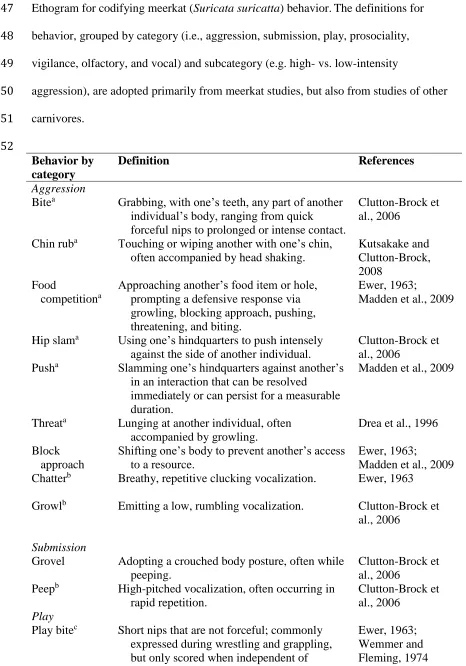
ethogram (Table 1) for use both during burrow and foraging focals. For all social 314
interaction, we included the partners and the directionality of behavior. We paused 315
observation whenever the focal subject was out of view (e.g. if it entered a ‘bolt hole’ 316
following a predator alarm call) and resumed observation once the focal subject was 317
back in sight. We recorded the frequency and, in some cases, duration of behavior, 318
which fell into the following seven categories: (1) aggression, (2) submission, (3) play 319
(Fig. 1), (4) other prosociality, (5) vigilance, (6) olfactory communication and (7) vocal 320
communication (see Table 1). Because occurrences of submission were so rare, we 321
dropped this category from our analyses. Also, owing to a drought-induced shortage of 322
pups at the time of our study, there were no opportunities to observe babysitting or pup 323
provisioning; therefore, the only cooperative behavior included in our study were 324
various forms of vigilance. For details about the vocal analyses, see below. In assessing 325
intra- and inter-observer reliability for the remaining five behavioral categories, we 326
- Insert Table 1 and Fig 1 - 328
329
Vocal recordings and sound analysis
330
331
We assessed any potential treatment effects on vocalizations by examining the rate 332
and acoustic structure of meerkat close calls, which are thought to be important in the 333
maintenance of group cohesion (Manser, 1998). We conducted 5-15 min sound focals 334
on each individual every third day during the treatment period, resulting in 5-7 335
recording sessions per male (12 hours of sound recordings in total). We recorded close 336
calls during the mornings, after groups had left the sleeping burrow and the focal males 337
had started foraging. We recorded individuals from a distance of 0.5-1.0 m with a 338
directional Sennheiser microphone (ME66 with a K6 power module and a MZW66 pro 339
windscreen, Old Lyme, CO, U.S.A) connected to a Marantz Professional PMD661 340
solid-state recorder (16bit, 44.1kHz, Marantz Japan Inc.). 341
We assessed the calls for quality using Cool Edit 2000 (Syntlillium Software 342
Corporation, Phoenix, AZ, USA), selected for analyses 16-68 calls per individual, and 343
carried out quantitative acoustic analyses in Praat v.5.3.84 (www.Praat.org). From each 344
call, we selected four acoustic parameters, including the number of pulses, call duration 345
(s), average pulse duration (s), and mean fundamental frequency (F0, Hz), as these have 346
been shown to be affected by androgen concentrations in other species (Bass and 347
Remage-Healey, 2008; Fusani et al., 1994; Pasch et al., 2011; Rek et al., 2011). We 348
based final analyses on 554 calls for all acoustic parameters, except average pulse 349
duration, which was based on 324 calls because the duration of all pulses in the calls 350
could not always be realiably calculated. 351
Enzyme immunoassays
353
354
To prepare fecal samples for analysis, we lyophilized, pulverized, and sifted fecal 355
samples into a fine powder within six months of collection, and stored the powder in 356
vials at -80 °C until extraction. We extracted steroid metabolites from fecal samples 357
following a protocol described elsewhere (Starling et al., 2010; Wasser et al., 2000). 358
Briefly, we weighed 0.2 g of dry fecal powder and mixed it with 2 mL of 90% 359
methanol. We placed the mixture on a rotating shaker for 30 min and centrifuged it 360
twice, discarding the sediment each time. We stored the methanol-extracts at -80 °C 361
until analysis. 362
We analysed serum and fecal extracts for circulating T and androgen metabolites 363
(hereafter fecal T or fT), respectively, via enzyme immunoassay (EIA). We used an 364
anti-T antibody raised in mice (Fitzgerald Industries International) that cross reacts 365
100% with T, 9% with dihydrotestosterone, < 1% with androstenediol, and < 0.1% with 366
androstenedione, estriol, estradiol, and progesterone. We paired this antibody with a 367
matched T 3-CMO-HRP conjugate (Fitzgerald Industries International). Plate 368
sensitivity was 0.2-12.5 ng/mL. Our EIA protocol is detailed in the ESM (§d). 369
To assess intra-assay reliability we assayed low, medium, and high controls in 10 370
wells on each of two plates. The average coefficient of variation (CV) between the two 371
plates was 9.8% (low control), 7.7% (medium control), and 5.7% (high control). Inter-372
plate reliability was assessed by assaying low, medium, and high controls in duplicate 373
on each of 10 plates. The average interplate CV was 5.5% (low control), 6.4% (medium 374
control), and 6.8% (high control). Serial dilutions of serum and fecal extracts pooled 375
from multiple individuals produced linear displacement curves that were parallel to the 376
concentrations of T prior to analysis. Recovery percentages for serum spikes were 378
90.2% (low control), 108.1% (medium control), 95.4% (high control), and for fecal 379
spikes were 93.6% (low control), 110.5% (medium control), and 104.3% (high control). 380
To assess our extraction efficiency for fecal samples, dried feces from multiple subjects 381
were pooled and spiked with T prior to extraction. Extraction efficiency was 85.4%. 382
383
Physiological validation
384
385
One means of biological validation of fecal hormone metabolites is to show that 386
the metabolites reveal a physiologically relevant difference across groups, detectable 387
from varying circulating hormone concentrations (Brown et al., 2005). We performed a 388
biological validation of fT in wild meerkats and obtained the expected age-related 389
change in fT characteristic of male puberty (Beehner and Whitten, 2004) (see ESM, §e 390
and Fig. S2). Another means of validation, particularly for showing a cause-and-effect 391
relationship, is to administer a drug known to stimulate hormonal production. In this 392
case, our administration of flutamide might also serve as a biological validation of our 393
assay, because in sufficient doses, flutamide is known to impair the negative feedback 394
loop, somewhat paradoxically raising T concentrations (Hellman et al., 1977). 395
Accordingly, flutamide-treated animals might reveal an initial increase in fT relative to 396
control animals. 397
398
Statistical analyses
399
400
We conducted our statistical analyses using R, version 2.15.2 (R Core Team, 401
endocrine data, which derived both from fecal and serum samples, were normally 403
distributed. To determine if serum T concentrations between our experimental 404
conditions (flutamide, placebo, no-pellet) differed prior to treatment, we ran a single 405
ANOVA using the aov function in R. Once we determined that the placebo and no-406
pellet conditions did not differ (see results), we combined these two conditions and ran 407
a single student’s t-test to compare serum concentrations of all control subjects against 408
those of flutamide-treated individuals. 409
We tested the influence of flutamide treatment on fecal T metabolites by 410
implementing a series of generalized linear mixed models (GLMMs) using the 411
glmmADMB package, version 0.7.4 (Skaug et al., 2013) in R, using Gaussian 412
distributions. The log of fT (ng/g) was entered as the response variable in each model. 413
The fixed effects in the full model were treatment (three levels: flutamide, placebo or 414
no-pellet), treatment period (two levels: pre-treatment or treatment), and time of 415
deposition (two levels: AM or PM). We included the individual nested within its social 416
group as a random effect. Following Crawley (2002), we included all probable 417
independent terms and interactions in the full model and excluded terms sequentially 418
until the model contained only statistically significant terms. 419
If fT concentrations did not differ significantly between the placebo and no-pellet 420
treatments, we pooled these two conditions in a single ‘control’ treatment and reran 421
models with only two levels for the treatment factor (flutamide and control). Because 422
treatment period (i.e. pre-treatment or treatment) influenced fT concentration, we 423
subsequently re-ran the model within the two treatment periods. Moreover, as the 424
response to flutamide treatment may have been different across weeks, we ran a model 425
independent terms and interactions in the full model and excluded terms sequentially 427
until the model contained only statistically significant terms (Crawley, 2002). 428
For the behavioral data, we also used the glmmADMB package, version 0.7.4 429
(Skaug et al., 2013) to implement GLMMs with zero-inflation. Each behavioral 430
category was entered as the response variable. The fixed effects in the full model were 431
treatment (three levels: flutamide, placebo or no-pellet), days on treatment (continuous 432
variable), location (two levels: burrow or forage), time of day (two levels: AM or PM), 433
and group size (continuous variable). Individual and group identities were entered as a 434
nested random effect in the models. The duration of each observation was accounted for 435
as an offset in the model. If a behavior did not significantly differ between the placebo 436
and no-pellet conditions, we pooled these two treatments in a single control treatment 437
and reran the model with only two levels for the treatment factor (flutamide and 438
control). As in our endocrine analyses, we included all probable independent terms and 439
interactions in the full model and excluded terms sequentially until the model contained 440
only statistically significant terms. For each model we used the Poisson and negative 441
binomial distributions and selected the model with the lowest AIC value. 442
We analysed call rates and vocal parameters using linear mixed effects models 443
(procedure lmer from package lme4 in R, version 1.1-7), except for number of pulses, 444
which we analysed using general linear mixed effects models with specified poisson 445
distribution (glmer procedure, nlme package version 3.1-118). We calculated call rates 446
for each recording session. We used treatment (three levels: flutamide, placebo or no-447
pellet) as a between-subjects factor and individual identity in all models to account for 448
multiple observations per invidiual. Call rates and average pulse duration were natural-449
log transformed to conform with linearity assumptions. Call rate analyses are based on 450
452
RESULTS 453
454
Baseline androgen patterns
455
456
During the baseline week of fecal endocrine monitoring, prior to treatment 457
administration, subordinate male meerkats that were to receive placebo, no pellet, or 458
flutamide did not differ in their fT concentrations (ANOVA: F2,11 = 0.65, P = 0.53). 459
These pre-treatment placebo and no-pellet conditions did not differ from each other (t -460
test: t10.903 = 0.29, P = 0.78), nor did males in the single collapsed, control group differ 461
in their baseline fT values from males that were assigned to the flutamide condition (t -462
test: t11.161 = 1.10, P = 0.29). Likewise, serum T concentrations from blood samples 463
collected at the time of capture (representing a more immediate pre-treatment baseline) 464
did not vary by the three eventual experimental conditions (ANOVA: F2,11 = 0.62, P = 465
0.55). There were also no differences in circulating T when the males assigned to the 466
two comparable control conditions (t-test: t4.25 = 0.54, P = 0.62) were collapsed and 467
compared against the males assigned to the flutamide condition (t-test: t11.87 = -1.01, P = 468
0.33). Thus, there were no baseline differences in the androgen profiles of our subjects. 469
470
Effect of flutamide on fecal androgens
471
472
During treatment, no-pellet and placebo males also did not differ in their fT 473
concentrations, either across all weeks of treatment (z value = -0.52, P = 0.60) or when 474
considering the first (z value = -1.14, P = 0.25) and second (z value = -0.4, P = 0.69) 475
compare these two conditions in the last week. Given the lack of differences, we 477
collapsed the two control categories in subsequent analyses. 478
Despite the absence of an overall difference in fT concentrations between 479
flutamide and control males across the entire 3-week treatment period (z value = 1.12, P
480
= 0.26), there was a clear time course in the effect of antiandrogen treatment on fT (Fig. 481
2). Notably, in the first week of treatment, flutamide-treated males showed the expected 482
effect of this form of antiandrogen treatment and had significantly greater fT 483
concentrations than did control males (z value = 3.71, P < 0.001; Fig. 2). Thereafter, 484
this difference disappeared: Flutamide and control males no longer differed in fT in 485
either the second (z value = -0.8, P = 0.42) or third (z value = 0.39, P = 0.70) weeks of 486
treatment. 487
- Insert Fig 2 - 488
489
Behavioral equivalence between placebo and no-pellet conditions
490
491
Consistent with their equivalent androgen values (and intact androgen function), 492
males in the no-pellet and placebo conditions did not differ in any of their behavioral 493
patterns. This equivalence was true for week 1 only (see ESM, §f and Table S2), 494
confirming that, after a 48-hour recovery period, the minor surgery for pellet implants 495
had no effects on behavior. Moreover, the same pattern of behavioral equivalence 496
maintained across all weeks of the study, as evidenced, for instance, by initiating (z 497
value = -0.02, P = 0.98) and receiving (z value = -1.62, P = 0.11) high-intensity 498
aggression (HIA; see Table 1) or initiating (z value = -1.64, P = 0.10) and receiving (z 499
collapsed the two control categories in subsequent behavioral comparisons against 501
flutamide-treated males. 502
503
Effects of flutamide on behavior and vocal parameters
504
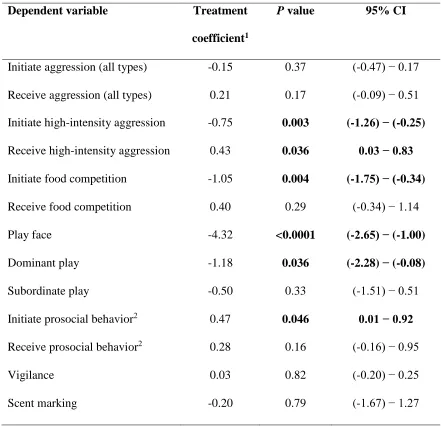
505
As expected, compared to all control males, flutamide-treated males initiated 506
significantly less (z value = -2.93, P = 0.003; Fig. 3a) and received significantly more (z 507
value = 2.10, P = 0.036; Fig. 3a) HIA (Table 2). The most frequent aggressive behavior 508
within the HIA category was food competition, which we examined independently. 509
Compared to all control males, flutamide-treated males initiated significantly fewer 510
foraging competitions (z value = -2.91, P = 0.004). The rates of receiving foraging 511
competition, however, were not affected by treatment (z value = 1.07, P = 0.29). 512
Flutamide treatment also altered certain aspects of social play. Compared to all 513
control males, flutamide-treated subjects were significantly less likely to initiate play 514
using the play-face invitation (z value = -4.32, P < 0.0001; Fig. 1a and Table 2). As 515
anticipated, flutamide treatment also decreased the expression of ‘dominant’ types of 516
play, such as pinning during wrestling (Fig. 1b). Whereas control and flutamide males 517
were equally likely to play in a ‘subordinate’ (e.g. pinned) position (z value = -0.97, P = 518
0.33), flutamide-treated males played significantly less in the dominant position than 519
did control males (z value = -2.09, P = 0.036; Fig. 3b). 520
Compared to all control males, flutamide-treated males also initiated significantly 521
more prosocial behavior at the burrow after foraging (z value = 1.99, P = 0.046; Table 2 522
and Fig. 3c). We could detect no effect of receiving other prosocial interaction relative 523
to an individual’s treatment (z value = 1.4, P = 0.16). Interestingly, when considering 524
prosocial interactions, the vast majority (82.3%) occurred with non-focal group 526
members (see ESM, §f and Table S3). The minimal involvement of the dominant male 527
and other flutamide-treated subjects suggests, respectively, that the effects of treatment 528
were unlikely to have been biased by the dominant, male breeder in each group or 529
confounded by having flutamide-treated animals as both the actor and recipient in given 530
interactions. 531
Unlike the patterns we observed for direct social interaction, flutamide males did 532
not differ from control males in their more solitary expression of vigilance (z value = 533
0.23, P = 0.82) or scent-marking (z value = -0.27, P = 0.79) behavior (Table 2, although 534
see Fig. S1b). Also contrary to expectations, call rate was not affected by treatment 535
(LMM: all t < 0.19, all P ≥ 0.8). Instead, individual identity explained a large proportion 536
of the variation in all models, revealing high individual variability in all of the measured 537
acoustic parameters of close calls (see ESM, §g and Table S4). 538
- Insert Fig 3 and Table 2 - 539
540
Time course of behavioral treatment effects
541
542
The number of days that subjects spent on treatment explained little to none of 543
the overall variance in our GLMM models. Owing to limited sample sizes, non-normal 544
distribution, and zero-inflation, we lacked the statistical power to further test for time-545
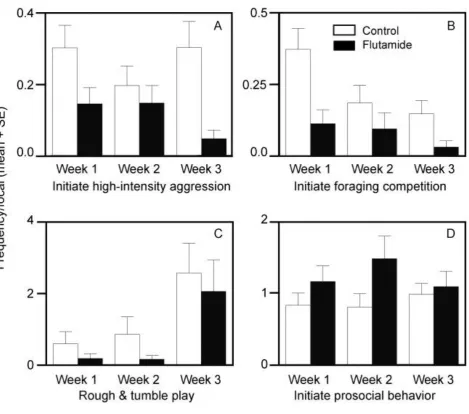
course effects in our data. Nevertheless, for comparison with the endocrine effects (Fig. 546
2), similar graphical representation of various types of behavior across weeks of 547
treatment shows consistency in the relationship between flutamide-treated and control 548
animals and, if anything, that treatment effects became stronger (rather than weaker) 549
551
- Insert Fig 4 - 552
553
DISCUSSION 554
555
In this first-ever, experimental manipulation of androgen action in wild meerkats, 556
we found that androgens were involved in regulating a range of social behavior among 557
subordinate, male helpers. Specifically, based on the effects of the antiandrogen, 558
flutamide, we deduce that androgens facilitate various forms of aggressive and 559
dominance interaction, influence aspects of social play, and dampen prosociality or 560
affiliative behavior. By contrast, androgens have potentially no effect on cooperative 561
antipredator behavior, scent marking or various parameters of close-call vocalizations. 562
Given that T concentrations do not differ between the social classes of adult male 563
meerkats (Carlson et al., 2004), androgens may not fully explain the social stratification 564
and behavioral roles of breeders and helpers; nevertheless, based on present results, 565
circulating androgens clearly play an important part in the daily, social lives of 566
subordinate males, perhaps maintaining their reproductive potential and roaming 567
proclivities to overcome the limited, unpredictable, and fleeting nature of their breeding 568
opportunities. 569
We found no inherent bias in circulating or fecal androgen concentrations between 570
our control and treated subjects, but we observed a significant, short-term (i.e., week-571
long) rise in fT concentrations as a result of blocking a subordinate male’s androgen 572
receptors with flutamide. This seemingly paradoxical result is consistent with effects of 573
flutamide treatment observed in other studies (e.g. Stone and Clejan, 1991) and likely 574
androgen production (Södersten et al., 1975). Beyond indicating that our early flutamide 576
treatment was successful and that we had achieved an effective dosage, this result 577
represents a second physiological validation of our assay of fecal androgen metabolites 578
(the first being detection of pubertal endocrine changes). Nevertheless, there is great 579
variation across studies in the impact of flutamide on circulating androgen 580
concentrations: In some cases, significant behavioral impacts of flutamide treatment 581
occur without any increase in T (Searcy and Wingfield, 1980) or occur even with a 582
decrease in T (Hegner and Wingfield, 1987); in other cases, increases in T remain in 583
effect long-term and until cessation of treatment (Stone and Clejan, 1991) or, as in our 584
study, over only a short time span (e.g. from day 5 to 7 of a week-long treatment, 585
despite daily injections: Södersten et al., 1975; see also Fusani, 2008). This range of 586
physiological responses to flutamide treatment across studies could owe to the varying 587
dosages achieved, the mode of administration used, the social context or the species 588
tested. 589
The possibility exists that the decrease in fT we observed after week 1 might have 590
indicated that, rather than lasting the full 21-day period, the pellets were exhasted after 591
only one week. This interpretation is contradicted by the persistent behavioral effects of 592
treatment across weeks, suggesting instead that androgen-receptor blockade remained in 593
effect, but that feedback mechanisms may have stabilized, effectively ‘resetting 594
homeostasis’, or that initial receptor blockade had lasting behavioral consequences, 595
perhaps via altered receptor sensitivity (Fusani, 2008). Although we cannot distinguish 596
between these alternative mechanistic explanations, it is clear that behavioral effects of 597
antiandrogen treatment persisted minimally throughout the three-week study period. 598
These behavioral effects of flutamide administration, as expected, were manifest 599
aggression than controls. The reduced initiation of aggression by treated males provides 601
strong evidence for a direct effect of androgens on agonism. That treated males also 602
received more aggression from conspecifics implicates additional indirect effects of 603
androgens on behavior. Perhaps group members perceived a difference or ‘weakness’ in 604
flutamide-treated males, which may have prompted an increase in the frequency with 605
which treated subordinates were targeted. Alternately, the stability of social relations 606
among subordinate males may be partially maintained by balanced interactions, such 607
that a mismatch in the aggressive performance between flutamide-treated males and 608
controls may have led to an escalation in the aggression against treated animals. 609
We also found that androgen-receptor blockade mediated certain aspects of social 610
play in adult meerkats. Notably, flutamide-treated males initiated less play and were 611
less dominant in their expression of social play than were control males. Thus, in the 612
absence of androgenic influence, male meerkats were less bold, assertive, or 613
competitive in their play. Although the directionality in these patterns is not unexpected, 614
these findings provide rare evidence of activational effects of androgens on adult social 615
play. Across mammalian taxa, prenatal, neonatal or prepubertal androgens have been 616
shown to influence rough-and-tumble play, specifically, during infancy or juvenility 617
(Meaney et al., 1985; Panksepp, 1981; Pedersen et al., 1990; Pellegrini, 1995). Those 618
studies established that organizational, rather than activiational, T is important for 619
modulating social play (Meaney et al., 1985) – a generalization that is called into 620
question by our present findings. 621
Flutamide administration also affected other prosocial interaction, although in the 622
opposite, enhancing direction. Flutamide-treated males were more likely to initiate 623
affiliative behavior, such as grooming, huddling, and social sniffing. Combined with the 624
these results are consistent with the hypothesis that there is an androgen-mediated trade-626
off between aggression and affiliation (Albers et al., 2002; Hegner and Wingfield, 1987; 627
Ketterson and Nolan, 1994). Nonetheless, it must be noted that in some monogamous or 628
cooperatively breeding mammals, T (either directly or following conversion to 629
estrogen) can promote, rather than inhibit, paternal or affiliative care (Storey et al., 630
2006; Trainor and Marler, 2001, 2002). We might therefore have expected androgen-631
receptor blockade to influence various facets of meerkat cooperation, but based on 632
vigilance behavior only, we found no such evidence. These results are in accord with a 633
previous study that found no relation between another form of cooperation – pup 634
provisioning – and T in subordinate males (Carlson et al., 2006a). As indicated by the 635
relation between prolactin and babysitting (Carlson et al., 2006b), other neuroendocrine 636
circuits may be involved in promoting pup care. 637
Conservatively, we might interpret that androgen function does not play a pivotal 638
role in regulating cooperative behavior in adult meerkats; however, it is important to 639
note that we lack information about any role androgens may play in prenatally priming 640
meerkats for their adult behavioral repertoire. In humans, for instance, there is evidence 641
to suggest that T’s action in promoting prosociality or cooperation may stem from 642
prenatal androgen exposure. Specifically, experimentally increasing circulating T in 643
humans leads to an increase in cooperative behavior, but only in those individuals who 644
had low prenatal exposure to androgens (van Honk et al., 2012). 645
Antiandrogen treatment also did not appear to influence scent-marking behavior, 646
including anal marking, body rubbing, chewing, and chinning vegetation. Nonetheless, 647
although expressed evenly among the treatment groups, scent marking occurred in only 648
22 focal observations (4.2%). It may be that these null results reflect a floor effect of 649
involvement in olfactory behavior or odorant quality. Although Jordan (2007) reports 651
no rank-related difference in male marking patterns at latrines, we suspect that the 652
marking behavior of male meerkats may be strongly rank related in other contexts (see 653
Leclaire et al., 2014). 654
Although androgens have been shown to affect vocalizations in various species, 655
including humans (e.g. Gyger et al., 1988, Charlton et al., 2011; Baker, 1999, Damrose, 656
2009), we did not detect any significant effects of flutamide treatment on meerkat close 657
calls. These null results, albeit consistent with the findings of some antiandrogen studies 658
in avian species (Grisham et al., 2007; Schwabl and Kriner, 1991), may owe, in part, to 659
the significant individual variability we observed: This variability confirms previous 660
findings of individual-specific close calls in meerkats (Townsend et al., 2010), but it 661
may have overridden any potential treatment effects. Alternately, it may be that close 662
calls produced during foraging are particularly insensitive to the actions of androgens. 663
Indeed, previous findings of significant androgenic or antiandrogenic effects on 664
vocalizations have involved calls produced in the contexts of reproductive 665
advertisement and antipredator behavior (Ball et al., 2003, Behrends et al., 2010, 666
Charlton et al., 2011, Gyger et al., 1988). In the future, it may be worth exploring if 667
meerkat vocalizations produced in more directed social interaction relate to circulating 668
androgen concentrations. 669
In summary, we found that androgen receptor blockade had important effects in 670
wild, subordinate male meerkats beyond modulating aggression: antiandrogens affected 671
a broad range of social interaction, from competitive to affiliative behavior. Continued 672
studies of equally ranked individuals are thus likely to reveal new insights into the 673
hormonal regulation of behavioral interaction. Whereas androgens are increasingly 674
considerably less attention, particularly in males. Because androgens can be readily 676
converted to estrogens, depending on local enzyme activity, addressing the role of 677
estrogens in monogamous and cooperatively breeding species will be an important next 678
step. In future studies, researchers should also examine the role of prenatal androgens in 679
establishing receptor distribution that might help explain how differential activational 680
responses may arise from animals showing roughly equivalent endocrine profiles. That 681
influencing the action of activational androgens could have such wide-ranging effects 682
within members of the same social class leads us to expect even more dramatic 683
influences of organizational androgens. It is noteworthy that all of the effects we 684
observed became evident in a relatively short time span. With longer-term endocrine 685
manipulation, even greater effects may be revealed. In sum, experimental endocrine 686
manipulation in the field, albeit challenging, is key to revealing the mechanisms 687
ACKNOWLEDGMENTS 689
690
We are grateful to the Kalahari Research Trust and to the Northern Cape 691
Conservation Authority for permission to conduct the research and to the Kotze family 692
and other farmers neighboring the Kuruman River Reserve for graciously allowing us to 693
work on their land. We thank J. Fenton, M. Jooste, J. Samson, and N. Thavarajah for 694
their help facilitating our field work. We thank L. Garside, L. Howell, M. Jerig, S. 695
Leclaire, J. Mitchell for their help with data collection and the Kalahari Meerkat Project 696
(KMP) volunteers for their help with fecal sample collection. We thank J. Petty for his 697
help with the endocrine assays and H. Batchelet for her help with acoustic analyses. We 698
are grateful to Duke University for supporting vehicle costs in the field. This research 699
was supported by National Science Foundation (IOS-1021633 to C.M.D.), with 700
contributions from the Swiss National Science Foundation (31003A_13676 to M.B.M). 701
T.C.B. was supported by a Natural Environment Research Council grant (RG 57058). 702
Cambridge, Duke, and Zurich Universities supported the KMP during the span of this 703
study. 704
REFERENCES 706
707
Albers, H.E., Huhman, K.L., Meisel, R.L., 2002. Hormonal basis of social conflict and 708
communication. In: Pfaff, D.W., Arnold, A.P., Etgen, A.M., Fahrbach, S.E., 709
Rubin, R.T. (Eds.), Hormones, Brain and Behavior. Academic Press, London, pp. 710
393-433. 711
Altmann, J., 1974. Observational study of behavior: sampling methods. Behaviour. 49, 712
227-267. 713
Arnold, K.E., Owens, I.P.F., 1998. Cooperative breeding in birds: a comparative test of 714
the life history hypothesis. Proc. R. Soc. Lond. B 265, 739-745. 715
Arnold, W., Dittami, J., 1997. Reproductive suppression in male alpine marmots. Anim. 716
Behav. 53, 53-66. 717
Baker, J., 1999. A report on alterations to the speaking and singing voices of four 718
women following hormonal therapy with virilizing agents. J. Voice 13, 496-507. 719
Bales, K.L., French, J.A., McWilliams, J., Lake, R.A., Dietz, J.M., 2006. Effects of 720
social status, age, and season on androgen and cortisol levels in wild male golden 721
lion tamarins (Leontopithecus rosalia). Horm. Behav. 49, 88-95. 722
Ball, G.F., Castelino, C.B., Maney, D.L., Appeltants, D., Balthazart, J., 2003. The 723
activation of birdsong by testosterone. Ann. N. Y. Acad. Sci. 1007, 211-231. 724
Barelli, C., Mundry, R., Heistermann, M., Hammerschmidt, K., 2013. Cues to 725
androgens and quality in male gibbon songs. PLoS ONE 8, e82748. 726
Bass, A.H., Remage-Healey, L., 2008. Central pattern generators for social 727
vocalization: Androgen-dependent neurophysiological mechanisms. Horm. Behav. 728
Bates, B.C., 1970. Territorial behavior in primates: a review of recent field studies. 730
Primates 11, 271-284. 731
Beatty, W.W., Dodge, A.M., Traylor, K.L., Meaney, M.J., 1981. Temporal boundary of 732
the sensitive period for hormonal organization of social play in juvenile rats. 733
Physiol. Behav. 26, 241-243. 734
Beehner, J.C., Whitten, P.L., 2004. Modifications of a field method for fecal steroid 735
analysis in baboons. Physiol. Behav. 82, 269-277. 736
Behrends, T., Urbatzka, R., Krackow, S., Elepfandt, A., Kloas, W., 2010. Mate calling 737
behavior of male South African clawed frogs (Xenopus laevis) is suppressed by 738
the antiandrogenic endocrine disrupting compound flutamide. Gen. Comp. 739
Endocrinol. 168, 269-274. 740
Bennett, N.C., Jarvis, J.U.M., Faulkes, C.G., Millar, R.P., 1993. LH responses to single 741
doses of exogenous GnRH by freshly captured Damaraland mole-rats, Cryptomys
742
damarensis. J. Reprod. Fertil. 99, 81-86.
743
Boksem, M.A., Mehta, P.H., Van den Bergh, B., van Son, V., Trautmann, S.T., Roelofs, 744
K., Smidts, A., Sanfey, A.G., 2013. Testosterone inhibits trust but promotes 745
reciprocity. Psychol. Sci. 24, 2306-2314. 746
Boulton, M.J., 1996. A comparison of 8- and 11-year-old girls' and boys' participation 747
in specific types of rough-and-tumble play and aggressive fighting: Implications 748
for functional hypotheses. Aggress. Behav. 22, 271-287. 749
Brown, J., Walker, S., Steinman, K., 2005. Endocrine Manual for Reproductive 750
Assessment of Domestic and Non-Domestic Species. Conservation & Research 751
Center, Smithsonian's National Zoological Park, Front Royal, Virginia. 752
Brown, R.E., Macdonald, D.W., 1985. Social Odours in Mammals. Oxford University 753
Carlson, A.A., Manser, M.B., Young, A.J., Russell, A.F., Jordan, N.R., McNeilly, A.S., 755
Clutton-Brock, T., 2006a. Cortisol levels are positively associated with pup-756
feeding rates in male meerkats. Proc. R. Soc. Lond. B 273, 571-577. 757
Carlson, A.A., Russell, A.F., Young, A.J., Jordan, N.R., McNeilly, A.S., Parlow, A.F., 758
Clutton-Brock, T. 2006b. Elevated prolactin levels immediately precede decisions 759
to babysit by male meerkat helpers. Horm. Behav. 50, 94-100. 760
Carlson, A.A., Young, A.J., Russell, A.F., Bennett, N.C., McNeilly, A.S., Clutton-761
Brock, T., 2004. Hormonal correlates of dominance in meerkats (Suricata
762
suricatta). Horm. Behav. 46, 141-150.
763
Charlton, B.D., Keating, J.L., Kersey, D., Rengui, L., Huang, Y., Swaisgood, R.R., 764
2011. Vocal cues to male androgen levels in giant pandas. Biol. Lett. 7, 71-74. 765
Clutton-Brock, T.H., Brotherton, P.N.M., O'Riain, M.J., Griffin, A.S., Gaynor, D., 766
Kansky, R., Sharpe, L., McIlrath, G.M., 2001. Contributions to cooperative 767
rearing in meerkats. Anim. Behav. 61, 705-710. 768
Clutton-Brock, T.H., Brotherton, P.N.M., Smith, R., McIlrath, G.M., Kansky, R., 769
Gaynor, D., O´Riain, M.J., Skinner, J.D., 1998. Infanticide and expulsion of 770
females in a cooperative mammal. Proc. R. Soc. Lond. B 265, 2291-2295. 771
Clutton-Brock, T.H., Hodge, S.J., Flower, T.P., 2008. Group size and the suppression of 772
subordinate reproduction in Kalahari meerkats. Anim. Behav. 76, 689-700. 773
Clutton-Brock, T.H., Hodge, S.J., Spong, G., Russell, A.F., Jordan, N.R., Bennett, N.C., 774
Sharpe, L.L., Manser, M.B., 2006. Intrasexual competition and sexual selection 775
in cooperative mammals. Nature 444, 1065-1068. 776
Clutton-Brock, T.H., O'Riain, M.J., Brotherton, P.N.M., Gaynor, D., Kansky, R., 777
Griffin, A.S., Manser, M., 1999. Selfish sentinels in cooperative mammals. 778
Crawley, M.J., 2002. Statistical Computing: an Introduction to Data Analysis Using S-780
Plus. Wiley, Chichester, UK. 781
Creel, S., Creel, N., Wildt, D.E., Monfort, S.L., 1992. Behavioural and endocrine 782
mechanisms of reproductive suppression in Serengeti dwarf mongooses. Anim. 783
Behav. 43, 231-245. 784
Cynx, J., Bean, N.J., Rossman, I., 2005. Testosterone implants alter the frequency range 785
of zebra finch songs. Horm. Behav. 47, 446-451. 786
Damrose, E.J., 2009. Quantifying the impact of androgen therapy on the female larynx. 787
Auris Nasus Larynx 36, 110-112. 788
Desjardins, J.K., Stiver, K.A., Fitzpatrick, J.L., Milligan, N., Van Der Kraak, G.J., 789
Balshine, S., 2008. Sex and status in a cooperative breeding fish: behavior and 790
androgens. Behav. Ecol. Sociobiol. 62, 785-794. 791
Drea, C.M., 2015. D’Scent of man: A comparative survey of primate chemosignals in 792
relation to sex. Horm. Behav. 68, 117-133. 793
Drea, C.M., Hawk, J.E., Glickman, S.E., 1996. Aggression decreases as play emerges in 794
infant spotted hyaenas: preparation for joining the clan. Anim. Behav. 51, 1323-795
1336. 796
Drea, C.M., Vignieri, S.N., Cunningham, S.B., & Glickman, S.E. 2002. Responses to 797
olfactory stimuli in spotted hyenas (Crocuta crocuta): I. Investigation of 798
environmental odors and the function of rolling. J. Comp. Psychol. 116, 331-799
341. 800
Dryden, G.L., Conaway, C.H., 1967. The origin and hormonal control of scent 801
production in Suncus murinus. J. Mammal. 48, 420-428. 802
Eisenberg, J.F., Kleiman, D.G., 1972. Olfactory communication in mammals. Annu. 803
Eisenegger, C., Haushofer, J., Fehr, E., 2011. The role of testosterone in social 805
interaction. Trends Cogn. Sci. 15, 263-271. 806
Epple, G., 1981. Effects of prepubertal castration on the development of the scent 807
glands, scent marking, and aggression in the saddle back tamarin (Saguinus
808
fuscicollis, Callitrichidae, Primates). Horm. Behav. 15, 54-67.
809
Evans, S., Neave, N., Wakelin, D., Hamilton, C., 2008. The relationship between 810
testosterone and vocal frequencies in human males. Physiol. Behav. 93, 783-788. 811
Ewer, R.F., 1963. The behaviour of the meerkat, Suricata suricatta (Schreber). Z. 812
Tierpsychol. 20, 570-607. 813
Fusani, L., 2008. Endocrinology in field studies: problems and solutions for the 814
experimental design. Gen. Comp. Endocrinol. 157, 249-253. 815
Fusani, L., Beani, L., Dessì-Fulgheri, F., 1994. Testosterone affects the acoustic 816
structure of the male call in the grey partridge (Perdix perdix). Behaviour 128, 817
301-310. 818
Fusani, L., Canoine, V., Goymann, W., Wikelski, M., Hau, M., 2005. Difficulties and 819
special issues associated with field research in behavioral neuroendocrinology. 820
Horm. Behav. 48, 484-491. 821
Fuxjager, M.J., Knaebe, B., Marler, C.A., 2015. A single testosterone pulse rapidly 822
reduces urinary marking behaviour in subordinate, but not dominant, white-footed 823
mice. Anim. Behav. 100, 8-14. 824
Gleason, E.D., Marler, C.A., 2010. Testosterone response to courtship predicts future 825
paternal behavior in the California mouse, Peromyscus californicus. Horm. Behav. 826
Goy, R.W., 1970. Early hormonal influences on the development of sexual and sex-828
related behavior. In: Schmitt, F.O. (Ed.), The Neurosciences: Second Study 829
Program. Rockefeller University Press, New York, pp. 196-207. 830
Goy, R.W., Phoenix, C.H., 1971. The effects of testosterone propionate administered 831
before birth on the development of behavior in genetic female rhesus monkeys. In: 832
Sawyer, C.H., Gorski, R.A. (Eds.), Steroid Hormones and Brain Function. 833
University of California Press, Los Angeles, pp. 193-201. 834
Griffin, A.S., Pemberton, J.M., Brotherton, P.N.M., McIlrath, G., Gaynor, D., Kansky, 835
R., O'Riain, J., Clutton-Brock, T.H., 2003. A genetic analysis of breeding success 836
in the cooperative meerkat (Suricata suricatta). Behav. Ecol. 14, 472-480. 837
Grisham, W., Park, S.H., Hsia, J.K., Kim, C., Leung, M.C., Kim, L., Arnold, A.P., 838
2007. Effects of long-term flutamide treatment during development in zebra 839
finches. Neuroscience Lett. 418, 92-96. 840
Gyger, M., Karakashian, S.J., Dufty Jr, A.M., Marler, P., 1988. Alarm signals in birds: 841
The role of testosterone. Horm. Behav. 22, 305-314. 842
Hall, M.L., 2009. A review of vocal duetting in birds. Adv. Stud. Behav. 40, 67-121. 843
Hediger, H., 1949. Säugetier-Territorien und ihre Markierung. Bijdragen tot de 844
dierkunde 28, 172-184. 845
Hegner, R.E., Wingfield, J.C., 1987. Effects of experimental manipulation of 846
testosterone levels on parental investment and breeding success in male house 847
sparrows. Auk 104, 462-469. 848
Hellman, L., Bradlow, H.L., Freed, S., Levin, J., Rosenfeld, R.S., Whitmore, W.F., 849
Zumoff, B., 1977. The effect of flutamide on testosterone metabolism and the 850
plasma levels of androgens and gonadotropins. J. Clin. Endocrinol. Metab. 45, 851
Holman, S.D., Seale, W.T.C., Hutchison, J.B., 1995. Ultrasonic vocalizations in 853
immature gerbils: emission rate and structural changes after neonatal exposure to 854
androgen. Physiol. Behav. 57, 451-460. 855
Huoviala, P., Rantala, M.J., 2013. A putative human pheromone, androstadienone, 856
increases cooperation between men. PLoS ONE 8, e62499. 857
Johnson, R.P., 1973. Scent marking in mammals. Anim. Behav. 21, 521-535. 858
Johnston, R.E., 1981. Testosterone dependence of scent marking by male hamsters 859
(Mesocricetus auratus). Behav. Neural Biol. 31, 96-99.
860
Jordan, N.R., 2007. Scent-marking investment is determined by sex and breeding status 861
in meerkats. Anim. Behav. 74, 531-540. 862
Joslyn, W.D., 1973. Androgen-induced social dominance in infant female rhesus 863
monkeys. J. Child Psychol. Psyc. 14, 137-145. 864
Ketterson, E.D., Nolan, V., Jr., 1994. Male parental behavior in birds. Annu. Rev. Ecol. 865
Syst. 25, 601-628. 866
Ketterson, E.D., Nolan, V., Jr., Wolf, L., Ziegenfus, C., 1992. Testosterone and avian 867
life histories: effects of experimentally elevated testosterone on behavior and 868
correlates of fitness in the dark-eyed junco (Junco hyemalis). Am. Nat. 140, 980-869
999. 870
Khan, M.Z., McNabb, F.M.A., Walters, J.R., Sharp, P.J., 2001. Patterns of testosterone 871
and prolactin concentrations and reproductive behavior of helpers and breeders in 872
the cooperatively breeding red-cockaded woodpecker (Picoides borealis). Horm. 873
Behav. 40, 1-13. 874
Kutsukake, N., Clutton-Brock, T.H., 2008. The number of subordinates moderates 875
intrasexual competition among males in cooperatively breeding meerkats. Proc. 876
Leclaire, S., Nielsen, J.F., Drea, C.M., 2014. Bacterial communities in meerkat anal 878
scent secretions vary with host sex, age, and group membership. Behav. Ecol. 25, 879
996-1004. 880
Lukas, D., Clutton-Brock, T., 2012. Cooperative breeding and monogamy in 881
mammalian societies. Proc. R. Soc. Lond. B 279, 2151-2156. 882
Madden, J.R., Drewe, J.A., Pearce, G.P., Clutton-Brock, T.H., 2009. The social network 883
structure of a wild meerkat population: