United Kingdom Vol. IV, Issue 7, July 2016
Licensed under Creative Common Page 33
http://ijecm.co.uk/
ISSN 2348 0386
“DETERMINANTS OF ECONOMIC KNOWLEDGE CREATION”
NEW RESEARCH CHALLENGES IN ECONOMIC
SCIENCES AND BUSINESS
Sławomir Czarniewski
University of Management in Bialystok, Poland [email protected]
Abstract
Scientific knowledge often refers to logic methods and rules that create a scientific base from
accumulated knowledge. Such knowledge is objective, constructed according to a scientific
scheme. The empirical base in economics are facts about reality, resulting from experience and
experiment. The construction of knowledge about economic problems can be based on
indicators, on the results of surveys, on econometric models and the expertise of scientific
institutes. Nowadays, the boundary between knowledge and ignorance has become very fluid.
Defining the characteristics of knowledge, its degree of credibility, and how to use it, have
become quite problematic issues. The aim of this study is to determine the main sources of
knowledge in the context of economic sciences. The author of this paper has also made an
attempt to present the essential features (parameters) of scientific knowledge. Reflections
contained in the paper do not have definite characteristics and should be treated as an opinion
in the discussion in fields management sciences.
Keywords: Economics, knowledge, information, management, market trends
INTRODUCTION
Licensed under Creative Common Page 34 exploit information, to put it into a certain time or spatial frame, to connect it with other information or circumstances. By subjective and intentional placement of relevant data, information gains its application and value.
Whether information becomes useful and reliable knowledge depends on the user and his experience. Through life, social, professional and cultural experience, the human being looks at the world in a certain way and, through the same prism, analyzes acquired data looking for relationships and connections with other facts. Consequently, knowledge constitutes a resource that was created by information utilized in a specific context and with given experience (Olander Roese & Olsson, 2012).
It should also be mentioned that this resource does not possess a defined volume and is characterized by a certain dynamism. New information replace sold; some – in the face of new
facts or arguments – should be rejected as false. Therefore, it is an in definite, in exhaustible and constantly changing resource.
The business environment is determined by personality characteristics and motives of individual entrepreneurs. Business situations are often unique in their unpredictability, complexity and changing requirements during the business process. Entrepreneurs must be capable to have the features of several personalities at once and as one person to demonstrate the ability to act as investors, inventors, accountants, dispute investigators, leaders, technologists, marketing specialists and top sellers. For this reason, the more knowledge and skills the entrepreneur is capable to demonstrate the better. (Frese, Gielnik, 2014).
RESEARCH APPROACH
The author has attempted to present several important issues of economic nature in the context of this study, including:
• the main parameters (features) of scientific knowledge, • determinants of economic knowledge creation,
• the role of knowledge in business and economics, • new research challenges in economic sciences.
The research methods used will include constructive criticism, a literature review, research synthesis and qualitative analysis. This will enable answering on signed above of research questions, problems or matters.
Licensed under Creative Common Page 35 to search for specific answers. They are to become an inspiration for further exploration to expand the boundaries of our knowledge and research skills in the field of economic sciences.
THE MAIN PARAMETERS OF SCIENTIFIC KNOWLEDGE
Scientific knowledge starts from an idea that is checked in terms of logical sequence, leading to a hypothesis that should be negated – to indicate an error. Scientific knowledge should therefore be subject to continuous criticism and testing.
The medium of knowledge, the way of its transfer, or the attitude of its user, define the scope of knowledge. The increased interest in gaining knowledge has caused people to treat it as capital or good (Anderson, Dodd & Jack, 2012). It is a medium of exchange and has a specified price and value. It can be effectively acquired and used. Knowledge may be regarded not only as a product but also as capital. Is constantly changes, increases and is mobile. It helps in achieving a profit, improves human activity, and increases social and human capital (Eppinger & Vladova, 2013).
There is knowledge that is independent from experience and observation that arises as a result of rational discovery. It uses the methods of logic and rules in order to create perfect and objective knowledge (Blichfeldt & Andersen, 2006). It is determined as an a priori or theoretical knowledge. This type of knowledge constitutes the foundation of scientific knowledge, based mainly on facts.
Science was formed from empirical and theoretical knowledge; it means the whole of knowledge achieved by using scientific methodology (Frankfort-Nachmias & Nachmias 2001, pp. 18-20). Science is based on knowledge and also constitutes its source. It allows for the specification of an area of ignorance and clearly defines the boundary between what science is and what isn‟t.
However, the division of science into theoretical and empirical is contractual. It is not possible to describe an experience without reference to theory. Each observation is based on concepts and regularities that have been introduced within specific theoretical knowledge. In turn, theory develops through empirical knowledge that provides research material and constitutes the stimuli to create the scientific base (Gustavsen, 2003).
Licensed under Creative Common Page 36 L. Wittgenstein, however, drew attention to the fact that the surrounding world is described by language, so language determines the quality and quantity of knowledge about reality, states, phenomena, changes or correctness (Wittgenstein, 2011, pp. 64-65). By using specific sentences and phrases, people can describe facts and specify the logical value. They concern the simplest forms, states of affairs, names. People build knowledge about the world and scientific knowledge using language and creating basic sentences that are expanded and enriched through time.
DETERMINANTS FOR THE CREATION OF ECONOMIC KNOWLEDGE
The process of creating economic knowledge usually begins with an observation that provides knowledge about changes taking place in reality. It is described precisely by using appropriate language. The description includes assumptions and circumstances of a given phenomenon. Each observation is repeated many times. As a result of this process, it is possible to produce a generalization of research results.
It should be noted that a theory or a system of theories are logically or empirically tested. In the first case, the logical correctness of a conducted application process is checked (Costa, Fernández-Jardón & Figueroa Dorrego, 2014). In the latter, empirical implications are examined. During examination, a given theory is rejected if it is not logically correct or is not verifiable. In this case a new theory – of larger scientific value – should replace the rejected one.
This new theory may also be strengthen by new hypotheses. However, if the theory is logically correct and withstands the verification process, it may be acceptable at any time as valid for the tested method and scientific knowledge.
Economic theories should be used in empiricism. Practice is the best indicator for the truth of a theory. If the theory is correct, the practical operation of this theory will be based on effective action, through which we will be able to achieve the intended aims. If the theory is false, the practical effect based on such a theory will fail and will be ineffective sooner or later (Bloom, Lemos, Sadun, Scur & Van Reenen, 2014). A close relationship between theory and practice is therefore in the interest of both theory and practice as separate disciplines.
Licensed under Creative Common Page 37 Economic sciences detect existing dependencies - laws in the economy. Economic laws are based on the results of empirical and theoretical research. They are presented in descriptive form or by using models that show the basic dependencies and relationships in the economy in a simple and theoretical way. They constitute a theoretical generalization of economic reality but, focusing only on the tested fragment, the rest are treated as unchangeable. The models maybe descriptive or mathematical. They differ from the language and form of presentation of studied phenomena. On account of these models, it is possible to determine causal relationships, general tendencies, typical choices or behaviors that are at the center of interest of macroeconomic theory (Lucas, 1998, pp. 20-22).
It should be noted, that after some time, even the most elaborated theory may require adjustment or replacement by another. Science does not give us any confidence in the limits of our cognitive abilities and the level of absolute knowledge. The system of education is only a stage on an infinitely long path of cognition. It does not mean that today's economic sciences are backward; it means that they are alive and dynamic, whereas life is full of imperfection and change.
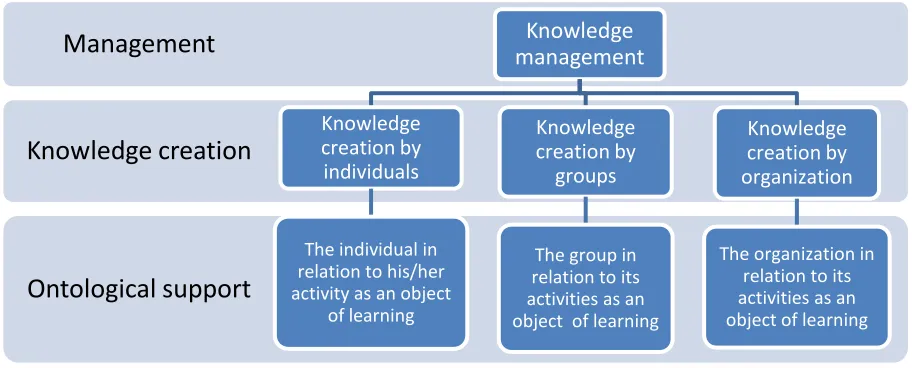
Figure 1. Model for knowledge creation
Source: Compiled by author
Figure 1 shows theoretical model for knowledge creation. The creation of knowledge by individuals (intuiting, tacit knowledge) often has, as ontological support, the individual that learns and physical, technical and social objects that are the focus of their activity. The creation of individual or collective knowledge (intuiting, interpreting, tacit and explicit knowledge,) simultaneously should has, as ontological support, the individual and group that learn and
Ontological support
Knowledge creation
Management
management
Knowledge
Knowledge creation by individuals
The individual in relation to his/her activity as an object
of learning
Knowledge creation by
groups
The group in relation to its activities as an object of learning
Knowledge creation by organization
Licensed under Creative Common Page 38 physical, technical and social objects that are the focus of their activity (Peris-Ortiza, Vivas-Lópezb & Rueda-Armengot, 2013). The creation of knowledge in the organization as a whole (integrating and institutionalizing through combination and internalization), often has, as ontological support, all the managerial and operational levels of the organization, all its areas and the set of beliefs and know-how that go with them, together with the physical, technical and social objects that are the focus of their activity.
THE ROLE OF KNOWLEDGE IN ECONOMIC AND BUSINESS SPHERES
The economists‟ profession was formed in order to determine how to govern the country in
terms of its economic sphere. The first economists were philosophers, followed by political economists. In later years, economics evolved into a science that began to grow in isolation from the needs of the practice of economic policy. The formalization of the language used showed the growing encapsulation of economics as a separate discipline (Blaug, 1992, pp. 23-35).
Economists‟ interest in influencing economic or business reality continues. At times, in
many spheres of reality, it has turned out that there is no theory that could help to solve an economic problem. This is often related to the overcoming the various obstacles that appear in the process of economic growth and development (Todaro & Smith, 2011, pp. 577-579).
Nowadays, an important issue in the business sphere is access to accurate knowledge about the market and consumers (Akehurst, Rueda-Armengot, Vivas-López & Palacios-Marqués, 2011). Modern companies have changed their organizational structures, improved management processes, searched for new business opportunities and have tried to adapt market strategies and marketing to rapidly changing environmental conditions (Czarniewski, 2014). Systematized and properly used knowledge about consumers allows companies to create an appropriate composition of values for their customers, which can become the main source of competitive advantage over rivals (Alvesson, 2004).
The development of modern information and communication technologies has aligned the asymmetry in consumer – company relations (Delporte-Vermeiren Vervest & van Heck, 2004, pp. 167-182). Modern consumers have become aware of their rights and demand market partners; they have new opportunities to compare and verify the offers of producers and service providers, as well as to comment and share their opinion in virtual space (forums, social networks, etc.).
Licensed under Creative Common Page 39 a prerequisite for effective marketing activities, allowing the company to react quickly to changing consumer expectations through appropriate modification of the product and service offer (Thoenig & Vernier, 2003, pp. 3-6). It is worth noting that knowledge about customers should be continuously collected. In the face of rapidly changing market trends, systematically updated knowledge concerning various aspects of consumer behavior can accurately predict the direction of change and give companies time to react.
NEW CHALLENGES IN ECONOMIC SCIENCE RESEARCH
The consumer is increasingly being directed at experiencing emotions and other spiritual feelings. In the literature, so called "experience economics" has been proposed by J. Pine and J. Gilmore; this type of economy has begun to replace the economy of ownership (Pine & Gilmore 1998, pp. 209-210). The essence of this new marketing concept is used in slogans such as: "give your customers a memorable experience or die".
The aim of research inexperience economics is the examination of inner experience rather than emotions after the purchase of goods and services. According to some scientists, modern consumption is about collecting impressions, not material things (Czarniewski, 2015). The consumer often looks for the joy of experience more than the excess of wealth and comfort. Consumers, bored with access to excessive goods in the market, want to "consume" emotions, unique experiences and joy. Does the modern consumer experience happiness through the possession of goods? In many situations, research done by psychologists claim the opposite is true (Waddell, Creed, Cummings & Worley, 2013).
As indicated by numerous studies, the experience of emotions and inner feelings make people happier than the ownership of material possessions. This creates prerequisites for positive thinking about the quality of life and, as a consequence, the reduction of consumerism (Pomerleano & Shaw, 2005). Quality of life, in this approach, plays the role of the factor of change; it becomes a component of rational consumption, located under certain conditions of its implementation (environment and consumers‟ characteristics).
Buying a fun experience rather than specific goods or services is already a known and noticeable consumer behavior. Instead of goods, the consumer wants to satisfy his large appetite for novelty through new experiences. Ever since the possession of things lost its power of status (in many social circles), and no longer serve as building blocks of image creation, the experiencing of pleasure creates richer and more mysterious emotions, gives a feeling of freedom, and the inspiration to develop one‟s self. A human being, through inner experiences,
Licensed under Creative Common Page 40 In contemporary conditions of the market economy, new needs and expectations appear, the existence of which had not been so important for individuals before. An example of this is the consumption of goods and services that build prestige and position in the environment. It considerably widens the scope of research of quality of human life by new needs. However, it is also associated with the needs of environmental governance, having a huge impact on sustainable development.
Quality of life, as a subject of research in economic sciences, is the subject of measurement through social statistics; which is not an easy task for several reasons. First of all, there is no standard definition of quality of life, which raises specific consequences for the measurement and correct comparative analysis, both structural and dynamic.
Economists, sociologists and psychologists have continuously been working to systematize the research methodology of this concept, which often appears in evaluations of economic and social situations. However, there is no final definition yet; in addition, there are opinions about the necessity to treat the role of quality of life in a dual way, which will probably raise further discussion (Sekaran, 2003).
Quality of life has two functions: at this stage of civilization, it is primarily an indicator of the state of life satisfaction and the happiness perceived by an individual. These two components of quality of life are often determined, to a large extent, by the ongoing trend of consumerism.
THE ECONOMICS AND PSYCHOLOGY – ESSENTIAL RELATIONS
The relationship between economy and psychology and the interaction proposed by behavioral economics is not without problems. Given the symbiotic relationship between psychology and economics, it is believed that we should not only focus on the role of the target-function, as in the case of behavioral economics, nor on constraints, as does sociology.
According to Camerer, it is precisely the strategic interaction between these two references (psychology-context) that has characterized all of neoclassical economics and which must be safeguarded, however, even when complex variables are introduced (Camerer, 2003). The road chosen by this line of thought originates from the assumption that individual rationality depends on the social context. What follows is the emergence of possible temporal inconsistencies in individual decisions, as well as marked differences between rational and real behavior and in some cases strategic, as the game of the ultimatum.
Licensed under Creative Common Page 41 the replacement between t and t+1 is always constant and equal, regardless of the value of t
(between 1 and ∞), in the theory introduced by Rubinstein (with almost hyperbolic discount
factor), the inter-temporal flow of goods, evaluated using a traditional utility function, differs significantly in choosing between t and t+1. The latter has the merit to fit easily into the nearly hyperbolic discount model that has gained wide credit among behavioral economists (Shane, Loewenstein & O‟Donoghue, 2002). The basic idea is to include in the formulation of the discount rate two different parameters, δ and β rather than a single parameter as in the classic
economic model: δ it possesses the properties of the classic discount rate, marked by the constant δ/1, where β it is a multiplier coefficient with decreasing effect 0 ≺β≺ 1; therefore, the discount rate used implicitly to estimate future emotions is expressed with δβ.
Labson‟s model describes the neural activity of the different areas of the brain which,
thanks to examinations with imaging techniques, appear to be involved in choices on distinct horizons (McClure, Laibson, Loewenstein & Cohen, 2004). Activation of the limbic region follows a temporal profile corresponding to parameter β and gives rise to a behaviour that in its pathological version assumes a characteristic of addiction. The pre-frontal and parietal regions observed are activated in time following a profile similar to the parameter β, which translates the
logical formulation of the discount rate considered into classical economic models.
A simpler example would be: the presence of a non-constant discount rate leads the individual to procrastinate until tomorrow those things of tomorrow that he/she would have wanted to get done today. But, what appears useful beyond the examples is a problem with the method of analysis, in which empirical evidence is not taken as final arbiter between theories (Morselli, 2015).
In addition, new models can be considered useful only if they are able not only to clarify all that the criticized theory explained, but even new and different facts and phenomena. Lastly, it is necessary that the new theories be not constructed arbitrarily, but that they rely on the same insights contained in the models they seek to replace. The issue, therefore, is to accept the idea of a sort of cognitive progression, whereby the behavioral economics, with its wealth of psychology-related tools, allows us to conduct a more successful study of better the economic consequences that accompany individual decision- making behaviors.
If we wanted to attempt to divide, albeit partially, neoclassical orthodoxy from behavioral innovation, we could say that orthodoxy:
Licensed under Creative Common Page 42 Instead, the core of behavioral economics moves the focus from the environment to the individual, from the constraints to the function we want to maximise.
As such, in the orthodox context, each actor must identify what is desirable and what is feasible, and consequently choose what is most desirable from what is feasible. The underlying assumption is the stability of preferences as the feasibility constraints change or, again, that the identification of feasible choices is independent of the specification of preferences.
THE ACTION RESEARCH AND CONSULTING IN BUSINESS
The process of a researcher interacting with research subjects is an acceptable part of research validity in some designs; otherwise, significant studies in the fields of anthropology and sociology could not have been undertaken. The richness of data gained from the researcher participating in social interaction is virtually unrivalled by other kinds of data gathering methods like surveys, experiments and literature reviews. When a researcher is intricately involved as part of the study, its effects and consequences, internal transformations of perception and understanding for the participating subjects and researchers naturally occur. When the participant observers in an action research project take those effects and analyse them, a powerful situational description and discourse ensues (Stephens, 2013).
A consultant in organizational settings, when adopting action research method, is a participant observer. Many consultants are paid to mingle with staff and managers and actively contribute to strategic or operational activities with the aim of assisting the organization to achieve its objectives. On the other hand, consultants have the parallel aim of delivering results valuable enough to warrant payment in the commercial relationship (Creed & Zutshi, 2014). There is a modernist, commercial mindset that motivates a consultant in the beginning, even if subsequent actions and interest may lead to selection of action research method.
Licensed under Creative Common Page 43 Figure 2. The conceptual positions of action research and consulting
Source: Compiled by author
Figure 2 shows that action research and consulting are able to overlap in practice but the two derive from different theoretical bases. For instance, some of the larger action research projects in management have parallel seams of longitudinal data from which pseudo-positivist findings combine with other data to construct new knowledge.
THE ROLE OF INFORMATION IN ECONOMICS
Economic theory has studied extensively how information exerts influence on economic decisions and the economy. To some extent there has been a disconnection between advancements of economic theory and those in information management and technology (maybe due to the comparatively bigger lead times of academic publishing compared to those of new product launches and technical evolution). Thus, the effect of information technology on markets, production factors, firms and on the economy has always been a topic of controversy (Cambra-Fierro, Florin, Perez & Whitelock, 2011).
The new collaborative technologies have a massive influence on the ways information is processed in markets, between consumers, throughout transactions, exchanges. At a firm level, it is becoming undisputable that consumer technology is creating new opportunities for optimizing processes and lowering inefficiencies. The re-engineering of the consumer-firm
Consulting- In theory. /controlling of knowledge, objective, borne of
changes/
In practices. /problem solving, mixed methods, an
ethics quandary/
Action Research- In theory. /interpretive of knowledge, subjective, borne
Licensed under Creative Common Page 44 relationship shares the gains with customers and accelerates the quest for innovation in product development. Furthermore, it provides the means for development of new tools, mechanisms, paths for productivity improvement, with some of the interrelated gains ultimately transmitted mainly to consumers at this phase. To some extent this is reflected in the study by Jorgenson et al. (2008), where a well-documented reversal of the productivity paradox is expressed, while still not reflecting the recent evolutions in consumer technology and their impact on the enterprise.
Resolving the productivity paradox or the role of information in economics is left for professional economists. From the “markets‟ watching” perspective, the new collaborative
technologies provide the building materials for developing tools, operations and standards that (1) restrain inefficiencies at firm level by creating new productivity improvement frontiers; (2) expand the functions, role and multitude of marketplaces; (3) re-engineer the customer-firm relationship; and (4) ultimately influence how firms, organizations and countries are run. The specific dynamics of this change challenge the roles and mission of organizations, by making customers, users, economic agents more informed, exchanges more transparent (Dikos, 2014). The effects on corporate organization are channeled mainly through the transformation of instrumental relations, whereas the impact on productivity is driven directly by the reduction of inefficiencies; indirectly by the transformation of transaction relationships, information asymmetries in commerce, evolution of reputation-based market norms, all which intensify competition in free markets (Czarniewski, 2015).
The opportunities that new collaborative technologies bring in creating value from information come together with substantial challenges. As access to information becomes easier, efficient and customized, relationships with customers, suppliers and all other external links of the firm are becoming more complicated, demanding organizations to manage and cope-up with.
Virtual integration in the retail industry has created operational efficiencies throughout the value chain, requiring the development of tools and systems that synchronize information across departments, working out a large amount of data and supporting physical operations on the shop floor. Managing external relationships goes beyond internal presentations of marketing or strategy among executives; focus shifts to extract value by reducing waste, inefficiencies that bring no value to the customer, create “win-win” partnerships, respond to a rapidly changing
world, where information sharing is instantly revealing the gap between strategy and image.
TYPES KNOWLEDGE IN BUSINESS
Licensed under Creative Common Page 45 work groups), other informal relationships, databases and the series of installations linked to obtaining the products and/or services of the firm make up the physical and social support, the ontological support, of knowledge (Peris-Ortiza, Vivas-Lópezb & Rueda-Armengot, 2013). Based on this support and particularly on some of the components that go to make it up, arises knowledge linked to the different practices and experience accumulated through them.
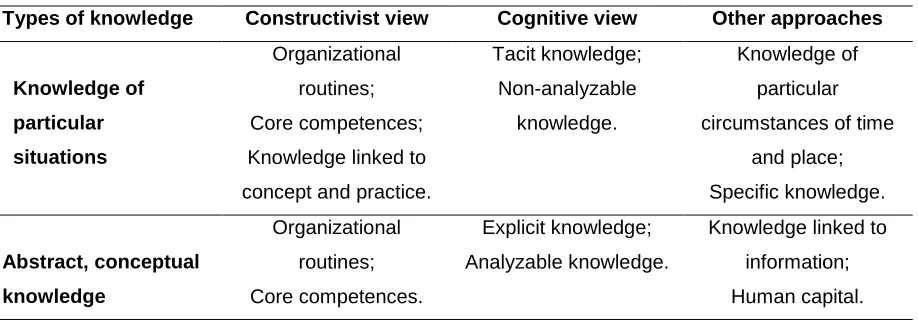
The distinction between knowledge of particular situations (concrete) and abstract or conceptual knowledge, along with the differences between constructivist and cognitive view, can help to come up with a general classification of the different ways in which knowledge is labeled.
Table 1. A classification of different labels and types of knowledge
Types of knowledge Constructivist view Cognitive view Other approaches
Knowledge of particular situations
Organizational routines; Core competences; Knowledge linked to concept and practice.
Tacit knowledge; Non-analyzable
knowledge.
Knowledge of particular circumstances of time
and place; Specific knowledge.
Abstract, conceptual knowledge
Organizational routines; Core competences.
Explicit knowledge; Analyzable knowledge.
Knowledge linked to information; Human capital. Source: Complied by author.
Table 1 shows this classification but adds the column other approaches in order to include the labels for knowledge that exclude the concepts of cognitive view or constructivist view. This table also excludes the concept of inter subjectivity from abstract or conceptual knowledge as, in organizations, explicit knowledge depends upon its particular idiosyncratic environment. Some forms of knowledge have two dimensions and are classified into two different boxes.
ORIGINS OF THE ACTION-DECISION
Pursuing research in this direction involves the need to deepen the various mental aspects to which to impute the action-decision, without ties to their conscious and intentional character or to the regulatory value compared to some rule or axiom ex ante.
Licensed under Creative Common Page 46 economy is precisely this awareness in the theory of human decision and action. Taking into account this approach, there are at least two possible contexts of comparison.
The first concerns the relationship between cognitive economy and orthodox economics when it comes to reading the decision and its contents as opposed to the topic of optimization- maximisation. The second concerns the theme of systemic balance, once the role of axioms and the underlying behavioural rules is clouded.
Those who have accepted the empirical results of cognitive choices as substantial refutation of the principles of rationality of orthodox neoclassical economics, often end up adding to the traditional model new assumptions on cognitive limitations and constraints (Morselli, 2015).
Kahneman has showed how the phenomenon of emotional-based accessibility is the core and source of a number of heuristics found in many economic decisions (Kahneman, 2003). These are prototype heuristics that identify themselves through a common characteristic, namely the representation of a category of phenomena through their prototype. The latter can be defined as characterized by the average values of the most significant properties of members of a given set of objects or events. It is evident that the mental accessibility of the prototype is not represented by the more intrinsic and objectively most relevant properties from the regulatory point of view of a category, but only by those of greater emotional impact from the subjective point of view. As a general rule, it must be said, therefore, that the so-called tacit dimension of the knowledge appears to be of great importance in the decision-making processes, and the intuitive mind qualifies as the proprietor of the cognitive processes that qualify its role.
Cognitive theories add restrictions to those limits that are determined by emotional-affective factors. What follows is an integrated cognitive duality that is absolute, so much that even decisions generally ascribable to the sphere of conscious reasoning are nonetheless influenced by the intuitive component, especially in relation to the specific contexts of decision. At this point, it seems at least sensible to consider psychological insights and integrate them in the mainstream. These research proposals are reflected in the recent methodological approach illustrated by Rabin, where the models are “portable”, or in other words, use the same
independent variables applied in the field of research that the change attempts precisely to extend (Rabin, 2013).
KNOWLEDGE, INNOVATIONS AND TECHNOLOGIES
Licensed under Creative Common Page 47 realization of action and here may be examined the widest range of possibilities (Sullivan & Marvel, 2011). Knowledge is seen as the ability to perform the specialized tasks and as a way or experience of communication (i. e. through the prism of skills and experience), so it is appropriate to accumulate new knowledge improving acquired skills and deepening the experience (Pacharapha & Ractham, 2012). Information is an invisible asset which is considered to be an essential resource in the value creation. Proper management of information increases the acquirement of the knowledge about the organizations and clients and business uniqueness. Therefore, researchers distinguish the need to combine tacit and explicit knowledge (Gluckler, 2013) and in this base to create a unified system, where the necessary information would be saved and which could be specified and shared at any moment.
Improperly managed knowledge loses its value faster than material resources, so the current knowledge must be used in the most efficient way. Decreasing the knowledge demand by increasing the knowledge supply arise the possibilities to use more advanced technologies and foster innovations in business processes (Vargas-Hernandez & Garcia-Santillan, 2011). As a result the fostering of successful technology application, making the attention to such key factors as: asset, knowledge, skills and organizational processes became especially important factor after the widespread use of IT in the organizations activity processes The integration of knowledge and technologies appears in the base of interaction and analysis of these aspects, and it promotes not only the search and application of more improved management methods, but also the changes of organizational business structure or more detailed presentation of industrial characteristics.
Innovations promote the interactive process of the generation and application of new knowledge (Czarniewski, 2016). Using innovations, the companies better meet the consumer needs, increase the operational efficiency, improve the product quality, reduce the project life cycle and as a result improve their position in the market. The results from the analysis of internal and external factors can be used for the targeted fostering of innovations and their application in several ways. In the broadest sense, innovations can be applied in four ways (Alam & Kabir, 2013): statically (transferring the existing knowledge); dynamically (learning collectively); formally (according to the rules and regulations); informally (communication ways).
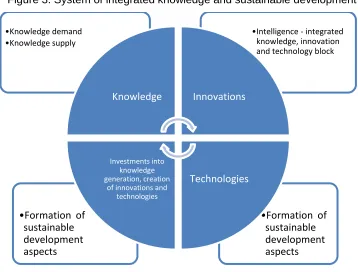
Licensed under Creative Common Page 48 Figure 3. System of integrated knowledge and sustainable development
Source: Complied by author.
Figure 3 illustrates the scheme for knowledge generation, design of the national universally sustainable development strategy and functional innovation and technology integration into strategy implementation. Sustainable development and purposeful integration of science, innovation and technologies are the main instruments that would help the world to overcome the current and potential future challenges. The rapidly progressing globalization and the existing need for national sustainable development are the main drivers for the continuous integration of knowledge, innovation and technology.
CONCLUSIONS
1. Economic theory is a set of assertions and general concepts related to the economic activities of people. Its value depends on its usefulness, which is possible when knowledge is reliable, consistent and presented in an appropriate way.
2. Economic theories should be applied in practice. If the theory is true, the practical action based on this theory will be effective. If the theory is false, the practical action based on this theory will make the operation ineffective. The close connection of particular economic theory with practice is therefore in the interest of both: practice and theory. 3. Economic language is particular; not only is it ambiguous, but also rich in abstract
concepts and ideas, where the designation is not directly observed, e.g. flexibility,
•Formation of sustainable development aspects •Formation of
sustainable development aspects
•Intelligence - integrated knowledge, innovation and technology block •Knowledge demand
•Knowledge supply
Knowledge Innovations
Technologies
Investments into knowledge generation, creation
Licensed under Creative Common Page 49 performance, production potential. Many phenomena and economic dependence is also immeasurable.
4. What are breakthroughs in economic sciences? They rely on finding the gaps between the explanation of the world offered by science and how this world actually works. Filling these gaps is a job for many scientists, though it is sometimes very difficult to notice very large gaps, when economics becomes a daily task.
5. Talent and knowledge workers are an important asset to the organization because of the specialist knowledge they possess. Usually they know more than anyone else in the company, are treated as experts in their field, and cannot be easily replaced. Thus, it should be a priority for enterprises to properly motivate this group of employees to work creatively and stay with the company as long as possible.
6. The power of new collaborative technologies to increase the efficiency of all types of exchanges aggregated over several phases of economic and social life makes the provision of services that reduce inefficiencies and more importantly develop structured, mechanisms, schemes, incentives for sharing the benefits of coordination in a non-disruptive way, an important market with potentially large rewards. As the underlying infrastructure increases its capabilities and becomes widely available, services will target informational waste giving rise to new forms of machine intelligence. This latest trend is reflected in the growing industry needs in building the computational resources and skills required for extracting value from data.
7. The development of science, education of societies, learning to use the knowledge and the concept of a modern organization play a fundamental role in the development of the new economy. The importance of proper people management, productive use of their knowledge, their abilities, talents and motivation to change and innovate has recently increased significantly in modern organizations. As a result, these organizations have a chance to increase their level of efficiency through the implementation of innovative solutions and the creation of new values.
REFERENCES
Akehurst, G., Rueda-Armengot, C. Vivas-López, S. & Palacios-Marqués, D. (2011). Ontological supports of knowledge: Knowledge creation and analytical knowledge. Management Decision, 49 (2), 183-194. Alam, S. & Kabir, N. (2013). Economic growth and environmental sustainability: empirical evidence from east and south-east Asia. International Journal of Economics and Finance, 5 (2), 86-97.
Licensed under Creative Common Page 50 Blaug, M. (1992). The methodology of economics. Or how economists explain. Cambridge: Cambridge University Press.
Blichfeldt, B. & Andersen, J. (2006). Creating a wider audience for action research: learning from case-study research. Journal of Research Practice, 2 (1), 1-12.
Bloom, N., Lemos, R., Sadun, R., Scur, D. & Van Reenen, J. (2014). The new empirical economics of management. Journal of the European Economic Association, 12 (4), 835-1126.
Cambra-Fierro J., Florin, J., Perez, L. & Whitelock, J. (2011). Inter-firm market orientation as antecedent of knowledge transfer, innovation and value creation in networks. Management Decision, 49 (3), 444-467. Camerer, C. F. (2003). Behavioral game theory. Princeton, Princeton University Press.
Cheung, Ch., Lee, M. & Rabjohn, N. (2008). The impact of electronic word-of-mouth - the adoption of online opinions in online customer communities. Internet Research, 18 (3), 231–234.
Chmielewski, A. (1995). Filozofia Poppera. Analiza krytyczna. Wroclaw: University of Wroclaw Press. Costa, R. V., Fernández-Jardón, C. & Figueroa Dorrego, P. (2014). Critical elements for product innovation at Portuguese innovative SMEs: an intellectual capital perspective. Knowledge Management Research and Practice, 12 (3), 322-338.
Creed, A. & Zutshi, A. (2014). A quandary in management practice: academic research or consulting?, International. Journal Management Practice, 7 (1), 39–54.
Czarniewski, S. (2014). Contemporary mechanisms of competition in the economy and in business. European Journal of Research and Reflection in Management Sciences, 2 (2), 69-75.
Czarniewski, S. (2015). Required features of modern enterprise – new challenges for management sciences. International Journal of Research in Economics and Social Sciences, 5 (11), 82-88.
Czarniewski, S. (2016). International technology and knowledge transfer as a tool for building a modern economy. International Journal in Management and Social Science, 4 (4), 292-304.
Delporte Vermeiren, D., Vervest, P. & van Heck, E. (2004). In search of margin for business networks: the European Patent Office. European Management Journal, 22 (2), 167–182.
Dikos, G. (2014). Turning economic inefficiencies business value: lessons from the new collaborative technology. International Journal of Business,19 (4), 381-402.
Eppinger, E. & Vladova, G. (2013). Intellectual property management practices at small and medium– sized enterprises. International Journal of Technology Management, 61 (1), 64–81.
Frankfort-Nachmias, Ch. & Nachmias, D. (2001). Metody badawcze w naukach społecznych. Poznan: Zysk i S-ka Press.
Frese, M., Gielnik, M. M. (2014). The psychology of entrepreneurship. Annual Review of Organizational Psychology and Organizational Behavior, 1, 413-438.
Gluckler, J. (2013). Knowledge, networks and space: connectivity and the problem of non-interactive learning, regional studies. Regional Studies, 47 (6), 880-894.
Górnik-Durose, M. (2010). Kupowanie rzeczy, kupowanie doświadczeń – nowe zjawiska w zachowaniach konsumenckich, In: Psychologiczne uwarunkowania zachowań ekonomicznych, (Eds.) M. Goszczyńska & M. Górnik-Durose, Warsaw: Difin Press.
Gustavsen, B. (2003). New forms of knowledge production and the role of action research. Action Research, 1 (2), 153–164.
Jorgenson, D., Ho, W., Mun, S. & Stiroh, K.J. (2008). A retrospective look at the U.S. productivity growth resurgence. Journal of Economic Perspectives, 22 (1), 3-24.
Kahneman, D. (2003). A Psychological perspective on economics. American Economic Review, 93 (2), 162-168.
Licensed under Creative Common Page 51 McClure, M. S., Laibson, I., Loewenstein, G. & Cohen, D.J. (2004). Separate neural system value immediate and delayed monetary rewards. Science, 306 (5695), 503-507.
Morselli, A. (2015). The decision-making process between convention and cognition. Economics and Sociology, 8 (1), 205-221.
Olander Roese, M. & Olsson, A. (2012). Challenging the strategy paradigm within the paper packaging industry. International Journal of Business Science and Applied Management, 7 (2), 1-12.
Pacharapha, T., Ractham, V. V. (2012). Knowledge acquisition: the roles of perceived value of knowledge content and source. Journal of Knowledge Management, 16 (5), 724- 739.
Peris-Ortiza, M., Vivas-Lópezb, S. & Rueda-Armengot, C. (2013). Ontological levels in the knowledge management field. International Journal of Business, 18 (1), 35-47.
Pine, J. & Gilmor, J. (1998). Welcome to the experience economy. Harvard Business Review, July, 209-210.
Pomerleano, M. & Shaw, W. (2005). Corporate restructuring. Lessons from experience. Washington: The World Bank.
Rabin M. (2013), An approach to incorporating psychology into economics. American Economic Review, 103, 617-620.
Rubinstein, A., (2003). Economics and psychology? The case of hyperbolic discounting. International Economic Review, 44, 1207-1216.
Rutkauskas, A. V., Raudeliūnienė, J. & Račinskaja, I. (2014). Integral knowledge, innovation and technology cluster formation nurturing the universal development sustainability in the context of globalization. Economics and Sociology, 7 (4), 41-58.
Sekaran, U. (2003). Research methods for business: A skill building approach (4th ed.). New Jersey: John Willey & Sons.
Shane, F., Loewenstein G. & O‟Donoghue T. (2002). Time discounting and time preference: a critical review. Journal of Economic Literature, 40 (2), 351-401.
Spender, J.C., (2008). Organizational learning and knowledge management: Whence and whither. Management Learning, 39 (2), 159-176.
Stefanowicz, B. (2011). Wiedza. Wybrane zagadnienia. Warsaw: Warsaw School of Economics Press. Stephens, A. (2013). Principled success: eco-feminism and systems thinking come together for better project outcomes. International Journal of Managing Projects in Business, 6 (1), 199–209.
Sullivan, D. M., Marvel, M. R. (2011). Knowledge acquisition, network reliance and early-stage technology venture outcomes. Journal of Management Studies, 48 (6), 1169-1193.
Thoenig, M. & Vernier, T. (2003). A theory of defensive skill-biased innovation and globalization. The American Economic Review, 93 (3), 3-6.
Todaro, M.P. & Smith, S.C. (2011). Economic development. Boston: Addison-Wesley.
Vargas-Hernandez, J. G. & Garcia-Santillan, A. (2011). Management in the innovation project. Journal of Knowledge Management, Economics and Information Technology, 7, 148-171.
Waddell, D., Creed, A., Cummings, T. & Worley, C. (2013). Organisational change: development and transformation. Melbourne, Cengage Learning.