2267
Intelligent Framework For Joint Data Hiding And
Compression Using SMVQ And Fast Local Image
In-Painting
A. Haja Sharieff, S. Sabena, V.Sathiyavathi, L. SaiRamesh
Abstract : An intelligent framework for Joint Data Hiding and Compression on image has been proposed in this paper. The proposed framework is the combination of the schemes such as data hiding, compression and image in-painting. In this intelligent framework, we have used an existing technique called Side Match Vector Quantization (SMVQ) and the proposed Intelligent Fast Local Image In-painting(IFLII) techniques to overcome the drawbacks in the existing system. In addition, we have used the multi agents for data hiding, compression and in-painting process in this proposed intelligent framework. In implementation, a cover image is taken first and is divided into blocks of n x n matrices. The topmost and the leftmost blocks are compressed using Vector Quantization (VQ). Other remaining blocks are called residual blocks and are embedded with the secret data. Simultaneously Side Match Vector Quantization (SMVQ) and prediction are applied to this current block and neighboring pixels. If prediction error exists then VQ technique is applied again, else SMVQ technique is applied to that block. Embedding is adjusted by incorporating the fast local Image In-painting. Finally, the image decompression process takes place and then the embedded secret bits are extracted. The experimental results show the efficiency of the proposed intelligent frameworks. The proposed framework achieves better performance in the way of capability of data hiding, compression ratio and quality of decompression.
Keywords: side match vector, vector quantization, In-painting, data hiding, Compression
—————————— ——————————
1.
INTRODUCTION
The internet usage is increases in daily which increases the data sharing including image, text and video content. The hiding of data within the data or hiding the sensitive information from unknown users will be the important task in current scenario. If the data is text then there will be no loss in information between encryption and decryption. If the data is image then the image loss is occur while hiding the information within the image and reconstruct it. Compression is also reduce the image quality during communication where bandwidth is reduced and communication efficiency is high. Compression along with hiding is quite effective in various applications [1]. Normally digital image is composed of image elements called pixels where the image constructed over the pixels by changing the basic pixels property. Texture image provides the measure of properties such as smoothness, coarseness, and regularity. There are four types of images they are Digital images, Monochrome image, Grayscale image and Color image. A new intelligent framework for data hiding and compression is proposed in this framework. The proposed framework uses the existing techniques SMVQ [15] and proposed Intelligent FLII for effective data hiding and compression. We have introduced agents for all the process in this framework to achieve better performance than the existing methods. The rest of the paper is framed
under five sections. Section 2 discusses the relevant works which are related with the proposed system. Section 3 describes the overall system design and system process. Followed by section 4 provides the algorithm proposed in this paper for Inpainting technique. Section 5 deals with experiments conducted and performance analysis with the result discussion. Section 6 concludes the work with detailed discussion about the advantages of the proposed SVMQ with FLII and provides the suggestions for further enhancement needed in the work.
2.
LITERATURE
SURVEY
There are many works have been done in this direction by various researchers in the past. Li and Kim [9] suggested the image segmentation scheme for medical images. It's mainly targets the pixel value in numeric manner and convert the pixels into that numeric values. If there is a changes or segmentation needed then the value of pixel is changed according to that and information for the pixel value is changed. This will provided the segmentation or other changes in faster manner. Zhang et al [10] proposed the least squares approach for computing the image values. If there is any changes or segmentation needed in the images then it will applied only to the particular squares which is involved in the process not to the whole image. This helps to fastens the any image processing techniques. In addition, weighted approach is includes with that to categorize the square which is mostly involved in any process and least weights are assigned to squares which is not involved in most of the process. Different data hiding techniques discussed in [12] [13] and [14]. In [12] histogram based reversible data hiding technique is suggested. It's mainly used for compressed images to hide the information within that. It calculates the histogram value of the actual image and compressed it before the information hiding. And after decompression, the histogram values is evaluate to analyze the losses in the processed image. In [13], the lossless data hiding technique is implemented in bit stream method. This work reduces the loss of pixel characters after compression. The same way in [14] the reversible data ————————————————
A. Haja Sharieff is pursued his masters degree from Anna University, Chennai, India, E-mail: [email protected]
S. Sabena is currently working as a Assistant Professor in the Department of Computer Science and Engineering, Regional center of Anna UniversityTirunelveli, India, E-mail: sabenazulficker @gmail.com
V. Sathiyavathi is currently working as a Assistant Professor in the Department of Computer Sciencein JBAS College for Women, Chennai, India, E-mail: [email protected]
hiding process is involved where the pixel values are interchanged and it will reduced the loss in image pixels while reconstruction. Arjun Nichal et al [2] proposed a high capacity Data hiding method for JPEG2000 to increase the imperceptibility and Hiding Capacity for efficient secret communication. Ranade et al [3] proposed an Embedding System using Projection Quantization to achieve high embedding rates. Their system is highly robust and achieves high visual imperceptibility. But, the computational cost is expensive. Raghuraman et al [6] proposed an image retrieval technique with annotation approaches. Rosa et al [4] proposed an image in-painting algorithm using the Non-Subsampled Contourlet Transform (NSCT). In addition, a new mechanism of source patch selection also proposed. Margarita et al [5] proposed a new image in-painting based self-organizing maps by using multi-agent implementation. Raghuraman et al [15] proposed the image retrieval technique for enhance the search result in search engine by applying multiple region of Interest methods. This methods mainly concentrates on segmentation of images and reconstructed in similar without any pixel loss in reconstructed image.
3.
SYSTEM
ARCHITECTURE
The overall system architecture of the proposed system is shown in Figure 1. The proposed system architecture is consists of five components namely Image database, User Interface module, Intelligent Framework, Knowledgebase and decision making agent. Image database contains the large amount of texture images and supplies the images to the user interface module. The user interface module collects the necessary images from image database and it send to the proposed intelligent framework module for further process. The intelligent framework consists of three sub modules namely data hiding module, data compression module and in-painting module. The data hiding and compression modules are calls the existing technique SMVQ [15] for hiding and compress.
Fig.1. System Architecture
The in-painting module uses the proposed algorithm called IFLII for effective image in-painting with less time. The proposed framework uses the decision making agent for
making effective decision and also uses the
knowledgebase. Knowledge base contains the existing rules which are played well on decision making in the past experiments by the various frameworks like the proposed framework. The intelligent framework stores the resulted images into the result table.
Decision making agent is taking care of the selection of effective image in-painting, data compression and data hiding technique from the system based on the knowledgebase information.
4.PROPOSEDWORK
An intelligent framework has been proposed for data hiding and compressing process. The proposed framework is the combination of data hiding, data compression and image in-painting processes. We have used the existing method called SMVQ [7] for data hiding and data compression and another algorithm called Intelligent Fast Local Image In-painting (IFLII) algorithm is introduced for image in-In-painting which is developed according to the uses of intelligent agent. In addition, a decision making agent is also used for making effective decision.
4.1 Data Hiding and Compression
The joint data hiding and compression techniques are used for digital image processing to avoid the existing problems. We have used an existing technique called Side Match Vector Quantization (SMVQ) [7]. In addition to that, a newly introduced cost effective method called IFLII for effective image in-painting. The SMVQ and IFLII are works based on the embedding bits in this proposed framework. The proposed intelligent framework has high hiding capacity, compression ratio, decompression quality, improved implementation and image recovery. Here, we have used a decision making agent and knowledge base for making effective decision making.
Side Match Vector Quantization (SMVQ)
The same procedure as used in SMVQ [7] followed in this proposed work. The summary of the SMVQ as follows:
Step 1: Embedding and choose an image and divided in to blocks.
Step 2:Take the indicator bit 0 and 1. Step 3: If indicator bit =0 then
Read (index value) and implement VQ-1 Extract bit(watermark)
Step 4: If indicator bit =1.
Read (index values (Image)). Step 5: If index values are equal then Implement SMVQ-1 compression
Extract the watermark bit 0. Else
Implement inverse process (Image In-painting) Extract the watermark bit 1.
Image Databa
se
User Interface
Data Hiding
Data Compressi onModule
Inpainting
Module
Decision Making
Agent
Knowled
ge
Base
Intelligent
Framewo
2269 4.2 Image In-painting
We introduced a new enhanced version of the existing image inpainting method is called Intelligent Fast Local Image In-painting (IFLII) for effective data hiding and compression. We have used the equations 1, 2 and 3 for reducing the computational cost and maintain the accuracy of the in-painting algorithm according to [5]. At initial stage, different pixels for in-painting domain wD. This will occur for
defining the missing region with the information provided by the equilibrium solution for the known region. The number of iterations for Inpainting is reduced by set c(x, 0) =0.5.
( ) { ( ( ))
( )
(1)
( ) {
( )
(2)
( ) (3)
where fmax is the maximum values and fmin is the minimum value of the given input image and n is the unit normal vector to . Thus, we have the normalized image data c(x, 0) [0, 1]. Equation 1 is also called as the Allen– Cahn equation according to [8], which is widely applied in image processing due to the motion by mean curvature. Even though, it has intrinsic smoothing effect on interfacial transition layers and its fast and accurate hybrid numerical solver is available [8].
Intelligent Fast Local Image In-painting Algorithm Step 1.Agent find the in-painting area wD, using various techniques such as based on inspection or based on the image segmentation methods[8].
Step 2. Describe in detail about the control function g and initialize c0 as
Step 3. Renew cn+1 based on cn according to [5 ] gi,j= 1 if(xi, yj) , 0
Else otherwise.
c0i j= 0.5 if (xi , y j) ,, fi,j−fminfmax−fminotherwise
An efficient preconditioned conjugate gradient (PCG) scheme is helpful to overcome the issues available in the existing data hiding approaches. The introduction of intelligent agent is helps to take an effective decision on choosing effective in-painting area from segmented images. It is also used to improve the calculation efficiency in the proposed intelligent scheme.
5.
RESULT
AND
DISCUSSION
5.1 Experimental Scenario
Experiments are conducted with the gray level images by dividing the images into 4 x 4. The uncompressed color image database (UCID) [11] with image size of 512 × 384 pixels is sued for conducting the experiments where total of 1338 colour images are available in that. The performance of the system was evaluated based on image compression
ratio, quality of the image after decompression and data hiding capacity.
5.2 Performance metrics
We have used five performance metrics for the proposed system such as Peak Signal-to-Noise Ratio (PSNR), Mean Squared Error Rate (MSE), Structural similarity (SSIM), Root Mean Squared Error Rate (RMSE) and Compression Ratio. We can discuss further in detail about these performance metrics.
5.3 Experimental Results and discussion
The various experiments have been conducted by using various images. The proposed intelligent data hiding and compression scheme consists of four basic operations such as choose and load an image, applying block dividing, apply prediction, prediction error, Choose key image and embedding the image. Figure 2 shows the embedding process of the Lena image. This is the final stage of the data hiding and compression scheme. It shows the overall operation of the proposed scheme.
Fig. 2. Embedding process of the image Lena
The embedding is the process of combining the original and key image. The key image values are randomly selected and each value is embedded with the original image. The embedded image seems to be like the original image. Then the embedded image is used to send to the receiver side. Code book is generated for the embedded image.
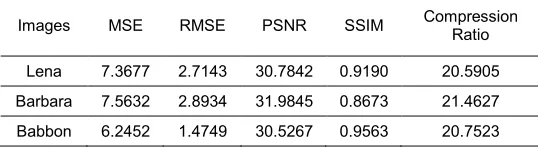
Table 1 shows the comparison of the proposed system performance in different performance metrics using various types of images.
TABLE 1 COMPARISON OF THE VALUES IN DIFFERENT IMAGES
Images MSE RMSE PSNR SSIM Compression Ratio
Lena 7.3677 2.7143 30.7842 0.9190 20.5905 Barbara 7.5632 2.8934 31.9845 0.8673 21.4627 Babbon 6.2452 1.4749 30.5267 0.9563 20.7523
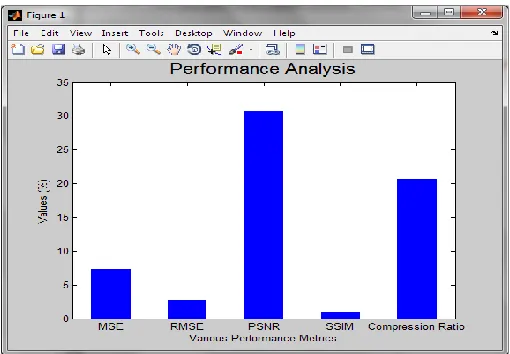
Figure 3 shows the performance analysis of the proposed system by using various performance metrics for Lena image.
Table 2 shows the comparison of hiding capacity between the proposed scheme and existing systems (Unit: Bts). This table considered the Lena image, minimum of UCID, maximum of UCID and the mean of UCID. We have compared the proposed SMVQ + FLII with existing schemes proposed in [12][13] and [14].
Figure 3. Various performance metrics for Lena Image
TABLE 2 COMPARISONS OF HIDING CAPACITY BETWEEN THE
PROPOSED SCHEME AND EXISTING SYSTEMS (UNIT: BITS)
Images Tsai et al [12]
Qian et al [13]
Ni et al [14]
SMVQ [7 ]
SMVQ+FLII Lena 5237 248 4604 10292 10298 Min. of
UCID
2055 124 2139 2246 2249
Max. of UCID
7126 609 91178 11832 11838 Mean of
UCID 4852 437 10076 9153 9157
From table 2, it can be observed that the performance of the proposed scheme is better than the existing schemes which are proposed in the past by the various researchers in this same direction. The achievement of this result is due to the uses of intelligent agents and knowledgebase. In addition, we have used a separate algorithm for improving the performance of the image Inpainting process and also combined this proposed algorithm into the existing SMVQ. Tables 3 gives the performance analysis of compression ratio and decompression based on different sizes of codebook where the size set to 36. For Lena image, results of PSNR and SSIM compared for different sizes of codebook. From that analysis, the proposed scheme SMVQ with FLII achieves better results and obtain higher range of compression ratios.
TABLE 3 COMPARISONS OF COMPRESSION PERFORMANCE WITH
DIFFERENT CODEBOOK SIZES FOR LENA
Scheme s
W = 128 W = 256 W = 512 W = 1024
PS SSI PSN SSI PS SSI PS SSI
NR M R M NR M NR M
VQ 29.7 0 0.88 71 30.4 0 0.91 01 31. 13 0.92 87 31. 67 0.94 12 SMVQ 29.7
0 0.88 71 30.4 0 0.91 00 31. 12 0.92 69 31. 64 0.94 13 SMVQ+ FLII 29.6 9 0.88 70 30.3 9 0.90 99 31. 09 0.92 60 31. 60 0.94 14 Standard SMVQ has exactly same output as given in [13] and high decompression ratio than [7] which is shown in Table 3. Figure 4 shows the comparative analysis of the proposed joint data hiding and compression scheme (SMVQ+FLII)and the standard SMVQ in two book codes such as 512 and 1024.
Fig. 4. PSNR Analysis between SMVQ and SMVQ+FLII
From figure 4, it can be observed that the proposed joint data hiding and compression scheme provides better performance when it is compared with the standard SMVQ due to the uses of intelligent agent, knowledgebase and the FLII algorithm. This FLII algorithm improves the performance of image in-painting. The improvement of image in-painting helps to improve the compression ratio and joint data hiding accuracy.
6.
CONCLUSION
An Intelligent framework has been proposed and implemented for Joint Data-hiding and Compression in this paper for digital images using SMVQ and the proposed image in-painting algorithm called IFLII. In this proposed framework, after choosing the images give the block size to the image and the prediction is applied after the block dividing. Finally, embedding and extractions are applied. Thus data hiding using SMVQ and image in-painting method was performed with less distortion and more accuracy. Future work in this direction can be the use of transformation based compression techniques like wavelet, curvelet instead of SMVQ compression to obtain more compression ratio.
REFERENCES
[1] Gregory K. Wallace ―The JPEG Still Picture
Compression Standard‖ Submitted in December 1991 for publication in IEEE Transactions on Consumer Electronics.
[2] ArjunNichal, Dr. Shraddha Deshpande― A High Capacity Data Hiding Method for JPEG2000 Compression System‖ International Journal of Engineering Research and Applications (IJERA) Vol. 2, Issue 4, June-July 2012.
[3] Ranadeet al 2012 ―Embedding system using projection quantization‖ IEEE transaction 2012, Vol 2
2271 [4] Rosa Rodriguez-Sánchez, J.A. García, J.
Fdez-Valdivia, ―Image inpainting with non subsampled contourlet transform‖, Pattern Recognition Letters, Vol. 34, pp. 1508–1518, 2013.
[5] Margarita Favorskay, Lakhmi C. Jain, Andrey Bolgov, ―Image inpainting based on self-organizing maps by using multi-agent implementation‖, Procedia Computer Science, vol. 35, pp. 861 – 870, 2014.
[6] G Raghuraman, S Sabena, L Sairamesh, ―Image Retrieval Using Relative Location of Multiple ROIs‖, Asian Journal of Information Technology, Vol. 15, no. 4, pp. 772 - 775, 2016.
[7] Chuan Qin, Chin-Chen Chang,Yi-Ping Chiu, ― A Novel Joint Data-Hiding and Compression Scheme Based on SMVQ and Image Inpainting‖, IEEE Transactions on Image Processing, Vol. 23, No. 3, pp. 969- 978, March 2014.
[8] Y. Li, H.G. Lee, D. Jeong, J. Kim, ―An unconditionally stable hybrid numeri-cal method for solving the Allen– Cahn equation‖, Comput. Math. Appl., Vol. 60, No.6, pp. 1591–1606, 2010.
[9] Y. Li, J. Kim, ―A fast and accurate numerical method for medical image segmentation‖, J. Korea SIAM., Vol. 14, No.4, pp. 201–210, 2010.
[10]B. Zhang, S. Makram-Ebeid, R. Prevost, G. Pizaine, ―Fast solver for some computational imaging problems: aregularizedwighted least-squares approach‖, Digit. Signal Process, Vol. 27, pp. 107–118, 2014.
[11]G. Schaefer and M. Stich, ―UCID—An uncompressed color imagedatabase,‖ Proc. SPIE, vol. 5307, pp. 472– 480, Jan. 2004.
[12]P. Tsai, ―Histogram-based reversible data hiding for vector quantisation compressed images,‖ IET Image Process., Vol. 3, No. 2, pp. 100–114,2009.
[13]Z. X. Qian and X. P. Zhang, ―Lossless data hiding in JPEG bitstream,‖J. Syst. Softw., Vol. 85, No. 2, pp. 309–313, 2012.
[14]Z. C. Ni, Y. Q. Shi, N. Ansari, and W. Su, ―Reversible data hiding,‖IEEE Trans. Circuits Syst. Video Technol., Vol. 16, No. 3, pp. 354–362,Mar. 2006.