3551
Consumer Acuity On Select Digital Wallets
Dr. SP. Mathiraj, Shetty Deepa Thangam Geeta, Dr.R.Saroja Devi
Abstract: The Indian Government of initiative such as ‗Digital India‘ and increased use of mobile and internet are the main reasons for the exponential growth in use of digital payment. Even though the thought of digitalization raised long years ago, it took growth pace recently. This is because of lack of awareness and knowledge among people, fear to make online payment, security issues etc. The E-Payment system will be boosted only when the awareness is created in the minds of the people. Digital Wallets have eased our buying experience by providing another convenient money transfer platform. It is a significant role and positive impact on adoption of digital wallets. The present study is an attempt to evaluate the consumer perception of e-wallet. The primary data collected through questionnaire, 200consumers were selected as the sample size for the study using convenient sampling techniques. The statistical tools used for the analysis is univariate one-way ANOVA and Hendry Garret Ranking Method. Uni-variate ANOVA is used to identify the significance of the difference in the levels of perception, influencing the factors and satisfaction of e-wallets between two groups. The Hendry Garret Ranking analysis is used to identify the problems of e-wallets services.
Index Terms: Consumer‘s perception, Consumer‘s Satisfaction, Problems of E wallets, Digital Wallet, Online Payments. —————————— ——————————
1.
INTRODUCTION
In today world mobile play an important part of everyday life. Because of technology, mobile user can nowadays use their mobile to make money transaction or payments by using different applications installed in their mobile. Besides payment, we can also store receipts, coupons and cards, bills in the mobile .when mobile can perform as leather wallets, and it is called ―Mobile wallet or digital wallets. Mobile wallet is virtual wallet service provided by certain service providers, here in people can load certain amount of money. The digital payment service works as a cashless payment service, where people do not have to pay cash or swipe their debit or credit card at offline merchants. A digital wallet refers to an Error! Bookmark not defined. or online service that allows an individual to make electronic transactions. This can include purchasing items on-line with a computer or using a Smartphone to purchase something at a store. An individual's bank account can also be linked to the digital wallet. They might also have their driver's license, health card, loyalty card(s) and other ID documents stored on the phone. The credentials can be passed to a merchant's terminal wirelessly via near field communication (NFC). Increasingly, digital wallets are being made not just for basic financial transactions but to also authenticate the holder's credentials. For example, a digital wallet could verify the age of the buyer to the store while purchasing alcohol. The system has already gained popularity in Japan, where digital wallets are known as "wallet mobiles".
2 DEFINITION OF DIGITAL WALLET
A digital wallet is a system that securely stores users' payment information and passwords for numerous payment methods and websites. By using a digital wallet, users can complete purchases easily and quickly with near-field communications technology. They can also create stronger passwords without worrying about whether they will be able to remember them later. Digital wallets can be used in conjunction with mobile payment systems, which allow customers to pay for purchases with their smart phones. A digital wallet can also be used to store loyalty card information and digital coupons. A digital wallet is also known as an e-wallet.
3. REVIEW OF LITERATURE
Miklesh Prasad Yadav &MadhuArora&Madhu(2019) Using e-wallet for payment is trending in Indian payment pattern for a layman. This paper makes an attempt to study customer satisfaction in use of e- wallet as dependent variable and problems in wallets, risk and solution to boost the use of e-wallet as independent variables. 351 respondents were considered duly completing forms and AMOS graphic is used for further analysis to test the formulated null hypotheses and to check validity of the results. Findings include that there is positive relationship of customer satisfaction with solutions in wallets and negative relation with problems in using e-wallets. Sharma, S. K., Mangla, S. K., Luthra, S., & Al-Salti, Z. (2018) The concept of the mobile wallet is increasingly adopted in developed and developing countries for improving the scale, productivity, and excellence of banking services. Oman is one of the most growing countries of the Middle Eastern economies. Acceptance of mobile wallets in Oman is being hindered by various inhibitors. There is no study in the Middle Eastern countries that addressed the concerns of probable inhibitors influencing mobile wallet acceptance from expert's perspective. In this study, eleven key inhibitors to mobile wallet adoption are identified from the literature and expert's feedback. This study employed Interpretive Structural Modeling (ISM) in conjunction with fuzzy MICMAC to reveal the intricate relationship among inhibitors to mobile wallet acceptance. To the end, an integrated hierarchical model is developed to understand the influence of a particular inhibitor on others. ‗Anxiety towards new technology‘, ‗Lack of new technology skills‘, ‗Lack of awareness of mobile wallet benefits‘ and ‗Complexity of new technology‘ have been reported as key inhibitors to promote mobile wallets in Oman. This study also suggests several recommendations for banking organizations _______________________
Associate Professor, Dept. of Corporate Secretaryship, Alagappa University, Karaikudi, Tamil Nadu India.. Email: [email protected], Mobile:9442215552
Ph,D Scholar, Department of Commerce, Alagappa University, Karaikudi, Tamil Nadu India. Email: [email protected], Mobile:9585152515
3552 and policymakers in developing the effective model to
popularize mobile wallets in Oman.
4. STATEMENT OF THE PROBLEM
The current scenario of Indian economy shows the tendency of movement from cash to cashless transactions. There are so many efforts have been taken by the government in order to convert the face of Indian economy into a new one. Now a day every transaction is going digital. In order to accelerate the execution of the concept of digital economy there are number of digital payment systems were introduced. These payment systems can make changes in the economic life of people. With the last decade or so, our world has become rapidly more digitized. Two important factors that have contributed to this development are the use of mobile phones, and the use of Internet..Thus, there is a need for an electronic wallet, an e wallet, with which mobile payment can be made. It is therefore relevant to pay attention on the Electronic payment option as cashless payment. One of the major problems is to get your money refund in case you sent it to a un-registered number or to a wrong number. Another is in case of large amount transfer to your bank account; you need to pay service charge for same. Sometimes, the coupon code is valid and it doesn‘t get applied successfully on the website even if you are eligible for the offer. Cash back can take time to get credited in your account, which in case if it doesn‘t get credited you may lose track of it, and check whether you received the amount or not.
5. SCOPE OF THE STUDY
The study is conducted to know the digital wallets concept adopted by the consumer. The scope of the work is limited to the user experience and they think terms of real utility of digital wallets. Consumers are really ready for everything to go cashless and for all facilities. The initiative of using internet in different stores. This study mainly focuses on security concerns related to digital wallet are also being take care by the company providing digital wallets. The scope of the study identifies the cash and cashless transactions factors which are Social influence, Security and privacy willingness to pay more and also towards consumer perception on select digital wallets. The present study also identifies various problems faced by the consumer in the study area and offers suitable suggestions. The study was confined to Karaikudi Town, Tamil Nadu in India
6. OBJECTIVES AND HYPOTHESIS
The objective of the study was to find out the customer perception, satisfaction level problems and factors influencing of demographic factors on adoption of using digital wallet: In pursuance of the above objectives, the following hypotheses were formulated for testing:
HoThere is no significant difference between demography
factors and consumer perception on digital wallet.
H1There is no significant difference between Education of the
respondents and perception of using digital wallet.
H2There is no significant difference between age of the
respondents and factors influencing of digital wallet
H3There is no significant difference between gender of the
respondents and satisfaction of using of digital wallet.
7. RESEARCH METHODOLOGY
Sources of Data
The present study comprises of both primary and secondary data. The Primary data is collected by conducting questionnaire-based survey among the population of consumer in Karaikudi Town. The Secondary data consist of information from various publications, Annual reports, Journals, Magazines, Seminar materials, Published and Unpublished reports, websites and libraries pertaining to RBI Websites.
Sample Size and Sampling Technique
The respondents for survey from population of consumer are selected by simple random sampling method. This sampling technique is a widely adopted technique when the size of target population is quite large and unknown. The researcher used Convenience sampling is identifying the sample respondents in Karaikudi town, Tamil Nadu in India with 200 respondents.
Questionnaire
The researcher questionnaire was framed for the study. The questionnaire pertains to consumer view points on perception to awareness, purpose, using of e-wallet, Factors influencing dimension of Digital Wallet, satisfaction level and problems based by e-wallet service. The questionnaires were used to elicit information on items measuring demographic factors, sources of consumer perception, level of satisfaction with the aspects of e-wallet services. The opinions/ satisfaction, factor influencing dimension of e-wallet and problems of e-payment services about e-wallet have been measured using 15 items scale with 5 point Likert type values ranging from 1 for Strongly Disagree2 for Disagree3 for Netural4 for Agree and 5 for Strongly agree. It took nearly seven months to complete the survey. There was no single questionnaire found with insufficient information due to researcher‘s physical presence and her explanation to the respondents about questionnaire items as and when there was a doubt. The study has covered the period of 1years from 2018– 2019.
Statistical Techniques
The statistical techniques used for analyzing the data vary from descriptive to multivariate. The details of the statistical tools are Frequency distribution analysis, Descriptive statistics like mean, standard deviation, One way ANOVA (also Called as F test), Reliability / Item Analysis, Garrett‘s table is used to find the problems faced by the respondents in digital wallet user.
8. LIMITATIONS OF THE STUDY
Consumer‘s perceptions changes from time to time with the advancement in the technology.
Most of the respondents will not answer for the open ended questions like suggestions and opinions about it.
9. ANALYSIS AND INTERPRETATION OF
CONSUMER ACUITY ON DIGITAL WALLET
3553 researcher has been collected primary data from 200
respondents.
Table 1- Demographic Description of the Respondents
SOCIO-ECONOMIC
CHARACTERISTICS NUMBER OF RESPONDENTS % TO TOTAL
AGE (IN YEAR )
BELOW18-25 73 36.5
26-35 48 24.5
36-45 45 22.5
ABOVE45 34 17.0
GENDER
MALE 142 71.0
FEMALE 58 29.0 MARITAL STATUS
MARRIED 73 36.5 UNMARRIED 127 63.5 EDUCATIONAL QUALIFICATION
UP TO SSLC 11 5.5 UP TO HSC 18 9.0 DIPLOMA 2 1.0 UNDER GRADUATE 27 13.5 POST GRADUATE 142 71.0 OCCUPATION
GOVERNMENT EMPLOYEE
18 9.0
PRIVATE EMPLOYEE 24 12.0 OWN BUSINESS 45 22.5 PROFESSIONAL 113 56.5 MONTHLY INCOME (IN RS.)
BELOW-10000 105 52.5
10001-50000 66 33.0
50001-100000 8 4.0
ABOVE 100001 10 5.0 TOTAL SAMPLE 200 100% Source: Primary Data
It is observed from the Table 1 that the majority of the respondents are in the age group of 18 to 25 years (36.5%), followed by the respondent group with age level of 26 – 35 years (24.5%) and 36 – 45 years (22.5%). The respondents aged above 46 years constitute 17 %. The majority of 71.0 percent of the respondents are Male and 63.5% of the respondents are unmarried. The respondents who have completed their Secondary school are the highest occupying 5.5 % of the total sample followed by Higher Secondary school are 9.0%, Diploma are completed1.0%, Graduates with 31.0% and Post-Graduates with 71.0 %. Being self-employed is the job status for 22,5 per cent of the respondents. Next to this, government employee constitutes 9.0% of the sample followed by private employees 12% and 56.5 % of the sample with job status as professional respectively. The monthly income is up to Rs.10000 for 52.5%, Rs.10001-50000 for 33%, Rs.50001-100000 for 4% and above Rs.Rs.50001-100000for 5% of the respondents in the sample.
The following tables use the type of account, mode of payment, various payment devices in E-wallet; Information gets the digital wallets and number of times using digital wallet payment in a week used in percentage analysis.
Table 2- Preference of E-wallet services in the sample
PREFERENCES OF E-WALLET SERVICES
NUMBER OF
RESPONDENTS % TO TOTAL
TYPES OF ACCOUNT
COMMERCIAL BANK 78 39.0 PRIVATE BANK 97 48.5 CO-OPERATIVE BANK 10 5.0 POST OFFICE 15 7.5 MODE OF PAYMENT
SMART PHONE 76 38.0 COMPUTER 55 27.5
BOTH 69 34.5
DIGITAL WALLET PAYMENT DEVICES
PAYTM 35 17.5
GOOGLE PAY 94 47.0 PHONEPE 13 6.5
BHIM 7 3.5
OTHERS 51 25.5 INFORMATIONGETS THE DIGITAL WALLETS
SOCIAL MEDIA 95 47.5 FRIENDS/RELATIVES 87 43.5 MAGAZINE/TELEVISION 16 8.0 FM RADIO 2 1.0 NUMBER OF TIMES USING DIGITAL WALLET PAYMENT IN A WEEK ONCE A WEEK 94 47.0
WEEKLY TWO TIMES 65 32.5
WEEKLY TWO OR THREE TIMES 26 13.0
WEEKLY ABOVE FIVE TIMES 14 7.0 TOTAL SAMPLE 200 100% Source: Primary Data
It is observed from the Table 2 that the majority of respondents use in private bank (48.5 %) followed by commercial bank 78 (39.0%), post office 15(7.5%) and Co-operative banks 5%. The mode of e-wallet payment out of 200 respondents, 76 (38.0%) respondents are using smart phone, 69(34.5 percent) respondents are both and only 55(27.5 percent) respondents using computer. The respondents use in payment through the Google pay 47.0 percent of the respondents followed by 25.5% respondents are making payment through the others, 17.5 percent of the respondents are making through pay tm, 6.5 percent of the respondents are payment through in Phonepe and 3.5 percent of the respondents are payment through in BHIM. The get the information in e-wallet service for social media 47.5% followed by 43.5 percent of the respondents are friends and relatives, 8.0 percent of the respondents are magazine and television and 1.0 percent of the respondents are getting FM radio. The following respondents use in E-wallet in the weekly, 47.0 percent of the respondents use in once, followed by weekly two times 32.5 percent of the respondents, weekly two- or three-times 13.0 percent of the respondents and 7.0 percent of the respondents are weekly above five time using digital wallet.
Table 3- Education of the respondents and perception of using digital wallet- ANOVA
Ho1: There is no significant difference between Education of
3554 S.NO PERCEPTION OF USING DIGITAL
WALLET F SIG.
HYPOTHESIS
(ACCEPTED/ REJECTED) 1 BRAND LOYALTY 4.673 0.001 REJECTED
2 CONVENIENCE IN USAGE 3.229 0.014 REJECTED
3 SECURED TRANSACTIONS 3.860 0.005 REJECTED
4 DISCOUNT OFFERED 6.442 0.000 REJECTED
5 TIME SAVING THROUGH DIGITAL
PAYMENT MODE 5.290 0.000
REJECTED
6 PRICE OF USING DIGITAL PAYMENT
MODE (SERVICE CHARGES ETC.) 20.517 0.000
REJECTED
7 CASH BACK 7.514 0.000 REJECTED
8 DIGITAL PAYMENT IS USER
FRIENDLY 3.110 0.016
REJECTED
9 DIGITAL PAYMENT IS EASIER TO MAKE MY FINANCIAL TRANSACTIONS
2.176 0.073 ACCEPTED* 10 DIGITAL PAYMENT IS SAFE AND
SECURED 5.665 0.000
REJECTED
11 DIGITAL PAYMENTS HAS LOW
LEVEL RISK 2.375 0.054 ACCEPTED*
12 DIGITAL PAYMENT PROTECTS MY
PRIVACY 5.586 0.000
REJECTED
13 DIGITAL PAYMENT IS HIGHLY EFFICIENT COMPARING TO CONVENTIONAL PAYMENT METHODS
13.945 0.000
REJECTED
14 DIGITAL PAYMENT IS DELAY IN ITS
PROCESSES 4.106 0.003
REJECTED
Source: Primary Data
Since p value is more than 0.05 the null hypothesis is accepted at 5 % level of significance. Hence it is concluded that there is mean difference between opinion about the perception of using digital wallet and Education of the respondents‘ in the study area. Based on the Tukey HSD test, the respondents who have responded with respect to opinion also do have any significant difference.
Table 4-Age of the respondents and factors influencing of digital wallet-ANOVA
Ho2: There is no significant difference between age of the
respondents and factors influencing of digital wallet.
S. NO
FACTORS INFLUENCING OF DIGITAL
WALLET F SIG.
HYPOTHESIS
(ACCEPTED/ REJECTED) 1 EASY ACCESSIBILITY 0.176 0.912 ACCEPTED
2 DISCOUNT OFFERS 1.507 0.214 ACCEPTED
3 CAN AVAIL CASH BACK 0.330 0.804 ACCEPTED
4 LOWER RISK 3.582 0.015 REJECTED
5 PROMPT SETTLEMENT 1.569 0.198 ACCEPTED
6 CAN ABLE TO MAKE PAYMENTS FROM
ANYWHERE 2.467 0.063
ACCEPTED
7 ONLINE TRANSACTION IS SECURED
THROUGH DIGITAL WALLET 0.424 0.736
ACCEPTED
8 CONVENIENT MODE OF PAYMENT 1.006 0.391 ACCEPTED
9 PRICING(TRANSACTION FEES,
SERVICE FEES) 0.403 0.751 ACCEPTED 10 24X7 AVAILABILITY 0.290 0.832 ACCEPTED
11 DIGITAL WALLET CAN BE
UNATTRACTIVE CHOICE OF PAYMENT 1.377 0.251 ACCEPTED
12 DIGITAL WALLET CAN SUPPORT THE
OTHER PAYMENT METHODS 1.224 0.302
ACCEPTED
13 DIGITAL WALLET IS NECESSARY 1.298 0.276 ACCEPTED
14 SATISFIED WITH THE PRIVACY
PROVIDED BY DIGITAL WALLET 2.099 0.102
ACCEPTED
15 DIGITAL WALLET SAVES TIME 0.128 0.943 ACCEPTED
Source: Primary Data
Since p value is more than 0.05 the null hypothesis is accepted at 5 % level of significance. Hence it is concluded
that there is no mean difference between opinion about the factors influencing of digital wallet and age of the respondents‘ in the study area. Based on the Tukey HSD test, the respondents who have responded with respect to opinion also do not have any significant difference.
Table 5 - Gender of the respondents and satisfaction of using digital wallet-ANOVA
Ho3: There is no significant difference between gender of the
respondents and satisfaction of using of digital wallet.
S. NO
SATISFACTION OF USING DIGITAL
WALLET F SIG.
HYPOTHESIS
(ACCEPTED/ REJECTED) 1 MOBILE WALLETS ARE CAPABLE OF
PROVIDING BENEFITS TO INDIVIDUAL FOR PURCHASE OF PRODUCT.
2.728 0.100 ACCEPTED
2 USING THE MOBILE WALLET IMPROVES THE QUALITY OF MY DECISION MAKING FOR BUYING PRODUCTS
0.582 0.447 ACCEPTED
3 BELIEVE MOBILE WALLETS ARE USEFUL IN BUYING PRODUCTS THAN THE TRADITIONAL METHODS
2.615 0.107 ACCEPTED
4 THINK THAT USING ONLINE WALLETS CAN OFFER ME A WIDER RANGE OF BANKING SERVICES AND PAYMENT OPTIONS
0.482 0.488 ACCEPTED
5 INTERACTING WITH MOBILE WALLET
IS HELPFUL. 19.873 0.000 REJECTED 6 TRUST THE SERVICE PROVIDERS OF
MOBILE WALLET 0.358 0.550 ACCEPTED
7 MONEY TRANSFER SPEED 0.998 0.319 ACCEPTED
8 ACCOUNT TO ACCOUNT TRANSFER 0.251 0.617 ACCEPTED
9 PAYMENT PROCESS SPEED 0.687 0.408 ACCEPTED
10 EXPENSIVE 0.405 0.525 ACCEPTED
11 SMS ALERTS ABOUT SPECIFIC INFORMATION TO THE BANK SERVICES / NEW PRODUCTS
0.836 0.362 ACCEPTED
12 REWARD POINT STATUS 7.624 0.006 ACCEPTED
13 WRONGLY ACQUIRING A LINE OF CREDIT BY SHARING UP ON ACCOUNT IN A WRONG NAME
1.279 0.260 REJECTED
14 STATEMENT REQUEST(BY EMAIL,
FAX, MAIL) 3.474 0.064 ACCEPTED 15 DUE INSTALMENT ENQUIRY 0.994 0.320 ACCEPTED
Source: Primary Data
Since p value is more than 0.05 the null hypothesis is accepted at 5 % level of significance. Hence it is concluded that there is no mean difference between opinion about the satisfaction of using of digital wallet and gender of the respondents‘ in the study area. Based on the Tukey HSD test, the respondents who have responded with respect to opinion also do not have any significant difference.
10. HENRY GARRETT RANKING METHOD
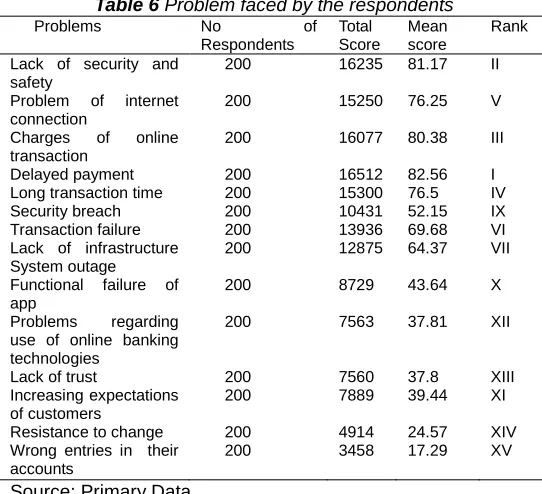
Garrett ranking technique has been used to analyze the purpose of digital wallet by the respondents. Under the Garrett-ranking-technique, the percentage position is calculated by using the following formula:
Percentage position = 100(Rij-0.5) Nj
where,
Rji-Rank given for ith variable by the jth respondents, Nj- Number of variables ranked.
Mean Score
3555 Mean score = Total Garrett score
No. of respondents
The percent position of each rank thus obtained is converted into score, by referring to the conversion table given by Henry Garrett. Then, for each factor, the scores of individual respondents are added. These mean scores for all the factors are arranged in the order of ranks and the inference are drawn.
Table 6 Problem faced by the respondents
Problems No of
Respondents
Total Score
Mean score
Rank
Lack of security and safety
200 16235 81.17 II
Problem of internet connection
200 15250 76.25 V
Charges of online transaction
200 16077 80.38 III
Delayed payment 200 16512 82.56 I
Long transaction time 200 15300 76.5 IV Security breach 200 10431 52.15 IX Transaction failure 200 13936 69.68 VI Lack of infrastructure
System outage
200 12875 64.37 VII
Functional failure of app
200 8729 43.64 X
Problems regarding use of online banking technologies
200 7563 37.81 XII
Lack of trust 200 7560 37.8 XIII
Increasing expectations of customers
200 7889 39.44 XI
Resistance to change 200 4914 24.57 XIV Wrong entries in their
accounts
200 3458 17.29 XV
Source: Primary Data
The Table 6 states that ‗Delayed payment‘ is ranked as the first source with a mean score of 82.56, ‗Lack of security and safety‘ is ranked as the second source with a score 81.175 Garrett points. ‗Charges of online transaction‘ is ranked as the third source with a score of 80.385Garrett points. ‗Long transaction time‘ is ranked as the fourth source with a score of 76.5Garrett points. ‗Problem of internet connection‘ is ranked as the fifth source with a score of 76.25Garrett points. ‗Transaction failure‘ is ranked as the sixth source with a score of 69.68 Garrett points. ‗Lack of infrastructure‘ is ranked as the seventh source with a score of 64.375 Garrett points. ‗System outage‘ is ranked as the eight sources with a score of 53.58 Garrett points. ‗Security breach‘ is ranked as the ninth source with a score of 52.155 Garrett points. ‗Functional failure of app‘ is ranked as the tenth source with a score of43.645 Garrett points. ‗Increasing expectations of customers‘ are ranked as the eleventh source of awareness with a score of 39.445 Garrett points. ‗Problems regarding use of online banking technologies‘ is ranked as the 12thsource with a score of 37.815 Garrett points. ‗Lack of trust‘ is ranked as the thirteen sources with a score of 37.8 Garrett points. ‗Theatre ticket‘ is ranked as the sixth source with a score of 49.925 Garrett points. ‗Resistance to change‘ is ranked as the fourteen sources with a score of 24.57Garrett points. ‗Wrong entries in their accounts‘ is ranked as the fifteen source of awareness with a score 17.29 of Garrett points. Thus, it could be concluded that ‗Delayed payment‘ ranks as the first in the source of awareness with a score 82.56 Garrett points about the digital wallets.
IMPLICATION OF THE STUDY
Consumers are really ready for everything to go cashless and for all facilities. The initiative of internet being used in different way in mobile phone which has made the work easy in doing financial transaction by using digital wallets in today‘s world. The main purpose of the study is bringing out the problems of the digital wallets Security of information is identified as an important obstacle faced by the digital wallet customers. This study mainly focuses on security concerns related to digital wallet are also being take care by the company providing digital wallets but also as a customers need not share any information without OTP connected to your Mobile to do financial transaction using digital wallets.
CONCLUSION
The study an attempt is made to empirically evaluate whether there are any univariate and multivariate differences between the consumer perception/acuity, satisfaction, factor influencing and problems with various aspects of E-Wallet services. One way ANOVA and Hendry Garret Ranking method is used to explore the univariate or multivariate different between two groups respectively. The result of ANOVA and Hendry Garret Ranking method exposed the existence of significant difference in perception of each perception/ influencing the factors of e-wallet satisfaction and problems of e-wallet payment services. Overall, it became evident that the respondents are satisfiedof e-wallet services or paymentonly by education customers which show it important factor .At last it can be concluded that among all problems it is identified, network and lack of data security is leading problem.
ACKNOWLEDGEMENT
One of the authors, Shetty Deepa Thangam Geeta, gratefully acknowledges RUSA- Phase 2.0/Ph.D.-Fellowship/2019 for awarding a fellowship. The corresponding author, Dr. SP. Mathiraj, Gratefully acknowledges the RUSA- Phase 2.0 Grant for the financial support to carry out this research work.
REFERENCES
[1] Sharma, S. K., Mangla, S. K., Luthra, S., & Al-Salti, Z. (2018). Mobile wallet inhibitors: Developing a
comprehensive theory using an integrated
model. Journal of Retailing and Consumer
Services, 45, 52-63.
[2] Prasad Yadav, Miklesh and Arora, Madhu(April 10, 2019). Study on Impact on Customer Satisfaction for E-Wallet Using Path Analysis.Model International Journal of Information Systems & Management Science, Vol. 2, No. 1, 2019. Available at SSRN: https://ssrn.com/abstract=3369651
[3] Subramanian, Sp Mathiraj & Geeta, Shetty Deepa. (2019). IMPACT OF GST ON ONLINE MARKETPLACES.
[4] KennethWeiss. (2011). Mobile payments, digital wallets and tunnel vision. Biometric Technology Today, 2011 (9), 8-9.doi.org/10.1016/S0969-4765(11)70171-0
[5] Singh, S., & Rana, R. (2017). Study of Consumer Perception of Digital Payment Mode. Journal of Internet Banking and Commerce, 22(3), 1-14.
3556
wallet market in
India.https://www.nfcworld.com/2016/03/14/343274/nielsen-reports-on-mobile-wallet-market-in-india
[7] Sanaz Zarrin Kafsh (2015), ―Developing Consumer Adoption Model on Mobile Wallet in Canada‖, Ottawa, Canada.
[8] Neeharika P et al, (2014), ―A Novel Interoperable Mobile Wallet Model with Capability Based Access Control Framework‖, International Journal of Computer Science and Mobile Computing, Vol.3 Issue 7, pg. 888.904
[9] Shwetu Kumar, Vijay Yadav, Atiqu-Ur-Rahman, Aditi Bansal (2014), ―A study on Paytm‖ Guru Gobind Singh Indraprastha University, Delhi.
[10] Ngoc Doan (2014) ―Consumer Adoption in Mobile Wallet – A Study of Consumers in Finland‖, Turku University of Applied Sciences.
[11] Nikita Rai, Anurag Ashok, Janhvi Chakraborty, Prajakta Aro,lker, Saumeel Gajera (2012), ―M-wallet: An SMS based payment system‖, International Journal of Engineering Research and Applications, ISSN: 2248-9622.
[12] Ramesh Pandit. Questionnaire for ewallet. Retrieved
From -
www.scribd.com/document/340196798/Questionnaire -for-ewallet
[13] Nazimsha, S. (2018). Study on Paytm Services in promoting Cashless economy after demonitization in India and an outline on its support towards Making India Digital. International Journal of Pure Applied Mathametics, 263-278.
[14] Dezan Shira & Associates. (July 27, 2017).Growth of Digital Payment Systems in India.. Retrieved from -www.india- briefing.com/news/growth-of-digital-
payment-systems-in-[15] india-14797.html
[16] 14. Kavitha, D., Kumar, D. S. (2018). A Study on Digital
[17] Payments System with Perspective of Customer‘s [18] Adoption. Eurasian Journal of Analytical
Chemistry, 13(SP), [19] emEJAC181225.
[20] .Dr. Ramesh Sardar.(2016).Preference towards Mobile Wallets among Urban Population of JalgaonCity.Journal of Management (JOM) Volume 3, Issue 2, July–Dec (2016), pp. 01–11, Article ID: JOM_03_02_001.
[21] MaitanmiOlusola AwodeleOludele, Ogbonna Chibueze,Osundina Samuel9(2013).Cashless Policy in Nigeria: The Mechanics, Benefits and Problems.International Journal of Information
Sciences and Techniques,Vol.3,
No.2,doi : 10.5121/ijist.2013.3201.
[22] https://www.academia.edu/27276358/Cashless_Socie ty_Drives_and_Challenges_in_Nigeria
[23] http://icommercecentral.com/open-access/study-of-consumer-perception-of-digital-payment-mode.php [24]
https://www.scribd.com/document/92508883/Paper-18
[25] https://en.m.wikipedia.org/wiki/Digital_wallets [26] https://www.youtube.com/watch?v=jGcZlDHSgaU [27] http://triaton.org/f3ew6/kx
[28] https://www.investopedia.com/terms/d/digital-wallet.asp
[29] https://www.slideshare.net/AkashKumar590/electronic -payment-system-types-risk-involve
[30] http://www.shodhganga.com [31] http://www.emeraldinsights [32] https://paytm.com/} [33] https://www.mobikwik.com/