772
Development And Validation Of Concept Mastery
Physics Test On The Electricity Topics
Ike Festiana, Harry Firman, Agus Setiawan, Muslim
Abstract: Electricity is a part of physics course in the engineering. Concept mastery on the topic of electricity is very useful and important for physics course. Electrostatic and electrodynamics are two topics in electricity that require representation in engineering that can b e used to solve a problem. However, concept mastery tests on the topic of electricity rarely use all four types of representations, such as more use verbal and mathematical representations. The purpose of this research is to develop validate the concept mastery test on the topic of electricity whi ch consists of 25 test items multiple choice. The concept mastery test was tested on 50 students from one of the universities in Lampung. The concept mastery test development uses the DDR method with four phases, namely analysis, design, development, and evaluation. The result of this research obtai ned a valid and reliable concept mastery test that is enriched with all four types of representations.
Index Terms: concept mastery test, electricity, design and development research, representation.
—————————— ——————————
1.
INTRODUCTION
Physics is one of the required subject for educational and engineering student at the University. Topics from physics course was basic knowledge to supporting futher subject. Electrostatic and electrodinamic werw topics in physics that they are closely related to course in the next semester. In additions, lecturers make test in physics course using verbal representation and mathematical representations. Therefore, it was necessary to develop a concept mastery test that can enrichment student so that they can find out other types of representations, such as picture representation and graph representation. The development of concept mastery test relates to the learning outcome of study program that originate from the faculty’s vision and mission. Meanwhile, learning outcomes in physics course are derived from learning outcome of study program. Learning outcome consist of aspect of attitudes, general skills, knowledge, and special skills. Aspect of special skills are distinguishing the direction and purpose of physics course in education students and engineering student. Lecturer will run well and having an impact on student success in understanding a topic can be invert from student achievement based on learning outcomes. The development of test was very useful for student and important at course. Test can be designed to determine the level of mastery of student concepts. A good test has gone thought the process of testing its validity and reliability. This validity and reliability test was needed to avoid bias so that it can measure and get accurate result [1], [2], [3]. The validity of an instrument shows how well it can measure and aims to observed or evaluated [4], [5]. Validity is also define as the abiity of an instrument to measure the properties of the construct under study [6]. Reliability is the extent to which the results of a measurement process can be trusted also called consistency, constancy, staility, etc. [7].
As a results from observations show that the concepts mastery student was low. This can be concluding from the students test. Concept mastery is the ability of student to understand scientific meaning well which consists of meaning in theory and how to apply it in everyday life [8]. According to Bloom’s theory [9], concept mastery is the ability of students to solve problems in the form of C1 to C6. The instruments used in physics course consist of five essay questions that gave priority to the types of verbal representations and mathematic representations. Therefore, the combination of different representations can lead to conceptual understanding [10]. The test instrument used previously did not measure concept mastery student. so that, we need an instrument test that can measure concept mastery students’ which can also enrichment knowledge abaout representation for students. Hence, this study is aimed at establishing validity and reliability concepts mastery test. The instrument was especially designed to evaluated the concept mastery physics test student at University.
2 LITERATURE REVIEW
This study aims to develop a concept mastery test. Concept mastery is part of learning outcome in the cognitive domain. The cognitive domain according to the revice Bloom’s consist ot C1 (remembering), C2 (understanding), C3 (applying), C4 (analyzing), C5 (evaluating) and C6 (Creating). C1 is to remember information that comes from long-term memory. C2 is understand previous knowledge and then connecting it. C3 is implement a user procesure to resolve the problem. C4 is analyzinf which means describing a problem or object to an element and determining the relationship between the element. C5 is evaluating an assessment based on criteria and standars. C6 creates several mergers of several element into an integrated form [11], [12]. The development of concept mastery test developed integrated four types of representation. The four types of representations include verbal, picture, mathematics, and graphs representations. Representation is very important in physics course and helps reduce difficulties in learning physics [13]. The purpose of using representation is that communications is also more effective and efficient [14]. Therefore, students can understand the topics in physics course. Validity is divided into content validity, construct validity, and criteria validity. Content validation is validation assessed by experts. Content validation according to Ley is defined as the extent of the feasibility of a test that is used as ————————————————
Ike Festiana is Doctoral student of science educations in Universitas Pendidikan Indonesia, Indonesia and assistant professor at Universitas Nahdlatul Ulama Lampung, Lampung, Indonesia. E-mail: [email protected], [email protected]
Harry Firman is associate professor of Sekolah Pascasarjana at Universitas Pendidikan Indonesia, Indonesia E-mail: [email protected]
Agus Setiawan is associate professor of Sekolah Pascasarjana at Universitas Pendidikan Indonesia, Indonesia E-mail: [email protected]
a sample of the domain item to be measured. Content validation is divided into two namely face validity and logical validity. This research is to measure the content validation conducted by five expert judgement. The number of expert judgement in content validation must not be less than two experts and may be more than six experts. The content validity was then analyzed using the Aiken’s V formula [7], please refer to (1):
(1)
Where s = r- lo, lo is the lowest validity rating number, c is the highest validity rating number, r is the number given by an expert. The coefficient value of Aiken's v ranges from 0-1. If the acquisition of the item calculation results the validation results show a number of more than 0.5 means that the item has good content validity. The next step is to calculate the level of difficulty. Concept mastery test questions were analyzed by correcting student answer sheets. Score 1 for the correct answer and 0 for the wrong answer. The equation used to calculate the degree of difficulty index refer to (2):
(2)
Where P is the level of difficulty index, Np the number of
students who answer the questions correctly, and N is the number of all participants who answer. The greater the difficulty index means the item is easy and the smaller the difficulty index means the problem is a difficult problem. While the power of distinction aims to find out groups of students who have high concepts mastery with those who have low concept mastery levels. The discriminatory index refer to (3):
(3)
Where D is the discrimination index, A is the number of upper group participants, AB is the upper group participant who
answers right, B is the number of lower group participants, BB
is the lower group participant who answers right, PA is the level
of difficulty of the upper group, PB is the level of difficulty of the
lower group. Difficulty index and discriminatory index can be concluding in Table 1 [15].
The reliability of the question items can be analyzed using SPSS. Test reliability means measuring what you want to measure. Reliability is calculated using the Cronbach’s alpha formula [16], refer to (4):
(4)
where k is the number of items of the test item, is the sum of the variance scores of each item, is the total variance. The reliability criteria α < 0.5 for low reliability, 0.5 < α < 0.8 for moderate reliability (acceptable), α > 0.8 for high reliability (good) [17]. This result is in line with Taber [18] stating that 0.45-0.98 is acceptable.
3 METHOD
Method in this research used design and development research (DDR). DDR types product and tool research have four phases. The phases consist of 1) analysis, 2) design, 3) development, 4) evaluation [19]. The sample of this study is students at a University in Lampung, which consisted of 50 students. In the first stage, an analysis of learning outcomes is conducted for the topic of electricity. The second step is to make matrix concept mastery test and adjust the indicators to the revised Bloom’s taxonomy. Then, design 25 multiple choice questions. In the third stage, after the test is completed the next stage is validation and then the implementation of the concept mastery test to student. The fourth stage is analyzing result of validation from expert judgement, reliability, discriminatory index, difficulty index of the questions.
4 RESULT AND DISCUSSION
The results of this study were obtained data from the validation and reliability of the development of concept mastery test questions. The process of developing the concept mastery test questions through four phases based on the DDR method. The results obtained at each phases are:
4.1 Analysis
At the analysis stage is conducting a study of the curriculum in the study program. Then, analysis learning outcomes study programs. Then, compile the learning outcomes of physics courses. Specific skills in learning outcomes developed for physics course focus in electricity. Students are expected to understand the concept of electricity and can apply it in everyday life. Therefore, the physics course needed to develop a concept mastery test that can also practice the use of types of representation.
TABLE 1
DIFFICULTY INDEX INTERPRETATION AND DISCRIMINATORY INDEX
Parameter Item statistic Interpretation Difficulty index
(p value)
P > 0.70 Easy
0.30 ≤ P ≤ 0.70 Moderate P < 0.30 Difficult Discrimination index
(D)
D > 0.40 Excellent
0.30 ≤ D ≤ 0.39 Good 0.20 ≤ D ≤ 0.29 Fair
D < 0.20 Poor items
1.An object can be positively or negatively charged. Explain when an object is said to be positively charged, and when it is said to be negatively charged.
A. a positively charged object is an object which has less electrons, and a negatively charged object is an object which has more electrons.
B. a positively charged object is an object which has more electrons, and a negatively charged object is an object which has less electrons.
C. a positively charged object is an object that has less protons than electrons, and a negatively charged object is an object which has less electronsthan protons.
D. a positively charged object is an object that has the same number of protons and electrons, and a negatively charged object is an object that has a smaller number of electrons than the number of protons.
774
4.2 Design
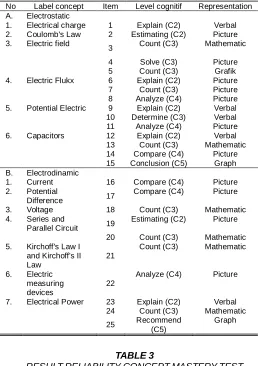
The topic of this study is electricity which consists of two topics, namely electrostatic and electrodinamic, these two sub-topics were chosen because they are very closely related to courses in the following semester. The concept mastery test questions are made in the form of multiple choice tests. The matrix concept mastery test can be seen in Table 2.
Based on Table 2, there are 15 questions on the topic of static electricity and 10 questions on the topic of dynamic electricity. Therefore, the total number of questions is 25 test questions concept mastery. Percentage of cognitive domain distribution 25 concept mastery questions based on bloom’s revision consisting of C1 to C6. That is 28% or 7 C2 questions, 40% or 10 C3 questions, 24% or 6 C4 questions, and 8% or 2 C5 questions. The following are examples of concept mastery questions with verbal representation, namely:
concept mastery questions with mathematic representation, namely:
concept mastery questions with graph representation, namely:
concept mastery questions with picture representation, namely:
TABLE 2
MATRIX CONCEPT MASTERY TEST
No Label concept Item Level cognitif Representation A. Electrostatic
1. Electrical charge 1 Explain (C2) Verbal 2. Coulomb's Law 2 Estimating (C2) Picture 3. Electric field
3 Count (C3) Mathematic 4 Solve (C3) Picture 5 Count (C3) Grafik 4. Electric Flukx 6 Explain (C2) Picture
7 Count (C3) Picture 8 Analyze (C4) Picture 5. Potential Electric 9 Explain (C2) Verbal 10 Determine (C3) Verbal 11 Analyze (C4) Picture 6. Capacitors 12 Explain (C2) Verbal 13 Count (C3) Mathematic 14 Compare (C4) Picture 15 Conclusion (C5) Graph B. Electrodinamic
1. Current 16 Compare (C4) Picture 2. Potential
Difference 17
Compare (C4) Picture
3. Voltage 18 Count (C3) Mathematic 4. Series and
Parallel Circuit 19
Estimating (C2) Picture
20 Count (C3) Mathematic 5. Kirchoff's Law I
and Kirchoff's II Law
21
Count (C3) Mathematic
6. Electric measuring devices
22
Analyze (C4) Picture
7. Electrical Power 23 Explain (C2) Verbal 24 Count (C3) Mathematic 25 Recommend
(C5)
Graph
TABLE 3
RESULTRELIABILITYCONCEPTMASTERYTEST
Topic N of item Cronbach’s Alpha
Electrostatic 15 0.709
Electrodinamic 10 0.703
Verbal Representation
2. There are three capacitors of 2 mF each. The capacitance of the capacitors if arranged in series and parallel are....
A. 1/3 mF and 4mF
B. 2/3 mF and 6 mF C. 4 mF and 1/3 mF D. 6 mF and 2/6 mF E. 5 mF and 3/6 mF
Mathematic Representation 5. Look at the graph below.
The graph shows the relationship between electric field E (N/C) with distance R (m). Based on the graph, if k is the constanta of electric field, the value of charge q is...?
Graph Representation
4. Look at the illustration of electric field lines that go through at the surface
Please predict which of the three picture has the same total flux? A. (iii), (ii), (i)
B. (iii) and (ii) C. (iii) and (i) D. (ii) and (i)
E. None has the same total flux
4.3 Development
At the development phase, validation and reliability tests were carried out 25 items multiple choice of concept mastery test. Validation was carried out for five expert judgement and reliability of the concept mastery test. The concept mastery test was tested on 50 students at one of the University at Lampung. The results of the validation of five expert judgement using Aiken's V formula in measuring aspects of language, construction, and language can be seen in diagram 1.
Based on the results obtained, the aspects of substance, construction, and language have an average score of each aspect above 0.5. This shows that the questions developed have good content validity based on expert judgment.
4.4 Evaluation
At the evaluation phase, an evaluation of the results of the validation and reliability of the concept mastery test consisted of 25 multiple choice test items that was implemented on 50 students. The reliability results of the concept mastery test questions can be seen in Table 3.The reliability category with conbach's alpha 0.709 on electrostatic topics and cronbach's alpha 0.703 on electrodynamic topics is included in the moderate reliability category (acceptable). Difficulty level analysis on 15 items of electrostatic topic mastery test items in the easy category amounted to 5 questions namely questions number 1, 3, 6, 8, and 9. Questions in the moderate category numbered 10 which were questions number 2, 4, 5, 7, 10, 11, 12, 13, 14 and 15. The questions in the difficult category are 0. While the difficulty index analysis for 10 items on the electrodynamic concept mastery test in the easy category is 2 item, namely item number 16 and 19. Item in the moderate category are 8, namely item number 17, 18, 20, 21, 22, 23, 24, and 25. Item in the difficult category are 0. The discrimination power analysis consists of four categories, namely: Excellent, good, fair, and poor (Arifin, 2009). Item in the excellent category on electrostatic topics number 10, namely item number 5, 6, 7, 8, 9, 10, 11, 12, 13, 14. Item in the good category amount to item number 1, 2, 4, and item in the category fair amounted to 2 item namely item number 3 and 15. Problems in the poor category are 0. Item in the excellent category on electrodynamic topics are 9 questions namely questions number 16, 17, 19, 20, 21, 22, 23, 24, and 25. Item in the good category number 1 item, namely item number 18. Items in the fair and poor category are 0. The concept mastery test consisting of 25 item is made by paying attention to four types of representations, namely verbal, mathematic, picture, and graph representations.
5
CONCLUSION
This study developed a concept mastery test. Concept mastery test questions consist of 25 multiple choice item with electrostatic and electrodinamic topics. The results of the study show the validation and reliability of the test items. Validation was carried out by five expert judgement with valid and reliability results showing alpha cronbach’s being for both topics, 0.709 for electrostatic topics and 0.703 for electrodinamic topics. Therefore, 25 items of the test are valid and reliable and can be used in physics course to find out the concepts mastery physics students. Concept mastery tests are designed using four types of representations, verbal, picture, mathematic and graphs. Therefore, this test can also be used to see the types of representations that are often used by students.
ACKNOWLEDGMENT
The authors wish to thank to all parties who assist in the collection of research data. This work was supported in part by a grant from Lembaga Pengelola Dana Pendidikan (LPDP) and to the program of Beasiswa Unggulan Dosen Indonesia dalam Negeri (BUDI-DN) for all of their support in this research. All activities and publications related to this research are funded and fully supported by LPDP.
REFERENCES
[1] Lam, K. W., Hassan, A., Sulaiman, T., & Kamarudin, N, ―Evaluating the Face and Content Validity of an Instructional Technology Competency Instrument for University Lecturers in Malaysia,‖ International Journal of Academic Research in Business and Social Sciences, vol.8, no.5, pp.367–385, 2018.
[2] Chiwaridzo, M., Chikasha, T. N., Naidoo, N., Dambi, J. M., Tadyanemhandu, C., Munambah, N., & Chizanga, P. T, ―Content validity and test-retest reliability of a low back pain questionnaire in Zimbabwean adolescents‖, Archives of Physiotherapy, vol.7, no.3, 1-12. doi: 10.1186/s40945-017-0031-y. 2017.
[3] Sikorskii, A., and Noble, P. C, ―Statistical considerations in the psychometric validation of outcome measures,‖ Clinical Orthopaedics and Related Research, vol.471, pp.3489–3495. doi: 10.1007/s11999-013-3028-1, 2013. [4] Goldin, I. M., Pinkus, R. L., & Ashley, K, ―Validity and
reliability of an instrument for assessing case analyses in bioengineering ethics education,‖ Science and Engineering Ethics, vol. 21 no. 3, pp. 789–807. doi: 10.1007/s11948-015-9644-2. 2015.
[5] Wong, K.L., Ong, S.F., & Kuek, T.Y. (2012). Constructing a survey questionnaire to collect data on service quality of business academics. European Journal of Social Sciences, 29, 209-21. Retrieved from http://eprints.utar.edu.my/860/1/6343.pdf.
[6] Zamanzadeh, V., Ghahramanian, A., Rassouli, M., Abbaszadeh, A., Alavi-Majd, H., and Ali-Reza Nikanfar, A-R,‖ Design and Implementation Content Validity Study: Development of an instrument for measuring Patient-Centered Communication,‖ J Caring Sci, vol.4, no.2, pp.165–178. doi: 10.15171/jcs.2015.017, 2015.
[7] Azwar, S. Reliabilitas dan validitas. Yogyakarta, Pustaka Pelajar, 2017.
[8] R. W. Dahar, Teori Belajar dan Pembelajaran. Jakarta, Penerbit Erlangga. 2011.
[9] B.S. Bloom, Taxonomy of educational objectives (Ed.).
776 New York, David McKay Company Inc, 1964.
[10]Moore, T. J., Miller, R. L. Lesh, R. A., Stohlmann, M. S., & Kim, Y. R. Modeling in Engineering: The Role of Representational Fluency in Students’Conceptual Understanding. Journal of Engineering Education, vol.102, no.1, pp.141-178, 2013.
[11]R.D. Klausner, National Science Education Standards, National Academy Press. Washington DC, 1996.
[12]J. Maknun, ―The Implementation of Generative Learning Model on Physics Lesson to Increase Mastery Concepts and Generic Science Skills of Vocational Students,‖ American Journal of Educational Research, vol.3, no.6, 742-748, 2015.
[13]J. Dolin, ―Representational form in physics,‖ Makalah Third International Conference of the European Science Education Research Association, August, 2001.
[14]M. Hill, M. Sharma, J. O’Byrne, and J. Airey, ―Developing and Evaluating a Survey for Representational Fluency in Science,‖ International Journal of Innovation in Science and Mathematics Education, vol.22, no.5, 22-42, 2014. [15]Z. Arifin, Evaluasi pembelajaran. Bandung, PT Remaja
Rosdakarya Publiser, pp. 271-274, 2009.
[16]N. L. Ritter, ―Understanding a Widely Misunderstood Statistic: Cronbach’s α. Texas: A&M University,‖ Annual Meeting of the Southwest Educational Research Association, New Orleans, February 18, 2010.
[17]Ekolu, Stephen O., & Quainoo, H, ―Reliability of assessment I engineering education using Cronbach’s alpha, KR, and split half methods,‖ Global journal of Engineering Education, vol.21, no.1, pp. 24-29, 2019. [18]K.S. Taber, ―The use of cronbach’s alpha when developing
and reporting research Instrument in Science Education,‖ Res Sci Educ, vol.48, pp.1273-1296, 2017.