Open Access
Research article
Current practice of abdominal wall closure in elective surgery – Is
there any consensus?
Nuh N Rahbari
†1, Phillip Knebel
†1, Markus K Diener
1,
Christoph Seidlmayer
2, Karsten Ridwelski
3, Hartmut Stöltzing
4and
Christoph M Seiler*
1Address: 1Study Centre of the German Surgical Society, University of Heidelberg, Heidelberg, Germany, 2Department of General and Visceral Surgery, St Bonifatius-Krankenhaus, Lingen, Germany, 3Department of General and Visceral Surgery, Städtisches Klinikum, Magdeburg, Germany and 4Department of General, Visceral, and Trauma Surgery, Robert-Bosch-Krankenhaus, Stuttgart, Germany
Email: Nuh N Rahbari - [email protected]; Phillip Knebel - [email protected]; Markus K Diener - [email protected]; Christoph Seidlmayer - [email protected]; Karsten Ridwelski - [email protected]; Hartmut Stöltzing - [email protected];
Christoph M Seiler* - [email protected] * Corresponding author †Equal contributors
Abstract
Background: Development of incisional hernia after open abdominal surgery remains a major cause of post-operative morbidity. The aim of this study was to determine the current practice of surgeons in terms of access to and closure of the abdominal cavity in elective open surgery.
Methods: Twelve surgical departments of the INSECT-Trial group documented the following variables for 50 consecutive patients undergoing abdominal surgery: fascial closure techniques, applied suture materials, application of subcutaneous sutures, subcutaneous drains, methods for skin closure. Descriptive analysis was performed and consensus of treatment variables was categorized into four levels: Strong consensus >95%, consensus 75–95%, overall agreement 50– 75%, no consensus <50%.
Results: 157 out of 599 patients were eligible for analysis (85 (54%) midline, 54 (35%) transverse incisions). After midline incisions the fascia was closed continuously in 55 patients (65%), using slowly absorbable (n = 47, 55%), braided (n = 32, 38%) sutures with a strength of 1 (n = 48, 57%). In the transverse setting the fascia was closed continuously in 39 patients (72%) with slowly absorbable (n = 22, 41%) braided sutures (n = 27, 50%) with a strength of 1 (n = 30, 56%).
Conclusion: In the present evaluation midline incision was the most frequently applied access in elective open abdominal surgery. None of the treatments for abdominal wall closure (except skin closure in the midline group) is performed on a consensus level.
Background
Approximately 700.000 open abdominal procedures are performed annually in Germany and 4.000.000 in the
United States [1]. Development of incisional hernia remains the major postoperative wound complication after open abdominal surgery with a stable incidence of
Published: 15 May 2009
BMC Surgery 2009, 9:8 doi:10.1186/1471-2482-9-8
Received: 2 January 2009 Accepted: 15 May 2009 This article is available from: http://www.biomedcentral.com/1471-2482/9/8
© 2009 Rahbari et al; licensee BioMed Central Ltd.
5% to 24% over the last decades [2,3]. Regarding patho-genesis of incisional hernias, the incision type (midline vs. transverse vs. oblique) and the strategy of fascia clo-sure, i.e. the combination of applied suture technique (interrupted vs. continuous) and suture material (mono-filament vs. braided; absorbable (rapidly, intermediately, slowly) vs. non-absorbable) are the main factors amena-ble to the surgeon.
There is still controversy about the best strategy for abdominal wall closure due to inconsistent and incom-plete evidence provided by several randomized controlled trials (RCT) [4-8] as well as meta-analyses [9-12]. Based on the lack of data from well-designed long-term surgical trials, a large multi-centre randomized controlled trial (interrupted or continuous slowly absorbable sutures – evaluation of abdominal closure techniques, INSECT-Trial) recruited 624 patients between 2004 and 2006 with the rationale to compare the most relevant surgical prac-tices for abdominal fascia closure after primary midline laparotomy [13]. Participating surgeons raised the follow-ing two questions durfollow-ing conduction of the INSECT-Trial:
1. Is midline incision still the most frequently applied access to the abdominal cavity in elective situations?
2. Has consensus for abdominal wall closure already been established in surgical routine?
The primary objective of this cross sectional study was therefore to identify current practice of abdominal cavity access and closure in elective surgery.
Methods
Study populationTwelve of the 25 participating centres of the INSECT-Trial group agreed in contribution to data acquisition (see acknowledgment). The local ethics committees of partici-pating centres granted ethical approval for the study These include hospitals of all levels of health care (county/com-munity, private, and university hospitals), thus ensuring representative study results. Surgeons at these hospitals were asked to assess surgical access and closure methods of 50 consecutive patients who underwent surgery at their service. Patients who underwent more than one operation during the study period were excluded.
Study design
The study was designed as a cross-sectional cohort study and performed between July and August 2005. A stand-ardized data entry form was designed in order to collect the following information: patient's gender and age, set-ting of surgery (elective vs. emergency surgery), surgical approach (open vs. laparoscopic surgery), history of pre-vious abdominal surgery, type of applied abdominal
inci-sion (transverse vs. midline), suture material used for fascia closure (monofilament vs. braided, suture strength, absorption features), the technique used for fascia closure (interrupted sutures, continuous suture or combinations), the use of subcutaneous suture and subcutaneous drain-age, and the method of skin closure. Classification of suture strengths was reported according to the United States Pharmacopeia XXII (1990).
All data entry forms were sent in an anonymous fashion to the Study Centre of the German Surgical Society and analyzed accordingly using Statistical Analysis System (SAS) version 9.1. Descriptive statistics were used in uni-variate analyses.
Levels of consensus
The treatment of patients were categorized into four levels of consensus according to a classification of Hoffmann et al. [14]:
1. Strong consensus: treatment applied in >95% of cases
2. Consensus: treatment applied in 75–95% of cases
3. Overall agreement: treatment applied in 50–75% of cases
4. No consensus: treatment applied in <50% of cases
Results
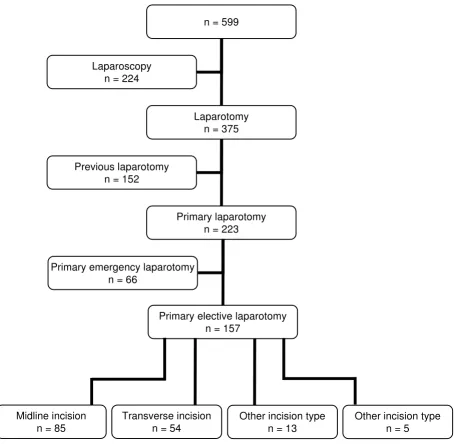
A total of 599 patient data entry forms out of 600 with an equal distribution of genders (49% men, 51% women) and a mean age of 57 years (SD 19 years) were available for analysis. An open approach was chosen in 375 patients (63%), a laparoscopic in 224 patients (37%). After exclusion of patients with previous open abdominal surgery, an emergency procedure, and laparoscopic proce-dures, a total of 157 patients with primary elective laparotomy were available for further analysis (Figure 1).
Access to the abdominal cavity
Of all patients with elective primary laparotomy (n = 157), midline incisions were performed in 85 patients (54%), transverse incisions (crossing the midline) in 54 patients (35%) and miscellaneous incisions (e.g. parame-dian and subcostal incisions) in 13 patients (8%).
Closure of the abdominal wall
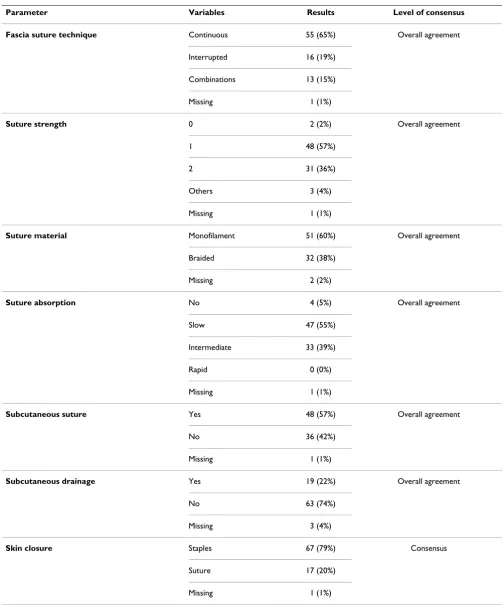
(38%). Non-absorbable sutures were chosen in four cases (5%), slowly absorbable sutures in 47 patients (55%), and moderately rapid absorbable sutures in 33 patients (39%). Sutures with the strength of 0 were used in two patients (2%), with strength of 1 in 48 patients (57%), and with strength of 2 in 31 patients (36%).
Subcutaneous suture was performed in 48 patients (57%) and a subcutaneous drain was placed in 19 patients (22%). Skin closure of patients who received midline inci-sions was performed with staples in 67 cases (79%).
In terms of consensus levels all technical features for clo-sure of midline incisions met the level of "overall agree-ment", except the item of skin closure for which the level of "consensus" was reached (Table 1).
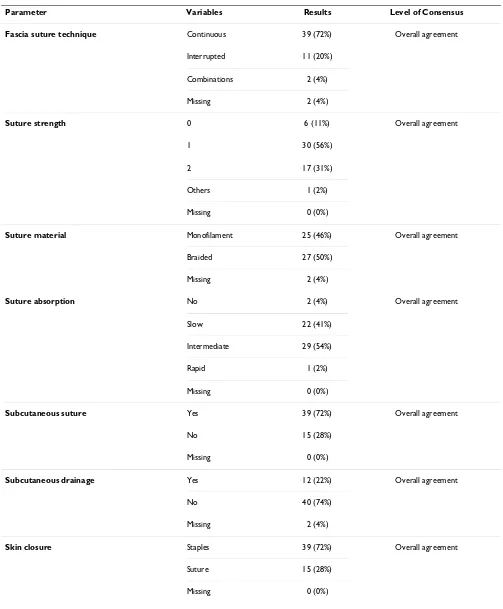
Abdominal fascia of patients who had a transverse inci-sion (n = 54) was sutured continuously in 39 patients (72%), interruptedly in eleven patients (20%), and with a combination of both techniques in two patients (4%). Suture material with the strength was 0 were chosen in 6 patients (11%), with a strength of 1 in 30 patients (56%)
Flow-chart on the number of available data entry forms and patients included in the final analysis
Figure 1
Flow-chart on the number of available data entry forms and patients included in the final analysis.
n = 599
Laparotomy n = 375 Laparoscopy
n = 224
Primary laparotomy n = 223 Previous laparotomy
n = 152
Primary elective laparotomy n = 157
Primary emergency laparotomy n = 66
Midline incision n = 85
Transverse incision n = 54
Other incision type n = 13
Table 1: Technical features for abdominal wall closure after elective and open primary midline laparotomies (n = 85)
Parameter Variables Results Level of consensus
Fascia suture technique Continuous 55 (65%) Overall agreement Interrupted 16 (19%)
Combinations 13 (15%) Missing 1 (1%)
Suture strength 0 2 (2%) Overall agreement 1 48 (57%)
2 31 (36%) Others 3 (4%) Missing 1 (1%)
Suture material Monofilament 51 (60%) Overall agreement Braided 32 (38%)
Missing 2 (2%)
Suture absorption No 4 (5%) Overall agreement Slow 47 (55%)
Intermediate 33 (39%) Rapid 0 (0%) Missing 1 (1%)
Subcutaneous suture Yes 48 (57%) Overall agreement No 36 (42%)
Missing 1 (1%)
Subcutaneous drainage Yes 19 (22%) Overall agreement No 63 (74%)
Missing 3 (4%)
Skin closure Staples 67 (79%) Consensus
and with a strength of 2 in 17 patients (31%). Monofila-ment sutures were applied for fascia closure of 25 patients (46%) and braided sutures for 27 patients (50%). In two patients (4%) non-absorbable sutures, in 22 patients (41%) slowly absorbable sutures, in 29 patients (54%) moderately rapid absorbable sutures, and in one patient (2%) rapidly absorbable sutures were applied.
Thirty-nine patients (72%) received a subcutaneous suture; a subcutaneous drain was placed in 12 patients (22%). Skin closure of patients who received midline inci-sions was performed with staples in 39 cases (72%).
All technical features for closure of transverse incisions reached the level of "overall agreement" (Table 2).
Discussion
In the present analysis midline incision is still the most frequent access to the abdominal cavity in elective surgery. No consensus for fascia closure either for midline or trans-verse incisions in daily practice of abdominal surgery was detected (>75% of surgeons acting similarly). Use of sta-ples for skin closure after midline incisions was the only item that reached the level of consensus.
Our finding that midline incisions are the most frequently applied access in open abdominal surgery is in accordance with previous reports [15]. While the abdominal access may to some degree depend on the target organ it was our aim to assess the overall frequency of midline incisions that would support the rationale of the INSECT-Trial. However, it appears valuable to perform further studies to evaluate the relative frequency of midline and transverse incisions in well-defined patient populations. The urgency of the intervention (i.e. elective vs. emergency laparotomy) as well as the target organ are critical factors to be considered for determination of the population under study. A recent Cochrane review indicated that transverse incisions are potentially less painful and less frequently associated with pulmonary complications, but failed to show a clear advantage for a reduction of inci-sional hernias [16] when compared to midline incisions. Further data analyzing the patient's perspective (i.e. post-operative pain) in a blinded randomized fashion are needed for evidence-based surgical decision making. Cur-rently, both incision types may be used in daily practice of elective surgery depending on the surgeons preference.
The lack of consensus for abdominal wall closure strate-gies after midline incisions demonstrates persistent uncer-tainty within the surgical community. Several RCTs [4-8] and meta-analyses [9-12] were published comparing dif-ferent closure methods of midline abdominal incisions. In a critical appraisal of meta-analyses in the surgical liter-ature [17] two of these meta-analyses have been found to
be of low methodological quality [9,11]. The meta-analy-sis by Hodgson et al. was of high quality and reported sig-nificantly less incisional hernias after closure with continuous non-absorbable sutures but also found signif-icantly more suture sinuses and wound pain requiring fur-ther interventions. This material was not used in the present survey which demonstrates the harm caused by this material in practice. Unfortunately, the authors com-pared absorbable and non-absorbable materials only and did not distinguish between rapidly and slowly absorbing sutures [10,12]. Therefore, a further meta-analysis was performed by van't Riet et al. [12] which was not evalu-ated in the above mentioned critical appraisal, but can be considered to be well-designed according to the methods of the Cochrane collaboration. However, it failed to show a clear superiority of one strategy regarding the prevention of incisional hernia, if all details of closure technique, clo-sure material, and needle type are taken into account [12]. In particular, it could not demonstrate a significant advan-tage between interrupted rapidly absorbable and continu-ous slowly absorbable sutures in terms of incisional hernia development. The rationale of the INSECT-Trial was based on these findings [13].
According to our data, there is no consensus in closure of transverse incisions either. Closure technique of the abdominal fascia with a continuous suture and skin clo-sure with staples were the only items that almost reached the level of consensus (both performed in 72%). In con-trast to midline incisions, however, so far no randomized trial has been solely conducted in order to investigate clo-sure techniques in this setting. Hence, the ideal cloclo-sure strategy is still to be determined. From some trials com-paring closure techniques in midline incisions [5,18,19] part of the data, concerning transverse closure procedures only, can be extracted. Looking at these subgroups, results show approximately equal incidence of incisional hernias between 4% and 10% in interrupted versus continuous closure procedures. However, these trials have not been designed to prove equivalence or superiority of either technique. Data from further high-quality RCTs are awaited in order to resolve this open question.
The results of our study might be affected due to bias. The participating hospitals of the INSECT-Trial who agreed to contribute to this study may be a subgroup of hospitals dedicated to clinical research and therefore act differently to other hospitals (e.g. surgeons agree to randomize their patients). However, it is unlikely that such an effect might have systematically shifted the results in favour of consen-sus.
Table 2: Technical features for abdominal wall closure after elective and open primary transverse laparotomies (n = 54)
Parameter Variables Results Level of Consensus
Fascia suture technique Continuous 39 (72%) Overall agreement Interrupted 11 (20%)
Combinations 2 (4%) Missing 2 (4%)
Suture strength 0 6 (11%) Overall agreement 1 30 (56%)
2 17 (31%) Others 1 (2%) Missing 0 (0%)
Suture material Monofilament 25 (46%) Overall agreement Braided 27 (50%)
Missing 2 (4%)
Suture absorption No 2 (4%) Overall agreement Slow 22 (41%)
Intermediate 29 (54%) Rapid 1 (2%) Missing 0 (0%)
Subcutaneous suture Yes 39 (72%) Overall agreement No 15 (28%)
Missing 0 (0%)
Subcutaneous drainage Yes 12 (22%) Overall agreement No 40 (74%)
Missing 2 (4%)
Skin closure Staples 39 (72%) Overall agreement Suture 15 (28%)
is prevented due to a consecutive recruitment and meas-urement bias due to standardized data collection. Further-more, surgeons of the INSECT-Trial group were trained in data collection during specific preparatory INSECT-Trial meetings [20]. Other study designs (e.g. surveys) have been used and detected, similar to our findings, consider-able differences between availconsider-able evidence and daily practice in abdominal wall closure [21]. However, large, prospective cohort studies would be required to more ulti-matel answer the question what the most frequently applied abdominal access and fascial closure techniques are. These studies would require separate study manage-ment and in particular extra funding. We are therefore confindent that our data may still provide a valuable pic-ture of current practice.
Currently, no clinical guidelines are available for abdom-inal wall closure after any type of incision. Further well designed pragmatic randomized controlled trials are nec-essary to support a development of such evidence-based guidelines and to change the current practice. Otherwise a reduction of incisional hernias seems unfeasible and treat-ment remains on the level of "overall agreetreat-ment". The results of the recently published INSECT-Trial certainly contribute to the body of evidence on abdominal fascia closure techniques[22]. Furthermore, the unexpected high incidence of incisional hernias in all study arms warrants further research in this field.
Conclusion
In conclusion, midline incisions were the predominant type of abdominal access in the present study of partici-pating centers of the INSECT-Trial. There is no consensus regarding the strategy for closure of the abdominal fascia after midline and transverse incisions.
Competing interests
The authors declare that they have no competing interests.
Authors' contributions
NNR: Study design, data analysis and interpretation, drafting of the manuscript PK: Study design, data acquisi-tion, data analysis, revsion of the manuscript. MKD: Data acquisition, analysis and interpretation, revsion of the manuscript. CS: Study design, data acquisition, data inter-pretation, revision of the manuscript. KR: Study design, data acquisition, data interpretation, revision of the man-uscript. HS: Study design, data acquisition, data interpre-tation, revision of the manuscript. CMS: Study design, data acquisition, data analysis and interpretation, drafting of the manuscript.
Acknowledgements
Data collection for this study was performed by the following centres of the INSECT-Trial group: Klinikum Augsburg (M. Anthuber, K. Breitschaft), Westküstenklinikum Heide (F. Kallinowski, D. Schuhmann), Chirurgische
Universitätsklinik Heidelberg (M. W. Büchler, C. M. Seiler), St. Bonifatius-Krankenhaus Lingen (C. Seidlmayer), Klinikum Lüdenscheid (C. Kelm, E. Urbanek), Städtisches Klinikum Magdeburg (K. Ridwelski, M. Wiederhold), Chirurgische Universitätsklinik München-Grosshadern (K.-W. Jauch, F. Brandenburg), Klinikum Südstadt Rostock (K. Ludwig, T. Kätscher), Rob-ert-Bosch-Krankenhaus Stuttgart (K. Thon, H. Stöltzing), Krankenhaus Gerresheim Düsseldorf (B. Ulrich, M. Lienert), Krankenhaus Wermel-skirchen (J. Buchholz), Westpfalz-Klinikum Kaiserslautern (B. Koch, H. Becker).
The INSECT-Trial is in part funded by BBD-Aesculap GmbH, Tuttlingen, Germany. The SDGC is funded by the German Federal Ministry of Educa-tion and Research [Bundesministerium für Bildung und Forschung (BMBF); 01GH99033]
References
1. Conze J, Klinge U, Schumpelick V: [Incisional hernia]. German. Chirurg 2005, 76:897-909.
2. Israelsson LA, Jonsson T: Incisional hernia after midline laparot-omy: a prospective study. Eur J Surg 1996, 162:125-129. 3. Hoer J, Lawong G, Klinge U, Schumpelick V: [Factors influencing
the development of incisional hernia. A retrospective study of 2,983 laparotomy patients over a period of 10 years]. Chirurg 2002, 73:474-480.
4. Wissing J, van Vroonhoven TJ, Schattenkerk ME, Veen HF, Ponsen RJ, Jeekel J: Fascia closure after midline laparotomy: results of a randomized trial. Br J Surg 1987, 74:738-741.
5. Gislason H, Gronbech JE, Soreide O: Burst abdomen and inci-sional hernia after major gastrointestinal operations – com-parison of three closure techniques. Eur J Surg 1995,
161:349-354.
6. Niggebrugge AH, Hansen BE, Trimbos JB, Velde CJ van de, Zwaveling A: Mechanical factors influencing the incidence of burst abdomen. Eur J Surg 1995, 161:655-661.
7. Rink AD, Goldschmidt D, Dietrich J, Nagelschmidt M, Vestweber KH:
Negative side-effects of retention sutures for abdominal wound closure. A prospective randomised study. Eur J Surg
2000, 166:932-937.
8. Hsiao WC, Young KC, Wang ST, Lin PW: Incisional hernia after laparotomy: prospective randomized comparison between early-absorbable and late-absorbable suture materials. World J Surg 2000, 24:747-751.
9. Rucinski J, Margolis M, Panagopoulos G, Wise L: Closure of the abdominal midline fascia: meta-analysis delineates the opti-mal technique. Am Surg 2001, 67:421-426.
10. Hodgson NC, Malthaner RA, Ostbye T: The search for an ideal method of abdominal fascial closure: a meta-analysis. Ann Surg 2000, 231:436-442.
11. Weiland DE, Bay RC, Del Sordi S: Choosing the best abdominal closure by meta-analysis. Am J Surg 1998, 176:666-670. 12. van't Riet M, Steyerberg EW, Nellensteyn J, Bonjer HJ, Jeekel J:
Meta-analysis of techniques for closure of midline abdominal inci-sions. Br J Surg 2002, 89:1350-1356.
13. Knaebel HP, Koch M, Sauerland S, Diener MK, Buchler MW, Seiler CM, INSECT Study Group of the Study Centre of the German Surgi-cal Society: Interrupted or continuous slowly absorbable sutures – design of a multi-centre randomised trial to evalu-ate abdominal closure techniques INSECT-trial [ISRCTN24023541]. BMC Surg 2005, 5:3.
14. Hoffmann JC, Fischer I, Hohne W, Zeitz M, Selbmann HK: [Method-ological basis for the development of consensus recommen-dations] Methodische Grundlagen fur die Ableitung von Konsensusempfehlungen. Z Gastroenterol 2004, 42:984-986. 15. Ellis H: Midline abdominal incisions. Br J Obstet Gynaecol 1984,
91:1-2.
16. Brown SR, Goodfellow PB: Transverse verses midline incisions for abdominal surgery. Cochrane Database Syst Rev 2005,
4:CD005199.
Publish with BioMed Central and every scientist can read your work free of charge "BioMed Central will be the most significant development for disseminating the results of biomedical researc h in our lifetime."
Sir Paul Nurse, Cancer Research UK
Your research papers will be:
available free of charge to the entire biomedical community
peer reviewed and published immediately upon acceptance
cited in PubMed and archived on PubMed Central
yours — you keep the copyright
Submit your manuscript here:
http://www.biomedcentral.com/info/publishing_adv.asp
BioMedcentral
18. Greenall MJ, Evans M, Pollock AV: Midline or transverse laparot-omy? A random controlled clinical trial. Part I: Influence on healing. Br J Surg 1980, 67:188-190.
19. Sahlin S, Ahlberg J, Granstrom L, Ljungstrom KG: Monofilament versus multifilament absorbable sutures for abdominal clo-sure. Br J Surg 1993, 80:322-324.
20. Knaebel HP, Kirschner MH, Reidel MA, Buchler MW, Seiler CM:
[Operative standardization in randomized controlled surgi-cal trials. Meeting of the INSECT trial] Operative Standard-isierung bei randomisiert kontrollierten Studien in der Chirurgie. Studientreffen der INSECT-Studie. Chirurg 2006,
77:267-272.
21. Hodgson NC, Malthaner RA, Ostbye T: Current practice of abdominal fascial closure: a survey of Ontario general sur-geons. Can J Surg 2001, 44:366-370.
22. Seiler CM, Bruckner T, Diener MK, Papyan A, Golcher H, Seidlmayer C, Franck A, Kieser M, Buchler MW, Knaebel HP: Interrupted or Continuous Slowly Absorbable Sutures For Closure of Pri-mary Elective Midline Abdominal Incisions: A Multicenter Randomized Trial (INSECT: ISRCTN24023541). Ann Surg
2009, 249(4):576-82.
Pre-publication history
The pre-publication history for this paper can be accessed here: