Open Access
Research article
A self administered reliable questionnaire to assess lower bowel
symptoms
Barbara-Ann Adelstein*
1, Les Irwig
1, Petra Macaskill
1, Peter H Katelaris
2,
David B Jones
2and Les Bokey
3Address: 1Screening and Test Evaluation Program (STEP), School of Public Health, University of Sydney, Australia, 2Gastroenterology Dept,
Concord Hospital, University of Sydney, Australia and 3Department of Colon and Rectal Surgery, Concord Hospital, University of Sydney,
Australia
Email: Barbara-Ann Adelstein* - [email protected]; Les Irwig - [email protected]; Petra Macaskill - [email protected]; Peter H Katelaris - [email protected]; David B Jones - [email protected]; Les Bokey - [email protected]
* Corresponding author
Abstract
Background: Bowel symptoms are considered indicators of the presence of colorectal cancer and other bowel diseases. Self administered questionnaires that elicit information about lower bowel symptoms have not been assessed for reliability, although this has been done for upper bowel symptoms. Our aim was to develop a self administered questionnaire for eliciting the presence, nature and severity of lower bowel symptoms potentially related to colorectal cancer, and assess its reliability.
Methods: Immediately before consulting a gastroenterologist or colorectal surgeon, 263 patients likely to have a colonoscopy completed the questionnaire. Reliability was assessed in two ways: by assessing agreement between patient responses and (a) responses given by the doctor at the consultation; and (b) responses given by patients two weeks later.
Results: There was more than 75% agreement for 78% of the questions for the patient-doctor comparison and for 92% of the questions for the patient-patient comparison. Agreement for the length of time a symptom was present, its severity, duration, frequency of occurrence and whether or not medical consultation had been sought, all had agreement of greater than 70%. Over all questions, the chance corrected agreement for the patient-doctor comparison had a median kappa of 65% (which represents substantial agreement), interquartile range 57–72%. The patient-patient comparison also showed substantial agreement with a median kappa of 75%, interquartile range 68–81%.
Conclusion: This self administered questionnaire about lower bowel symptoms is a useful way of eliciting details of bowel symptoms. It is a reliable instrument that is acceptable to patients and easily completed. Its use could guide the clinical consultation, allowing a more efficient, comprehensive and useful interaction, ensuring that all symptoms are assessed. It will also be a useful tool in research studies on bowel symptoms and their predictive value for colorectal cancer and other diseases. Studies assessing whether bowel symptoms predict the presence of colorectal cancer should provide estimates of the reliability of the symptom elicitation.
Published: 1 March 2008
BMC Gastroenterology 2008, 8:8 doi:10.1186/1471-230X-8-8
Received: 24 September 2007 Accepted: 1 March 2008
This article is available from: http://www.biomedcentral.com/1471-230X/8/8
© 2008 Adelstein et al; licensee BioMed Central Ltd.
Background
Bowel symptoms are considered indicators of the pres-ence of colorectal cancer and other bowel diseases. How-ever, there is a dearth of reliable self administered questionnaires that elicit information about lower bowel symptoms.
Details of bowel symptoms are usually obtained from patients as part of a face-to-face clinical consultation. However, a self administered questionnaire may be an efficient way of eliciting such information for clinical care and screening programs. Self reported questionnaires about bowel symptoms have been used successfully to assess patients with upper gastrointestinal disease, to dis-criminate between organic and functional bowel disease and to assess faecal incontinence and constipation [1-8]. The reliability of some of these questionnaires has also been assessed.
Questionnaires to assess lower bowel symptoms relevant to colorectal cancer have also been developed. However, the importance of symptoms is disputed. Some papers suggest that specific symptoms may be useful to predict colorectal cancer [9-16], while others have found no asso-ciation for any symptoms [17-21]. One of the reasons for this disparity in results may be the quality of symptom elicitation; yet we could find little research assessing the reliability of the questionnaire items used.
The aim of this study is to develop and assess the reliabil-ity of an accessible and acceptable questionnaire about bowel symptoms with particular relevance to colorectal cancer, which can be used clinically and for research.
Methods
Questionnaire design
Content and face validity was achieved by basing the questionnaire on literature review to determine question content, with emphasis placed on symptoms that may have predictive value for colorectal cancer, and on estab-lished questionnaires [3,5,22,23]. Gastroenterologists and colorectal surgeons were asked to comment on the relevance and clarity of the questions, and an iterative process with these specialists was undertaken to decide which symptoms to include and how to word the ques-tions.
Accessibility (understanding of the questions, and that the questions ask what they purport to ask) was achieved by interviewing 20 patients who completed the initial draft of the questionnaire while waiting to see their gastroenter-ologist or surgeon in consultation. Changes suggested by this process were included in the questionnaire, and the process repeated until no further problems were found.
Readability of the questionnaire was assessed from Micro-soft Word 2003 using the Flesch reading score and the Fle-sch-Kincaid reading level. The questionnaire has a Flesch-Kincaid Reading Grade Level of 4.6 and a Flesch Reading Ease score of 78.9. These scores are based on the average number of syllables per word and words per sentence. The Flesch-Kincaid Grade Level score rates text based on the U.S. high school grade level system (i.e. a score of 4.0 would mean a 4th grader should be able to comprehend the text). The Flesch Reading Ease score is based on a 100 point scale; the higher the score, the easier it is to compre-hend. "Plain English" has a score of 65, which has an aver-age sentence length of 15 to 20 words, and an averaver-age word of two syllables [24].
The questionnaire we developed captures the information about the presence or absence of symptoms, their charac-teristics including severity, duration and timing, and whether the symptom alone was regarded as serious enough to prompt seeking medical advice. The questions were presented in a flow diagram format, with connecting arrows. The questionnaire was presented in a stapled booklet format, and consisted of 10 pages of questions, and a cover page for the participant's name and instruc-tions for completing the questionnaire. There were 12 questions about bowel symptoms. These had an initial question asking about the presence of the symptom. If the symptom was present, the participant was directed to fur-ther subquestions about detail of that symptom. An exam-ple of a question is shown in Figure 1. The full questionnaire is shown in the attached file [see Additional file 1]. The questionnaire generally takes less than 15 min-utes to complete.
Assessing agreement
The study was conducted with gastroenterologists and colorectal surgeons at the Concord Repatriation General Hospital, Sydney, Australia. The study was approved by the University of Sydney and Central Sydney Area Health Service (CRGH Zone) Ethics Committees.
Patients attending for consultation were invited to partic-ipate. Those patients with predominantly lower gastroin-testinal symptoms in the referral letter, who might subsequently be advised to have a colonoscopy, were included. Participants completed the questionnaire in the waiting room immediately prior to their consultation with the doctor. Exclusion criteria were patients younger than 18 years, and insufficient English proficiency to com-plete the questionnaire.
Example of a page from the questionnaire
Figure 1
Example of a page from the questionnaire.
2. In the past few months, have you had pain in or around (outside) your back passage (anus)?
Go to question 3 on next page Yes
No
I don't know
Go to question 3 on next page Yes
No
2e. Have you been to see a doctor specifically about this pain in or around your back passage?
Almost constantly A few hours or less A few minutes or less
2d. In general, how long does this pain in or around your back passage last? 2c. In general, how bad is this pain/discomfort in or around your back passage?
Daily
2 - 3 times a week
Weekly
Monthly
Every few months 1 or 2 episodes only
2b. On average, how often do you ge t this pain/discomfort in or around your back passage?
2a. How long ago did this pain or discomfort start?
More than 2 years 1 - 2 years 1 - 12 months 2 - 4 weeks Less than 2 weeks
Very mild (I can usually ignore the pain)
Mild (I can ignore the pain if I don't think about it)
Moderate (I can't ignore the pain, but it does not stop me doing the things I usually do)
Severe (The pain sometimes stops me doing the things I usually do)
is little evidence for this assumption, our approach was to assess the reliability of the questionnaire, which is a meas-ure of the extent to which the same measmeas-urements of indi-viduals obtained under different conditions yield similar results [25]. We assessed two components of reliability: reproducibility (the closeness of results obtained in the same test material under a change of observer – inter-observer comparison) by assessing agreement between patients and doctors, and repeatability (the closeness of results obtained in the same test material by the same observer (intra-observer comparison) by assessing agree-ment within patients.
The study therefore had two components: patient-doctor agreement, and patient-patient agreement. Patient-doctor agreement was assessed in one group of patients by paring the results obtained from the questionnaire com-pleted by the patient with those from a clinical interview undertaken during the patient's usual consultation with the specialist, immediately after the patient completed the questionnaire. The specialist completed an identical ques-tionnaire, blinded to the patient's response to the self-administered questionnaire.
Patient-patient agreement was assessed in a separate, independent group of patients by comparing the results obtained from the self-administered patient question-naire completed immediately prior to their consultation with the doctor with those from a second identical ques-tionnaire which was mailed to participants. In the second questionnaire, patients were asked to answer the ques-tions as they remembered their symptoms when they saw their doctor. Where participants did not return the ques-tionnaire, another questionnaire was mailed to them a few weeks later. No incentives were offered for participa-tion.
Testing took place in two phases. Following an initial phase, minor changes were made to the questionnaire. These changes were mainly changing free text answers to tick box responses (based on the answers obtained in the free text form in the initial questionnaire), or to the word-ing of the options given. For questions that were changed, results are reported only from the second testing phase. Where questions were unchanged between the two ques-tionnaires, the results are reported from both phases.
Statistical Analysis
Analysis was done using SAS (version 8.02) software. The proportion of responses showing absolute agreement was calculated. The kappa statistic (κ), a measure of agreement that represents the proportion of agreement beyond that expected by chance alone, was also calculated. κ can range between 1 (perfect agreement), and 0 (level of agreement expected by chance alone); κ > 0.80 is considered to reflect
almost perfect agreement, κ between 0.61 and 0.80 sub-stantial agreement, 0.41–0.60 moderate agreement, 0.21–0.40 fair agreement, and κ < 0.20 poor agreement [26]. Where the responses to the questions were ordinal, a weighted kappa, using linear weights, has been used.
When assessing agreement for subquestions that were asked if a particular symptom was reported, a category of "symptom not reported" was included in the analysis. Hence, all participants were included to take account of disagreements in the reporting of the presence of the symptom.
McNemar's test has been used to assess whether, for disa-greements, there was evidence of a systematic direction for the disagreements. For the patient-doctor study, this assessed whether responses were more commonly reported by patients or by doctors, and for the patient-patient component, this assessed whether responses were more commonly reported on the first or second occasion.
Results
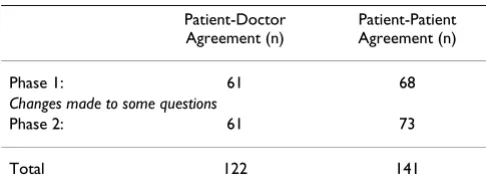
A total of 263 participants completed the questionnaire (patient-doctor study: n = 122; patient-patient study: n = 141) (see Table 1). For the patient-patient agreement study, there was an 88% response rate for return of the second questionnaire. The second questionnaire was completed an average of 4.2 weeks after the first.
Patient-Doctor Agreement Study
There were 7 participating specialists: 3 gastroenterolo-gists saw 74 (61%) patients, and 4 colorectal surgeons saw 48 (39%) patients. A total of 122 patients participated. The age range of participants was 21 to 83 years (mean age, 53 years); 58% were male. Thirty percent had a terti-ary education (university degree), and a further 20% had a diploma or trade qualification.
Bleeding per rectum, abdominal pain and change in bowel habit were the most frequently reported symptoms (see Table 2). Patients reported up to 12 (range 0 to12) symptoms each (average 9.3, median 5), and doctors reported up to 11 (range 0 to11) symptoms (average 8.5, median 4) per patient.
Table 1: Study description and numbers participating
Patient-Doctor Agreement (n)
Patient-Patient Agreement (n)
Phase 1: 61 68
Changes made to some questions
Phase 2: 61 73
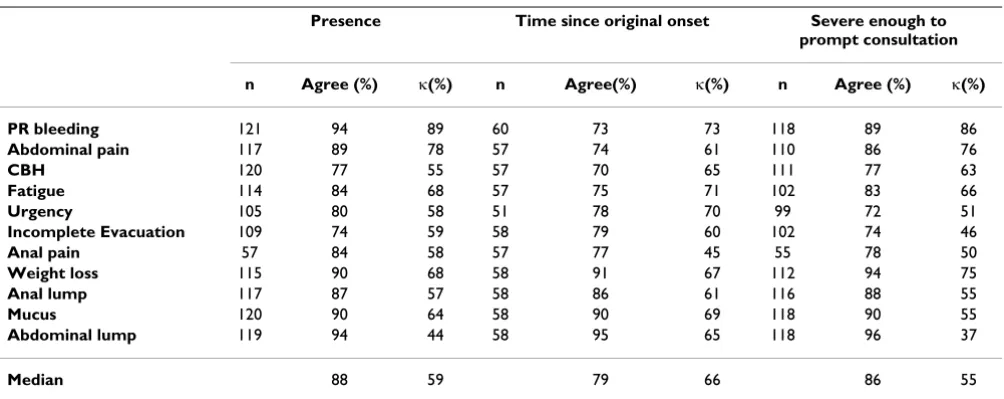
Comparison of the patient-completed and doctor-com-pleted responses show that in 78% of all questions there was more than 75% agreement (agreement range 65%–96%, median 81%, interquartile range 75–89%). Eight percent (8%) of questions had a κ > 80%, indicating perfect agreement; 58% had a κ between 61 and 80%, indicating substantial agreement; 30% had a κ between 41 and 60%, indicating moderate agreement only 4% (2 questions) had a κ < 40%, indicating fair agreement. The median κ overall was 65% (range 34–89%; interquartile range 57–72%).
Questions were grouped and analysed according to the detail they elicited about the symptom (Table 3). The main question (which elicited information about the presence of a symptom) had a median κ of 59% (inter-quartile range 57% to 68%) and median agreement of 88% (interquartile range 83%–91%). The duration of symptoms had a median κ of 61% (interquartile range 59% to 64%) and median agreement of 78% (interquar-tile range 75% to 80%), and the frequency of occurrence had a median κ of 70% (interquartile range 52% to 73%) and median agreement of 75% (interquartile range 74%
Table 3: Agreement and κ(%) between question detail categories: Patient- Doctor comparison
Presence Time since original onset Severe enough to prompt consultation
n Agree (%) κ(%) n Agree(%) κ(%) n Agree (%) κ(%)
PR bleeding 121 94 89 60 73 73 118 89 86
Abdominal pain 117 89 78 57 74 61 110 86 76
CBH 120 77 55 57 70 65 111 77 63
Fatigue 114 84 68 57 75 71 102 83 66
Urgency 105 80 58 51 78 70 99 72 51
Incomplete Evacuation 109 74 59 58 79 60 102 74 46
Anal pain 57 84 58 57 77 45 55 78 50
Weight loss 115 90 68 58 91 67 112 94 75
Anal lump 117 87 57 58 86 61 116 88 55
Mucus 120 90 64 58 90 69 118 90 55
Abdominal lump 119 94 44 58 95 65 118 96 37
Median 88 59 79 66 86 55
Note: n refers to the total number of patients and doctors answering this question (for the time since onset, the results are based only on the second phase questionnaire). CBH = Change in bowel habit
Table 2: Symptom: frequency (ranked by proportion of patients with the symptom in the patient-doctor agreement study)
Patient-Doctor Study Patient-Patient Study
Patient Doctor Patient (first questionnaire)
Symptom present % Symptom present % Symptom present %
PR Bleeding 55 45 54 44 53 38
Abdominal pain 53 45 48 40 69 50
Change Bowel Habit 52 43 50 41 65 46
Fatigue 39 34 39 32 47 34
Urgency 45 41 37 32 50 37
Incomplete Evacuation 42 38 32 27 60 44
Anal pain* 15 26 13 21 19 26
Weight loss 18 16 21 17 21 15
Anal lump 23 20 14 11 17 12
Mucus 14 12 18 15 21 15
Anaemia 9 8 7 6 17 12
Abdominal lump 7 6 3 2 6 4
Notes: For the doctor agreement study, n = 122 except for missing responses (maximum 8) or where indicated by asterisk; for patient-patient study n = 141, except for missing responses (maximum 7) or where indicated by asterisk.
to 76%). Compared to other symptom detail, severity of a symptom had the highest median κ of 73% (interquartile range 72%–74%), and median agreement of 77% (inter-quartile range 77% to 78%). Information about other symptom detail is given in Table 3.
When assessing disagreement between the patient and doctor responses, only 4 (out of total of 50 questions) showed evidence of a systematic difference (p < 0.05). Of these, two questions showed a higher response from doc-tors than patients: 9% more for whether an anal lump was severe enough to prompt consultation (p = 0.01) 12% more for whether or not urgency was severe enough to prompt consultation (p = 0.02). Two questions showed a higher response from patients than doctors: 10% more for how long anal lump had been present (p = 0.03) and 7% more for the presence of mucus (p = 0.02).
Patient-Patient Agreement Study
Patients were recruited from 9 participating specialists, with 49% of patients attending gastroenterologists and 51% attending colorectal surgeons. A total of 141 patients participated. The age range of patients was 24 to 87 years (mean age of 59 years); 55% percent of the participants were male. Thirty three percent had a tertiary education (university degree), and a further 16% having a diploma or trade qualification.
Abdominal pain, change in bowel habits and a feeling of incomplete evacuation were the symptoms most com-monly reported by patients. Rectal bleeding was the fourth most common symptom (Table 2). Patients reported up to 13 (range 0 to 13) symptoms each (average of 11.2 symptoms, median 5) in the first questionnaire,
and up to 12 (range 0 to12) symptoms (average 9 symp-toms, median 4) in the second questionnaire.
Comparison of the first and second patient responses showed that in 92% of questions there was more than 75% agreement (agreement range 68%–99%, median 86%, interquartile range 81–92%). Thirty four percent (34%) of questions had a κ > 80%, indicating perfect agreement; 52% had a κ between 61 and 80%, indicating substantial agreement; 30% had a κ between 41 and 60%, indicating moderate agreement; 12% had a κ between 21 and 40%, indicating fair agreement only 2% (1 questions) had a κ < 20%, indicating poor agreement.
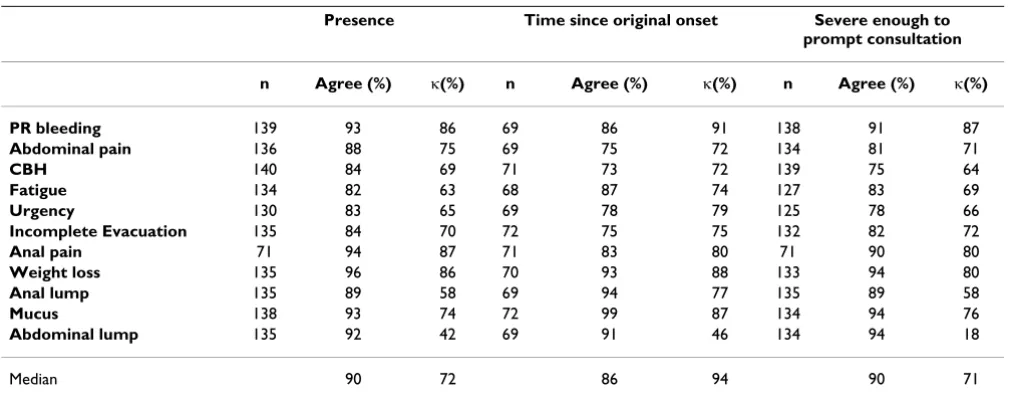
Questions were grouped and analysed according to the detail they elicited about the symptoms (Table 4). The main question (which elicited information about the presence of a symptom) had a median κ of 72% (inter-quartile range 65 to 78%) and median agreement of 90% (interquartile range 84 to 93%). The duration of symp-toms had a median κ of 77% (interquartile range 75 to 79%) and median agreement of 84% (interquartile range 81 to 86%), frequency of occurrence had a median κ of 81% (interquartile range 80 to 83%) and median agree-ment of 83% (interquartile range 79 to 83%), and severity of a symptom had a median κ of 71% (interquartile range 65 to 78%), and median agreement of 87% (interquartile range 83 to 91%). Information about other symptom detail is given in Table 4.
When assessing disagreement between the first and sec-ond patient responses, only 3 (out of total of 50 ques-tions) showed evidence of a systematic difference (p < 0.05). Of these, 2 questions showed a higher response in
Table 4: Agreement and κ(%) between question detail categories: Patient- Patient comparison
Presence Time since original onset Severe enough to prompt consultation
n Agree (%) κ(%) n Agree (%) κ(%) n Agree (%) κ(%)
PR bleeding 139 93 86 69 86 91 138 91 87
Abdominal pain 136 88 75 69 75 72 134 81 71
CBH 140 84 69 71 73 72 139 75 64
Fatigue 134 82 63 68 87 74 127 83 69
Urgency 130 83 65 69 78 79 125 78 66
Incomplete Evacuation 135 84 70 72 75 75 132 82 72
Anal pain 71 94 87 71 83 80 71 90 80
Weight loss 135 96 86 70 93 88 133 94 80
Anal lump 135 89 58 69 94 77 135 89 58
Mucus 138 93 74 72 99 87 134 94 76
Abdominal lump 135 92 42 69 91 46 134 94 18
Median 90 72 86 94 90 71
the first questionnaire: 7% more for the presence of abdominal pain (p = 0.03) and 4% more for whether the pain woke the patient at night (p = 0.04). By contrast, in their second questionnaire, 13% more of patients reported a longer time that a change in bowel habit had been present (p = 0.04).
Comparison of agreement between patient-doctor and patient-patient completed questionnaires
The kappa values for patient-patient agreement were con-sistently higher than those for patient-doctor agreement (Table 4). This is shown graphically in Figure 2 for the main questions (presence of symptoms). The patient-patient kappa values and agreement are also higher than the patient-doctor values for the questions relating to time since onset of the symptom, its frequency, severity and whether it was considered severe enough to prompt med-ical consultation.
Discussion
A questionnaire should meet several criteria: it must elicit information of relevance (content validity); the questions must ask what they purport to ask (face validity); it must
be accessible; and information obtained must show good agreement between patient and doctor and within patients (patient-patient). Our questionnaire meets these criteria. Compared to general medical history taking and clinical examination, the kappa values and agreement are good [26]. They are similar to those reported for question-naires applied to upper gastrointestinal disease or faecal incontinence [2,3,5,7,8,22,23].
Our questionnaire was completed by the patient in the waiting room immediately prior to their consultation with the specialist. It might be argued that, at that time, patients are more focussed on their symptoms or are dis-tracted by the imminent consultation. Nevertheless, there is good agreement between the questionnaires completed in the waiting room and those completed several weeks later, so that the timing of administration of the question-naire does not seem to be an important issue.
Bowel symptom history is usually taken by medical prac-titioners as part of a face-to-face consultation. We have used the data from the physician interview to assess agree-ment between this clinical history with that obtained from the patient. However, there is no research to show that the data from the physician's history of symptoms is more accurate than that obtained from patients. Indeed, it has also been shown that patients and doctors may have different perceptions of health problems, and of the importance of these [27]. Health questionnaires com-pleted by patients frequently capture more positive symp-toms than are elicited by doctors during consultation [28-30]. This is the case with our questionnaire, with patients reporting on average 1 more symptom than elicited by the specialists.
People presenting with bowel symptoms are often inves-tigated with colonoscopy. There is little high quality evi-dence to show which symptoms, if any apart from bleeding, improve the diagnostic yield of cancers or pre-cancerous polyps. While some papers suggest that symp-toms may be useful to predict colorectal cancer [9-14], others have found no association [17-21]. One recent study in the UK has suggested that a questionnaire can be used to elicit symptoms, and that these symptoms, com-bined with a weighted numerical score, can be used to predict colorectal cancer [15], and that this combination of symptoms performs better than other symptom groups proposed in cancer referral guidelines [16]. On the other hand, a large study in the USA has found that people with and without bowel symptoms show no difference in rates of colorectal cancer or polyps [31]. With the current drive towards public education about colorectal cancer symp-toms it is likely that that many more individuals with minimal symptoms might present for colonoscopy. The costs, both clinical and financial, of performing
colono-Scatterplot: Kappa agreement: presence of symptom
Figure 2
Scatterplot: Kappa agreement: presence of symp-tom. Note: the numbers in the plot refer to the question number. 1 = abdominal pain; 2 = anal pain; 3 = change in bowel habit; 4 = urgency; 5 = incomplete evacuation;; 6 = rectal mucus; 7 = rectal bleeding; 8 = fatigue; 9 = weight loss; 10 = abdominal lump; 11 = anal lump; 12 = anaemia.
1
2
3 4
5 6
7
8 9
10
11 12
0 20
40 60 80
100
0 20 40 60 80 100
patient-doctor
pa
t
ie
n
t
-p
a
t
ei
n
scopies and the implications for health service provision, both at individual and community levels, are therefore high. It is thus important to assess which symptoms pre-dict and which do not prepre-dict the presence of cancer, and an easily applied self administered questionnaire may provide a tool for use in this assessment.
Results in studies about the predictive value of symptoms may differ because of the quality of symptom elicitation. If symptom elicitation is inaccurate or incomplete, the predictive value of the symptoms will be diminished. Mis-classification in symptom elicitation between studies may therefore account for the differing study results. To allow adequate interpretation, studies of the predictive validity of symptoms should include estimates of the reliability of the questionnaire, using methods like we have presented.
Conclusion
Our study shows that this questionnaire is reliable means of assessing bowel symptoms, and is acceptable to patients. Potential application of the questionnaire includes use as part of the clinical consultation to enhance the consultation and to ensure that all patient symptoms are assessed. One of the strengths of this study is the assessment of the agreement between patients and their doctors. This agreement was good. On average, patients reported one more symptom than reported by the doctor. Use of the questionnaire could therefore facilitate discus-sion of all patient symptom concerns. Its use could guide the consultation, allowing a more efficient, comprehen-sive and useful interaction. It may also have use for research, for example to assess the significance and predic-tive value of symptoms for colorectal cancer, and as part of a bowel cancer screening program to elicit symptoms of potential significance. The questionnaire can be used as a reliable standardised instrument in studies to assess the predictive validity of symptoms for colorectal cancer.
Competing interests
The author(s) declare that they have no competing inter-ests.
Authors' contributions
BA and LI developed the core idea and designed the study. BA, PK and LI designed, revised and reviewed the ques-tionnaire. BA collected the data. BA and PM did the statis-tical analysis. PK, BJ and LB completed some of the doctor questionnaires. All authors interpreted the data and wrote the paper. All authors read and approved the final manu-script.
Additional material
Acknowledgements
We wish to thank the gastroenterologists and colorectal surgeons who participated in this study: Drs Gavin Barr, Grace Chapman, Charles McDonald, Matt Rickard, and Peter Stewart and Associate Professor Pierre Chapuis.
We also wish to thank Dr Elizabeth Davey for providing feedback on drafts of this paper.
This work was supported by Program Grant 211205 and 402764 from the National Health and Medical Research Council, Australia. The funding source had no involvement in the design, analysis, writing of the paper or decision to publish this work.
References
1. Osterberg A, Graf W, Karlbom U, Pahlman L: Evaluation of a ques-tionnaire in the assessment of patients with faecal inconti-nence and constipation. Scandinavian Journal of Gastroenterology
1996, 31(6):575-580.
2. Talley NJ, Phillips SF, Wiltgen CM, Zinsmeister AR, Melton LJ 3rd:
Assessment of functional gastrointestinal disease: the bowel disease questionnaire. Mayo Clinic Proceedings 1990,
65(11):1456-1479.
3. Talley NJ, Phillips SF, Melton J 3rd, Wiltgen C, Zinsmeister AR: A patient questionnaire to identify bowel disease. Annals of Inter-nal Medicine 1989, 111(8):671-674.
4. Frank L, Kleinman L, Farup C, Taylor L, Miner P Jr.: Psychometric validation of a constipation symptom assessment question-naire. Scandinavian Journal of Gastroenterology 1999, 34(9):870-877. 5. Agreus L, Svardsudd K, Nyren O, Tibblin G: Reproducibility and
validity of a postal questionnaire. The abdominal symptom study. Scandinavian Journal of Primary Health Care - Supplement 1993,
11(4):252-262.
6. Chisholm EM, de Dombal FT, Giles GR: Validation of a self admin-istered questionnaire to elicit gastrointestinal symptoms.
British Medical Journal Clinical Research Ed 1985,
290(6484):1795-1796.
7. Romero Y, Thistle JL, Longstreth GF, Harmsen WS, Schleck CD, Zinsmeister AR, Pardi DS, Zein CO, Van Dyke CT, Arora AS, Locke GR: A questionnaire for the assessment of biliary symptoms.
American Journal of Gastroenterology 2003, 98(5):1042-1051. 8. Reilly WT, Talley NJ, Pemberton JH, Zinsmeister AR: Validation of
a questionnaire to assess fecal incontinence and associated risk factors: Fecal Incontinence Questionnaire. Diseases of the Colon & Rectum 2000, 43(2):146-153.
9. Fijten GH, Starmans R, Muris JW, Schouten HJ, Blijham GH, Knot-tnerus JA: Predictive value of signs and symptoms for colorec-tal cancer in patients with reccolorec-tal bleeding in general practice. In Fam PractVolume 12. Issue 3 ENGLAND ; 1995:279-286. 10. Neugut AI, Garbowski GC, Waye JD, Forde KA, Treat MR, Tsai JL, Lee WC: Diagnostic yield of colorectal neoplasia with colon-oscopy for abdominal pain, change in bowel habits, and rec-tal bleeding. In Am J Gastroenterol Volume 88. Issue 8 UNITED STATES ; 1993:1179-1183.
Additional file 1
Bowel symptom questionnaire. Copy of the questionnaire used to elicit bowel symptoms
Click here for file
Publish with BioMed Central and every scientist can read your work free of charge "BioMed Central will be the most significant development for disseminating the results of biomedical researc h in our lifetime."
Sir Paul Nurse, Cancer Research UK
Your research papers will be:
available free of charge to the entire biomedical community
peer reviewed and published immediately upon acceptance
cited in PubMed and archived on PubMed Central
yours — you keep the copyright
Submit your manuscript here:
http://www.biomedcentral.com/info/publishing_adv.asp
BioMedcentral
11. Norrelund N, Norrelund H: Colorectal cancer and polyps in patients aged 40 years and over who consult a GP with rectal bleeding. Family Practice 1996, 13(2):160-165.
12. Staniland JR, Ditchburn J, de_Dombal FT: Clinical presentation of diseases of the large bowel. A detailed study of 642 patients.
In GastroenterologyVolume 70. Issue 1 UNITED STATES ; 1976:22-28. 13. Wauters H, Van Casteren V, Buntinx F: Rectal bleeding and color-ectal cancer in general practice: diagnostic study. Bmj 2000,
321(7267):998-999.
14. Curless R, French J, Williams GV, James OF: Comparison of gas-trointestinal symptoms in colorectal carcinoma patients and community controls with respect to age. Gut 1994,
35(9):1267-1270.
15. Selvachandran SN, Hodder RJ, Ballal MS, Jones P, Cade D: Predic-tion of colorectal cancer by a patient consultaPredic-tion quesPredic-tion- question-naire and scoring system: a prospective study. Lancet 2002,
360(9329):278-283.
16. Hodder RJ, Ballal M, Selvachandran SN, Cade D: Variations in the evaluation of colorectal cancer risk. Colorectal Disease 2005,
7(3):254-262.
17. Farrands PA, O'Regan D, Taylor I: An assessment of occult blood testing to determine which patients with large bowel symp-toms require urgent investigation. British Journal of Surgery 1985,
72(10):835-837.
18. Jensen J, Kewenter J, Swedenborg J: The correlation of symp-toms, occult blood tests, and neoplasms in patients referred for double-contrast barium enema. In Scand J Gastroenterol Vol-ume 28. Issue 10 NORWAY ; 1993:911-914.
19. Mant A, Bokey EL, Chapuis PH, Killingback M, Hughes W, Koorey SG, Cook I, Goulston KJ, Dent OF: Rectal bleeding. Do other symp-toms aid in diagnosis? In Dis Colon RectumVolume 32. Issue 3 UNITED STATES ; 1989:191-196.
20. Muris JW, Starmans R, Fijten GH, Crebolder HF, Krebber TF, Knot-tnerus JA: Abdominal pain in general practice. Family Practice
1993, 10(4):387-390.
21. Aldridge MC, Sim AJ: Colonoscopy findings in symptomatic patients without X-ray evidence of colonic neoplasms. Lancet
1986, 2(8511):833-834.
22. Talley NJ, Boyce PM, Owen BK, Newman P, Paterson KJ: Initial val-idation of a bowel symptom questionnaire and measure-ment of chronic gastrointestinal symptoms in Australians.
Australian & New Zealand Journal of Medicine 1995, 25(4):302-308. 23. Talley NJ, Jones M: Self-reported rectal bleeding in a United
States community: prevalence, risk factors, and health care seeking. American Journal of Gastroenterology 1998,
93(11):2179-2183.
24. Flesch RF: The art of readable writing. New York , Harper and Row; 1974.
25. Everitt BS: The Cambridge Dictionary of Statistics. United Kingdom , Cambridge University Press; 1998.
26. Sackett DL, Haynes RB, Guyatt GH, Tugwell P: Clinical Epidemiol-ogy: A Basic Science for Clinical Medicine. 2nd edition. Bos-ton/Toronto/London , Little, Brown and Company; 1991.
27. Scheuer E, Steurer J, Buddeberg C: Predictors of differences in symptom perception of older patients and their doctors.
Family Practice 2002, 19(4):357-361.
28. Sprangers MA, Aaronson NK: The role of health care providers and significant others in evaluating the quality of life of patients with chronic disease: a review. [Review] [109 refs].
Journal of Clinical Epidemiology 1992, 45(7):743-760.
29. Fromme EK, Eilers KM, Mori M, Hsieh YC, Beer TM: How accurate is clinician reporting of chemotherapy adverse effects? A comparison with patient-reported symptoms from the Quality-of-Life Questionnaire C30. Journal of Clinical Oncology
2004, 22(17):3485-3490.
30. Justice AC, Chang CH, Rabeneck L, Zackin R: Clinical importance of provider-reported HIV symptoms compared with patient-report. Medical Care 2001, 39(4):397-408.
31. Lieberman DA, de Garmo PL, Fleischer DE, Eisen GM, Chan BK, Hel-fand M: Colonic neoplasia in patients with nonspecific GI symptoms. Gastrointestinal Endoscopy 2000, 51(6):647-651.
Pre-publication history
The pre-publication history for this paper can be accessed here: