R E V I E W
Open Access
Skip metastases to lateral cervical lymph
nodes in differentiated thyroid cancer: a
systematic review
Andrea Attard
1, Nunzia Cinzia Paladino
2, Attilio Ignazio Lo Monte
1, Nicola Falco
1, Giuseppina Melfa
1, Giulia Rotolo
1,
Stefano Rizzuto
1, Eliana Gulotta
1, Giuseppe Salamone
1, Sebastiano Bonventre
1, Gregorio Scerrino
1*and Gianfranco Cocorullo
1Abstract
Papillary thyroid carcinoma is a slow-growing cancer with a generally good prognosis that sometimes have an aggressive behaviour. Metastases to neck lymph nodes is the first step of the diffusion. The central neck compartment is involved most commonly. The ipsilateral lateral neck compartments are usually involved afterwards, and the involvement of the contralateral one is considered a quite rare occurrence. In more rare cases, metastases to lateral neck compartment without central lymph node metastasis (so called“skip metastases”) could be observed. Aim of this literature review study is to analyse the average incidence, pattern and risk factors of this occurrence.
This study was performed according toPRISMAcriteria. A final selection of 13 articles published in English language from 1997 to 2017 was performed. Any research article, review or meta-analysis was taken into consideration. Research was expanded considering the related references of articles.
The incidence of skip metastases ranged from 1.6 to 21.8%. Risk factors such as age > 45 years, size < 5 mm and tumor located in the upper pole or isthmus of thyroid gland were found.
Due to the frequency of skip metastases in thyroid cancer, a careful preoperative examination of lateral lymph nodes should be necessary.
Keywords:Papillary thyroid carcinoma, Lymph node dissection, Skip metastasis
Introduction
Papillary thyroid carcinoma (PTC) is slow-growing can-cer and has generally a good prognosis for the majority of patients with a 5 years survival of 97–99% according to literature data [1–3].
Despite this excellent prognosis, some PTC and some-times papillary thyroid microcarcinoma (PTMC), have an aggressive medical behaviour with an increase in mortality in some patients, as a consequence of molecu-lar biology changes and other unclear causes [4–7].
Regional lymph node metastases are commonly ob-served in PTC and the risk of local regional recurrence
occurs in 30–80% of cases [4, 8]. The central neck re-gion is involved most commonly, increasing the overall morbidity and mortality as a potential consequence of increased risk of local recurrence [2, 5–7, 9, 10]. In spite of these observations, guidelines available up till now (2015 ATA guidelines) are cautious in extending indications for prophylactic central neck dissection (recommendation 36) and, on the other hand, restrict indication for lateral neck dissection only in the pres-ence of biopsy-proven metastatic lateral compartment involvement (recommendation 37) [11].
According to the majority of papers available in litera-ture, routine prophylactic node dissection is not indi-cated for all patients with PTC, in particular in small size tumors (T1 and T2) so pathological lymph nodes should be systematically identified preoperatively to avoid reoperation associated with a higher complication rate [2,3].
* Correspondence:[email protected]
1Policlinico“P. Giaccone”, Department of general emergency and transplant
surgery, Unit of general and emergency surgery, Palermo, Italy Full list of author information is available at the end of the article
The first anatomical site involved is the central com-partment followed by the ipsilateral lateral comcom-partment. Controlateral lateral compartment seems to be rarely in-volved [7,12,13].
The surgical treatment depends on the characteristics and evolution of PTC [5].
The risk factors of cervical metastases would appear to be the following: young age (< 45 years), multifocality, tumor size (> 0,5 cm) and site [6].
Zhang et al. [14] showed that the rate of lateral neck in the PTMC are located more frequently in upper pole than in middle portion of thyroid gland; in their experi-ence PTMC located in upper pole of thyroid gland was associated with a reduced incidence of central lymph nodes metastases.
Xiang et al. [6] find 57.5% of central metastases in the PTMC located in the middle third of the thyroid gland.
Other authors emphasize a correlation with PTC lo-cated in the upper pole and development of lateral neck metastases [6,7,14,15].
However, controversies remain regarding the correlation between tumor location and neck metastasis in PTMC [6].
Total Thyroidectomy with central neck dissection (CND) is recommended for patients with PTC according current guidelines but [6, 16] controversies still exists about the extension of cervical lymphadenectomy [6].
Despite the behaviour, some patients develop lateral lymph node metastasis without central lymph node me-tastasis. A lateral metastasis in the absence of a central one is defined skip metastasis.
According to literature, skip metastases occur with the dissemination of PTC cells through the lymphatic sys-tem gradually [5,13].
Its incidence is variable according different studies. In Jianyong Lei et al. experience, the incidence of skip metastases ranged from 6.8–37.5%.
According to other authors, this incidence varies be-tween 11.1 and 37.5% [13].
In literature, many articles describe cases of skip metas-tasis but their behaviour unpredictable and small patients sample reported make their characterization difficult.
The present study revised the literature concerning skip metastases, with the aim of analysing average inci-dence, their pattern and risk factors.
Materials and methods
This study was performed according toPRISMAcriteria [17]. According to these guidelines, the selection of pa-pers included has been carried out as follows.
Literature search strategy
A systematic and comprehensive review of full texts was realized with literature research on PubMed. It included articles published in English language from 1997 to
2017. Medical Subject Heading (MESH) used for inter-net research were:“thyroid skip metastases”,“recurrence thyroid cancer”, “papillary thyroid carcinoma metasta-ses”, “lymphadenectomy” with the Boolean operators AND or OR. In a first step of recruitment, all titles and abstracts of the identified studies for inclusion were eval-uated. In a second phase a screening of full-text con-cerned the qualitative assessment of studies.
Selection criteria
Clinical trials, systematic review and meta-analysis arti-cles were included. Case reports were considered only in the presence of substantial theoretical knowledge. Accord-ing to a collective decision of all Authors of this manu-script, we included in the systematic review all articles that reported incidence and described behaviour and risk factors of skip metastases. Our research was expanded considering the related references of articles. Articles concerning poorly differentiated or undifferentiated car-cinomas were excluded. Articles concerning pediatric pa-tients, concomitant diseases such as hyperparathyroidism, tumours arising from organs different from thyroid gland were also excluded.
Study selection
At first, a total of 49 articles were considered in compli-ance with search strategy. The search process, that led to the final 13 selected articles was carried out as in Fig.1.
Literature analysis
Incidence
The incidence of skip metastases varies in a wide range. Some studies analyse only its occurrence: Lee et al. [9] between 55 PTC analysed found 3 skip metastases; there are no other data on these 3 cases; Roh et al. [4] ana-lysed 22 patients who underwent surgery for lateral nodal recurrence of PTC and found three skip metasta-ses (14%). In another study the same Author [2], among 52 patients that underwent in all cases total thyroidec-tomy, CND and lateral neck dissection, found five skip metastases. (9.6%). According to Lei et al. [6], its inci-dence is 8.7%.
pluslateral neck dissection (LND), the authors found 12 with lateral metastases and 3 skip metastases (7.7%).
The biggest series published in the literature are re-ported in the following three articles that we want to highlight: Wada et al. [19] in 231 patients included, all treated with total thyropoidectomy (TT), CND and ipsi-lateral ipsi-lateral dissection, found 17 skip metastases; Xiao et al. [20] enrolled 121 patients that underwent TT with CND and LND and they found nine skip metastases. In
this study, a rate of incidence of 14.1% (9/64 lateral me-tastases) was reported.
Concerning the incidence, there is a wide variability from study to study.
Park et al. [15] report an average of 21.8% and finally Nie et al. [5] find an incidence of skip metastases of 14.8%.
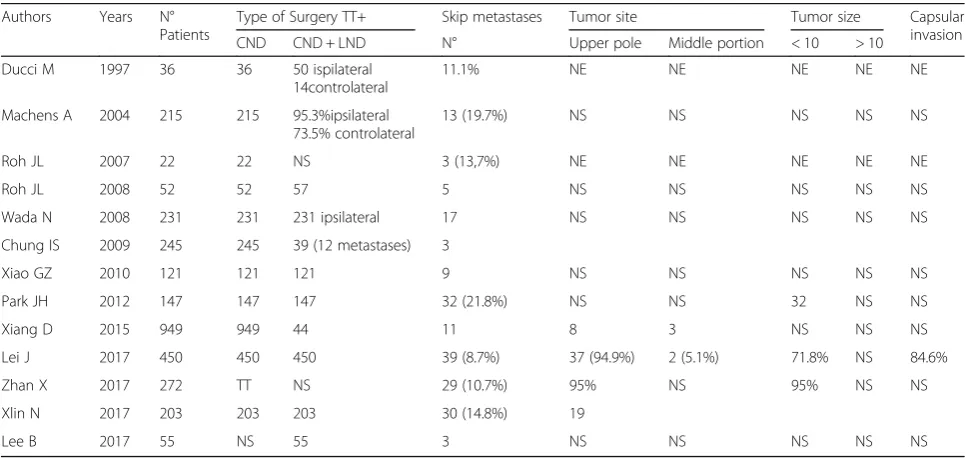
In summary, in all studies consulted the incidence of skip metastases ranges from 1.6 to 21.8% (Table1). Fig. 1Screening of search results
Table 1Studies published
Authors Years N°
Patients
Type of Surgery TT+ Skip metastases Tumor site Tumor size Capsular
invasion
CND CND + LND N° Upper pole Middle portion < 10 > 10
Ducci M 1997 36 36 50 ispilateral
14controlateral
11.1% NE NE NE NE NE
Machens A 2004 215 215 95.3%ipsilateral 73.5% controlateral
13 (19.7%) NS NS NS NS NS
Roh JL 2007 22 22 NS 3 (13,7%) NE NE NE NE NE
Roh JL 2008 52 52 57 5 NS NS NS NS NS
Wada N 2008 231 231 231 ipsilateral 17 NS NS NS NS NS
Chung IS 2009 245 245 39 (12 metastases) 3
Xiao GZ 2010 121 121 121 9 NS NS NS NS NS
Park JH 2012 147 147 147 32 (21.8%) NS NS 32 NS NS
Xiang D 2015 949 949 44 11 8 3 NS NS NS
Lei J 2017 450 450 450 39 (8.7%) 37 (94.9%) 2 (5.1%) 71.8% NS 84.6%
Zhan X 2017 272 TT NS 29 (10.7%) 95% NS 95% NS NS
Xlin N 2017 203 203 203 30 (14.8%) 19
Lee B 2017 55 NS 55 3 NS NS NS NS NS
Risk factors
From the analysis of literature, it would seem that site, size and capsular invasion of primary cancer could affect development of skip metastases. In support of this hy-pothesis, the article of Lei (6) showed that primitive PTC commonly had capsular invasion (84.6% vs 52.8%, P> 0.001), it was PTMC (71.8% vs 16.3%, P> 0.001), as confirmed in other articles [19] and most frequently was located in the upper thyroid portion except in two cases that were located in the middle portion. When all three risk factors (primary tumor located in the upper thyroid portion, tumor size < 10 mm and capsular invasion) were associated, the authors demonstrate the predictability of skip metastasis with the specificity of 0.98 and the Area Under Curve (AUC) was 0.7.
The importance of site of primary cancer is also em-phasized by Xiang [6]. In this study, CND was realized for all patients. For bilateral and multifocal tumors or cancer located in the isthmus, ipsilateral CND was per-formed (236 patients). Central neck metastases were found in 299 patients (31.5%) and lateral neck metasta-ses in 44 (4.6%). These 44 patients had lymphadenec-tomy from II to IV level. The skip metastases occurs only in tumors located in the upper poles (8 patients) and in middle portion of thyroid gland (3 patients).
These results confirm that the tumor site is an import-ant risk factor in the development of skip metastases. In this analysis, owing to small number of skip metastases found, no statistical conclusions were made. Chung [18] did not find any risk factor associated to skip metastases, probably because of the small number of cases of CND orLND (n= 3) and CND + LND (n= 9).
Zhan and coll [21] also underline the importance of association between tumor size (< 10 mm), tumor site (upper pole of thyroid gland) and age of patients (> 45 years old) to develop skip metastases.In their experience, 95% of patients with skip metastases had a PTC located in the upper pole.
In the article of Nie [5] the inverse relation between tumor size and incidence of skip metastases was empha-sized: in fact, the Author found it more frequently in PTMC especially when tumor size was≤5 mm.
Park and coll. [15] report that skip metastases were less common (12.5% vs 30.4%) with multifocal tumors. Moreover, there were no differences in terms of age, sex, tumor bilaterality, tumor extension in the group with and without skip metastases. On the contrary, a signifi-cant association between skip metastases, primary tumor location and size was showed. Tis could be explained by the possible correlation between skip metastases and tumor located in the upper pole for possibly migration via lymphatic drainage accompanying the superior thy-roid artery. In this study the primary tumor was < 1 cm, and presented single focus.
As regards as histology of primary tumor, from 215 patients included by Machens et al. [13] 66 were papil-lary, 8 follicular and 141 were medullary thyroid cancer. The Authors found 13 skip metastases (19.7%) in 66 papillary thyroid cancers and 30 (21.3%) in 141 medul-lary thyroid cancer.
Finally, capsular invasion and age > 45 years are pos-sible risk factors underlined in some studies [18,21].
Pattern and localization of metastases
Skip metastases showed most frequently Level II metas-tases and less usually Level III, IV and V metasmetas-tases. The PTC skip metastases showed a very high number of single-level metastases in the lateral compartment more rarely triple-and quadruple-level metastases [6,7].
According to Park [15] the group with skip metastases had an inferior number of metastases of lateral nodes (3.3 ± 2.5 vs. 5.8 ± 3.5; p< 0,001) probably because these were found more frequently at a single level (53.1% vs. 20%;p< 0.001). In the group with skip metastases, these were found more frequently at levels III or II, a single cervical level and only a single node were involved. In support of the pathophysiologic hypothesis concerning the role of lymphatic drainage running close the superior thyroid artery, the levels III and II were most frequently involved in patients with skip metastases, so primary tumor located in upper pole tends to metastasize to upper levels rather than to the others levels.
Discussion
The causes leading a metastasis to skip the central com-partment are not completely clarified yet. At present, only risks factors could be invoked and few pathogenetic mechanism would be assumed.
Zhang et al. [14] underlined the importance of age > 45 years (95%), presence of microcarcinoma (95%), tumor site (cancers located in the upper pole of the thyroid gland showed incidence of 95%).
To predict a possible existence of skip metastases and to know their natural history could help the surgeon in establishing surgical strategy, performing total thyroidec-tomy with adequate lymphecthyroidec-tomy especially avoiding reoperations for recurrence, with an increase in morbid-ity and a worsening in prognosis.
Tumor locations, age, sex and tumor size can be con-sidered strong risk factors and they can be useful in pre-operative stratification of patients.
In the most of articles concerning skip metastases, the first tumor is PTMC.
In a recent analysis is proven that tumor size > 0.5 is cor-related with both central and lateral metastases. In this ana-lysis tumor size > 0.5 cm is an important risk factor [7].
this analysis the authors show that the primary tumor lo-cation in the context of the upper pole of thyroid gland was significantly associated with lateral lymph node me-tastases (p= 0.000, OR = 10.471, 95%). In detail, in this analysis, a tumor located in the upper pole was more aggressive and it was correlated to development of skip metastases. This correlation can be explained by the lymphatic drainage system. Thyroid gland has rich lymph-atic drainage [9]. Most usually affected lymph node levels in differentiated thyroid carcinoma are those of the anter-ior compartment group (VI) and the internal jugular chain (II-III-IV); less often those of the posterior triangle group (V); submental (Ia) and submandibular (Ib) nodes are only exceptionally involved (Fig.1). An impressive work on ca-daveric dissection was performed and previously pub-lished in Japanese literature by Sato et al. in 1994 [22] and subsequently published in English for the first time by Likhterov et al. in 2017 [23]. In this publication, the lymphatic system draining the thyroid gland was closely evaluated to explain the patterns of metastatic spread in patients with PTC. The anatomy of lymphatic channels coming from the gland explains the different ways of DTC metastasization to cervical lymph nodes. Although the central compartment lymph nodes seem to be the first step of lymphatic drainage before tumour cell transit to the lateral compartment, lymphatic drainage through su-perior lymphatic channels is directed from the central neck directly to levels II and III of the lateral neck; this ex-plains the possibility of skip methastases occurrence.
Some authors [24–26] have reported that the lobes of thyroid gland have its own internal lymphatic system and no communication with controlateral regional lymph nodes. Although it is generally accepted that lymphatic drainage occurs from the thyroid primarily to the central lymphatic compartment and secondarily to the lateral compartment nodes, there are not many data about skip metastases and they are unpredictable.
Cervical metastasis occurs approximately in 35–80% of cases of PTC. They increase the risk of locoregional tumor recurrence and reoperation [9].
We would underline that most of selected studies have some limitations ad biases: as showed in Table 1, most papers did not report data about tumor size, site and capsular invasion.
As regards as treatment guidelines, complication commonly experienced from surgeons [27–35] that are more frequent after more extended neck proce-dures compared to standard thyroidectomy could in-fluence in its turn the choice of performing a neck dissection in the absence of proven localization at central or lateral lymph nodes. Finally, it should be taken into consideration that in high-risk patients lat-eral lymph node involvement seems to be more fre-quent [36–38].
Conclusion
In summary, according to this literature review, we can define “the high risk patient” by the following features: papillary or medullary PTMC located in upper pole or isthmus, unifocal. Due to frequency of skip metastases, that are rarely but not unusually found, a meticulous preoperative examination of all lateral lymph node com-partments, especially in a typical “high risk patient”, should be necessary. In these patients the lymph nodes suspected for metastatic involvement should be identi-fied at ultrasound exam, a biopsy should be also per-formed Moreover, a dosage of thyroglobulin in the eluate could confirm the diagnosis. Owing to the typical involvement of a single level a selective lateral neck dis-section of the involved compartment seems to be an ac-ceptable choice in most cases. The role of systematic lymphadenectomy is controversial considering the low aggressiveness of the PTC. However, it is necessary to distinguish patients at high risk to develop recurrences.
Total Thyroidectomy with extended lymphadenectomy may be indicated in high-risk patients, in whom lymph nodal recurrence is more frequent.
Abbreviations
AUC:Area under curve; CND: Central neck dissection; LND: Lateral neck dissection; MESH: Medical subject heading; PTC: Papillary thyroid carcinoma; PTMC: Papillary thyroid microcarcinoma; TT: Total thyroidectomy
Acknowledgements
Not applicable
Funding
None
Availability of data and materials
As a review study, the data are entirely available at PUBMED.
About this supplement
This article has been published as part ofBMC Surgery Volume 18 Supplement 1, 2018: Updates and New Technology in Endocrine Surgery. The full contents of the supplement are available online athttps:// bmcsurg.biomedcentral.com/articles/supplements/volume-18-supplement-1.
Authors’contributions
AA participated in the study conception and design, helped to draft the manuscript. PNC participated in the study conception and design, helped to draft and revising the manuscript. LMAI participated in the study conception, helped to revising the manuscript. FN participated in data collection. MG participated in data collection. RG participated in data collection. RS participated in data collection. GE participated in data collection. SG participated in data collection and selection of included references. BS participated in data collection and selection of included references. SG participated in the study conception and design, helped to draft and revising the manuscript. CG participated in study conception and substantially revised the manuscript for final approving. All authors read and approved the final manuscript.
Ethics approval and consent to participate
Not applicable
Consent for publication
Competing interests
The authors declare that they have no competing interests.
Publisher’s Note
Springer Nature remains neutral with regard to jurisdictional claims in published maps and institutional affiliations.
Author details
1
Policlinico“P. Giaccone”, Department of general emergency and transplant surgery, Unit of general and emergency surgery, Palermo, Italy.2Unit of
General, Endocrine and Metabolic Surgery, CHU AP-HM Hôpital de la Conception (Marseille), 147 Boulevard Baille, 13385 Marseille cedex, France.
Received: 3 October 2018 Accepted: 29 October 2018 Published: 24 April 2019
References
1. Lombardi CP, Bellantone R, De Crea C, Paladino NC, Fadda G, Salvatori M, Raffaelli M. Papillary thyroid microcarcinoma: extrathyroidal extension, lymph node metastases, and risk factors for recurrence in a high prevalence of goiter area. World J Surg. 2010;34:1214–122.
2. Roh JL, Kim JM, Park CI. Lateral cervical lymph node metastases from papillary thyroid carcinoma: pattern of nodal metastases and optimal strategy for neck dissection. Ann Surg Oncol. 2008;15(4):1177–82. 3. Scerrino AA, Melfa GI, Raspanti C, Di Giovanni S, Attard M, Inviati A, Mazzola
S, Modica G, Gulotta G, Bonventre S. Role of prophylactic central neck dissection in cN0-papillary thyroid carcinoma: results from a high-prevalence area. Minerva Chir. 2016;71(3):159–67.
4. Roh JL, Parck JY, Rha KS, Park CI. Is central neck dissection necessary for the treatment of lateral cervical nodal recurrence of papillary thyroid carcinoma? Head Neck. 2007;29(10):901–6.
5. Nie X, Tan Z, Ge M. Skip metastasis in papillary thyroid carcinoma is difficult to predict in clinical practice. BMC Cancer. 2017 Oct 25;17(1):702. 6. Xiang D, XieL XY, Li Z, Hong Y, Wang P. Papillary thyroid microcarcinomas
located at the middle part of the middle third of the thyroid gland correlates with the presence of neck metastasis. Surgery. 2015;157(3):526–33. 7. Lei J, Zhong J, Jiang K, Li Z, Gong R, Zhu J. Skip lateral lymph node
metastasis leaping over the central neck compartment in papillary thyroid carcinoma. Oncotarget. 2017;8(16):27022–33.
8. Scerrino G, Di Giovanni S, Salamone G, Melfa GI, Inviati A, Cristina R, Gulotta G. Surgical complications in prophylactic central neck dissection: preliminary findings from a retrospective cohort study. Minerva Chir. 2014;69(2(Suppl. 1)):131–4.
9. Lee BJ, Wang SG, Lee JC, Son SM, Kim IJ, Kim YK. Level IIb lymph node metastasis in neck dissection for papillary thyroid carcinoma. Arch Otholaryngol Head Neck Surg. 2017;133(10):1028–30.
10. Conzo G, Docimo G, Pasquali D, Mauriello C, Gambardella C, Esposito D, Tartaglia E, Della Pietra C, Napolitano S, Rizzuto A, Santini L. Predictive value of nodal metastases on local recurrence in the management of
differentiated thyroid cancer. Retrospective clinical study. BMC Surg. 2013; 13(Suppl 2):S3.
11. Haugen BR, Alexander EK, Bible KC, Doherty GM, Mandel SJ, Nikiforov YE, Pacini F, Randolph GW, Sawka AM, Schlumberger M, SI SKGS, Sosa JA, Steward DL, Tuttle RM, Wartofsky L. 2015 American Thyroid Association management guidelines for adult patients with thyroid nodules and differentiated thyroid Cancer: the American Thyroid Association guidelines task force on thyroid nodules and differentiated thyroid Cancer. Thyroid. 2016;26(1):1–133.
12. Goropoulos A, Karamoshos K, Christodoulou A, Ntitsias T, Paulou K, Samaras A, et al. Value of the cervical compartments in the surgical treatment of papillary thyroid carcinoma. World J Surg. 2004;28(12):1275–81. 13. Machens A, Holzhausen HJ, Dralle H. Skip metastases in thyroid cancer
leaping the central lymph node compartment. Arch Surg. 2004;139(1):43–5. 14. Zhang L, Wei WJ, Ji QH, Zhu YX, Zy W, Wang Y, et al. Risk factors for neck
nodal metastasis in papillary thyroid microcarcinoma: a study of 1066 patients. J Clin Endocrinol Metab. 2012;97:1250–7.
15. Park JH, Lee YS, Kim BW, Chang HS, Park CS. Skip lateral neck node metastases in papillary thyroid carcinoma. World J Surg. 2012;36(4):743–7. 16. Cooper DS, Doherty GM, Hunger BR, Kloos RT, Lee SL, Mandel SJ, et al.
Revised American Thyroid Association management guidelines for patients
with thyroid nodules and differentiated thyroid cancer. Thyroid. 2009;19: 1167–214.
17. Moher D, Liberati A, Tetzlaff J, Altman DG. PRISMA group, preferred reporting items for systematic reviews and meta-analyses: the PRISMA statement. Int J Surg. 2010;8(5):336–41.
18. Chung YS, Kim JY, Bae JS, Song BJ, Kim JS, Jeon HM, Jeong SS, Kim EK, Park WC. Lateral lymph node metastasis in papillary thyroid carcinoma: results of therapeutic lymph node dissection. Thyroid. 2009;19(3):241–6.
19. Wada N, Masudo K, Nakayama H, Suganuma N, Matsuzu K, Horakawa S,
Rino Y, Masuda M, Imada T. Clinical outcomes in older or younger patients with papillary thyroid carcinoma: impact of lymphadenopathy and patient age. Eur J Surg Oncol. 2008;34(2):202–7.
20. Xiao GZ, Gao L. Central Lymph Node Metastasis: Is It a Reliable Indicator of Lateral Node Involvement in Papillary Thyroid Carcinoma? World J Surg. 2010;34(2):237–41.
21. Zhan X, Xue S, Yin Y, Chen G. Related factors on skip metastasis of neck lymph node in papillary thyroid carcinoma. Zhonghua Wai Ke Za Zhi. 2017; 55(8):599–602.
22. Sato T, Sakamoto H, Heima S. Regional anatomy for head and neck surgery (13) thyroid gland (3). Otolaryngol Head Neck Surg (Tokyo). 1994;66:286–29. 23. Likhterov I, Reis LL, Urken ML. Central compartment management in
patients with papillary thyroid cancer presenting with metastatic disease to the lateral neck: anatomic pathways of lymphatic spread. Head Neck. 2017; 39(5):853–9.https://doi.org/10.1002/hed.24568.
24. Noguchi S, Noguchi A, Murakami N. Papillary carcinoma of the thyroid I. Developing pattern of metastasis. Cancer. 1970;26:1053–60.
25. Cruz LF, Astudillo E, Pera C. Lymphography of the thy- roid glands: is intraglandular dissemination of thyroid carcinoma possible? World J Surg. 1977;1:647–54.
26. Lim YC, Koo BS. Predictive factors of skip metastases to lateral neck compartment leaping central neck compartment in papillary thyroid carcinoma. Oral Oncol. 2012;48:262–5.
27. Tartaglia F, Salvatori FM, Pichelli D, Sgueglia M, Blasi S, Custureri F. Preoperative embolization of thyroid arteries in a patient with a large cervicomediastinal hyperfunctioning goiter. Thyroid. 2007;17(8):787–92. 28. Fingerhut A, Uranues S, Ettorre GM, Felli E, Colasanti M, Scerrino G, Melfa GI,
Raspanti C, Gulotta G, Meyer A, Oberhoffer M, Schmoeckel M, Weltert LP, Vignolini G, Salvi M, Masieri L, Vittori G, Siena G, Minervini A, Serni S, Carini M. European Initial Hands-On Experience with HEMOPATCH, a Novel Sealing Hemostatic Patch: Application in General, Gastrointestinal, Biliopancreatic, Cardiac, and Urologic Surgery. Surg Technol Int. 2014;25:29–35. 29. Romano G, Scerrino G, Profita G, Amato G, Salamone G, Di Buono G, Lo
Piccolo C, Sorce V, Agrusa A, Gulotta G. Terminal or truncal ligation of the inferior thyroid artery during thyroidectomy? A prospective randomized trial. nt J Surg. 2016;28(Suppl 1):S13–6.
30. Scerrino G, Attard M, Lo Piccolo C, Attard A, Melfa GI, Raspanti C, Zarcone M, Bonventre S, Mazzola S, Gulotta G. The coexistence of primary hyperparathyroidism and thyroid nodules: should the preoperative work-up of the parathyroid and the thyroid diseases be specifically adjusted? G Chir. 2016;37(3):123–9.
31. Tartaglia F, Blasi S, Giuliani A, Merola R, Livadoti G, Krizzuk D, Tortorelli G, Tromba L. Parathyroid autotransplantation during total thyroidectomy. Results of a retrospective study. Int J Surg. 2016;28(Suppl 1):S79–83. 32. Scerrino G, Inviati A, Di Giovanni S, Paladino NC, Di Giovanni S, Paladino NC,
Di Paola V, Raspanti C, Melfa GI, Cupido F, Mazzola S, Porrello C, Bonventre S, Gullotta G. Long-term esophageal motility changes after thyroidectomy: associations with aerodigestive disorders. G Chir. 2017;37(5):193–9. 33. Scerrino G, Tudisca C, Bonventre S, Raspanti C, Picone D, Porrello C,
Paladino NC, Vernuccio F, Cupido F, Cocorullo G, Lo Re G, Gulotta G. Swallowing disorders after thyroidectomy: what we know and where we are. A systematic review. Int J Surg. 2017;41(Suppl 1):S94–S102. 34. Melfa G, Porrello C, Cocorullo G, Raspanti C, Rotolo G, Attard A, Gullo R,
Bonventre S, Gulotta G, Scerrino G. Surgeon volume and hospital volume in endocrine neck surgery: how many procedures are needed for reaching a safety level and acceptable costs? A systematic narrative review. G Chir. 2018;39(1):5–11.
35. Lee YS, Shin SC, Lim YS, Lee JC, Wang SG, Son SM, Kim IJ, Lee BJ. Tumor location-dependent skip lateral cervical lymph node metastasis in papillary thyroid cancer. Head Neck. 2014;36:887–91.
36. Lo Monte AI, Palumbo VD, Damiano G, Maione C, Florena AM, Gioviale MC,
neoplasia in renal transplantation recipient: case report and review of the literature. Transplant Proc. 2011;43(4):1201–5.
37. Conzo G, Docimo G, Ruggiero R, Napolitano S, Palazzo A, Gambardella C, Mauriello C, Tartaglia E, Cavallo F, Santini L. Surgical treatment of papillary thyroid carcinoma without lymph nodal involvement. G Chir. 2012;33(10): 339–42.