R E S E A R C H A R T I C L E
Open Access
Utility-preserving anonymization for
health data publishing
Hyukki Lee
1, Soohyung Kim
2, Jong Wook Kim
3and Yon Dohn Chung
1*Abstract
Background: Publishing raw electronic health records (EHRs) may be considered as a breach of the privacy of individuals because they usually contain sensitive information. A common practice for the privacy-preserving data publishing is to anonymize the data before publishing, and thus satisfy privacy models such ask-anonymity. Among various anonymization techniques, generalization is the most commonly used in medical/health data processing. Generalization inevitably causes information loss, and thus, various methods have been proposed to reduce information loss. However, existing generalization-based data anonymization methods cannot avoid excessive information loss and preserve data utility.
Methods: We propose a utility-preserving anonymization for privacy preserving data publishing (PPDP). To preserve data utility, the proposed method comprises three parts: (1) utility-preserving model, (2) counterfeit record insertion, (3) catalog of the counterfeit records. We also propose an anonymization algorithm using the proposed method. Our anonymization algorithm applies full-domain generalization algorithm. We evaluate our method in comparison with existence method on two aspects, information loss measured through various quality metrics and error rate of analysis result.
Results: With all different types of quality metrics, our proposed method show the lower information loss than the existing method. In the real-world EHRs analysis, analysis results show small portion of error between the anonymized data through the proposed method and original data.
Conclusions: We propose a new utility-preserving anonymization method and an anonymization algorithm using the proposed method. Through experiments on various datasets, we show that the utility of EHRs anonymized by the proposed method is significantly better than those anonymized by previous approaches.
Keywords: Medical privacy, Data anonymization, Utility-preserving data publishing, K-anonymity
Background Motivation
In recent years, various health and medical institutions have collected a large amount of medical data, called Elec-tronic Health Records (EHRs). These data are valuable resources that can be used for the prevention of disease, medical decision making, and many other areas of health-care. Furthermore, various medical data besides EHRs are also widely used in the health domain [1, 2]. Accordingly, data owners have attempted to use the data gathered to
*Correspondence: [email protected]
1Department of Computer Science and Engineering, Korea University, 145
Anam-ro, Seongbuk-gu, 02841, Seoul, Republic of Korea Full list of author information is available at the end of the article
make profits through publishing or outsourcing of the data to research organizations.
However, the EHR data usually contain sensitive infor-mation such as diagnosis and medication. If data subjects pertaining to sensitive information are disclosed to others, privacy can be breached. For this reason, many coun-tries protect individuals’ privacy in data publishing by laws. These laws allow the publication of only privacy-preserved data. For example, the US Health Insurance Portability and Accountability Act (HIPAA) privacy rule grants the publication of medical information for public purposes without a patient’s consent, if the privacy is pre-served adequately. In European Union, privacy regulations are more strict. If data privacy is breached, the data have
to be erased [3]. Data anonymization can preserve pri-vacy by eliminating identifiability from the dataset, i.e., the link between sensitive information and people. However, removing Personally Identifiable Information (PII) is not sufficient for eliminating identifiability. A combination of characteristic information (e.g., sex, zipcode, and age), called quasi-identifiers, can play the role of an identifier [4]. To prevent the breach of privacy by quasi-identifiers,
k-anonymity was proposed [4].k-anonymity means each
record contained in a released dataset cannot be
distin-guished from at leastk-1 other individuals.k-anonymity is
used as the privacy criteria in real applications such as the ‘Family Educational Rights and Privacy Act’ (FERPA) [5] of US and the ‘Guidelines for De-identification of Personal Data’ of South Korea [6].
A typical method to achieve k-anonymity is
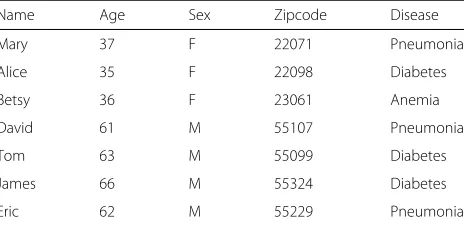
general-ization. Generalization involves transforming values of quasi-identifiers into more general values to make a per-son indiscernible from several people. For example, sup-pose that we release a 4-anonymous dataset for the raw
EHR dataset in Table 1, in whichnameis a direct
identi-fier,age, sex, and zipcodeare quasi-identifiers, anddisease
is a sensitive attribute. The identifier is removed, and the quasi-identifiers are generalized to anonymize the data; the sensitive information should not be removed or modified because it is a critical attribute for analysis. The anonymized result is shown in Table 2. Each record is generalized to an indistinguishable group, called the
equivalent class,<[35-66], *, [22071-55324]>. As a result of generalization, each record is related to at least three identical records, and thus, the dataset in Table 2 satisfies the 4-anonymity.
Note that anonymization achieved with generalization-only approaches inevitably distort the records. There-fore, over-generalization negatively affects the analysis of the anonymized dataset. For example, when perform-ing the age-period-cohort analysis usperform-ing Table 2, as the
age is over-generalized, it is difficult to obtain
mean-ingful results. In addition, it is important to prevent over-generalization, as the “doctor in the loop” paradigm increases, which the expert knowledge of the doctor is
Table 1Original EHR data
Name Age Sex Zipcode Disease
Mary 37 F 22071 Pneumonia
Alice 35 F 22098 Diabetes
Betsy 36 F 23061 Anemia
David 61 M 55107 Pneumonia
Tom 63 M 55099 Diabetes
James 66 M 55324 Diabetes
Eric 62 M 55229 Pneumonia
Table 24-anonymous version of Table 1
Age Sex Zipcode Disease
[ 35−66] * [ 22071−55324] Pneumonia
[ 35−66] * [ 22071−55324] Diabetes
[ 35−66] * [ 22071−55324] Anemia
[ 35−66] * [ 22071−55324] Pneumonia
[ 35−66] * [ 22071−55324] Diabetes
[ 35−66] * [ 22071−55324] Diabetes
[ 35−66] * [ 22071−55324] Pneumonia
incorporated into “intelligent” systems (e.g., using inter-active machine learning) and enriched with additional information and expert know-how [7].
However, anonymization with generalization-only
approaches cannot prevent over-generalization, because there is no other way to organize an equivalent class that
consists of dissimilar records for achievingk-anonymity.
To reduce over-generalization, several approaches were proposed [8–10]. Nevertheless, these methods still can-not avoid over-generalization for all records. Therefore, we propose utility-preserving anonymization to achieve
k-anonymity with high utility. In this method, we propose
a utility-preserving model to guarantee the prevention of over-generalization. Furthermore, we propose an anonymization method that satisfies the proposed model and preserves privacy as well.
Generalization, suppression, and relocation
In order to generalize the records, numerical attribute values are transformed into range values, and categori-cal attribute values are transformed into superordinate values. Taxonomy trees are usually employed to describe hierarchies of categorical attributes. Figure 1 shows the
taxonomy tree ofAgeattribute. The degree of
generaliza-tion is quantified as a number between 0 (i.e., minimum generalization) and 1 (i.e., maximum generalization). The
degrees of generalization for a numerical attributeanum
and a categorical attributeacatare computed as follows.
DA(anum)=
Uq−Lq
U−L (1)
DA(acat)= |
Mp| −1
|M| −1 (2)
Uq and Lq denote the upper bound and lower bound
of the generalized interval, respectively. U andLdenote
the maximum and minimum value of the whole domain,
respectively.Mdenotes the set of leaf nodes in the
tax-onomy tree andMp denotes the set of leaf nodes of the
[10-19]
[0-9] [20-29]
[0-29]
[40-49]
[30-39] [50-59]
[30-59]
[90-99] [90-99]
[0-59] [60-99]
*
(0-99)
[70-79]
[60-69] [80-89]
[60-99]
Fig. 1Taxonomy tree ofAgeattribute
The degree of generalization for the recordris
D(r)= 1 n
n
i=1
DA(ai) (3)
wherenis the number of attributes. For instance, in the
4-anonymous Table 2, Age is a numerical attribute and
its domain is [0-99]. Generalization degree forAgeof the
first record is (66 − 35)/(99 − 0) = 0.31. The other
attributes’ generalization degrees are(2−1)/(2−1)=1
and (33254 − 1)/(100000 − 1) = 0.33, respectively.
Therefore, the generalization degree of the first record is
(0.31+1+0.33)/3=0.55.
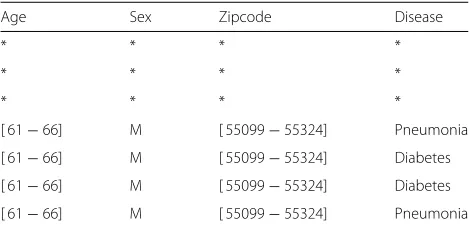
There are two types of anonymization methods that are used in conjunction with generalization for reduc-ing over-generalization: suppression and relocation [8, 9]. Suppression involves the removal of outliers, and relo-cation involves the changing of the quasi-identifiers of outliers. The presence of outliers is one of the main causes of over-generalization. This is because the outliers are dis-tant from other records, as well as the number of them is not sufficient that they can organize equivalent classes by themselves. In these methods, the values of outliers are removed or changed. Therefore, they can avoid organiz-ing an equivalent class that collects the outlier with other records, and can less generalize a majority of records. Table 3 is obtained from Table 1 by suppressing the first
Table 34-anonymous version of Table 1 with suppression
Age Sex Zipcode Disease
* * * *
* * * *
* * * *
[ 61−66] M [ 55099−55324] Pneumonia
[ 61−66] M [ 55099−55324] Diabetes
[ 61−66] M [ 55099−55324] Diabetes
[ 61−66] M [ 55099−55324] Pneumonia
three records. On the other hands, Table 4 is acquired by relocating the first three records in Table 1. Quasi-identifiers of the first three records are relocated to the quasi-identifiers of the other records. By the suppression and relocation of outlier records, the remaining records are not over-generalized.
Data utility
The main objective ofk-anonymization is privacy
protec-tion; however, it is also important that the anonymized dataset should be as useful as possible. There are
vari-ous k-anonymization of a given dataset, but one having
the highest utility is desirable. In PPDP, a data owner does not know how the published data will be analyzed by recipients, thus the data utility is measured by the quality of the anonymized dataset. We mainly focus on information loss and data truthfulness for assessing data utility, because these can cover the entire quality of the anonymized dataset in the proposed method (the details will be described later). Information loss refers to the amount of loss caused by generalization. Data truthful-ness implies that each anonymized record corresponds to a single original record [11]. Relocated records cannot cor-respond to original records; thus, they are untruthful. In privacy-preserving data publishing, it is important that a published dataset is truthful. If a published dataset is not truthful, it is difficult to use the results of the data analysis,
Table 44-anonymous version of Table 1 with relocation
Age Sex Zipcode Disease
[ 61−66] M [ 55099−55324] Pneumonia
[ 61−66] M [ 55099−55324] Diabetes
[ 61−66] M [ 55099−55324] Anemia
[ 61−66] M [ 55099−55324] Pneumonia
[ 61−66] M [ 55099−55324] Diabetes
[ 61−66] M [ 55099−55324] Diabetes
because false-positive and false-negative results may be obtained. For example, in Table 1, there is a female patient withAnemiain her 30s. However, in Table 4, there is no
femaleAnemiapatient, and in addition, it contains a male
Anemiapatient in his 60s that does not exist in Table 1. To quantify data utility, various quality metrics are pro-posed, such as classification metric discernibility metric (DM) [12], loss metric (LM) [13], and reconstruction error (RCE) [14]. DM measures the cardinality of the equiva-lent class. DM considers only the number of records in the equivalent class; thus, DM does not capture information loss caused by generalization. LM can measure both the cardinality of the equivalent class and information loss. Although LM is more accurate when measuring infor-mation loss, it does not consider the data truthfulness. RCE measures the similarity between the original record and the anonymous record. This metric can reflect both information loss and data truthfulness.
Limitations of the previous methods
While previous methods such as suppression and relo-cation could reduce information loss, they have some shortcomings that we will here discuss. First, the num-ber of records that can be relocated or suppressed is limited. Suppression and relocation harm data truthful-ness. Therefore, data suppression and relocation are only performed on negligible amounts of records for preserv-ing data truthfulness. If the number of outliers exceeds the limitation, over-generalization cannot be prevented, which leads to unacceptable information loss. For exam-ple, in Table 4, there are three relocated records. However, the relocation method cannot be applied, if the num-ber of relocatable records is limited to less than 40% of the total number of records. Second, the quality metric they employed does not measure data truthfulness [9]. In
hybridk-anonymity, an LM is used. LM measures
infor-mation loss caused only by generalization, and not by relocation [13]. For this reason, data utility of anonymized data can be severely decreased despite low LM.
Methods Basic concepts
In this section, we introduce the basic concepts behind the proposed anonymization method. The three main goals of the proposed method are as follows: the anonymized dataset should remain (1) useful, (2) privacy-preserving, and (3) reliable. In other words, the anonymized dataset should not be over-generalized, and it should satisfy the
privacy model (k-anonymity in this paper) and be
truth-ful. To meet these goals, the proposed method comprises three parts: (1) The first part is to restrict the
gener-alization by using a utility-preserving model, called h
-ceiling, which implies that the degree of generalization
is limited to h (Subsection h-ceiling). (2) The second
part is to generalize counterfeit records. Both the k
-anonymity andh-ceiling are satisfied by inserting
counter-feit records (Subsection Insertion of countercounter-feit records). (3) The third part is to publish a catalog of the coun-terfeit records that were inserted in the second part to improve data truthfulness (Subsection Catalog of counter-feit records). The catalog consists of sensitive information of counterfeit records and their number in each group of equivalent class. In addition, we describe a quality metric from the results of the proposed method and pro-pose the implementation of an anonymization algorithm using the proposed method (Subsection Implementation of anonymization algorithm).
h-ceiling
To prevent over-generalization, we limit the
general-ization degree to h, which is the criterion for
over-generalization. We now formally define the concepts of
h-ceiling.
Definition 1(h-ceiling)Let OT be an original table and AT be an anonymized table of OT. AT satisfiesh-ceilingif and only if D(r)≤h.
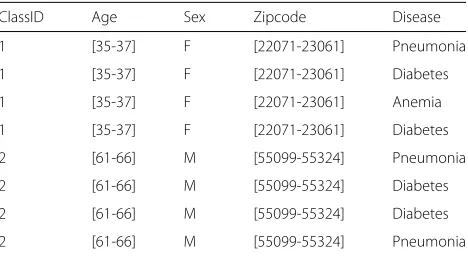
For example, Table 5 satisfies 0.02-ceiling because
D(r1),. . .,D(r4)=(2/99+0/1+990/99999)/3 =0.01 and
D(r5),. . .,D(r8)=(6/99+0/1+222/99999)/3 = 0.02.
Insertion of counterfeit records
We describe the insertion of counterfeit records for
achieving h-ceiling and k-anonymity. The counterfeit
records are inserted into equivalent classes that satisfyh
-ceiling but notk-anonymity. The counterfeit records have
the same quasi-identifiers as the records of the equivalent class, while the sensitive information is randomly selected within the domain of the sensitive attribute. For example,
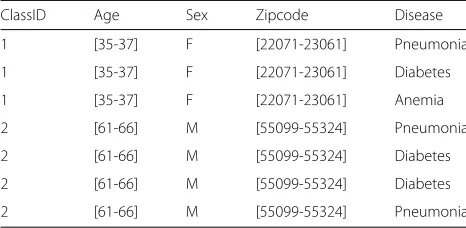
Table 6 cannot satisfyk-anonymity, because there are only
three records in class 1. Therefore, the counterfeit record is inserted into class 1 to satisfy 4-anonymity as shown in Table 5. A counterfeit record is defined as follows.
Table 50.02-ceiled and 4-anonymous version of Table 1 with insertion
ClassID Age Sex Zipcode Disease
1 [35-37] F [22071-23061] Pneumonia
1 [35-37] F [22071-23061] Diabetes
1 [35-37] F [22071-23061] Anemia
1 [35-37] F [22071-23061] Diabetes
2 [61-66] M [55099-55324] Pneumonia
2 [61-66] M [55099-55324] Diabetes
2 [61-66] M [55099-55324] Diabetes
Table 60.02-ceiled version of Table 1
ClassID Age Sex Zipcode Disease
1 [35-37] F [22071-23061] Pneumonia
1 [35-37] F [22071-23061] Diabetes
1 [35-37] F [22071-23061] Anemia
2 [61-66] M [55099-55324] Pneumonia
2 [61-66] M [55099-55324] Diabetes
2 [61-66] M [55099-55324] Diabetes
2 [61-66] M [55099-55324] Pneumonia
Definition 2(Counterfeit record)We define a record r ∈AT is a counterfeit record, if and only if f−1(r) /∈OT, where f()be an anonymization function and f−1()be an inverse function of f()
For example, Table 5 is an anonymized table that satis-fies 0.02-ceiling and 4-anonymity by adding one counter-feit record,<[35-37], F, [22071-23061], Diabetes>(fourth record).
Catalog of counterfeit records
The definition and schema of the catalog of counterfeit records are as follows.
Definition 3 (Catalog for counterfeit records)Let Et(t = 1,. . .,l) be an equivalent class in AT. A group
of equivalent classes Gi(i = 1,. . .,m) consists of several
equivalent classes in Et. The catalog has schema
Catalog(ClassID list,Sensitive value,Count)
where ClassIdList is a list of equivalent class ids in same Gi.
The ID list should be organized considering for pri-vacy during creation of the catalog; else, pripri-vacy can be breached by the catalog. For example, some adversaries obtain Table 5, and Table 7 and they try to extract per-sonal information. They can remove a record that has
Diabetes in class 1. Then, only three indistinguishable records exist in class 1; hence 4-anonymity is breached. Although an adversary has some information on coun-terfeit records, the adversary cannot eliminate councoun-terfeit records when the counterfeit records are not identified [15]. The following lemma shows when the records cannot be eliminated.
Table 7Privacy breached catalog of counterfeit records for Table 5
IDList Disease Count
1 Diabetes 1
Lemma 1Let Etibe a certain equivalent class in a group GiandEitbe a set of other equivalent classes in Gi, except
Eti. If the sum of none-counterfeit records in Eit for each sensitive value is more than or equal to the number of counterfeit records in Eti, then adversaries cannot identify counterfeit records in Eti
ProofLetoit(s)be the sum of none-counterfeit records for a certain sensitive value s in Eit, uit(s) be a sum of counterfeit records forsinEit, andpit(s) be the number
of counterfeit records for s in Eti. Assume that at least
one counterfeit record exists inEitand thatoit(s)is more
than or equal tops. To ensure that at least one
counter-feit record exists inEit, the following inequation should be satisfied by the pigeonhole principle.
pit(s)+uit(s) >oit(s)+uit(s)
It is contradictory to the assumptionpit(s)≤oit(s).
The ID list should be organized for preserving privacy by Lemma 1. For example, Table 8 is a well-grouped
cata-log. CounterfeitDiabetespatients can be located in both
class 1 and class 2, and thus, adversaries cannot be sure where counterfeit records are located.
Table 5 is the 4-anonymous and 0.02-ceiled version of Table 1, and Table 8 shows the catalog of counterfeit records in Table 5. If Table 1 is generalized to satsify 0.02-ceiling, 4-anonymity cannot be satisfied as shown in Table 6, because there are only three records in class 1. Therefore, one counterfeit record is inserted to satisfy 4-anonymity, as seen in Table 5. The catalog shows that
there is one counterfeitDiabetespatient record in a
equiv-alent group of class 1 or class 2. If data recipients require a more precise dataset without considering data truthful-ness, they can use the anonymized dataset in Table 5 as it is. If the data recipients require a truthful dataset, they can handle the dataset as Table 9 using Table 8. The data recipients must remove the counterfeit record to obtain the truthful dataset. Although they cannot know exactly which equivalent class the counterfeit record belongs to, they can remove the counterfeit record using Table 8. To
remove the counterfeit record, the one Diabetes record
in each equivalent class should be suppressed. After that, the recipients can remove one of the suppressed records because one of the suppressed records is a real record, and one is a counterfeit record. In [15], counterfeit records are inserted to protect the privacy only and there are no other methods to preserve the utility. On the other hand, in the
Table 8Catalog of counterfeit records for Table 5
IDList Disease Count
Table 9Truthful version of Table 5
ClassID Age Sex Zipcode Disease
1 [35-37] F [22071-23061] Pneumonia
1 [35-37] F [22071-23061] Diabetes
1 [35-37] F [22071-23061] Anemia
2 [61-66] M [55099-55324] Pneumonia
2 [61-66] M [55099-55324] Diabetes
2 [61-66] M [55099-55324] Pneumonia
* * * * Diabetes
proposed method, counterfeit records are inserted to pro-tect the privacy and preserve the utility. Furthermore, data utility can be preserved through the catalog.
Quality metric
In this paper, we adopted two anonymization methods, generalization and insertion of counterfeit records. There-fore, the data utility is determined by the information loss (caused by generalization) and the data truthfulness (caused by insertion). As we mentioned, existing metrics such as DM, LM are not sufficient for measuring quality of the counterfeit records. Because they measure infor-mation loss only through quasi-identifier transforinfor-mation, counterfeit records and catalog cannot be considered in these metrics. For example, for measuring the utility by LM, the most efficient anonymization method is adding
k-1 counterfeit records to all original records; then LM is
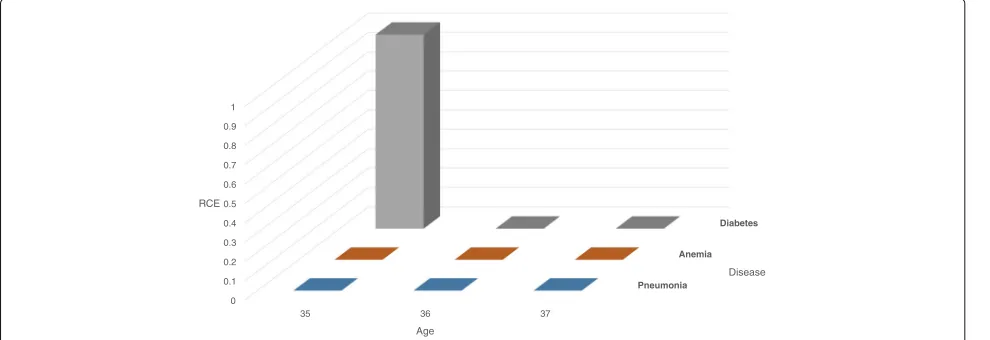
always zero. Therefore we will measure utility using RCE. RCE measures utility by using the difference between anonymized data and original data based on the prob-ability density function. For instance, Fig. 2 shows the
probability density function of the second record (Alice)
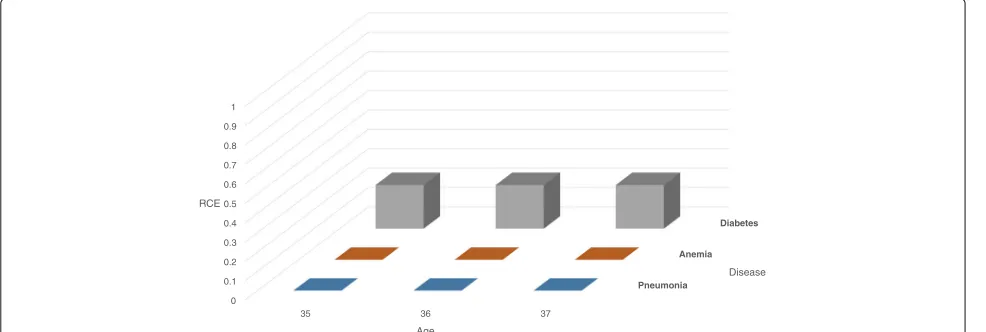
forAgeattribute in Table 1. Next, Fig. 3 shows the
proba-bility density function of the same record in Table 5. Then,
the information loss measured by RCE forAgeattribute is
the difference between Figs. 2 and 3. To calculate RCE of a record, the probability density function is generated for all attributes. The definition of RCE is as follows.
RCE=
∀t∈T
x∈DS(
˜
Gt(x)−Gt(x))2dx
where DSis the dimensional space (including all the QI
and sensitive attribute) of the record,G˜t is the
probabil-ity densprobabil-ity function of the original dataset, andGtis the
probability density function of the anonymized dataset. In the proposed method, the probability density is changed
owing to the catalog. In Table 5, there are fourDiabetes
patients in class 1 and class 2, and thus, the probability that the record is counterfeit is 25%. Therefore, the prob-ability density is reduced to 3/4, as in Fig. 4. We measure RCE through the difference between Figs. 2 and 4.
Implementation of anonymization algorithm
In this section, we present the implementation of the anonymization algorithm using the proposed method. In our methods, we traverse the hierarchical lattice in a bottom-up manner and use heuristics for pruning the node. In addition, we propose a grouping algorithm for catalog publication. The proposed anonymization algo-rithm applies the full-domain generalization algoalgo-rithm [16]. The full-domain generalization algorithm finds a solution in the hierarchical lattice that describes all the possible generalization cases as nodes. Many heuristic techniques have been proposed to reduce the search space. Traditional heuristic optimization methods for the algorithm focus on pruning the lattice using the
mono-tonicity of k-anonymity [16, 17]. If a node satisfies the
k-anonymity property, then all the parent nodes linked
to that node satisfy k-anonymity. On the other hand, if
Pneumonia Anemia
Diabetes
0 0.1 0.2 0.3 0.4 0.5 0.6 0.7 0.8 0.9 1
35 36 37
Disease RCE
Age
Pneumonia Anemia
Diabetes
0 0.1 0.2 0.3 0.4 0.5 0.6 0.7 0.8 0.9 1
35 36 37
Disease RCE
Age
Fig. 3Probability density function of generalized record forAgeattribute
a node does not satisfy the k-anonymity property, then
all the child nodes linked to that node do not satisfy
k-anonymity. When using the proposed method, every
node satisfies k-anonymity, and thus, the lattice cannot
be pruned by the monotonicity ofk-anonymity. Instead,
we can prune the lattice by the monotonicity ofh-ceiling.
If a node does not satisfy h-ceiling, then all the parent
nodes linked to the node cannot satisfyh-ceiling, and vice
versa. In the proposed method, determining an
appropri-ate value ofhis important for improving data utility. In
our algorithm, if the value of h is not determined, the
algorithm searches every node in the lattice and finds an
optimal value ofhbased on RCE.
Algorithm 1 shows the anonymization algorithm. The algorithm begins with the creation of the hierarchical lat-tice. Pruning the lattice using monotonicity, we only create a part of the lattice, wherein the generalization
bound-ary of a node is less thanh(line 1), and search all nodes
(lines 3-13). When records are generalized, the number of records in a certain equivalent class can be less than
k. Then, we add counterfeit records to the equivalent
class and store the number of the counterfeit records in TempC (lines 7-13). After generalizing the records based on the generalization rule of the node, TempC is grouped
(line 14). TheGrouping function is described in Section
4.2. After grouping, the algorithm calculates data utility. If the catalog is null, the result is also null(line 15). In the completion phase, compare the data utility of each node and choose the node that has maximum data utility (lines 16-19).
For grouping a catalog with privacy concerns, we use the heuristic grouping method. Algorithm 2 is the pseudo-code of the grouping algorithm. First, we create a list of
the set Se about equivalent classes that have aggregated
data in Tˆ∗ and counterfeit records in TempC by
sensi-tive information (line 1). For safe grouping, all equivalent
Pneumonia Anemia
Diabetes
0 0.1 0.2 0.3 0.4 0.5 0.6 0.7 0.8 0.9 1
35 36 37
Disease RCE
Age
Algorithm 1:Anonymization Algorithm
Input : Original dataO, Generalization ruleG, Privacy parameterk, utility parameterh Output: Anonymized dataAT, Catalog for
counterfeit records C
1 Create hierarchical latticehlfor all possible generalization cases, except for the case where the degree of generalization is more thanh.
2 min=Maximum value of RCE 3 foreach node ni∈hldo
4 TempC =∅, C =∅
5 Tˆ∗=generalization(O,ni)
6 Em←list of equivalent class inTˆ∗ 7 forj=1to|m|do
8 if|Ej|<kthen 9 forj=1to|m|do
10 addCounterfeitRecords(Ej, TempC);
11 end
12 end
13 end
14 C =Grouping(Tˆ∗, TempC)
15 result=CalcuateRCE(Tˆ∗, C) 16 ifmin>result&&result=nullthen
17 AT =Tˆ∗
18 min=result
19 end
20 end
21 returnAT and C
Algorithm 2:Grouping Algorithm
Input : Generalized dataTˆ∗, Temporary catalog for counterfeit records TempC
Output: Catalog for counterfeit records C 1 Letebe the equivalent class.
2 Create a list of setSe<SensitiveInformationd, Countd, CounterfeitRecordsCountd,>with respect
toTˆ∗and TempC
3 Seis sorted by the sum of CounterfeitRecordsCount
4 groupedIDList=∅ 5 C=∅
6 fori=1to|e|do
7 max=0
8 remainCounterfeitRecords=the sum of
CounterfeitRecordsCountin Si
9 whileremainCounterfeitRecords>0do 10 forj=1to|e|do
11 ifi==jthen continue 12 cnt=matching(Si,Sj, C)
13 ifcnt≥maxthen
14 tempClassID=j
15 max=cnt
16 end
17 end
18 ifmax==0then returnnull 19 addToC(Si,StempClassID)
20 addToGroupedIDList(i,tempClassID)
21 remainCounterfeitRecords=
countRemainedRecords(i,C)
22 end
23 end 24 returnC
classes should find other equivalent classes that have suf-ficient none counterfeit records to conceal the counterfeit records by Lemma 1. It is harder to find other equiva-lent classes when the equivaequiva-lent class has more counterfeit
records. Thus, the list Se is sorted since the
equiva-lent class that is hard to group takes priority (line 3). After sorting, the algorithm finds equivalent classes grouped into the catalog in descending order (lines 6-23). In this phase, we count matched records to find the
most appropriate equivalent class. The matching
func-tion returns the matched count of the counterfeit records
of Si and the none counterfeit records of Sj. If Si or
Sj is already grouped, then the counterfeit records ofSi
can match the none counterfeit records of another set
S in the group (line 12).matching function returnsnull
for all equivalent classes whileremainCounterfeitRecords
is over 0, the equivalent class Si cannot be protected
by grouping; hence, the algorithm returns null (line 18). If the most appropriate equivalent class is found, the algorithm groups the equivalent classes and counts the
unconcealed records and puts that records into
remain-CounterfeitRecords(lines 18-21). If the counterfeit records cannot be concealed at a time, the process is repeated.
Results and discussions
In this section, we present the experimental evaluation of the proposed method. For the evaluation, we use the Adult dataset from the UCI Machine Learning Repository [18],
which is a de facto standard dataset for measuring the
quality of anonymization algorithms. The Adult dataset has 15 attributes and 32,561 rows. In our experiments, we use eight features, seven quasi-identifiers, and one sensi-tive attribute for all rows. We used three metrics to assess loss of information: (1) LM, (2) RCE, and (3) query error rate.
In addition, we evaluate the effectiveness of the pro-posed method in a real world analysis through the NPS dataset from HIRA (Health Insurance Review and Assess-ment service in Korea) [19]. The NPS (National Patients Sample) dataset consists of EHRs of 3% sampled Korean people in 2011. We analyze 1,375,900 records with 6
attributes: Age, Sex, Length of stay in hospital,
Loca-tion, Surgery status, and Disease. We consider the first five attributes to be quasi identifiers and the disease attribute to be a sensitive attribute. In the experiments,
in addition to reporting results for the k-anonymity
with h-ceiling method presented in this paper, we also
report results for the existing k-anonymity algorithm
in [16].
LM
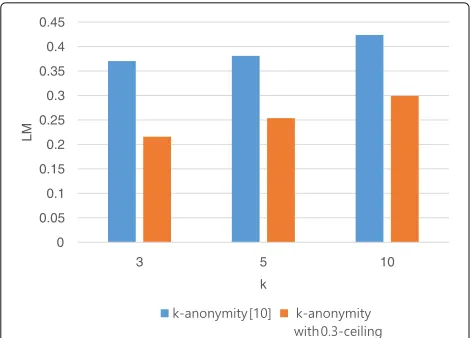
LM is a general metric for measuring information loss caused by generalization. Figures 5 and 6 show the
0 0.05 0.1 0.15 0.2 0.25 0.3 0.35 0.4 0.45
3 5 10
LM
k
Fig. 5LM variation with k (The lower the bar in the graph, the better are the results)
the utility parameter h, respectively. In Fig. 5, we
com-pare the h-ceiled dataset and the k-anonymous datasets
whenhis fixed to 0.3 while the value ofkvaries. Thek
-anonymous datasets have at least 0.37 LM whenkis 3; LM
increases to more than 0.4 whenkis 10. This is because
the data are more generalized to satisfy stricter privacy
constraints; that is, LM is proportional tok. However, the
h-ceiled dataset has at most 0.3 LM whenkis 10 because
we constrain the generalization degree byh-ceiling. The
counterfeit records are inserted with 125, 132, and 103 as
the value ofkincreases from 3 to 10. Figure 6 illustrates
the LM whenkis fixed to 5 andhvaries. The counterfeit
records are inserted with 138, 132, and 38 as the value of
hincreases from 0.25 to 0.35. LM increases withh. This
is because counterfeit records that can decrease LM are inserted to minimize RCE according to the anonymization algorithm. Therefore, LM increases to reduce RCE.
RCE
In our anonymization method, RCE measures informa-tion loss instead of LM, because LM cannot reflect the
0 0.05 0.1 0.15 0.2 0.25 0.3 0.35 0.4
LM
5-anonymity [10] 5-anonymity
with 0.25-ceiling
5-anonymity
with 0.3-ceiling
5-anonymity
with 0.35-ceiling
Fig. 6LM variation with h
32150 32200 32250 32300 32350 32400
3 5 10
RC
E
k
Fig. 7RCE variation with k (The lower the bar in the graph, the better are the results)
distortion of counterfeit records. Figures 7 and 8 show the variation in RCE with respect to the privacy
param-eterkand the utility parameterh, respectively. Figure 7
shows the comparison between theh-ceiled dataset and
k-anonymous dataset whenhis fixed to 0.3 and the value
ofkvaries. In Fig. 7, his fixed to 0.3 and the value ofk
is varied; the result is compared with k-anonymous data.
RCE increases quite a bit when the value ofkis 10 because
a lot of counterfeit records are created to satisfy privacy constraints. Nevertheless, the loss of results in theh-ceiled dataset is less than that of results in k-anonymous data. Figure 8 illustrates the variation in RCE with the value of
h. As the parameterhdecreases from 0.35 to 0.25, RCE
increases. This is because a lot of counterfeit records were created owing to the strict constraint of the generalization degree.
Query error rate
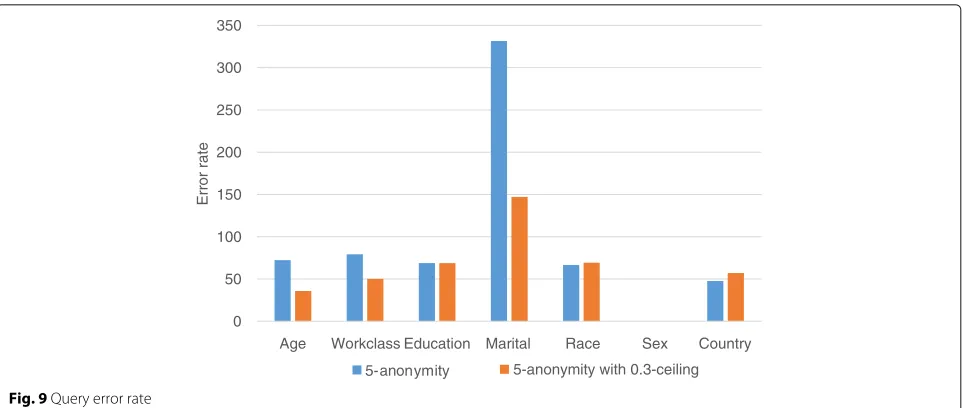
We show the result of range queries to verify the
effective-ness of the proposed method. We fix the value ofkas 5 and
the value ofhas 0.3 in these experiments. Figure 9 shows
32150 32200 32250 32300 32350 32400
RC
E
5-anonymity 5-anonymity
with 0.25-ceiling
5-anonymity
with 0.3-ceiling
5-anonymity
with 0.35-ceiling
0 50 100 150 200 250 300 350
Age Workclass Education Marital Race Sex Country
Err
or rate
5-anonymity 5-anonymity with 0.3-ceiling
Fig. 9Query error rate
that the error rate of the query result for each attribute. We performed an aggregation query such as SELECT
COUNT(*) FROMAdultdatasetWHEREOccupation =
‘Sales’ GROUP BYAgeon both the original dataset and the anonymized dataset, and then compared the results. InAdult dataset, the marital status is skewed, and thus, the error rate of the query result on marital status is almost 300%. However, when the proposed method is applied, the error rate can be reduced by half. Further, the
error rate on the other attribute for the h-ceiled data is
also less or nearly equal to the k-anonymous data. The
error rate on attribute Sex is 0 because this attribute is
not generalized. Only two values, man and woman, are in this attribute, and thus, the height of the taxonomy tree is 2. This means that if the attribute is general-ized, the generalization degree becomes 1 although it is generalized by only one level. In Fig. 10, we show the variation in query error rate with the number of
0 10 20 30 40 50 60 70 80 90 100
1 2 3
Err
or rate
5-anonymity 5-anonymity with 0.3-ceiling
Fig. 10Query error rate variation with number of attributes
attributes. The error rate on the h-ceiled dataset is less
than thek-anonymous data, regardless of the number of
attributes.
Real world analysis
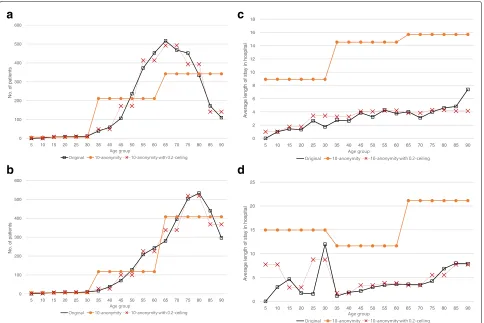
We present a real-world analysis to illustrate the useful-ness of the proposed method. We experimented using the statistical analysis queries used in HIRA [19]. The
dataset is anonymized in two ways: (1)k-anonymization
with k = 10, and (2) using the proposed method with
k = 10 and h = 0.2. We further compare the results
of the anonymized data with those of the original data by using aggregation queries. The queries are described as follows.
• Q1: SELECT FLOOR(Age/5)*5 AS AgeGroup,
COUNT(*) AS No._of_patients FROMNPS dataset
WHERESex=‘M’ andSurgery status=‘N’ and
Disease=‘stroke’ GROUP BY FLOOR(Age/5)*5
• Q2: SELECT FLOOR(Age/5)*5 AS AgeGroup,
COUNT(*) AS No._of_patients FROMNPS dataset
WHERESex=‘F’ andSurgery status=‘N’ and
Disease=‘stroke’ GROUP BY FLOOR(Age/5)*5
• Q3: SELECT FLOOR(Age/5)*5 AS AgeGroup,
AVG(Length of stay in hospital) AS Average_length_of_stay_in_hospital FROM
NPS datasetWHERESex=‘M’ and
Surgery status=‘N’ andDisease=‘stroke’ GROUP BY FLOOR(Age/5)*5
• Q4: SELECT FLOOR(Age/5)*5 AS AgeGroup,
AVG(Length of stay in hospital) AS Average_length_of_stay_in_hospital FROM
NPS datasetWHERESex=‘F’ andSurgery status=
‘N’ andDisease=‘stroke’ GROUP BY
0 100 200 300 400 500 600
5 10 15 20 25 30 35 40 45 50 55 60 65 70 75 80 85 90
No. o
f p
atients
0 100 200 300 400 500 600
5 10 15 20 25 30 35 40 45 50 55 60 65 70 75 80 85 90
No. o
f p
atients
0 2 4 6 8 10 12 14 16 18
5 10 15 20 25 30 35 40 45 50 55 60 65 70 75 80 85 90
A
v
erage length o
f stay in hospital
0 5 10 15 20 25
5 10 15 20 25 30 35 40 45 50 55 60 65 70 75 80 85 90
A
v
erage length o
f stay in hospital
a
c
b
d
Fig. 11Result of the anaysis queries.aQueryQ1bQueryQ2cQueryQ3dQueryQ4
Q1 and Q2 represent the number of stroke patients for
each age group (0-4, 5-9,...,86-90). Q3 andQ4 represent
the average length of stay in hospital. Figure 11 shows the results of the analysis queries. In Fig. 11-(a) and (b), the x-axis represents the age group (which corresponds to the first projection column ofQ1andQ2) and the y-axis
repre-sents the number ofstrokepatients (which corresponds to
the second projection column ofQ1andQ2). In Fig. 11-(c)
and (d), the x-axis represents the age group (which
corre-sponds to the first projection column ofQ3andQ4) and
the y-axis represents the average length of stay in hospital forstrokepatients (which corresponds to the second
pro-jection column ofQ3 andQ4). In each figure, the result
of the h-ceiled data is more similar to the original data
than that of the k-anonymous data. Especially, the
pro-posed method shows better performance in Fig. 11-(c) and (d). Because the average length of stay in hospital is a generalized value, the errors increase as the degree of generalization increases.
Conclusions
In this paper, we proposed a utility-preserving
anonymiza-tion method for organizing h-ceiled and k-anonymous
data using two main ideas: counterfeit records, and cat-alog. Furthermore, we devised an anonymization algo-rithm with a grouping algoalgo-rithm and a precise measuring metric of data utility by RCE. Through our
experimen-tal results, we demonstrated that h-ceiling can prevent
the over-generalization and the catalog can preserve data truthfulness of an anonymized dataset.
As possible future works, we can design new
anonymization methods that can satisfy h-ceiling with
other privacy preserving models such as l-diversity, t
-closeness, or MS(k,θ∗)-anonymity [20–22]. In this paper,
we considered only the full-domain generalization which is the most widely used anonymization methodology especially in health/medical domains [16, 17, 23, 24]. As future work, we need extend the proposed method to other types of generalization mechanisms such as clustering and Mondrian [25, 26].
Abbreviations
Acknowledgements
This work was supported by Institute for Information & communications Technology Promotion(IITP) grant funded by the Korea government(MSIP) (No.R0190-15-2019,Development of personal information protection technology using unidentifiability technique on big data environment).
Availability of data and materials
The datasets generated and analysed during the current study are available in the UCI Machine Learning Repository [18] and the HIRA repository [19].
Authors’ contributions
HL designed the study, performed analysis, and drafted the manuscript. HL and SK conducted the evaluation. JWK and YDC reviewed the manuscript. YDC contributed to the discussion, assisted with and supervised the design of the study. All authors read and approved the final manuscript.
Ethics approval and consent to participate
Not applicable.
Consent for publication
Not applicable.
Competing interests
The authors declare that they have no competing interests.
Publisher’s Note
Springer Nature remains neutral with regard to jurisdictional claims in published maps and institutional affiliations.
Author details
1Department of Computer Science and Engineering, Korea University, 145 Anam-ro, Seongbuk-gu, 02841, Seoul, Republic of Korea.2Department of IT Convegence, Korea University, Seoul 145 Anam-ro, Seongbuk-gu, 02841, Republic of Korea.3Department of Media Software, Sangmyung University, Seoul 20-Gil, Hongji-dong, Seongbuk-gu, 03016, Republic of Korea.
Received: 6 April 2017 Accepted: 28 June 2017
References
1. Holzinger A, Dehmer M, Jurisica I. Knowledge discovery and interactive data mining in bioinformatics-state-of-the-art, future challenges and research directions. BMC Bioinforma. 2014;15(6):1.
2. Holzinger A, Jurisica I. Knowledge discovery and data mining in biomedical informatics: The future is in integrative, interactive machine learning solutions. In: Interactive Knowledge Discovery and Data Mining in Biomedical Informatics. Berlin: Springer; 2014. p. 1–18.
3. Malle B, Kieseberg P, Schrittwieser S, Holzinger A. Privacy aware machine learning and the right to be forgotten. ERCIM News. 2016;107(10):22–3. 4. Sweeney L. k-anonymity: A model for protecting privacy. Int J Uncertain
Fuzziness Knowledge-Based Syst. 2002;10(05):557–70.
5. Family Educational Rights and Privacy Act. 2015. Available at https://ed. gov/policy/gen/guid/fpco/ferpa.
6. Guidelines for De-identification of Personal Data. 2016. Available at http:// privacy.go.kr.
7. Kieseberg P, Malle B, Frühwirt P, Weippl E, Holzinger A. A tamper-proof audit and control system for the doctor in the loop. Brain Inform. 2016;3(4):269–79.
8. Sweeney L. Achieving k-anonymity privacy protection using generalization and suppression. Int J Uncertain Fuzziness Knowledge-Based Syst. 2002;10(05):571–88.
9. Nergiz ME, Gök MZ. Hybrid k-anonymity. Comput Secur. 2014;44:51–63. 10. Prasser F, Kohlmayer F, Kuhn KA. Efficient and effective pruning
strategies for health data de-identification. BMC Med Inform Decis Making. 2016;16(1):49.
11. Fung BC, Wang K, Fu AW-C, Philip SY. Introduction to Privacy-preserving Data Publishing: Concepts and Techniques. Boca Raton: CRC Press; 2010. 12. Bayardo RJ, Agrawal R. Data privacy through optimal k-anonymization. In:
Proceedings of the 21st International Conference on Data Engineering. Tokyo: IEEE Computer Society; 2005. p. 217–28.
13. Iyengar VS. Transforming data to satisfy privacy constraints. In: Proceedings of the Eighth ACM SIGKDD International Conference on Knowledge Discovery and Data Mining. Edmonton: ACM; 2002. p. 279–88. 14. Xiao X, Tao Y. Anatomy: Simple and effective privacy preservation. In:
Proceedings of the 32nd International Conference on Very Large Data Bases. Seoul: VLDB Endowment; 2006. p. 139–50.
15. Xiao X, Tao Y. M-invariance: Towards privacy preserving re-publication of dynamic datasets. In: Proceedings of the 2007 ACM SIGMOD International Conference on Management of Data. Beijing: ACM; 2007. p. 689–700. 16. Kohlmayer F, Prasser F, Eckert C, Kemper A, Kuhn KA. Flash: Efficient, stable and optimal k-anonymity. In: Proceedings of the 2012 ASE/IEEE International Conference on Social Computing and 2012 ASE/IEEE International Conference on Privacy, Security, Risk and Trust. Amsterdam: IEEE Computer Society; 2012. p. 708–17.
17. El Emam K, Dankar FK, Issa R, Jonker E, Amyot D, Cogo E, Corriveau JP, Walker M, Chowdhury S, Vaillancourt R, et al. A globally optimal k-anonymity method for the de-identification of health data. J Am Med Inform Assoc. 2009;16(5):670–82.
18. UCI Repository of Machine Learning Databases. 2013. Available at http:// archive.ics.uci.edu/ml.
19. Health Insurance Review and Assessment Service in Korea. 2012. Available at http://opendata.hira.or.kr.
20. Machanavajjhala A, Kifer D, Gehrke J, Venkitasubramaniam M. l-diversity: Privacy beyond k-anonymity. ACM Trans Knowl Discov Data (TKDD). 2007;1(1):3.
21. Li N, Li T, Venkatasubramanian S. t-closeness: Privacy beyond k-anonymity and l-diversity. In: Proceedings of the 21st International Conference on Data Engineering. Istanbul: IEEE Computer Society; 2007. p. 106–15.
22. Lin WY, Yang DC, Wang JT. Privacy preserving data anonymization of spontaneous ade reporting system dataset. BMC Med Inform Decis Making. 2016;16(1):58.
23. Kohlmayer F, Prasser F, Eckert C, Kemper A, Kuhn KA. Highly efficient optimal k-anonymity for biomedical datasets. In: Computer-Based Medical Systems (CBMS), 2012 25th International Symposium On. Rome: IEEE; 2012. p. 1–6.
24. Kohlmayer F, Prasser F, Kuhn KA. The cost of quality: Implementing generalization and suppression for anonymizing biomedical data with minimal information loss. J Biomed Inform. 2015;58:37–48.
25. Byun JW, Kamra A, Bertino E, Li N. Efficient k-anonymization using clustering techniques. In: International Conference on Database Systems for Advanced Applications. Berlin: Springer; 2007. p. 188–200. 26. LeFevre K, DeWitt DJ, Ramakrishnan R. Mondrian multidimensional
k-anonymity. In: Data Engineering, 2006. ICDE’06. Proceedings of the 22nd International Conference On. Atlanta: IEEE; 2006. p. 25–5.
• We accept pre-submission inquiries
• Our selector tool helps you to find the most relevant journal
• We provide round the clock customer support
• Convenient online submission
• Thorough peer review
• Inclusion in PubMed and all major indexing services
• Maximum visibility for your research
Submit your manuscript at www.biomedcentral.com/submit