R E S E A R C H A R T I C L E
Open Access
Effects of treadmill exercise versus Flutter®
on respiratory flow and sputum properties
in adults with cystic fibrosis: a randomised,
controlled, cross-over trial
Tiffany J. Dwyer
1,2,3*, Rahizan Zainuldin
1,4,5, Evangelia Daviskas
2, Peter T. P. Bye
2,3and Jennifer A. Alison
1,6Abstract
Background:Treadmill exercise and airway clearance with the Flutter® device have previously been shown to improve mucus clearance mechanisms in people with cystic fibrosis (CF) but have not been compared. It is therefore not known if treadmill exercise is an adequate form of airway clearance that could replace established airway clearance techniques, such as the Flutter®. The aim of this study was to evaluate respiratory flow, sputum properties and subjective responses of treadmill exercise and Flutter® therapy, compared to resting breathing (control). Methods:Twenty-four adults with mild to severe CF lung disease (FEV128–86% predicted) completed a three-day randomised, controlled, cross-over study. Interventions consisted of 20 min of resting breathing (control), treadmill exercise at 60% of the participant’s peak oxygen consumption and Flutter® therapy. Respiratory flow was measured during the interventions. Sputum properties (solids content and mechanical impedance) and subjective responses (ease of expectoration and sense of chest congestion) were measured before, immediately after the interventions and after 20 min of recovery.
Results: Treadmill exercise and Flutter® resulted in similar significant increases in peak expiratory flow, but only Flutter® created an expiratory airflow bias (i.e. peak expiratory flow was at least 10% higher than peak inspiratory flow). Treadmill exercise and Flutter® therapy resulted in similar significant reductions in sputum mechanical impedance, but only treadmill exercise caused a transient increase in sputum hydration. Treadmill exercise improved ease of
expectoration and Flutter® therapy improved subjective sense of chest congestion.
Conclusions:A single bout of treadmill exercise and Flutter® therapy were equally effective in augmenting mucus clearance mechanisms in adults with CF. Only longer term studies, however, will determine if exercise alone is an adequate form of airway clearance therapy that could replace other airway clearance techniques.
Trial registration:Australian and New Zealand Clinical Trials Registry, Registration number #ACTRN12609000168257,
Retrospectively registered (Date submitted to registry 26/2/2009, First participant enrolled 27/2/2009, Date registered 6/4/2009).
Keywords:Cystic fibrosis, Exercise, Oscillating PEP, Flutter®, Airway clearance, Physiotherapy, Sputum
* Correspondence:[email protected]
1
Discipline of Physiotherapy, Faculty of Health Sciences, University of Sydney, Sydney, Australia
2Department of Respiratory Medicine, Royal Prince Alfred Hospital, Sydney, Australia
Full list of author information is available at the end of the article
Background
Cystic fibrosis (CF) lung disease is characterised by re-duced hydration at the airway surface and dehydrated mucus, [1] resulting in impaired mucus clearance that leads to a cascade of inflammation and progressive lung damage [2]. Interventions to improve mucus clearance are integral to the respiratory management of CF [3].
Most therapies are required daily and adults with CF report spending an average of 108 min on treatment activ-ities each day, the majority of that time performing airway clearance and exercise [4]. Strategies to combine effective interventions to minimise treatment time are needed. Exer-cise improves physical fitness and may also improve lung function and quality of life in people with CF [5]. If exercise also aids mucus clearance, it would reduce treatment time, as exercise could substitute airway clearance interventions, while gaining the other known benefits of exercise.
Airway clearance or physiotherapy techniques aim to improve mucus clearance by the following mechanisms: altering airflow (increasing the peak expiratory flow and creating an expiratory airflow bias, with the ratio of peak expiratory to peak inspiratory flow, PEF:PIF > 1.10); [6, 7] improving the physical properties of the mucus; [8] poten-tially increasing airway surface hydration; [9–13] and coughing [14].
Treadmill exercise improves mucus clearance mecha-nisms in CF by increasing PEF and reducing sputum mechanical impedance [15]. Physiotherapy with a device creating oscillating positive expiratory pressure, the Flutter®, is an established form of airway clearance in CF and is equally effective to other airway clearance tech-niques [16]. The Flutter® improves mucus clearance
mechanisms in CF by increasing PEF and creating an expiratory airflow bias, [17] as well as reducing sputum mechanical impedance [18]. Exercise and Flutter®, how-ever, have not been compared. Therefore, the aim of this study was to determine the effects of treadmill exercise and Flutter® therapy, compared to resting breathing (con-trol), on respiratory flow (including airflow bias), sputum properties and subjective responses in adults with CF.
Methods
Participants
Participants were recruited from the Adult CF Clinic at Royal Prince Alfred Hospital, Sydney, Australia. Patients were eligible for inclusion if they were at least 17 years old, had a confirmed diagnosis of CF (genetic testing and/ or previous positive sweat test results) and their treating physician deemed them to be clinically stable [19]. Patients were excluded if they had received a lung trans-plant, were infected with Burkholderia cepacia complex or were pregnant. Potential participants were volunteers or personally approached by one of the researchers (TJD) at either a routine clinic visit or at the end of a hospital admission. Research procedures were approved by the Sydney South West Area Health Service Ethics Committee (Protocol X08-0175) and participants provided written informed consent prior to trial enrolment.
Study design
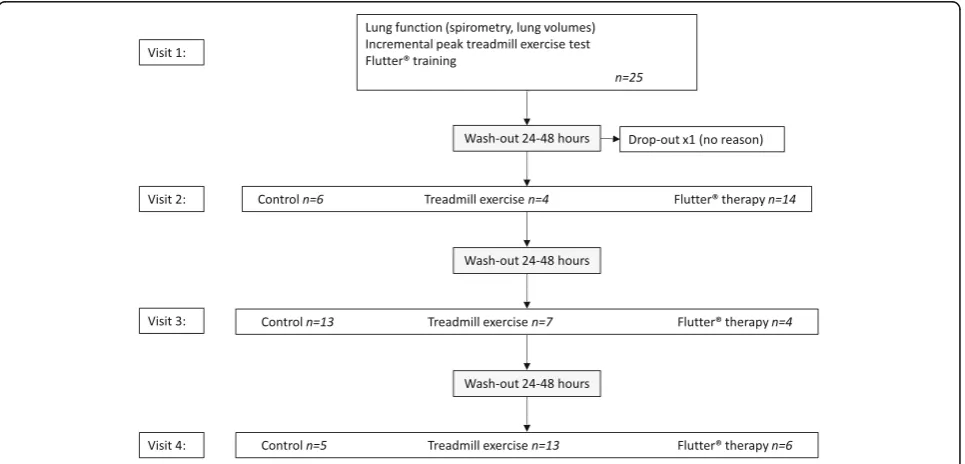
The trial was a randomised, cross-over design, registered with the Australian and New Zealand Clinical Trials Registry (#ACTRN12609000168257). The study involved four visits (Fig. 1). On Visit 1, participants’ spirometry
and lung volumes (via body plethysmograpy) (VMax229, SensorMedics, Yorba Linda, USA) were measured ac-cording to the American Thoracic Society/European Respiratory Society guidelines [20, 21]. Participants then completed an incremental peak treadmill exercise test, according to a modified Balke protocol, [22] with breath-by-breath measurement of ventilatory and meta-bolic variables (VMax229 system) and pulse oximetry (RadicalTM, Masimo, Irvine, USA). All exercise tests were classified as maximal effort according to the cri-teria outlined in the CF exercise testing guidelines [23]. Participants were taught to use the Flutter® device (Flut-ter VRP1 valve®; Axcan Scandipharm Inc., Birmingham, USA) by a senior physiotherapist. If participants were using the Flutter® on a regular basis, any corrections to their technique were made if necessary. After com-pletion of all study procedures on Visit 1, participants were randomised to the order of interventions for the following three sessions (Visits 2, 3 and 4). Interven-tion order was determined by computer-generated randomisation (with a random integer generator on www.random.org). Randomisation was performed by a person not involved in the interventions on Visits 2, 3 and 4 and stored in sealed, sequentially numbered, opaque envelopes.
On Visits 2, 3 and 4, participants completed the three-day, randomised, cross-over study, according to the data collection procedures in Fig. 2. Visits 2, 3 and 4 were scheduled at the same time in the morning within a one-week period (during which medication, airway clear-ance and exercise regimens were unchanged). Partici-pants were also asked to withhold routine mucolytic therapy, airway clearance and exercise on the morning of a trial visit. On each Visit 2, 3 and 4, sputum samples were collected immediately before (pre) and after (post + 0) a 20-min intervention, and after a further 20 min of resting breathing/recovery (post + 20). If participants spontaneously expectorated a sputum sample in the five minutes following the intervention (i.e. they were not requested to do so), this was also collected (post + 5). The three interventions were resting breathing (control), constant-load treadmill exercise and Flutter® plus the forced expiratory technique (FET), [24] from now on referred to as“Flutter® therapy”.
Treatment interventions
For the control intervention, participants sat quietly for 20 min. For the exercise intervention, participants exer-cised on the treadmill for 20 min at a constant work rate equivalent to 60% of the peak oxygen consumption (VO2) achieved in the incremental peak treadmill test on
Visit 1. This intensity and duration were chosen to repli-cate a typical prescription used for exercise training [25]. The Flutter® therapy intervention consisted of breathing through the Flutter® for 15 breaths, followed by relaxed and deep breathing, huffing and coughing, according to the FET [24]. This cycle was repeated six times. The Flutter® angle/inclination was chosen for each participant that maximised the sensation of vibrations within the lungs [26] and held in a constant position with a clamp during the intervention. The Flutter® angle was mea-sured with an inclinometer.
Measurements
Respiratory flow
During each 20-min intervention, respiratory flow was measured with a heated pneumotachograph (Hans Rudolf model 3813, Hans Rudolf Inc., Kansas City, USA), calibrated on each occasion, where scaling factors were pre-determined by a rotameter (Model 2000 Fisher Controls, Croydon, England). The Flutter® was attached to the expiratory port of a two-way non-rebreathing valve (2700 series, Hans Rudolf Inc.) in order to collect inspiratory and expiratory flow (i.e. the participant in-spired through the pneumotachograph and expired through the pneumotachograph and Flutter®). Data were collected at 125 Hz and flow signals were later analysed by a blinded assessor using custom-made software (PhysioDAQxs v3.0 and Breathalyser v1.0, University of Sydney, Australia) to determine PEF and airflow bias (PEF:PIF) for all interventions, and oscillation frequency during the Flutter® intervention. For the Flutter® inter-vention, respiratory flow was measured only whilst participants breathed in and out through the Flutter® (i.e. not during the FET component of the intervention).
Sputum properties
Sputum samples were manually separated from saliva and stored in 1.2 mL tubes in a −80 °C freezer. The
storage tubes were coded, to ensure de-identification at later analysis when measured by a blinded assessor. Sputum analysis procedures were followed as reported previously [15, 27, 28]. The sputum solids content per-centage, from which inferences of airway hydration are made, was estimated by measuring the weight of a 50μL aliquot of sputum before and after lyophilisation to dryness for 24 h using a freeze dryer (Kinetics, Stone Ridge, USA). Sputum elasticity (dynamic G´) and viscos-ity (dynamic G´´) were measured using a 20 μL aliquot of sputum and a controlled stress rheometer with geom-etry 20 mm, 0.5° aluminium cone and plate over the frequency of 1–100 rad/s (AR2000, TA Instruments, New Castle, USA). The results were reported as sputum mechanical impedance (G*), also known as rigidity factor, which is the vector sum of viscosity and elasticity. Sputum mechanical impedance values at 1 rad/s repre-sent sputum properties during resting breathing and mucociliary clearance, values at 100 rad/s represent those during cough and cough clearance.
Cough
All coughs (spontaneous and those directed, according to the FET) were manually counted during each 20-min intervention and recovery period.
Subjective responses
For each requested sputum sample, participants recorded on a 10 cm visual analogue scale the subjective sense of chest congestion (0 = very congested, 10 = very clear) and ease of expectoration (0 = very difficult to expectorate, 10 = very easy to expectorate). The visual analogue scales were later measured by an assessor blinded to the intervention.
Statistical analyses
Repeated measures ANOVA were performed to compare differences between the interventions in sub-jective responses and sputum properties data. Paired t-tests were used to compare respiratory flow between the interventions. Wilcoxon signed rank tests were used to determine differences between the interven-tions in the number of coughs, as these data were not normally distributed. Statistical significance was set at p< 0.05.
The difference in sputum mechanical impedance between interventions was the primary outcome meas-ure. Data from our previous study showed that 20 par-ticipants would be required to provide 80% power to detect the anticipated between group differences as significant for three of the four measures of sputum mechanical impedance (alpha 0.05) [15]. We sought to recruit 25 participants to allow for a 20% dropout and increase precision around our estimates.
Results
Twenty-five adults with mild to severe CF lung disease were recruited and 24 completed the study (one partici-pant withdrew after Visit 1 without giving a reason). Participant baseline characteristics are presented in Tables 1 and 2 [29–32]. Routine mucolytic therapy was: hypertonic saline only for 6 participants; rhDNase only for 9 participants; both hypertonic saline and rhDNase for 7 participants. No participant used mannitol and 2 participants did not use any mucolytic medication. Twenty-one of the 24 participants exercised regularly when well and 22 performed some form of airway clearance routinely (3 only exercised; 1 performed established airway clearance only and 18 performed a combination of exercise and established airway clear-ance techniques, including 2 who performed Flutter® therapy on a regular basis (see Additional file 1 for full details).
All participants were able to spontaneously expector-ate a sputum sample at each requested time point. There were no significant differences in pre-intervention sputum properties or subjective sense of chest conges-tion and ease of expectoraconges-tion on Visits 2, 3 and 4, and no carry-over or order effect between interventions was detected (Additional file 1).
Treatment descriptors
Pulse rate, oxygen saturation and treatment descriptors (work rate and perceived intensity during treadmill exercise; [33, 34] Flutter® angle, oscillation frequency and average expiratory pressure) for the 20-min inter-ventions are presented in Table 3. Treadmill exercise was moderate intensity for breathlessness and perceived exertion. All treatments were well-tolerated with no adverse events.
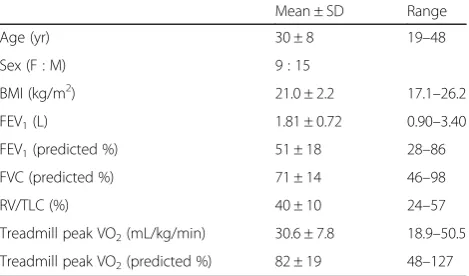
Table 1Participant characteristics
Mean ± SD Range
Age (yr) 30 ± 8 19–48
Sex (F : M) 9 : 15
BMI (kg/m2) 21.0 ± 2.2 17.1–26.2
FEV1(L) 1.81 ± 0.72 0.90–3.40
FEV1(predicted %) 51 ± 18 28–86
FVC (predicted %) 71 ± 14 46–98
RV/TLC (%) 40 ± 10 24–57
Treadmill peak VO2(mL/kg/min) 30.6 ± 7.8 18.9–50.5
Treadmill peak VO2(predicted %) 82 ± 19 48–127
Mean ± standard deviation and range of participant baseline characteristics for the 24 participants who completed the study. Forced expiratory volume in 1 s (FEV1), forced vital capacity (FVC) [30] and treadmill peak VO2[31,32] expressed
Mucus clearance mechanisms
Respiratory flow
Peak expiratory flow (PEF) was significantly higher dur-ing treadmill exercise and Flutter® compared to control (Table 4). Only Flutter® resulted in an expiratory airflow bias (PEF:PIF > 1.10).
Sputum properties
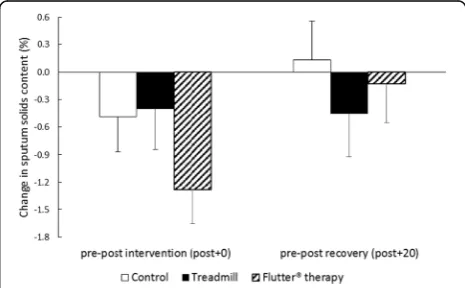
There were no significant differences in sputum water content, measured by sputum percent solids, between any interventions immediately after (post + 0) or after 20-min recovery (post + 20) (Fig. 3). However, for those who spon-taneously expectorated a sputum sample in the five minutes following an intervention (post + 5; n= 12/15/16 for control/exercise/Flutter® therapy respectively), tread-mill exercise resulted in significantly lower sputum percent solids than control (pre-post + 5 mean difference 1.2%, 95% CI 0.4 to 1.9) and a trend for lower sputum percent solids compared to Flutter® therapy (pre-post + 5 mean difference 1.1%, 95% CI−0.1 to 2.3).
Treadmill exercise resulted in significant reductions in sputum mechanical impedance compared to control both
immediately following the intervention (pre-post + 0 mean difference at 1 rad/s 7.1 Pa, 95% CI 1.9 to 12.3; at 100 rad/s 32.5 Pa, 95% CI 5.5 to 59.6) and after 20-min recovery (pre-post + 20 mean difference at 1 rad/s 11.5 Pa, 95% CI 4.0 to 19.1) (Fig. 4). Flutter® therapy resulted in significant reduc-tions in sputum mechanical impedance both immediately following the intervention (pre-post + 0 mean difference 6.4 Pa, 95% CI 0.7 to 12.2) and after 20-min recovery (pre-post + 20 mean difference at 1 rad/s 7.3 Pa, 95% CI 3.3 to 11.2; at 100 rad/s 29.9 Pa, 95% CI 29.9 Pa, 9.0 to 50.9). There were no significant differences in sputum mechanical impedance following treadmill exercise compared to Flut-ter® therapy.
Cough
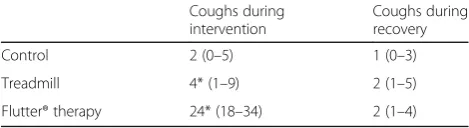
There were significantly more coughs during treadmill exercise and Flutter® therapy compared to control, and during Flutter® therapy compared to treadmill exercise (Table 5). Note that participants were instructed to cough 18 times during the FET in the Flutter® therapy intervention. There were no differences between inter-ventions in the number of spontaneous coughs during the 20-min recovery.
Table 2Baseline sputum properties and subjective reports
Mean ± SD Range
Sputum solids content (%) 6.4 ± 2.6 1.6–13.3
Sputum mechanical impedance (G*) at 1 rad/s (Pa)
21.0 ± 15.9 5.7–59.1
Sputum mechanical impedance (G*) at 100 rad/s (Pa)
174.8 ± 76.7 84.1–396.7
Sense of chest congestion (cm) 5.5 ± 2.4 0.5–9.8
Ease of expectoration (cm) 4.9 ± 2.5 0.1–10.0
Mean ± standard deviation and range of sputum properties and subjective reports for the first sputum sample collected from the 24 participants who completed the study. Sputum mechanical impedance (G*, the vector sum of sputum viscosity and elasticity). Subjective sense of chest congestion (0 = very congested, 10 = very clear) and ease of expectoration (0 = very difficult to expectorate, 10 = very easy to expectorate) scored by participant on a 10 cm visual analogue scale
Table 3Treatment descriptors
PR (bpm) SpO2(%) Treatment descriptors
Control 81 ± 14 96 ± 3 resting breathing
Treadmill 129 ± 18 96 ± 3 5.4 km/h ± 0.7 at 3% incline ± 3, dyspnoea 3 ± 1, RPE 3 ± 2
Flutter® 84 ± 10 97 ± 2 7.3° ± 3.6 at 17.5 Hz ± 1.7, 31 cmH2O ± 10
Data are presented as mean ± standard deviation for group values of the pulse rate (PR) and oxygen saturation (SpO2), and treatment descriptors (treadmill speed and
incline, modified Borg dyspnoea [34] and modified 0-to-10-point rate of perceived exertion (RPE) [33]; Flutter® angle and oscillation frequency, average expiratory pressure). Treadmill work rate was set at the speed and incline equivalent to 60% of the participant’s peak VO2achieved on Visit 1 of the study. Flutter® angle
(positive numbers represent an inclination above the horizontal at 0°) was set at the inclination determined to be the most effective by the senior physiotherapist on Visit 1 of the study (i.e. that maximised the sensation of vibrations within the lungs)
Table 4Respiratory flow during the interventions
PEF (L/s) PEF:PIF
Control 0.68 ± 0.28 0.85 ± 0.14
Treadmill 1.68* ± 0.51 0.90 ± 0.10
Flutter® 1.53* ± 0.25 1.13* ± 0.37
Data are presented as mean ± standard deviation for group values of peak expiratory flow (PEF) and ratio of peak expiratory to peak inspiratory flow (PEF:PIF). Mean difference and (95% CI): Treadmill v control PEF 1.00 L/s (0.82 to 1.18); Flutter® v control PEF 0.85 L/s (0.69 to 1.01); Flutter® v control PEF:PIF: 0.28 (0.11 to 0.45)
*p< 0.01 compared to control
Subjective responses
Treadmill exercise significantly improved subjective ease of expectoration compared to control after 20-min recovery (pre-post + 20 mean difference 1.3 cm, 95% CI 0.3 to 2.3) (Fig. 5a). There were no significant differences in ease of expectoration following Flutter® therapy compared to control or Flutter® therapy compared to treadmill exercise.
There were no significant differences in subjective sense of chest congestion following treadmill exercise compared to control or treadmill exercise compared to Flutter® therapy (Fig. 5b). Flutter® therapy significantly improved subjective sense of chest congestion compared to control both immediately post intervention (pre-post + 0 mean difference 0.8 cm, 95% CI 0.1 to 1.4) and after 20-min recovery (pre-post + 20 mean difference 0.9 cm, 95% CI 0.2 to 1.7).
Discussion
The primary purpose of this study was to compare treadmill exercise and Flutter® therapy on mucus clear-ance mechanisms in CF. The main findings were that both treadmill exercise and Flutter® resulted in similar significant increases in PEF, but only Flutter® created an expiratory airflow bias. In addition both treadmill
exercise and Flutter® therapy resulted in similar signifi-cant reductions in sputum mechanical impedance, but only treadmill exercise caused a transient increase in sputum hydration.
The PEF and airflow bias measured during treadmill exercise was similar to that reported by our group previ-ously [15]. The PEF and oscillation frequency measured during Flutter were higher than previously reported by our group (1.53 L/s v 1.13 L/s and 17.5 Hz v 11.3 Hz respectively), yet the airflow bias was similar (1.13 v 1.15), [17] and above the 1.10 threshold proposed to augment annular flow of mucus towards the oropharynx [6]. The higher PEF and oscillation frequency with Flutter® in this study compared to our earlier work may be explained by the Flutter® position. In the earlier study the Flutter® was used in the horizontal position for all participants, [17] however in the current study the Flutter® inclination was individually determined (with an average angle 7.3° above the horizontal). Holding the Flutter® at higher inclinations results in higher oscillations [35, 36].
The reductions in sputum mechanical impedance following treadmill exercise were similar to those reported previously by our group [15]. Different techniques to measure sputum viscosity and elasticity prevented com-paring the changes following Flutter® therapy in this study to those reported by other researchers [18]. Our study found no significant difference between treadmill exercise and Flutter® therapy in the reductions in sputum mechan-ical impedance, suggesting that the combined effects of shearing forces and airway oscillations with the two inter-ventions were similar.
There was no change in sputum hydration immedi-ately following treadmill exercise or after 20 min of recovery, similar to our previous study [15]. However, we found a significant reduction in sputum solids con-tent in the five minutes following treadmill exercise but Fig. 4Change in sputum mechanical impedance (G* vector sum of sputum viscosity and elasticity) at (a) 1 rad/s and (b) 100 rad/s. Measured pre to post intervention (post + 0) and pre to post recovery (post + 20). A negative change represents an improvement in sputum mechanical impedance. Results are group mean and SE for the control (white), treadmill exercise (black) and Flutter® therapy (diagonal lines) interventions. *p< 0.03
Table 5Coughs during and following the interventions
Coughs during intervention
Coughs during recovery
Control 2 (0–5) 1 (0–3)
Treadmill 4* (1–9) 2 (1–5)
Flutter® therapy 24* (18–34) 2 (1–4)
Data are presented as median (interquartile range) for group values of the number of coughs during the 20-min intervention and 20-min resting breathing/recovery period. NB. Participants were instructed to cough 18 times during the Flutter® therapy intervention
not after Flutter® therapy. Previously researchers have shown an inhibition of sodium conductance channels [11, 12, 37] and altered ion regulation with submaximal cycle exercise in adults with CF [13], suggesting improved airway hydration or airway surface liquid, however these changes only lasted for four minutes after ceasing exercise [37]. Our study provides some evidence to support the proposed increase in mucus water con-tent with exercise in CF [10–12]. The 1.2% reduction in sputum solids content that we observed is likely to be clinically significant as it is similar to that achieved with mannitol in people with CF, [28] which results in signifi-cant improvements in mucus clearance [38] and lung function in the long term [39].
Consistent with the improved changes in sputum properties, participants reported significant improve-ments in ease of expectoration following treadmill exercise but not following Flutter® therapy. Alter-nately, participants reported significant improvements in subjective sense of chest congestion following Flutter® therapy but not following treadmill exercise. We did not measure the amount of sputum expectorated, as this would have interfered with sputum rheology and solids content measurements. Perhaps treadmill exercise facilitated sputum expectoration (due to increased PEF and reduced sputum mechanical im-pedance), but participants did not spontaneously expectorate sufficient sputum to feel less chest con-gestion. Also, potentially the format of the FET dur-ing Flutter® treatment (18 directed coughs in 20 min) increased the amount of sputum expectorated (and hence sensation of less chest congestion), but it was a taxing treatment and so participants did not consider it easier to expectorate.
Conclusions
A single bout of moderate-intensity treadmill exercise and Flutter® therapy improved mucus clearance mecha-nisms in adults with CF. Both treatments increased PEF, but only Flutter® created an expiratory airflow bias. Both treatments resulted in similar significant reductions in sputum mechanical impedance, however only treadmill exercise created a significant transient reduction in sputum solids content. It would therefore appear that treadmill exercise and Flutter® therapy are equally effect-ive in augmenting mucus clearance mechanisms in adults with CF. Physiological or mechanistic findings on their own, however, are insufficient to implement changes to clinical practice. Studies that directly meas-ure mucus and mucociliary clearance or longer term studies with clinically important outcomes (such as exacerbation frequency, antibiotic use, quality of life and lung function) are required to ascertain the relative merit of these interventions and to determine if people with CF can use exercise alone as an adequate form of airway clearance therapy.
Additional file
Additional file 1.Excel spreadsheet includes participant characteristics, treatment descriptors, and the results of interventions (respiratory flow and cough, sputum properties and subjective responses. (XLSX 65 kb)
Abbreviations
CF:cystic fibrosis; FET: forced expiratory technique; FEV1: forced expiratory
volume in 1 s; G*: sputum mechanical impedance; PEF: peak expiratory flow; PIF: peak inspiratory flow; RPE: rate of perceived exertion; RV: residual volume; Rx: treatment; TLC: total lung capacity; VO2: oxygen consumption
Acknowledgements
Thank you to John Eisenhuth (Faculty of Health Sciences, University of Sydney, Sydney, Australia) for developing the PhysioDAQxs v3.0 and Breathalyser v1.0.
Funding
The Australian Respiratory Council funded the study. The Australian Respiratory Council had no input or contribution to the design of the study and collection, analysis, and interpretation of data and in writing the manuscript.
Availability of data and materials
The dataset supporting the conclusions of this article is included within the article and the Additional file 1.
Authors’contributions
TJD, PTPB and JAA were involved in the conception and design of the study. TJD and RZ were responsible for data acquisition. TJD and ED were responsible for the sputum analyses and interpretation. TJD was responsible for data and statistical analyses. TJD and JAA were responsible for interpretation of findings. TJD was responsible for drafting the manuscript. All authors were involved in revising, critically appraising and providing final approval of the published version and agree to be accountable for all aspects of the work.
Competing interests
The authors declare that they have no competing interests.
Consent for publication
Not applicable.
Ethics approval and consent to participate
Research procedures were approved by the Sydney South West Area Health Service Ethics Committee (Protocol X08-0175) and participants provided written informed consent prior to trial enrolment.
Author details
1
Discipline of Physiotherapy, Faculty of Health Sciences, University of Sydney, Sydney, Australia.2Department of Respiratory Medicine, Royal Prince Alfred Hospital, Sydney, Australia.3Central Clinical School, Sydney Medical School, University of Sydney, Sydney, Australia.4Rehabilitation Department, Ng Teng Fong General Hospital, Jurong Health Services, Jurong East, Singapore. 5Health and Social Sciences, Academic Programme, Singapore Institute of Technology, Jurong East, Singapore.6Department of Physiotherapy, Royal Prince Alfred Hospital, Sydney, Australia.
Received: 23 November 2016 Accepted: 23 December 2016
References
1. Matsui H, et al. Evidence for periciliary liquid layer depletion, not abnormal ion composition, in the pathogenesis of cystic fibrosis airways disease. Cell. 1998;95(7):1005–15.
2. Robinson M, Bye PTB. Mucociliary clearance in cystic fibrosis. Pediatr Pulmonol. 2002;33(4):293–306.
3. Dodd ME, Prasad SA. Physiotherapy management of cystic fibrosis. Chron Respir Dis. 2005;2(3):139–49.
4. Sawicki GS, Sellers DE, Robinson WM. High treatment burden in adults with cystic fibrosis: challenges to disease self-management. J Cyst Fibros. 2009;8(2):91–6.
5. Radtke T, et al. Physical exercise training for cystic fibrosis. Cochrane Database Syst Rev. 2015;6, CD002768.
6. Kim CS, Iglesias AJ, Sackner MA. Mucus clearance by two-phase gas–liquid flow mechanism: Asymmetric periodic flow model. J Appl Physiol. 1987;62(3):959–71.
7. Olseni L, Lannefors L, van der Schans CP. Airway-clearance techniques individually tailored to each patient, in Therapy for mucus-clearance disorders. Rubin BK and van der Schans CP, Editors. Therapy for mucus-clearance disorders. New York: Marcel Dekker, Inc; 2004. p. 413–431. 8. King M. Role of mucus viscoelasticity in clearance by cough. Eur J Respir Dis
Suppl. 1987;153:165–72.
9. Button B, Boucher RC, University of North Carolina Virtual Lung Group. Role of mechanical stress in regulating airway surface hydration and mucus clearance rates. Respir Physiol Neurobiol. 2008;163(1–3):189–201.
10. Button B, Picher M, Boucher RC. Differential effects of cyclic and constant stress on ATP release and mucociliary transport by human airway epithelia. J Physiol. 2007;580(2):577–92.
11. Hebestreit A, et al. Exercise inhibits epithelial sodium channels in patients with cystic fibrosis. Am J Respir Crit Care Med. 2001;164(3):443–6. 12. Schmitt L, et al. Exercise reduces airway sodium ion reabsorption in cystic
fibrosis but not in exercise asthma. Eur Respir J. 2011;37(2):342–8. 13. Wheatley CM, et al. Moderate intensity exercise mediates comparable
increases in exhaled chloride as albuterol in individuals with cystic fibrosis. Respir Med. 2015;109(8):1001–11.
14. Mellins RB. Pulmonary physiotherapy in the pediatric age group. Am Rev Respir Dis. 1974;110(6 Pt 2):137–42.
15. Dwyer TJ, et al. Effects of exercise on respiratory flow and sputum properties in cystic fibrosis. Chest. 2011;139(4):870–7.
16. Morrison L, Agnew J. Oscillating devices for airway clearance in people with cystic fibrosis. Cochrane Database Syst Rev. 2014;7, CD006842.
17. McCarren B, Alison JA. Physiological effects of vibration in subjects with cystic fibrosis. Eur Respir J. 2006;27(6):1204–9.
18. App EM, et al. Sputum rheology changes in cystic fibrosis lung disease following two different types of physiotherapy: flutter vs autogenic drainage. Chest. 1998;114(1):171–7.
19. Fuchs HJ, et al. Effect of aerosolized recombinant human DNase on exacerbations of respiratory symptoms and on pulmonary function in patients with cystic fibrosis. N Engl J Med. 1994;331(10):637–42. 20. Miller MR, et al. Standardisation of spirometry. Eur Respir J. 2005;26(2):319–38. 21. Wanger J, et al. Standardisation of the measurement of lung volumes. Eur
Respir J. 2005;26(3):511–22.
22. Balke B, Ware RW. An experimental study of physical fitness of Air Force personnel. U S Armed Forces Med J. 1959;10(6):675–88.
23. Hebestreit H, et al. Statement on Exercise Testing in Cystic Fibrosis. Respiration. 2015;90(4):332–51.
24. Pryor J. The forced expiration technique, in Respiratory Care. Pryor J, Editor. Respiratory care. Edinburgh: Churchill Livingstone; 1991. p. 79–100. 25. American College of Sports Medicine. ACSM's guidelines for exercise testing
and prescription. 9th ed. Philadelphia: Wolters Kluwer/Lippincott Williams & Wilkins Health; 2014.
26. Konstan MW, Stern RC, Doershuk CF. Efficacy of the Flutter device for airway mucus clearance in patients with cystic fibrosis. J Pediatr. 1994;124(5 Pt 1):689–93. 27. Daviskas E, Anderson SD, Young IH. Inhaled mannitol changes the sputum
properties in asthmatics with mucus hypersecretion. Respirology. 2007;12(5):683–91.
28. Daviskas E, et al. Inhaled mannitol improves the hydration and surface properties of sputum in patients with cystic fibrosis. Chest. 2010;137(4):861–8. 29. Goldman HI, Becklake MR. Respiratory function tests; normal values at
median altitudes and the prediction of normal results. Am Rev Tuberc. 1959;79(4):457–67.
30. Morris JF, Koski A, Johnson LC. Spirometric standards for healthy nonsmoking adults. Am Rev Respir Dis. 1971;103(1):57–67.
31. Drinkwater BL, Horvath SM, Wells CL. Aerobic power of females, ages 10 to 68. J Gerontol. 1975;30(4):385–94.
32. Froelicher Jr VF, Allen M, Lancaster MC. Maximal treadmill testing of normal USAF aircrewmen. Aerosp Med. 1974;45(3):310–5.
33. Borg GA. Psychophysical bases of perceived exertion. Med Sci Sports Exerc. 1982;14(5):377–81.
34. Mahler DA, et al. Continuous measurement of breathlessness during exercise: validity, reliability, and responsiveness. J Appl Physiol. 2001;90(6):2188–96.
35. Alves LA, Pitta F, Brunetto AF. Performance analysis of the Flutter VRP1 under different flows and angles. Respir Care. 2008;53(3):316–23. 36. Brooks D, et al. The flutter device and expiratory pressures. J Cardiopulm
Rehabil. 2002;22(1):53–7.
37. Alsuwaidan S, et al. Effect of exercise on the nasal transmucosal potential difference in patients with cystic fibrosis and normal subjects. Thorax. 1994;49(12):1249–50.
38. Robinson M, et al. The effect of inhaled mannitol on bronchial mucus clearance in cystic fibrosis patients: a pilot study. Eur Respir J. 1999;14(3):678–85. 39. Nolan SJ, et al. Inhaled mannitol for cystic fibrosis. Cochrane Database Syst