Open Access
Research article
Automation of a problem list using natural language processing
Stephane Meystre* and Peter J Haug
Address: Department of Medical Informatics, University of Utah School of Medicine, Salt Lake City, Utah, USA
Email: Stephane Meystre* - [email protected]; Peter J Haug - [email protected] * Corresponding author
Abstract
Background: The medical problem list is an important part of the electronic medical record in development in our institution. To serve the functions it is designed for, the problem list has to be as accurate and timely as possible. However, the current problem list is usually incomplete and inaccurate, and is often totally unused. To alleviate this issue, we are building an environment where the problem list can be easily and effectively maintained.
Methods: For this project, 80 medical problems were selected for their frequency of use in our future clinical field of evaluation (cardiovascular). We have developed an Automated Problem List system composed of two main components: a background and a foreground application. The background application uses Natural Language Processing (NLP) to harvest potential problem list entries from the list of 80 targeted problems detected in the multiple free-text electronic documents available in our electronic medical record. These proposed medical problems drive the foreground application designed for management of the problem list. Within this application, the extracted problems are proposed to the physicians for addition to the official problem list.
Results: The set of 80 targeted medical problems selected for this project covered about 5% of all possible diagnoses coded in ICD-9-CM in our study population (cardiovascular adult inpatients), but about 64% of all instances of these coded diagnoses. The system contains algorithms to detect first document sections, then sentences within these sections, and finally potential problems within the sentences. The initial evaluation of the section and sentence detection algorithms demonstrated a sensitivity and positive predictive value of 100% when detecting sections, and a sensitivity of 89% and a positive predictive value of 94% when detecting sentences.
Conclusion: The global aim of our project is to automate the process of creating and maintaining a problem list for hospitalized patients and thereby help to guarantee the timeliness, accuracy and completeness of this information.
Background
The problem list is an important piece of the medical record as well as a central component of the problem-ori-ented electronic medical record in development in our institution (Intermountain Health Care, Utah). To serve
the functions it is designed for, the problem list has to be as accurate and timely as possible. In most of our inpa-tient settings, we are converting to an electronic problem list from a paper-based tool. However, the current prob-lem list, hand written on a form in the paper chart, is Published: 31 August 2005
BMC Medical Informatics and Decision Making 2005, 5:30 doi:10.1186/1472-6947-5-30
Received: 18 March 2005 Accepted: 31 August 2005
This article is available from: http://www.biomedcentral.com/1472-6947/5/30
© 2005 Meystre and Haug; licensee BioMed Central Ltd.
usually incomplete and inaccurate, and is often totally unused. While we hope that the advantages of a univer-sally available problem list will change this behavior, as an addition incentive, we are building an environment where the problem list is easily and effectively maintained.
The medical problem list
More than three decades ago, Larry Weed proposed the Problem-Oriented Medical Record as a remedy for the complexity of the medical knowledge and clinical data, and for weaknesses in the documentation of medical care [1,2]. He noted the lack of consistent structure and con-tent in the progress notes that make up a large part of the medical record. He proposed a standard approach empha-sizing a list of patient medical problems that is scrupu-lously maintained by those caring for the patient. This problem list serves the dual purpose of providing a brief, formal summary of the patient's illnesses and of acting as a tool for organizing the routine documentation of the physician's decision-making process and the plan for and results of care. The problem-oriented, Computer-based Patient Record (CPR) and the problem list have seen renewed interest as an organizational tool in the recent years [3-10], but most of today's patient records retain a time-oriented structure. The Institute of Medicine report on the CPR [11] recommends that it contain a problem list that specifies the patient's medical problems and the status of each. It mentions advantages to this approach: the problem list can be the central place for clinicians to obtain a concise view of all patients' medical problems; this list facilitates associating clinical information in the record to a specific medical problem; and the problem list can encourage an orderly process of medical problem solving and clinical judgment. The problem list in a prob-lem-oriented patient record also provides a context in which continuity of care is supported, preventing both redundant and peripheral actions [3].
Problem list entries coding
To enable most of these potential advantages, problem list entries in the electronic medical record should be coded, which means that medical problems entered must have a corresponding code in a controlled vocabulary. Medical vocabularies used in problem lists are numerous, ranging from ICD-9-CM [12], to SNOMED [13], the Unified Med-ical Language System (UMLS®) [14-16], and to locally developed vocabularies [17]. SNOMED-CT has been shown to allow 98.5% coverage of problem list terms [13]. Coding of medical problems may be achieved by manually assigning a code when the problem is entered, or by using NLP techniques to map free-text problem list entries with an appropriate code, as described below. The former method is usually eased by the use of pick lists or search engines [18], both features available in our
institu-tion's application for managing the problem list. While tools for structured problem entry provide a simple way to assure the availability of coded problems, using NLP tech-niques to extract coded data from free text allows the use of natural language as the input medium. Natural lan-guage remains the most user-friendly and expressive way of recording information, and the application of NLP can still provide the advantages of coded data.
Medical text mapping to standard vocabularies
Many authors have reported on methods to automatically map clinical text concepts to a standardized vocabulary such as the Unified Medical Language System (UMLS®) [19-26]. An example is MetaMap [22,27], an application developed by the US National Library of Medicine (NLM) as an element of the SPECIALIST™ system [28,29]. Meta-Map is used to index text or to map concepts in the ana-lyzed text with UMLS concepts. It returns ranked medical concepts, but no negation detection is performed. Five steps are needed, beginning with noun phrase identifica-tion using the SPECIALIST minimal commitment parser [30], followed by variant generation, candidate phrase retrieval, and computation of a score for each candidate by comparing it with the input phrase. The process ends with the mapping and the ranking of candidates using the computed score. MetaMap has been shown to identify most concepts present in MEDLINE titles [31]. It has been used for Information Retrieval [32-34], for Information Extraction in biomedical text [31,35], and to extract differ-ent types of information like anatomical concepts [36] or molecular binding concepts [37]. It has also been used with electronic messages submitted by patients to auto-matically provide relevant health information to the patients [24]. Finally, the system was able to extract the most critical findings in 91% of the documents in a previ-ous study done on pathology reports [38].
Another approach to mapping concepts in text to UMLS concepts is found in an application called IndexFinder. IndexFinder functions by generating all valid UMLS con-cepts by permuting the set of words in the text, and select-ing relevant concepts usselect-ing syntactic and semantic filtering [26].
Negation detection algorithms
The techniques described above can find medical prob-lems, but they are not designed to detect negation. Meta-Map, in particular, does not do negation detection. In the medical domain finding negatives is essential due to the fact that findings and diseases are often described as absent.
more complex general-purpose Negfinder [40]. These algorithms have been evaluated and have shown good results. NegEx has shown a sensitivity of 94.5% and a spe-cificity of 77.8% [39], and Negfinder demonstrated a sen-sitivity of 95.3% and a specificity of 97.7% [40]. After its evaluation, NegEx was updated to a version 2, available on the main author's website [41].
Natural language processing in medicine
The patient record contains a considerable amount of information in addition to problem list entries. However, much of the recorded clinical information is unstructured text, also called free-text. These free-text documents repre-sent patient history and reports of therapeutic interven-tions or clinical progress and make up a substantial part of the medical record. The increasing use of encoded data in decision support and the requirement for standard medi-cal data sets creates a need for coded information instead. As a possible answer to this issue, NLP can convert narra-tive text into coded data, and therefore extend the use of the CPR [42].
Several groups have evaluated techniques for automati-cally encoding textual documents from the medical record. The Linguistic String Project [43,44] has devel-oped a series of tools for analyzing medical text. X-ray reports appear to be an especially fertile ground for NLP. Two groups have developed systems whose focus is the radiologist's report of the chest x-ray. Zingmond [45] has applied a semantic encoding tool to these reports to rec-ognize abnormalities that should receive follow-up, and Friedman has studied techniques for encoding interpreta-tions found in these reports [46-50]. In addition, Fried-man and her colleagues have studied NLP in mammography reports [51], neuroradiology reports [19], discharge summaries [52], and pathology reports [53]. Good performance was demonstrated. The application developed, called MedLEE (Medical Language Extraction and Encoding system) [54], has also been used to help develop and maintain vocabularies [55], and recently adapted to extract UMLS concepts from medical text doc-uments, achieving 83% recall and 89% precision [56]. MedLEE was also the first biomedical NLP system that was applied to data in an institution different than the one where it was developed. This resulted in a small drop in performance, but after making some adjustments, it per-formed as well as in the original institution [49].
The understanding of natural language has been a topic of interest for our Medical Informatics group at the LDS Hos-pital and the University of Utah (Salt Lake City) for a number of years. SPRUS (Special Purpose Radiology Understanding System) [57,58] was the first NLP applica-tion developed at the Medical Informatics group at the University of Utah, and was only semantically driven.
Later came SymText (Symbolic Text processor) [59-61], with syntactic and probabilistic semantic analysis. The lat-est version is called MPLUS [62], provides interleaved syn-tactic analysis based on a context-free grammar with a bottom-up chart parser, interleaved with object-oriented semantic analysis.
SymText and its successor, MPLUS, make extensive use of semantic networks for semantic analysis. These networks are implemented as Bayesian networks (also called belief networks) [63], trained to infer probabilistic relationships between extracted terms and their meaning. This approach has the advantages of being tolerant to noisy data, and of allowing training to refine performances.
A key realm for testing various approaches has been in the Radiology Department. Here we have focused on reports for chest radiographs [58-60] with a further focus on the data in these reports that supports the diagnosis of pneu-monia [64,65]. Admit diagnoses [66] and reports describ-ing the results of pulmonary perfusion scans have also been used to test these NLP approaches [67]. For the project described in this paper, MPLUS has been adapted and trained to extract medical problems from electronic free-text documents [68].
Medical document models
Research into modeling medical documents has been a focus in the development of standards for the electronic medical record. A central example is the first ANSI-approved healthcare standard: the HL7 Clinical Docu-ment Architecture (CDA) [69]. It uses XML (eXtensible Markup Language) [70] to facilitate the exchange of docu-ments between users. XML is a data modeling toolkit, a configurable vehicle for any kind of information, and an evolving open standard consistent with a variety of Inter-net applications. It can store and organize most kinds of data, offers many ways to check the quality of documents, and is easy to read and parse by humans and programs alike.
Several examples of specific medical documents exist. In one case, a successful prototype of a CDA-based, struc-tured discharge summary system was implemented for use in the clinical and community environments of a fam-ily practice [71]. In Germany discharge and referral infor-mation has been exchanged between Hospital Information Systems and Physician Office Systems in the SCIPHOX project [72]. And in other medical settings this formalism has been used to format discharge letters [73,74].
Regular expressions
regexp or regex). These are templates that describe a whole set of strings, according to certain syntactic rules. Regular expressions are used by many text editors and utilities to search bodies of text for certain patterns and, for example, replace the found strings with a certain other string. Regu-lar expressions trace back to the work of Stephen Kleene, a mathematician, who described these models using his mathematical notation called "regular sets" [75]. His work was used to develop text-manipulation tools on the Unix platform (including ed [76] and grep) as well as in many other scripting languages, editors, programming environ-ments, and specialized tools such as: expr, awk, Emacs, vim, lex, Perl, Java™ and Microsoft® Word. Regular expres-sions are well described in many publications [77].
Methods
Targeted medical problems
The first step in the process of developing a NLP applica-tion to support a problem list was to identify the medical problems for which the system would be responsible. Since the focus of this project has been in the cardiovascu-lar domain, we developed the problem list application with an emphasis on the patient population seen there. Problems appropriately entered into the problem list include both simple observations, representing basic abnormalities noted during a patient's workup (ex: dysp-nea, hyperkalemia), and interpretive statements that may represent either syndromic descriptions (ex: Respiratory Failure) or the etiologies for the simple abnormalities that may appear there (ex: Myocardial Infarction as an etiology for Chest Pain). Simple medical problems, whose etiology is not yet understood, are included as they are recognized. Etiologic problems are entered as the physician becomes convinced that they represent a reasonable interpretation of the patient's condition.
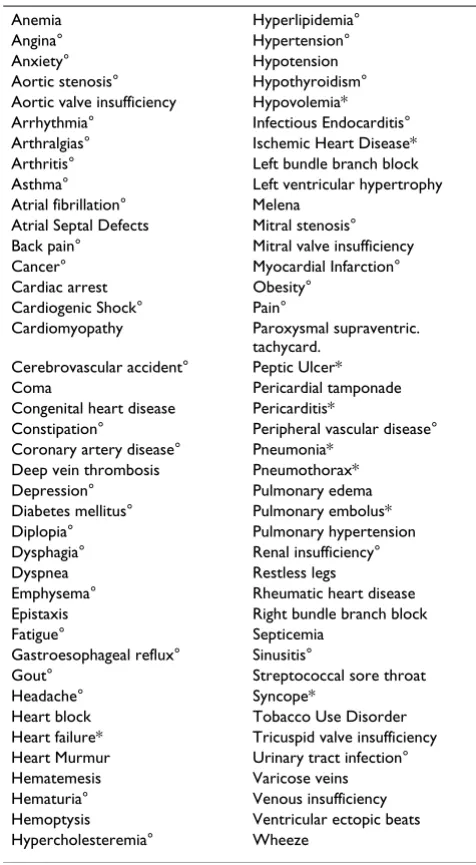
For our prototype, we focused on a limited set of 80 med-ical problems. These problems are listed in Table 1. They were selected for their frequency of use in our institution and in the field of evaluation of our system (cardiovascu-lar). Two sources of information were used to create this list: the log of all coded concepts stored in the central clin-ical database, called Clinclin-ical Data Repository (CDR) in our institution, and a list of the top 25 diagnoses for car-diovascular patients at the LDS Hospital (Salt Lake City, Utah). The first author extracted all concepts coded as medical problems from the log, and ordered them by number of uses during the year 2002. The most common general diagnoses (37 of them) and cardiovascular diag-noses (34 of them) were selected, and 9 of the top 25 car-diovascular diagnoses at the LDS Hospital were added to this list. The resulting list was finally submitted to two expert physicians (a board-certified Internal Medicine spe-cialist and a board-certified Critical Care spespe-cialist with more than 20 years of experience) for validation. The
sec-ond expert is the head of one of the departments where our system will be evaluated at the LDS Hospital.
To estimate the proportion of patient's coded diagnoses covered by our set of targeted problems, we retrieved ICD-9-CM codes assigned for administrative purposes to all cardiovascular adult inpatients during 2003 in our institu-tion (LDS Hospital, Salt Lake City, Utah), and compared it with our set of problems. ICD-9-CM codes were selected because they were the only coded medical problems avail-able for cardiovascular inpatients at the LDS Hospital at this time.
Table 1: List of the selected medical problems. Origin of the problems: 37 from most frequent diagnoses at IHC°, 9 from the field of evaluation (LDS Hospital 7th floor)*, and 34 from other IHC diagnoses (cardiovascular).
Anemia Hyperlipidemia° Angina° Hypertension° Anxiety° Hypotension Aortic stenosis° Hypothyroidism° Aortic valve insufficiency Hypovolemia* Arrhythmia° Infectious Endocarditis° Arthralgias° Ischemic Heart Disease* Arthritis° Left bundle branch block Asthma° Left ventricular hypertrophy Atrial fibrillation° Melena
Atrial Septal Defects Mitral stenosis° Back pain° Mitral valve insufficiency Cancer° Myocardial Infarction° Cardiac arrest Obesity°
Cardiogenic Shock° Pain°
Cardiomyopathy Paroxysmal supraventric. tachycard.
Cerebrovascular accident° Peptic Ulcer* Coma Pericardial tamponade Congenital heart disease Pericarditis*
Constipation° Peripheral vascular disease° Coronary artery disease° Pneumonia*
Deep vein thrombosis Pneumothorax* Depression° Pulmonary edema Diabetes mellitus° Pulmonary embolus* Diplopia° Pulmonary hypertension Dysphagia° Renal insufficiency° Dyspnea Restless legs
Emphysema° Rheumatic heart disease Epistaxis Right bundle branch block Fatigue° Septicemia
Gastroesophageal reflux° Sinusitis°
Gout° Streptococcal sore throat Headache° Syncope*
Automated Problem List system
The Automated Problem List (APL) system was designed to extract potential medical problems from free-text med-ical documents, and uses NLP to achieve this task. It is constructed of two main components: a background application and the problem list management application.
The background application does all text processing and analysis and stores extracted medical problems in the Clinical Data Repository. These medical problems can then be accessed by the problem list management appli-cation integrated into our Clinical Information System. Clinicians use this application to access and confirm the proposals of the APL system. The problem list manage-ment application allows the viewing, editing and creation of medical problems, and gives access to Internet-based medical knowledge sources allowing rapid review of med-ical facts for each encoded problem. This latter feature is called "infobutton" [78]. The medical problems extracted by our background application are listed in this applica-tion, and link back to a customized view of the source document(s). This display of the document(s) that each problem was extracted from helps users of the problem list determine if a medical problem should be part of the "official" problem list.
Information model for medical documents and problems
The information model used by our system was created to ease the exchange of data between the background appli-cation and the problem list management appliappli-cation. It models medical documents and medical problems.
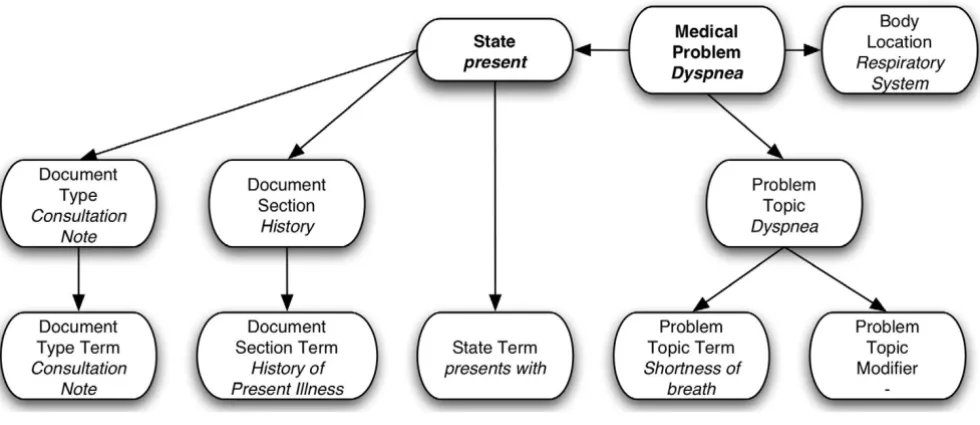
Medical documents are represented using HL7's Clinical Document Architecture (CDA) standard [69], with detected medical problems coded as Observations. CDA XML Schemata are therefore used for validation (Figure 1). The XML format allows us to link the extracted medical problem back to its source sentence(s): We use it to dis-play the document(s) a medical problem was extracted from, with the sentence(s) containing mentions of the problem highlighted for easier reading. Medical problems are represented using an information model currently associated with the Clinical Information System in use at our institution: the Clinical Event model [79], instead of the custom model implemented in XML and described in a previous publication [68]. The Clinical Event model is implemented in ASN.1 [80].
Background application
The application for processing clinical documents runs in the background and follows the sequence of steps depicted in Figure 2 and explained below.
Information model diagram Figure 1
In our organization, all data stored in the central database (CDR) pass through an event monitor called the "data driver". This tool recognizes medical events that may require additional processing and allows applications to subscribe to these events and to receive notification of their arrival and storage in the database. A subscription was created to route notification of free-text clinical docu-ments to our system. The notification includes related information such as the patient identifier. We use the
patient identifier to determine whether the patient is in the targeted group of cardiovascular patients. If this is the case, the corresponding document is retrieved from the CDR. The document processing phase then begins, start-ing with section and sentence detection.
Section detection
Sections are main paragraphs of the document, sharing a common class of information, like the "History of present Automated Problem List system diagram
Figure 2
illness", the "Physical examination", the "Family history", and many others. To develop this processing, we analyzed 200 documents randomly selected from a set of 5271 doc-uments from cardiovascular adult inpatients at the LDS Hospital in 2002. Section titles were recognized using spe-cific regular expressions. For example, in some "Progress Notes", section titles start with an uppercase letter after a carriage return and a space, and are followed by two colons. In some "Surgery Reports", all section titles are in uppercase letters, following a carriage return, and ending with a colon. The resulting section detection algorithm was implemented using regular expressions, and first used on this set of 5271 medical text documents to extract all possible section titles. 539 different titles were recognized and manually mapped to a list of 20 generic section titles. This latter step was required because we wished to use a version of the NLP module designed to integrate the title of a section as context in recognizing medical problems.
Sentence detection
After a section title is detected, the text following it until the next section title is extracted as the section's textual content. This text is then split into sentences using a sen-tence detection algorithm also implemented using regular expressions. The same 200 documents mentioned above and generic sentence boundary information described in another publication [81] were used to define the required regular expressions.
Before applying the sentence detection algorithm, some data cleaning was needed: white spaces (space, tabs, car-riage return, etc.) before the first letter or number charac-ter and afcharac-ter the last one were removed. The regular expressions were then used to split the section text into sentences. Text was split at periods, exclamation and inter-rogation marks, and at white spaces, when those were pre-ceded and followed by some specified characters, as in the following example:
(?<=[0-9a-z\.][0-9a-z%"])\.(?=[ \n\r]+[A-Z0-9])
This regular expression splits text at periods preceded by one number (0–9), lowercase letter (a-z), or period (.), this character being followed by one number, lowercase letter, percent sign (%), or quote ("). The period must be followed by one to many spaces or carriage returns, the latter being followed by one uppercase letter (A-Z) or number. For all twelve regular expressions used, see [Additional file 1].
A small pilot evaluation of our section and sentence detec-tion algorithms was executed to determine their effective-ness in the clinical text documents planned for our subsequent studies. For this small evaluation, 20 docu-ments from the test set described above were randomly
selected, and sections and sentences were determined by the first author to build the reference standard. Each doc-ument was analyzed three times, in different random order, and at an interval of at least 3 days. Sections and sentences determined by the majority of the three reviews were finally used as reference standard. The section and sentence detection algorithms were then applied to these documents and results compared with the reference standard.
Natural language processing module
After the algorithms described above split the document's text into sections and sentences, each sentence is passed to the NLP module with context information including the document type and the section descriptor. The NLP mod-ule then analyzes each sentence and extracts potential medical problems, inferring the state of the problem using this contextual information. For example, a problem found in the Family History section will be stated as absent in the patient, if not found in another section of the document. At the sentence level, priority is given to the state present if the same problem is found more than once in the sentence. Thus, if the same problem is found once absent and once present in the same sentence, it is categorized as present at this sentence level. The priority of the state present is justified by examples like "the patient is known for angina, but hasn't suffered from anginal pain for more than two years". The first mention of the prob-lem is stated as present, and the second as absent, and it will finally be considered present, since mention of this problem in the problem list with an inactive status is desirable.
At the document level, priority is given to the state absent. This means that if the same problem is found present in one sentence and absent in another, it will finally be cate-gorized as absent in the document, unless the absent problem reference was found in the Family History sec-tion. Medical problems are often mentioned more than once in a document, and their states usually match, but examples of multiple mentions of the same problem with different states are common in documents like Discharge Summaries. A problem could be mentioned in the patient medical history, and then negated at the end of the docu-ment, when explaining that the problem was successfully treated during the hospitalization and is now absent. In this case, no mention of the problem in the problem list is desirable (considering that this type of document is ana-lyzed by our system after discharge of the patient).
contexts and the semantic part was adapted to accommo-date the clinical documents and medical concepts neces-sary to identify medical problems (e.g. history and physical, surgery report, consultation note, etc...). Train-ing for this tool applies principally to the semantic model. Its semantics are represented as collections of Bayesian Networks representing the relationship between the words and phrases in a sentence and the concepts that they represent. Once the structure of the network is defined, the relationships among the semantic elements are captured as tables of probabilities. The Bayesian Net-work used by our application was made of 11 nodes and is displayed in Figure 3, with nodes corresponding to the word(s) or phrase(s) in the text at the bottom, and related concepts at the top.
To capture these relationships, training cases are needed. We created those training cases using a semi-automated technique depicted in Figure 4. We started by applying the section and sentence detection algorithms on 3000 free-text documents and 91483 sentences were detected. Those documents were randomly selected from the set of 5271 test documents described above. Regular expressions and a list of phrases representing possible ways of describing each of the 80 targeted problems were then used to select sentences with mentions of the targeted problems. Lexical variants of phrases were partially taken into account by using regular expressions. The phrase table was built using the UMLS Metathesaurus MRCONSO table and a
manu-ally built table linking the 80 targeted problem concepts with all related subconcepts (e.g. Right Bundle Branch Block was linked to Incomplete Right Bundle Branch Block, Com-plete Right Bundle Branch Block, and Other or unspecified Right Bundle Branch Block). All phrases corresponding to the 80 concepts and their subconcepts were first retrieved from the MRCONSO table (6928 phrases). We then did some filtering, removing all phrases containing brackets, angled brackets, commas, forward slashes, squared brack-ets, dashes, and the words NOS or unspecified (e.g. "Ane-mia unspecified", "Ane"Ane-mia <1>", "Ane"Ane-mia (disorder)", "Anemia, aplastic", etc.). After removal of duplicates, the final table contained 4570 phrases.
Once this algorithm had selected target sentences, each sentence and its corresponding medical problem, along with the document type, the section title, and the sentence text were then proposed to a human reviewer (the first author). He proceeded to extract the word or phrase expressing the state of the problem, and added the state of the problem (present or absent) to the case. A medical problem was considered present if mentioned in the text as probable or certain in the present or the past (e.g. "the patient has asthma"; "past history positive for asthma"; "pulmonary edema is probable"), and considered absent if negated in the text or not mentioned at all (e.g. "this test excluded diabetes..."; "he denies any asthma"). The result-ing file contained 4436 trainresult-ing cases. Trainresult-ing cases were prepared in a tab-delimited format as required by for Medical problems Bayesian Network
Figure 3
Training cases creation process Figure 4
training by Netica [82], the Bayesian Networks processing application used by SymText. A fine-tuning phase fol-lowed, using the NLP module to analyze sentences and eventually add training cases to improve the application's accuracy.
After the training, the tables in the NLP application's Baye-sian Networks contained a statistical representation of the relationship between the words and phrases in the sen-tences and the medical problems that we had identified for extraction.
The second version of the NLP module was based on Met-aMap Transfer (MMTx) [83], the Java version of MetMet-aMap, and on the negation detection algorithm called NegEx [39]. This version worked in two steps. The first step used MMTx with the default full Metathesaurus data set to detect medical problems. The second step then used NegEx to infer the state of the concept detected, determin-ing whether the concept was absent (negated) or present.
CDA document creation
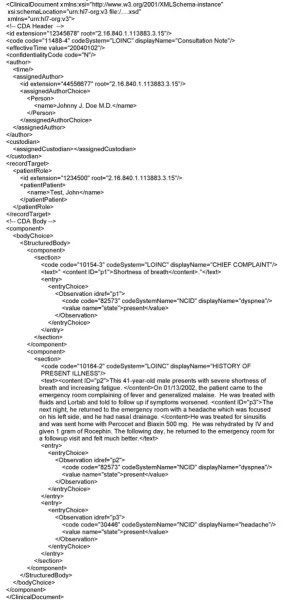
In addition to detecting problems referenced in medical documents, the system formats the documents according to the CDA standard. After section and sentence detection and NLP analysis, this XML-based CDA version of the source document is created, with each medical problem embedded as an encoded Observation, and with markup of the source sentences to allow the creation of the cus-tomized view of the document when a problem list user views the source documents associated with a problem. An example of a CDA document in both its XML form and its customized and rendered HTML (Hypertext Markup Language) form is displayed in Figures 5 and 6.
Document and problems storage
To avoid displaying repeated instances of a previously rec-ognized problem, a patient's problems that are already stored in the CDR are analyzed. If the same problem has already been previously stored, and if this problem is not of "Family History" type, then the medical problem found by our system will not be stored in the CDR. In all other cases, the problem will be stored with a reference to the CDA version of the source documents. This link is required to allow recovery of this source document for dis-play to users in the problem list management application. Finally, the medical problems recognized by the system as present are stored in the CDR, along with the resulting CDA document. These are given the status of "proposed" to distinguish them from problems stored manually in the CDR.
Problem list management application
The problem list management application is the users' interface to the Automated Problem List system. It is the
window through which end users interact with the medi-cal problems proposed by the Automated Problem List system described above. For this project, an earlier prob-lem list management application was rewritten to take advantage of the proposed problems. This new applica-tion for managing the problem list includes addiapplica-tional functionality focused on the proposed medical problems. It is designed to prompt the user to consider adding these extracted problems into the problem list.
Our clinical information system's user interface, called the Clinical Desktop, offers secured access to clinical data through specialized modules like the "Patient search", "Labs", "Medications", or "Problems" module.
The "Problems" module is our problem list management application. Features already present allow viewing, modifying, and adding medical problems in the problem list. An "infobutton" also allows access to medical knowl-edge relevant to the problem listed [78]. Filters control the display of medical problems based on their status (active, inactive, resolved, error, or proposed) and other personal preferences.
Functions added to take advantage of the proposed prob-lems include the capability to list these probprob-lems with a new "proposed" status, and the provision of a link back to the source document to allow viewing of the document from which the problem was extracted. Human interven-tion is required to officially add a medical problem to the problem list, but for problems mentioned in the clinical documentation, addition is guided and simplified by this extended interface. To accept a problem, the user simply changes the status of the problem from "proposed" to "active" or "inactive", and to reject it, changes the status to "error". A "source button" has been added to each pro-posed problem listed, giving access to a viewer pop-up window displaying the source document with the source sentences of the medical problem highlighted in red (Fig-ure 7). The user can locate the sentences and read them in a few seconds to determine whether the automatic system correctly proposed a problem for addition. To this end, the CDA version of the source document is retrieved from the CDR and transformed to a customized HTML version of the document. After preprocessing, an XSLT (XML Stylesheet Transformation) [84] stylesheet can be used to generate the HTML version of the document.
Example CDA document Figure 5
XML manipulation features provided by a library for working with XML and XSLT on the Java™ platform. It searches the CDA document for Observation elements with codes corresponding to the medical problem's code. If Observation element(s) are found, corresponding content elements in the text element of the same section are searched and their tag name changed from content to bold when found, as described in Figure 8. The next step is the XSLT transformation, using the stylesheet included as [Additional file 2]. The whole retrieval and transforma-tion process is fast, taking less than a second to retrieve, transform, and display the source document.
Results
Targeted medical problem set coverage
To estimate the proportion of coded diagnoses covered by our set of 80 targeted problems, all unique ICD-9-CM codes assigned to cardiovascular adult inpatients during 2003 in our institution (LDS Hospital, Salt Lake City, Utah) were retrieved. A total of 1531 different codes had been used. Our set of 80 targeted problems therefore covered only 5.2% of all possible codes. In the data set we found a total of 24160 ICD-9-CM code instances, and 15449 of them corresponded to one of our 80 targeted problems. Our set of problems therefore covered 63.9% of all code instances.
Section and sentence detection
A small pilot evaluation of the section and sentence detec-tion algorithms showed good performance. The secdetec-tion detection algorithm reached a sensitivity of 1.00 and a positive predictive value of 1.00. It detected all 146 sec-tions present in the 20 randomly selected documents
from our dataset, and detected only those 146 sections. With the sentence detection algorithm, a sensitivity of 0.889 (95% confidence interval 0.78-0.998) and a posi-tive predicposi-tive value of 0.946 (0.907-0.985) were meas-ured. 687 out of 731 sentences present in the test set of 20 documents were detected. Of those 687 sentences, 662 were correctly detected (i.e. true positives), and 25 were false positives.
Discussion
The development and functions of the Automated Prob-lem List system have been reported in this paper, along with results of two preliminary evaluations: The coverage of the set of 80 targeted problems was only about 5% of all possible diagnoses coded in ICD-9-CM, but about 64% of all instances of these coded diagnoses. The section and sentence detection algorithms performed well, with a sen-sitivity and positive predictive value of 100% when detect-ing sections, and a sensitivity of 89% and a positive predictive value of 94% when detecting sentences.
Some potential issues concerning this system have to be discussed. A key issue is the level of use of the problem list. Our goal is a system that eases the effort of maintain-ing an accurate, up-to-date problem list. However, our system can only be beneficial if users feel a commitment to maintain a problem list.
In the environment represented by the electronic medical record, there are much improved incentives to do so. Elec-tronic implementation helps to mitigate key reasons for a lack of proper problem list maintenance. With the list available in one place, the EMR, rather than independ-ently in each of the sites where the patient receives care, there is a significant incentive to both maintain and con-sult this document.
Another issue could be insufficient accuracy in the NLP portion of our system, with deficient sensitivity, positive predictive value, or speed. A sufficient sensitivity is required to significantly improve the quality of the prob-lem list. We are seeking a sensitivity higher than 80%. A sufficient positive predictive value is also desirable to avoid overloading the collection of proposed problems with false positives. Those incorrectly proposed medical problems could make the use of the APL slower by requir-ing the user to reject an excessive number of incorrectly proposed problems. We are seeking a positive predictive value higher than 60%.
A last issue, which might effect our evaluation of this sys-tem, would be speed with which proposed medical prob-lems are returned from the target documents. Our focus here is on the speed of the NLP module. This is clearly the slowest part of our system, requiring heavy computing Example rendered HTML version of the document
Figure 6
Example rendered HTML version of the document.
Example of the customized HTML version of the document, as seen if linked from the problem headache
Consultation Note
Author: Johnny J. Doe M.D. Date: 01/02/2004 Patient: Test, John
__________________________________________________________
CHIEF COMPLAINT
"Shortness of breath."
HISTORY OF PRESENT ILLNESS
This 41-year-old male presents with severe shortness of breath and increasing fatigue. On 01/13/2002, the patient came to the emergency room complaining of fever and generalized malaise. He was treated with fluids and Lortab and told to follow up if symptoms worsened.
power to allow deep text analysis. The evaluation of the NLP module will allow us to select the version to use (i.e. based on SymText or on MMTx/NegEx) for subsequent use and evaluation in a clinical setting. We will continue to study the issues of speed, along with scalability and accuracy as we evolve the system to manage problems beyond the cardiovascular domain.
In the future, the NLP module will be evaluated first, and, if satisfactory, the system described above will be evalu-ated in a clinical setting to determine its effectiveness in guaranteeing the accuracy, completeness, and timeliness of the medical problem list. We expect an increased pro-portion of correct problems, a reduced propro-portion of incorrect problems, and a reduced time between problem identification and addition to the problem list.
Coverage of instances of problem mentions in the free-text medical documents by the set of UMLS-derived phrases described in the Methods section could affect the
accuracy of the NLP module, but this will not be evaluated in the future. We will focus on the bottom line question: performance of the NLP module when detecting medical problems.
The proposed Automated Problem List will be beneficial for many reasons: A better problem list should improve patient outcomes and reduce costs by reducing omissions and delays, improving the organization of care, and reducing adverse events. It will enhance decision-support for applications that require knowledge of patient medical problems to function optimally. A timely and accurate problem list should improve patient safety, an important and timely issue that has received substantial attention since the 1999 Institute of Medicine report [85].
Conclusion
We have developed an Automated Problem List manage-ment system using NLP to extract potential medical prob-lems from free-text documents in a patient's EMR. This Screenshot of the problem list management application
Figure 7
system's goal is to improve the problem list's quality by increasing its completeness, accuracy and timeliness. By encouraging the use of a problem list of good quality, this system could potentially improve patient outcomes and security, improve the organization of care, reduce costs, and reduce adverse events.
The medical problem list figures prominently in our plans for computerized physician order entry and medical doc-umentation in the new Clinical Information System (HELP2) currently under development at IHC. A well-maintained list will significantly enhance HELP2's appli-cations. We believe that this clinical tool, which has been taught in medical schools and used sporadically in medi-cal practice for decades, will become a key component for managing clinical information in systems that are devel-oped to provide a longitudinal view of the health record.
Competing interests
The author(s) declare that they have no competing interests.
Authors' contributions
SM has conceived the Automated Problem List, developed it with the help of some acknowledged programmers, and implemented it. SM also has drafted this manuscript. PJH has proposed the general design and aim of the project, has guided its development and implementation, and has critically revised this manuscript. All authors read and approved the final manuscript.
Additional material
Acknowledgements
This work is supported by a Deseret Foundation Grant (#444).
We would like to thank Lee Christensen for his work on MPLUS and Sym-Text, and Min Bowman for her help with the modified Problems module. We would also like to thank Greg Gurr for his advices and his help. Finally, Scott Narus and Stan Huff also gave us helpful advice and guidance for which we are grateful.
References
1. Weed LL: Medical records that guide and teach. N Engl J Med
1968, 278:593-600.
2. Weed LL: Medical records that guide and teach. N Engl J Med
1968, 278:652-657. concl
3. Bayegan E, Tu S: The helpful patient record system: problem oriented and knowledge based. Proc AMIA Symp 2002:36-40. 4. Campbell JR, Payne TH: A comparison of four schemes for
cod-ification of problem lists. Proc Annu Symp Comput Appl Med Care
1994:201-205.
5. Campbell JR: Strategies for problem list implementation in a complex clinical enterprise. Proc AMIA Symp 1998:285-289. 6. Donaldson MS, Povar GJ: Improving the master problem list: a
case study in changing clinician behavior. QRB Qual Rev Bull
1985, 11:327-333.
7. Elkin PL, Mohr DN, Tuttle MS, Cole WG, Atkin GE, Keck K, Fisk TB, Kaihoi BH, Lee KE, Higgins MC, Suermondt HJ, Olson N, Claus PL, Carpenter PC, Chute CG: Standardized problem list genera-tion, utilizing the Mayo canonical vocabulary embedded within the Unified Medical Language System. Proc AMIA Annu Fall Symp 1997:500-504.
8. Goldberg H, Goldsmith D, Law V, Keck K, Tuttle M, Safran C: An evaluation of UMLS as a controlled terminology for the Problem List Toolkit. Medinfo 1998, 9(Pt 1):609-612.
9. Hales JW, Schoeffler KM, Kessler DP: Extracting medical knowl-edge for a coded problem list vocabulary from the UMLS Knowledge Sources. Proc AMIA Symp 1998:275-279.
10. Starmer J, Miller R, Brown S: Development of a Structured Prob-lem List Management System at Vanderbilt. Proc AMIA Annu Fall Symp 1998:1083.
11. Institute of Medicine (U.S.): Committee on Improving the Patient Record. In The computer-based patient record: an essential technology for health care Rev edition. Edited by: Dick RS, Steen EB, Detmer DE. Washington, D.C.: National Academy Press; 1997. 12. Scherpbier HJ, Abrams RS, Roth DH, Hail JJ: A simple approach to
physician entry of patient problem list. Proc Annu Symp Comput Appl Med Care 1994:206-210.
13. Wasserman H, Wang J: An Applied Evaluation of SNOMED CT as a Clinical Vocabulary for the Computerized Diagnosis and Problem List. Proc AMIA Symp 2003:699-703.
Preliminary XML manipulation example Figure 8
Preliminary XML manipulation example. In this extract of a CDA document, the code of the Observation element (dyspnea problem) and the reference identifiers are in bold characters. Reference identifiers link Observation elements (i.e. coded problems) to content elements (i.e. sen-tence(s) they were extracted from).
… <section> …
<text><content ID="p2">This 41-year-old male presents with severe shortness of breath</content> On 01/13/2002, the patient came to the emergency room complaining of fever and generalized malaise...</text>
<entry> <entryChoice> <Observation idref="p2">
<code code="82573" codeSystemName="NCID" displayName="dyspnea"/> <value name="state">present</value>
</Observation> </entryChoice> </entry> … </section>
Additional File 1
Sentence detection algorithm regular expressions Text file listing all regular expressions used for sentence detection.
Click here for file
[http://www.biomedcentral.com/content/supplementary/1472-6947-5-30-S1.txt]
Additional File 2
XSLT stylesheet Stylesheet used to transform the CDA version of the med-ical problem source document into its customized HTML version for view-ing in the problem list management application.
Click here for file
14. Unified Medical Language System (UMLS) [http://uml sks.nlm.nih.gov]
15. Payne T, Martin DR: How useful is the UMLS metathesaurus in developing a controlled vocabulary for an automated prob-lem list? Proc Annu Symp Comput Appl Med Care 1993:705-709. 16. Goldberg H, Hsu C, Law V, Safran C: Validation of clinical
prob-lems using a UMLS-based semantic parser. Proc AMIA Symp
1998:805-809.
17. Zelingher J, Rind DM, Caraballo E, Tuttle M, Olson N, Safran C: Cat-egorization of free-text problem lists: an effective method of capturing clinical data. Proc Annu Symp Comput Appl Med Care
1995:416-420.
18. Wang SJ, Bates DW, Chueh HC, Karson AS, Maviglia SM, Greim JA, Frost JP, Kuperman GJ: Automated coded ambulatory problem lists: evaluation of a vocabulary and a data entry tool. Int J Med Inf 2003, 72:17-28.
19. Elkins JS, Friedman C, Boden-Albala B, Sacco RL, Hripcsak G: Coding neuroradiology reports for the Northern Manhattan Stroke Study: a comparison of natural language processing and manual review. Comput Biomed Res 2000, 33:1-10.
20. Tuttle MS, Olson NE, Keck KD, Cole WG, Erlbaum MS, Sherertz DD, Chute CG, Elkin PL, Atkin GE, Kaihoi BH, Safran C, Rind D, Law V:
Metaphrase: an aid to the clinical conceptualization and for-malization of patient problems in healthcare enterprises. Methods Inf Med 1998, 37:373-383.
21. Cooper GF, Miller R: An experiment comparing lexical and sta-tistical method for extracting MeSH terms from clinical free text. J Am Med Inform Assoc 1998, 5:62-75.
22. Aronson AR: Effective mapping of biomedical text to the UMLS Metathesaurus: the MetaMap program. Proc AMIA Symp
2001:17-21.
23. Nadkerni P, Chen R, Brandt C: UMLS concept indexing for pro-duction databases: a feasibility study. J Am Med Inform Assoc
2001, 8:80-91.
24. Brennan PF, Aronson AR: Towards linking patients and clinical information: detecting UMLS concepts in e-mail. J Biomed Inform 2003, 36:334-341.
25. Huang Y, Lowe H, Hersh W: A pilot study of contextual UMLS indexing to improve the precision of concept-based repre-sentation in XML-structured clinical radiology reports. J Am Med Inform Assoc 2003, 10:580-587.
26. Zou Q, Chu WW, Morioka C, Leazer GH, Kangarloo H: Index-Finder: A Method of Extracting Key Concepts from Clinical Texts for Indexing. Proc AMIA Symp 2003:763-767.
27. Aronson AR, Bodenreider O, Chang HF, Humphrey SM, Mork JG, Nelson SJ, Rindflesch TC, Wilbur WJ: The NLM Indexing Initiative. Proc AMIA Symp 2000:17-21.
28. McCray AT, Sponsler JL, Brylawski B, Browne AC: The role of lex-ical knowledge in biomedlex-ical text understanding. In SCAMC 87 IEEE; 1987:103-107.
29. McCray AT: Extending a natural language parser with UMLS knowledge. Proc Annu Symp Comput Appl Med Care 1991:194-198. 30. Rindflesch TC, Tanabe L, Weinstein JN, Hunter L: EDGAR:
extrac-tion of drugs, genes, and relaextrac-tions from the biomedical literature. Pac Symp Biocomput 2000:517-528.
31. Pratt W, Yetisgen-Yildiz M: A Study of Biomedical Concept Identification: MetaMap vs. People. Proc AMIA Symp
2003:529-533.
32. Aronson AR: Query expansion using the UMLS Metathesaurus. Proc AMIA Symp 1997:485-489.
33. Wright LW: Hierarchical Concept Indexing of Full-Text Doc-uments in the Unified Medical Language System Information Sources Map. Journal of the American Society for Information Science
1998, 50:514-523.
34. Pratt W, Wassermann H: QueryCat: Automatic categorization of MEDLINE Queries. In Proc AMIA Symp Los Angeles; 2000:655-659.
35. Weeber M, Klein H, Aronson AR, Mork JG, de Jong-van den Berg LT, Vos R: Text-based discovery in biomedicine: the architecture of the DAD-system. Proc AMIA Symp 2000:903-907.
36. Sneiderman CA, Rindflesch TC, Bean CA: Identification of ana-tomical terminology in medical text. Proc AMIA Symp
1998:428-432.
37. Rindflesch TC, Hunter L, Aronson AR: Mining molecular binding terminology from biomedical text. Proc AMIA Symp
1999:127-131.
38. Shadow G, McDonald C: Extracting structured information from free text pathology reports. Proc AMIA Symp 2003:584-588. 39. Chapman WW, Bridewell W, Hanbury P, Cooper GF, Buchanan BG:
A simple algorithm for identifying negated findings and dis-eases in discharge summaries. J Biomed Inform 2001, 34:301-310. 40. Mutalik PG, Deshpande A, Nadkarni PM: Use of general-purpose negation detection to augment concept indexing of medical documents: a quantitative study using the UMLS. J Am Med Inform Assoc 2001, 8:598-609.
41. NegEx 2 [http://web.cbmi.pitt.edu/chapman/NegEx.html] 42. Spyns P: Natural language processing in medicine: an
overview. Methods Inf Med 1996, 35:285-301.
43. Chi E, Lyman M, Sager N, Friedman C: Database of computer-structured narrative: methods of computing complex relations. SCAMC 85 1985:221-226.
44. Sager N, Friedman C, Chi E: The analysis and processing of clin-ical narrative. In Medinfo 86 Amsterdam (Holland); 1986:1101-1105.
45. Zingmond D, Lenert LA: Monitoring free-text data using medi-cal language processing. Comput Biomed Res 1993, 26:467-481. 46. Friedman C, Alderson PO, Austin JH, Cimino JJ, Johnson SB: A
gen-eral natural-language text processor for clinical radiology. J Am Med Inform Assoc 1994, 1:161-174.
47. Friedman C, Hripcsak G, Shagina L, Liu H: Representing informa-tion in patient reports using natural language processing and the extensible markup language. J Am Med Inform Assoc 1999,
6:76-87.
48. Hripcsak G, Friedman C, Alderson PO, DuMouchel W, Johnson SB, Clayton PD: Unlocking clinical data from narrative reports: a study of natural language processing. Ann Intern Med 1995,
122:681-688.
49. Hripcsak G, Kuperman GJ, Friedman C: Extracting findings from narrative reports: software transferability and sources of physician disagreement. Methods Inf Med 1998, 37:1-7. 50. Knirsch CA, Jain NL, Pablos-Mendez A, Friedman C, Hripcsak G:
Res-piratory isolation of tuberculosis patients using clinical guidelines and an automated clinical decision support system. Infect Control Hosp Epidemiol 1998, 19:94-100.
51. Jain NL, Friedman C: Identification of findings suspicious for breast cancer based on natural language processing of mam-mogram reports. Proc AMIA Annu Fall Symp 1997:829-833. 52. Friedman C, Knirsch C, Shagina L, Hripcsak G: Automating a
severity score guideline for community-acquired pneumonia employing medical language processing of discharge summaries. Proc AMIA Symp 1999:256-260.
53. Xu H, Friedman C: Facilitating Research in Pathology using Natural Language Processing. Proc AMIA Symp 2003:1057. 54. Friedman C, Johnson SB, Forman B, Starren J: Architectural
requirements for a multipurpose natural language processor in the clinical environment. Proc Annu Symp Comput Appl Med Care 1995:347-351.
55. Friedman C, Liu H, Shagina L: A vocabulary development and vis-ualization tool based on natural language processing and the mining of textual patient reports. J Biomed Inform 2003,
36:189-201.
56. Friedman C, Shagina L, Lussier Y, Hripcsak G: Automated Encod-ing of Clinical Documents Based on Natural Language Processing. J Am Med Inform Assoc 2004.
57. Ranum DL: Knowledge-based understanding of radiology texts. Comput Methods Programs Biomed 1989, 30:209-215. 58. Haug PJ, Ranum DL, Frederick PR: Computerized extraction of
coded findings from free-text radiologic reports. Work in progress. Radiology 1990, 174:543-548.
59. Haug P, Koehler S, Lau LM, Wang P, Rocha R, Huff S: A natural lan-guage understanding system combining syntactic and semantic techniques. Proc Annu Symp Comput Appl Med Care
1994:247-251.
60. Haug PJ, Koehler S, Lau LM, Wang P, Rocha R, Huff SM: Experience with a mixed semantic/syntactic parser. Proc Annu Symp Comput Appl Med Care 1995:284-288.
61. Koehler SB: SymText : a natural language understanding system for encod-ing free text medical data 1998.
Publish with BioMed Central and every scientist can read your work free of charge
"BioMed Central will be the most significant development for disseminating the results of biomedical researc h in our lifetime."
Sir Paul Nurse, Cancer Research UK
Your research papers will be:
available free of charge to the entire biomedical community
peer reviewed and published immediately upon acceptance
cited in PubMed and archived on PubMed Central
yours — you keep the copyright
Submit your manuscript here:
http://www.biomedcentral.com/info/publishing_adv.asp
BioMedcentral
63. Nivre J: On Statistical Methods in Natural Language Process-ing. In Promote IT Second Conference for the Promotion of Research in IT at New Universities and University Colleges in Sweden Edited by: Bubenko JjW, Benkt. Skövde (Sweden): University of Skövde;; 2002:684-694. 64. Fiszman M, Chapman WW, Aronsky D, Evans RS, Haug PJ:
Auto-matic detection of acute bacterial pneumonia from chest X-ray reports. J Am Med Inform Assoc 2000, 7:593-604.
65. Fiszman M, Haug PJ: Using medical language processing to sup-port real-time evaluation of pneumonia guidelines. Proc AMIA Symp 2000:235-239.
66. Haug PJ, Christensen L, Gundersen M, Clemons B, Koehler S, Bauer K: A natural language parsing system for encoding admitting diagnoses. Proc AMIA Annu Fall Symp 1997:814-818.
67. Fiszman M, Haug PJ, Frederick PR: Automatic extraction of PIOPED interpretations from ventilation/perfusion lung scan reports. Proc AMIA Symp 1998:860-864.
68. Meystre S, Haug PJ: Medical problem and document model for natural language understanding. Proc AMIA Symp 2003:455-459. 69. Dolin RH, Alschuler L, Beebe C, Biron PV, Boyer SL, Essin D, Kimber E, Lincoln T, Mattison JE: The HL7 Clinical Document Architecture. J Am Med Inform Assoc 2001, 8:552-569.
70. Extensible Markup Language (XML) 1.0 (Second Edition)
[http://www.w3.org/TR/REC-xml]
71. Paterson G, Shepherd M, Wang X, Watters C, Zitner D: Using the XML-based Clinical Document Architecture for Exchange of Structured Discharge Summaries. Proceedings 35 th Hawaii Int Conf on System Sciences 2002.
72. Heitmann K, Schweiger R, Dudeck J: Discharge and referral data exchange using global standards – the SCIPHOX project in Germany. Int J Med Inf 2003, 70:195-203.
73. Muller ML, Butta R, Prokosch HU: Electronic discharge letters using the Clinical Document Architecture (CDA). Stud Health Technol Inform 2003, 95:824-828.
74. Bludau H, Wolff A, Hochlehnert AJ: Presenting XML-based med-ical discharge letters according to CDA. Methods Inf Med 2003,
42:552-556.
75. Kleene SC: Representation of events in nerve nets and finite automata. In Automata Studies Edited by: Shannon C, McCarthy J. Princeton, NJ: Princeton University Press; 1956:3-41.
76. Thompson K: Regular expression search algorithm. Communi-cations of the ACM 1968, 11:419-422.
77. Friedl JEF: Mastering regular expressions Cambridge: O'Reilly; 1997. 78. Reichert JC, Glasgow M, Narus SP, Clayton PD: Using LOINC to
link an EMR to the pertinent paragraph in a structured ref-erence knowledge base. Proc AMIA Symp 2002:652-656. 79. Huff SM, Rocha RA, Bray BE, Warner HR, Haug PJ: An event model
of medical information representation. J Am Med Inform Assoc
1995, 2:116-134.
80. International Organization for Standardization: International Standard ISO/IEC 8824: specification of Abstract Syntax Notation One (ASN.1) Sec-ond edition. Geneva, Switzerland: International Organization for Standardization; 1990.
81. Manning CD, Schutze H: Foundations of Statistical Natural Language Processing 6th edition. Cambridge, Massachusetts, London, England: MIT Press; 2003.
82. Netica™ Application [http://www.norsys.com/netica.html] 83. MetaMap Transfer (MMTx) [http://mmtx.nlm.nih.gov] 84. XSL Transformations (XSLT) Version 1.0 [http://
www.w3.org/TR/xslt]
85. Institute of Medicine Committee on Quality of Health Care in Amer-ica, Kohn LT, Corrigan JM, Donaldson MS: To Err is Human: Building A Safer Health System National Academy Press, Washington, DC; 1999.
Pre-publication history
The pre-publication history for this paper can be accessed here: