Open Access
Research
Impact of stress reduction on negative school behavior in
adolescents
Vernon A Barnes*
1,2
, Lynnette B Bauza
2
and Frank A Treiber
1,2,3
Address: 1Georgia Institute for Prevention of Human Diseases and Accidents, Medical College of Georgia, Augusta, GA 30912, USA, 2Department
of Pediatrics, Medical College of Georgia, Augusta, GA 30912, USA and 3Department of Psychiatry, Medical College of Georgia, Augusta, GA
30912, USA
Email: Vernon A Barnes* - [email protected]; Lynnette B Bauza - [email protected]; Frank A Treiber - [email protected] * Corresponding author
Abstract
Background: The purpose of this study was to determine the effect of stress reduction via the Transcendental Meditation program on school rule infractions in adolescents.
Methods: Forty-five African American adolescents (ages 15–18 years) with high normal systolic blood pressure were randomly assigned to either Transcendental Meditation (n = 25) or health education control (n = 20) groups. The meditation group engaged in 15-min sessions at home and at school each day for 4 months. The control group was presented 15-min sessions of health education at school each day for 4 months. Primary outcome measures were changes in absenteeism, school rule infractions and suspension days during the four-month pretest period prior to randomization compared with the four-month intervention period.
Results: Comparing the pretest and intervention periods, the meditation group exhibited a mean decrease of 6.4 absentee periods compared to an increase of 4.8 in the control group (p < .05). The meditation group exhibited a mean decrease of 0.1 infractions over the four months compared to an increase of 0.3 in the control group (p < .03). There was a mean reduction of 0.3 suspension days due to behavior-related problems in the meditation group compared to an increase of 1.2 in the control group (p < .04).
Conclusion: These findings demonstrate that the Transcendental Meditation program conducted in the school setting has a beneficial impact upon absenteeism, rule infractions, and suspension rates in African American adolescents.
Background
The prevalence of negative school behaviors remains a sig-nificant health problem in the U.S [1]. For example, with respect to behaviors that contribute to intentional inju-ries, according to the Youth Risk Behavior Surveillance Survey, 36.6% of high school students reported having been in a physical fight in the past month, with 14.8% of the fights occurring on school property, 3.5% were
in-jured in a physical fight and five percent of students missed school because of feeling unsafe [1]. Results of studies attempting to reduce such aggressive behaviors in schools have been mixed. A school-based violence pre-vention curriculum reportedly reduced self-reported ag-gressive behaviors among middle school boys in 2 of 6 classes only [2]. On the other hand, an 18-session vio-lence-prevention curriculum [3], resulted in decreased
Published: 23 April 2003
Health and Quality of Life Outcomes 2003, 1:10
Received: 31 January 2003 Accepted: 23 April 2003
This article is available from: http://www.hqlo.com/content/1/1/10
frequency of self-reported violence and other problem be-haviors in 6th grade boys, but not in girls [4]. Few studies
have focused on observable behavioral outcomes and findings have been mixed [5]. 'Students for Peace', a mul-ti-component violence prevention project with 9000 mid-dle school students, failed to reduce fights at school and absenteeism due to feeling unsafe at school [6]. Violence prevention education has been reported to reduce suspen-sion rates [7].
It has been hypothesized that the high prevalence of neg-ative school behaviors is in part due to greater exposure to chronic psychosocial stress, e.g., inadequate economic re-sources, family disintegration, information overload, me-dia violence [8–11]. Self-reported feelings of anger have been shown to be predictive of aggression in youth [12]. The escalating prevalence of anger and violence in youth has been associated in part with increased levels of anxiety and stress [13].
School systems are increasingly interested in reducing negative school behaviors, however, they have had diffi-culty identifying programs that are effective and easy to implement on a broad scale [14]. Given the urgent need and the readiness of school boards to address these needs, the testing and implementation of promising intervention programs is of great urgency. One approach to the grow-ing problem of school-related conduct problems may be to provide skills in stress reduction. Few studies have ex-amined whether stress reduction programs improve school behavior in youth.
Research suggests that behavioral stress reduction via the Transcendental Meditation® (TM) program may hold
promise in the improvement of school-related behaviors in youth. Research has demonstrated that TM produces improvements in mental health, including reduction of various forms of psychological distress, such as depres-sion, anxiety, hostility and emotional instability [15–21]. TM has been shown to reduce aggression [22], and to in-crease overall relaxation in adults [23].
Black college students and adults increased significantly on an overall mental health factor and showed a greater reduction in self-reported anxiety and neuroticism after one year of TM practice [24]. Although findings have not been entirely consistent [25], improved academic per-formance has been reported in high school students prac-ticing TM [26], and in African American college students practicing a simple meditation process [27]. In a medium-sized chemical manufacturing company, with employees practicing TM over a six-year period, days lost through ill-ness or injury decreased by 50 per cent and absenteeism declined by 89 per cent [28]. These findings suggest that
examination of the effects of TM on improving school-re-lated behaviors in youth is warranted.
This study was part of a larger study examining the impact of stress reduction via TM on high normal blood pressure levels in adolescents. The results of this study on blood pressure have been reported previously and indicated a beneficial impact of TM on cardiovascular functioning at rest and during stress [29]. This is the first report of a con-trolled trial of stress reduction via TM as a means of im-proving school-related conduct behaviors. In the present study, African American youth with high normal blood pressure (BP) were randomly assigned to either a 4-month TM program experimental group or a health education control group. Based on previous findings it was predicted that youth who practiced TM would exhibit greater de-creases in school absenteeism, rule infractions, and days suspended from pre-test to 4 month post-test than controls.
Methods
ProceduresA blood pressure screening was conducted on 677 youth in two inner-city public high schools. These schools were chosen on the basis of being representative of the broader population of African American high school students in Richmond County. Forty-five African American adoles-cents (ages 15–18 years) were eligible on the basis of rest-ing systolic blood pressure ≥ 85th percentile on 3
consecutive occasions with respect to age, gender and height [30]. None of the students declined to participate. Each school was alternately assigned to either TM (n = 25, 6 females, 19 males) or a health education control (CTL, n = 20, 7 females, 13 males). The study was conducted over 2 semesters with two 4-month interventions per se-mester. In order to control for differences between the schools, the order of interventions was counterbalanced between schools with both schools receiving both the TM or CTL interventions by the completion of the study. The students were assigned to only one intervention. The sam-ple size variation was due to a disparity in subject recruit-ment between the schools. The blood pressure findings have been reported previously [29].
completed by the subjects to document meditations at home.
After four months of intervention both groups' data were collected from the school records of grades, school disci-plinary actions (i.e., rule infractions such as dress code vi-olations, excess tardies, disruptive classroom behavior, fighting, etc.), numbers of absentee and tardy periods, and suspension days for behavior-related problems for the 4 months preceding the intervention and for the 4 months of the intervention.
Measurements
Permission to conduct the study was granted by the Super-intendent of Richmond County Public Schools and the Medical College of Georgia Human Assurance Commit-tee. All pre- and post intervention assessments testing was conducted at the Georgia Prevention Institute of the Med-ical College of Georgia. After consent and assent forms were signed, subjects completed an expectation of benefits questionnaire, and parents completed a demographic in-formation form. Subjects completed the Spielberger Anger Expression Scale [31], as well as measures of lifestyle and environmental stress, including television viewing, before and after the 4 month intervention period [32]. A Detecto CN220 scale with height rod (Cardinal Scale Manufactur-ing Corp, Webb City, MO) was used to measure the height and weight according to standard protocol [33].
Suspension rates
The number of days suspended before and during the 4-month intervention was determined from school records. The change in the number of days suspended between the period 4 months before intervention and the 4 months during the intervention period was the primary outcome measure. Suspension categories specific to violence in-cluded fighting, classroom disruption, as well as other cat-egories involving high-risk behaviors such as illegal absences, disregarding commands, excessive tardies and leaving campus without permission.
Tardies and Absenteeism
The accumulated numbers of tardy and absentee class pe-riods in the 4-month intervention period were compared with the 4-month pre-intervention period.
Grades
The grade percentage achieved at the end of the 4-month intervention period was compared with that of the 4-month pre-intervention period.
Rule infractions
A separate measure of rule infractions (total number of in-fractions as defined by the Augusta Richmond County Board of Education, such as dress violations, excess
tar-dies, disruptive classroom behavior, fighting) was deter-mined from the school records. The number of rule infractions during the 4-month intervention period was compared with the number of rule infractions during the 4-month period before the intervention.
Interventions
Stress reduction
The rationale for the selection of TM rather than a stand-ard meditation technique is that TM is by far the most studied mental relaxation technique [23]. The TM tech-nique has been described as a simple mental procedure practiced for 15 min twice a day while sitting comfortably with eyes closed [34]. The TM technique has its origin in the ancient Vedic approach to health [35], and does not require changes in personal belief, lifestyle, or philosophy [36]. No mental effort is required toward intentionally al-tering physiological processes (e.g., respiration rate, mus-cle relaxation, etc.). The ordinary thinking process becomes quiescent and a distinctive state of psycho-phys-iological 'restful alertness', a wakeful but deeply restful state, is gained [37,38]. The TM technique was taught by a certified TM instructor using the standard seven-step pro-gram presented on consecutive days. The first and second steps are introductory and preparatory lectures presented in a group. The third and fourth steps are conducted indi-vidually and consist of a personal interview, and instruc-tion. The remaining three steps are verification and validation of the practice and are presented in a group format.
Health Education Control
A didactic series of lessons was presented focusing upon the role of weight management, diet and physical activity in the prevention of essential hypertension and their ben-eficial influence upon blood pressure and other CVD risk factors based on National Institutes of Health guidelines on weight loss, diet (reducing salt and sodium intake) and increasing physical activity. See: http://www.nhl-bi.nih.gov/health/prof/heart/index.htm. Subjects attend-ed daily 15-minute school sessions during the 4-month intervention period.
Statistical analyses
The comparability between the two groups at pre- and post-intervention on all sociodemographic and anthropo-metric variables (e.g., age, weight, height) was assessed via a series of 2 (intervention group: TM vs. CTL) by 2 (time: pre- vs. post-intervention) repeated measures analyses of variance (ANOVA) with time as the repeated measure.
and anger control were analyzed as dependent variables using 2 (sex: male vs. female) by 2 (intervention: TM vs. CTL) by 2 (time: pre- vs. intervention period) repeated measures ANOVAs. Gender was included in the analysis due to previous reports of gender differences in self-re-ports of anger coping styles [39].
Results
Descriptive characteristics
Descriptive characteristics of the TM and CTL groups are presented in Table 1. There were no significant main (i.e., group, time) or interaction effects for any parameter (all ps > .10) indicating the groups did not differ significantly at pre-intervention in any anthropometric or demograph-ic parameters. The groups did not differ at pre-interven-tion in expectapre-interven-tion of benefits (p > .10).
Compliance
From the attendance monitored at sessions at school and self reports to document meditations at home, which in-cluded 240 possible school and home meditation ses-sions, a determination of average compliance of the TM group for twice daily practice was calculated as 71.6%. Compliance ranged from 5.8 to 97.4%, with 15/25 sub-jects determined to be greater than 70% compliant.
Rule Infractions and Suspension Rates
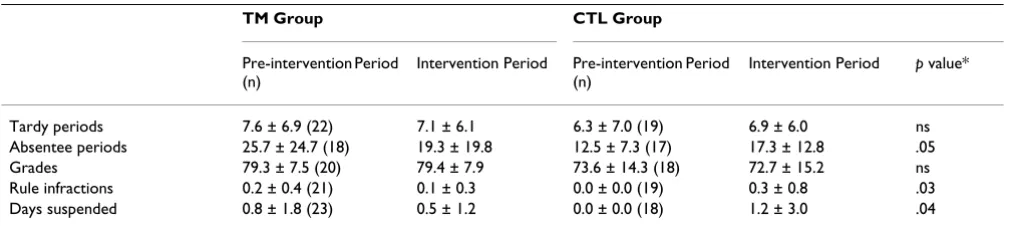
As depicted in Table 2, the TM group exhibited a mean to-tal reduction of 0.1 rule infractions over the four months of intervention compared to an increase of 0.3 infractions in the CTL group (F1,38 = 5.4, p < .03). There was a mean
total reduction of 0.3 suspension days due to behavior-re-lated problems in the TM group compared to an increase of 1.2 suspension days in the CTL group (F1,39 = 4.7, p < .04).
Tardy and Absentee Periods
Comparing the pre-intervention and intervention peri-ods, the TM group exhibited a mean total reduction of 6.4 absentee class periods compared to an increase of 4.8 in the CTL group (F1,33 = 4.2, p < .05, see Table 2 for means).
Comparing the pre-intervention and intervention peri-ods, the TM group exhibited a non-significant decrease of 0.5 tardies compared to an increase of 0.6 tardies in the CTL group (F1,39 = 0.3, p = ns).
Grades
Non-significant changes were observed in grade point av-erage between the TM group which increased by 0.2% and CTL group which decreased by 1.1% (F1,36 = 0.75, p > .10).
Table 1: Descriptive Characteristics
TM Group CTL Group
Pre-intervention Period
Intervention Period Pre-intervention Period
Intervention Period p value*
Age (years) 16.2 ± 1.3 16.7± 1.3 16.0 ± 1.4 16.6 ± 1.3 ns Weight (kg) 81.4 ± 26.9 81.3 ± 26.2 83.2 ± 23.4 85.8 ± 24.2 ns Height (cm) 171.1 ± 9.3 171.7 ± 9.4 171.3 ± 7.7 171.8 ± 7.8 ns Body mass index (kg/m2) 27.4 ± 7.4 27.2 ± 7.2 28.5 ± 8.4 29.3 ± 8.8 ns
TV watched per week (hours) 34.3 ± 17.2 37.2 ± 21.3 36.1 ± 9.6 39.1 ± 18.7 ns
Values are means ± standard deviations. *P values are for group x time interactions. NS = not significant.
Table 2: School-related behaviors by intervention and time
TM Group CTL Group
Pre-intervention Period (n)
Intervention Period Pre-intervention Period (n)
Intervention Period p value*
Tardy periods 7.6 ± 6.9 (22) 7.1 ± 6.1 6.3 ± 7.0 (19) 6.9 ± 6.0 ns Absentee periods 25.7 ± 24.7 (18) 19.3 ± 19.8 12.5 ± 7.3 (17) 17.3 ± 12.8 .05 Grades 79.3 ± 7.5 (20) 79.4 ± 7.9 73.6 ± 14.3 (18) 72.7 ± 15.2 ns Rule infractions 0.2 ± 0.4 (21) 0.1 ± 0.3 0.0 ± 0.0 (19) 0.3 ± 0.8 .03 Days suspended 0.8 ± 1.8 (23) 0.5 ± 1.2 0.0 ± 0.0 (18) 1.2 ± 3.0 .04
Anger
A group x sex x time interaction was observed for anger-in such that the TM group females exhibited greater decreas-es compared to slight increasdecreas-es among the CTL group fe-males while no significant changes were observed in males (F1,36 = 5.7, p < .03). No significant main or inter-action effects were observed for anger-out and anger con-trol (all ps > .21). Regarding other psychosocial variables, no significant main or interaction effects were observed between the groups on measures of lifestyle and environ-mental stress (all ps > .10).
Discussion
To our knowledge this is the first clinical trial examining the impact of a behavioral stress-reduction intervention on a quality of life-related issue (school behavior) in youth. This study examined the impact of a four-month participation in the TM program on absenteeism, rule in-fractions, and suspension rates in adolescents with high normal BP. The findings were not attributable to baseline differences in anthropometrics since the TM and control groups were similar on these parameters at pre- and post-intervention, and both groups were similar in their expec-tations of health benefits at pre-intervention. Evaluation of impact of possible moderators, such as exposure to en-vironmental stress, i.e., neighborhood stress, showed no differences between the groups. All subjects resided in the same geographical locale (i.e., lower socioeconomic sta-tus neighborhoods), and none participated in any formal lifestyle programs during the intervention period, besides school sports and/or physical education.
Counterbalancing interventions between schools control-led for school-to-school variations in which unknown characteristics of a particular school population or poli-cies of operation could have differentially impacted im-plementation of the protocol. A previously reported beneficial impact on cardiovascular functioning was shown by decreases in systolic blood pressure from pre- to post-intervention in the TM group compared to controls [29]. The TM group also exhibited greater decreases in systolic blood pressure reactivity to acute laboratory be-havioral stressors [29]. These physiological benefits are corroborated with behavioral and psychological benefits in the present study.
The present findings compare favorably with the results of another skills-based approach upon conduct related be-haviors. Changes in suspension status among 1523 high school students was compared across groups exposed to school-based violence prevention. Those exposed in a class-specific violence prevention education intervention showed a 71% reduction in suspension rate [7]. The present study showed a reduction in suspensions of 83% during the 4-month intervention. Improvement in overall
mental health factor and reduction in anxiety and neuroticism in African American college students was pre-viously shown after one year of TM practice [24]. These findings are encouraging and indicate a combination of anger management, conflict resolution skills testing and stress reduction may be particularly beneficial and need to be examined.
The present study extends previous findings, with incor-poration of a randomized controlled study design and use of documented records of behavior rather than typical self-report data which are open to the problem of social desirability. Counterbalancing treatment assignment by school decreased likelihood of within-school intervention contamination owing to potential inter-subject interac-tions, and unanticipated between-school differences. Ef-forts were made to provide comparable instruction time and attention at school to both groups. Similar to the present findings, previous findings using health education as a control, reportedly did not impact the attitudinal or behavioral preferences for non-aggressive conflict resolu-tion among 6th grade students [40].
One strength of the intervention is that the TM technique was taught in a standardized manner by a qualified TM in-structor. Subjective meditation experiences were moni-tored by the TM instructor via self-reports and additional instruction was provided when necessary. Daily group TM practice in the presence of the instructor facilitated suc-cessful practice. The present findings are supported by other TM studies which have shown reductions in aggres-sion [22], anxiety [41], stress-related neuromodulators, such as cortisol [42], and blood pressure [43] in Cauca-sian American adults. Since the present study was con-ducted in inner-city public high schools, with African American students with high normal blood pressure, em-pirical evaluation is needed to determine if the findings may be generalizable to other students.
and/or behavioral impact of stressors and/or utilizing mock conflict-evoking scenarios to determine possible changes in behavioral response patterns.
Conclusions
The TM group exhibited a decrease in absentee periods, rule infractions and suspension days due to behavior-re-lated problems compared to the CTL group. The findings also indicate a potential beneficial impact upon anger ex-pression in African American females. The successful im-plementation of the intervention suggests the feasibility of school-based stress reduction programs in efforts to im-prove both physical and behavioral risk factors in youth.
Competing Interests
None declared.
Author contribution
VB and FT designed the study, secured funding and super-vised the execution of the study. VB recruited subjects and supervised the intervention. VB, LB and FT analyzed the data. All authors contributed the manuscript preparation and approved the final paper.
Acknowledgements
This study was supported in part by National Institutes of Health Grant #HL62976 to Dr. Treiber and an American Heart Association Scientist De-velopment Grant #9930073N to Dr. Barnes. We would like to thank Dr. Charles Larke, Superintendent; Dr. Vivian Pennamon, and Mr. Quentin Motley, Principals, Richmond County Public Schools in Augusta, Georgia for their cooperation in providing the facilities for this study.
References
1. Brener ND, Simon TR, Krug EG and Lowry R Recent trends in vi-olence-related behaviors among high school students in the United StatesJAMA 1999, 282:440-446
2. Orpinas P, Parcel GS, McAlister A and Frankowski R Violence pre-vention in middle schools: a pilot evaluationJ Adolesc Health
1995, 17:360-371
3. Farrell AD, Meyer AL and Dahlberg LL Richmond youth against violence: a school-based program for urban adolescentsAm J Prev Med 1996, 12:13-21
4. Farrell AD and Meyer AL The effectiveness of a school-based curriculum for reducing violence among urban sixth-grade studentsAm J Public Health 1997, 87:979-984
5. Webster DW The unconvincing case for school-based conflict resolution programs for adolescentsHealth Aff 1993, 12: 126-141
6. Orpinas P, Kelder S, Frankowski R, Murray N, Zhang Q and McAlister A Outcome evaluation of a multi-component violence-pre-vention program for middle schools: the Students for Peace projectHealth Educ Res 2000, 15:45-58
7. Hausman A, Pierce G and Briggs L Evaluation of comprehensive violence prevention education: effects on student behaviorJ Adolesc Health 1996, 19:104-110
8. Weist MD, Paskewitz DA, Jackson CY and Jones D Self-reported delinquent behavior and psychosocial functioning in inner-city teenagers: a brief report Child Psychiatry Hum Dev 1998,
28:241-248
9. Rosella JD and Albrecht SA Toward an understanding of the health status of black adolescents: an application of the stress-coping frameworkIssues Compr Pediatr Nurs 1993, 16: 193-205
10. Guerra NG, Huesmann LR, Tolan PH, Van Acker R and Eron LD
Stressful events and individual beliefs as correlates of
economic disadvantage and aggression among urban childrenJ Consult Clin Psychol 1995, 63:518-528
11. Spencer MB, Dobbs B and Swanson DP African American adoles-cents: adaptational processes and socioeconomic diversity in behavioral outcomesJ Adolesc 1988, 11:117-137
12. Cornell DG, Peterson CS and Richards H Anger as a predictor of aggression among incarcerated adolescents J Consult Clin Psychol 1999, 67:108-115
13. Lowry R, Cohen LR, Modzeleski W, Kann L, Collins JL and Kolbe LJ
School violence, substance use, and availability of illegal drugs on school property among US high school studentsJ Sch Health 1999, 69:347-355
14. Everett SA, Kann L and McReynolds L The Youth Risk Behavior Surveillance System: policy and program applicationsJ Sch Health 1997, 67:333-335
15. Brooks JS and Scarano T. Transcendental Meditation in the treatment of post-Vietnam adjustmentJournal of Counseling and Development 1985, 65:212-215
16. Alexander CN, Swanson GC, Rainforth MV, Carlisle TW, Todd CC and Oates RM Effects of the Transcendental Meditation pro-gram on stress reduction, health, and employee develop-ment: A prospective study in two occupational settings
Anxiety, Stress and Coping: An International Journal 1993, 6:245-262 17. Haratani T and Hemmi T Effects of Transcendental Meditation
(TM) on the mental health of industrial workersJapanese Jour-nal of Industrial Health 1990, 32:656
18. Davis L Management of depression in general practiceBritish Medical Journal 1986, 292:64
19. Eppley K, Abrams AI and Shear J Differential effects of relaxation techniques on trait anxiety: A meta-analysisJournal of Clinical Psychology 1989, 45:957-974
20. Abrams AI and Siegel LM The Transcendental Meditation pro-gram and rehabilitation at Folsom State Prison: A cross-val-idation studyCriminal Justice and Behavior 1978, 5:3-20
21. Aron A, Orme-Johnson DW and Brubaker P The Transcendental Meditation program in the college curriculum: A 4-year lon-gitudinal study of effects on cognitive and affective functioningCollege Student Journal 1981, 15:140-146
22. Shapiro J The relationship of the TM program to self-actuali-zation and negative personality characteristicsIn: Scientific re-search on the Transcendental Meditation program: Collected papers (Edited by: Orme-Johnson DW, Farrow JT) Rheinweiler, W. Germany: Ma-harishi European Research University Press; 1976, 1:462-467
23. Alexander CN, Robinson P, Orme-Johnson DW, Schneider RH and Walton KG Effects of Transcendental Meditation compared to other methods of relaxation and meditation in reducing risk factors, morbidity and mortalityHomeostasis 1994, 35: 243-264
24. Gaylord C, Orme-Johnson D and Travis F The effects of the Tran-scendental Meditation technique and progressive muscle re-laxation on EEG coherence, stress reactivity, and mental health in black adultsInternational Journal of Neuroscience 1989,
46:77-86
25. Carsello CJ and Creaser JW Does transcendental meditation training affect grades?J Appl Psychol 1978, 63:644-645
26. Nidich SI and Nidich RJ Increased academic achievement at Ma-harishi School of the Age of Enlightenment: A replication studyEducation 1989, 109:302-304
27. Hall PD The effect of meditation on the academic perform-ance of African American college students Journal of Black Studies 1999, 29:408-415
28. Swanson G Enlightened Management: Building High Performance People Fairfield, Iowa: MIU Press 1989,
29. Barnes VA, Treiber FA and Davis H Impact of Transcendental Meditation on cardiovascular function at rest and during acute stress in adolescents with high normal blood pressure
J Psychosom Res 2001, 51:597-605
30. National High Blood Pressure Education Program Working Group on Hypertension Control in Children and Adolescents Update on the 1987 Task Force Report on High Blood Pressure in Children and Adolescents: a working group report from the National High Blood Pressure Education Program Pediatrics 1996,
98:649-658
Publish with BioMed Central and every scientist can read your work free of charge "BioMed Central will be the most significant development for disseminating the results of biomedical researc h in our lifetime."
Sir Paul Nurse, Cancer Research UK
Your research papers will be:
available free of charge to the entire biomedical community
peer reviewed and published immediately upon acceptance
cited in PubMed and archived on PubMed Central
yours — you keep the copyright
Submit your manuscript here:
http://www.biomedcentral.com/info/publishing_adv.asp
BioMedcentral and Hostility in Cardiovascular and Behavioral Disorders(Edited by:
Ches-ney MA, Rosenman RH) New York: Hemisphere/McGraw-Hill 1985, 5-30 32. Kann L, Kinchen SA, Williams BI, Ross JG, Lowry R, Hill CV, Grun-baum JA, Blumson PS, Collins JL and Kolbe LJ Youth risk behavior surveillance – United States, 1997Mor Mortal Wkly Rep CDC Sur-veill Summ 1998, 47:1-89
33. National Center for Health Statistics NHANES III Anthropomet-ric procedures (video),In: Book NHANES III Anthropometric proce-dures (video)City: US Dept of Health and Human Services, US Government Printing Office 1988,
34. Roth R Maharishi Mahesh Yogi's Transcendental MeditationWashington, DC: Primus 1994,
35. Maharishi Mahesh Yogi Maharishi's Vedic Approach to HealthVlodrop, Holland: Maharishi Vedic University Press 1995,
36. Nader T Human Physiology – Expression of Veda and the Vedic Literature Vlodrop, Holland: Maharishi Vedic University Press 1994,
37. Jevning R, Wallace RK and Biedebach M The physiology of medi-tation: A review. A wakeful hypometabolic integrated responseNeuroscience and Biobehavioral Reviews 1992, 16:415-424 38. Wallace KR The Physiology of consciousnessFairfield: Maharishi
Interna-tional University Press 1993,
39. Casper RC, Belanoff J and Offer D Gender differences, but no ra-cial group differences, in self-reported psychiatric symptoms in adolescentsJ Am Acad Child Adolesc Psychiatry 1996, 35:500-508 40. Petchers MK, Hirsch EZ and Bloch BA A longitudinal study of the
impact of a school heart health curriculumJ Community Health
1988, 13:85-94
41. Dillbeck MC The effect of Transcendental Meditation on anx-iety levelJournal of Clinical Psychology 1977, 33:1076-1078
42. MacLean CR, Walton KG, Wenneberg SR, Levitsky DK, Mandarino JV, Waziri R and Schneider RH Altered responses of cortisol, GH, TSH and testosterone to acute stress after four months' practice of Transcendental Meditation (TM)Annals of the New York Academy of Sciences 1994, 746:381-384