www.scienceworldjournal.org ISSN 1597-6343
A Qualitative Study of Smartphone Usage Patterns: The Case of Ghana
A QUALITATIVE STUDY OF SMARTPHONE USAGE PATTERNS:
THE CASE OF GHANA
Percy Okae
Department of Computer Engineering, School of Engineering Sciences, College of Basic and Applied Sciences (CBAS), University of Ghana, Legon, Accra, Ghana
E-mail: [email protected], [email protected]
ABSTRACT
Over the past decade, the use of smartphones has become the norm rather than the exception among all the income groups of people around most parts of the World. Foremost among the reasons why people invest substantial amounts of money to purchase a smartphone, is mainly to employ its computing powers to facilitate their day-to-day routines as well as gain recognition and respect as compared to the traditional cellular phones used mainly for making telephone calls and also sending text messages. This study sought to use survey responses from a cross-section of various income groups in Ghana; namely low-income, middle-low-income, and high-low-income, to determine the underlying reasons why even people who are at the very bottom of the income brackets strive to acquire a smartphone at all cost. The responses analyzed in this study were sourced from varied sources using three research instruments namely; questionnaires, interview guides, and observation schedule. The data obtained were tested using chi-square analysis for purposes of firming up the research findings. The principal finding was that most individuals, even the least educated, had become so much used to technology such that an Internet-enabled telephone has become more or less a must-have so that they could use its numerous applications (apps) especially social network applications such as WhatsApp, Facebook, Twitter, and Instagram. Also Google Play Store, Apple Play Store, where various software applications could be downloaded were also influencers for the acquisition of a smartphone.
Keywords: Smartphone, Ghana, WhatsApp, Facebook, Twitter, Martin Cooper.
INTRODUCTION
The advent of the so-called smartphone in recent years has indeed been more of an explosion than had even been anticipated by its developers. It is now prosaic to see a smartphone displayed in every nook and cranny of a business environment that one finds himself or herself in.
One may ask then, what is a smartphone? The simple answer is that it is still the same old mobile phone we have always known since its invention on 3rd April, 1973 by Motorola senior engineer
Martin Cooper, except that these ones have more advanced computing power, more sophisticated add-ons such as a USB port that facilitates connectivity to other external devices such as a printer, a computer and are almost always very flashy. It cannot be gainsaid that technology has made such a major impact in the lives of the generality of humankind such that the idea of living for only just a day or even a few hours without access to a cell phone has become more or less a taboo to so many people. Presently, the World has over 7 billion mobile phone users (https://www.gartner.com/newsroom/id/2996817) and I daresay
that all these people are more or less addicts and survival for just a day without their treasured cell phones will be such a troubling time. On a personal level, I have had access to a mobile phone since 1999 and I cannot fathom how life for me would be like after all these years of usage if ever I am denied its use for even a day. We have all as human becomes prisoners of technology giving the facilitation it brings to our individual lives to the extent that even during bedtime many still keep their smartphones on and by their bedside (https://hothardware.com/news/your-tablet-and-smartphone-are-ruining-your-sleep-, https://www.cnet.com/how-to/stop-your-gadgets-from-keeping-you-awake-at-night/). The bottom line here is that man by nature is an adaptive being and once a situation occurs repetitively in our lives, we get accustomed to it and sees it from hence as the norm rather than the exception. That is exactly what the cell phone has transformed all humans into.
In times past, one normally would have a regular cell phone, and perhaps a desktop computer at home which became so rife during the dotcom boom. Then came the era of the PDAs, media players, digital cameras, and GPS navigation units all as stand-alone devices. However, the emergence of the smartphone transformed all the listed examples above and more into an all-in-one portable device combining the regular functions of a cell phone with that of a computer. Even more impressively, present day smartphones have add-on features such as touchscreen functionality, third-party applications and also web-browsing technology in-built as well. Because of time and convenience, people have indeed taken to the smartphone so much since they love to be informed even whist on the go.
In fact, the term smartphone was actually designed by IBM in 1992 when it developed a prototype that it demonstrated at a computer trade show (http://www.bbc.com/news/technology-28802053). This device, named “Simon”, which went on sale on 16 August, 1994, beside its usual phone functions, was able to send and receive faxes and e-mails using its GUI (touchscreen display). However, despite these smart features possessed by “Simon”, it was not until 1997 that the term smartphone was coined when Ericsson described its GS 88 “Penelope” concept as a smartphone. However, a year earlier, Nokia had developed the Nokia 9600 communicator but did not use the term smartphone. Today, the term smartphone is applied to any cellular or mobile device that can do voice communications and extra such as Internet browsing, computations, has an in-built camera etc., such that nowadays point-and-shoot photo-taking is gradually fading affecting the businesses of photographers (https://gigaom.com/2011/12/22/smartphones-killing-point-and-shoots-now-take-almost-13-of-photos/).
No wonder, some technologists have thus coined the term superphone to describe the modern-day smartphones (https://mashable.com/2010/07/12/superphone/#mm690IkBiEqk).
Fu
ll L
en
gt
h Rese
ar
ch
Ar
A Qualitative Study of Smartphone Usage Patterns: The Case of Ghana However, on the negative side, research has also shown that
there are quite a lot of children who because they have access to an Internet-enabled smartphone have become social deviants. A typical case involves teenagers who are having sex with strangers online due to the proliferation of smartphones ( https://www.theregister.co.uk/2012/11/01/smartphones_more_sex ually_active/).
Background of study
Ghana as a country has experienced a massive explosion in the usage of cellular phones for the past two decades. Right from 1991 when the first cellular phone subscription occurred, the exponential growth in the numbers has seen no stopping since. Today, the number of cellular phones subscription lines which stood at 36,613,987 at the end of the second quarter of 2016 (https://www.statista.com), have surpassed the population of Ghana which is under 30 million and the estimates are that in the not too-distant future, the ratio of cell phones lines to the Ghanaian population will be in a ratio of about 2:1.
It is, however, worth noting that the usage of smartphones by Ghanaian cellular phone subscribers gained currency just about five ago just as it is in most parts of the World. The situation is now such that those who use the traditional cell phones that can only be used to receive and make calls as well as sending and receiving text messages have now become a “laughing stock”. As a result, the numbers of people using such phones have kept on dwindling over the last few years especially among the educated elite who can afford smartphones, even if not of the highest quality. Today in Ghanaian markets, businesses have sprung up all over the place who deal in smartphones and their accessories. The situation is something very akin to the dotcom boom in the early 2000s where PCs became so rife and prosaic.
According to an evaluation done in 2015, the World has a total of
7 billion mobile phone lines or
numbers(https://www.gartner.com/newsroom/id/2665715, https://www.gartner.com/newsroom/id/2996817) . At the end of 2016, Ghana had a mobile phone subscription totaling 38.31 million (www.citifmonline.com, www.statista.com) indicating a massive increase in numbers from the early 2000s.
However, at the heart of this boom in Ghana is the smartphone. In The Mobile Africa 2015 Study conducted by Geo Poll in collaboration with World Wide Worx, it was identified that the five major markets in Africa were South Africa, Nigeria, Kenya, Ghana and Uganda. The study was conducted to assess the rate of smartphone and Internet usage in Africa. The study used 3,500 persons selected randomly from the five major markets identified above. The most significant finding of this study was that Internet browsing via phones now stands at 40 % across the five markets used for the study. Ghana led the way with 51 % of respondents answering yes to Internet browsing via mobile phones. Nigeria follows with 47 %, South Africa with 40 %, Kenya 34 % and Uganda 29 %. With regards to applications downloads via cell phones, South Africa led the way with 34 %, Ghana recorded 31 %, 28 % in Nigeria, 19 % in Kenya, and 18 % in Uganda. The statistics on smartphone usage in the five study areas also revealed the following figures (source: www.expandgh.com).
Phone calls — 71 % Facebook — 48 %
SMS/Text Messaging — 45 % Radio/FM Listening — 41 % Instant Messaging — 38 %
Taking Photos — 37 % Playing Games — 32 %
Mobile Application Downloads — 26 % Twitter — 13 %
The same study also revealed that the most common smartphones used by the five major markets surveyed were the following:
Nokia — 34 % Smartphone — 17 % I-phone — 2 % Blackberry — 6 %
Table 1: Most common use of mobile phone activity by country in selected African countries.
Source: www.itnewsafrica.com
The technological revolution that has swept the World has mainly accounted for the rise in the acquisition of smartphones by the broader majority of Ghanaians in the various income groups. Worldwide, android phones have led the way in terms of numbers leaving Windows-based smartphones trailing (https://www.pcworld.com/article/3035100/phones/). The satisfaction obtained from Web browsing to socializing via social media to the easy manipulation of sophisticated mobile applications are the key factors most Ghanaians now use when they have to purchase a new mobile phone. Hence the rising cost of smartphones on the Ghanaian market with each passing day. This study therefore intends to formalize the smartphone usage patterns among a cross-section of Ghanaians to form the foundation of any future analysis.
LITERATURE REVIEW
Ever since smartphones became a common feature to many users of mobile phone services, many people have assigned various reasons as to why they chose a smartphone. For some it is for the convenience of been online at any time of their choosing, for others, it is for the various apps that are available on a smartphone which other mobile phones lack. The list goes on and on. At a higher level, governments have also taken advantage of the facilities smartphones offer and have rolled out national projects that are accessible to residents via a smartphone. A typical example, is the GhanaPostGPS software launched recently by the government of Ghana.
On Wednesday Oct 18th 2017, the government of Ghana
deployed a digital addressing system it termed as The Ghana Digital Property Address System (GhanaPostGPS). This it claimed was to help in the location of residences as well as lands
A Qualitative Study of Smartphone Usage Patterns: The Case of Ghana in Ghana which had always been a challenge
(http://citifmonline.com/2017/10/18/). For a fact, the lack of an effective addressing system has always compelled Ghanaians to develop a culture of relying on directions from people, navigating areas via basic landmarks such as electricity poles, shops, institutions, etc. In cases where emergencies occur such as accidents, giving directions to emergency personnel is really difficult. Thus the service is simply to ameliorate a bad situation using the facility of a smartphone. The application (or app) is downloadable from the Apple Store or Google Play Store. Figure 1 is a diagram of the app.
Figure 1: A screenshot of the GhanaPostGPS app
(source: https://buzzghana.com/ghanapostgps-app-download/)
The system which uses Google Maps technology, partitions the whole of Ghana into grids of roughly 5 m x 5 m squares and assigns one unique address to each grid known as digital address using the technology of Global Positioning System (GPS). To download the application, all that one needs is an Internet-enabled smartphone and then subsequently perform these four steps:
1. Visit your application store (Google Play Store for Android Phones, Apple Store for iOS) and search for GhanaPostGPS and download application.
2. Once the app is installed, follow instructions to register 3. Verify and confirm your login details
4. Your digital address system is ready to use Next, to generate the digital address, you do the following: 1. Turn on your device location button
2. Open the GhanaPostGPS app and click on the button 3. Your unique address will appear next to the digital address,
for example, Digital Address: GA-543-0125.
Thus, this app available freely via a smartphone has enabled many Ghanaians to acquire digital addresses over the past seven months since its launch. This is a typical benefit of a smartphone usage.
Objective of this study
In this paper, the objective is solely to identify the patterns of smartphone usage among the various income groups in Ghana. The study is conducted by taking surveys from samples of the various income groups identified through a random selection. Their responses are firmed up using chi-square analysis and conclusions are consequently drawn.
METHODOLOGY OF RESEARCH
(Dix et al., 1998) affirm that to be able to conclude on the success or otherwise of a product, the most effective way is to engage the user of the product to find out whether it has met the user’s
expectations. As a consequence, this study adopted the same concept by sampling the views of users of smartphones in the various income brackets. The responses are then tested using chi-square analysis so as to firm the study findings.
The responses analyzed in this study were sourced from varied sources using three research instruments namely, questionnaires, interview guides, and observation schedule. The varied sources included the sampled views of customers of the various networks who were interviewed at customer service offices of these companies, as well as the inputs of some university students where virtually almost all the interviewees fall within the age bracket identified as youthful. Then also, the study tested whether the gender of respondents had any role to play in the type of response obtained with regards to the efficacy of smartphones compared to a non-smartphone on their daily lives. The data collected were analyzed using the chi-square tests.
This study, as stated earlier, used chi-square tests to analyze the data acquired. A chi square statistic, χ2, is used for the purposes
of investigating whether distributions of categorical (non-numerical) variables have any statistically significant differences between them. The study used test to test the hypothesis that observed frequencies differs from their expected values. When we carry out a χ2 test and observed frequencies are similar to
expected frequencies, we interpret the value of χ2 as small and
consequently retains the null hypothesis (fail to reject H0), whilst when observed frequencies are significantly different from expectedfrequencies, then we conclude that χ2 is large and the
null hypothesis is rejected (reject H0). By definition, the chi-square statistic is given as:
χ2 =
E
E
O
2
In the equation above, χ2 is the chi square statistic, O is the
observed frequencies, and E is the expected frequencies. The hypotheses for all our chi-square tests throughout this study will be as follows:
H0: The categorical variables are independent. H1: The categorical variables are related.
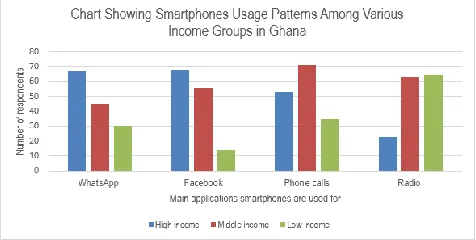
Table 2 gives the responses obtained from people of various income groupings who were interviewed randomly for their views on how they use their smartphones and the frequencies of usage. The income groups were high income, middle income, and low income. A chi-square analysis test was next performed on the compiled data to affirm the findings.
Table 2: Table showing responses from various income groups of Ghanaians
A chi-square test was also performed on the responses from respondents randomly selected concerning the kinds of uses they normally put their smartphones to.
A Qualitative Study of Smartphone Usage Patterns: The Case of Ghana The calculations using R yields, χ2 = 66. 584, df = 6, p-value =
2.047e-12.
From the original table, there are four rows and three columns. Hence our degree of freedom will be (3-1) (4-1) = 2(3) = 6. With our significance level, α = 0.05, and df = 6, we observe from tables that the critical value is 12.592. The test statistic obtained using R is 66.584 and it exceeds the threshold (12.592) read from tables, so we conclude that the data is consistent with the fact that there is a relation between the type of usage the smartphone is put to and the income group in which an individual falls. At the 0.05 level of significance, there is evidence of a relationship between income group and usage patterns of a smartphone given that the p-value is so small.
Figure 1: Chart showing the main applications various income groups use their smartphones for
Table 4 are also the responses of a group of students who are either in tertiary institutions or in secondary institutions or both. The number of people interviewed among this group were 260 in total. The questions posed this batch of students were whether they owned a smartphone or not, and apart from normal voice conversations, whether the ownership of a smartphone has facilitated communications and social interactions for them. A chi-square analysis test was performed on the responses obtained from this group of people to firm up the findings.
Table 4: Table showing responses from 260 youthful students indicating observed and expected numbers in various cells
A chi-square test was also performed on the responses from randomly selected youth on how a smartphone acquisition has changed their lives.
The calculations using R with Yates’ continuity correction yields, χ2 = 30.257, df = 1, p-value = 3.784e-08.
From the original table, there are two rows and two columns. Hence our degree of freedom will be (2-1) (2-1) = 1(1) = 1. With our significance level, α = 0.05, and df = 1, we observe from tables that the critical value is 3.84. The test statistic (30.257) exceeds the critical value or threshold (3.84), so we conclude that
the data is consistent with the fact that there is a relation between the use of the smartphone by these sample of students and their lifestyles facilitated by technology. At the 0.05 level of significance, there is evidence of a relationship between age and attitudinal usage of a smartphone confirmed by the small value of the p-value (3.784e-08).
The next group of people interviewed in this study were corporate executives of various organizations to solicit their views on the way the sophistry of the smartphone which is more or less a mini-computer in terms of size has impacted their daily routines such as efficiency of their jobs, and meeting of timelines etc. In fact, many of them affirmed that even on the go, they are able to execute work that otherwise they could not execute if not for the smartphone. Table 6 gives the responses of various age groups of corporate executives interviewed, with the responses broken into four parts namely strongly agree, somewhat agree, somewhat disagree, and not really.
Table 6: Data showing relationships between the age groups of selected corporate executives and their responses on smartphone impact on their jobs.
A chi-square test was also performed on the responses from randomly selected corporate people in various age groups about their impressions of a smartphone usage on their jobs.
The calculations using R yields, χ2 = 42.258, df = 9, p-value =
2.948e-06.
The original table gives us a degree of freedom of 9 and hence at the 0.05 significance level, we obtain a threshold or critical value of 16.919 from chi-square tables. The test statistic (42.258) obtained using R statistical software is greater than this threshold value so we reject the null hypothesis, i.e., there is a significant difference between the observed and expected values. At the 0.05 level of significance, there is evidence of a relationship between age and attitude, more so from the small probabilistic value (p-value) obtained through calculation. It appears the jobs of the corporate executives are nowadays very much impacted by the use of smartphones precipitating a higher efficiency than in the past.
A Qualitative Study of Smartphone Usage Patterns: The Case of Ghana Figure 2: Chart showing the responses of various age groups of
corporate executives on their smartphone usage patterns
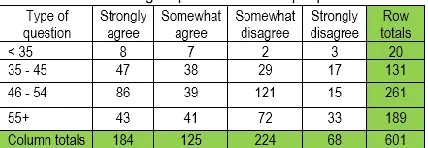
Next, this study undertook a survey among people in academia to solicit their views on the way the advent of the smartphone has also affected the way they teach and conduct research. Table 8 presents compiled data obtained on using various age categories of academics. The question posed these group of people was:
Do you strongly agree, somewhat agree, somewhat disagree, or stronlgy disagree that a smartphone and its array of sophisticated software contributes positively to your ability to improve on teaching and research?
Table 8:Tables showing responses from 601 people in academia.
A chi-square test was also performed on the responses from group of academics randomly selected to source their views on how a smartphone usage has impacted their teaching and research activities.
The calculations using the statistical software R yields, χ2 =
48.482, df = 9, and p-value = 2.075e-07.
From the original table, there are four rows and four columns. Hence our degree of freedom will be (4-1) (4-1) = 3(3) = 9. With our significance level, α = 0.05, and df = 9, we observe from tables that the critical value is 16.919. The test statistic χ2 =
48.482 exceeds the threshold or critical value (16.919), so we conclude that the data is consistent with the fact that there is a relation between the use of the smartphone and teaching and research progress of academics in these contemporary times. In other words, the smartphone is a mini-computer able to execute almost all of the functions of a conventional computer making teaching and research as flexible as possible irrespective of geographical location. It has therefore had a positive impact on teaching and collaborative research of academics. The small value of the p-value justifies the rejection of the null hypothesis (H0).
Figure 3: Chart showing the responses of various age groups of academics on their smartphone usage patterns
DISCUSSION OF RESULTS
The chi-square analysis tests on all the data gathered confirmed one perception or the other. For instance, test on data in Table 2 firmed up the perception that there is a relation between the type of usage the smartphone is put to and the income group in which an individual falls. From the data in Table 4, data solicited from students of various age groups gave an affirmation to the fact that there is a relationship between a student’s ownership of a smartphone and the facilitation in communications reflecting in their daily lifestyles due to the usage of a smartphone. A similar trend was observed in all the other tests carried out that had corporate executives, and academicians as the interviewees. This implies that the smartphone despite its usually prohibitive cost depending on brand, is indeed a technological facilitator making job execution and social networking possible irrespective of location.
Conclusions
This study wanted to understand the reasons behind the massive surge in the crave for smartphones in Ghana in the past five years. Conclusive evidence indicated that the major reasons behind the choice of a smartphone as against an ordinary cell phone were the numerous applications (software) that could be downloaded onto a smartphone such as the GhanaPostGPS cited in the introduction and also the appealing features it has compared to an ordinary phone. As a result, in present day Ghana, even the least paid by way of income, are likely to purchase a smartphone even if on credit just to be able to enjoy its numerous facilities. After all, if in the comfort of one’s bed, it is possible to enjoy an all-in-one device that can provide TV pictures, applications of various news portals, a variety of social networking sites etc., then it presupposes that its acquisition is worth the investment.
REFERENCES
"Android leads, Windows phones fade further in Gartner's smartphone sales report". PC World. IDG.
Retrieved 18 May 2016.
https://www.pcworld.com/article/3035100/phones/android - leads-and-windows-phone-fades-in-gartners-smartphone-sales-report.html
Colaner, Seth (August 27, 2012)."Your Tablet and Smartphone Could Be Ruining Your Sleep". Retrieved January 22, 2018. https://hothardware.com/news/your-tablet-and-smartphone- are-ruining-your-sleep-
A Qualitative Study of Smartphone Usage Patterns: The Case of Ghana years". BBC News. BBC News, retrieved May 16,
2018. http://www.bbc.com/news/technology-28802053 Dix, A., Finlay, J., Abowd, G., & Beale, R. (1998).
Human-Computer Interaction. 2nd edition. U.K.: Prentice Hall Don Reisinger (October 17, 2012). "Worldwide smartphone user
base hits 1 billion". CNet. CBS Interactive, Inc.
Retrieved July 26, 2017.
smartphone-user-base-hits-1-billion/
Gartner Says Annual Smartphone Sales Surpassed Sales of Feature Phones for the First Time in 2013,
retrieved May 24, 2018 from
https://www.gartner.com/newsroom/id/2665715 "Gartner Says Smartphone Sales Surpassed One Billion Units in
2014". Gartner. March 3, 2015. retrieved May 28,
2018 from
https://www.gartner.com/newsroom/id/2996817 GhanaPostGPS App: How to Download, Register, and Use the
New Navigation Technology, retrieved 31st May,
2018 from https://buzzghana.com/ghanapostgps-app-download/
Nana Addo launches Ghana’s Digital Property Address System,
retrieved 31st May, 2018 from
http://citifmonline.com/2017/10/18/nana-addo-launches-ghanas-digital-property-address- system/ Number of mobile cellular subscriptions in Ghana from 2000 to
2016 (in millions) retrieved 17th March, 2018 from
https://www.statista.com/statistics/498203/number-of-mobile-cellular- subscriptions-in-ghana/.
Ogg, Erica (December 22, 2011). "Smartphones killing point-and-shoots, now take almost 1/3 of photos". GIGAOM.
retrieved May 27, 2018 from
https://gigaom.com/2011/12/22/smartphones-killing-point-and-shoots-now-take-almost- 13-of-photos/ "Quarterly Device Sales In 2011"(Infographic). Mobile Statistics.
Mobile Statistics. 2013, retrieved July 25, 2017 from http://www.mobilestatistics.com/mobile-statistics "SMARTPHONES make TEENS have SEX with STRANGERS",
retrieved May, 31st, 2018 from
https://www.theregister.co.uk/2012/11/01/smartphones _more_sexually_active/
Smartphone and Internet Penetration in Ghana on the Rise: retrieved March, 18th, 2018 from
http://www.expandgh.com/smartphone-and-internet-penetration-in-ghana-on-the-rise/
"Stop your gadgets from keeping you awake at night". CNET. Retrieved 1 June 2016. https://www.cnet.com/how-to/stop-your-gadgets-from-keeping-you-awake-at-night/ Study reveals Ghana mobile phone usage stats: retrieved 18th
March, 2018 from
http://citifmonline.com/2015/04/08/study-reveals-ghana-mobile-phone-usage-stats/
What Makes a Smartphone a Superphone? retrieved May 31st,
2018 from
https://mashable.com/2010/07/12/superphone/#mm69 0IkBiEqk Retrieved 25th April, 2018 from
www.itnewsafrica.com.
About the author
Percy Okae is an electrical engineer/computer scientist and faculty at the Department of Computer Engineering in the School of Engineering Sciences at the University of Ghana.
He holds a BSc (HONS.) Electrical/Electronic Engineering from the KNUST, Kumasi, Ghana, MS Telecommunications from the University of Louisiana at Lafayette, USA and a PhD Computer Science from the African University of Science & Technology (AUST), Abuja, Nigeria. E-mail: [email protected]