© 2015 IJSRSET | Volume 1 | Issue 4 | Print ISSN : 2395-1990 | Online ISSN : 2394-4099 Themed Section: Engineering and Technology
Energy-Efficient Medium Access Control (MAC) Protocols for
Wireless Body Area Networks: A Survey
Aparna A. R., Malini Soman
Department of Electronics and Communication Engineering, SNGCE, Ernakulam, Kerala, India
ABSTRACT
With recent advances in wireless networking, Wireless Body Area Networks (WBANs) became practically feasible. This paper presents a survey about energy-efficient MAC protocols for WBANs. The importance and significance of MAC protocols are discussed. Several methods that provide energy efficiency for WBANs are identified. Also highlights features of various existing MAC protocols along with their advantages and limitations.
Keywords: Wireless Body Area Networks (WBANs), Medium Access Control (MAC), Energy Efficiency.
I.
INTRODUCTION
A WBAN is composed of miniaturized, low power and intelligent sensor nodes deployed on, in or around the human body. These sensors collect vital data from the body and transmit via single hop or multi-hop mechanism to the sink. The sink further sends this data to the medical server. The medical specialist can access the patient’s data and perform further advices and procedures. WBANs can also handle emergency situations [3].
According to the IEEE 802.15 (TG6) [4], a BAN consists of “low power devices operating on, in or around the human body (but not limited to humans) to serve a variety of applications including medical, consumer electronics/ personal entertainment and other”. BANs have a wide range of applications, both medical and non-medical. Medical applications include wearable health monitoring, diabetes, cancer detection, tele-medicine systems, asthma, Ambient-Assisted Living (AAL) etc., while non-medical applications may include real-time streaming, entertainment, interactive gaming etc.
The subsequent session discusses the role and importance of MAC protocols. Section III gives an idea about works related to the study of MAC protocols. Section IV is an investigation about various
Energy-Efficient MAC protocols proposed for WBANs highlighting each one’s advantages and disadvantages. The collision avoidance techniques are listed in section V. finally section VI concludes the research work.
Figure 1: A WBAN system [28]
II.
METHODS AND MATERIAL
Role of MAC Protocols
Also, MAC protocol plays a significant role in reducing the average energy consumption of the sensor nodes. The MAC protocol is required to achieve maximum throughput, minimum delay and to maximize the network lifetime.
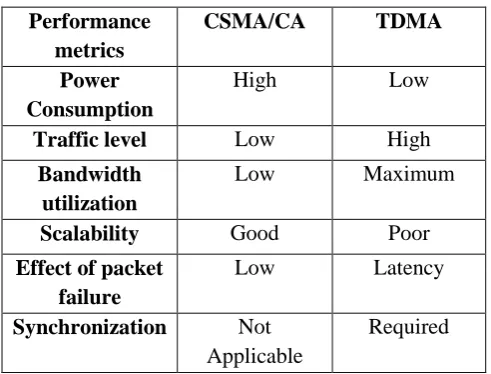
Most Wireless Sensor Networks use either Carrier Sense Multiple Access (CSMA) or Time Division Multiple Access (TDMA). CSMA has inefficiencies in the fact that it uses idle channel listening to determine when to transmit. However these protocols are scalable with no strict time synchronization constraint. In TDMA the channel is divided into fixed or variable time slots. These slots are assigned to nodes so that each node transmits in its own slot period. TDMA has high overheads in clock synchronization. [2]. Table I gives a comparison of both types.
Table 1: Comparison of CSMA/CA and TDMA protocols
Performance metrics
CSMA/CA TDMA
Power Consumption
High Low
Traffic level Low High
Bandwidth utilization
Low Maximum
Scalability Good Poor
Effect of packet failure
Low Latency
Synchronization Not Applicable
Required
The Quality of Service (QoS) is an important factor of a good MAC protocol for BAN. For emergency situations, the MAC protocol should allow the nodes to get quick access to the channel to send emergency data to the sink. The current IEEE 802.15.6 is working on the standardization of WBAN including the development of a unified MAC protocol
A. Related Works
Analysis of performance of MAC protocols is an interesting area. Pei Huang et.al in [7], surveyed the latest WSN MAC progresses over the period 2002-2011, showed that in the early development stages, designers
concentrated mainly on energy efficiency. But recently emerging protocols guarantee efficient delivery during variable and bursty traffic, along with providing multi task support. Research work by Vinay Singh et.al in [10], Rahim et.al in[11], Sai Anand Gopalan in [8] concentrates on Energy Efficient MAC protocols for WBANs.
B. Energy-Efficient MAC protocols for WBANs
In this section, several existing well-known and
established MAC protocols for WBANs are
investigated. The following subsections provide detailed operation of these protocols with the strengths and weaknesses of each one listed as the last subsection.
i] S-MAC
S MAC (Sensor MAC) [12] suggested by W. Ye et.al in 2002 is one of the popular MAC protocols used in WBANs. This protocol uses fixed duty cycles to solve the idle-listening problem. Here the nodes remain in sleep mode always, and gets turned on only for data transmission, thereby energy wastage due to collision, over hearing, idle listening etc is minimized. All nodes employ a CSMA scheme in active mode, to determine when to transmit. In short, nodes toggle between predetermined active and sleep periods. Actually this is a source of inefficiency, because it creates an instant of awakening all nodes, but only one is sending data to the sink. Also sleep schedule create un-tolerable latency. Therefore it is not efficient to handle continuously varying data rates in WBAN.
ii] T MAC
iii] IEEE 802.15.4 MAC
IEEE 802.15.4 [26] is a low power standard designed for low data rate applications like WPANs. It offers 3 operational frequency bands: 868 MHz, 915 MHz, and 2.4 GHz bands. There are 27 sub-channels allocated in IEEE 802.15.4, i.e., 16 sub-channels in 2.4 GHz band, 10 sub-channels in 915 MHz band and one sub-channel in the 868 MHz band. IEEE 802.15.4 MAC has two operational modes: a beacon-enabled mode and a non-beacon enabled mode. [2], [14] It can support upto 250 kbps data rate with a maximum of 10 meter coverage. It’s a fact that this data rate is not high enough to support WBANs. WBANs require upto 10 mbps according to IEEE 802.15.6. The IEEE 802.15.4 is not adaptive to quality variation of channel. It is not suitable to heterogeneous and variable traffic since only limited number of Guaranteed Time Slots [GTS0 is supported.
iv] Wise MAC
Wise MAC (Wireless Sensor MAC) [15] is an Ultra-Low power MAC protocol for multi-hop Wireless Sensor Networks put forward by A. El-Hoiydi et.al in the year 2006. This protocol is based on non-persistent CSMA. A preamble sampling technique known as LPL (Low Power Listening) is used here. A node regularly samples/polls the nodes for a small sample period with a purpose of testing whether a packet needs to be received. It can go back to sleep whenever it senses no traffic. The source sends a wake-up preamble when it has to send data. Here access point (AP) serving a number of sensor nodes stay awake to learn sensor’s wake-up schedules. The AP sends a long preamble, if it does not know the channel sampling schedule of a sensor node. When node receives this, it includes this schedule in the ACK. Thus up to date schedules collected by AP, will start preamble transmission just before receiver target wakes up.
v] Okundu MAC
Okundu Omeni et.al in 2008, suggested a new TDMA based protocol [16], based on centrally controlled wake-up and sleep mechanisms. This protocol consists of 3 processes:
Link establishment
Wake up service and
Alarm process.
Wake-Up Fall Back time (WFT) mechanism is used to avoid collision. If a slave wake up and fails to communicate with master, it goes back to sleep with time set by WFT. Master is the central co-ordinator and the sensor nodes constitute slaves. Each slave node is assigned one slot by the master node initially. If the slave node wants to transmit more, it sends an alarm. However it is not suitable to variable traffic, since an alarm is supported only when there is no scheduled node. Also, only one slave node can join the network at a time. However, problems like idle listening and over-hearing can be reduced because of central management of traffic.
vi] MedMAC
N.F Timmons et.al proposed an adaptive TDMA based MAC protocol called MedMAC (Medical MAC) [17]. It consist of the AGBA (Adaptive Guard Band Algorithm) and the DAF (Drift Adjustment Factor) schemes for power saving. AGBA allows the node to sleep through many beacon broadcasts by introducing a Guard Band (GB) time for each time slot to track the actual drift. This GB time is adjustable. DAF minimizes the Bandwidth waste by monitoring GB and using extra GB if required. OpNET is used for simulation. For low data rate and medium data rate applications, MedMAC is better than IEEE 802.15.4 MAC. Collision avoidance achieved using GTS. Thus energy wastage due to collision is reduced. But the fact that WBAN require high data rate made MedMAC non reliable for BANs.
vii] B MAC
B MAC (Body MAC) protocol [18] was introduced by Fang et.al in 2009.Three bandwidth management
schemes here, to improve the energy efficiency.
The Burst bandwidth
Periodic bandwidth and
Adjust bandwidth
channel exclusively within a portion of each MAC frame or few MAC frames. It is also allocated by the coordinator, based on node’s QoS requirements and current availability of the bandwidth. Adjust bandwidth defines the amount of bandwidth to be added to or reduced from previous Periodic Bandwidth [7].
viii] Low Duty Cycle MAC
Marinkovic et.al in 2009, proposed a new modified TDMA based low duty-cycle MAC protocol with extra reserved slots for retransmission according to request by sensors[19]. The authors proposed a synchronization scheme, when nodes can wait for a fixed maximum number of TDMA periods before resynchronization The
concept of Guard Time ( ) is implemented here to
prevent overlapping between time slots and thereby
avoiding collision of packets. For periodic
synchronization, this protocol uses Network Control (NC) packet which may result in extra energy consumption. It is actually a fixed frame structure based on pure TDMA, hence cannot fulfil need of dynamic traffic of WBAN.
ix] H MAC
H-MAC (Heart-beat driven MAC) exploits heart beat rhythm for node synchronization [20]. Thus external clock can be avoided by achieving reduced complexity and reduced power consumption. This novel concept was introduced by H. Li and J. Tan in 2009. HMAC is TDMA based, with guard bands allocated in each time slot to prevent data overlapping and thereby collision. However, this idea reduces bandwidth utilization since no transmission i the guard bands. Simulation results in OmNET++ shows that HMAC has longer life time compared to L-MAC [25] and S-MAC [12].
Traditional synchronization methods like periodic synchronization beacons, are replaced by heart beat rhythm pattern reduces energy consumption. Since any data collected from human body is influenced by heartbeat, this protocol is having low overhead, but limitation is that the heart beats are not faster enough so that it may create inter node interference and not suitable for EEG like applications, if used for synchronization.
x] In-Body MAC
M Al-Ameen, J. Liu, S Ullah and Kwak in 2011, introduced a power efficient TDMA based MAC
protocol called In-Body MAC, which can handle normal, emergency and on-demand traffic [21]. Two basic wake-up procedures employed, by traffic based patterns for normal traffic using wake-up table and the next by radio for emergency and on-demand traffic. Thus the wake up signal helps in resource allocation by switching the nodes from sleep to active state. However, this results in higher complexity. Also, this extra wake-up circuit will result in increased cost for its hardware implementation. The concept was actually good for variable traffic due to wake-up strategies.
xi] FrameComm MAC
Tony O Donovan et.al presented a WBAN, within the context of falls assessment among elder patients [22]. The FrameComm protocol employed by this BAN, is designed to ensure that patients’ vital signals are communicated under a variety of network loads and conditions. Three BAN data management techniques are evaluated within the context of falls assessment among the elderly, they are
1) Priority
i.e. in an emergence situation, which sensor readings or data packets get priority over other sensor readings, 2) Aggregation
Combining the data from several messages into one in order to reduce overhead and network contention and congestion, this allows more data travel through the network and helps ensure that the server or medical practitioner receives critical data, and
3) Adaptive duty cycles
Based on a specific set of circumstances the duty cycle durations may be increased or decreased to meet the application requirements, thus preserving the life of the battery while meeting the needs of the medical application.
xii] CA-MAC
Bin Liu et.al presented a Context-Aware MAC protocol (CA-MAC) in 2013, taking into account various issues which are not addressed in the previous works [23]. This CAMAC introduces traffic-aware adjustment of transmission priority and channel-aware adjustment of access mechanisms effectively. The combination of traffic aware and channel-aware adjustment makes this MAC reliable for WBANs. The authors introduced a new hybrid contention/TDMA superframe structure with beacon, contention (slotted CSMA/CA) and TDMA parts. The advantage of suppresing deep fading problems by the contention based mechanism and the
advantage of contention free TDMA mechanisms are effectively blended. Besides the Energy-Efficiency can be enhanced by decreasing the contention part when fading problem is mitigated [23]. This is good for variable traffic due to dynamic schedule based and polling based slots allocation so that nodes can obtain requested slots in the current super-frame.
Unlike context aware BAN described in [22], here the context analysis is done by the coordinator so that most computation can be removed from sensors. The interference and remaining energy is not considered here, which are important to be taken into account.
III.
RESULTS AND DISCUSSION
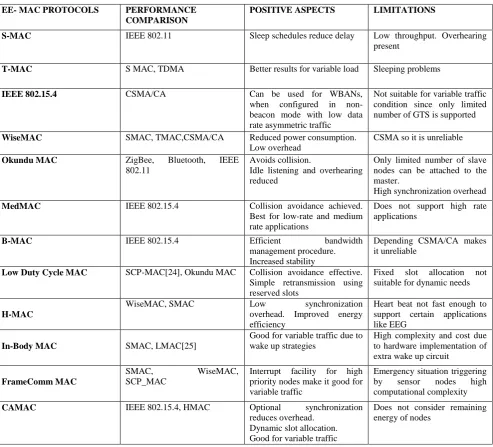
Table II:
Advantages and limitations of investigated Energy-Efficient MAC protocol
EE- MAC PROTOCOLS PERFORMANCE COMPARISON
POSITIVE ASPECTS LIMITATIONS
S-MAC IEEE 802.11 Sleep schedules reduce delay Low throughput. Overhearing present
T-MAC S MAC, TDMA Better results for variable load Sleeping problems IEEE 802.15.4 CSMA/CA Can be used for WBANs,
when configured in non-beacon mode with low data rate asymmetric traffic
Not suitable for variable traffic condition since only limited number of GTS is supported WiseMAC SMAC, TMAC,CSMA/CA Reduced power consumption.
Low overhead
CSMA so it is unreliable Okundu MAC ZigBee, Bluetooth, IEEE
802.11
Avoids collision.
Idle listening and overhearing reduced
Only limited number of slave nodes can be attached to the master.
High synchronization overhead MedMAC IEEE 802.15.4 Collision avoidance achieved.
Best for low-rate and medium rate applications
Does not support high rate applications
B-MAC IEEE 802.15.4 Efficient bandwidth management procedure. Increased stability
Depending CSMA/CA makes it unreliable
Low Duty Cycle MAC SCP-MAC[24], Okundu MAC Collision avoidance effective. Simple retransmission using reserved slots
Fixed slot allocation not suitable for dynamic needs
H-MAC
WiseMAC, SMAC Low synchronization overhead. Improved energy efficiency
Heart beat not fast enough to support certain applications like EEG
In-Body MAC SMAC, LMAC[25]
Good for variable traffic due to wake up strategies
High complexity and cost due to hardware implementation of extra wake up circuit
FrameComm MAC
SMAC, WiseMAC,
SCP_MAC
Interrupt facility for high priority nodes make it good for variable traffic
Emergency situation triggering by sensor nodes high computational complexity CAMAC IEEE 802.15.4, HMAC Optional synchronization
reduces overhead. Dynamic slot allocation. Good for variable traffic
From the above table it can be understood that for
every protocol investigated, each one has its own
advantages and limitations too.
Techniques for Energy-Efficiency
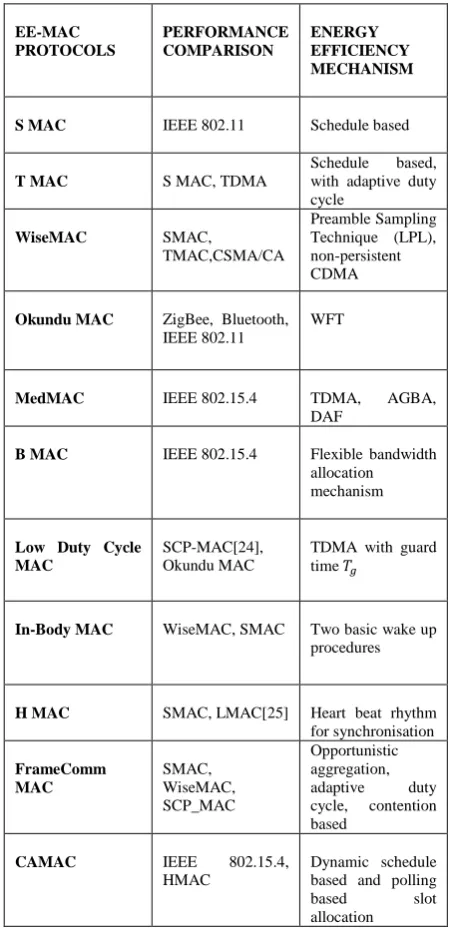
The techniques for collision avoidance for the
above mentioned protocols are listed next, in table
III.
Table III: Performance comparison and energy efficiency mechanisms
EE-MAC PROTOCOLS
PERFORMANCE COMPARISON
ENERGY EFFICIENCY MECHANISM
S MAC IEEE 802.11 Schedule based
T MAC S MAC, TDMA
Schedule based, with adaptive duty cycle
WiseMAC SMAC,
TMAC,CSMA/CA
Preamble Sampling Technique (LPL), non-persistent CDMA
Okundu MAC ZigBee, Bluetooth, IEEE 802.11
WFT
MedMAC IEEE 802.15.4 TDMA, AGBA, DAF
B MAC IEEE 802.15.4 Flexible bandwidth allocation mechanism
Low Duty Cycle MAC
SCP-MAC[24], Okundu MAC
TDMA with guard time
In-Body MAC WiseMAC, SMAC Two basic wake up procedures
H MAC SMAC, LMAC[25] Heart beat rhythm for synchronisation
FrameComm MAC
SMAC, WiseMAC, SCP_MAC
Opportunistic aggregation, adaptive duty cycle, contention based
CAMAC IEEE 802.15.4, HMAC
Dynamic schedule based and polling based slot allocation
IV.
CONCLUSION
Table IV gives an overview about the advantages and limitations of the investigated MAC protocols. Most of the works are giving much concentration on
energy-efficiency. Techniques for collision avoidance of these MAC protocols are also analysed separately. In contention based protocols (CSMA/CA) there is always competition for the channel by the nodes to get convenient chance for transmission. Such protocols, for e.g. IEEE 802.15.4_MAC can handle fading, but at the same time, it suffers from intense packet collisions due to this contention. In schedule based TDMA protocols, such as HMAC, Okundu_MAC, etc., the channel is divided into time slots with nodes assigned to these slots. So, packet collisions can be prevented to a great extent. Thus energy wastage can be reduced. But synchronization is a need here, resulting large overhead. Hybrid contention/TDMA structure as proposed in [22], [23] is a good solution to above mentioned problems. For WBANs, as different applications require different data rates, the proposals put forward by the latest standardization for WBANs, i.e., IEEE_802.15.6, is more advanced. TG6 can support a vast range of data rates (75.9 kbps Narrow Band upto 15.6 mbps UltraWide Band).
V.
REFERENCES
[1] B. Latr´e, B. Braem, I. Moerman, C. Blondia, and P. Demeester, "A survey on wireless body area networks," Wireless Network, vol. 17, pp. 1-18, Jan. 2011.
[2] S. Ullah, Henry Higgins, Bart Braem, Benoit Latre, Chris Blondia, Ingrid Moerman, Shahnaz Saleem, Ziaur Rahman, Kyung Sup Kwak, "A Comprehensive Survey of Wireless Body Area Networks: On PHY, MAC, and Network Layers Solutions," J.Medical Systems, vol. 36, no. 3, pp. 1065-1094, 2012.
[3] M. M. Sandhu, N. Javaid, M. Akbar, F. Najeeb, U. Qasim, Z. A. Khan, "FEEL: Forwarding Data Energy Efficiently with Load Balancing in Wireless Body Area Networks," 2014 IEEE 28th International Conference on Advanced Information Networking and Applications.
[4] IEEE 802.15.6, Technical requirements document, 2008. [5] A. Boulis and Y. Tselishchev, "Contention vs. Polling: A Study
in Body Area Networks MAC Design," 5th International Conference in Body Area Networks (BodyNets 2010), Sept. 2010, pp. 151-157.
[6] Drs. Baruch Awerbuch & Amitabh Mishra, "Medium Access Control (MAC) Protocols for Ad hoc Wireless Networks - I," Department of Computer Science Johns Hopkins University, 2008
[7] Pei Huang, Li Xiao, Soroor Soltani, Matt W. Mutka, And Ning Xi, "The Evolution Of MAC Protocols In Wireless Sensor Networks: A Survey," IEEE Communications Surveys & Tutorials, Vol. 15, No. 1, First Quarter 2013 101
International Congress on Ultra Modern Telecommunications and Control Systems and Workshops (ICUMT)
[9] S. Hayat, N. Javaid, Z. A. Khan§, A. Shareef, A. Mahmood, S. H. Bouk, "Energy Efficient MAC Protocols," 2012 IEEE 14th International Conference on High Performance Computing and Communications
[10]Vinay Singh, Rahul Sharma, "Performanance Analysis of Mac Protocols for WBAN on Varying Transmitted Output Power of Nodes," International Journal of Computer Applications (0975 - 8887) Volume 67- No.7, April 2013
[11]A. Rahim, N. Javaid, M. Aslam, Z. Rahman, U. Qasim, Z. A. Khan, "A Comprehensive Survey of MAC Protocols for Wireless Body Area Networks," arXiv:1208.2351v1cs. NI] 11 July 2012.
[12]Wei Ye, John Heidemann, Deborah Estrin "An Energy-Efficient MAC Protocol for Wireless Sensor Networks," 21st Conference of the IEEE Computer and Communications Societies (INFOCOM), volume 3, Pages 1567-1576 June 2002.
[13]T. Van Dam and K. Langendoen, "An adaptive energy-efficient MAC protocol for wireless sensor networks", In ACM Conference on Embedded Networked Sensor Systems (Sensys), Los Angeles, USA, Page 171-180, November 2003.
[14]F. Timmons, W. Scanlon, "Analysis of the Performance of IEEE 802.15.4 for Medical Sensor Body Area Networking," 1st Annual IEEE Communications Society Conference on Sensor and Ad Hoc Communications and Networks, Santa Clara, US, October 2004, 16-24
[15]A. El-Hoiydi, J.-D. Decotignie, C. Enz and E. Le Roux ," WiseMAC, An Ultra Low Power MAC Protocol for multihop Wireless Sensor Networks". 4th ACM Conference on Embedded Networked Sensor Systems (SenSys), 2006
[16]Okundu Omeni, A.C.W Wong, A.J Burdett, C. Toumazou,"Energy Efficient Medium Access Protocol for Wireless Medical Body Area Sensor Networks," IEEE Transactions on Biomedical Circuits and Systems, volume 2, number 4, December 2008, Page 251-259.
[17]N. F. Timmons and W. G. Scanlon, "An Adaptive Energy Efficient MAC Protocol for the Medical Body Area Network," Wireless VITAE 2009
[18]Fang, G. and Dutkiewicz, E., "BodyMAC: Energy efficient TDMA based MAC protocol for Wireless Body Area Networks", ISCIT, 2009.
[19]H. Li and J. Tan, "Heartbeat-Driven Medium-Access Control for Body Sensor Networks," IEEE Transactions on Information Technology in Biomedicine, volume 14, number 1, January 2010.
[20]M. Ameen, J Liu, S Ullah, KS Kwak, "A Power Efficient MAC Protocol for Implant Device Communication in Wireless Body Area Networks," 8th Annual IEEE Consumer Communications And Networking Conference-Smart Spaces and Personal Area Networks (CCNC), January 2011, Pages 1155-1160
[21]S. J. Marinkovi, E. M Popovici, C Spagnol, S Faul, W.P Marnane "Energy-Efficient Low Duty Cycle Body Area Networks," IEEE Transactions on Information Technology in Biomedicine, volume 13, number 6, November 2009, Pages 915-925.
[22]T. O’Donovan, John O’ Donoghue, C Sreenan, D Sammon, P O’ Reilly, Kieran A.O’ Connor "A Context Aware Wireless Body Area Network (BAN)," 3rd International Conference in Pervasive Computing Technologies for Healthcare, April 2009
[23]Bin Liu et al., "MAC Protocol in WBANs for E-Health: Challenges and a Context-Aware Design." IEEE Wireless Communications, August 2013, Pages 64-72
[24]W. Ye, F. Silva and J. Heidemann. "Ultra-Low Duty Cycle MAC with Scheduled Channel Polling," 4th ACM Conference on Embedded Networked Sensor Systems (SenSys), 2006 [25]L. van Hoesel and P. Havinga, "A Lightweight Medium Access
Protocol (LMAC) for Wireless Sensor Networks: Reducing Preamble Transmissions and Transceiver State Switches," 1st Int. Workshop Network Sensor Systems (INSS 2004),Tokyo, Japan, 2004.
[26]IEEE 802.15.4, Wireless Medium Access Control (MAC) and Physical Layer (PHY) Specifications for Low-Rate Wireless Personal Area Networks (LR-WPANs), IEEE, Sept. 2006 [27]P Honeine, F Mourad, M Kallas, H Snoussi, H Amoud, C
Francis, "Wireless Sensor Networks in Bio-Medical: Body Area Networks," 7th International Workshop on Systems,Signal Processing and their Applications (WOSSPA) 2011.
![Figure 1: A WBAN system [28]](https://thumb-us.123doks.com/thumbv2/123dok_us/1165752.1618996/1.595.324.535.378.553/figure-a-wban-system.webp)