f a c t o r s . C a n a d i a n Jo u r n al of Zo olo gy, 8 8 ( 1 1). p p . 1 1 0 3-1 1 1 2 .
Do w n l o a d e d fr o m : h t t p ://i n si g h t . c u m b r i a . a c . u k /i d/ e p ri n t/ 1 9 7 6 /
U s a g e o f a n y i t e m s f r o m t h e U n i v e r s i t y o f C u m b r i a’ s i n s t i t u t i o n a l r e p o s i t o r y ‘I n s i g h t ’ m u s t c o n f o r m t o t h e f o l l o w i n g f a i r u s a g e g u i d e l i n e s .
Any it e m a n d it s a s s o ci a t e d m e t a d a t a h el d i n t h e U niv e r si ty of C u m b r i a ’s in s ti t u ti o n al r e p o si t o r y I n si g h t ( u nl e s s s t a t e d o t h e r wi s e o n t h e m e t a d a t a r e c o r d ) m a y b e c o pi e d , di s pl ay e d o r p e rf o r m e d , a n d s t o r e d i n li n e wi t h t h e JIS C f ai r d e a li n g g ui d eli n e s ( av ail a bl e
h e r e) fo r e d u c a t i o n al a n d n o t-fo r-p r ofi t a c tiviti e s
p r o v i d e d t h a t
• t h e a u t h o r s , ti tl e a n d full bi blio g r a p h i c d e t ail s of t h e it e m a r e ci t e d cl e a rly w h e n a n y p a r t
of t h e w o r k is r ef e r r e d t o v e r b a lly o r i n t h e w ri t t e n fo r m
• a h y p e rli n k/ U RL t o t h e o ri gi n al I n si g h t r e c o r d of t h a t it e m is i n cl u d e d i n a n y ci t a ti o n s of t h e w o r k
• t h e c o n t e n t is n o t c h a n g e d i n a n y w a y
• all fil e s r e q ui r e d fo r u s a g e of t h e it e m a r e k e p t t o g e t h e r wi t h t h e m a i n it e m fil e.
Yo u m a y n o t
• s ell a n y p a r t of a n it e m
• r e f e r t o a n y p a r t of a n it e m wi t h o u t ci t a ti o n
• a m e n d a n y it e m o r c o n t e x t u ali s e it i n a w a y t h a t will i m p u g n t h e c r e a t o r ’s r e p u t a t i o n
• r e m ov e o r a l t e r t h e c o py ri g h t s t a t e m e n t o n a n it e m .
T h e full p oli cy c a n b e fo u n d h e r e.
Alt e r n a t iv ely c o n t a c t t h e U niv e r si t y of C u m b ri a R e p o si t o ry E di t o r b y e m a ili n g
The diving behaviour of mammal-eating killer whales
1
(
Orcinus orca
L., 1758): variations with ecological not
2
physiological factors
3
4
Patrick James O’Malley Miller1, Ari Daniel Shapiro2, Volker Bernt Deecke1,3,4 5
6
1) School of Biology, University of St Andrews, St Andrews, Fife KY16 8LB. email:
7
8
2) Biology Department, Woods Hole Oceanographic Institution, MS #50, Woods Hole, MA
9
02543
10
3) Marine Mammal Research Unit, University of British Columbia, Vancouver BC V6T 1Z4,
11
4) Cetacean Research Laboratory, Vancouver Aquarium, Vancouver BC V6B 3X8
12
13
ABSTRACT
14
Mammal-eating killer whales (Orcinus orca L., 1758) are a rare example of a social predator 15
where sexually dimorphic adults and juveniles with diverse physiological diving 16
capacities.hunt together in groups Day-night ecological differences should also affect diving 17
as their prey show diel variation in activity and mammal-eating killer whales do not rely on 18
echolocation for prey detection. Our objective was to explore the extent to which 19
physiological aerobic capacities versus ecological factors shape the diving behaviour of this 20
cooperatively feeding breath-hold diver. We used suction-cup attached depth recorders 21
showed a strong bout structure in both dive depth and duration. Day-night comparisons 1
revealed reduced rates of deep dives, longer shallow dives and shallower long-duration dives 2
at night. In contrast, dive variables did not differ by age-sex class. Estimates of the aerobic 3
dive limit (cADL) suggest that juveniles exceeded their cADL during up to 15% of long 4
dives, whereas adult males and females never exceeded their cADL. Lack of variation 5
among age-sex classes indicates that mammal-eating killer whales in this area employ a 6
strategy of physiological compromise, with smaller group members diving nearer their 7
physiological limits and large-bodied males scaling down their physiological performance. 8
9
Key-words: cetacean, diving, group-hunting, sexual dimorphism, diel variation, aerobic dive 10
limit 11
INTRODUCTION
12
In this study, we examine how physiological versus ecological factors shape the diving 13
patterns of a sexually-dimorphic marine mammal, the killer whale (Orcinus orca L., 1758). 14
Studies in the North Pacific have documented distinct forms, or ecotypes, of killer whales 15
that specialize on different prey (Ford et al. 1998; Saulitis et al. 2000, Morin et al. 2010). 16
Similar dietary specialization appears to apply to other populations of killer whales as well 17
(Berzin and Vladimirov 1983; Pitman and Ensor 2003). Within the inshore waters of the 18
Eastern North Pacific, members of the ‘resident’ ecotype feed only on fish, especially on 19
Pacific salmon (Oncorhynchus spp.). ‘Transient’ killer whales, however, exclusively hunt 20
warm-blooded marine mammals and birds. Their primary food source in the summer months 21
is harbour seals (Phoca vitulina L., 1758, Ford et al. 1998), though transients also attack 22
Steller (Eumetopias jubatus Schreber, 1776)and California (Zalophus californianus Lesson, 23
1828) sea lions, harbour porpoises (Phocoena phocoena L., 1758), Dall's porpoises 24
(Phocoenoides dalli True, 1885), and Pacific white-sided dolphins (Lagenorhynchus
obliquidens Gill, 1865). Transients also occasionally take minke (Balaenoptera acutorostrata
1
Lacépède, 1804, Ford et al. 2005) and grey whales (Eschrichtius robustus Lilljeborg, 1861,
2
Baldridge 1972; Goley and Straley 1994), as well as seabirds (Ford et al. 1998). 3
Typical body lengths of adult male killer whales exceed adult female body length by 4
20% and adult males weigh roughly 75% more than adult females (Clark and Odell 1999; 5
Sato et al. 2006). The factors driving adult sexual dimorphism in killer whales are not 6
understood, but two alternative hypotheses propose that male body size evolved under either 7
sexual selection, or natural selection for greater diving capabilities. With a 75% greater body 8
mass than adult females, adult male killer whales should have roughly a 15% longer aerobic 9
dive limit, based on a mass0.75 scaling of diving metabolic rate (Kleiber 1975). Despite 10
pronounced sexual dimorphism, mammal-eating killer whales in the north-eastern Pacific are 11
social predators that typically hunt in groups of mixed age and sex. 12
Killer whales have an extended period of maternal care. Offspring often travel with 13
their mothers beyond the onset of sexual maturity around 15 years of age (Olesiuk et al. 14
1990). Dependent offspring typically travel in close associations with their mothers, possibly 15
benefiting energetically from swimming in echelon formation (Noren 2008). In eastern 16
North Pacific transients, social groups typically consist of one or more adult females and their 17
offspring (Ellis et al. 2008). Adult males travel in long-term stable associations with an adult 18
female (presumed to be their mothers) or roam between groups, and occasionally travel by 19
themselves (Baird and Whitehead 2000). Hunting in these animals typically involves prey 20
sharing and a high degree of coordination among all group members (Jefferson et al. 1991; 21
Ford et al. 1998; Ford et al. 2005). 22
Since adult males and females with dependent offspring typically hunt in communal 23
groups, group members face the challenge of reconciling their different physiological 24
be done in one of two ways: either the larger animals in the group could scale down their 1
physiological performance to accommodate the lower physiological limits of smaller group 2
members (physiological compromise), or the animals could take different roles in the 3
foraging process to capitalize on a greater range of physiological capacities (division of 4
labour). A strategy of physiological compromise suggests that all group members employ a 5
common strategy geared to the limitations of the most constrained individual. A strategy of 6
division of labour implies that the less constrained animals use their greater physiological 7
capacities to maximise prey capture rates for the group, potentially exploiting a wider range 8
of prey niches. 9
All marine mammals must dive underwater without breathing in order to forage. 10
Performing energetic underwater movements without intake of oxygen represents a clear 11
physiological challenge (Kooyman and Ponganis 1997; Acevedo-Gutiérrez et al. 2002). 12
Many studies have focused on the ability of marine mammals to remain underwater without 13
utilizing significant anaerobic metabolism (aerobic dive limit) as a critical factor in their 14
diving behaviour (e.g. Weise and Costa 2007). However, the actual diving behaviour 15
undertaken by a marine mammal should be influenced by physiological, ecological and social 16
factors, with the ultimate goal of foraging being to consume and process sufficient prey to 17
meet energetic requirements (Rosen et al. 2007). Consuming prey requires accessing the 18
prey underwater, and is thereby constrained by the diving ability and budget of the predator, 19
and critically by the location, behaviour, and detectability of prey in the water column. 20
One particularly strong ecological factor that influences depth use and behaviour in a 21
wide range of marine species is the presence of light (Hays 2003). The presence or absence of 22
light alters the sensory basis by which predators can detect prey. As a consequence, prey 23
may be adapted to reduce their risk of being captured during daytime by shoaling (i.e. Ryer 24
1981). Vertical diel migrations of marine organisms are well documented, including for 1
zooplankton (Hays 2003) and fishes (Bozzano et al. 2005). The diel diving patterns of many 2
marine mammal species are thought to be shaped by the diel activities of their primary prey 3
(i.e., crab-eater seals, Lobodon carcinophagus Hombron and Jacquinot, 1842, Burns et al. 4
2008, sperm whales, Physeter macrocephalus L., 1758, Aoki et al. 2007, long-finned pilot 5
whales, Globicephala melas Traill, 1758, Baird et al. 2002). Several species eaten by 6
mammal-eating killer whales in the eastern Pacific show pronounced diel variation in their 7
activity patterns. Harbour seals off Alaska do most of their foraging during the hours of 8
darkness (Frost et al. 2001; Hastings et al. 2004) and Steller sea lions are also reported to 9
forage extensively at night (Thomas and Thorne 2001). 10
In addition to indications that their prey are more active during nighttime, the vast 11
difference in sensory ecology of nighttime versus daytime may be particularly marked for 12
mammal-eating killer whales. Marine mammal-eating killer whales echolocate much less 13
than fish-eating killer whales, likely because most of their prey have good hearing in the 14
frequency range of killer whale echolocation clicks (Barrett-Lennard et al 1996). Although 15
the methods of prey detection of mammal-eating killer whales remain poorly understood, 16
vision and passive acoustic detection are therefore thought to be the primary sensory 17
modalities available to detect their prey, and this would be influenced by day-night 18
differences in ambient light. Any changes in predation between day and night would have 19
especially important ecological implications in high latitudes where daylight is limited 20
throughout a large part the year. 21
To date, most of the limited research on the diving behaviour of free-ranging killer 22
whales has been conducted on fish-eating populations. Baird et al. (2005) investigated the 23
diving behaviour of 34 southern resident killer whales in the inshore waters of southern 24
significantly between social groups or between males and females of all age classes. 1
However, adult males made deep dives significantly more frequently during the day than 2
adult females. Both sexes swam significantly faster and dove significantly deeper during the 3
day compared to nighttime, suggesting decreased levels of activity during the night. 4
However, diving performance and behaviour could vary greatly between killer whale 5
ecotypes given the differences in prey type. For mammal-eating killer whales, Baird (1994) 6
presents a single dive record that also suggests reduced nighttime activity of the tagged 7
individual. Erickson (1978) used VHF telemetry to track a pair of mammal-eating killer 8
whales for 10 consecutive days in the inshore waters of British Columbia and Washington 9
State and noted a decrease in dive duration in the afternoon and evening, which they 10
interpreted as an increase in foraging activity during this time. 11
In this study, we analysed the diving behaviour of 13 mammal-eating killer whales 12
recorded using Dtags containing high-resolution depth loggers (Johnson and Tyack 2003). 13
We examined how diving behaviour was influenced by ecological and physiological factors 14
by testing whether diving behaviour differed across body-size class and day-vs-night. To 15
determine how changes in ambient light might have affected the diving behaviour of 16
mammal-eating killer whales, we compared diving behaviour between daytime and nighttime 17
for tagged individuals. Day-night differences would suggest a direct consequence of the 18
difference in ambient light on the ability of marine-mammal eating killer whales to detect 19
their prey, or an indirect consequence of changes in depth usage or behaviour of their prey. If 20
foraging success depended primarily upon diving capabilities and the group members 21
exhibited role specialization, then we would have expected each member of a foraging group 22
to maximize its diving performance. In that case, adult males should have taken advantage of 23
their greater oxygen stores by diving longer or spending more time at depth than adult 24
classes allowed us to evaluate how the diving and hunting behaviours of these social 1
predators have evolved in light of different physiological capacities of group members. By 2
analysing day-night differences and body-size factors together, we assessed whether they 3
varied independently or interacted somehow. Body-size differences in diving behaviour 4
should have been most apparent in the context of maximal diving effort, which was most 5
likely limited by physiological constraints. 6
7
METHODS
8
Groups of transient killer whales in the eastern North Pacific that belonged to the West 9
Coast Transient population (Ellis et al. 2008) were studied in the inshore waters of Southeast 10
Alaska in summer 2006 and 2007. We used digital archival tags (Dtags: Johnson and Tyack 11
2003) to record diving behaviour of individual animals. Upon encountering a group, all 12
individuals were photographed from a skiff for identification using the method of Bigg 13
(1982). Tags were deployed on animals using a 7m hand pole and attached non-invasively 14
with suction cups. The tagged individual was re-photographed to confirm its identity. The 15
tag samples pressure at 50 Hz, later down-sampled to 10Hz. Pressure data were converted to 16
depth in meters using calibration constants derived in the laboratory. The tag also records 17
sound using two hydrophones at 96 kHz and 3-axis magnetic and acceleration vectors at 50 18
Hz. After deployment, the tagged individual was tracked from an 18m fishing vessel using a 19
VHF beacon and visual observations. Whales were followed at a distance of 1-2km to 20
minimize potential influences of the vessel on their behaviour. 21
Each surfacing of each whale was identified using the depth record. Initially, this was 22
done automatically based on a threshold of whale dive depth. All of the automatically-23
detected surfacings were carefully checked by eye and by listening to the acoustic record. 24
surfacing event depended on where the tag was placed on each whale’s body and on how 1
much of the tagged whale’s body came out of the water when it surfaced. In a few cases, 2
surfacing events could be clearly identified using the acoustic record even though the tag did 3
not break the surface of the water. This was observed in the field when the whale surfaced 4
without a VHF signal received from the tag. However, in those cases, the surfacing by the 5
tagged whale was still audible as splashing and/or blow sounds heard in the tag recording. 6
The most common surfacing behaviour of killer whales is to surface and then dive 7
again immediately, with one breath taken during the surfacing. Killer whales are occasionally 8
observed to drift, or log, at the surface (Martinez 1978). We inspected this in the tag records 9
as the duration between a surfacing and start of the subsequent dive. In our records, no 10
interval exceeded 16s total, and 99.3% of the durations between the end of a dive and the 11
start of a subsequent dive were <5s. Field observations indicated a whale would breathe once 12
during such an interval. Because the whales in our tag records were not observed to log at 13
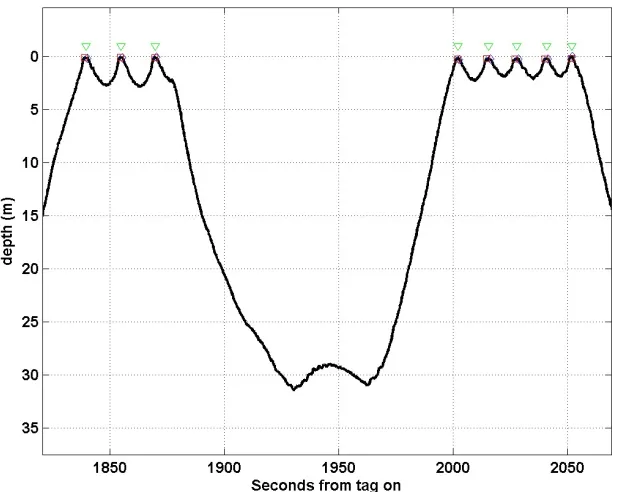
the surface, respiration events of the whales were identified as surfacings (Fig. 1). The half-14
way point between the end of the previous dive and the start of the subsequent dive was 15
considered the time of the respiration event. Although the exact time of the respiration may 16
have varied slightly, it should be accurate to within ±2.5s. 17
Time of day, duration and maximum depth associated with all dives were tabulated. 18
Visual inspection of the depth records indicated that whales often conducted numerous short 19
and shallow dives that were occasionally followed by a longer, deeper dive. This suggests 20
that diving is conducted in bouts, which can be separated either by duration or depth. To test 21
the possibility that the diving behaviour could be broken into bouts to obtain dive bout 22
criteria (Sibly et al. 1990), we conducted a log-frequency analysis of dive duration and 23
short dives for analyses of dive depth, and shallow and deep dives for analyses of dive 1
duration. 2
To contrast the roles of physiological constraints and ecology on the diving behaviour 3
of transient killer whales, we tested for differences both by age-sex class and day-night for 4
three dive variables: dive rate for deep and shallow dives, dive duration for deep and shallow 5
dives, and dive depth for long and short dives. Here, deep and long dives referred to dives 6
deeper than and longer than the bout criterion interval, respectively. The effects of age-sex 7
and time of day were assessed in separate analyses rather than a single 2-way model as 4 8
records did not include both day- and nighttime data. For the age-sex class comparison, we 9
calculated the mean value for each individual and tested for differences using a non-10
parametric Kruskal-Wallis test. All recorded dives were classified as day or night dives using 11
civil twilight (Seidelmann 1992) to define the start and end of nighttime. We computed 12
differences in diving behaviour during day versus nighttime and tested the differences using 13
paired t-tests. 14
We conducted three additional analyses to explore whether physiological limitations 15
might have influenced diving and breathing performance. We expected that if physiological 16
limitations primarily shaped the behaviour of these whales, large-bodied males should have 17
had a lower overall breathing rate, the capacity to spend more time at greater dive depths, and 18
required fewer breaths to prepare for, and recover from, a long-duration dive. First, for each 19
whale, we tabulated the maximum dive depth, maximum dive duration, and the overall blow 20
rate (equivalent to the dive rate since only one breath was taken per surfacing) of the tag 21
record. Next, the proportion of time spent at depth was calculated for each whale. Finally, 22
we analysed the effect of dive duration on the number of breaths taken before and after each 23
long dive: we averaged the number of breaths before and after each long dive to consider 24
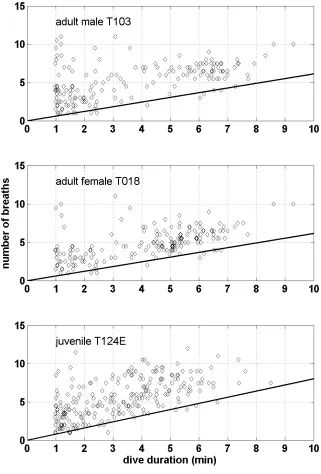
greater than the bout criterion interval against the number of breaths. Limitations in 1
behaviour due to physiological constraints would be revealed by a lack of data points 2
representing a small number of breaths before or after long duration dives, whereas there are 3
no limits to more breaths being taken after any duration of dive. We used quantile regression 4
to evaluate the slope of a line anchored at (0,0) above which 95% of the data would fit, with 5
only 5% below the line. This slope was then compared across age-sex classes. 6
7
RESULTS
8
A total of 12 tags were deployed on 11 transient killer whales, with a total recording 9
time of 123 hours. Two other tag records of less than one hour duration were not included in 10
the analysis. One individual killer whale, adult female T91, was tagged on two subsequent 11
days. All of the dive data for that individual were pooled, leaving a total of 11 individual 12
whales for analysis: 3 adult males, 4 adult females, and 4 juveniles, comprising a total of 13
7,608 dives. Data from 7 individuals (1 adult male, 2 adult females, and 4 juveniles) included 14
more than one hour of nighttime data, and were used in the day-night comparison (Table 1). 15
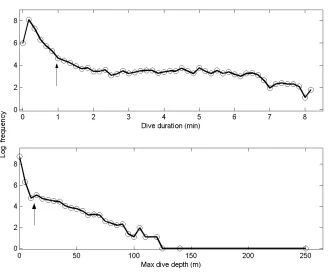
Log-frequency analysis demonstrated that diving behaviour of transient killer whales 16
was strongly characterized by bouts of dive duration and maximum depth (Fig 2). A two-17
process exponential model provided a significantly better fit for dive duration (F2,45 = 74.3,
18
P<0.001) and maximum dive depth (F2,45 = 14.2, P<0.001) than a single-process exponential
19
model (Sibly et al. 1990). Using the formula to minimize the number of events misclassified 20
(Slater and Lester 1982), we calculated bout criteria of 57.77s (0.96 min) for dive duration 21
and 12.73m for dive depth. 22
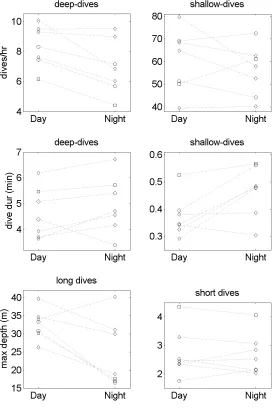
There were some clear differences between daytime and nighttime diving behaviour for 23
was higher during the daytime than during the night (t6 = 3.46, P = 0.014), but the rate of
1
shallow diving did not differ (t6 = 1.12 , P = 0.31). The duration of deep dives did not differ
2
significantly between day- and nighttime (t6 = -1.33, P = 0.23), but shallow dive duration
3
tended to be longer during the night (t6 = -2.80 , P = 0.031). Dividing the dives by duration
4
showed that depths of short duration dives did not differ for day versus night (t6 = 0.258, P =
5
0.81), but that maximum dive depths of long duration dives were shallower during the night 6
than during the day (t6 = 2.87, P = 0.029). Blow rates differed only slightly, with a mean of
7
68.8 blows/hr during the daytime, and 62.9 blows/hr during the night, a non-significant 8
difference (t6 = 1.43, P = 0.20). Interestingly, the rate of occurrence of long duration dives
9
was almost equivalent during the day (10.7/hr) and night (10.6/hr). 10
For the same parameters, none differed significantly among age and sex classes (Fig. 11
4). Juveniles did have a somewhat higher rate of deep diving than adult females and adult 12
males, but that difference was not statistically significant (H2 = 2.96, P = 0.23), nor were
13
differences in the rate of shallow diving (H2 = 0.58, P = 0.75). The only difference that had
14
borderline statistical significance involved large males tending to dive deeper during the short 15
dives between breaths (H2 = 5.60, P = 0.06), a difference likely due to biomechanical factors
16
(e.g., the greater height of the male dorsal fin). 17
Because deep dives were more common during the day, we retested the same 18
parameters using only the daytime data recorded from all 11 individuals. Doing so did not 19
result in any substantial changes in the observed age-sex patterns and no significant 20
differences were found across age-sex classes using only the daytime dives. 21
Further testing of dive performance by age-sex class did not reveal any strong 22
differences. Diving performance did not differ significantly by age-sex class for overall 23
blow-rate (H2 = 0.60, P = 0.74), duration of the single longest dive recorded (H2 = 1.69, P =
24
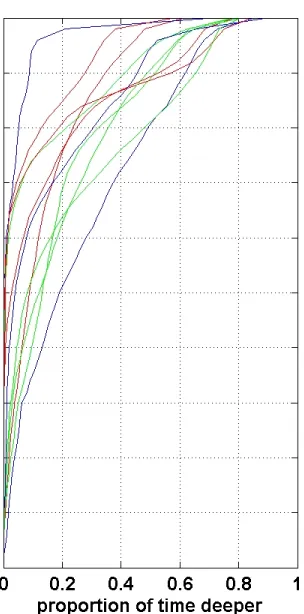
0.74), or depth of deepest dive recorded (H2 = 1.30, P = 0.52). The proportion of time spent
at depth by each whale and the proportion of time spent below a given depth showed 1
considerable variability from whale to whale (Fig. 5, left panel), likely shaped by the 2
particular behavioural states which dominated during the tag deployment or individual 3
variation. Inspection of cumulative depth use revealed no consistent differences in depth use 4
by age-sex class (Fig. 5, right panel). 5
Finally, analysis of the number of blows following and preceding dives versus duration 6
of dives which exceeded 57.77s (the bout criterion) did reveal a clear tendency for there to be 7
few data points in the lower-right corner of the plot (Fig. 6). This pattern is consistent with 8
whales needing to breathe more before or after a longer dive. However, there was no clear 9
pattern of differences by age-sex class and no significant differences by age-sex class (H2 =
10
0.39, P = 0.82). 11
12
DISCUSSION
13
Our results indicate consistent differences in diving behaviour of mammal-eating killer 14
whales in the daytime versus the nighttime. Though our statistical analyses were limited to a 15
sample of 7 whales, we found a consistent and statistically significant increase in the rate of 16
deep (>12.74m) diving during the day compared to the nighttime (Fig. 3). While the duration 17
of deep dives did not differ from day to night, the duration of shallow dives was significantly 18
longer during the night than during the day. Consistently, long duration (>57.77s) dives were 19
shallower during the night than during the day, while short-duration dives did not differ from 20
day versus night. The rate of long-duration dives was almost equivalent during the day 21
(10.7/hr) and night (10.6/hr). 22
Taken together, these results indicate a tendency for whales to dive deep less often and 23
lower overall during the night than the daytime, but we cannot conclude that mammal-eating 1
killer whales were simply less active during the nighttime because that difference was not 2
consistent across individuals in our sample and therefore not statistically significant. Instead, 3
the differences in diving behaviour were likely also related to day-night differences in the 4
diving behaviour of their prey and/or to differences in ambient light. High levels of 5
downwelling light during the day could enable a strategy of foraging using visual cues at 6
greater depths than would be possible during the night. More detailed information on the 7
diving behaviour of killer whale prey and the sensory ecology of mammal-eating killer 8
whales is needed to assess these possible explanations for day-night differences in the diving 9
behaviour of mammal-eating killer whales. 10
In contrast to consistent day-night differences in diving behaviour, we found no clear 11
differences between age-sex classes for overall blow rate, depth of the deepest recorded dive, 12
or duration of the longest recorded dive. The rate and duration of deep and shallow dives and 13
the depth of long and short dives did not differ across the 11 animals in our sample – even 14
though these parameters did show day-night differences (Figs. 3 and 4). We also tested these 15
parameters using only the daytime intervals, as day-night comparison indicated that deep 16
dives were more common during the day than the night, but again no significant differences 17
were found across age sex-classes. Further tests indicated no differences by age-sex class in 18
depth use or the number of breaths taken before or after a long dive. 19
Because of the substantial differences in body size, we would predict differences in the 20
aerobic dive limit capacity among juvenile, adult female, and adult male killer whales. 21
Though the aerobic dive limit has not been experimentally measured in killer whales, we can 22
calculate an estimated aerobic dive limit (cADL) by scaling up measurements taken from 23
other cetaceans for which the ADL has been measured (see Watwood et al. 2006, Tyack et al. 24
1975), while oxygen stores scale in a linear fashion. Consequently, larger animals can dive 1
longer aerobically than smaller animals (Castellini et al. 1992). Assuming diving metabolic 2
rate scales with lean body mass in a manner similar to the basal metabolic rate, and that killer 3
whales contain similar mass-specific oxygen stores as bottlenose dolphins (Noren et al. 4
2002), the cADL of killer whales can be estimated from the 5.4 minute aerobic dive limit of a 5
187 kg bottlenose dolphin (Noren et al. 2002). With this approach (cADLkiller=ADLbottlenose*
6
(Mkiller/Mbottlenose) -0.25), we estimate that killer whale cADLs should range from 10.2 and 11.8
7
min for mean mass estimates of 2418kg for captive adult females and 4249 kg for captive 8
adult males, respectively (Clark et al. 2000; Sato et al. 2006). The body mass of the tagged 9
juveniles can be estimated using age-mass regression curves derived from captive juveniles 10
(Clark et al. 2000). The exact birth date of free-ranging killer whales is not known, but the 11
birth year is known (Ellis et al. 2008; Table 1). Assuming the birth date of a calf is ½ year 12
before the summer it was first sighted, we can calculate the mass of 1, 2, and 8 year juveniles 13
to be 673kg, 865kg, and 2008kg, respectively. These mass estimates correspond to cADLs of 14
7.4, 7.9, and 9.8 min, which is probably an over-estimate of cADL as 0-2 year old bottlenose 15
dolphins have been shown to have substantially lower oxygen stores than adults (Noren et al. 16
2002). 17
Using these estimates for cADL, no dives of adult males (N = 1256 dives) or adult 18
females (N = 3004 dives) exceeded their cADL. From a total of 3348 dives from the 4 19
tagged juvenile animals, 23 exceeded their cADL. These dives represented 0.3%, 0.1%, and 20
2.7% of all dives made by 1-2 yr old juveniles T073A1, T002C2, and T068B2, respectively. 21
The 8-year old juvenile T124E did not conduct any dives longer than its cADL of 9.8 min. 22
This suggests that the dives of adult killer whales were almost entirely aerobic, and their 23
foraging behaviour did not substantially challenge their aerobic capacity. Interestingly, the 24
cADL were only a small proportion of the total dives, they represent 1.6%, 0.8%, and 15.2% 1
of the long-duration dives defined using the bout criterion interval of 57.77s. Juveniles also 2
had a non-significant tendency to breathe more (i.e., higher dive rate) and make shorter 3
duration dives for both deep and shallow dives (Fig. 4). These observations indicate that 4
smaller animals in killer whale groups are more aerobically challenged than larger animals. 5
Our results argue against a pronounced division of labour among body-size classes 6
while diving to search for and attack prey, which would predict males to dive longer and 7
deeper and breathe less often than female or juvenile killer whales. Instead, the behaviour 8
indicates a strategy of physiological compromise with individuals of different age-sex classes 9
diving similarly. This strategy pushes the smaller animals closer to their aerobic dive limits 10
and in the case of young juveniles sometimes even beyond it, while leaving adult males with 11
the largest unutilized aerobic diving capacity. 12
Physiological limitations influence the behaviour of both predators and prey in an 13
encounter (Ydenberg and Dill 1986). A solid understanding of the physiology of both players 14
is therefore crucial when examining these dynamics. In predator-prey interactions involving 15
breathhold divers that forage in the water column, the ability of both the predator and the 16
prey to remain submerged and dive to depth typically exerts one of the primary physiological 17
constraints that impact foraging decisions (e.g., Frid et al. 2007). The large body size of the 18
killer whale may enable them to exceed the aerobic diving capacities of their prey. An 19
important characteristic of mammal-eating killer whales is that their prey types are 20
constrained to come to the surface to obtain oxygen. This may enable mammal-eating killer 21
whales to remain close to the surface, waiting for their prey to return. Such a strategy might 22
reduce the need for extended dives beyond aerobic capacities. Coordinated foraging by the 23
group may allow individuals to take turns diving to prevent marine mammal prey from 24
exceed their aerobic capacities. Thus, our conclusion that physiological factors do not appear 1
to influence the diving patterns of mammal-eating killer whales may reflect the fact that their 2
ecology does not put heavy demands on aerobic diving capability. 3
We should stress that our results should not be extrapolated to killer whales feeding on 4
other prey types. For example, specialized diving roles that take advantage of the greater 5
aerobic capacity of males may be advantageous for killer whale that feed on deep-sea squid 6
or deeper diving mammals such as sperm whales (Pitman et al. 2001) or ziphiids 7
(Notobartolo-di-Sciara 1987). For deep-diving prey, one avenue of escape may be to dive 8
away from the killer whale predator. In such a case, the greater aerobic capacity of the adult 9
male may allow it to pursue such prey more effectively than smaller bodied females or 10
juvenile animals. Observations of mammal-eating killer whales foraging on diverse prey 11
types will help to unravel more fully how ecological factors influence role specialization and 12
coordination of feeding in sexually-dimorphic predators. 13
14
ACKNOWLEDGEMENTS
15
Thanks to the field team: Jim and Gayle Eastwood, Michael deRoos, Michiru Main and 16
Filipa Samarra. Mark Johnson, Alex Bocconcelli, Tom Hurst and Peter Tyack provided 17
valuable tag support. This study was funded through grants by the North Pacific Marine 18
Science Foundation through the North Pacific Universities Marine Mammal Consortium, the 19
National Geographic Society, the BC Wild Killer Whale Adoption Program, as well as 20
Fisheries and Oceans Canada. PJOM was supported by a visiting professorship from the 21
International Coastal Research Center at the University of Tokyo, Ōtsuchi. ADS was 22
supported by a National Defense Science and Engineering Graduate Fellowship and by the 23
1
REFERENCES
2
Acevedo-Gutiérrez, A., Croll, D. A. and Tershy, B. R. 2002. Feeding costs limit dive time in 3
large whales. J. Exp. Biol. 205: 1747-1753. 4
Baird, R. W., Borsani, J. F., Hanson, M. B., and Tyack, P. L. 2002. Diving and night-time 5
behaviour of long-finned pilot whales in the Ligurian Sea. Mar. Ecol. Prog. Ser.237: 6
301-305. 7
Baird, R. W. and Dill, L. M. 1996. Ecological and social determinants of group size in 8
transient killer whales. Behav. Ecol.7: 408-416. 9
Baird, R. W., Hanson, M. B. and Dill, L. M. 2005. Factors influencing the diving behaviour 10
of fish-eating killer whales: sex differences and diel and interannual variation in 11
diving rates. Can. J. Zool., 83: 257-267. 12
Baird, R. W. and Whitehead, H. 2000. Social organization of mammal-eating killer whales: 13
group stability and dispersal patterns. Can. J. Zool.78: 2096-2105. 14
Baldridge, A. 1972. Killer whales attack and eat a gray whale. J. Mammal.53: 898-900. 15
Barrett-Lennard, L. G., Ford, J. K. B. and Heise, K. A. 1996. The mixed blessing of 16
echolocation: differences in sonar use by fish-eating and mammal-eating killer 17
whales. Anim. Behav. 51: 553-565. 18
Berzin, A. A. and Vladimirov, V. L. 1983. A new species of killer whale (Cetacea, 19
Delphinidae) from Antarctic waters. Zoologichesky Zhurnal, 62: 287-295. 20
Clark, S. T. and Odell, D. K. 1999. Allometric relationships and sexual dimorphism in 21
captive killer whales (Orcinus orca). J. Mammal.80: 777-785. 22
DeMaster, D. P., Trites, A. W., Clapham, P. J., Mizroch, S. A., Wade, P., Small, R. A. and 23
Hoef, J. V. 2006. The sequential megafaunal collapse hypothesis: Testing with 24
existing data. Prog. Oceanogr. 68: 329-342. 25
Ellis, G. M., Towers, J. R. and Ford, J. K. B. 2008. Transient killer whales of British 26
Columbia and Southeast Alaska - Photo Identification Catalog 2008. 48 pp. 48pp. 27
Nanaimo, BC: Pacific Biological Station, Fisheries and Oceans Canada. Available 28
from http://www.pac.dfo-mpo.gc.ca/sci/sa/cetacean/default_e.htm [accessed 01 July,
29
2010].
Erickson, A. W. 1978. Population Studies of Killer Whales (Orcinus orca) in the Pacific 1
Northwest: A Radio-Marking and Tracking Study of Killer Whales. Marine Mammal 2
Commission, Washington, DC: 3
Ford, J. K. B., Ellis, G. M., Barrett-Lennard, L. G., Morton, A. B., Palm, R. and Balcomb, K. 4
C. 1998. Dietary specialization in two sympatric populations of killer whales (Orcinus
5
orca) in coastal British Columbia and adjacent waters. Can. J. Zool. 76: 1456-1471. 6
Ford, J. K. B., Ellis, G. M., Matkin, D. R., Balcomb, K. C., Briggs, D. and Morton, A. B. 7
2005. Killer whale attacks on minke whales: Prey capture and antipredator tactics. 8
Mar. Mamm. Sci.21; 603-618. 9
Frid, A., Heithaus, M. R. and Dill, L. M. 2007. Dangerous dive cycles and the proverbial 10
ostrich. Oikos, 116: 893-902. 11
Frost, K. J., Simpkins, M. A. and Lowry, L. F. 2001. Diving behavior of subadult and adult 12
harbor seals in Prince William Sound, Alaska. Mar. Mamm. Sci.17: 813-834. 13
Goley, P. D. and Straley, J. M. 1994. Attack on gray whales (Eschrichtius robustus) in 14
Monterey Bay, California, by killer whales (Orcinus orca) previously identified in 15
Glacier Bay, Alaska. Can. J. Zool. 72: 1528-1530. 16
Jefferson, T. A., Stacey, P. J. and Baird, R. W. 1991. A review of killer whale interactions 17
with other marine mammals: Predation to co-existence. Mammal Rev.21: 151-180. 18
Johnson, M.P. and Tyack, P.L. 2003. A digital acoustic recording tag for measuring the 19
response of wild marine mammals to sound. IEEE J. Ocean. Eng. 28: 3-12. 20
Kooyman, G. L. and Ponganis, P. J. 1997. The challenges of diving to depth. Am. Sci. 85:
21
530-539. 22
Mizroch, S. A. and Rice, D. W. 2006. Have North Pacific killer whales switched prey species 23
in response to depletion of the great whale populations? Mar. Ecol. Prog. Ser. 310: 24
235-246. 25
Morin, P. A., Archer, F. I., Foote, A. D., Vilstrup, J., Allen, E. E., Wade, P., Durban, J., 26
Parsons, K., Pitman, R., Li, L., Bouffard, P., Abel Nielsen, S. C., Rasmussen, M., 27
phylogeographic analysis of killer whales (Orcinus orca) indicates multiple species. 1
Genome Res. 20: 908-916. 2
Noren, S. R. 2008. Infant carrying behaviour in dolphins: costly parental care in an aquatic 3
environment. Funct. Ecol. 22: 284-288. 4
Noren, S. R., Lacave, G., Wells, R. W., and Williams, T. M. 2002. The development of 5
blood oxygen stores in bottlenose dolphins (Tursiops truncatus): implications for 6
diving capacity. J. Zool. (London) 258: 105-113. 7
Notarbartolo-di-Sciara, G. 1987. Killer whale, Orcinus orca, in the Mediterranean Sea. Mar. 8
Mamm. Sci. 3 (4): 356-360. 9
Olesiuk, P. F., Bigg, M. A. and Ellis, G. M. 1990. Life history and population dynamics of 10
resident killer whales (Orcinus orca) in the coastal waters of British Columbia and 11
Washington State. Rep. Int. Whaling Comm. Spec. Issue No. 12: 209-243. 12
Pitman, R. L., Ballance, L. T., Mesnick, S. I. and Chivers, S. J. 2001. Killer whale predation 13
on sperm whales: Observations and implications. Mar. Mamm. Sci. 17: 494-507. 14
Pitman, R. L. and Ensor, P. 2003. Three forms of killer whales (Orcinus orca) in Antarctic 15
waters. J. Cetacean Res. Manag. 5: 131-139. 16
Saulitis, E. L., Matkin, C. O., Barrett-Lennard, L. G., Heise, K. A. and Ellis, G. M. 2000. 17
Foraging strategies of sympatric killer whale (Orcinus orca) populations in Prince 18
William Sound. Mar. Mamm. Sci. 16: 94-109. 19
Seidelmann, P. K. 1992. Explanatory Supplement to the Astronomical Almanac. University 20
Science Books, New York. 21
Springer, A. M., Estes, J. A., van Vliet, G. B., Williams, T. M., Doak, D. F., Danner, E. M., 22
Forney, K. A. and Pfister, B. 2003. Sequential megafaunal collapse in the North 23
Pacific Ocean: An ongoing legacy of industrial whaling? Proc. Natl. Acad. Sci. 24
U.S.A. 100: 12223-12228. 25
Stich, H. B. and Lampert, W. 1981. Predator evasion as an explanation of diurnal vertical 26
migration by zooplankton. Nature(London) 293: 396-398. 27
Trites, A. W., Deecke, V. B., Gregr, E. J., Ford, J. K. B. and Olesiuk, P. F. 2007. Killer 28
comparative analysis of the dynamics of marine mammals in Alaska and British 1
Columbia following commercial whaling. Mar. Mamm. Sci. 23: 751–765 . 2
Tyack, P. L., Johnson, M., Soto, N. A., Sturlese, A. and Madsen, P.T. 2006. Extreme diving 3
of beaked whales. J. Exp. Biol. 209: 4238-4253. 4
Watwood, S. L., Miller, P. J. O., Johnson, M., Madsen, P. T. and Tyack, P. L. 2006. Deep-5
diving foraging behaviour of sperm whales (Physeter macrocephalus). J. Anim. Ecol.
6
75: 814-825. 7
Weise, M. J. and Costa, D. P. 2007. Total body oxygen stores and physiological diving 8
capacity of California sea lions as a function of sex and age. J. Exp. Biol. 210: 278-9
289. 10
Williams, T. M., Estes, J. A., Doak, D. F. and Springer, A. M. 2004. Killer appetites: 11
Assessing the role of predators in ecological communities. Ecology 85: 3373–3384. 12
Ydenberg, R. C. and Dill, L. M. 1986. The economics of fleeing from predators. Adv. Stud. 13
Behav. 16: 229-249. 14
Table 1. Details of whales tagged with Dtags for this study. Whale ID and date of birth 1
information is based on Ellis et al. 2008. An ‘*’ in the Hrs tagged column indicates 2
individuals for which nighttime data was recorded. 3
Tag ID Whale ID
Age-sex Date of birth*
Date tagged
Hrs tagged
Location Blow rate (blows/hr)
Longest dive duration (min)
Deepest dive depth (m)
oo06_180a T068A Male ≤1984 29/06/2006 1.4 Frederick Sound 56.8 7.2 127 oo06_181a T065B Female 1993 30/06/2006 12.7* Stephens Passage 77.1 8.3 112
oo06_182a T073A1 Juvenile 2005 01/07/2006 4.8* Seymour Canal, Stephens Passage, Frederick Sound
71.6 8.9 51
oo06_183a T002C2 Juvenile 2005 02/07/2006 12.3* Frederick Sound, Chatham Strait
75.8 7.5 123
oo06_186a T068B2 Juvenile 2004 05/07/2006 16.3* Endicott Arm 46.9 11.2 122 oo06_188b/
oo06_189a
T091 Female ≤1974 07/07/2006, 08/07/2006
18.1* Snettisham Inlet, Stephens Passage, Tracy Arm
57.9 9.4 80
oo06_188c T092 Male ≤1969 07/07/2006 4.0 Endicott Arm 60.5 5.8 42
oo06_190a T077 Female 1981 09/07/2006 10.3 Tracy Arm,
Endicott Arm 56.4 7.9 65
oo06_190b T103 Male ≤1968 09/07/2006 16.0* Stephens Passage, Frederick Sound, Chatham Strait
58.7 9.3 143
oo06_191a T018 Female <1974 10/07/2006 8.0 Chatham Strait 49.3 8.3 53 oo07_199a T124E Juvenile 1999 18/07/2007 18.4* Stephens Passage,
Endicott Arm
71.1 8.5 254
4
FIGURE LEGENDS: 1
2
Figure 1. A typical dive and surfacing sequence with respiration events marked in green. 3
4
Figure 2. Log-frequency analysis of dives by duration (top) and depth (bottom). The arrow 5
indicates the bout criteria interval used in this study to split dives into long vs short dives 6
(top) and deep vs shallow dives (bottom). 7
8
Figure 3. Diving behaviour of individual transient killer whales during day- and nighttime. 9
Each whale is given a symbol to identify its age-sex class. There were consistent and 10
statistically-significant day-night differences (indicated within each panel) in: the rate of deep 11
diving, the duration of shallow dives, and the depth of long dives. 12
13
Figure 4. Diving behaviour of transient killer whales divided by age-sex class. AM – adult 14
male, AF – adult female, J - juvenile. Boxes show median with upper and lower quartile 15
values. Errorbars show the total extent of the data. None of the parameters differed 16
significantly. 17
18
Fig. 5. Left: proportion of time spent at depth for each of the 11 tagged whales separated by 19
age-sex class (coloured lines). Right: cumulative proportion of time spent below a given 20
depth separated by age-sex class. Overall, the whales spent 50% of their time 8m or 21
depth use by age-sex class with the possible trend that males had more variable depth use 1
than females or juveniles. 2
Fig. 6. Duration of each long dive (>57.77s) versus the averaged number of blows before and 3
after each dive for a representative example from each age-sex class. The green line shows 4
the slope of the 5% quantile regression fits, which did not differ significantly across age-sex 5
class. 6
7
1
Figure 1 2
3
4
5
Figure 2 1
2
3
Figure 3 1
2
3
4
5
1
Figure 4 2
3
4
5
1
2
Figure 5 3
4
5
6
7
8
9
10
1
Figure 6 2