Geschke Center
Doctoral Dissertations Theses, Dissertations, Capstones and Projects
2017
Folklórico Testimonios: Identity, Community, and
Agency as Social Justice Cultural Performance for
Dancers of Mexican Folklórico
Manuel Alejandro Perez
University of San Francisco, [email protected]
Follow this and additional works at:https://repository.usfca.edu/diss
Part of theDance Commons,Education Commons, and theFolklore Commons
This Dissertation is brought to you for free and open access by the Theses, Dissertations, Capstones and Projects at USF Scholarship: a digital repository @ Gleeson Library | Geschke Center. It has been accepted for inclusion in Doctoral Dissertations by an authorized administrator of USF Scholarship: a digital repository @ Gleeson Library | Geschke Center. For more information, please [email protected].
Recommended Citation
Perez, Manuel Alejandro, "Folklórico Testimonios: Identity, Community, and Agency as Social Justice Cultural Performance for Dancers of Mexican Folklórico" (2017).Doctoral Dissertations. 340.
The University of San Francisco
FOLKLÓRICO TESTIMONIOS: IDENTITY, COMMUNITY, AND AGENCY AS SOCIAL JUSTICE CULTURAL PERFORMANCE
FOR DANCERS OF MEXICAN FOLKLÓRICO
A Dissertation Presented to
The Faculty of the School of Education
International and Multicultural Education Department
In Partial Fulfillment
of the Requirements for the Degree Doctor of Education
by
Manuel Alejandro Pérez López San Francisco
THE UNIVERSITY OF SAN FRANCISCO Dissertation Abstract
Folklórico Testimonios: Identity, Community, and Agency
As Social Justice Cultural Performance for Dancers of Mexican Folklórico
Mexican students in higher education have few opportunities to learn about their heritage and history outside of Ethnic Studies courses. Some students seek alternative opportunities to learn about their identity and to build community with other Mexican students through folklórico. In Mexican folklórico, dancers learn the techniques and skills to communicate stories about their history, culture, and heritage through movement, song, and dance. This study is the story of Mexican students and folkloristas on their journey to (re)discover identity, community, and agency as they move through higher education.
This dissertation, written under the direction of the candidate’s dissertation committee and approved by members of the committee, has been presented to and accepted by the Faculty of the School of Education in partial fulfillment of the requirements for the degree of Doctor of Education. The content and research methodologies presented in this work represent the work of the candidate alone.
Manuel Alejandro Pérez May 12, 2017
______________________________________________ __________________
Candidate Date
Dissertation Committee
Dr. Emma Fuentes May 12, 2017
______________________________________________ __________________ Chairperson
Dr. Shabnam Koirala-Azad May 12, 2017
______________________________________________ __________________
Dr. Roberto Gutiérrez Varea May 12, 2017
para mí amá y mí apá, who work so hard so that we don’t have to . . . to my brothers and my babies,
who make my días llenos de color . . . to all of my folklórico familia,
who make my corazoncito smile and dance . . . a el tigre que me cautiva
esto,
ACKNOWLEDGEMENTS
Este trabajo jamás hubiera sido posible sin el apoyo de mi amá, de mi apá y de mis hermanos. Gracias por entenderme, quererme, y apoyarme en momentos de risas, batallas, locuras, y payasadas. I love you. Este trabajo es nuestro.
A mi nana y a mi padrino que me vigilan desde arriba - thank you. You were right there with me on each those late nights of writing and pouring my corazón into my palabritas – allí estaban conmigo. Siempre estaban conmigo.
My best writing, creativity, and imagination have always ignited more
passionately within community. For this, I must thank my higher education SOULdiers, amigas chingonas, my Raza camaradas, all other comunidades, and especially un Tigre – gracias for pushing me onward when I felt like I just could not take another step.
To all of my familia en la danza, les doy las gracias. En la danza encontré otro idioma para expresar amor – for this I will be forever grateful.
A final gracias to my mentors and guides through this entire process, my Profes: Emma Fuentes, Shabnam Koirala-Azad, and Roberto Varea. Your wisdom and
experience spoke volumes to me. I am eternally grateful for your sage advice. En
TABLE OF CONTENTS
ABSTRACT ... ii
DEDICATION ...v
ACKNOWLEDGEMENTS ... vi
We say nosotros los mexicanos ...1
CHAPTER 1: THE RESEARCH PROBLEM ...2
Introduction: Mi testimonio de folklórico ...2
Background and Need for the Study ...7
Reframing Language ...12
PurposeStatement ...14
Research Questions ...15
Theoretical Framework ...16
Community Cultural Wealth ...17
Social Justice Cultural Performance ...19
Educational Significance ...21
Limitations ...24
My Experience as a Limitation ...24
My Experience as an Assett ...25
Time, Place, and Manner ...26
Folklórico, Danza, or Bailables ...27
CHAPTER 2: REVIEW OF THE LITERATURE ...29
Community Cultural Wealth ...29
Reframing Realidades ...30
Critical Practice ...35
Social Justice Cultural Performance ...38
Mexican Folklórico in Education ...39
Dance as Social Justice Praxis ...42
Performance, the State, and Imagination ...46
Testimonio ...51
Testimonio as Radical Storytelling ...52
Extensiónes de Community Cultural Wealth ...53
CHAPTER 3: METHODOLOGY ...57
Research Design ...57
Testimonio & Latin Critical Race Theory (LatCrit) ...59
Research Questions ...67
Research Site & Selection of Participants ...68
Data Collection & Analysis ...69
Folklórico Testimonios (individual & colectiva) ...72
Ethical Considerations ...76
CHAPTER 4: FINDINGS ...78
Cuerpo, Mente, Alma, y Corazón ...79
Testimonio Folkloristas ...81
Alejandra ...81 Claudia ...81 David ...82 Erica ...82 Laura ...82 Jacob ...82 Natalie ...82 Rodrigo ...82 Silvia ...82 Vanessa ...82 Cuerpo ...86 Alejandra ...88 David ...90 Laura ...93 Rodrigo ...95 Silvia ...99 Vanessa ...104
La Colectiva – San Francisco ...107
Mente ...112 Claudia ...113 Erica ...117 Rodrigo ...118 Vanessa ...121 Alma ...123 David ...125 Erica ...126 Laura ...129 Natalie ...130 Rodrigo ...133 Vanessa ...134
La Colectiva – Sacramento ...138
La Colectiva – San Francisco ...147
Vanessa ...173
La Colectiva – Sacramento ...178
Stepping Back from the Data ...183
CHAPTER 5: DISCUSSION, RECOMMENDATIONS, AND CONCLUSIONS ...184
Oración al Danzante ...184
Introduction ...184
Overview: the Study, el Problema, and Testimonio ...187
CuerpoMenteAlmaCorazón Testimonios of Folklórico ...187
Community Cultural Wealth and Social Justice Cultural Performance ...190
Identity through CuerpoMenteAlmaCorazón ...191
Community through CuerpoMenteAlmaCorazón ...196
Agency through CuerpoMenteAlmaCorazón ...199
Spatial Testimonio through CuerpoMenteAlmaCorazón ...205
Implications ...207
Folklórico and Higher Education ...207
Spatial Testimonio ...209
En el futuro – Ideas for Potential Studies ...211
El Fin – Reflections and Consejos ...212
We say nosotros los mexicanos (by mexicanos we do not mean citizens of Mexico; we do not mean a national identity, but a racial one). We distinguish between Mexicans del otro lado and mexicanos de este lado. Deep in our hearts we believe that being Mexican has nothing to do with which country one lives in. Being Mexican is a state of soul – not one of mind, not one of citizenship. Neither eagle nor serpent, but both. And like the ocean, neither animal respects borders. Borderlands|La Frontera
CHAPTER 1: THE RESEARCH PROBLEM Introduction: Mi testimonio de folklórico
Folklórico!found!me!when!I!was!just!12;years;old.!Barring!the!few!months! that!I!was!walking!with!crutches!due!to!a!broken!foot!in!college,!I!never!took!
extended!periods!of!time!away!from!dancing.!If!I!was!sick,!I!still!danced.!When!I!had! too!much!homework!to!complete,!I!still!danced.!When!I!was!scheduled!for!work,!I’d! switch!my!shifts!with!co;workers!so!that!I!could!still!dance.!My!story!is!not!one!of!
being!a!folklórico!over;achiever.!Actually!it’s!quite!the!contrary.!I!needed!folkórico.! In!spite!of!multiple!commitments!and!distractions,!I!have!learned!that!my!
testimonio!of!commitment!and!dedication!to!folklórico!is!not!unique.!This!is!the! focus!of!my!research.!My!story!is!one!of!finding!my!self,!my!strength,!my!history,!and! my!voice!within!the!performance!of!my!cultura!through!folklórico.!!!
I!do!not!have!unusual!amounts!of!extra!time!to!spare.!I!do!not!have!fewer! commitments!or!stress!to!manage!than!most!of!my!peers!with!similar!life,!career,! and!education!circumstances.!Even!now,!as!an!early!thirty;something;year;old! doctoral!candidate,!folklórico!is!constant!in!my!life.!!For!me,!folklórico!lightens!the! load!of!worries,!concerns,!and!barriers!that!I!work!through!daily.!I!refuel!my!spirits,!
I!recharge!my!outlook,!and!my!ánimo!is!uplifted!when!I!dance.!A!better!question!to! ask!myself!is!what!would!I!do!if!I!did!not!have!folklórico!in!my!life?!!
Traditional Mexican folklórico is the use of footwork, movement, color, song, and dance to recreate and perform statewide, regional, and historical folklore of México. This cultural practice is one that involves much technical practice and discipline. I first
folklórico because I loved my culture and I wanted to learn more about what it meant to be Mexican. I yearned for new and exciting ways to learn about my identity, to become more familiar with my heritage, and to make friends who identified as Mexican as well. My introduction to the world of folklórico came at a very important time for me. I was an adolescent boy on the verge of becoming a teenager. I felt awkward in my own skin and my interactions often reflected this anxiety. I’ve always been a nervous kid. I shied away from competitive sports that most of the boys at school played. I was not very athletic. I felt awkward in most of my social interactions, and I struggled to connect with other kids my age. I did, however, loved learning about my Mexican identity. I loved when my mom would tell me stories – stories of my abuelos selling dulces on the beach or ice cream in the plaza, working the fields throughout California, and making an honest day’s wage to provide for familia in the rancho. I was thirsty for more relationships with other Mexican youth who could relate to these stories. My heart beat fast in excitement every time I learned more about what it meant to be Mexican, to be brown, and to be on this side of the México-United States border. My parents recommended that I look into Mexican folklórico. After consulting with the familia’s extended network of compadres, tios, tias and familiares, I ultimately joined a local, community-based dance company and I fell in love with the color, the passion, and the excitement of the dance.
challenges, chisme and payasadas with my folklórico homies before diving into a particular dance routine and practice. This was the companionship and friendship that I had been seeking. The group was part of the community and the dancers came from all over my hometown of Sacramento. Each dancer brought with them the frustration, the happiness, the struggles, the triumphs, and the miscellaneous goings-on of their barrios. We all shared one very big thing in common – a pride in our ethnic heritage. We were anxious and excited to learn more and become better at understanding how our
movements, our songs, and our dance relate to our us, to our parents, and to our families. Nearly 25 years later, I am still dancing Mexican folklórico. I have grown a lot in my practice of Mexican folklórico. Approximately seven years ago, I was given an opportunity to teach other dancers as an assistant artistic director for a local Mexican folklórico company. Since then, I have been directly involved in the artistic direction of folklórico companies and the instruction of its dancers within the local area. I danced foklórico because long ago it had become a way for me to make sense of the world around me. For most of my adolescent, teenage, and young adult years I struggled to make sense of my identity as both queer and Mexicano. One of the few places that I always felt comfort, support, and a sense of community and familia was in folklórico.
conditioning, and the discipline gave me peace of mind, a sort of meter to balance my paranoia and hyper vigilance of my own self-identity and expression. Folklórico was a home away from my casa. In many ways, folklórico saved me. I learned more about what being Mexicano truly meant for me as a brown-skinned, U.S.-born Mexicano. I learned to love who I was, my family origins, and all the value that my Mexicanidad brought to my own education. Folklórico became an essential element to my schooling beyond the classroom. Folklórico reminded me that my cultural identity was an asset to my educational journey.
Through my relationships to other dancers, I also learned that my success was not an exception to the rule, and that other brown-skinned boys were learning what it meant to be Mexican as well. I learned that other youth also sought a connection to their ethnic heritage with the same zeal and passion. My involvement with dance provided me with the space to explore my contribution to and role within a larger testimonio of arte y conciencia from within the Mexican community. My connection to the world of folklórico became a moment of liberation and exploration for me within a space that embraced my brown skin, my Spanish/English/Spanglish, my conflicted sexual identity, and taught me to find pride in my cultural heritage. As I moved through my own formal education, I read the stories of historical figures who changed the landscape of history. None of these characters had names like mine, they did not speak the languages that I could speak, nor did they come from spaces and places that resembled the home of my parents and my family.
may not be so uncommon for youth and adolescents altogether. However, for young people of color these same questions about identity are often asked within the context of a dominant narrative. Their lived experiences are framed as fringe and alternate. These questions of self-exploration are not always asked from within an environment that uplifts and empowers young people of color and teaches them to love their culture and their identity. Folklórico is a cultural artform that teaches dancers to communicate the traditional representation of Mexican culture through music, song, dance, and
performance. In this spirit, this research is a testament to the role of folklórico in
exploring CuerpoMenteAlma – the sharing of stories that connect the body, the mind, and the soul. Later in this study, I discuss how the heart is a critically-important fourth
dynamic that connects the CuerpoMenteAlma to the Corazón of the Mexican community: Cuerpo, Mente, Alma, y Corazón. This testimonio research is a journey to understand the role, the power, and the value that traditional folklórico has within the Mexican
community.
In this research, I highlight the testimonios of folklórico dancers, or folkloristas, who have turned to folklórico through the formative years of their identity development and experiences in higher education. In this research, each folklorista reflects on their past and current experiences of moving through higher education while they maintained a connection to Mexican folklórico. I first explore how testimonio as a methodology brings to light the value of the folklorista experience in revealing stories of empowerment, identity development, and community building. Next, I introduce each of the
folklórico testimonios are shared in the tone, language, and style that each folklorista believes is authentic to their testimonio. This research is conducted and presented to honor and value the cuentos of my folklórico familia. These testimonios are not counter stories to the popular and dominant narrative. Rather, these stories of folklórico are testimonios that exist outside of a dominant-subordinate binary of narratives. They are not a reflection, nor are they a counter, to a master narrative. Each of the testimonios within this study exists as a testament of Truth to the experiences of Mexican-identified folklórico dancers as they explore their identities, their place and space in higher
education, and their relationship to their respective communities.
The folklórico testimonios in this research are cuentos and stories of resilience, of empowerment, and of reinvigorating self from within a Latin Critical Race Theory (LatCrit) framework. These testimonios are stories of art, movement, color, passion, cultural pride, and ethnic heritage. These stories of folklórico are testimonios that excavate and illustrate the value of layered identities through cultural performance. The testimonios within this research tease at the fibers of space, movement, and
CuerpoMenteAlmaCorazón to evoke stories of Mexican folkloristas who have learned more about their identities through dance.
Background and Need for the Study
Little to no research has been done on the role of Mexican folklórico in identity-development and community building for Mexican students as they move through higher education in the United States. Most research that directly references the influence and value of Mexican folklórico in the United States uses psychology
developmental stages of identity. Performance studies research can include cultural dance and specifically references folklórico minimally within its findings. This research will use a Latin Critical Race Theory (Lat CRT) to explore the relationship that Mexican
folklórico has to students who identify as Mexican in their higher education.
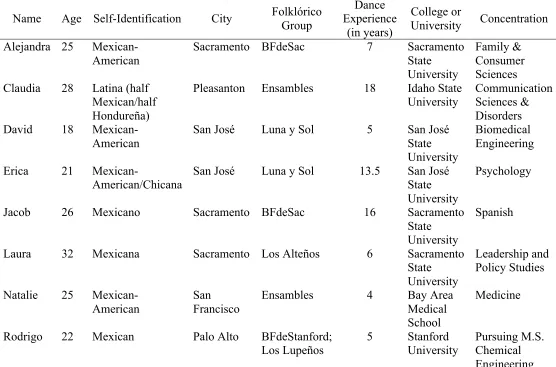
This research is unique in three ways. First, this study adds to the limited research about the relationship of traditional Mexican folklórico dance to Mexican students in higher education. The last documented research that explored the aforementioned variables was published in the 1970s and 1980s (Trujillo, 1975; Trujillo, 1979; Trujillo, 1981; Trujillo, 1983). An additional and more recent study on the indigenous education and dance closely examines the relationship of indigenous danza in educating the community (Colín, 2014). Only one other publication specifically explores the role of folklórico from an educational theory framework or praxis (Pérez, 2016). This writing used Latin Critical Race Theory (LatCrit) to explore the relationship between four friends who all dance folklórico, who all identify as queer and as hermanas, and who all identify as Mexican. The research focused on their relationship to one another and the impact of folklórico in their lives.
of this study. In incorporating the lived realities of the participants of this research, the telling of the testimonios and the design of this research is influenced, changed, and shaped by the vozes and collective conciencia of all participants, including myself. As a researcher, scholar practitioner, and folklorista, this study is part of my embodied Truth, and as such includes part of my own CuerpoMenteAlmaCorazón as part of the process that is integral to authentic and transformational testimonio.
Through Mexican folklórico, dancers learn the techniques and skills to communicate stories about Mexican history, culture, and lifestyles. Dancers train to physically condition their bodies to meet the physical demand of movement, balance, and coordination. They combine this training in physical dexterity with self-awareness and skill-building about non-verbal communication, performance, and history. Dancers learn about the significance of certain movements within the context of a song or dance. The movement of a handkerchief, the positioning of a skirt, the placement of the sombrero, or the interaction of the partners with one another – each particular movement
communicates something very specific about the history or about the particular region of México from which the dance originated. Dancing folklórico is learning to tell the story of México and of its people through art and movement. In a way, folklórico is a lens through which dancers learn about their identity as Mexicans and experience the history and culture of their ethnic heritage through story, song, color, and dance. Folklórico is community education.
Mexicans living in the United States. More importantly, Ethnic Studies curricula in higher education have taught Mexican students how to think critically about their respective identities (Cammarota, 2009; Romero, Arce, & Cammarota, 2009; Sleeter, 2011). Currently, Ethnic Studies programs in education are not required in all school systems, nor are they fully funded and developed to teach the breadth and scope of the curricula. The relationship of Ethnic Studies to this study then becomes clearer in light of México’s curriculum for teaching history and legacy.
In Mexico, educational systems provide students with opportunities to learn about their history and identity as Mexicans in numerous ways. However in the U.S., very few higher education institutes have institutionalized both Ethnic Studies programming and folklórico courses into their respective curricula (Sleeter, 2011). Most folklórico groups that exist within university and college institutions are rarely fully-funded by the
the CSU system included 23 campuses. Of these campuses only eight campuses had folklórico groups who were actively participating in performances and folklórico-related events and festivals.
The CSU system is one example of a large system institutions in higher education with a growing folklórico community. In general, many higher education institutions inside and outside of California have Ethnic Studies courses as optional coursework or concentrations for each student’s educational journey, even fewer schools incorporate Mexican folklórico as part of the curriculum. Mexican students who live in the United States have limited opportunities to learn about their ethnic and cultural heritage identity within the education pipeline, even far less opportunities through Mexican folklórico.
Through these folklórico testimonios I explore the impact that folklórico as performance art and as education has had on the lives of dancers. This testimonio-sharing provides insight into the factors that motivate dancers to invest in learning, dancing, and living traditional Mexican folklórico. In this exploration, I uncover the value and impact that learning about ethnicity and cultural heritage through dance can have on identity development for Mexican-identified individuals through testimonio. Furthermore, this research also explores the role that Mexican folklórico plays in the journey of these same students who identify as Mexican as they move through higher education.
is important to preserve the aesthetic and transformative literary value of testimonio within academic research. Testimonio is dynamic. Testimonio grips at the center of a story to transform the landscape of contested truth for the writer, the reader, and the testimonialista in the construction and reproduction of the testimonio. In this spirit, these folklórico testimonios honor the voice and authenticity of the stories of the dancers. The folklórico testimonios represent the history of arte, color, and dance in an effort to foster and cultivate third spaces from which to bear witness to the value of folklórico
(Anzaldua, 1987). In this exploration, this study highlights the unique ways in which folkloristas have learned to achieve greater knowledge and awareness about their intersectional identities as Mexicanos in a way that only schooling outside of the classroom and in the community can do.
Reframing Language
relationship that language has to nationality, citizenship, and identity for many Spanish-speaking and Mexican-identified individuals living in the U.S.
Italics have historically been used to identify language that is not part of the dominant language. Italics are a visual reminder to the reader that the language is
different and foreign. Delgado Bernal, Burciaga, and Carmona (2012) explain the power dynamics that are endemic to language translation in the following quote:
When translating, for example, terms of endearment, underlying meaning can get lost in translation. One must be cautious to translate conceptually rather than literally because in translating particular terms, nuances get lost, and we run the risk of reproducing language marginalization. Translating testimonios from Spanish into English includes translating culturally-specific knowledge that can shift meaning and reproduce negative connotations associated with gendered or racialized terms of endearment. (p. 3)
The relationships within these folklórico testimonios are born of Spanish, English and Spanglish tongue. They are home. They are not foreign. This language choice is The Story. These testimonios are their Truth. Italics would restrict how each folklorista’s may be expressed authentically. The deliberate choice to avoid italics is the resistance of further marginalization of non-English languages in academic research.
are presented more authentically, in the way that each folklorista chose to share organically.
The testimonios of this research express emotion, value, and meaning through their stories. In honor of each participant’s Truth, I do not use italics to distinguish any part of this study and I do not directly translate any text that was not initially
communicated in English. The testimonios of each folklorista are shared authentically in the spirit, flavor, and energía in which it was gifted to this study. Each of these
testimonios are a testament of power and resilience and thus they stay true to their original form. In this way, folklórico testimonios add to the body of literature
surrounding identity, language, performance, cultura, and CuerpoMenteAlmaCorazón by resisting italics and translation. These testimonios are examples of how the way in which we choose to share stories of resistance and Truth can be a way to super charge the already-powerful role of uncontested and unapologetically rich Spanish and Spanglish research within academia.
Purpose Statement
The purpose of this study is to better understand identity development, community-building, and agency for Mexican students in higher education through testimonios of folklórico dancers, or folkloristas. This study focuses on folkloristas who identify as Mexican, who are currently enrolled in traditional Mexican folklórico dance groups within the community, and who are pursuing their undergraduate or graduate degrees. These testimonios examine the role of folklórico in developing identity, building community, and teaching advocacy for folkloristas. In sharing these stories, this
are moving through systems of higher education and who are committed to traditional folklórico.
In many ways, folklórico is a way in which I learned more about my whole self as a queer, Xicano, first-generation, Spanish/Spanglish speaking muchacho. Folklórico is my education beyond the classroom and it opened my eyes to the value and richness that all aspects of my identity add to my ethnic heritage. Folklórico provided me with an opportunity to explore and understand myself with pride, confidence, and self-awareness. If I found great value within this community-based model of education, then perhaps other folkloristas may have had a similar experience with Mexican folklórico. This study is an exploration of this relationship between cultural performance and self-empowerment, education and the comunidad.
Research Questions
These testimonios explore the relationship between Mexican folklórico and identity, community-building, self-empowerment and advocacy. Specifically, this study is guided by the following research questions as they apply to folkloristas who are pursuing their degrees in higher education and who identify as Mexican:
1) What do folklórico testimonios reveal about the relationship between traditional Mexican folklórico and identity development?
2) What do folklórico testimonios reveal about the relationship between traditional Mexican folklórico and community building?
4) How do testimonios provide a space for sharing stories of community cultural wealth and social justice cultural performance?
Theoretical Frameworks
In exploring the testimonios within this study, certain theoretical frameworks are crucial to making sense of the role of folklórico as community education in teaching Mexican students about identity, community, and advocacy. This study briefly references Latin Critical Race Theory (Lat Crit), as informed by Critical Race Theory (CRT), as a necessary precursor to the exploration of ethnic and racial identity development within communities of folklórico for Mexican students in the United States. The use of
Community Cultural Wealth
In her research on community cultural wealth, Yosso (2005) highlights the false illusion that students of color come to education at a deficit with no valuable skills and resources to enhance their student success. Schools both oppress and marginalize while they emancipate and empower. Schools urge self-awareness and education while also suppressing community cultural wealth, which can enhance the educational experience for marginalized communities of students. In her research on critical race theory, Yosso (2005) theorizes about the importance of challenging racism through a revelation of cultural wealth within the realities of students of color and their families. Yosso frames the strengths and values that students of color bring to their educational pathways in six different types of capital: aspirational, linguistic, familial, social, navigational, and resistant.
• Aspirational capital: This form of capital refers to the ability for communities of color to maintain hope in light of unfavorable, toxic, or oppressive environments. Aspirational capital is the propensity for students to dream and imagine
possibilities beyond their current reality.
• Linguistic capital: The possession of multiple languages and communication skills is how Yosso defines linguistic capital. This form of capital also underscores the skill of communities of color to use art, music, or poetry to capture, share, and remember stories as engaged participants.
this form of cultural wealth for communities of color.
• Social capital: People and community resources are the crux of this form of capital for communities of color. Social capital is the ability to use information and resources to enhance and build upon a social network to move through a system.
• Navigational capital: This form of capital refers to the skills that people of color possess in maneuvering through social institutions. Specifically, these skills are helpful in moving through institutions that were not built with the success of people of color in mind.
• Resistant capital: Resistant capital refers to the behaviors, skills and attitudes necessary to resist toxic and unjust environments. Students of color often possess the knowledge and skills fostered through behavior that challenges inequality. Each of these forms of capital play a role in centering the experience of social and racial justice in the strengths and attributes of communities of color. In turn, community cultural wealth is one way in which to understand the testimonios of each of the participants.
Each type of capital builds a case for how students of color use the lessons, culture, experience, and teachings from their home environments to successfully move into, through, and beyond higher education. This community cultural wealth is
Yosso’s (2005) research on critical race theory and education provide a
framework and context for the transformative impact of the stories of students of color. Yosso asserts, “ . . . schools most often oppress and marginalize while they maintain the potential to emancipate and empower. Indeed, CRT in education refutes dominant
ideology and White privilege while validating and centering the experiences of People of Color” (p. 74). A combination of community cultural wealth as a project of CRT and Lat Crit within this testimonio research will help to make sense of the value of the
community and the individual in a collective process of sense-making and education. Social Justice Cultural Performance
The following sub-section summarizes key literature that informs what I refer to as social justice cultural performance. This literature includes Rich’s (2006) permeable membrane, Taylor’s (2011) research on the archive and the repertoire of cultural
memory, and Haiven and Khasnabish’s (2014) writings on the use of radical imagination. This research offers a lens through to which to makes sense of identity, community, and agency in this study. Each area of research is explained in a format that allows each area to speak with one another as a larger conversation about social justice cultural
performance, which then becomes another framework for this study.
The permeable membrane is “passionate language in movement” (Rich, 2006). In this context, Rich discusses the unique role of art, movement, and performance in
creating a space that centers the role of imagination in moving beyond tension or conflict (Cohen, Varea, & Walker, 2011a; Cohen, Varea, & Walker, 2011b). Within this
performers can tease, push, and pull at imagination to move beyond conflict to imagine futures that exist beyond the parameters of the acceptable/the unacceptable, the sacred/the conventional, the appropriate/the inappropriate.
Taylor (2011) theorizes about cultural memory in two different contexts – the archive and the repertoire. These elements frame cultural memory in distinct ways. The archive refers to cultural memory that is available to select members of society with access to memory as a resource. Access to this archive is what distances the community from cultural memory. The repertoire is the embodiment of cultural memory that is readily accessible and performed by the community. Both the archive and the repertoire are key components to understanding how folkloristas access and perform cultural memory.
Haiven and Khasnabish (2014) write about the role of imagination in evolving social movement research. Specifically, radical imagination helps to envision possibilities for resolving social and institutional systemic challenges through creative and strategic innovation of collective organizing. Power to influence change exists and thrives within a collective ability to envision possible solutions to conflict beyond the scope of current and available resources. Haiven and Khasnabish assert, “the radical imagination catalyses a shared sense of purpose and power and emerges from and contributes to encounters and relationships between actors.” (Haiven & Khasnabish, 2014, p. 63-64).
centers around a collective process as opposed to an individual one. The term radical specifically refers to the awareness that systemic change will only come about through the use of resources and mobilization outside of our beyond our current political system. Radical imagination is contextualized within a larger narrative about social movements within Haiven and Khasnabish’s research. Still, the fundamental concepts of radical imagination are critically important to extracting meaning and power from the past, infusing the present with this power in order to conjure possibilities of a future beyond pain, conflict, and strife – this is the radical imagination. The radical imagination can be beneficial to understanding how to understand the motivations and passion of performers of Mexican folklórico in imagining a future that honors the fullest expression of their identities, communities, and agency.
Each of these three elements makes important space for the union of imagination and cultural memory in the performing in, through, and beyond our past for the sake of an imagined future that transcends our current realities. I call this a practice in social justice cultural performance. This framework underscores the importance of making space for imagination and cultural memory in envisioning futures that harness the individual, that focus collective power, and that shape testimonios in a way that make sense for the community. This social justice cultural performance framework leads to a conversation about the critical components of performance, imagination, and memory in shaping identity, community, and agency.
Educational Significance
pursuit of continued education. Folklórico has always existed within the context of understanding Mexican history. Folklórico did not suddenly emerge as a counter-story to dominant narratives about ethnic identity. The notion of folklórico as a counter-story is romantically nostalgic. At the same time, to assume that folklórico feeds into a counter-narrative also acknowledges that Mexican history and culture exist outside of center. Mexican folklórico is a perfect example of the uniquely powerful and empowering nature of testimonio methodology. The story of Mexican folklórico exists as a testimonio in and of itself, and without the need to counter a dominant story. Rather, Mexican folklórico is the story. Mexican folklórico testimonios are also a unique way to explore physical movement through performance with the sociological underpinnings of identity-development and community building. Being a dancer is a way of life. Being a trained dancer in traditional Mexican folklórico is a way to fuse your ethnic identity and cultural awareness with the physical discipline of a dancer’s lifestyle.
Folklórico dancers may identify as Mexican in a variety of different ways. In folklórico dance companies, folkloristas often possess similar perspectives on the
familism. The Latin@ epistemology research that Hidalgo proposes is embodied within the values and objectives of Mexican folklórico.
. . . the more one knows about the context of Latino/as lived experiences, the better one may understand their processes of adaptation and change. Latino/a knowledge creation is, in part, a process of accommodation, resistance, and change in response to the cultural and structural forces that shape the lived experiences of individuals and the collective groups. (Hidalgo, 2005, p. 378) This study is significant in that it provides insight into the factors that motivate Mexican students to pursue their education beyond traditional educational institutions within the community. Through this research, education professionals gain a deeper understanding of what Mexican students seek in the way of education and fulfillment during their journey through higher education systems. Ultimately, the findings provide researchers with more background about educational frameworks that promote equity, access, and success in the education pipeline for Mexican students.
Lastly, this study provides an important contribution to testimonio research of performance, identity, and space as one. Specifically, these testimonios provide insight into the value of spatial testimonios as explorations of individual stories, group stories, methods of story-telling and story-sharing, and voice. These elements interact
simultaneously and are captured by framing the story as one that belongs to the space – not to any one person or persons. Instead, the entirety of the space authors the testimonio. In other words, the space with its dancers, the colors, the arts, the movements, and the energy all becomes the author and contributor to the body of testimonio research.
Limitations
This folklórico testimonio study presents some limitations and delimitations to conducting research. Specifically, I discuss four areas that may have impacted the
testimonios and results of this study. Two of these areas relate specifically to the years of experience that I have worked within the folklórico community and the impact that they may have had on the study. The third area discusses the role that logistics and planning took in how folkloristas participated in the study based on time, place, and manner of data collection. The final area expands upon the semantics of words used to define traditional Mexican dance and the impact of this discussion in the folklórico community. My Experience as a Limitation
I have been a dancer, an assistant director, and I now co-direct one of the performance companies for Mexican folklórico in Northern California. I have been connected to the Mexican folklórico community for over 20 years. The Mexican
folklórico community within the United States and specifically in California may have an impact in how participants choose to share their testimonios within this study. The role that I play with the different types of folkloristas who may come forward in this study may be influenced by community-set standards of respeto which can easily translate to both direct and indirect dynamics of power. These power dynamics, even in the most inclusive and non-bureaucratic leadership styles within folklórico companies, can greatly influence the process of collecting each testimonio. My connections within folklórico will undoubtedly impact the process of authentic testimonio-sharing for the participants in this research. Within the context of this research, the stories that are provided to me and subsequently incorporated into this research can be triangulated with feedback from the group of participants of the study. In this way, my positionality as researcher and
testimonio-participant will inform the study as part of the process, rather than a disruptive element to the testimonios.
My Experience as an Asset
Another consideration, however, is that this study draws in the researcher as an author to both my own testimonio as well as the testimonio of the other folkloristas. Rather than assume that my relationship to the participants potentially disrupted the stories that I collected, testimonio methodology research suggests that my role and voice in the community and in (dis)connection to the participants is part of the larger
criteria. My experience as a folklorista in the community is a factor to consider. In this case, I argue that my voice in the community may have been an asset to the study. Time, Place, and Manner
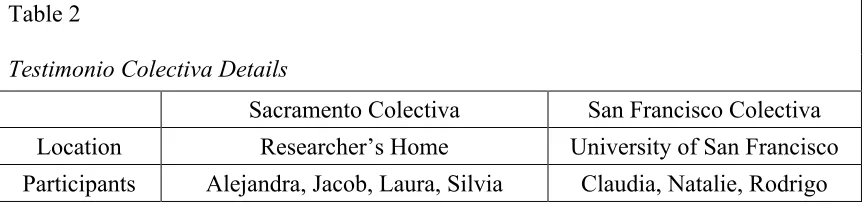
More specific constraints within this study included the logistics of how I invited participants to this study and how I collected their testimonios. For this study, I wanted to be mindful of how to collect the testimonios and how the medium could impact the testimonio as well. Whether the testimonio is shared as a performance, an oral story shared face-to-face, a collective testimonio shared as part of a group, a streaming video conference call, or a collected written testimonio – the format can certainly impact the dynamics of the testimonio’s energy, flow, impact, message and a variety of other variables. These limitations seemed obvious and, to a certain extent, did play a factor in how participants connected to the study. In at least two cases, distance and school schedules played a significant role in participant’s reason for declining to participate in the study. All the folkloristas who contributed individual testimonios also wished to participate in a second opportunity to share their testimonio in a small group. However, again, logistics with schedules played a big factor in securing each small group
Folklórico, Danza, or Bailables
Another possible constraint to this study stems from the variation that exists in the word: folklórico. The word is commonly used to describe Mexican cultural performance art through dance and movement. For purposes of this study, I use the word folklórico to describe all practice, technique and training related to dance forms that teach about Mexican history, culture, and identity. Within this context, folklórico includes styles that are contemporary and stylized forms of dance that have been modified for theater
presentations. As a category, folklórico also extends to the more traditional forms of dance that aim to honor the original and authentic styles of the dances. Depending on the context, origin, and style of dance, some dancers will refer to the more stylized and theatrical presentations of dance as “folklórico” and often even as “ballet folklórico” to make reference to the ballet foundation to their dance. Other folkloristas will refer to their practice as “danza”, “bailables”, or “grupo folklórico”. In most cases, the term
“folklórico” is a more widely accepted term to apply to all styles of dance related to the retelling of México’s culture, heritage, history, and identities through traditional dance.
For purposes of this study, each participant self-identified as a folklórico dancer and their experiences varied along the spectrum of dance styles and training within this definition of folklórico. Still, some cultural purists actively resist the word folklórico. Some would argue that the word folklórico, in and of itself, is a more contemporary word that refers to the performance of dance for theater and spectacle only. Other folkloristas argue that some of the aforementioned words are interchangeable with the word
Words are powerful and have meaning. Each of these words is loaded with social, historical, and cultural context that further flavors the conversation. In this study, the conversation of what constituted real folklórico and what constituted danza came up in at least one instance. In this instance the conversation occurred between potential
CHAPTER 2: REVIEW OF THE LITERATURE
In order to make sense of the folklórico testimonios in this research, I explores key literature that provide a framework from which to organize patterns and themes that emerge from each of the stories. This review targets three main areas of literature. The first review provides a summary of research that demonstrates the various tenets and applications of Yosso’s (2005) community cultural wealth framework primarily in higher education settings. The next section provides an overview of research about ethnic dance and performance, with a specific emphasis on the role that dance plays in education and in communities of color. These specific texts serve as a foundation from which to more fully understand the research of social justice cultural performance (Haiven and
Khasnabish, 2014; Rich, 2006; Taylor, 2011). Lastly, this literature review concludes with an exploration of research that illustrates the diversity of studies that uses testimonio as a means of radical story-telling, as both product and process. This review organizes key literature in a way that provides a foundation from which to understand the relationship between LatCrit, traditional folklórico, art and performance, and higher education for students who identify as Mexican.
Community Cultural Wealth
to the classroom: aspirational capital, linguistic capital, familial capital, social capital, navigational capital, and resistant capital. The literature within this section utilizes Yosso’s community cultural wealth to illustrate how students of color add value to their educational experiences through the various skills and resources that they bring with them into the classroom.
In this section, I divide the literature on into two themes. The first theme
highlights the stories of students of color who actively utilize community cultural wealth to succeed in higher education. More importantly, their stories are posited in such a way as to reframe the perceived narratives about their success. In this section, I refer to community cultural wealth as having the properties necessary to shift the focus of lived realities, and to re-center narratives for and by students of color. I refer to the studies in this section under the theme of Reframing Realidades. The second theme is a review of studies that use community cultural wealth as a teaching tool for communities to improve or enhance their educational practices to support the success of students of color. In these studies, community cultural wealth is used as a sobering lens for researchers and
practitioners of education to better understand how to transform their educational landscapes for the success of students of color. I refer to this process as one of raising awareness about how to best practice pedagogies and support systems that transform problematic structures and processes. This section is titled Critical Practice.
Reframing Realidades
Various studies use community cultural wealth to amplify the stories of success for students of color in higher education. Yosso’s (2005) intention was for this
to school. Some studies often use this frame as a pedestal from which to make sense of how students of color use their environments, their upbringings, and their life contexts as an impetus for success. Some studies combine this frame with CRT and/or LatCrit to highlight the strength and potential of values that students from Chicanx, Latinx, or Mexican backgrounds bring into their higher education pathways (Araujo, 2012; Bejarano & Valverde, 2012; Burciaga & Herbstein, 2012; Espino, 2014; Pérez Huber, 2009; Pérez II, 2014).
In her study about farmworker student success in higher education, Araujo (2012) discusses how students use their home experiences to inform and influence their
movement through the education pipeline. In particular, Araujo’s study focuses on the experiences of Santiago, a Mexican student farmworker from California. The study specifically focuses on how Santiago uses his cultural knowledge to graduate from high school and successfully complete his first year of college. This study is unique in that it uses cultural wealth as a way to illustrate how students can gain a deeper sense of agency.
Similar to Araujo’s study (2012), Bejarano and Valverde (2012) also explore stories of student success in higher education from within the farm worker community. Bejarano and Valverde use mixed-methods research to focus specifically on patterns of success for students entering New Mexico State University through the College
applying the study’s findings about cultural capital to the CAMP program curriculum. In this parallel value structure with students and within the CAMP program, students from farm work backgrounds find a place and space that feels like familia and home within the university at large through the practices inside the CAMP program.
Beyond telling the story of how students come into the institution with cultural capital, some studies use their community cultural wealth research to challenge
problematic narratives about communities of Mexican and Latina/o students (Burciaga & Erbstein, 2012; Espino, 2014; Pérez Huber, 2009; Pérez II, 2014). These studies burst through a counter-story framework to drop their kernels of verdades into a problematic mix of stories about their presumed deficiencies. The studies are not counter to a dominant story – they become the story and take over the space. In a way, these studies change the landscape of educational research about success for students of color.
In a study on Latina/o dropouts, Burciaga and Erbstein (2012) explore the
testimonios of six Latina/o and their experiences moving through the educational pipeline on a journey to graduation. This study is another example of how the combination of a community cultural wealth framework can reframe the lived experience of students. In particular, this study focuses on moving from a narrative of despair and inadequacy to one of strength and persistence. Pérez II (2014) would echo the intention and impact of Burciaga and Erbstein’s study (2012) in its active reframing of the narrative of Latino male achievement trends through community cultural wealth. Pérez II (2014) provides context for how two Latino males successfully navigate the pathways in their
employ at the university in order to reaffirm their ethnic identity and navigate around and through barriers to their academic success. Much like Burciaga and Erbstein (2012), Pérez II (2014) carefully and clearly asserts that community cultural wealth encourages a narrative reframing that highlights Latino student patterns of achievement from a
strengths based approach.
The testimonios within Burciaga and Erbstein’s study (2012) belong to Latina students who thrived and persevered through various obstacles in their quest for graduation. The students reframe their lived reality as determined students. This
reframing is posited as their Truth that exists beyond the framework of a counter-story. Rather, community cultural wealth is combined with testimonio to supersede a dominant-counter story binary. This study represents the students’ testimonios as central to
understanding the story. The research is one of determination and reframed success in the face of various barriers to their success. Both aforementioned studies offer frameworks from which to contextualize deficit-thinking frames for the success of Latinas and Latinos (Burciaga and Erbstein, 2012; Pérez II, 2014).
Pérez Huber (2009) presents stories of the strengths and values that Chicanas bring into education. Moreover, the testimonios in Pérez Huber’s research (2009) are not counter-stories. Rather, they are a profession of the power and potential of undocumented
students to transform the landscape of their educational institutions from within their own definitions of value, resources, and capital.
This same reframing is also present as similar communities of students of color move into graduate studies. Espino (2014) uses community cultural wealth to
contextualize the pathway of 33 Mexican-American students into their PhD programs across 15 different universities in the United States. The study looks at ways in which each of the participants utilized and was reminded of the importance of using the various forms of capital from Yosso’s (2005) community cultural wealth framework. Cultural capital was used in order to successfully navigate the intricacies, processes, structures, written and unwritten rules of engagement for their respective institutions’ graduate programs. Within the study, Espino underscores the important value of channeling community cultural wealth for Mexican-American students as a survival mechanism, and more importantly as a way to flourish in graduate studies.
These aforementioned studies illustrate community cultural wealth as a
Critical Practice
Much like the aforementioned studies, the research within this section also underscores the strengths and values that students of color bring into the classroom. The studies that I present in this section, however, have a similar focus to their use of
community cultural wealth frameworks. These various studies use community cultural wealth as a lens through which educational programs and institutions can improve their pedagogy and practice.
This lens helps to make sense of the spaces that foster more successful outcomes in higher education for students of color. These studies illustrate how community cultural wealth is used as a lens through which to critically assess and reframe problematic
practice and pedagogy that is of no use, and possibly even detrimental, to the success of students of color (Aragon & Kose, 2007; Liou, Antrop-González, & Cooper, 2009). The positioning of the cultural capital frameworks with a defined intention of honoring the various values that students of color learn and bring with them from their home environments.
In their research on the attrition and graduation rates for students color in
postsecondary education, Aragon and Kose (2007) use cultural capital in two ways. First, they utilize cultural capital as a sense-making tool to understand how and why
necessary in postsecondary education. In this way, the framework will provide a deeper breadth and scope of cultural capital for more students of color.
Aragon and Kose’s (2007) study set out to integrate cultural capital as a means of assessing how postsecondary education could support the trajectory of students of color through their institutions. Other studies serve as examples of how students use their community cultural wealth as a way to overcome obstacles, supersede expectations at their respective schools, and pave the way for more students of color. The research of Liou, Antrop-González and Cooper (2009) reinforced the belief that students of color will seek the resources within their community and home environments. This study
underscores that the integration of cultural capital from the home environments of students of color is particularly salient when institutions continually fail to provide student of color with the resources necessary to succeed in their pursuit of higher education.
respective institutions have not provided that pathway for them. This survival tool is then reframed as a mechanism for students of color to thrive at the college and university.
Other studies provide a deep dive into specific tasks and programs within higher education that can be strengthened through the incorporation of a cultural capital (Rios-Ellis et al., 2015; Valdez & Lugg, 2010; Saathoff, 2015). Researchers use aspects of community cultural wealth to explore how key service areas or support systems can parallel the same values and capital that students of color already bring into the institution. In this way, institutions are creating a landscape that already speaks to the strengths of students of color.
In their study on Latinos in higher education, Rios-Ellis et al. (2015) uses community cultural wealth to build a university peer-mentoring model to close the achievement gap. This program is referred to as the Promotores de Educación peer education group and the program is a function of the Hispanic-serving initiatives at California State University, Long Beach. Valdez and Lugg (2010) review how public schools can combine aspects of community cultural wealth with Latin Critical Race theory to facilitate the success of communities of color, and in particular Chicana/os and Latina/os. The researchers provide public educators with culturally relevant and
pre-service teachers how to create educational spaces that honor the values that their Mexican and Mexican-American students bring into the classroom.
Social Justice Cultural Performance
In this section, I provide a summary of studies that explore cultural performance in the form of dance. In particular, the research within this section focuses on literature that examines the relationship of cultural performance to different forms of education with a focus on literature about higher education or performance that explain the history of people of Mexican origin. This search was conducted through browsing literature at the intersection of ethnic and cultural dance, folklore, and higher education. The limited research provided gives deeper context for how to situate the folklórico testimonios within this study.
In this section, I explore the literature about traditional dance forms as it relates to Mexican culture. Over time, the literature on this topic has referred to this style of dance and performance with words such as Hispanic, ethnic, Mexican, and Mexican-American (Trujillo, 1975; Trujillo, 1979; Trujillo, 1981; Trujillo, 1983). The literature of these subject areas within education is limited. The research provided within this section is a mix of different designs and directions at the intersections of dance, performance, education, and the Mexican community (broadly used to refer to all of the
aforementioned key terms). All studies within this section are organized around three themes. The first theme revolves around the origins of Mexican folklórico within
key studies address how dance can be social justice performance. The final theme discusses the role of conflict, peace, and healing in performance studies.
Mexican Folklórico in Education
This review has limited its span of literature to include those studies that explore the relationship of Mexican cultural performance, dance, or folklórico within research about education. For purposes of this section, the literature reviews the key research within this area.
Earlier production of knowledge specifically around the role of Mexican dance and education comes from a collection of research by Dr. Lorenzo A. Trujillo. His work is foundational in the area of ethnic dance curriculum. Trujillo was one of the first researchers to combine his research of traditional Mexican folklórico with education research. In 1979, Trujillo first presented his research on the history of the Hispanic dance experience to the Presidential Task Force on Hispanic American Arts. This presentation is particularly foundational in that it was one of the first instances that a researcher was publicly presenting the role and impact of traditional cultural performance in education at a national level by United States researchers. This presentation provided a description of the traditional dance, the research defined ethnic dance, and outlined the significance of this dance form in the larger narrative of education in the United States (Trujillo, 1979).
relationship between a Hispanic Ethnic dance curriculum and students at San Francisco’s Mission High School (Trujillo, 1981). The curriculum was comprised of the history, folklore, and culture through what the researcher referred to as Latino Mexican dance. Low achievement scores and a perceived sense of low self-concept initially motivated the researcher to conduct this study of Mexican students at the school. Trujillo’s research was a quantitative study that used treatment groups, control groups and various other
assessment tools to measure the impact that the dance curriculum had on the high school students. In this much, Trujillo was taking his prior research and presentation (1979) and applying his theoretical assumptions about the role of dance in the San Francisco Bay Area (1981). The Mission High School study did report a noticeable positive impact on self-concept and achievement for students who were exposed to the curriculum. This study is particularly important in that it is one of the first and few documents that exists as a review of traditional Mexican dance as an impact on students’ education.
Trujillo’s (1983) earlier work on the Hispanic tradition serves as a teacher’s guide to inform practice for teachers of the folkloric tradition. This particular study, however, makes no distinction between such terms as Hispanic and Mexican. More importantly, this research combines the psychological and cultural values of traditional waltzes within this style of dance that has a much heavier Spanish influence in its execution, dress, and dance style.
Trujillo’s research on folklórico was not without its diverse applications,
1979; Trujillo, 1981; Trujillo, 1983). Still, all of the aforementioned research was
foundational in setting the groundwork for literature about traditional Mexican folklórico dance within education.
The 1970s and 1980s was one of the last time periods that included a documented exploration of Mexican folklórico as a part of education research, until recently.
Although the research was based on indigenouse education, Colín’s (2014) study of the role of indigenous education in dance and ceremony relates tangentially to the pool of research on education and dance forms that connect to people whose family origins are from México. In this research, Colin reviews how sacred and ritual performance of indigenous education and community standards and practices can be found in modern-day performance of danza. Colín (2014) discusses the role of and need for community in indigenous cultures. Specifically, Colín connects the role of community work to a civic duty that then contributes to the sustainability of indigenous communities. This ancient concept is framed as tequio and is central to the life and vitality of community
connection. In his research, the ancient concept of tequio is then rooted to in modern-day practice of indigenous ceremonies and rituals, including dance. This research paves the way for more contemporary educational research on the role of dance and performance for communities who can trace their heritage to México.
queer mexicanos, and more. The research engages with the dancers as individuals and together at once. Pérez’s research marks the most recent publication of research about Mexican folklórico and identity through an education-based theoretical framework. Dance as Social Justice Praxis
In considering the relationship between dance, culture, and education, some studies have explored the dynamic within these variables and their impact on student success. The following literature provides more general explorations of the role of dance in education. Most of the research findings are determined through exploring these dynamics within communities of color outside of students who identify as Mexican, Chicanx, or Latinx.
One key element that the literature clearly underscores in its exploration of dance education about racial and ethnic communities is the impactful role of researcher and educator bias and limitations. Power, privilege, identity, and access to information play a crucial role in how dance education about communities of color is disseminated.
Kerr-Berry (2004) takes Rovegno and Gregg’s research (2007) to task as well. In Kerr-Berry’s editorial, the researcher posits the matter of misinformed teaching in the world of ethnic dance. By probing and asking about the context and permission for educators to teach the history, style, and discipline of dance styles that belong to
countries and cultures outside of their own community. This document becomes a call to action for educators to pursue further dialogue on the matter of cross-cultural sharing of dance pedagogy and practice. In turn, this call to action calls to mind Rovegno and Gregg’s original finding: White teachers educating African American youth about Native history, folklore, and dance will be impacted by the teachers’ racial identity.
In a way, Risner and Stinson (2010) research on social justice dance education becomes a solution to the challenges found within earlier accounts of ethnic dance exploration (Kerr-Berry, 2004; Rovegno & Gregg, 2007). Risner and Stinson challenge educators to consider how dance education could and should invoke principles of social justice in dance curriculum. By acknowledging that stepping into the landscape of social justice education in dance can be frightening, the process of seeking equity in ethnic dance can be made less difficult. By openly embracing the difference within our community practices and making the differences more familiar within the context of performance and dance, dancers can more closely relate to and understand the role of dance in promoting social justice.
Through this lens of social justice art, this study carefully deconstructs the influence that dance can have in communicating messages about power and critical consciousness. The author asserts that “conceptualizing dance as a critical site of encounter for dancers and viewing audiences . . . is a blend of raising awareness, reflection, and social action (p. 332).
The tenets of both prior studies remind readers of the importance of integrating discomfort and the unfamiliar as part of the process of social justice dance education (Risner & Stinson, 2010; Roberts, 2011). Risner and Stinson (2010) find unique parallels between dancer training of the physical body and a stretching of comfort levels and consciousness with social justice education. In dance, the physical body will stretch, bend, and move. In the same way, this practice can push dancers to stretch, bend, and move their consciousness. In exploring the role of critical consciousness for performance and performers, Roberts (2011) reviews the important and necessary body of work of prominent black choreographers and performers in an effort to push and move beyond dominant frames for conceptualizing the role and extent of performance and social justice story-telling. Social justice dance education requires a movement into discomfort for the sake of capturing the essence of the stories through the dance.
culture and practice in the United States in order to inform counseling services for Greek-Americans. The study reveals how dance becomes the conduit for knowledge about the culture, for socialization patterns, and for intra group dialogue and connection. Issari’s research is instrumental for the body of literature around ethnic and cultural identity and dance in that it declares dance education as a story of embodied language. In considering that dance education is an embodied process, it is easier to understand why researchers in prior studies found it difficult to connect the content of their dance education with their audience (Kerr-Berry, 2004; Rovegno & Gregg, 2007).
Issari’s research (2011) asserts that dance must no longer be viewed as an
autonomous act, but rather as a layered and complex combination of multiple negotiated and contested ideologies (p. 254). Similarly, the research of Tezozomoc, Danza Azteca Huehueteotl, and Danza Azteca Tenochtitlan (1997) pushes the boundaries of this