An Ant System based on Moderate Search for TSP
Ping Guo and Zhujin Liu
College of Computer Science, Chongqing University, Chongqing, China Chongqing Key Laboratory of Software Theory & Technology, Chongqing 400044,
China
Abstract. Ant Colony Optimization (ACO) algorithms often suffer from criticism for the local optimum and premature convergence. In order to overcome these inherent shortcomings shared by most ACO algorithms, we divide the ordinary ants into two types: the utilization-oriented ants and the exploration-utilization-oriented ants. The utilization-utilization-oriented ants focus on constructing solutions based on the learned experience like ants in many other ACO algorithms. On the other hand, inspired by the adaptive behaviors of some real-world Monomorium ant species who tend to select paths with moderate pheromone concentration, a novel search strategy, that is, a completely new transition rule is designed for the exploration-oriented ants to explore more unknown solutions. In addition, a new corresponding update strategy is also employed. Moreover, applying the new search strategy and update strategy, we propose an improved version of ACO algorithm— Moderate Ant System. This improved algorithm is experimentally turned out to be effective and competitive.
Keywords: Ant Colony Optimization; Adaptive behavior; Traveling Salesman Problem; Local optimum; Premature convergence
1.
Introduction
satisfactory solution in markedly less time. Particularly, ant colony optimization (ACO) is a typical sort of SI algorithms. For many problems, ACO algorithms generate competitive results that are very close to the best known solutions while on some problems like quadratic assignment problem (QAP) they are the state-of-the-art [5].
ACO takes inspiration from the foraging behaviors of real ants which can always find the shortest path between their nests and food sources. The famous experiment, known as “shortest bridge” experiment, simulates the behaviors and explains the optimization ability [6,7]. When there are more than one path between a nest and a food source, each ant will choose one path by chance. And the ants will return to their nest as soon as they arrive at the food source. Meanwhile, they lay pheromone on the paths they have passed. It is obvious that it takes less time for the ants that choose the shorter path to get back to the nest. Accordingly, the shorter path gains more pheromone from ants than longer paths because of the high round-trip frequency. After that, ants in the nest tend to choose the path with higher pheromone concentration instead of random selection when departing for the food source. Thus, an increasing number of ants will be attracted to the shorter path and those ants will lay more pheromone on the shorter path over time. Eventually, the path between the nest and the food source selected by almost all of the ants, that is, the shortest path, is found. An individual ant has little intelligence. However, a swarm of ants achieves incredible high intelligence [8]. The term “stigmergy” is used to illustrate the distinguished capability that owned by ants as well as other animals. Specifically, stigmergy, refers to a self-organized mechanism which describes such an activity: a number of individuals interact with each other indirectly via modifying the common environment which serves as a medium; in other words, ants affect the local environment and the environment feeds back to ants, thus, ants exchange information; as a consequence, the interaction contributes to the update of the environment which affords a new platform for new interaction 5. Drawing on this mechanism, a multitude of ant algorithms have been created and ACO meta-heuristic is used to describe these algorithms in a more general way [9], however, ant algorithms are not confined to ACO.
Overall, the existing ACO algorithms share similar search and update strategies. More precisely, the transition rules that they employ render them in favor of components with higher pheromone concentration during the construction of feasible solutions. And update rules are more likely to give the better solutions more pheromone when updating the pheromone trails [13]. It is evident that transition rules and update rules supplement each other. The average quality of solutions benefits from the selection bias and update bias indeed. On the other hand, taking into account that ACO is an iterative approach, the biases may lead to premature convergence and local optimum, that is, limit the discovery of new or better answers, which is the starting point of our research. As a matter of fact, not all species of ants in the real world tend to select paths with more pheromone. According to some new research [14], some kinds of ants will strike a balance between paths with different quantity of pheromone. They prefer paths with moderate pheromone rather than paths with overly high or overly low pheromone concentration. Inspired by this, we present an improved ACO algorithm by bring in an extra transition rule and the counterpart update rule. The improved ACO algorithm is experimentally proven that it can obtain better solutions than other ACO algorithms in most cases.
The rest of this paper is organized as follows: Section 2 introduces several main ACO algorithms and discusses their design ideas. In Section 3, the original idea of Moderate Ant System (MAS) is explained and we present the search strategy and update strategy of MAS as well as the concrete algorithm. Section 4 gives a performance comparison and analysis between our improved algorithm and main ACO algorithms. Finally, Section 5 concludes the paper.
2.
Related Work
A lot of ACO algorithms have been proposed since Dorigo et al. introduced the first ant algorithm in 1996. Here we present typical ones of them: Ant System (AS) [11,15], Max-Min Ant System (MMAS) [16] and Ant Colony System (ACS) [17,18]. In order to be in lines with our experiments, we use TSP as a specific instance to describe the algorithms.
For the convenience, Let Gbest is the global best solution.
2.1. Ant system
framework in terms of implementation. The main framework of ACO algorithms including AS is shown in Algorithm 1.
Algorithm 1 The framework of ACO algorithms Initialize the parameters and pheromone trails; while termination conditions not satisfied do Step 1: Each ant constructs a solution Step 2: Update the pheromone trails end while
end
It can be seen that the core of the algorithms is a loop body and each loop consists of two crucial steps: the construction of solutions and the update of pheromone trails. The loop body, in fact, is an iterative process through which the accumulation of pheromone can play a role.
Iteration is defined as the interval in (t, t+1) during which each of the m ants constructs a solution. In other words, every ant traverses all of the n cities in each iteration. AS together with other ant algorithms employs the tabu table to record the already visited cities of an iteration in order to obtain feasible answers. In Step 1 of Algorithm 1, during the construction of a solution, ants choose the next city to be visited via certain search strategy which is a stochastic mechanism [19]. When ant k is in city i, the probability of going to city j is given by:
otherwise tabu j if p k tabu l il il ij ij k ij k 0 (1)
Where, tabukis the tabu table of ant k which is comprised of the cities that have been visited in the current iteration. The parameters α and β control the relative importance of the pheromone τij versus the visibility ηij. The visibility represents the heuristic information, which is given by:
ij ij 1/d
(2)
Where, dij denotes the distance between city i and city j. This transition rule is also shared by other algorithms.
After each iteration, Step 2 of Algorithm 1 is performed. The pheromone τij linked to the path connecting city i and j, is updated as Eq. (3).
m k k ij ij
ij t t
1 ) ( ) 1 ( ) 1 ( (3)
Where ρ is the evaporation rate, m is the number of ants, and Δτij k
is the quantity of pheromone laid on path(i,j) by ant k:
Where, Q is a constant and Lk is the tour length of the solution obtained by ant k.
2.2. Ant system with elitist strategy
ASelite is the fisrt improved version of the original AS. In order to make the so-far solution more attractive to ants in the follwing iterations, the best-so-far solution is given extra pheromone. The best-best-so-far solution is called global-best solution and the ants who obtain this solution are called elitist ants. The update formula of pheromone is given by:
e ij e m k k ij ij
ij t t n
1 ) ( ) 1 ( ) 1 ( (5)
Where e denotes the elitist ants, ne denotes the number of elitist ants and
e ij
is defined as follows:
otherwise G j i path if L Q best gb e ij 0 ) , ( / (6)
Where Lgb is the tour length of global-best solution.
The elitist strategy enables AS to improve the quality of average solution and to find better solutions at earlier time. However, the strategy narrows the difference between selections of different ants.
2.3. Rank-based Ant System
ASrank draws on the concept of ranking and adopts it into the pheromone update procedure. The n ants are ranked according to the quality of their solutions in decresing order (i.e., L1L2Lm) . σ is a parameter of ASrank. Only the paths included in the solutions of σ-1 best ants acquire extra pheromone and the amout depends directly on the ant’s rank μ and the quality of its solution. Moreover, the paths belong to global-best solution Lgb receive an additional amount of pheromone which depends on the length of Lgb, weighted by parameter σ. The pheromone update function is given by:
1 1 ) ( ) ( ) 1 ( ) 1 ( ij e ij ij
ij t t (7)
where ijeas Eq.(6) and ij
otherwise j i path travels ant best th the if L Q ij 0 ) , ( (8)
2.4. Max-Min Ant System
MMAS differs from the AS in two main aspects: only the best ant is allowed to update the pheromone trails, and the value of pheromone on the paths is bound. The pheromone update function is implemented as follows:
max min ] ) ( ) 1 [( ) 1 ( best ij ij
ij t t (9)
Where τmax and τmin are the upper bound and lower bound of the amount of pheromone on the paths, respectively. And [x]ab as Eq.(10) and ijbest as
Eq.(11). otherwise x b x if b a x if a x]ab
[ (10) otherwise G j i path
Lbest best
best ij 0 ) , ( 1 (11)
Lbest is the length of the tour obtained by the best ant. It can be the best solution found in the current iteration—iteration-best, Lib or the best solution found since the beginning of the algorithm—global-best, Lgb , or a combination of both.
With respect to the upper and lower bounds on the pheromone values, τmax and τmin tend to be set empirically and are determined on a case-by-case basis. Nevertheless, there are still some guide lines that have been proposed for defining τmax and τmin on the basis of analytical considerations.
2.5. Ant Colony System
The local pheromone update is executed by all the ants after each construction step of the n steps of an iteration. Moreover, each ant applies it only the last path which has just been traversed:
0
) 1
(
ij ij (12)
Where φ(0, 1] is the pheromone decay coefficient, and τ0 is the initial value of the pheromone trail on the path.
Similar to the MMAS algorithm, the pheromone is also updated at the end of each iteration by the iteration-best or the global-best ant only. However, the update function is slightly different:
otherwise G j i path t
t
ij
best ij
ij
ij
( 1) (1 ) () (, ) (13)
where
best ij 1/L
(14)
As in MMAS, Lbest can be either Lib or Lgb.
ACS also uses a different transisiton rule, called the pseudorandom proportional rule. If let k be an ant located on city i, q0 [0, 1] be a parameter and q be a random value in [0, 1], then the next city j is selected according to Eq.(15) with q≤q0 , else Eq.(1).
otherwise
tabu j j
if
pijk ij ij k
0
} |
max{ arg
1
(15)
Additionally, ACS employs the candidate lists to make the selections prefer some nearer cities during the construction process. In the TSP instance, each of the n has a candidate list. The city i’s candidate list consists of a certain number of cities which are the closest ones to city i. Obviously, the candidate lists of the cities can be built prior to the loop body and they remain stable when performing the algorithm. When an ant is at city i, it will choose the next city among those of city i’s candidate list which are not visited yet in the current iteration. Only if all of the cities in the candidate list are included in tabu table, would the other cities be selected according the transition rule.
3.
Moderate Ant System
3.1. Design Ideas of MAS
when constructing a feasible solution at an iteration; the paths belong to the good solutions tends to gain greater amount of pheromone when updating the pheromone trails. Clearly, the two principles strengthen each other. These two principles are able to improve the quality of the solutions and speed up the convergence to some extent.
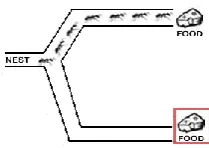
However, if ants select the paths at a probability in proportion to the pheromone concentration, the chances of finding new solutions would decrease over time. As can be seen from Figure 1, suppose that there is only one food source in the upper path at the beginning, definitely, all the ants will converge to the upper path, and new ants will make the same choice as well because of the great amount of pheromone laid on the upper path, even when a new food source appears in the lower path. According to Figure 2, there are two food sources in the two paths. The upper food source is nearer to the nest than the lower food source. Accordingly, ants go there and back between the upper food source and the nest more frequent and deposit more pheromone on the upper path. Thus, ants will converge to the upper path eventually. Under both the two circumstances, the ability to find new food sources (solutions) are limited by selection bias and update bias of traditional principles which are illustrated above when solving a concrete problem such as TSP.
Fig. 1. A new food source appears after convergence
Fig. 2. Two food sources in different length of paths
Actually, the advantages that acquired by applying the principles are accompanied by premature convergence and local optimum which are highly criticized. In consideration of this, we intend to explore other principles to overcome these drawbacks. In particular, some research in animal behavior field offers us an alternative way to design new ACO algorithms.
induce either no response or repellency [14]. This is the adaptive behavior of the three Monomorium ant species. They regard paths with moderate amount of pheromone as promising sources and tend to choose them, which seems to run contrary to the traditional principles used in ant algorithms.
In the view of traditional design ideas, ants have a better chance to choose paths with higher pheromone concentration. There are two main reasons that cause the high pheromone. Firstly, if there are numerous ants traveling the same path, it indicates that ants for the food source on the path are enough. Thus, a multitude of ants travel the path and lays a great amount of pheromone on the path. Secondly, if ants can frequently travel the same path, it indicates that the food source on the path is close to the nest and do not require too much ants. In this case, a few ants travel the path frequently and also deposit a great amount of pheromone. Two different behaviors end with the same result. At a deeper level, it involves an important problem to ants, that is, distributing the workforce. Be it sufficient ants selecting a path or ants traveling a path frequently enough, it is unnecessary to allocate more ants to the path whose pheromone concentration is already high enough. Otherwise, it would be a waste of workforce. Therefore, the Monomorium ant species’ adaptive behavior (tend to choose the paths with moderate pheromone concentration) is understandable and reasonable. It equips the ants with the ability to distribute their workforce more probably and efficiently. Inspired by the adaptive behavior of the Monomorium ant species, we develop a novel ACO algorithm -- Moderate Ant System (MAS). In MAS, a new transition rule which can enhance the capability to find new solutions is designed. Furthermore, in order to match the new transition rule and improve the performance of the algorithms, new update rule is designed as well.
3.2. Concrete Algorithm
MAS is an improved version based on AS, differs from AS in search and update strategy (i.e., transition rule and update rule) corresponding to the two main steps of Algorithm 1.
First, actually, the utilization-oriented ants share the same business with that of the ants in most ACO algorithms. This kind of ants mainly concentrates on utilizing the search experience accumulated by the iterative process in previous iterations. They choose the paths with higher pheromone concentration at a higher probability. During the construction of solutions, the utilization-oriented ants make their choices according to the probability distribution given by Equation 1 which is same to the ordinary ants.
Second, the design of exploration-oriented ants is inspired by the Monomorium ant species and is the core of MAS. The utilization-oriented ants perform a biased search and they can choose poor paths (with lower pheromone concentration) but at a low probability. Unlike the utilization-oriented ants, in order to explore more possibilities, the exploration-utilization-oriented ants employ a more aggressive transition rule which is discussed in detail.
The pheromone concentration determines the choices of ants in real world, while in ACO algorithms, the combination of pheromone and visibility determines the choices of ants for the sake of better performance. Here, infoj is used to represent the integrated factors on the path from city i to city j, and infoij is given by:
ij ij ij
info (16)
Drawing on the search strategy of Monomorium ant species, the new transition rule should make the ants tend to select paths with moderate information instead of too much or too little information.
Suppose that ant k is at city i at step t of an iteration. When selecting the next city as part of the solution, ant k has n-t adjacent cities available. According to Figure 3, from city i’s point of view, the information values on the n-t adjacent paths can be regarded as a stochastic variable follow a normal distribution N(μ,σ2) since n in TSP is usually a big enough number.
Fig. 3. n-t choices of an ant at city i at step t
The parameters of N(μ,σ2) are estimated as follow:
tabuk
j ij
info t
n 1
tabuk
j ij info t n 2 2 ) ( 1 (18)
In addition, attractionij is defined as follows:
otherwise tabb j if e attraction k info ij ij 0 2 1 2 2 2 ) ( (19)
Which denotes the attraction of path from city i to city j for the exploration-oriented ants in MAS. If let k be an ant located on city i, q0[0, 1] be a parameter, and q be a random variable uniformly distributed in [0, 1], then the exploration-oriented ants will choose the next city j according to Eq.(20) with q ≤q0, else Eq.(19) is used.
1 arg max
0
k
j tabu ij k
ij
if j arrtration
p otherwise , , (20)
With probability q0, the exploration-oriented ants select the most moderate path in terms of attraction, while with probability (1- q0), the exploration-oriented ants incline to select the more moderate paths but have a chance to select other paths.
The number of the utilization-oriented ants and the number of the exploration-oriented ants are important parameters of MAS. Tuning their numbers can affect the degree of utilization and exploration (i.e. decide whether to attach more importance to utilizing the learned search experience or exploring new solutions). If there are far more exploration-oriented ants than utilization-oriented ants, the algorithm is about to lose the benefit brought by the iterative process on the basis of relatively good solutions and achieve poor performance.
Update strategy of MAS. In order to achieve the greatest effect of our new transition rule, the counterpart update strategy is designed and employed in MAS. The update strategy in MAS consists of two parts: the evaporation of pheromone trails and the accumulation of pheromone trails. The evaporation lessens the pheromone value on paths while the accumulation adds the pheromone value on paths.
In MAS, similar to the phenomenon in the real world, the pheromone on all of the paths evaporates over the time, which is implemented by:
0 ) ( ) 1 ( ) ( '
ij t ij t (21)
avoid unlimited accumulation of the pheromone trails. Moreover, if a path does not gain extra pheromone in several consecutive iterations, its corresponding pheromone concentration decreases rapidly until the pheromone trail value is equal to τ0.
After evaporation, the accumulation of pheromone trails is performed. Not all of the paths gain extra pheromone. As in ASrank, only paths belonging to the best nb-1 solutions in an iteration are given extra pheromone in MAS and the amount of extra pheromone that paths gain depends on the rank of solutions. The better the rank is, the more pheromone paths of the solutions gain. These paths are provided with strong additional reinforcement and in the following iterations will attract more utilization-oriented ants. However, the update rule is quite different from that of ASrank, which is given by:
1
1
)) ( ' (
) ( ' ) 1
( b
n
ij ij b b ij
ij t
n n t
t
(22)
It means that nb-1 ants (be it utilization-oriented ants or exploration-oriented ants) will deposit extra pheromone to the paths they visited at the current iteration. It is notable that these nb-1 ants accumulate the pheromone trails one by one and ij(t) is updated at the same time, so ij(t) may differ from ant to ant. Hence, it is easy to prove that the upper bound of the pheromone value on a path is ∆ij. According to our research, using Lgb to calculate ∆ij in MAS achieves better performance than using Lib, especially when MAS is applied to TSP data sets with more than 200 cities.
MMAS employs pheromone limits to prevent the pheromone value on the paths from overly low or overly high, thus, MMAS is able to avoid algorithm stagnation. In particular, MAS implements the similar limits in an implicit manner. The pheromone trails in MAS are guaranteed that (i,j): τ0≤τij≤Δτij, which will contribute to the performance of MAS as well.
Pseudo-code of MAS. On the basis of the designed search strategy and update strategy, as can be seen in Algorithm 2, the pseudo-code of MAS is given.
Algorithm 2 Moderate Ant System
Initialize the parameters and pheromone trails; while termination conditions not satisfied do begin
Step 1:
For each utilization-oriented ant
Construct a solution according to Eq. 1. End For
For each exploration-oriented ant
Construct a solution according to Eq. 19, 20. End For
Step 2:
For all the paths
End For
For the paths belonging to the nb best solutions
Update the pheromone trail use Eq. 22. End For
end while; end.
4.
Experimentation
To show the performance of MAS and compare it with other ACO algorithms (i.e., AS, ASelite, ASrank, MMAS, and ACS), these experimentations are completed that based on the TSPLIB’s data sets (http://www.iwr.uni-heidelberg.de/groups/comopt/software/TSPLIB95/).
4.1. Data Sets Used
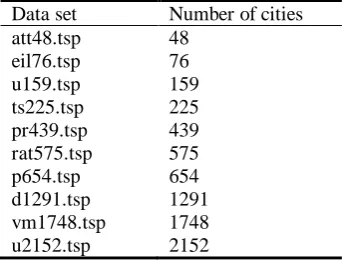
In the following experimentations, 10 test data sets are employed. Table 1 illustrates the data sets and their size used in the experiments.
Table 1. TSP test data sets
Data set Number of cities
att48.tsp 48
eil76.tsp 76
u159.tsp 159
ts225.tsp 225
pr439.tsp 439
rat575.tsp 575
p654.tsp 654
d1291.tsp 1291
vm1748.tsp 1748
u2152.tsp 2152
4.2. Parameters Setup
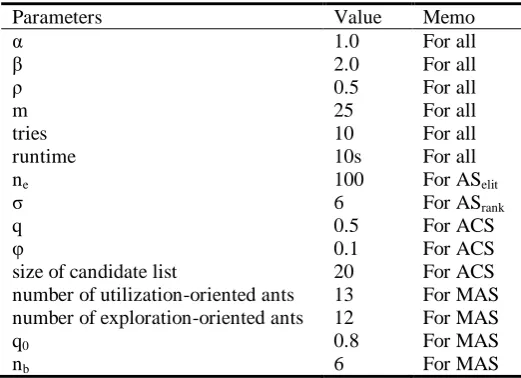
Our experimentation is based on ACOTSP which offers a high-quality implementation of various ACO algorithms for TSP [20]. With the common code, MAS is developed and compared in the same framework. And the parameters adopted in the experimentation are the default parameters set in ACOTSP. The main parameters used in the experiments are set as shown in Table 2.
algorithm 10 times, respectively. And in each try, the maximum runtime is set to 10 seconds. Because ACO algorithms are iterative algorithms, the runtime should not be too short. 10 seconds is an acceptable time for most application and the obtained results are relatively stable. And we also do the experiments with runtime set to 15s and 20s, however, the difference of solutions’ quality over the three runtimes is quite small, not greater than 0.5%. In addition, in order to examine the usefulness of our new search strategy and update strategy, local search is not employed in all tested algorithms.
Table 2. Main parameters
Parameters Value Memo
α 1.0 For all
β 2.0 For all
ρ 0.5 For all
m 25 For all
tries 10 For all
runtime 10s For all
ne 100 For ASelit
σ 6 For ASrank
q 0.5 For ACS
φ 0.1 For ACS
size of candidate list 20 For ACS
number of utilization-oriented ants 13 For MAS
number of exploration-oriented ants 12 For MAS
q0 0.8 For MAS
nb 6 For MAS
4.3. Experimental Results
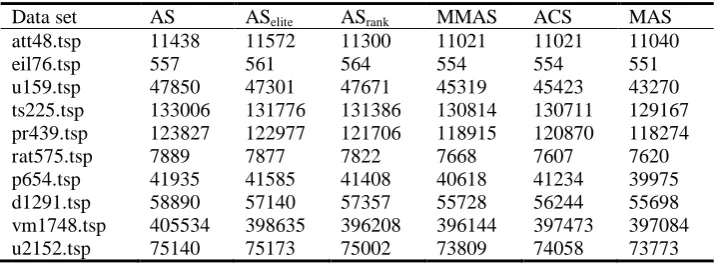
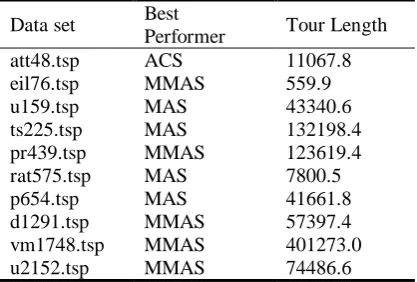
The results obtained are presented in Table 3 and Table 4. Table 3 illustrates the shortest tour lengths (best solutions in 10 tries) obtained by the six tested ant algorithms on the 10 test data sets, while Table 4 illustrates the average tour lengths (average solutions of 10 tries) obtained by the six tested ant algorithms on the test data sets. Table 5 and Table 6 give the results of the best performer for each algorithm regarding the shortest tour and the average tour, respectively.
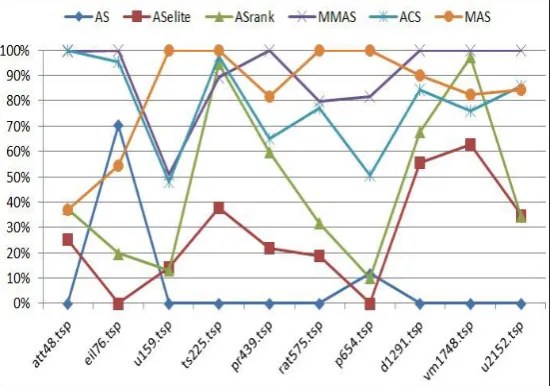
In order to show the performance of different ACO algorithms more clearly, Relative Solution Quality (RSQ) of algorithm A, achieved on data set D, is defined as follows:
% 100 ) 1
(
,
Best Worst
Best solution
RSQDA A (23)
shortest tour length or average tour length) obtained by the six tested ant algorithms, and Worst denotes the worst solution (the shortest tour length or average tour length) obtained by the six tested ant algorithms. Obviously, the greater the value of RSQ is, the better the solution.
Given the definition of RSQ, two line graphs are created. According to Figure 4, the RSQ of MAS stabilizes at 100% or very close to 100%. To be more exact, MAS obtains the best solution on all data sets except att48.tsp (RSQ= 96.55%), rat575.tsp (RSQ= 95.39%) and vm1748.tsp (RSQ= 89.99%). MMAS and ACS are commonly regarded as very effective ACO algorithms. Both of them achieve good performance but second to MAS in terms of finding the shortest tour. As shown in Figure 5, in terms of average solution quality, MMAS performs best. MAS also obtains decent average solutions. Specifically, MAS get best average solutions in four TSP data sets. And it performs better than ACS and only second to MMAS. By comparison, AS’s performance is the poorest regarding both the best solutions and the average solutions.
Table 3. The shortest tour lengths obtained
Data set AS ASelite ASrank MMAS ACS MAS
att48.tsp 11438 11572 11300 11021 11021 11040
eil76.tsp 557 561 564 554 554 551
u159.tsp 47850 47301 47671 45319 45423 43270
ts225.tsp 133006 131776 131386 130814 130711 129167
pr439.tsp 123827 122977 121706 118915 120870 118274
rat575.tsp 7889 7877 7822 7668 7607 7620
p654.tsp 41935 41585 41408 40618 41234 39975
d1291.tsp 58890 57140 57357 55728 56244 55698
vm1748.tsp 405534 398635 396208 396144 397473 397084
u2152.tsp 75140 75173 75002 73809 74058 73773
Table 4. The average tour lengths obtained
Data set AS ASelite ASrank MMAS ACS MAS
att48.tsp 11889.3 11682.3 11581.7 11071.7 11067.8 11584.8
eil76.tsp 567.9 586.8 581.5 559.9 561.2 572.2
u159.tsp 49168.4 48348.6 48396.2 46208.5 46378.9 43340.6
ts225.tsp 135751.7 134408.1 132394.3 132575.9 132289.4 132198.4
pr439.tsp 126033.8 125511.9 124594.4 123619.4 124463.8 124065.4
rat575.tsp 7950 7921.8 7902.6 7830.9 7834.7 7800.5
p654.tsp 42682.7 42818.6 42700.6 41873.2 42233.9 41661.8
d1291.tsp 59487.7 58324.2 58073.3 57397.4 57725.6 57605.1
vm1748.tsp 409406.6 404314.6 401487.7 401273.0 403220.4 402692.3
u2152.tsp 76209.4 75608.9 75621.3 74486.6 74733.5 74759.0
Table 5. Results of best performers in terms of the shortest tour
Data set Best
Performer Tour Length
att48.tsp MMAS, ACS 11021
eil76.tsp MAS 551
u159.tsp MAS 43270
ts225.tsp MAS 129167
pr439.tsp MAS 118274
rat575.tsp ACS 7607
p654.tsp MAS 39975
d1291.tsp MAS 55698
vm1748.tsp MMAS 396144
u2152.tsp MAS 73773
Table 6. Results of best performers in terms of the average tour
Data set Best
Performer Tour Length
att48.tsp ACS 11067.8
eil76.tsp MMAS 559.9
u159.tsp MAS 43340.6
ts225.tsp MAS 132198.4
pr439.tsp MMAS 123619.4
rat575.tsp MAS 7800.5
p654.tsp MAS 41661.8
d1291.tsp MMAS 57397.4
vm1748.tsp MMAS 401273.0
Fig. 4. Best solutions obtained by the tested algorithms. The data sets are sorted by the size in ascending order.
5.
Conclusion
This paper discussed the shortcomings of several main ACO algorithms which often get in trouble in local optimum and premature convergence when searching the optimum solution owing to the selection bias and update bias. To overcome these obvious defects, we propose a new ACO algorithm named Moderate Ant System. In MAS, the ordinary ants are divided into two groups, the utilization-oriented ants and the exploration-oriented ants. As for the exploration-oriented ants, taking inspiration from the adaptive behavior of the Monomorium ant species, a novel transition rule is designed and adopted by the exploration-oriented ants. The new transition rule requires a little more time and space, but the extra overhead is linear complexity. Moreover, we also design new update rules to match MAS’s search strategy. Taking TSP as an example, ten standard TSP test data sets are employed to examine the performance of MAS algorithm in the experiments. As a result, MAS does achieve our design intent and conquer the known defects to some extent. Overall, the best solution of MAS is better than that of other ant algorithms at the expense of slightly losing the average solution quality.
In the future work, more thorough experimentation and further investigation into MAS algorithm are required in order to explore more characteristics of MAS and perfect the performance of MAS. Moreover, we are planning to apply MAS to other classical problems and give a further study about the performance of MAS.
References
1. R. Demontis, “A simple NP-hard problem”, ACM SIGACT News, vol. 40, no. 2, pp. 45-48, 2009.
2. D. S. Hochba, “Approximation algorithms for NP-hard problems” ACM SIGACT News, vol. 28, no. 2 , pp. 40-52, 1997.
3. K. Socha, and M. Dorigo, “Ant colony optimization for continuous domains,” European Journal of Operational Research, vol. 185, no. 3, pp. 1155-1173, 2008. 4. Z. Wu, N. Zhao, G. Ren, T. Quan, “Population declining ant colony optimization
algorithm and its application”, Expert Systems with Applications, vol. 36, no. 3, pp. 6276-6281, 2009.
5. M. Dorigo, M. Birattari, and T. Stützle, “Ant colony optimization,” Computational Intelligence Magazine, IEEE, vol. 1, no. 4, pp. 28-39, 2006.
6. O. Cordon, F. Herrera, and T. Stützle, “A review on the ant colony optimization metaheuristic: basis, models and new trends,” Mathware & Soft Computing, vol. 9, pp. 141-175, 2002.
7. B. Chandra Mohan, R. Baskaran, “A survey: Ant Colony Optimization based recent research and implementation on several engineering domain”, Expert Systems with Applications, vol. 39, no. 4, pp. 4618-4627, 2012.
9. M. Dorigo, and G. Di Caro, “Ant colony optimization: a new meta-heuristic,” Proceedings of the 1999 Congress on Evolutionary Computation, Washington, DC, July, 1999.
10. Uğur, D. Aydin, “An interactive simulation and analysis software for solving TSP using Ant Colony Optimization algorithms”, Advances in Engineering Software, vol. 40, no. 5, pp. 341-349, 2009.
11. M. Dorigo, V. Maniezzo, and A. Colorni, “Ant system: optimization by a colony of cooperating agents,” IEEE Transactions on Systems, Man, and Cybernetics, Part B: Cybernetics, vol. 26, no. 1, pp. 29-41, 1996.
12. S. M. Chen, C. Y. Chien, “Solving the traveling salesman problem based on the genetic simulated annealing ant colony system with particle swarm optimization techniques”, Expert Systems with Applications, vol. 39, no. 12, pp. 14439-14450, 2011.
13. R. J. Mullen, D. Monekosso, S. Barman, and P. Remagnino, “A review of ant algorithms,” Expert Systems with Applications, vol. 36, no. 6, pp. 9608-9617, 2009.
14. M. A. Mashaly, “Monomorium ant's trail pheromones: Glandular source, optimal concentration, longevity and specificity,” Journal of Asia-Pacific Entomology, vol. 13, no. 1, pp. 23-26, 2010.
15. Bullnheimer, R. F. Hartl, and C. Strauss, “A new rank-based version of the Ant System: a computational study,” Central European Journal for Operations Research and Economics, vol. 7, no. 1, pp. 25-38, 1999.
16. T. Stützle, and H. H. Hoos, “MAX-MIN ant system,” Future Generation Computer Systems, vol. 16, no. 8, pp. 889-914, 2000.
17. M. Dorigo, and L. M. Gambardella, “Ant colony system: a cooperative learning approach to the traveling salesman problem,” IEEE Transactions on Evolutionary Computation, vol. 1, no. 1, pp. 53-66, 1997.
18. M. Dorigo, and T. Stützle, Ant Colony Optimization. Cambridge: The MIT Press, 2004, pp. 76-80.
19. O. Baskan, S. haldenbilen, H. Ceylan, H. Ceylan, “A new solution algorithm for improving performance of ant colony optimization”, Applied mathematics and computation, vol. 211, no. 1, pp. 75-84, 2009.
20. T. Stützle, ACOTSP, Version 1.0. Available from http://www.aco-metaheuristic.org/aco-code, 2004.
Ping Guo (b. September 7, 1963) received his M.Sc. (1989) and PhD (2004) in Computer software and theory from Chongqing University. Now he is full professor of Computer Science at School of Computer Science, Chongqing University, China. His current research interests include different aspects of Artificial Intelligence and Biological computing model. He has (co-) authored 1 books and more than 130 papers.
Zhujin Liu (b. November 30, 1986) received her M.Sc. (2012) in Computer science and technology from Chongqing University of Chongqing. Now he is an engineer of access network in Huawei Company. His current research interests include multicast, gpon and Qos. He has (co-) authored more than 5 papers.