© 2016 IJSRSET | Volume 2 | Issue 2 | Print ISSN : 2395-1990 | Online ISSN : 2394-4099 Themed Section: Engineering and Technology
On Demand Routing Protocol Compression Based On the Energy Consumption
and Routing Load Presence in Different Network Condition
Margam Suthar
Assistant Professor, Post Graduate Research Centre for Mobile Computing and Wireless Technologies, Gujarat Technological University, Chandkheda, Ahmedabad.Gujarat.
ABSTRACT
Mobile Ad hoc Network are defined by multi hope technology that doesn’t have a fixed infrastructure and such infrastructure change rapidly with the time. Movement in the network due to the link failure and node movement happened due to the congestion in the network. Mobile node operates with the power sources. Due to the infrastructure change rapidly in the wireless network there are many routing algorithms are developed so far. But in our analysis we focus on two on-demand routing protocol namely AODV and DSR. These protocol are also called as reactive routing protocol, it find route path when source wants to send packets to the destination. In this protocol first route has been establish then transmission of packet will be done and establish route path valid until the transmission has been done. In this paper, we use NS2 to compare routing load and energy consumption in the network using AODV and DSR routing protocol at different number of node presence in the network.
Keywords: AODV (Ad-hoc On-demand Distance Vector), AWK (Aho Weinberger Kernighan), ACK (Acknowledgement) and Dynamic Source Routing protocol (DSR)
I.
INTRODUCTION
A mobile ad hoc network is a group of mobile node that communicate with each other via wireless channels. In mobile ad hoc network have no fixed infrastructure so nodes are move randomly in the network. Within radio range nodes are communicated directly with each other, while the other remote nodes are dependent on its neighbouring node to make communication path between the sender and receiver. In ad hoc network data packets are transmitted in a store and forward mode from source to destination through the intermediate node. In wireless network there are not defined based station so every node in network are act as the routers. Due to this behaviour wireless network have many challenges and issues in the implementation of network. To transmit data in the network we require establishing path between sender and receiver. So, the process of establish path in network is called routing. In routing basically two process involves first is to find shortest path and second is to transfer data between sender and receiver. To find shortest path many protocol available. In wireless network node are moving around everywhere in the network and with this condition it is difficult to find
shorted path between sender and receiver. So, routing protocol determine the specific path for the route.
II.
ROUTING PROTOCOLS
Wireless network has some limitation like; power consumption, bandwidth, error rate and mobility of network etc. For a wired network, all nodes are connected to each other but in a case of the wireless network all nodes sender as well as a receiver are mobile and they are connected to each other based on demand. Router in the wireless are managed the packet path to reach the destination. So due to this reason routing protocol used in a wired network cannot be directly used for the wireless network.
the shortest path. Such path recorded in router table until all transition completed by a sender.
Ad hoc routing protocol is classified into three categories.
(1) Proactive Routing Protocol (Table driven routing protocol)
Example: DSDV, GSR and OLSR
(2) Reactive Routing Protocol (On Demand routing protocol)
Example: AODV, DSR and TORA (3) Hybrid Routing Protocol
Example: ZRP
AD-HOC ON-DEMAND DISTANCE VECTOR ROUTING (AODV)
A wireless network requires mobile mode without establishing fix route between the node and self-starting and route packet to the destination. In wireless networks are not require fixed establish a route between nodes after active communication. AODV routing protocol is the Ad hoc on demand routing protocol that makes the route between node when to require to send data and it disconnect the route when the active communication over.
AODV define three type of message to route the packet in the network. (1) Route Requests (RREQs) (2) Route Replies (RREPs) and (3) Route Errors (RERRs)
1. Route Requests messages send by a sender to their neighbour node to start to find the destination.
2. Route Replies messages send by the destination node to a sender when the route for the data establish the network.
3. Route Errors messages active means that active route link was broken and/or and miscommunication happen in the network.
the wireless ad hoc network. In DSR, Route Discovery and Route Maintenance each operate entirely “On Demand”. In Particular, unlike other protocol, DSR require no periodic packets of any kind at any layer within the network. For Example, DSR does not use any periodic routing advertisement, link status sensing, or neighbour detection and does not rely on these functions from any underlying protocol in the network. This entirely on demand behaviour and lack of periodic activity allows the number of overhead packets caused by DSR to scale all the way down to zero, when all nodes are approximately stationary with respect to each other and all routes needed for current communication have already been discovered. As nodes begin to move more or as communication patterns change, the routing packet overhead of DSR automatically scales to only what is needed to track the routes currently in use.
III.
ESIMULATION BASED ANALYSIS USING
NETWORK SIMULATIOR (NS-2)
Simulation Tool
In this paper the simulation tool used for analysis is NS-2 which is highly proffered by research communities.NS-2 is a discrete event simulator targeted at networking research. NS provides substantial support for simulation of TCP, routing and Multicast protocol over wired and wireless (Local and satellite) networks.NS2 is an object oriented simulator, written in C++ with an OTcl interpreter as a frontend. This means that most of the simulation scripts are created in Tcl (Tool command language). If the components have to be developed for NS-2, then both TCL and C++ have to be use.
Simulation Setup
IV.
PARAMETER COMPARISON: ENERGY
CONSUMPTION AND ROUTING LOAD
Good Put
Figure 1: Comparison of AODV and DSR Good-put
Table 1: Good Put
No of
Nodes
AODV
DSR
10
0.4485 0.4765
20
0.447 0.4995
30
0.434 0.5065
40
0.4465
0.497
50
0.4355 0.4615
End To End Delay:
Figure 2: Comparison AODV & DSR End to End Delay
Table 2: End To End Delay
Nodes
AODV
DSR
10
0.0892
0.28696
20
0.0716
0.15829
30
0.0607
0.29763
40
0.4597
0.33811
50
0.0681
0.39925
Energy Consumption:
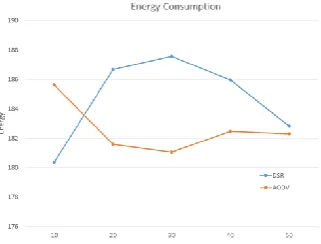
Figure 3: Comparison of AODV and DSR Energy Consumption
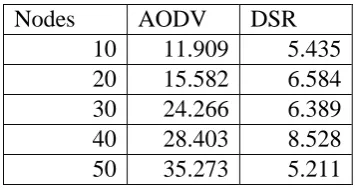
Figure 4: Comparison of AODV and DSR Routing Lode
Table 3: Routing Lode
Nodes
AODV
DSR
10
11.909
5.435
20
15.582
6.584
30
24.266
6.389
40
28.403
8.528
50
35.273
5.211
From Figure 2, Comparison of AODV and DSR Energy Consumption, DSR Energy Consumption increase as a number of node increase in the network compared to the AODV routing protocol. But as shown in fig.5, AODV has the disadvantage that the data packet routing expires in the network. To Control of routing in the network AODV sends many packets and due to this region routing load of AODV increase compare to the DSR.
V.
CONCLUSIONS
As shown in the results, AODV has the disadvantage that the data packet routing expires in a network. Due to this reason AODV send many packets to the control of routing in the network. But on other hand DSR, routing information never expires and also it add more delay to find a destination. Due to this reason DSR use for the small network and for the large network we use AODV
[2]. J.A.G. Garrido, Routing in Wireless Mobile Ad Hoc
Networks: Adaptive Cache Mechanism for
Dynamic Source Routing, Saarbrucken: VDM,
2008.
[3]. Yoo Y, Ahn S, Agrawal DP, “Impact of a simple
load balancing approach and an incentive-based
scheme on MANET performance” Journal of
Parallel and Distributed Computing, Volume: 70 Issue: 2, Pages: 71-83, FEB 2010.
[4]. Josh Broch, David A. Maltz, David B. Johnson, Yih-Chun Hu, and Jorjeta Jetcheva. A
“Performance Comparison of Multi-Hop Wireless
Ad Hoc Network Routing Protocols. In
Proceedings of the Fourth Annual ACM/IEEE International Conference on Mobile Computing
and Networking” (MobiCom’98), pages 85–97,
Dallas, TX, October1998 ACM.
[5]. Information Sciences Institute, “The Network
Simulator – ns- 2”, June 2004,
<http://www.isi.edu/nsnam/ns/>
[6]. David B. Johnson, David A. Maltz and Yih-Chun Hu, "The Dynamic Source Routing Protocol for
Mobile Ad Hoc Networks (DSR)", RFC 4728,
February 2007.
[7]. Charles E. Perkins, Elizabeth M. Royer, Samir R. Das and Mahesh K. Marina, “Performance Comparison of Two On-Demand Routing Protocols for Ad Hoc Networks”, IEEE Personal Communications magazine 2001.
[8]. Rachit Jain, Naresh B. hairnar, Laxmi Shrivastava, “Comparative Study of Three Mobile Ad-hoc Network Routing Protocols under Different Traffic Source”, International Conference on Communication and Network Technologies,IEEE2011
[9]. Asma Tuteja1, Rajneesh Gujral, Sunil Thalia, “Comparative Performance Analysis of DSDV, AODV and DSR Routing Protocols in MANET using NS2”, International Conference on Advances in Computer Engineering, IEEE2010
[10]. Dhananjay Bisen, Preetam Suman, Prof. Sanjeev Sharma and Rajesh Shukla, “Effect of Pause Time on DSR, AODV and DYMO Routing Protocols in MANET”, Manuscript received November 20, 2009.
characteristics of aqm schemes in qos-enabled networks” computing and informatics, vol. 22, [14]. 2003, 317–335 September 2004; revised 15
November 2004.
[15]. Sukant kishoro bisoy and Sunil kumar Mohapatra, “Simulation analysis of active queue management for internet congestion control”, special issue of international journal of computer applications (0975 – 8887) international conference on computing, communication and sensor network (ccsn) 2012.
[16]. E. Alessio, M. Garetto, R. Lo Cigno, M. Meo, M. Ajmone Marsan,” Analytical Estimation of Completion Times of Mixed NewReno and TahoeTCP
[17]. Connections over Single and Multiple Bottleneck Networks”, Dipartimento di Elettronica – Politecnico di Torino,IEEE 2001.
[18]. Qutaiba Razouqi, Ahmed Boushehri, Mohamed Galallah, Lina Alsaleh, “Extensive Simulation Perfomance Analysis for DSDV, DSR, AODV [19]. MANETRouting Protocols”, International
Conference on Advanced Information Networking and Application Workshops, IEEE2013