TDCM: An IP Watermarking Algorithm based on Two
Dimensional Chaotic Mapping
Wei Liang1, Keshou Wu1,Yong Xie1 and Jiajun Duan2
1
College of Software Engineering, Xiamen University of Technology, 361024, Xiamen, China
{Wliang, kswu, yongxie}@xmut.edu.cn
2 Department of Electrical and Computer Engineering, Lehigh University, 18015, Bethlehem, USA
Abstract. With the rapid development of VLSI (Very Large Scale Integration) circuit, IP (Intellectual Property) protection for reused technology is widely concerned. A watermarking scheme for IP protection is proposed on basis of a two dimensional chaotic mapping model (TDCM). The scheme utilizes a secure and controllable embedding model to compute the aggregation level of physical resource positions and the secure threshold of controllability. A two dimensional chaotic sequence is generated with the control of secure threshold. The first dimensional sequence is used to determine random watermark positions and the second dimensional sequence is to control watermark number in each position. Finally, the watermarks are inserted into corresponding places orderly. The experiments show that the proposed scheme has low resource overhead by comparing with other schemes. The resistance to attacks and robustness of the watermark are encouraging as well.
Keywords: IP watermarking, controllable secure threshold, two dimensional chaotic mapping, Robust.
1.
Introduction
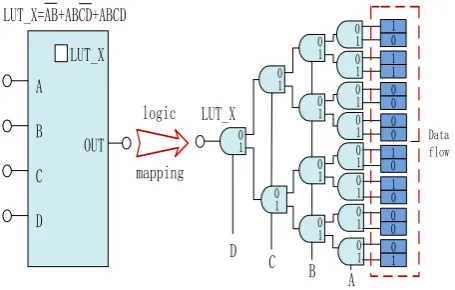
In order to solve security problem of FPGA based IP design, J. Lach’s team [8] firstly proposed the concept of FPGA IP watermark and utilized unused LUTs (Lookup Tables) in FPGA for watermark insertion [9], [10], [11], [12], [13], [14], [15], [16]. The basic flow of the proposed algorithms is shown in Fig. 1, each CLB module in the figure can be set as distributed RAM configuration as well as distributed ROM configuration. The data initialization of distributed ROM configuration is realized by setting corresponding parameters. The most important of CLB is the 4 input function generation LUT. It is eventually used to achieve certain logic function. The data flow information of the matched storage is able to be modified without impacting the performance of IP core when LUT is free and the safety insertion of IP core watermark information is achieved.
LUT_X=AB+ABCD+ABCD A B C D LUT_X LUT_X 0 1 0 1 0 1 0 1 0 1 0 1 0 1 0 1 0 1 0 1 0 1 0 1 0 1 0 1 0 1 A B C D 1 0 1 1 0 0 0 0 1 0 1 1 0 0 0 0 Data flow logic mapping OUT
Fig. 1. The internal logical structure of LUT
In last decade, highly integrated circuits make IP reuse technology be popular since it greatly cuts the cycle of IP design. In company with the popular utilization of IP reuse technology, the reused IP is easily to cause disputes on ownership. Meanwhile, chaos theory is introduced in IP watermarking scheme for its good performance on security. For example, literatures [17], [18] employed logistic mapping to generate a sequence as watermark. Furthermore, the chaotic mapping can be used to scramble image space and the watermarks are then inserted. For its effectiveness on digital watermark, chaotic mapping is widely used in recent IP watermarking schemes [19].
good ability against reverse analysis attacks and noise attacks. It will provide a secure and effective watermarking method for IP protection.
2.
TPCM mathematical models
The model is designed for security of random watermark insertion. The watermark positions may be easily to be determined once the illegal user utilizes resource discreteness analysis. It will bring great threat to security of the watermarked system. Consequently, we design a secure embedding model based on two dimensional chaotic mapping. The model makes the watermarked resources combine with original design resource which achieves better security.
Definition 1: Assume that all CLBs (Configurable Logic Blocks) in FPGA are formed into an array with the size ofm*n . The coordinates of all CLBs are
established. The CLB at coordinate
(
i
,
j
)
is denotedby
C
k,0
k
m
*
n
1
,k
i
*
m
j
. All of the CLBs will be classified accordingto the criterion whether
C
kis used. The resources are divided into two parts, usedresource sequence
C
u and unused resource sequenceC
n.}
,...,
,
{
C
u
u
0u
1u
p1 (1)}
,...,
,
{
Cn
n
0n
1n
q1 (2)Definition 2: The used resources in FPGA has a standard aggregation level
p
0. The average distance of any cellu
k,(
0
k
p
1
)
in used resource sequenceC
u and other cells is denoted as:)
,
(
1
10
j p
j
k
k
D
u
u
p
ud
(3)Since the average distance from a single resource
u
kcannot represent the globalproperty of
C
u. In this case, the average distance will be extended to all resources inu
C
. The standard aggregation levelp
0 is defined as the average distance of the average distances between all resources inC
uto other resources inC
u. The expression is stated as follows:
10 0
1
1
pj i
ud
p
The wave range of
Ud
i is denoted by
p
:2 0 1
0
)
(
1
1
p
ud
p
p
p
j
j
(5)
In definition 2, the aggregation level of used resources in IP design is represented by
0
p
. Before watermark insertion, we need to know not only the aggregation level of original IP design, but also the watermarked positions with the best security andreliability. In theory, if the values of standard aggregation level
p
0 of watermarked IP and original IP are similar, the watermark has high security and strong ability against attacks. But generally, watermark insertion will affect the value of standard aggregationlevel
p
0. Consequently, we introduce the concept of controllable secure threshold in definition 3.Definition 3: Controllable secure threshold
P
is an accepted variation rage of aggregation level of used resources after watermark insertion..
{
p
p
0
p
p
p
0
p
}
(6)The controllable secure threshold
P
represents aggregation level of used resources in FPGA and their variation rage. The threshold can be used to constrain the aggregation level of used resources into the minimum. In this case, the watermarks will be elusive and robust.(1) Firstly, the FPGA design
T
is prepared. The watermarks are ordered as sequenceR
{
t
0,
t
1,
t
2,
,
t
n1}
.n
is the number of elements in watermark sequenceR
.(2) The controllable secure threshold
p
ofT
is calculated with definition 2.p
will be used to constrain watermark positions. It also control the effect on aggregation level after watermark insertion with the standard aggregation levelP
0 and variation rangep
.(3) The location sequence is selected with the constraint, denoted by
} , , , ,
{ 0 1 2 1
I I I In
L . Each element
I
i in sequenceL
is chosen to embed watermark with the random position allocation algorithm and secure watermarkembedding model. The selection procedure of
I
i is as follows:a) Select the resource
I
i{
0
i
n
1
}
according to original watermark embedding algorithm.b) Supposing to add the resource
I
i into used resource sequenceC
u.I
i will bec) The value of
Ud
ican be calculated with expression (5), denoted byp
0. It is the average distance betweenI
i and the used resources in IP designT
.d) Judge to determine whether the calculated
p
win c) satisfies the controllable secure thresholdp
in definition 3.p
p
p
p
p
0
w
0
(7)(4) Generation of watermark positions
The prepared watermark sequence
R
{
t
0,
t
1,
t
2,
,
t
n1}
in step (1) is orderly inserted into the positions in sequence. L{I0,I1,I2,,In1}The watermarked FPGA design is generated, denoted byT
mark.2.1. Two Dimensional Chaotic Mapping Model
Chaos system is a nonlinear dynamical system sensitive to the initial value. For its good randomness, chaos system is widely applied in information security. The Lyapunov exponent is used to describe the nonlinear feature of chaotic map [21], [22], [23]. The number of Lyapunov exponent is consistent with the dimension of system. The system with one Lyapunov exponent great than zero can be called as chaotic system and with more than two Lyapunov exponent great than zero can be called as hyper chaotic system. It is of significance that Lyapunov exponent can describe the instability of chaotic system accurately. Large Lyapunov exponent represents the system is more instable. In this case, the feature of chaotic system is close to random.
The model utilizes the randomness of chaotic system and embeds watermarks into IP circuit in a secure way. The illegal user is hard to analyze the ownership information by analysis attacks.
Definition 4: Two dimensional chaotic mapping can be denoted by two dimensional nonlinear equations. The expressions are as follows:
)
,
(
)
,
(
2 1 1 1 n n n n n ny
x
f
y
y
x
f
x
(8)
f
1(
x
n,
y
n)
,f
2(
x
n,
y
n)
can be represented by the following expressions.
n n n n n n n n n n n n n n n ny
x
a
y
a
y
a
x
a
x
a
a
y
x
f
y
x
a
y
a
y
a
x
a
x
a
a
y
x
f
12 2 11 10 2 9 8 7 2 6 2 5 4 2 3 2 1 1)
,
(
)
,
(
(9)
The coefficient
a
i(
i
1
,
2
,
3
,...,
12
)
in (10) is constant.a
i is a key factor to determine Lyapunov exponent in two dimensional chaotic system. In this case, thedimensional chaos has more complex timing sequence by comparing with one dimensional chaos. It will lead to the time increase of chaotic mapping and affect the
requirement of real time. In this paper, we select a group of coefficients
a
iin literature [18] to achieve a two dimensional chaotic system. The procedure shows as follows:(1) Select a system with large Lyapunov exponent (denotes the system is the most instable) as the chaotic mapping function for watermark insertion, that is:
n n n n n ny
a
x
a
a
y
y
a
x
a
x
10 9 7 1 4 2 1(20)
Here, a2 0.95,a4 1.55,a7 0.45,a92.4 and a101.05.
(2) Determine a pair of keys as the initial key of the two dimensional chaotic system.
The two dimensional chaotic sequence
w
{
w
0,
w
1,...
w
n1}
is calculated with theexpression in (10). Here, n is large enough. Each element in Wconsists of
i
x and yi, that is
w
(
x
i,
y
i)
,0
i
n
1
.(3) Assume that the binary sequence of watermark is denoted by
}
,...
,
{
0 1 1
mark Lr
r
r
R
with the length ofL
mark. The element in generated sequenceWis meaningless real number. So it should be first transformed into integrated number. The element Wi is transformed into binary number {0,1}. Then the binary chaotic sequence is divided by
m
. Each group withm
bits will be further transformed intodecimal number. After all transformation, a decimal
sequence { , , ,... }
1 2 1
0
z z z zp
Z is generated and each element
) ,
( i i
i
z ( 0i p1 ).
i and
i are decimal number, satisfying
1 0 p i i markL . The sequence
Z
can be classified into two sequences with differentdimension,
{
0,
1,
2,...
p1}and {0,1,2,...p1} respectively.
is used to control watermark embedding positions and
is a constraint to limit watermark length in each position.(4) According to the length of sequence Z and
i inz
i, the watermark sequenceR
is grouped and the grouped sequence is obtained. The bit number of each element)
1
,...,
2
,
1
,
0
(
p
g
i is consistent with that of
i inz
i.3.
Robust IP Watermarking Algorithm based on Two
Dimensional
The two dimensional chaotic mapping is employed to achieve better security. Definition 3 gives the definition of controllable secure threshold. It is used as a constraint for the selection of watermark positions. An IP watermarking algorithm based on two dimensional chaotic mapping is proposed. Finally, the watermark embedding and extraction are performed on basis of the proposed algorithm.
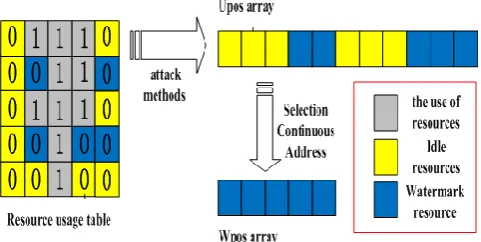
As secret key is employed to control the position where IP watermark information is embedded in real time, design of its sequence directly determines the concealment of watermark position. In the process of secret key generation discussed in this paper, we consider the following scenario: It may easily attract the attention of an adversary and increase the chances of exposure to attacks if the generated secret key is not dispersedly distributed and instead positioned closely to the original watermark. Therefore, it is an essential aspect of robustness of watermark methods to devise an effective security strategy that distribute generated secret key as dispersedly and far away from the original watermark as possible. As depicted in Figure 2, we introduce our secret key generation algorithm from three perspectives that guarantees secure use of secret key, including resource searching, resource recording, as well as secret key generation.
(1) Resource searching. All CLB matrices used in FPGA design are read as an entirety. Then, LUT resources inside CLB matrices are scanned using probes. Based on architectural characteristics of FPGA devices, CLB matrices can be traversed in a zig-zag fashion to ensure every single LUT is visited.
(2) Resource recording. In parallel to resource searching, each CLB matrix is accompanied with a two-dimensional matrix which keep track of the utilization of LUT, using 0 to mark free LUTs and 1 to mark used ones.
Fig. 2. Schematic diagram of the structure of the key generation
two-dimensional chaotic mappings. Finally, we will be able to save selected address information Wpos into bit-files.
3.1. Watermark Embedding
The embedding algorithm utilizes the feature of LUT in FPGA. The controllable secure model is proposed to constrain the watermark positions. In this paper, DES encryption algorithm is introduced to encrypt watermark information. The encrypted information is further hashed. Since hash is irreversible, watermark extraction can only verify whether the watermark exists. The original watermark information cannot be recovered from watermarked IP design
T
mark. The algorithm shows as Fig. 3:Search algorithm bitfile
Locations of unused LUTs the sequence Z
Two Dimensional Chaotic Mapping
Primary Watermarks R
the sequence G the sequence β
A
Safety control Threshold P
Watermarked IP core bitfile design Execute searching
Fig.3. The flow of watermark embedding
Step 1: Preprocess watermark information. The original watermark information
S
is preprocessed to get sequenceR
. This procedure is divided into two parts. Firstly, the watermark informationS
is encrypted by DES algorithm. After that, the cipher text is hashed and the message is regarded as watermark. The binary sequence of watermark isdenoted by
R
{
r
0,
r
1,...
r
Lmark1}
.r
i(
i
0
,
1
,
2
,...,
L
mark
1
)
is the ith bit value
mark
L
,T
markrepresents the length of watermark bits.Step 3: Select initial key
k ey
and generate two dimensional chaotic sequenceZ
.The
key
is used as the initial key of two dimensional chaotic system. With the controllable secure threshold Pand requirement in definition 3,a chaotic sequenceZ
satisfying the requirement is selected.
Z
consists of
and
,respectively for controlling watermark positions and watermark bits. Since the generation ofZ
is limited by the secure thresholdP
, a part of sequence that cannot satisfy the requirement is removed. The removed items are written in mapping log file for recovery ofZ
in watermark extraction.Step 4: The watermark sequence
{
0,
1,..,
1}
mark
L
r
r
r
R
is divided and transformed intosequence G{g g g0, 1, 2,..gp1}with the sequence {0,1,2,...,p1}. The bit number of each element is consistent with the length of i(0,1, 2,...,p1).
Step 5: All elements in sequence G{g g g0, 1, 2,..gp1} are orderly inserted into positions in sequence
α
{
α
0,α
1,
α
2,...,
α
p1}
.The watermarked FPGA design isgenerated and denoted by
T
mark .3.2. Watermark Extraction
When the IP ownership is suspected to be infringed, the IP owner can extract and verify the watermarks in the design for ownership proof. The procedure is stated as follows.
Step 1: With the initial key
k ey
of two dimensional chaotic mapping and themapping log file, the chaotic sequence
Z
can be recovered.Step 2: The grouped sequence
G
is extracted in designT
mark by using the positionscontrolling sequence { , ,..., }
1 2
1 ,
0
p
. Then, the watermark sequenceR
canbe recovered according to sequence
{
0,
1,
2,...,
p1}.Step 3: According to the procedure in step 1 of watermark embedding, the original watermark information
S
is preprocessed to get sequenceR
.Step 4: The generated sequence
R
in step 3 is compared with that in step 2. If they are equal, the ownership verification is successful; otherwise, it is failure.4.
Experiments and Analysis
4.1. Resource Overhead Analysis
In watermark embedding procedure, original watermark information is encrypted by DES algorithm and then hashed. The data can be compressed by using Hash algorithm. Consequently, despite the length of original watermark, the hashed result is 128bit constantly. The resource overhead will not increase when the length of watermark bits is great than 128. The watermark volume is improved. With the proposed algorithm, the length of watermark bits is unlimited.
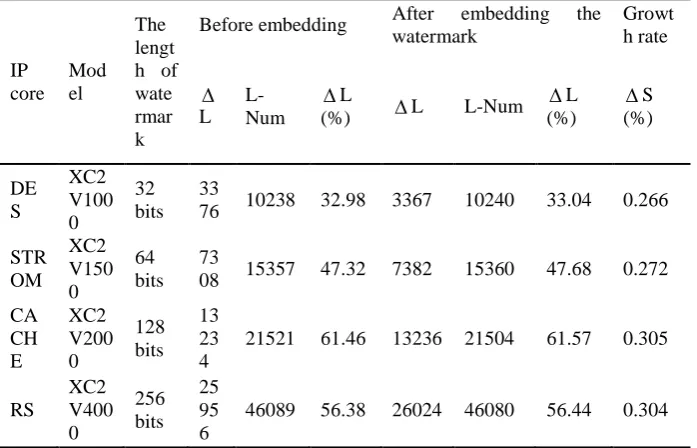
Table 1. IP watermarking performance indexes in resource utilization and growth
IP core Mod el The lengt h of wate rmar k
Before embedding After embedding the watermark Growt h rate L L-Num L
(%) L L-Num
L (%) S (%) DE S XC2 V100 0 32 bits 33
76 10238 32.98 3367 10240 33.04 0.266
STR OM XC2 V150 0 64 bits 73
08 15357 47.32 7382 15360 47.68 0.272
CA CH E XC2 V200 0 128 bits 13 23 4
21521 61.46 13236 21504 61.57 0.305
RS XC2 V400 0 256 bits 25 95 6
46089 56.38 26024 46080 56.44 0.304
Table1 records some performance indexes in resource utilization and growth.
L
is the total number of utilized LUTs. L-Num represents the total number of LUTs in FPGA device.
L
(%)
denotes the rate of utilized LUTs and
S
(%)
is the growth rate of utilized resource after watermark insertion. The growth rate of utilized resource is constantly close to 0.3% after embedding watermark, which satisfies the requirements resource overhead. Since the proposed algorithm utilizes unused LUTs for watermark insertion, the watermark will lead to increase of resource overhead. However, the watermarked resources will not be accessed when the system is running. Therefore, the power overhead will not increase. The experiments show that the proposed algorithm has good performance on resource overhead and power consumption.also calculated. Meanwhile, we analyze the resource variation and the resource aggregation is better.
(a) Resource distribution of original RS IP design
(b)Resource distribution of watermarked RS IP design
Fig.4. Resource distribution of RS IP designs
4.2. Robustness
In section 2, a concept of standard aggregation level
p
0 of utilized resources in designis proposed and controllable secure threshold
p
is also defined.p
is used as constraint to limit the watermarks around the functional resources. In this way, the watermarks are hard to be removed and destroyed. So the robustness is strengthened. Furthermore, the use of two dimensional chaotic mapping has good effects to improve watermark randomness and security.To evaluate the practical effect of the proposed secure model, we conduct experiments on watermark robustness. Two types of FPGA device are selected, respectively XC2V2000 and XC2V4000. The target IP cores [24] are aes_dec and rs_dec4. We insert the original watermark information “Test IPMark” into IP designs with two watermark embedding algorithm. With the performance testing module in platform implemented by VC language, the resource distributions in original design and watermarked design are compared, as shown in Fig. 5(a)(b).
places. The standard aggregation level
p
0 after embedding watermark differs with thatof the original design. It will bring great threat to watermark security and robustness. Consequently, In Fig. 5(b), we propose a secure watermark embedding model to guarantee better security and robustness.
(a) General watermark embedding
(b) Watermark embedding under control of
p
Fig.5. The resource distribution of rs_dec4 (XC2V4000)
4.3. Security Analysis
Ability against Reverse Analysis Attacks. In the proposed two dimensional chaotic mapping based IP watermarking scheme, the watermarks insertion can be implemented by configuration of logic function. It is difficult for illegal attackers to get logic function in programmable logic circuit by reverse analysis attacks. To perform reverse analysis attacks, they should firstly obtain all configuration data of FPGA design. There are two ways to get configuration data generally. One is to steal the bit stream and another one is to read configuration data in RAM by using micro-probe.
With the way of stealing bit stream, attackers need to import the programmable data in every time of system booting. The way makes it possible to analyze circuit function from bit stream. In our proposed scheme, a stabilized power is used to keep the information in storage nonvolatile. The configuration data is no need to be imported again in system booting. In this case, the attackers cannot steal the bit stream of IP circuit.
Besides the way of stealing bit stream, attackers may use micro-probe to read configuration information in RAM. Therefore, the RAM units and the output signal in our scheme are set at the low level of chip. The attackers cannot probe related configuration logic by micro-probe. Consequently, IP circuits with our proposed watermark scheme has good ability against reverse analysis through stealing bit stream, especially reverse analysis on layout.
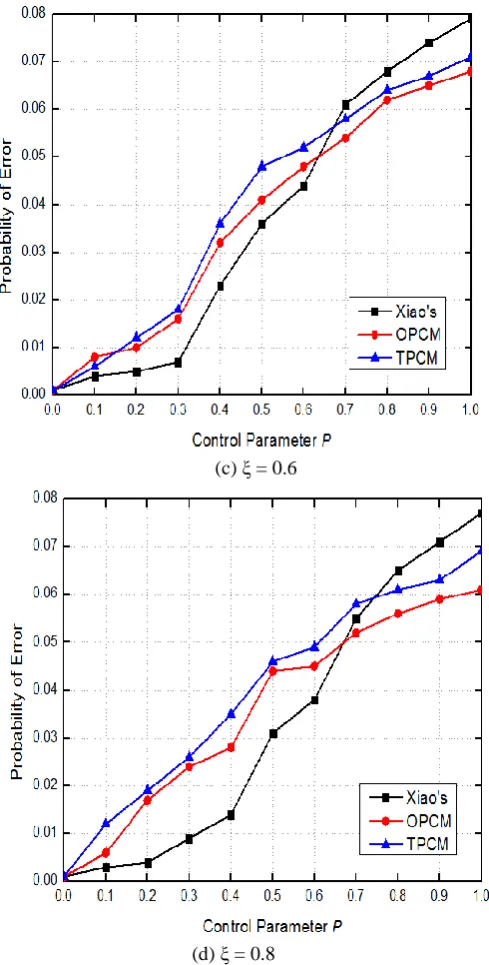
The noises in above experiments are Gaussian noise. In following experiments, we focus on noise attacks of GGD type and MSS type. The noise intensity is denoted by P, 0<P<1. Fig. 6(c) compares the proposed scheme with the method based on one dimensional chaotic mapping (ODCM).The experimental results in Fig. 6(c) show that the performance of ODCM against GGD noise attack is low with the increase of P. The reason is that the position aggregation parameter becomes small after suffering GGD noise attacks when P increases. In this case, the error probability of IP circuit increases correspondingly. In Fig. 6(d), when P becomes larger, our scheme has better ability against MSS noise attack by comparing with that in literature [30].
(a) ξ = 0.2
(c) ξ = 0.6
(d) ξ = 0.8
5.
Conclusions and further work
This paper is focused on the intellectual protection problem of the very large integration circuit and a novel algorithm which is suitable for the IP protection of integration circuit has been proposed. The presented method utilized the two-dimensional chaotic encryption to design the safety hidden modal of intellectual property core, and then applied it on the intellectual property core algorithm which is based on the idea of two dimensional chaotic scrambling. The contributions of this paper are as follows.
1) Define the aggregation degree of the resources of physical location in the intellectual property core by safety hidden mathematical modal, and then make the prediction of the used resources aggregation degree of the inserted intellectual property core. In order to guarantee that the information of intellectual property core watermark is effectively inserted surrounding the used circuit resources, the real time inserting mode is selected according to the aggregation degree of the modal.
2) Use the safety valve built up in safety modal to control the hidden algorithm which has the super chaos effect on the two dimensional chaotic sequence. The first dimension sequence is used to control the position of the watermark which the second dimension sequence decides the bits of inserted watermark on each position. By this method, the algorithm succeeded in reducing the power consuming as well as largely increasing the watermark information concealment of the safety modal. Thus, it indeed improved the resistance ability of the watermark algorithm against the illegal attacks.
Although the intellectual property core watermark technique has provided many effective watermark algorithms for the research area of integration circuit secure design in recent years, these achievements is not mature enough for the industrial application. Thus, more research and exploration is still required to find the solution which has a high recognition by both academic and industrial fields. For the future work,we will focus on the following two perspectives:
(1) Active and low cost security control algorithm. The existing IP protection methods mainly include active and passive watermark. The effectiveness and performance of active IP protection technique is limited because it can only take the hysteresis measure to testify and prosecute the suspicious illegal. However, the passive blind watermark technique is more effective to control the fake and illegal infringement in the public scenario by putting the protection right into the hands of IP core processor. How to realize the low cost positive security technique is one of our future directions.
(2) Propose a watermark detection algorithm with high security and high practicability. Lots of existing IP protection methods are based on certain assumptions, some may even require a trustful third party. But in practical industry, the third party is untrustworthy and those methods that based on the assumption of reliable technique e.g. PUF which is not mature enough in the industry. These practical problems are the key factors which decide whether the IP protection methods can be applied into the market safely and effectively. Thus, one of the future directions is also about to propose a real time watermark detection method which is suitable for the public scenario.
References
1. Sur-Kolay S. and Bhunia S.: Tutorial T4: Intellectual Property Protection and Security in System-on-Chip Design, in VLSI Design (VLSID), 2012 25th International Conference on, Hyderabad, India, 18-19. (2012)
2. Caldwell, A. E., Choi, H., Kahng, A. B, Mantik, S., Potkonjak, M., Qu, G., J. L, W.: Effective Iterative Techniques for Fingerprinting Design IP, 36th ACM/IEEE Design Automation Conference Proceedings, New York, NY, USA 843-848. (1999).
3. Abdel-Hamid, A.T., Tahar, S., and Aboulhamid E. M.: A Survey on IP Watermarking Techniques, Design Automation for Embedded Systems, Vol. 9, No. 3, 211-227.(2004) 4. Castillo, E. L., Parrilla, A. Garcia, U. Meyer-Baese, G. Botella, and A. Lloris.: Automated
Signature Insertion in Combinational Logic Patterns for HDL IP Core Protection, in 4th Southern Conference on Programmable Logic, San Carlos de Bariloche, 183-186.(2008) 5. Oliveira, A.L.: Techniques for the Creation of Digital Watermarks in Sequential Circuit
Designs, IEEE Transactions on Computer-Aided Design of Integrated Circuits and Systems, Vol. 20, No . 9,1101-1117. (2001)
6. T.V. L and Desmedt. Y.: Cryptanalysis of UCLA Watermarking Schemes for Intellectual Property Protection, in IH02: Revised Papers from the 5th International Workshop on Information Hiding. London, UK: Springer-Verlag, 213-225. (2003)
7. Ziener.D and Teich.J.: Power Signature Watermarking of IP Cores for FPGAs, Journal of Signal Processing Systems,Vol. 51, No. 1, 123-136. (2008)
8. Ziener. D., Techniques for Increasing Security and Reliability of IP Cores Embedded in FPGA and ASIC Designs, Dissertation, University of Erlangen-Nuremberg, Germany, verlag Dr.Hut, Munich, Germany. (2010)
9. Abdel-Hamid, A.T., Tahar, S., and Mostapha, A. El: IP watermarking techniques: survey and comparison, in System-on-Chip for Real-Time Applications, 2003. Proceedings. The 3rd IEEE International Workshop on, 60-65. (2003)
10. Wei, L., Dafang, Z., Zhiqiang, Y., Osama, H.: A Survey of Techniques for VLSI IP Protection. Information Technology Journal, Vol. 12, No. 12, 2324-2332. (2013)
11. Lach, J., Mangione-Smith, W., and Potkonjak, M.: Signature hiding techniques for FPGA intellectual property protection, in Proc.Int. Conf. Compute-Aided Design, 186-189. (1998) 12. Castillo E., et al.: IPP@HDL: efficient intellectual property protection scheme for IP cores.
IEEE Transactions on VLSI Systems, Vol. 15, No. 5, 578-591. (2007)
13. Ji Liang, Z.: Efficient verification of IP watermarks in FPGA designs through lookup table content extracting.IEICE Electronics Express, 1735-1741. (2012)
14. Cui, A., Ch, C., Taha ,S.: IP watermarking using incremental technology mapping at logic synthesis level. IEEE Transactions on Computer-Aided Design of Integrated Circuits and Systems, vol. 27, no. 29, 1565-1570. (2008)
15. Qu, G.: Publicly detectable watermarking for intellectual property authentication in VLSI design. IEEE Transactions on Computer-Aided Design of Integrated Circuits and Systems", Vol. 21, No. 11, 1363-1368. (2002)
16. Le Gal. B: Lilian Bossuet Automatic low-cost IP watermarking technique based on output mark insertions. Design Automation for Embedded Systems, Vol. 16, No. 2, 71-92. (2012) 17. Fan,Y.: Testing-based watermarking techniques for intellectual-property identification in
SOC design. IEEE Trans. on Instrumentation and Measurement, Vol. 57, No. 3, 467-479. (2008)
18. Schmid, M., Ziener, D., Teich, J.: Netlist-Level IP Protection by Watermarking for LUT-Based FPGAs. In: Proceedings of IEEE International Conference on Field-Programmable Technology (FPT 2008), Taipei, Taiwan 209-216. (2008)
20. Aijiao, C., C. H., C., Tahar, S.: A robust FSM watermarking scheme for IP protection of sequential circuit design. IEEE Trans Comput Aid D, Vol. 30, No. 5, 678-690. (2011) 21. Tefas, A., Nikolaidis, A., Nikolaidis, N. Solachidis, V. Sekeridou, S., Pitas, I.: Markov
chaotic sequences for correlation based watermarking schemes, chaos, solitons & fractals Vol. 17, No. 2, 567-573. (2003)
22. L-Y.X, Tang-W. K.S., Chen-G, R.: Generating hyperchaos via state feedback control. International Journal of Bifurcation and Chaos, Vol. 15, No. 10, 3367-3375. (2005)
23. Y. X, L, W. T, K. S., G. R, C.: Hyperchaos evolved from the generalized Lorenz Equation. International Journal of Circuit Theory and Applications, Vol. 33, No.4, 235-251. (2005)
24. Basic Crypto Core: Overview.,(2013). [Online]. Available:
http://www.opencores.org/projects.cgi/web/basicdes.pdf (opencores.org: Overview.urrent October 2013)
25. Qian-chuan, Z., Qing-xin, Z.: A DCT domain color watermarking scheme based on chaos and multilayer Arnold transformation. Proc of International Conference on Networking and Digital Society, Chengdu, China, 209-212. (2009)
26. Rong-rong, N., Qiu-qi, R., Yao, Z.: Pinpoint authentication watermarking based on a chaotic system. Forensic Science International, Vol. 179, No. 1, 54-62. (2008)
27. Shen, Z. W., Liao, W. W., Shen, Y. N.: Blind watermarking algorithm based on henon chaos system and lifting scheme wavelet, International Conference on Wavelet Analysis and Pattern Recognition, Baoding, 308-313. (2009)
28. Basu, A., Roy, D. B., Banerjee, D. et al.: FPGA Implementation of IP Protection through Visual Information Hiding. International Journal of Engineering Science and Technology, Vol. 3, No. 5, 4191-4199. (2011)
29. Wei, L., Xingmin, S., Zhihua, X.: A Chaotic IP Watermarking in Physical Layout Level Based on FPGA. Radio engineering.Vol. 20, No.1, 118-125. (2011)
30. Xiaoyan Sun, Maosheng Zhang, Huanguo Zhang.: Two-Dimension Chaotic-Multivariate Signature System .Vol. 10, No. 1, 1694-0814. (2013)
Wei Liang received his BS in automation from Central South University, China, in2003, MS in computer science and technology from Hunan University of Science and Technology, China, in 2008, and PhD in computing science from Hunan University, China, in 2013. He is currently a Associate Professor in College of Software Engineering, Xiamen University of Technology, China. His current research interests include steganography, real-time embedded systems, intellectual property protection, and field programmable gate arrays. Contact him at [email protected].
Keshou Wu received the PhD degree in computational mathematics from Huazhong University of Science and Technology, China, in 2011. He is currently at Xiamen University of Technology as a professor. His research interests include intellectual property protection, field programmable gate arrays, data mining, and machine learning. Contact him at [email protected].
Jiajun Duan is a research assistant and a PhD in Electrical Engineering the Lehigh University, USA, in 2014. His current research interests include real-time embedded systems, intellectual property protection, and field programmable gate arrays. Contact him at [email protected].