World Maritime University
The Maritime Commons: Digital Repository of the World
Maritime University
World Maritime University Dissertations Dissertations
2006
Analysis of China's liquid chemicals transportation
market
Bin Yu
World Maritime University
Follow this and additional works at:http://commons.wmu.se/all_dissertations
Part of theTransportation Commons
This Dissertation is brought to you courtesy of Maritime Commons. Open Access items may be downloaded for non-commercial, fair use academic purposes. No items may be hosted on another server or web site without express written permission from the World Maritime University. For more information, please [email protected].
Recommended Citation
WORLD MARITIME UNIVERSITY
Shanghai, China
ANALYSIS OF CHINA’ S LIQUID CHEMICALS
TRANSPORTATION MARKET
By
Yu Bin
China
A research paper submitted to the World Maritime University in partial Fulfillment of the requirements for the award of the degree of
MASTER OF SCIENCE
(INTERNATIONAL TRANSPORT AND LOGISTICS)
2006
DECLARATION
I certify that all the material in this dissertation that is not my own work has been identified, and that no material is included for which a degree has previously been conferred on me.
The contents of this dissertation reflect my own personal views, and are not necessarily endorsed by the University.
……… (Yu Bin)
………
Supervised by
Professor Zong Beihua
Shanghai Maritime University
Assessor
Professor Takeshi Nakazawa
World Maritime University of Sweden
Co-Assessor
Professor Shi Xin
ACKNOWLEDGEMENT
ABSTRACT
Title of Dissertation: Analysis of China’s Liquid Chemicals Transportation Market
Degree: Master of Science in International Transport and Logistics
The development of GNP creates great space of market of liquid chemicals transportation in China. Today, the situation that domestic producing and import are concurrent has been formed. The market of liquid chemicals would have great potential in the future. The development of liquid chemicals market brings the huge opportunities. However, the industry of liquid chemicals transportation has not growth up in China. Especially, compare to foreign companies, Chinese companies have long way to go in this industry.
The contents of the dissertation is base on the analysis the status of liquid chemicals transportation market in China, The analysis would focus on the demand and supply of the market as well as the freight rate of the market. In the end, I will give my own opinion about foreground for Chinese liquid chemicals transportation.
chemicals
TABLE OF CONTENTS
Declaration i Acknowledgement ii Abstract iii
Table of contents v
List of figures ix
List of tables x
List of abbreviations xi
CHAPTER 1 INTRODUCTION 1
1.1 Objectives and significance 1 1.2 Contents of the study and the techniques employed 1 1.3 Synopsis of the literatures 2 1.3.1 The features of the market of liquid bulk chemicals 2 1.3.2 Theory of supply and demand in the liquid bulk chemical market 4 1.3.3 Theory of freight rate of the bulk chemical shipping market 7
CHAPTER 2 FEATURES OF THE DEVELOPMENT OF CHINA’S LIQUID
CHEMICAL SHIPPING MARKET 10
2.2.2 Coming into shape of the three liquid chemical production centers
in China 17
2.2.3 Limited productivity for refinery chemical product 17 2.3 Summary for the chapter 18
CHAPER 3 ANALYSIS OF THE SUPPLUY AND DEMAND OF LIQUID
BULK CHEMICAL SHIPPING MARKET IN CHINA 19
3.1 Status quo of the supply and demand of liquid bulk chemical shipping in China 19
3.1.1 Analysis of the demand for import and export trade of liquid
chemical product in China 20 3.1.2 Analysis of the supply and demand of the domestic shipping of
liquid chemicals 23
3.2 The trend of the supply and demand of liquid chemical shipping market in China 25
3.2.1 The influence from the increase of import on the domestic shipping sector 25 3.2.2 The influence from the putting into production of some major projects invested by multinational companies on the domestic shipping sector 26 3.2.3 Features of the demand of the China’s liquid chemical shipping market 26 3.3 Summary of the chapter 27
CHAPTER4 ANALYSIS OF THE SUPPLY OF THE TRANSPORT CAPACITY
OF THE LIQYID CHEMICAL SHIPPING MARKET IN CHINA 29
shipping market 29 4.1.1 Status quo of the supply of the transport capacity of the liquid chemical shipping market for the foreign trade 29 4.1.2 Status quo of the supply of the transport capacity of the liquid chemical shipping market for the domestic trade. 33 4.2 Trend for the supply capacity of the liquid chemical shipping market in China 37
CHAPTER 5 THE ANALYSIS OF MARKET PRICE OF CHINA’S LIQUID
CHEMICIAL TRANSPORTATION 39
5.1 The status quo and trend of the market price of liquid chemicals seaborne transportation 39 5.2The impact of price trend on the market 46 5.2.1The prevailing of COA 46 5.2.2The expansion of shipping alliance 46
CHAPTER 6 THE DEVELOPMENT PROSPECT OF CHINESE LIQUID
CHEMICALS TRANSPORTATION 48
6.2.3 The continuous improving requirements for bulk chemical
transportation 52 6.3 Countermeasures and advices to the development of Chinese bulk chemical transportation 53
6.3.1 The establishment of technical management standard for Chinese bulk chemical shipping 53 6.3.2 The amendment of bulk chemical shipping legislation system 54 6.3.3 The supporting of the development of powerful national bulk chemical port corporation 55 6.3.4 The completion of the system of Chinese chemical tanker seafarer training, examination and certification 55
SUMMARY OF THE DISSERTAION 57
Bibliography 58
LIST OF FIGURES
Figure 1.1 Contents of the study and the techniques employed 2 Figure3.1 The capacity of importing Phenol; Acetone; Propylene; Acrylonitrile 21 Figure3.2 The capacity of importing Methanol; Ethylene Glycol; Styrene Monomer
21 Figure3.3 The capacity of importing P-xylene; Mixed xylene; Toluene; TDI 22
Figure3.4 The capacity of exporting Phenol; Acetone; Propylene; Acrylonitrile 22 Figure3.5 The capacity of exporting TDI; Ethylene Glycol; Glacial Acetic Acid 23 Figure3.6 The capacity of exporting P-xylene; m-xylenen; mixed xylene; Methanol;
Toluene 23 Figure5.1 The trend of price in the oriental liquid chemical transportation market 40
Figure5.2: The trend of price in the oriental liquid chemical transportation market
from 2004 to 2005 41
Figure5.3 GDP of China 42
LIST OF TABLES
Table4.1 the tonnage statistics of the world chemical fleet (unit: 1000 DWT) 30 Table5.1 China GDP of recent years 41 Table5.2 The predict of China’s GDP in the future 43 Table 5.3 The average price of Asian Northward transportation line 43 Table5.4 The predict of Asian Northward transportation line 44 Table5.5 The average price of Asian Southward transportation line 45 Table5.6 The predict of Asian Southward transportation line 46
LIST OF ABBREVIATIONS
GDP Gross domestic production IMF International Monetary Fund IMO International Maritime Organization ILO International Labor Organization ISM International Safety Management Code
MARPOL International Convention for the Prevention of Pollution from Ship SMC Safety Management Certificate
C
CHHAAPPTTEERR 11
I
INNTTRROODDUUCCTTIIOONN
1.1 Objectives and significance
Following the rapid development of the domestic economy, the huge demand for liquid chemicals has robustly grown. So far, on the basis of two complementary supplying factors, domestic production and external import, the market pattern has been established which contribute to a strong market impetus for the liquid chemicals production in the future.
Based on the status quo of supply and demand of the market of liquid chemicals and the freight rate in China, with an aim to probe into the trend of these aspects, this dissertation will bring to the readers a vista of liquid chemicals market in China for the future.
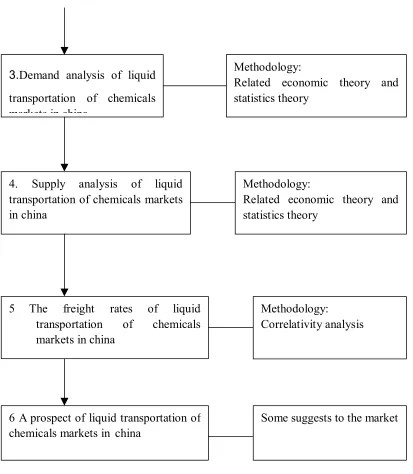
1.2 Contents of the study and the techniques employed
1.Background Brief introduce contents and methodology
Figure 1.1 Contents of the study and the techniques employed
1.3 Synopsis of the literatures
1.3.1 The features of the market of liquid bulk chemicals
Liquid bulk chemicals are those liquid chemical substances other than oil or the quasi-oil inflammables such as LPG or LNG. To date, there are over 30,000 kinds of
3.Demand analysis of liquid transportation of chemicals markets in china
Methodology:
Related economic theory and statistics theory
4. Supply analysis of liquid transportation of chemicals markets in china
Methodology:
Related economic theory and statistics theory
5 The freight rates of liquid transportation of chemicals markets in china
Methodology: Correlativity analysis
6 A prospect of liquid transportation of chemicalsmarkets in china
chemicals registered in IMO, among which 1400 are identified by the GEMSAMP of IMO, and it is estimated that 1100 are bulk chemicals, 596 of which are marked as Noxious Liquid Substance which can be transported in bulk by sea-going chemical vessels according to the 1992 Amendment of MARPOL Annex II “Regulations for the Control of Pollution of Noxious Liquid Substances in Bulk”.
Vessels engaged in carrying bulk chemicals are called Bulk Chemical tankers. Modern bulk chemical tanker is normally equipped with an independent pump/pipe system, 70% of its cargo hold is made of high quality stainless steel, which can carry highly dense and strongly corrosive liquid cargo, and fitted with alarming system and the inert gas system as well. For the strict requirements on the ship, bulk chemical tankers must go through a series of special surveys, which will lead to the certification of COF, NLS or SNLSPEP, all of which evidence the high threshold of the industry of bulk chemical transportation.
The chemical cargo in broad terms transported by chemical tankers reaches 130m tons a year, the volume of which could be omitted compared with the annual 1.9 billion tons of the sea-borne oil transportation. Nevertheless, the salient feature of bulk chemical transportation is not its volume but the diversity of the competitors and the transportation modes. Differed from the large quantity of oil transportation regularly bound for the developed countries from Middle East or West Africa, the chemical product centers scatted all over the world, which cover EU (centered in Rotterdam), American Bay, Middle East, Japan, Korea, China Taiwan, Malaysia, Singapore and so on, where there are importers as well as export centre, the traffic linkage between which meshed the whole world. Thanks to multiple cargo holders fit in with segregating different categories of bulk chemicals, chemical tanker never pursues the full loading status such as oil tanker, but it subjects to the stowing of different varieties of liquid cargos and the logistic capability of small parcels of such kinds of cargos, which in turn contribute to the bulwark for chemical tanker shipping, and sometimes even impossible.
1.3.2 Theory of supply and demand in the liquid bulk chemical market
Recently, bulk chemical shipping market experiences its prosperity following the boom of the Chinese economy and especially the recovery of the world economy from 2003, therefore, it stimulates the sharp demand for petrochemical product, which leads to the soar of the freight markets and the overflow of the profit arising from it, and which in turn causes the shortage of the tanker fleet supply and is unable to fulfill the requirements from the freight markets.
The volume of the world seaborne chemical trade in 1988 reached 70 million tons1, to date; its increasing rate still runs at 4.8% per year. From the second or the third
decade of the 1970s, the number and Gross tonnage of the bulk chemical tanker kept the uprising trend with a high increase rate each year, even through the continuous depression days. With the development of the domestic economy especially for that of the energy or the petrochemical industry, the marine transportation for bulk chemicals surges greatly, and the numbers of the chemical tankers arrived in ports rise sharply especially for the recent years. Chinese chemical shipping began just in the recent years, which left the majority of the bulk chemicals shipped by the foreign flag vessels. This brings about great deals of orders for the chemical tankers by the domestic shipping companies and gives rise to the establishments of many tanker fleets nowadays in China, such as COSCO Dalian, JiChem Shipping Company in Hainan, China Shipping, and YangYang Shipping Company of Nanjin, MingSheng Shipping Company headquartered in ChongQing, which operate the inland river transportation sectors.
As the Report of the chemical tanker market for the year 2000 to 2010 published 2, the annual increasing rates for chemical shipping from 2000 to 2005 was about 4%, which will push the shipping volume to 149 million tons in 2005. And the increasing rate for 2005 to 2010 will be between 3.7% and 4%, as it put it, the chemical volume shipped in 2010 will reach 180 million tons. Meanwhile, with the aim to survival of the competition, the consolidation of the chemical shipping sectors prevails, which strengthened each other through merge, consortia or alliance, for instance, NYK recently sold out 8.8% of its shares to the top player Stolt-Nielsen SA, with which they pooled a company named Stolt Tanker Joint Service to occupy the leading status in the market.
The world demand for ethylene ramification in 2003 was 97.6 million tons and 103 million tons 2004, which implies a gross increase trend. A marked increase in the
demand occurs in China, which will rise up by 10.9 million tons from 2003 to 20093..Whereas the world supply for ethylene ramification in the end of 2003 was 116.6 million tons, and that of 2009 will be 149.1 million tons based on the estimation of the new plants input till 2009. It also predicts that the average annual capacity of the supply will jump by 4.2 % a year, and as the raw material, the productivity for ethylene will rise up from 110.2 million in 2003 to 143.7 million in 2009, which increase by 4.5% per year in Middle East, China and India. According to the estimated capacity arise from the tentative schedule of new building plants supposedly erected by the end of 2008, the supply lag far more behind the demand will further the unfavorable balance of trade on ethylene ramification in China, where the slit between supply and demand in 2009 will be 12.7 million tons compared with 12 million for the rest of Asia.
The world demand for propylene ramification in 2003 will be 58.8 million tons, and 78.9 million tons in 2009, which increase by 5% annually. The increase rate for Asia will be 6.3%. The capacity for the world propylene ramification production will be 66.1 million tons in 2003, According to the estimated capacity arise from the tentative schedule of new building plants supposedly erected by the end of 2008, in 2009, it will be 82.8 million tons, and annual percentage is 3.8%. The annual increase percentage for different areas in the world from 2003 to 2009 is as follows; Asia 3.8%, North America 1.7%, and the import volume for Asia in 2009 will be 3.9 million tons.
The world demand for benzene, toluene and dimethylbenzene is 35.9 million tons, 16.4 million tons and 33.7 million tons respectively. The increase rate for the capacity of the production of benzene, toluene and dimethylbenzene will be 2.5%,
2.5% and 2.2%, it is estimated that the demand for benzene, toluene and dimethylbenzene will further outrun the supply.
Another report namely Report of the Chemical tanker market4 before 2015 further indicated that the charter market for the chemical tankers such as a 24,000 DWT IMO type II tanker, undergoes a decline in revenues from $16,000 to $14,500 per day in 2006, similarly, for a 12,000 DWT tanker, that will subsidize from $12,000 to $10,750 a day in 2006.
A report, namely the Analysis of domestic seagoing cross-province liquid dangerous cargo ships, indicates that the number of the domestic seagoing cross-province liquid dangerous cargo ships was 988 and 5.101 million DWT by the end of 2004, which respectively are 109.3% and 108.5% year-on-year of 2003. Due to the limited number of chemical tankers in China, the average ages for the tankers are relatively young, with the entry into force of the Order No. 6 from MOC of China in 2004, which bans the rebuilding of chemical tankers, together with the privilege given to approve the bulk chemical sector of the Cabotage open to the joint venture between Chinese and foreign shipping companies, the average number of the ages of chemical tankers in China will continue to drop. On new building sectors, both shipyards and ship owners became much more prudent than before, due to the rise of the price of mild steel or stainless steel that is the basic material for the mainstream stainless steel tankers over years, and the negotiation for those newbuildings duly in 2007 near to stagnation.
1.3.3 Theory of freight rate of the bulk chemical shipping market
By reference to the article, Short Sea Shipping Enters into the era of COA, due to the
uprising of the chemical import in China, freight rate goes up rampantly, it makes how to soup up the efficiency of the seaborne cargo to China a problem to the each accountant sector in the shipping companies, therefore, the short sea bulk chemical shipping transits from the tramp shipping era to the era of contract of affreightment.
The increase speed of the freight rate of bulk chemical shipping in 2004 exceeds either of the prosperities occurred in the 1990s (1991 and 1995 respectively), however, this rising impetus was far more behind of that of the other freight markets. At the beginning of 2004, although the boom of shipping markets for bulk carrier, oil tanker and container liner, the price rates for chemical shipping and reefer shipping still lies at the end of the list. Nevertheless, price for the whole year 2004 goes up distinctly, thanks to the sharp expansion of import in China. The freight rate for some voyage of the tramp shipping rises by one time more than that of last year’s, while for the negotiation on the modification of the COA in 2005, the price rate jumped 2 or 3 more times.
C
CHHAAPPTTEERR 22
F
FEEAATTUURREESS OOFF TTHHEE DDEEVVEELLOOPPMMEENNTT OOFF CCHHIINNEESSEE LLIIQQUUIIDD CCHHEEMMIICCAALL
S
SHHIIPPPPIINNGG MMAARRKKEETT
2.1 Special requirements of the liquid chemical shipping industry
As an auxiliary service to the liquid chemical producing and trading, bulk chemical transportation is of vital importance in the circulating process from production to consumption. At present, there are 3 kinds of patterns for bulk chemical transportation, namely, road transportation, railway transportation and shipping.
Road transportation is a mode fit for small quantity of cargoes transferred within a short or intermediate range distance, the either side of which is easily to reach. Special tanker vehicles are the main transportation media in this kind of mode, which normally provide the PTP service. Due to the easy reachability of the road transportation, this kind of mode usually is used for dangerous goods, which is in a small demand or will be specially treated by heating and pressing. One of the drawbacks for road transportation mode is its high cost, therefore, low value-added bulk chemicals, such as methanol or glycol, normally don’t employ this mode.
planned economy times, when the capacity of it was in scarcity and the quota for liquid bulk chemical is limited just fit for the middle west inland area.
Compared with the above two modes, shipping is a mode of high economy. The large quantity of capacity, low cost and safety make it the main mode for liquid bulk chemical transportation especially for those economically developed and river intensively covered area such as the Yangtse River Delta or the ZhuJiang River Delta, which in turn swallows a large quota of the market share.
Because shipping mode occupies the leading status in the bulk chemical transportation, it is inevitable for the prosperous petrochemical industry in China to promote the bulk chemical shipping market continuously.
Due to the dangerous feature of the bulk chemical goods, the requirements for safer shipping, for environmental protection and for high cargo quality are relatively strict, which also drive shipping company to pursue the advanced know-how for fleet as well as the superb special-purpose chemical tankers
2.1.1 Requirement for liquid chemical ships
maintaining measures should be applied to increase its viability upon serious damage to the hull. Most cargo holds of chemical tankers belong to type 2G, where “2” stands for integrated liquid cargo hold, which is the requirement for the integrity of the ship structure, where “B” stands for the gravity cargo hold, either independent cargo hold or integral cargo hold, whose construction and test should satisfied with the standards set by the competent authorities, where the temperature and the relative density of the cargo transported should be taken into account. Due to the different characteristic of chemical cargoes, the material for building the tanker is different. Presently, the construction material includes stainless steel, epoxy, coatings and carbon steel, among which for instance, the stainless steel is fit for phenol or glacial acetic acid.
2.1.2 Requirement for seafarers
Staff working on board chemical tankers should be qualified for trainings of familiarization of chemical cargo, trainings of petrochemical industry, and trainings of ship maneuvering, trainings of firefighting on board, trainings of medical first aid on board and so on. They should also master the necessary knowledge of the prevention measures for cargoes of mutual reactions, knowledge of the special heating practice for certain kind of cargo carried onboard, knowledge of the harm of corrosive cargo, knowledge of human protection measures, knowledge of the medical treatment to people contaminated by noxious cargoes and so on.
2.1.3 Requirements for operators
of the vessel and the compliance status of the integrated safe management level of the vessel and its seafarers to those of the world standard, which also provide for the tanker operators the whole evaluation data of the risk management and risk assessment onboard chemical tanker. Survey items of CDI cover almost all the aspects of the tanker fleet technical management.
Both China and the other countries promulgate very strict code to control the storage and the transportation of dangerous cargoes including liquid chemicals. For bulk chemical shipping companies, every logistic market sets a high threshold for the entry, so the only solution is to meet the requirements from both domestic and international.
Globally, the legal instruments are: UN Recommendations for the transport of dangerous goods (as referred to the UN orange book, which would be updated irregularly by UNCETDG), the International Maritime Dangerous Goods Code 5, etc.
Domestically, the national legislation includes: the Regulations of the safety management of dangerous chemicals (promulgated by the State Council on 29th Jan.
2002 and entered into force on 5th Mar. 2002), the code for the waterway transportation of dangerous goods (by MOC on 4th Nov. 1996).
With the entry into force of the Regulations of the safety management of dangerous chemicals by the State Council, it is required that virulent chemical cargoes are strictly prohibited for transporting in the internal river and the other landlocked waters; the special vehicles owned by the profit-making enterprise of road
transportation of dangerous goods should not be less than 10; under proper circumstances, enterprise approved for producing and storing dangerous chemicals by the competent authority could engage in the non-profit-making transportation of the dangerous chemicals once they get the approval from the transportation authority at the provincial level; foreign exclusively invested enterprise who engage in the production of dangerous chemicals could possess its own vehicles which are confined to the non-profit-making transport; within the total number of the vehicles of the non-profit-making road transportation enterprise for dangerous goods, the number of vehicles whose price is above 800,000 RMB should not be less than 3 or the price below 800,000 should not be less than 5; non-profit-making transportation enterprise can only transport the dangerous chemicals produced, stored or used by its own; for those vehicles with a high risk to transport virulent, explosive chemicals and so on, should be equipped with the GPS system or the operating recorder and relevant communication systems.
2.2 Features of the development of the liquid chemical shipping market
invested project become more and more, which would rather outsourced their logistic sector to those professional logistic companies.
Recent years’ rapid development of the domestic economy booms up the domestic petrochemical industry, which gain the important status in the national economy. A systematic chemical industry has come into being, which covers over 20 different sectors, including chemical ore mine, chemical fertilizer, pesticide, soda and inorganic chemical product, chlorine alkali, basic organic raw material, dyestuff, dope , new product, new refinery chemical product, etc, the quantity of which could satisfy the domestic demand. Nowadays, the productivity of Chinese chemical producing has been listed among the top players in the world, especially for those bulk chemical products like fertilizer, pesticide, soda, and methanol and tyre shoe, etc. In 2003, the quantity of Chinese fertilizer production was 39.246 million tons, increased by 6.7% from 2002, pesticide 0.863 millions, which is No. 1 in the world up by 1.2% from 2002. And the type shoe’s production reached 188 million units, up by 16.4% from 2002, among which those of belt type are 68.87 million units, up by39.4% from 2002, dyestuff 0.86million tons, up by 17.4%, the production and the supplying quantity of which is the world No.1What’s more, In 2005, the output of vitriol, ammonia, fertilizer, and calcium carbide all reach the world No.16
In 2002, the sales income of the Chinese petrochemical industry is 1458.7 billion RMB, which account for 13.5% of the total GDP, its gross value is 1029.4 billion RMB, account for 10.2% of the national volume, the net profit is 122.3 billion RMB, account for 21.8%, tax payable is 220.9 billion RMB, account for 18.8%, the foreign trade value is 85.2 billion RMB, 13.7% of that of national scope. Another statistic
snapshot from the National Statistics Bureau, in 2003, the gross industrial output value of Chinese petrochemical industry is 1840.29 billion RMB, up by 25.5% from 2002, the value added increases by 23% from 2002 to 570.38 billion RMB, sales revenue reaches 180.5 billion RMB, and the net profit is 176.37 billion RMB, the increasing rate are 26.4% and 43.6% respectively compared with 2002. The percentage of the main economic indicators of the petrochemical industry account for those of the national industry is: the net present value by 13%, the industry value added by 13.9%, sales revenue by 12.8%, net profit by 21.6%, all of which stands first on list of the entire industry sectors, and the trend of which continues its rising till the present. In 2005,the increasing of the net profit of the market slowed down, but it will remain fast increase in 2006.7
With a summary based on the aforementioned, we conclusively found that the dimensions of Chinese petrochemical production have already reached such high status and its structure is becoming much more rational than ever, which bring about a strong impetus for the demand of transportation solutions.
At the present stage, liquid chemical market in China has the following characteristics:
2.2.1 Huge volume of import
According to the statistics, in 2001, the total production volume of the Chinese liquid chemical product is 15.75million tons, the year-on-year increasing rate is 3.23%. Meanwhile, the import volume of the raw material of the organic chemical product is 16.2118 million tons, up by 24.67% compared with that of last year. Within the
supply and demand relationship of all range of chemical products, the self-support ratio of ethylene is 43%, glycol 46%, methanol 57.5%, the reliance on import section for those refinery chemical product is even bigger. Till 2005, the productivity for ethylene has reached 9 million tons a year, while the consumption ratio will be 15 million per year, which makes the difference still exist, and import is still a good solution for the basic chemical product like ethylene.
2.2.2 Coming into shape of the three liquid chemical production centers in
China
Geographically, compared with the other liquid chemical production sites in China, those in Yangtse Delta, Zhujiang Delta and the circle of Bohai bay are among the top three highly developed production centers. In 2001, the total product volume of these 3 areas is 7.3344 million tons, account for 57.51% of the total national production. The production centers have already come into shape that located in towns like Yangtse, Jingshan, Zhenghai, Gaoqiao, TianJin, Maoming, and Guangzhou, which developed into a so-called chemical industry park with the economic function of producing, supply and sales. With the strategic development of Shanghai international shipping center, the Yangtse Delta become the most powerful site among the three chemical production centers, where burst out some newly built chemical industry parks like Caojing .In 2005,some noticeable new chemical industry park, for example Chaojing have been found, which enforce the leader position of Yangtse.
2.2.3 Limited productivity for refinery chemical product
as the small scale of the production. So far, the 18 ethylene production appliances in the 16 ethylene producing enterprise could only provide an average production of 250,000 tons a year, the maximum of which is 480,000 tons a year, while the world average productivity reached 450,000 tons in 1996, the maximum of which was 1.16 million tons per year. Due to the limited scale of the ethylene productivity, the equipments for its three ramifications are also facing up with the problem of the confined productivity.
2.3 Summary for the chapter
C
CHHAAPPEERR 33
A
ANNAALLYYSSIISS OOFF TTHHEE SSUUPPPPLLUUYY AANNDD DDEEMMAANNDD OOFF LLIIQQUUIIDD BBUULLKK
C
CHHEEMMIICCAALL SSHHIIPPPPIINNGG MMAARRKKEETT IINN CCHHIINNAA
3.1 Status quo of the supply and demand of liquid bulk chemical shipping in
China
In recent years, the import volume of methanol soars. In 2001, the total import volume is 1.5213 million tons, while the domestic production is 2.06 million tons, which makes the self-support ratio 57.5%. The inland river transportation volume in 2001 is 600,000 tons. Till 2005, the total consumption volume of methanol was 3.8 million tons, and around 2005, the 600,000 tons methanol project by CNOOC and the 300,000 tons methanol project by Zhongyuan Company have been established.
Glycol is the basic raw material for producing polyester. In 2001, the domestic glycol production is around 900,000 tons, and the domestic shipping volume is 453,000 tons, which flow mainly from Nanjin Jiangsu province, Maoming Guangdong province and Quanzhou Fujian province etc to the coastal areas and the riverbank areas. With the increasing of glycol production in China, and that of Yangtse/BASF, CNOCC/SHELL joint ventures project, the total volume reached 2 million tons in 2005, which makes Jiangsu province, Shanghai and Guangdong province of South China the area of the increasing demand for chemical transportation.
account for 9% of the total volume of inland river shipping. Till 2005, after the establishment of the 900,000 tons ethylene project by SECCO Shanghai and the 800,000 tons ethylene project by CNOCC/SHELL, it has been generating at least 300,000 tons styrene shipping demand. Till 2005, the domestic volume of styrene will exceed 500,000 tons, the newly demand for shipping of which will concentrate in East China and South China.
Aromatic hydrocarbon includes benzene, toluene and xylene, which is the major portion of the total domestic chemical transportation account for 42% of the total shipping volume. The LG CHEM in Qingdao will build up a world class production project with annual volume of 700,000 tons xylene and 200,000 tons benzene, which will dramatically prompt the production of the aromatic hydrocarbon upon its finishing in July 2006.
In 2005, the domestic shipping volume of butadiene and epichlorohydrin will be 110,000 tons and 75,000 tons respectively, which account for a major proportion in the newly shipping demand.
TDI and MDI are two liquid substances with grave hazard, between which TDI will send off noxious gas upon touching water. Therefore, the requirements on the safety of carriers and the thermo control equipment are so high that there is no competent shipping company in China who are qualified to transport TDI or MDI. In 2005, following putting into production of several important projects there will generate production of 280,000 tons TDI and 390,000 tons MDI annually. Other cargoes like glycol, chloroethylene are those import majority.
product in China
The supply through production of the organic chemical raw material could not satisfy the demand from the domestic market, which stimulate a mass of import demand, some varieties of which are even pushed up to a 30% quota in the domestic consumption market. See the detail in the following charts.
Figure3.1 The capacity of importing Phenol; Acetone; Propylene; Acrylonitrile
Source: Shanghai shipping exchange
Figure3.2 The capacity of importing Methanol; Ethylene Glycol; Styrene Monomer
Source: Shanghai shipping exchange
0 55000 105000 155000 205000 255000 305000
1997 1998 1999 2000 2001 2002 2003 2004
Pheno Acet o Pr opy Acr yl on
0 2 05000 4 05000 6 05000 8 05000 10 05000 12 05000 14 05000 16 05000 18 05000
199 7 19 98 19 99 2000 2 001 200 2 2003 20 04
Figure3.3 The capacity of importing P-xylene; Mixed xylene; Toluene; TDI
Source: Shanghai shipping exchange
From the value of import trading, product like styrene, 1,2-glycol, chloroethylene, toluene, methanol and so on, account for a major proportion.
Figure3.4 The capacity of exporting Phenol; Acetone; Propylene; Acrylonitrile
Source: Shanghai shipping exchange
0 105000 205000 305000 405000 505000 605000 705000 805000
1997 1998 1999 2000 2001 2002 2003 2004
P- xyl ene Mi xed- xyl e Met ha TDI 0 10000 15000 20000 25000 30000
1997 1998 1999 2000 2001 2002 2003 2004
Phenol Ac et on Pr op Ac r y l o 1, 2- Di m
0 10000 15000 20000 25000 30000
1997 1998 1999 2000 2001 2002 2003 2004
Figure3.5 The capacity of exporting TDI; Ethylene Glycol; Glacial Acetic Acid
Source: Shanghai shipping exchange
Figure3.6 The capacity of exporting P-xylene; m-xylenen; mixed xylene; Methanol; Toluene
Source: Shanghai shipping exchange
As regard to the import of liquid chemical product, there are a certain level of product has to be imported from oversea market because the domestic production could not satisfy the demand of domestic market, therefore, there is little export of the organic chemical raw material from China. However, the export of chemical raw material keeps its rising trend in the recent years, which bring together the uprising of the liquid chemical product.
3.1.2 Analysis of the supply and demand of the domestic shipping of liquid
chemicals
At present, the logistic flow of the domestic liquid chemical shipping arises from the following aspects:
0 25000 45000 65000 85000 105000 125000 145000
1997 1998 1999 2000 2001 2002 2003 2004
P xyl ene M- xyl ene Mi xed
M ethan
The first kind of flow comes from the yielding place to the consumption sites. In the deployment of today’s chemical industry of China, north China and east China are the production places of the raw materials, while east China and south China are the main places of refinery chemical products and the deep consumption of both primary product and finished one, shipping capacity arising from this deployment mainly consists of shipping within East China and South China areas and the north-south line, among which the transport within East China has high proportions, including downstream of the Yangtse river and part of coastal areas, while on the contrary, the north-south line has low proportions which mainly made up of the logistic flow from north China(Dalian, Fushun), east China(Shanghai, Nanjin) to south China(Santou, Guangzhou, Zhuhai, Zhujiang River Delta area).
The second kind of flow comes from the domestic feeder service to transfer arrived import cargoes, which contribute a big quota to the domestic shipping. The transfer ports in China locate in Dalian, Lianshan of North China, Ningbo, Zhoushan, Shanghai, Taichang of East China, and Zhuhai, Guangzhou and Dongguan of South China. The transfer shipping mainly follows the direction from east to west, among which those volume generated from areas of the Yangtse River and the Zhujiang River have a high proportion.
3.2 The trend of the supply and demand of liquid chemical shipping market in
China
3.2.1 The influence from the increase of import on the domestic shipping sector
At present, the import volume of liquid chemical product increases rapidly on the basis of each year. The impact on the domestic market from these import products prompts the expansion of the capacity of storage tankers and the emergence of large scale chemical terminals in coastal areas, especially for those in South China. According to the statistics from Guangdong MSA, there are over 60 difference scales of chemical dock or terminal in Guangdong province, the total capacity of which is 1.1 million cubic meters. In the next 3 years, a serial of chemical terminal with big tonnage and the auxiliary storage tankers will be built without stop, international transfer terminals like the present HengJiDaXin terminal in Zhuhai is now under construction of expanding (the third stage project will amplify 239,000 cubic meters more to its original capacity). The expansion of the capacity of terminals changes the deployment mode of the original domestic shipping, on one hand, the long distance shipping volume from north to south decreased upon the impact from huge import, on the other hand, transfer volume increased obviously within the areas.
3.2.2 The influence from the putting into production of some major projects
invested by multinational companies on the domestic shipping sector
Following the penetration of foreign investment fund into the domestic liquid chemical production, trade and distribution area, Chinese government has already approved 8 large scale liquid chemical production projects, which is now either planning to built or under construction, these include: Yangtse Petrochem/BASF 600,000 tons Ethylene Cracking project in Nanjin, SECCO/BP/China Chem 900,000tons Ethylene Cracking project in Shanghai,CNOCC/SHELL,800,000tons Ethylene Cracking project in Huizhou,Exxon/Refinery Chem Fujian,600,000 tons Ethylene Cracking project in Quanzhou,DOW Chemical. Besides, the Taisu Group from Taiwan invested a big project in Ningbo to build up a 1.3 million tons ethylene production centre. The total capacity of these 9 projects for producing ethylene will be 4.2 million dons a year. There are data shown that the above projects have already put into production in 2005, 90% of which product trades in the domestic market. The projects invested by the multinational companies, on one hand, bring about supplements for the import products, on the other hand, take the competition onto the domestic players. The sales channel would bring a large quantity of cargoes to the domestic transportation, which eventually would impact on the domestic chemical shipping pattern.
3.2.3 Features of the demand of the China’s liquid chemical shipping market
According to the estimation, the demand of shipping of the liquid chemical product in China will undergo the following movements with the development of Chinese petrochemical industry:
in Shanghai, Nanjin, Huizhou and Quanzhou invested by the multinational companies will be even outstanding, plus those production bases in Maoming, Zhenghai and Tianjin, the expanded scale of the production will strengthen the advantages of waterway transport mode, which in turn increased the total volume of transportation. Upon the putting into production of those major projects by the multinational companies, the regional value chain for this sector was stretched, which decreased the past long distance transportation mode of the primary product and replaced it with the proliferation of the domestic chemical shipping, especially for those in the East China areas. Additionally, another economic growth point of shipping will arise from the short distance lighterage in the Yangtse River Delta and Zhujiang River Delta.
Secondly, the proportion of the shipping demand of the refinery chemical product transportation will increase. Upon those projects under construction, the refinery chemical product like TDI, MDI and acrylonitrile will be produced at over 2 million tons a year. Once the products put into the domestic market, the shipping volume will increase prominently. It shows that the domestic shipping demand of the refinery chemical product for the year 2005 was about at least 1.2 million tons, and the present situation of the domestic chemical shipping could hardly satisfy the demand arisen from the refinery chemical products, which will intensify the contradiction between supply and demand of the domestic refinery chemical shipping.
3.3 Summary of the chapter
C
CHHAAPPTTEERR44
A
ANNAALLYYSSIISS OOFF TTHHEE SSUUPPPPLLYY OOFF TTHHEE TTRRAANNSSPPOORRTT CCAAPPAACCIITTYY OOFF TTHHEE
L
LIIQQYYIIDD CCHHEEMMIICCAALL SSHHIIPPPPIINNGG MMAARRKKEETT IINN CCHHIINNAA
4.1 Status quo of the supply of the transport capacity of the liquid chemical
shipping market
4.1.1 Status quo of the supply of the transport capacity of the liquid chemical
shipping market for the foreign trade
The status quo of the supply of the transport capacity of the liquid chemical shipping market for the foreign trade is now totally opened, which allows the competition between the domestic shipping companies and the foreigners. In China, there are presently 22 professional liquid chemical shipping companies with at least 95 Chinese flag tankers at 159,559 DWT, among which there are 6 companies engaging in the foreign trade shipping with 22 vessels at 109,118 DWT, while the rest of the supply come from foreign companies.
Table4.1: the tonnage statistics of the world chemical fleet (unit: 1000 DWT)
Source ISL2000, 2001, 2002
From the above data, the number of chemical tankers in recent years takes on a sliding trend, which shows a decrease in the number of small vessels and the steady of the large or middle size vessels. Following the increase of the international chemical trade, the demand for cargoes and the supply from the shipping capacity seems to level off.
Although the characteristics of the chemical cargoes, such as the multiple varieties, the wide ranges, the special nature, the high value, the small parcel and the high requirements for the safety, etc., the multiple segregated cargo hold is still popular in most of the ocean-going chemical tankers for the purpose of chasing economic of scale of the shipowners, while in the short sea voyage and those of coastal and inland river voyage, the small and economy sized vessels are used frequently.
From the ages of the tankers in use, the average age of vessels above 300 GT in 1988 was 15.3 years old, while in 2002 it reaches 17.7 years old, about 25.7% of the world
2002 2003 2004
Tonnage No DWT No DWT No DWT
Below 5 898 1600 903 1600 900 1600 5~10 170 1300 170 1200 160 1200 10~40 215 5100 219 5200 219 5200 40~80 10 400 14 600 11 500
Above 80 1 100 1 100 1 100
fleet exceeding 20 years’ service. In conclusion, the trend of aging of the liquid chemical tankers is prominent in recent years with the increase in the average age and the slow down of the renewal rate.
According to the latest statistics from ISL, in 2002, the world chemical tankers increase by 30 vessels at 400,000 DWT, among which the number of tankers below 40,000 DWT are 28, only 2 of the vessels above 40,000 DWT, which also explains the trend for small and middle-sized tanker of the new buildings. Influenced by the great demand for more shipping capacity, the growing speed of the chemical tankers’ scraping slows down. In 2000, the number of demolished tanker is 12 at 100,000 DWT, 2001 10 at 100,000.
The orders for the new buildings of chemical tankers above 300 GT are 53, 11 more than that of 2001, among which the number of tankers between 10,000 and 40,000 DWT is 23, between 5,000 and 10,000 DWT 12, between 40,000 and 80,000 2. Within countries for the new buildings, Turkey and Japan are the top two of the single country whose orders account for 60% of the total.
In conclusion, the demand for the world chemical shipping capacity is increasing. Countries who demand for new buildings mainly concentrate in EU and Asia region, among which those come from EU account for 60%. Besides, the trend for the enlargement of the chemical tankers is going down.
The top three players for chemical shipping in the world are the following: Odfjell, stolt Nielsen, and Tokyo Marine.
mainly covers oceangoing, Inner Asia and Inner America. In recent years, the expansion of Odfjell in Asia is speeding up, it decided to build chemical terminals with the local enterprise of Jiangyin of Jiangsu province, which is the third terminal after that of Dalian and Ningbo.
Stolt Nielsen is the largest chemical shipping company in the world who was built on the basis of the former parcel tanker shipping company in 1959. From the acquisition of the United Tanker Container Company, Stolt Nielsen began its containership voyages with small parcels of chemical cargos, and in recent years, it starts its joint venture investment on the business of terminals in Shenzhen and Shanghai.
Tokyo Marine is the largest chemical shipping company in Japan; in 2004 it operates 61 chemical tankers at around 720,000 DWT, among which the oceangoing fleet has 46 vessels at around 600,000 DWT, the short sea going fleet has 15 vessels at around 120,000 DWT. In August 2003, Tokyo Marine established its association office in Shanghai, which enables it to cooperate with the Chinese super petrochemical companies to establish the joint venture chemical plants. Now, Chinese market is of great importance for Tokyo Marine. Upon the lifting of the ban on domestic chemical shipping operation right in China, Tokyo Marine reacted swiftly, and the pool with Nanjin YangYang Chemical shipping and trading Company is the symbol for its success in participating in the Chinese domestic chemical shipping market.
thought by the experts of the practitioners that for the voyages with plenty of cargoes, it is a win-win mode to both the carriers and the cargo owners, and will to some extend gain more flexibility for the shipping companies as well as satisfy the demand of transportation from cargo owners, which in turn raise up the efficiency of the deployment of vessels.
The alliance and the acquisitions between chemical shipping companies predominate over the present shipping mode. Odfjell buyout the Morocco’s West KIME Tankers, which enable it to run neck and neck with Stolt Nielsen. Stolt cooperated with the world No. 3 tanker company, JO Tankers, which was started from February of 2002. West Chare and Alber established an alliance on the Arabic Bay/Far East line based on the cooperation of the businesses. Besides, the Banye transport from Japan and Odfjell Chemical Tanker Company established a joint venture company named the “United Chemical Tanker Company”. Under this circumstance, a complex pool are established by BLT from Indonesia, Rizhen Shipping Mitsubishi Chemical Logistics from Japan which are the medium-small chemical tanker operators within the Asia area.
4.1.2 Status quo of the supply of the transport capacity of the liquid chemical
shipping market for the domestic trade.
At present, the domestic chemical tanker shipping market is in a semi-open situation; where presently there are only 5 Chinese and foreign joint venture companies that have gain the privilege from MOC of China and the domestic companies could have the operating right.
steel made tankers at around 30507 DWT, which have the right to engage in the oceangoing voyages; there are 14 special coating tankers at around 78611 DWT. Within the tankers engaged in the domestic shipping, there are 25 stainless steel tankers at 22524 DWT, 8 special coating tankers at 14253 DWT, 40 carbon steel tankers at 13664 DWT.8
Through the investigation, the operating situation of those tankers engaged in the domestic bulk chemical shipping could be summarized as following:
Sino Chemical shipping and Stolt Nielsen now operate 17 tankers, among which 10 engaged in the domestic transportation with an average age 10 years, the types of these tankers are: 2 tankers at 7000DWT, 7 between 3000 and 4000, 1 at 1000 DWT, among those tankers, there are 4 stainless steel tankers, 6 special coating tankers. There are 7 vessels engaged in the foreign trade transportation with the average age 14 years, there are 4 9000 DWT class tankers and 3 3000 DWT class tankers, among them there are 4 stainless steel tankers and 3 coating tankers, all of which enable them to be the largest chemical shipping company in China.
Shanghai Jinhai shipping and trade company is the joint venture between Shanghai shipping Group company and Shanghai Petrochemical Group Company that is built up in 1989 with the purpose of carrying out liquid bulk chemical transportation. It now operates 6 bulk chemical tankers with the transport capacity of 35,000 DWT, among which 3 are stainless steel tankers and the other 3 are epoxy zinc plating coating tankers. The company mainly engages in the transportation of the import cargoes from oversea, which includes the line from South Korea, Japan and Singapore to China, and also Taiwan province to the Mainland China, and it also has
a little domestic quota. In 2001, it accomplished 650,000 tons transport volume, among which the direct carriage takes 600,000 tons and the domestic transfer carriage takes 50,000 tons. Within the domestic voyage, there are 10,000 tons on the line from North China to East China, 40,000 tons North China to South China.
COSCO Dalian Chemical Tanker Management Company has 4 bulk chemical tankers, the total capacity of which is 11,000 tons with 2 stainless steel tankers and 2 coating tankers. In 2001, the company finished 190,000 tons transportation volume, within which there were 180,000 tons import cargoes from Southeast Asia to Ningbo and Zhujiang River Delta areas, and the other 10, 000 tons were domestic transfer voyage which were distributed from Ningbo to the Yangtse River Delta.
Nanjin YangYang Chemical shipping Co. & Tokyo Marine established in 1994 has now operated 7 bulk chemical tankers, the total capacity of which is 17,400 DWT with the maximum tanker of 3000 DWT. M.T. NingHua 406, 407, 408 of this company are epoxy-coating tankers, which engaged in the direct voyage from South Korea, Japan and Southeast Asia to the Yangtse River Delta. M.T. NingHua 402, 409 which are the stainless steel tankers and M.T. NingHua 403, 404 which are the zinc plating coating tankers mainly engaged in the domestic shipping within the coastal area and Yangtse River Delta. It is estimated that the total volume to be finished in 2001 would be around 600,000 tons.
tons and mainly rebuilt from the dry cargo vessels. In 2001, it finished its direct voyage transportation of 102,600 tons cargos. This company has little domestic quota, which is only 1,000 tons in 2001 that most of its volume arise from the import from Japan, South Korea and Singapore to the Zhujiang River Delta, which is also its main domestic market.
Shanghai Yatong shipping Company, with 4 tankers at around 4,600 DWT, mainly engaged in the coastal and inland river transportation. There are 3 stainless steel tankers with the average capacity of 1,000 DWT and 1 1600 DWT epoxy coating tankers. In 2001, the company finished 100,000 tons domestic transport, which operates in the domestic lines among North China, South China, South China, and Zhujiang River Delta and Yangtse River Delta area. There are a lot of short distance lighterage in the estuary of Yangtse River and Zhujiang River by Yatong.
Yongji shipping company from Zhoushan has 1 1,100 DWT and 1 700 DWT stainless steel tankers. In 2001, it finished 75,000 tons domestic transportation, with the main operation voyage in North China to East China, North China to South China and those river voyages in Yangtse River and Zhujiang River.
Nanjin Tongda shipping Company has 3 stainless steel tankers each of which is 500 DWT, 700 DWT and 900 DWT respectively. In 2001, it finished 60,000 tons domestic quantity with its total capacity of 2200 DWT.
Yinli Xijiang shipping Company from Liuzhou Guanxi province has 6 250 DWT class bulk chemical tankers. In 2001, it finished 50,000 tons domestic quota, with the operating range in the Zhujiang River Delta area.
Inland River shipping Company from Liuzhou Guanxi province has now 8 tankers with the total capacity of 980 DWT. In 2001, it finished 12,000 tons domestic quota, with the operating range in the Zhujiang River Delta area.
Yuanzhai shipping Company from Liuzhou Guanxi province has 5 chemical tankers with the total capacity of 1000 DWT. In 2001, it finished 12,000 tons domestic quota, with the operating range in the Zhujiang River Delta area.
Fenghua shipping Company from Liuzhou Guanxi province has 3 chemical tankers, among which 2 are 150 DWT and 1 170 DWT. In 2001, it finished 28,000 tons domestic volume, with the operating range in the Zhujiang River Delta area.
Additionally, Dongzhan oil shipping Co. & Odfjell, COSCO Dalian & YOKUKU oil tanker Company, and China NORINCO & Int'l Maritime Carriers Ltd from Singapore are all playing the important role in the domestic chemical shipping.
4.2 Trend for the supply capacity of the liquid chemical shipping market in
China
Firstly, the East China line, the cargo capacity will be at 560,000 tons with a tolerance of 20%, which will meet the launchings of 5 3000 DWT class new tankers.
Secondly, north bound line, the cargo capacity will be at 290,000 with a tolerance of 20%, which will greet the launchings of 5 3000 DWT tankers, 2 of them have the capability of carrying PO
Thirdly, southbound line, the cargo capacity will be 310,000 tons with a tolerance of 20%, which will welcome in 2 new launchings of 3000 DWT tankers.
4.3 Summary of the chapter
C
CHHAAPPTTEERR 55
T
THHEE AANNAALLYYSSIISS OOFF MMAARRKKEETT PPRRIICCEE OOFF CCHHIINNAA’’SS LLIIQQUUIIDD CCHHEEMMIICCIIAALL
T
TRRAANNSSPPOORRTTAATTIIOONN
As analyzed in the majority of the cargo in Chinese liquid chemicals seaborne transportation market is the import and export of the liquid chemicals, among which the import is the major part. Therefore, the fluctuation of Asian market price of chemicals transportation will influence Chinese market. This chapter analyzes the relation between Asian market price of chemicals transportation and the GDP of China.The conclusion of the forecasting in this chapter wouldn’t suggest the freight rate will keep direct proportion or inverse proportion with GDP of China in longterm.It just suggest the a kind of implied relationship betweeen the freight rate and GDP of China in past few years and in the near future.
5.1 The status quo and trend of the market price of liquid chemicals seaborne
transportation
Singapore.
In general, the cargo carried in the south-north transportation between far east and northeast Asia is unbalanced as the northward cargo is the twice of the south cargo. The price of Asian coastal transportation eventually rose gradually in later 2004; especially the rise of the price of southward transportation is the first time since 1998. For this reason, the majority of the northward chemical tankers from Malacca Strait went back to Malacca with empty tanks after discharging in China. What can be predicted is that the market will continue to be prosperous, as the future Chinese imports keep optimistic.
The following diagram shows the trend of market price of Asian liquid chemicals transportation from 2002 to 2005,in which the red line describes southward transportation and the blue line describes northward transportation.
Figure5.1 The trend of price in the oriental liquid chemical transportation market
Figure5.2: The trend of price in the oriental liquid chemical transportation market from 2004 to 2005
Source: Shanghai shipping exchange
According to the data of IMF, the GDP of China has been increasing from 2002 to 2005. As described in Chapter 2, the development of national economics stimulated the demand of Chinese import and export of liquid chemicals, while the market price of Asian liquid chemicals transportation of the corresponding period shows that the price is also keeping rising steadily. It’s not difficult to discover that the two above phenomena have the correlativity. We will analyze the Asian liquid chemicals transportation market by using the regression analytical method and make a prediction of the future market price trend of Asian liquid chemicals transportation according the relevant data.
Table5.1 China GDP of recent years
Year 2001 2002 2003 2004 2005 2006 2007
GDP (hundred million RMB) 5392.672 5883.406 6471.746 7125.3937830.807 8574.7339346.459
Source IMF
bX a
Y)= + 5-1 X is the independent variable, while Y is the dependent variable. B is the slope and a is the intercept.
, a=Y −bX,
∑
= = n i i X n X 1 1 ,
∑
= = n i i Y n Y 1 1 5-2First, we take GDP of China to do linear regressive
GDP 0 1000 2000 3000 4000 5000 6000 7000 8000 9000 10000
2001 2002 2003 2004 2005 2006 2007 Year in billions
Figure5.3 GDP of China
By calculating, we could do that the correlative coefficient approaches 1.So the statistics of Chinese GDP accord to the law of linear regressive function. Then, we could forecast by using the model of linear regressive
we can predict China GDP from 2008 to 2010 according to the data of IMF. The following result is based on the account by Excel:
X
Y) =4574.591+664.396 5-3
∑
∑
= = − − = n i i ni i i
Y stands for annual China GDP, X means time t. supposing 2001 is time 1, 2002 is time 2, 2003 is time 3, 2004 is time 4.... 2010 is time 9, the annual China GDP from 2008 to 2010 is obtained as 98897.56, 105541.52, 112185.47 hundred million annually. The result shows as follows:
Table5.2: The predict of China’s GDP in the future
Year 2006 2007 2008 2009 2010
Estimated GDP (hundred million RMB)8574.733 9346.4599889.756 10554.15211218.547
Then we analyze the Asian liquid chemicals transportation market by using the regression analytical method by Excel account.
(A)Asian northward transportation line:
The mean price of northward transportation shows as follows:
Table 5.3: The average price of Asian Northward transportation line
Year 2002 2003 2004 2005
Mean price (USD) 19.58 21.92 26.33 33.33
NE Asia/Southbound
0 5 10 15 20 25 30
2002 2003 2004 2005
Year USD
Figure5.4 The average price of Asian Northward transportation line
By calculating, we could do that the correlative coefficient approaches 1.So the statistics of the average price of Asian Northward transportation line accord to the law of linear regressive function. Then, we could forecast by using the model of linear regressive
Then we get
X
Y) =−23.065+0.0071 5-4 If replacing X with GDP and Y with mean price, the estimated price of future 5 years shows in the table5.4 according to the formula.
Table5.4: The predict of Asian Northward transportation line
Year 2006 2007 2008 2009 2010
Estimated price (USD) 37.56 42.27 46.97 51.68 56.39
Table5.5: The average price of Asian Southward transportation line
Year 2002 2003 2004 2005
Estimated price (USD) 16.83 17.00 18.25 24.67
First, we take the average price of Asian Southward transportation line to do linear regressive
SE Asia/Northbound
0 5 10 15 20 25 30 35
2002 2003 2004 2005 Year
USD
Figure5.5 The average price of Asian Southward transportation line
By calculating, we could do that the correlative coefficient approaches 1.So the statistics of the average price of Asian Southward transportation line accord to the law of linear regressive function. Then, we could forecast by using the model of linear regressive
Then we have
X
Y)=−7.388+0..0039 5-5
shows in the following table5.6 according to the formula.
Table5.6 The predict of Asian Southward transportation line
Year 2006 2007 2008 2009 2010
Estimated price (USD) 25.93 28.52 31.11 33.69 36.28
5.2The impact of price trend on the market
5.2.1The prevailing of COA
In the foreseeable future, the price trend of different transportation line is expected to rise due to the rapid concentration of Chinese demand, which results in the rise of spot price and that the transportation capacity relating to Chinese market will become saturated even insufficient from being overmuch. This direct impact is that the affreightment market of liquid chemicals will be apt to COA, under which cargo owners or his agents sign the freight contract of gross lump and batch conveyance with shipowners, which means that shipowners dispatch ships to convey the cargo in a regulated period from the loading port to the discharging port as a batch until all the cargo is conveyed. One advantage of such COA is that the transportation price is relevant to the market and cargo owners can ensure freight berth and good price without the influence of freight shortage.
5.2.2The expansion of shipping alliance
companies is more and more obvious. The latest example is that the alliance of Rizhen shipping and defeated Oterfield, Stollter, and Tokyo Shipping and won a freight contract of 600 thousand tons of chemicals per year in the negotiation of COA of Kerute in Malaysia.
Chinese domestic companies basically do not have the capacities to meet the requirement of chemical fleet and transportation knowledge by the ultra sized petro-chem plants. Therefore, China government permit the alliance between domestic shipping companies and abroad companies, under which domestic companies are required to have more than half of the total capital. Alliances companies have got such permission. Hence force, those companies’ pulse will directly influence the trend of domestic market price.
5.3 Summary of the chapter
C
CHHAAPPTTEERR 66
T
THHEE DDEEVVEELLOOPPMMEENNTT PPRROOSSPPEECCTT OOFF CCHHIINNEESSEE LLIIQQUUIIDD CCHHEEMMIICCAALLSS
T
TRRAANNSSPPOORRTTAATTIIOONN
The steady increase of global chemicals shipping market, the rapid development of China national economy, the gradual order of liquid chemicals seaborne transportation and the accelerated development of Chinese petro-chem industry, will increase greatly the type and amount of domestic seaborne chemicals on one hand, which brings great development opportunity to national liquid chemicals transportation. On the other hand, the development of national petro-chem industry will increasingly enhance the requirement on the quality, management of domestic chemicals seaborne transportation and safety, environmental protection, which is a serious challenge as well to the present domestic chemicals seaborne transportation
6.1 The future chances of Chinese liquid chemicals transportation
6.1.1The al-right expectation of world chemicals shipping market
transportation from 2000 to 2005 is about 4% and the transportation amount will reach 1.49 hundred million tons in 2005; the annual mean increase rate of chemicals transportation from 2006 to 2010 is from 3.7% to 4% and the transportation amount will reach 1.8 hundred million tons in 2010.
6.1.2The steady increase of future China economy
China economy has kept the rapid increase rate of 7~8%. The 16th congress of CNPC stipulated the development strategy of comprehensively constructing a wealthy society and the goal to reach the fourfold of GNP. To realize this goal, China economy has to keep the rapid increase rate of around 7%. With the further deepening of national reform and open policy, the further adjustment of industry structure and the enforcement of the strategy of west exploitation, China economy will keep a steady increase in the future years.
6.1.3The all-right development trend of China chemicals industry
At present the development level of China petro-chem industry still has quite a gap with international standard and the domestic production can not meet domestic demand. The self-support rate of ethane, which is a sign of petro-chem industry, is only 43%, additionally domestic fine petro-chem rate is only 35% while the rate in developed countries exceeds 60%. Therefore, the gap between the supply and demand of domestic chemicals, which is represented by the ramification of ethane, is still great and need reparation by large amount of import.
buildup the self-competition ability facing the impact on the domestic petro-chem industry by the gradual decrease of tariff and gradual cancel of quota. Therefore, the industry has to reduce the production cost to occupy the domestic market share by optimizing the product structure and expanding the production scale. Consequently, Petro-chem Industry Bureau stipulated the “ten five” layout requiring domestic petro-chem to accelerate development: by the end of “ten five” national production capacity of ethane reaches 8.3 million tons per year, self-support rate of ethane reaches 60%; at the same time the industry should develop the fine petro-chem to increase the fine petro-chem rate up 45%. The mail approaches to realize the goal are to make technical rebuild, capacity expansion and production increase in domestic petro-chem plants. Consequently, the increased demand and raw material and production seaborne transportation will bring great development opportunity to domestic chemicals seaborne transportation.
6.1.4The vigorous neatening of Chinese market of liquid chemicals seaborne
transportation
liquid chemicals transportation, provide operators a unified open competitive ordered market environment, and hasten the persistent rapid healthy development of national liquid chemicals transportation.
6.2 The future challenger for Chinese bulk chemical carriage
6.2.1The orderless national market of bulk chemical carriage
For the reason of loose trade constraint and low entry standard of Chinese bulk chemical carriage market, along with the depression of world oil transportation market of recent years, a great number of oil tankers have been roughly reconstructed and put into the carriage of bulk chemicals, causing the emerging of a great deal of unqualified chemical tankers which are engaged in the bulk chemical transportation, and boosting market competition. At the same time, some regional administrations adopt different management standards between state-owned and private bulk chemical transportation corporations, as a result of which the competition become unjust and most private corporations reduce the necessary cost for the purpose of obtaining the price advantage. The competition between Chinese bulk chemical shipping operators is more and more severe, but it’s only limited to level of price. At its primitive stage of Chinese bulk chemical shipping, owing to the lack of qualified bulk chemical personnel with advanced technology, the hunting of future qualified human resource will surely become the focus of bulk chemical transportation market competition.
6.2.2 The low level of national bulk chemical transportation