DOI: 10.2298/CSIS121218068R
Using Reverse Engineering to Construct the
Platform Independent Model of a Web Application
for Student Information Systems
Igor Roˇzanc and Boˇstjan Slivnik
University of Ljubljana
Faculty of Computer and Information Science Trˇzaˇska cesta 25, 1000 Ljubljana, Slovenia
{igor.rozanc,bostjan.slivnik}@fri.uni-lj.si
Abstract. A methodology for extracting the domain knowledge from an existing three-tier web application and subsequent formulation of the plat-form independent model (PIM) is described. As it was devised during a re-verse engineering process of an existing web application which needed to be reimplemented on a new platform using new technology, it focuses on the domain knowledge and business functions. It produces the business model and the hypertext model leaving the presentation model aside. The methodology is semi-automated — the generation of the activity diagrams and parts of the hypertext model must be in part performed by an analyst, preferably the one with some domain knowledge. As the paper is primar-ily aimed at practitioners, a case study illustrating the application of the presented method is included.
Keywords:reverse engineering, web application, platform independent model, PL/SQL
1.
Introduction
Reverse engineering of an existing software application can be aimed at differ-ent goals. One is to gain the insight into a competitors’ product to learn how to replicate its design, the other is to discover possible patent infringements. Often it is performed to produce various kinds of documentation [5] as the documen-tation might be either outdated or even nonexistent. The final result of reverse engineering is a description of the application at a higher level of abstraction, but this may be understood differently by different people. If only the documentation has to be obtained, reverse engineering can result in a formal text description. However, if the result is to be used further on, i.e., for upgrading, modification or even reimplementation of the existing application, diverse design models are needed.
ever be produced since one of the main principles of the “Manifesto for Agile Software Development” explicitly valuesworking software over comprehensive documentation[3]. Furthermore, the agile methodology concentrates more on management rather than on technical aspect and documentation [25].
Later on the agile approach to software development can become an ob-stacle for the maintenance of the application for many reasons. First, porting an application from the existing platform to a new one might be difficult (even if the new platform is only a major new version of the existing platform). Second, business processes might change and since they are hard coded, a significant amount of the code must be changed. Third, in time people initially working on the application get replaced by new people with less insight into the application. Hence, at certain point in the application’s life cycle the existence of a model at a higher level of abstraction is an advantage for both managers and pro-grammers [37]. Furthermore, it can also reduce maintenance costs [18]. The appropriate model can be produced even if no domain knowledge nor the appli-cation’s architecture is known but even a limited amount of domain knowledge and insight into the application’s architecture proves to be highly beneficial.
As the model-driven development (MDD) promotes a definition of the soft-ware development through a hierarchy of defined models at different levels of abstraction, it seems a natural choice for the formulation of the results obtained by reverse engineering [20, 30, 42]. These models are defined by the model-driven architecture (MDA) which implements the MDD. An important character-istic of MDA is promotion of the automatic generation of the lower level descrip-tion models - the applicadescrip-tion code in the selected technology. Addidescrip-tionally, MDD promotes the use UML notation which became a standard modeling approach supported by various efficient tools. Thus by selecting the platform independent model (PIM) as defined in MDA for the final result of reverse engineering we gain a clear definition and an important advantage for the subsequent reimple-mentation of the application.
This paper describes a methodology of reverse engineering for producing the platform independent model (PIM) in order to modernize the application. In
Using Reverse Engineering to Construct the PIM of a Web App for Student IS
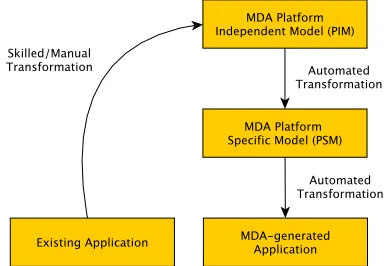
the ideal situation it would be used by the Architecture-Driven Modernization approach [41] as shown in Fig. 1. The methodology is especially targeted for situations where the team producing the PIM includes at least some members of the development team. Unlike some other papers [35], the paper includes an in-depth case study on how the methodology has been applied to a real world application. Initially the methodology advocated the generation of busi-ness model only [36]. As described here, it has been extended to include the generation of the hypertext model as well (leaving the presentation model aside as it is not needed if the application is reengineered). The generated class di-agrams are now fully object oriented and by far the most critical part, i.e., the generation of the activity diagrams, has been improved significantly with (a) a new step of dead code elimination and (b) semi-automatic code simplification. Furthermore, the latest experiences with the described method are included as well.
Nowadays a large number of different languages, technologies and tools for the development of web applications is available. Hence, a completely general description of reverse engineering is almost impossible to formulate: either it is too general to be valuable as no concrete actions and procedures can be de-scribed or in trying to be comprehensive it becomes too large and imprecise. To ensure the paper has a practical value, the approach is given for the Oracle DB and Oracle Portal1as the selected case study is based on this technology. It is believed the Oracle technology is a good choice for presenting the new ap-proach as it is (1) wide spread, (2) suitable for implementing the most complex web applications, and (3) a market leader and model for others. However, as PL/SQL is not object oriented (OO), reverse engineering of an existing PL/SQL application and generation of the PIM involve the shift to the OO-design.
The rest of the paper starts with Section 2 which contains an overview of the application used as a case study. Section 3 gives a short introduction into what the PIM of a web application should consist of. Section 4 describes elimination of unused parts of the application. Sections 5 and 6, the core of the paper, describe how the PIM can be extracted from an existing web application. The next two sections present the practical experience gained while producing the PIM for the actual real-world web application, and the discussion. The paper is concluded with a section on related work and conclusion. For the purpose of this paper, figures obtained from the generated diagrams have been manually translated to English.
2.
A student information system as a case study
As the procedure presented in this paper sprang from practice, a case-study based on a web student information system named e- ˇStudent (developed and initially deployed at the Faculty of Computer and Information Science of the University of Ljubljana, Slovenia) is to be introduced first [26, 27].
1
e- ˇStudent is a student information system developed and used at the Uni-versity of Ljubljana, Slovenia. It is a three-tier web application built using the Oracle DB and Oracle Portal technology and written primarily in PL/SQL with some JavaScript. It consists of almost 800 different programming objects (dy-namic pages, stored procedures and functions) with over 220.000 lines of code in total; its database contains almost 120 tables. The developer team consisted of people who were themselves developers and users at the same time, and hence the agile methodology seemed a natural choice [3, 29].
The development of e- ˇStudent started in 2001 and by 2003 the initial release has been used by most faculties of the University of Ljubljana. Its main functions are providing electronic support for student enrollment, management of exami-nation records and grades, and keeping the alumni records. All together it has been used by approximately 20.000 users (students, professors and staff). In 2008 the University of Ljubljana decided to replace e- ˇStudent with at that time yet nonexistent successor. The reasons were many. First, the existing e- ˇStudent was designed to be used by a single faculty and therefore different faculties were running their own instances instead of a single inter-faculty instance de-sired by the University. Second, as the number of elective courses increased dramatically by the introduction of the imminent new Bologna study programs (compared with the old pre-Bologna programs), the structure of the study pro-grams was modified significantly and, sometimes even within the same faculty, in different directions.
The new system built after 2008 did not meet the expectations as it was focused more on implementing additional functionalities and less on suitable implementation of the existing, i.e., essential, ones. After the new system was made and evaluated it has been realized that during the development and main-tenance of the original e- ˇStudent a huge amount of the domain knowledge had been accumulated. In fact, due to the turbulent times of the Bologna reform, the source code of e- ˇStudent is most likely the most comprehensive and the most formal specification of the student examination process. It is precisely this domain knowledge that should be extracted during reverse engineering, and it should be extracted as a model suitable for the development of e- ˇStudent’s suc-cessor after the first attempt, i.e., without e ˇStudent domain knowledge, failed.
3.
Platform independent model of a web application
Model-driven development is based on a notion of automatic transformations between different models describing an application on different levels. In the ideal situation, a developer would produce a platform independent model (PIM), add some platform specifications to reach the platform specific model (PSM), and finally generate the application [24]. Apart from this, the PIM provides a standard way to model an application in a technology independent way, i.e., by using UML diagrams. This approach is supported by a number of tools [42].
For web applications it has been advised [32] that the PIM should consist of
Using Reverse Engineering to Construct the PIM of a Web App for Student IS
– a hypertext model, and – a presentation model.
Apart from the (usual) business model describing the business processes, the hypertext model describes how web pages are built and linked while the presen-tation model contains details of the graphic appearance of a web application. The three-model web application description is a prevalent approach supported by most methods, however other model names, i.e., content, navigation and behavior model, may be used instead [7, 42].
It has been shown that by using the appropriate MD methodology, namely URDAD [39], out of 13 different kinds of UML diagrams only the following 4 kinds of diagrams are sufficient to produce the business model:
– class diagram, – use case diagram, – activity diagram, and – sequence diagram.
The first three types are usually produced during the analysis phase (which is not an issue in reverse engineering) while all four types are needed during the design phase. Class diagrams are used for the service contract and for the collaboration context, use case diagrams are used for the responsibility identi-fication and allocation, activity diagrams specify the full business process while sequence diagrams denote the user work flow and the success scenario [39].
The hypertext model is an abstract description of the composition and navi-gation between web application pages, page elements, and fragments of page elements [32]. This model is especially important in case of dynamic web ap-plications with their distributed integration, user directed flow of execution and dynamic creation of HTML forms [33].
In most cases the PIM of an existing application is needed when the ap-plication must be reimplemented using the new platform. Hence, the focus is on the business model and the hypertext model; the presentation model is less important as it is to be replaced by a new one suitable for the new platform.
4.
Elimination of the dead code and the dead data
During the development and especially during the maintenance developers pro-duce a number of redundant code and data objects which are not used by the application anymore. Some of these objects might contain older or alternate solutions, some are temporary data collections, etc. Most of them are obsolete or even invalid.
The technique for dead code and dead data elimination is pretty straight-forward: all objects not identified as live are considered dead. Live objects are identified using the following two steps:
User pages Dyn. pages Procedures Functions Tables Triggers
All objects 288 253 523 291 382 65
Live objects 236 186 388 207 117 58
Percentage 81.94 73.52 74.19 71.13 30.63 89.23
Table 1.The summary of dead code and dead data elimination.
and start pages of Portal user groups are retrieved from the Portal’s Data Catalog.
2. Computing all live objects: Once the root objects are known, all objects reachable from the root objects must be identified. In other words, a tran-sitive closure of the set containing the root objects must be computed. The connections among objects can be obtained by (a combination of) the fol-lowing two methods:
– by inspecting the metadata contained in the Portal’s Data Catalog; – by parsing every object and extracting all links to other objects.
Inspecting the metadata can most often produce perfectly adequate results. However, if nonstandard techniques have been used, the second method must be used also — it requires more effort since a parser for every pro-gramming language used within the application must be produced.
Note that the dead code elimination works on entire objects: if an object, i.e., a dynamic page, stored procedure or function, is found to be used, its entire contents is considered as live — dead code elimination within each particular code object is performed during the construction of activity diagrams.
Case study: e- ˇStudent is an application made in Oracle Portal using Oracle DB. By inspecting the application’s metadata in Oracle Portal the application’s start page, five user groups and start pages for each user group were identified.
The core of the entry point for each user group is designed as a menu imple-mented in JavaScript (see also the description of use case diagrams below). By parsing JavaScript implementations of menus for all user groups the initial list of live user pages was obtained. Using Portal’s Data Catalog all other live objects of the application were determined; apart from the user pages the list of live objects includes dynamic pages, stored procedures and functions, database tables and triggers.
Using Reverse Engineering to Construct the PIM of a Web App for Student IS
5.
Producing the business model
5.1. Class diagrams
Class diagrams represent the static structure of software systems in a graphical way [31]. Hence, it describes the structure of data and the structure of business processes.
In reverse engineering of a non-OO application based on the relational database the structure of data is obtained from the entity relationship model (ERM). The ERM might not exist or might be outdated, but it can be generated by inspecting the database using standard database tools. Once the relevant ERM is obtained, it is first transformed automatically into the conceptual class diagram, i.e., a class diagram without methods. This transformation encom-passes the following rules [40]:
– Class definition: each entity is transformed into a separate class without any methods.
– Attribute definition: all table fields are transformed into attributes of appro-priate classes.
– Associations definition: relations are transformed into associations and ag-gregations.
The names of classes and attributes are the same as the names of the cor-responding entities and fields; classes corcor-responding to composite types get synthetic names.
The list of different tools that can carry out this transformation (at least to some degree if not entirely) includes tools like ‘PowerDesigner’ by SAP Sy-base [4], ‘UML Modeler for SQL’ by Entrionics [2], and ‘Altova UMODEL 2012’ by Altova [1].
Although conceptional class diagram can be considered adequate [40], the proper way is to augment its classes with methods so that the resulting class diagram includes the description of behavior. During reverse engineering, the behavior is extracted from the stored procedures and functions of an existing application. To enhance the class diagram with methods, each stored procedure and function should be mapped into a method of a certain class. In cases where a stored procedure or function is associated with one table only, it is automati-cally transformed into a method of a class representing that table. Otherwise, a skilled analyst should manually determine the appropriate class.
12/8/12 4:32 PM
Page 1 of 1 file:///Users/sliva/Downloads/s3c.svg 0..* PRED_ASIS_DEL_A_FK 0..* PRED_ASIS_DEL_FK 0..* PO_IZJ_FK 0..* PO_PRE_FK 0..* PP1_IZJ_FK 0..* PP1_PRE_FK 0..1 0..* 1..1 0..* 1..1 0..* 1..1 0..* 1..1 0..* 1..1 0..* 1..1 0..* 1..1 0..* 1..1 0..* 1..1 0..* 0..1 0..* 0..1 0..* 0..1 0..* 0..1 0..* 0..1 0..* 0..1 0..* 0..1 0..* 1..1 0..* 0..1 0..* 1..1 0..* 1..1 0..* 1..1 0..* 1..1 0..* 1..1 0..* 1..1 0..* 1..1 0..* 1..1 0..* 1..1 0..* 1..1 0..* 1..1 0..* 1..1 0..* 1..1 0..* 1..1 0..* 1..1 0..* 1..1 0..* 1..1 0..* 0..1 0..* 0..1 0..* 1..1 0..* 0..1 0..* 0..1 0..* 1..1 0..* 0..1 0..* 1..1 0..* 0..1 0..* 0..1 0..* 0..1 0..* 0..1 0..* 0..1 0..* 0..1 0..* 0..1 0..* 0..1 0..* 0..1 0..* 1..1 0..* 0..1 0..*
0..10..1 0..*0..*
0..1 0..* 0..1 0..* 0..1 0..* 0..1 0..* 0..1 0..* 0..1 0..* 1..1 0..* 1..1 0..* 1..1 0..* 0..1 0..* 0..1 0..* 0..1 0..* 0..1 0..* 0..1 0..* 0..1 0..* 0..1 0..* 0..1 0..* 0..1 0..* 1..1 0..* 1..1 0..* 1..1 0..* 1..1 0..* 0..1 0..* 1..1 0..* 1..1 0..* 1..1 0..* 1..1 0..* 1..1 0..* 1..1 0..* 1..1 0..* 1..1 0..* 1..1 0..* 1..1 0..* 1..1 0..* 1..1 0..* 1..1 0..* 1..1 0..* 1..1 0..* 1..1 0..* 1..1 0..* 0..1 0..* 1..1 0..* 1..1 0..* 1..1 0..* 1..1 0..* 1..1 0..* 1..1 0..* 1..1 0..* 1..1 0..* 1..1 0..* 0..1 0..* 1..1 0..* 1..1 0..* 1..1 0..* 1..1 0..* 1..1 0..* 1..1 0..* 0..1 0..* 1..1 0..* 1..1 0..* 1..1 0..* 1..1 0..* 1..1 0..* 1..1 0..* 1..1 0..* 1..1 0..* 1..1 0..* 1..1 0..* 1..1 0..* 1..1 0..* 1..1 0..* 0..1 0..* 1..1 0..* 1..1 0..* 0..1 0..* 0..1 0..* 1..1 0..* 1..1 0..* 1..1 0..* 1..1 0..* 1..1 0..* 1..1 0..* 1..1 0..* 1..1 0..* 1..1 0..* 1..1 0..* 1..1 0..* 0..1 0..* 0..1 0..* 1..1 0..* 0..1 0..* 0..1 0..* 0..1 0..* 0..1 0..* 0..1 0..* 0..1 0..* 0..1 0..* 0..1 0..* 0..1 0..* 0..1 0..* 0..1 0..* 0..1 0..* 0..1 0..* 0..1 0..* 0..1 0..* 0..1 0..* 0..1 0..* 0..1 0..* 0..1 0..* 0..1 0..* 0..1 0..* 0..1 0..* 0..1 0..* 0..1 0..* 0..1 0..* 0..1 0..* 0..1 0..* 1..1 0..* 0..1 0..* 0..1 0..* 0..1 0..* 0..1 0..* 0..1 0..* 0..1 0..* 1..1 0..* 0..1 0..* 0..1 0..* 0..1 0..* 0..1 0..* 0..1 0..* 0..1 0..* 0..1 0..* 0..1 0..* 0..1 0..* 0..1 0..* 0..1 0..* 0..1 0..* 0..1 0..* 0..1 0..* 0..1 0..* 1..1 0..* 1..1 0..* 1..1 0..* 0..1 0..* 0..1 0..* 1..1 0..* 1..1 0..* 0..1 0..* 1..1 0..* 1..1 0..* 1..1 0..* 1..1 0..* 0..1 0..* 0..1 0..* 1..1 0..* 0..1 0..* 0..1 0..* 0..1 0..* 1..1 0..* 1..1 0..* 1..1 0..* 1..1 0..* 0..1 0..* 1..1 0..* 0..1 0..* 1..1 0..* 1..1 0..* 1..1 0..* 1..1 0..* 1..1 0..* 1..10..* 1..1 0..* 0..1 0..* 0..1 0..* 1..1 0..* 1..1 0..* 1..1 0..* 0..* EKV_PRE_B_FK 0..* EKV_PRE_FK 0..* PD_PRE_FK 0..* PD_VSI_FK ABSOLVENT + + + + + + + + ZAP_ST ABS_STAZ USR_INS TS_INS IP_INS IP_UPD TS_UPD USR_UPD : double : Date : String : Date : String : String : Date : String APP + + + + + + + + STUD_LETO ZG_MEJA IP_INS IP_UPD USR_INS USR_UPD TS_INS TS_UPD : double : String : String : String : String : String : Date : Date BIVANJE + +BIVANJE
POMEN_BIV: String : String CENIK + + + + + + + + + + + + SIFRA_STORITVE OPIS_STORITVE CENA MERSKA_ENOTA KONTO1 KONTO2 KONTO3 KONTO4 STROSKOVNO_MESTO STROSKOVNI_NOSILEC VIR_FINANCIRANJA STOPNJA_DDV : double : String : double : String : String : String : String : String : String : String : String : double CENTRI + + + VRSTA_STUD IME_CENTRA ULICA_CENT : String : String : String DAT DVIG + + + + MESEC_DV DAN_DV MESEC_ODD DAN_ODD : double : double : double : double DELAVEC + + + + + + + + + + + + DELAVEC PRIIMEK_D IME_D EMAIL GESLO IP_INS IP_UPD USR_INS USR_UPD TS_INS TS_UPD IND_VELJ : String : String : String : String : String : String : String : String : String : Date : Date : double DELNA_OC + + + + + + + + + + + + + + + + + LETNIK LETO_UN DELEZ_I DELEZ_V URE1_SL URE2_SL URE3_SL URE4_SL NADALJ IP_INS IP_UPD USR_INS USR_UPD TS_INS TS_UPD KRED_TOCKE IND_ZAKLJUC : double : double : double : double : double : double : double : double : double : String : String : String : String : Date : Date : double : double DINAMICNA_TABELA + + + + + + + + + + + + + + + + + + + + + + + + ID_SESSION ID_REPORT ZAP_ST DATUM COL1 COL2 COL3 COL4 COL5 COL6 COL7 COL8 COL9 COL10 COL11 COL12 COL13 COL14 COL15 COL16 COL17 COL18 COL19 COL20 : double : String : double : Date : String : String : String : String : String : String : String : String : String : String : String : String : String : String : String : String : String : String : String : String DIPLOMA + + + + + + + + + + + + + + + + + + + + + + DATUM_DV ROK_ODD DATUM_ODD DATUM_POD PO_IZP PO_VAJ DPO_IV PRVI_TU SL_ABS ST_DIPL OCENA_DN OCENA_ZG DATUM_Z OCENA_ZS PRILOGA_DIPL IP_INS IP_UPD USR_INS USR_UPD TS_INS TS_UPD PRILOGA_DIPL_ANG : Date : Date : Date : Date : double : double : double : Date : double : String : double : double : Date : double : String : String : String : String : String : Date : Date : String DOD_IZP + +DOD_IZP
POMEN_DI: String : String DRUZ_RAZ + + DRUZ_RAZ OPIS_DR : String : String DRZAVA + +DRZAVA
IME_DRZ: String : String EKVIVAL + + + + + + IP_INS IP_UPD USR_INS USR_UPD TS_INS TS_UPD : String : String : String : String : Date : Date FREKVENCA + + + + + + + + + + STUD_LETO LETNIK DATUM_FREKV FREKVENCA IP_INS IP_UPD USR_INS USR_UPD TS_INS TS_UPD : double : double : Date : String : String : String : String : String : Date : Date GESLO + + + + + + GESLO_I MAIL_ADDRESS USERNAME GESLO_M GESLO_CIT GESLO_EDU : String : String : String : String : String : String IZBIRNI + + + + + + IP_INS IP_UPD USR_INS USR_UPD TS_INS TS_UPD : String : String : String : String : Date : Date IZBIRNI3 + + + + + + IP_INS IP_UPD USR_INS USR_UPD TS_INS TS_UPD : String : String : String : String : Date : Date IZJEME + + + + + + + + + + LETNIK LETO_UN SKUPINA D_VELJAV IP_INS IP_UPD USR_INS USR_UPD TS_INS TS_UPD : double : double : String : Date : String : String : String : String : Date : Date IZPIT + + + + + + + + + + + + + DATUM_OC ST_POL OCENA_I OCENA_V ST_POL1 VPIS_ST IP_INS IP_UPD USR_INS USR_UPD TS_INS TS_UPD VELJAVEN : Date : double : String : String : double : String : String : String : String : String : Date : Date : double IZPRASEVALEC + + + + + + + + IZPR OPIS_IZPR IP_INS IP_UPD USR_INS USR_UPD TS_INS TS_UPD : String : String : String : String : String : String : Date : Date JEZIK + +JEZIK
IME_JEZ: String : String KANDIDAT + + + + + + + + + + + + + + + + + + + + + + + + + + + + + + + + + + + + + + + KANDIDAT PRIIMEK IME SPOL EMSO ULICA_S ULICA_S1 DRZAVLJAN LETO_SS MLAD_ODR LETO_D STOPNJA_D DEL_DOBA USPEH_3 USPEH_4 USPEH_ZI USPEH_VS OCENA_DIP ST_1_MEST ST_2_MEST ST_3_MEST ZE_VPISAN ZSS IZJAVA PDRZAVLJ KRAJ ZELJA LETNIK MORA_DIF MORA_DIF1 MORA_PR MORA_PR1 MATICNA_PR TEST TELEFON GSM E_MAIL MATURA TOCKE : String : String : String : double : String : String : String : String : double : double : double : double : double : double : double : double : double : double : double : double : double : double : String : String : String : String : double : double : double : double : double : double : double : String : String : String : String : String : double KLASIUS_SRV + + + + + SIFRA OPIS OPIS_ORG NACIN_ZAK_SOL_ZN_NASLOV RAVEN : String : String : String : String : String KOMISIJA + SKUPINA : String
MATURA + +MATURA
POMEN_MAT: String : String NACIN + + NACIN NAZIV_NAC : String : String NAC_IZV + + NAC_IZV OPIS_NAC_IZV : String : String NAC_OC + + NAC_OC POMEN_NOC : String : String NAMEN_PL + + NAMEN_PL OPIS : String : String NAMERA_Z + + NAMERA_Z OPIS_NZ : String : String NAPAKA_IZPIT + + + + + TS KODA SPOROCILO VPIS_ST ID_ROK : Date : double : String : String : double NAROD + +NAROD
IME_NAROD: String : String OBCINA + + + + + + + + OBCINA IME_OBC IP_INS IP_UPD USR_INS USR_UPD TS_INS TS_UPD : String : String : String : String : String : String : Date : Date OBVESTILA + + + + + + + + + + + + + + + LETNIK STUD_LETO NASLOV_OBV OPRAVIL TEKST_OBV LETO_PRED DATUM ST_OBVESTILA IP_UPD IP_INS USR_INS USR_UPD TS_INS TS_UPD KOLOKVIJ : double : double : String : String : String : double : Date : double : String : String : String : String : Date : Date : String OBV_PRED + + + + + + VSI SKUPINA LETNIK OZN_SKUP VRSTA_OC STATUS : String : String : double : double : String : String OBV_SKUP + + + + + LETNIK OZN_SKUP NAP_PON GLAVA ST_OPR : double : double : String : String : double OBV_STATUS + + STATUS OPIS_STATUSA : String : String PAGE_ID + + + + + + MENU_ID PAGE_ID PAGE_NAME PAGE_ID_PIS PAGE_ID_SKRB IND_DOSTOP : double : String : String : String : String : String PARAMETER + + + + + + + + + PARAMETER OPIS VREDNOST IP_INS IP_UPD USR_INS USR_UPD TS_INS TS_UPD : String : String : String : String : String : String : String : Date : Date PLACNIK + +PLACNIK
POMEN_PL: String : String POKLIC + + + + POKLIC IME_POK POKLIC_MSS POKLIC_ST : String : String : double : double POKLIC_S + + POKLIC_S IME_POK_S : String : String POLOZAJ + +POLOZAJ
IME_POL: String : String POS_POTREBA + + POS_POTREBA POMEN_POS_POTREBA : String : String POSTAVKA_DOBROPISA + + + + + + + VEZA IP_INS IP_UPD USR_INS USR_UPD TS_INS TS_UPD : double : String : String : String : String : Date : Date POSTAVKA_RACUNA + + + + + + + + + + + + + + + ID_POSTAVKE_R OPIS_STORITVE DATUM_STORITVE KOLICINA ZNESEK STOPNJA_DDV RACUN_ST DATUM_STORNACIJE_POSTAVKE STORNIRAL IP_INS IP_UPD USR_INS USR_UPD TS_INS TS_UPD : double : String : Date : double : double : double : String : Date : String : String : String : String : String : Date : Date POSTE + + + + + + + + POSTA IME_POSTE IP_INS IP_UPD USR_INS USR_UPD TS_INS TS_UPD : double : String : String : String : String : String : Date : Date POTRDILO + + + + + + + ST_POTRDILA IP_INS IP_UPD USR_INS USR_UPD TS_INS TS_UPD : double : String : String : String : String : Date : Date PP + + + + + + + STUD_LETO IP_INS IP_UPD USR_INS USR_UPD TS_INS TS_UPD : double : String : String : String : String : Date : Date PRAZNIK + + DATUM IME_PRAZ : Date : String PRED_AT + + + + + + + + + + + + + LETO_UN URE1_SK URE2_SK URE3_SK URE4_SK IP_INS IP_UPD USR_INS USR_UPD TS_INS TS_UPD KVOTA PROSTI : double : double : double : double : double : String : String : String : String : Date : Date : double : double PRED_DIF + + + + + + IP_INS IP_UPD USR_INS USR_UPD TS_INS TS_UPD : String : String : String : String : Date : Date PRED_IZB + + + + + + + + + + + + + + + + + + + + + + + + + + + LETNIK SEMESTER IZBIRNI NADALJ STROKOVNI URE1_SL URE1_T URE1_T1 URE2_SL URE2_T URE2_T1 URE3_SL URE3_T URE3_T1 URE4_SL URE4_T URE4_T1 LETO_UN IP_UPD IP_INS USR_INS USR_UPD TS_INS TS_UPD KRED_TOCKE KRED_TOCKE_PRAVE NABOR : double : String : double : double : double : double : double : double : double : double : double : double : double : double : double : double : double : double : String : String : String : String : Date : Date : double : double : String PREDMET + + + + + + + + + + + + + + PREDMET IME_PRED DOD_OBV MAX_ST_TOCK MEJA_POZITIVNO IP_INS IP_UPD USR_INS USR_UPD TS_INS TS_UPD ROK_ZA_SKUPINO DOLGO_IME DOLGO_IME_ANG : String : String : double : double : double : String : String : String : String : Date : Date : String : String : String PREDMET_KOL + + + + + + + + + + + + + + + STUD_LETO ST_KOL MEJA_OPR DATUM_PK URA_PK MIN_POVPRECJE IP_INS IP_UPD USR_INS USR_UPD TS_INS TS_UPD STEVILKA_KOL MAX_TOCK VSI_STUDENTI : double : double : double : Date : String : double : String : String : String : String : Date : Date : double : double : double PRED_OBC + + + + + + IP_INS IP_UPD USR_INS USR_UPD TS_INS TS_UPD : String : String : String : String : Date : Date PREDPOG + + + + + + + IP_INS IP_UPD USR_INS USR_UPD TS_INS TS_UPD LETO_UVELJ : String : String : String : String : Date : Date : double PRED_PR + + + + + + IP_INS IP_UPD USR_INS USR_UPD TS_INS TS_UPD : String : String : String : String : Date : Date PREHRANA + +PREHRANA
POMEN_PREH: String : String PRE_PRE + + + + + + IP_INS IP_UPD USR_INS USR_UPD TS_INS TS_UPD : String : String : String : String : Date : Date PRIJAVA + + + + + + + + + + + + + + + + + + + + DATUM_ODJ DATUM_PRIJ DATUM_ZP ST_POL ST_POL1 ST_POL2 SL_POS KOLOK LETNIK PLACA_IZP ST_TOCK_OST ST_TOCK_PISNI IP_INS IP_UPD USR_INS USR_UPD TS_INS TS_UPD OPOMBE SKUPINA : Date : Date : Date : double : double : double : double : double : double : double : double : double : String : String : String : String : Date : Date : String : String PRIJAVA_KOL + + + + + + + + + STUD_LETO IP_INS IP_UPD USR_INS USR_UPD TS_INS TS_UPD TREN_POVPRECJE OCENA_ZE_VPISANA : double : String : String : String : String : Date : Date : double : double PRIJAVA_U + + + + + + + + + DATUM_ODJ IP_INS DATUM_PRIJAVE IP_UPD USR_INS USR_UPD TS_INS TS_UPD URA_IZPITA : Date : String : Date : String : String : String : Date : Date : String PRILOGA_DIPLOME + + + + DOKUMENT OPIS TEMPLATE TEMPLATE_ANG : String : String : String : String PRISPEVEK + + PRISPEVEK POMEN_PR : String : String RACUN + + + + + + + + + + + RACUN_ST DATUM_IZDAJE_RACUNA DATUM_STORITVE ROK_PLACILA IP_INS IP_UPD USR_INS USR_UPD TS_INS TS_UPD SKLIC : String : Date : Date : Date : String : String : String : String : Date : Date : String RANGIRANJE + + + ID ZAP_ST RANG : double : double : double REZULTAT_KOL + + + + + + + + ZAP_ST_KOL ST_TOCK IP_INS IP_UPD USR_INS USR_UPD TS_INS TS_UPD : double : double : String : String : String : String : Date : Date ROK + + + + + + + + + + + + + + + DEJ_STEV ID_ROK MAX_STEV DATUM_IZP PROSTOR URA MEJA SKPN_ST_TC IP_INS IP_UPD USR_INS USR_UPD TS_INS TS_UPD STEV_KOMIS : double : double : double : Date : String : String : String : String : String : String : String : String : Date : Date : double ROK_U + + + + + + + + + + + + + + + DATUM_UST PROSTOR URA MAX_STEV DEJ_STEV ID_ROK_U IP_INS IP_UPD USR_INS USR_UPD TS_INS TS_UPD STEV_KOMIS DOLZINA_INTERVALA STEVILO_NA_INTERVAL : Date : String : String : double : double : double : String : String : String : String : Date : Date : double : String : double SALDO + + + SALDO RACUN_ST ROK_PLACILA : double : String : Date SIFRANT_DATA + + + + + + + + ID_TABLE F_OD F_DO TABLE_NAME SORT_COLUMN FROM_PART WHERE_PART TABLE_DESC : String : double : double : String : String : String : String : String SIFR_LOOKUP_DATA + + + + + SIFR_TABLE SIFR_COLUMN LOOK_TABLE LOOK_COLUMN LOOK_CAPT_COLUMN : String : String : String : String : String SKLEPI + + + + + + + + + + ST_SKLEPA ORGAN DATUM_S VSEBINA_S IP_INS IP_UPD USR_INS USR_UPD TS_INS TS_UPD : double : String : Date : String : String : String : String : String : Date : Date SKPOBV
+ SKPOBV : String
SKPP + + + + + + + + + STUD_LETO VIP_SMER ZG_MEJA IP_INS IP_UPD USR_INS USR_UPD TS_INS TS_UPD : double : String : String : String : String : String : String : Date : Date SKUPINA + + + + + + + + SKUPINA IME_SK IP_INS IP_UPD USR_INS USR_UPD TS_INS TS_UPD : String : String : String : String : String : String : Date : Date SLED_IZDELAVE_RACUNOV + + + + + + + DATUM_IZDELAVE ZAP_ST ZACETEK_POSTOPKA KONEC_POSTOPKA PRVI_RACUN ZADNJI_RACUN NACIN_IZDELAVE : Date : double : Date : Date : String : String : String SMER + + + + + + + + + + + + + SMER IME_SMERI IME_SMERI_K VELJA_OD VELJA_DO VRSTA_PROG STAT_89 IP_INS IP_UPD USR_INS USR_UPD TS_INS TS_UPD : String : String : String : double : double : String : double : String : String : String : String : Date : Date SPP + + + + + + + + + STUD_LETO VIP_SMER ZG_MEJA IP_INS IP_UPD USR_INS USR_UPD TS_INS TS_UPD : double : String : String : String : String : String : String : Date : Date SREDSOLA + + + + + + + + + SREDSOLA DO_LETA IME_SS1 IME_SS2 IME_SS3 ULICA SRED_MSS OD_LETA IME_K : String : double : String : String : String : String : double : double : String STANJE + + + + + + + + STUD_LETO LETNIK IP_INS IP_UPD USR_INS USR_UPD TS_INS TS_UPD : double : double : String : String : String : String : Date : Date STAT_POS + +STAT_POS
POMEN : String : String STAT_PR + + STAT_PR POMEN_SP : String : String STATUS_POSTAVKE + + STATUS_POSTAVKE POMEN : String : String STOP_IZ + +STOP_IZ
POMEN_SI: String : String STOPNJA + + + + STOPNJA IME_STOP IND_VELJ IND_VPIS : String : String : String : String STUD + + + + + + + + + + + + + + + + + + + + + + + + + + + + + + + + + ULICA_Z VRSTA_ST PRVI_TU PRVI_STUD SPOL DATUM_R LETO_SS USPEH_SS USPEH_MA TOCKE_MA TOCKE_PZ TOCKE_SK UVRSTITEV VOZNJA STIP ZNESEK DRUZ_POK LETO_VS LETO_VIS OCENA_VIS ZAP_ST DO_ZAP DEL_DOBA PLACANO DATUM_PL IME_OM VROCANJE_S VROCANJE_Z PRVI_TU_LETNIK SOGLASJE1 SOGLASJE2 SLOVBREZDRZ OCENA_VS : String : String : double : double : double : Date : double : double : double : double : double : double : double : String : String : double : double : double : double : double : String : String : double : double : Date : String : String : String : double : String : String : String : double STUDENT + + + + + + + + + + + + + + + + + + + + + + + + + + + + PRIIMEK IME DATUM_ROJSTVA EMSO GESLO ULICA_S ULICA_S1 ULICA_P ULICA_P1 VPIS_ST KRAJ_ROJSTVA BLOKADA GSM EMAIL STATUS PRIJAVA IP_INS IP_UPD USR_INS USR_UPD TS_INS TS_UPD STU_PRIJAVA ST_OBVESTIL DNI_OBVESTILA TELEFON PRIIMEK_DEKLISKI DAVCNA_ST : String : String : Date : String : String : String : String : String : String : String : String : double : String : String : String : double : String : String : String : String : Date : Date : double : double : double : String : String : String SUM_OCEN_LETNIK_VSI + + + + + + + + + + ID ZAP_ST VSI LETNIK AVG_POLAGANJA_IZPIT AVG_POLAGANJA_VAJE AVG_OCENA_IZPIT AVG_OCENA_VAJE AVG_OCENA_IZPIT_POZ AVG_OCENA_VAJE_POZ : double : double : String : double : double : double : double : double : double : double TEMA + + + + + + + + + + + ST_TEME NASLOV_TEME ST_DVIGOV KRATEK_OPIS IP_INS IP_UPD USR_INS USR_UPD TS_INS TS_UPD NASLOV_TEME_ANG : String : String : double : String : String : String : String : String : Date : Date : String TMPPRIDNIH5 + + + + + + + + + + + VPIS_ST EMSO PRIIMEK IME POVPRECJE ST_IZPITOV ST_VAJ ST_OPR_IZPITOV ST_LET VSI LETNIK : String : String : String : String : double : double : double : double : double : String : double TOE + +TOE
NAZIV: String : String USMERJANJE + + + + + + ID URE URE_PRVI SKUPINA RANG PONAVLJANJE : double : double : double : double : double : double VAJE + + + + + + + + + + + + ST_POL1 OCENA ST_POL DATUM_OC VPIS_ST IP_INS IP_UPD USR_INS USR_UPD TS_INS TS_UPD VELJAVEN : double : String : double : Date : String : String : String : String : String : Date : Date : double VIP + + + + + + + + + + + + + + + USMERITEV VIP IME_VIP IME_VIP_K STOPNJA VELJA_OD VELJA_DO STAT_567 ST_SEM IP_INS IP_UPD USR_INS USR_UPD TS_INS TS_UPD : String : String : String : String : String : double : double : double : double : String : String : String : String : Date : Date VIP_F + + + PARAMETER VREDNOST OPIS : String : String : String VLOGA + + VPIS_ST DATUM : String : Date VPIS + + + + + + + + + + + + + + PLACANO DATUM_PL DATUM_ZAJ LETO_UN STUD_LETO LETNIK KRAJ IP_INS IP_UPD USR_INS USR_UPD TS_INS TS_UPD DALJAVA : double : Date : Date : double : double : double : String : String : String : String : String : Date : Date : double VPIS_DRUG + + VPIS_DRUG OPIS_VD : String : String VPIS_INT + + + + + + + + + + + + ZAP_ST IZB_SK LETNIK STEVILKA_PARA UPORABLJENO IP_INS IP_UPD USR_INS USR_UPD TS_INS TS_UPD IZBIRNI : double : String : double : double : double : String : String : String : String : Date : Date : double VPLACILO + + + + + ZAP_ST DATUM ZNESEK KREDIT TRANSAKCIJA : double : Date : double : double : String VRSTA + + + + VRSTA IME_V IND_VPIS IND_VELJ : String : String : String : double VRSTA_DOKUMENTA + + VRSTA_DOKUMENTA POMEN : String : String VRSTA_IZJEME + + VRSTA_IZJ IME_IZJEME : String : String VRSTA_OC + + + VRSTA_OC POMEN_VOC1 POMEN_VOC2 : String : String : String VRSTA_POT + + + VRSTA_POT NAZIV_VRSTE_POT OPIS : double : String : String VSI + + + + + + + + + + + + + + + VSI IME_VSI K_IME_VSI D_IME_VSI POKLIC PREIZKUS VELJA_OD VELJA_DO IME_IS IP_INS IP_UPD USR_INS USR_UPD TS_INS TS_UPD : String : String : String : String : String : String : double : double : String : String : String : String : String : Date : Date VSI_F + + + PARAMETER VREDNOST OPIS : String : String : String ZACPOI + + + + + + + + + + + + + SESSION_ID DATUM ZAP_ST VPIS_ST PREDMET LETNIK DATUM_IZP OCENA_IZP TIP MORA OPRAVIL VSI KT : double : Date : double : String : String : String : Date : String : double : double : double : String : double ZAHF + + + + + + ID NUM ST_ZAHTEVA ST_POTRDILA VPIS_ST VSI : double : double : double : double : String : String ZAH_IZVOZ + + + + SESSION_ID VRSTA USER_ID DATOTEKA : String : String : String : String ZAHTEVA + + + + + + + + + + + + + ST_POTRDIL ST_ZAHTEVE DATUM_ZAH DATUM_IZD ULICA_P ULICA_P1 IP_INS IP_UPD USR_INS USR_UPD TS_INS TS_UPD IZBRANO : double : double : Date : Date : String : String : String : String : String : String : Date : Date : String ZAVOD + + + + + + + + + + ZAVOD IME_ZAV ULICA STAT_1234 IP_INS IP_UPD USR_INS USR_UPD TS_INS TS_UPD : String : String : String : double : String : String : String : String : Date : Date
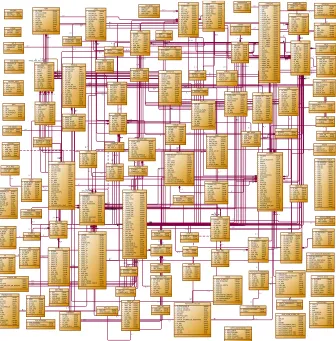
Fig. 2.The conceptual class diagram of e- ˇStudent.
In the second step, the conceptual class diagram was transformed into the proper OO class diagram. The associations, i.e., the mapping of stored pro-cedures and functions to tables, were first determined using the information available in Oracle DB Data Catalog and by subsequent parsing of stored pro-cedures and functions source code2. In cases where a single stored procedure
or function is associated with multiple tables, a heuristic was used to determi-ne the list of most probable tables a stored procedure or function belongs to: tables with a higher number of inter table associations are placed higher on the candidate list. For each such stored procedure and function its sorted list of table candidates was presented to the analyst. He first selected the right
2The parser was made using the ANTLR v3.5-based PL/SQL parser by Patrick Higgins,
Using Reverse Engineering to Construct the PIM of a Web App for Student IS 6/18/13 12:03 PM
Page 1 of 2 file:///Volumes/NO%20NAME/__COMSIS/class_diagram_1.svg EXAM_REG -STUD_ID EXAM_ID REGISTRATION_DATE CANCELATION_DATE LAST_REG_DATE REG_NUM REG_NUM1 REG_NUM2 ACADEMIC_YEAR MIDTERM YEAR PAYMENT_REQUIRED POINTS_ON_EXAM POINTS_LAB_WORK IP_INS IP_UPD USR_INS USR_UPD TS_INS TS_UPD REMARKS GROUP : String : String : Date : Date : Date : int : int : int : int : int : int : boolean : int : int : String : String : String : String : Date : Date : String : String + + + + + + + + + + FUN_EXAM_REGISTRATION () FUN_EXAM_CANCELATION () FUN_UPDATE_REMARKS () FUN_SAVE_EXAM_RESULTS () PROC_WRITTEN_EXAM_REG_LIST () PROC_ORAL_EXAM_REG_LIST () PROC_OPEN_EXAM_REG_LIST () PROC_WRITTEN_EXAM_REGISTRATION () PROC_ORAL_EXAM_REGISTRATION () PROC_UPDATE_REGISTRATION () ... : boolean : boolean : int : int : void : void : void : void : void : void PERSON -PERSON_ID SURNAME NAME PASSWORD IP_INS IP_UPD USR_INS USR_UPD TS_INS TS_UPD IND_VALID : String : String : String : String : String : String : String : String : Date : Date : int + + + + + + + + + + + + FUN_PERSON_NAME () FUN_ADD_PERSON () FUN_NAME_SURNAME () FUN_STAFF_PERSON () FUN_USER_IN_GROUP_STAFF () FUN_USER_IN_GROUP_PROF () PROC_PERSON () PROC_PERSON_SUBJECT () PROC_SELECT_PERSON () PROC_TRUSTEE () PROC_MENTOR () FUN_SAVE_PERFORMERS () ... : String : boolean : String : String : boolean : boolean : void : void : void : void : void : boolean PARAMETER -PARAMETER_ID DESCRIPTION VALUE IP_INS IP_UPD USR_INS USR_UPD TS_INS TS_UPD : String : String : String : String : String : String : String : Date : Date + + + + + + + + + + + + + FUN_PAR () FUN_PARN () FUN_TRS () FUN_ACADEMIC_YEAR () FUN_STAFF_NAME () FUN_ADMIN_NAME () FUN_NEW_STUD_ID () PROC_BANNER () PROC_EXCEPTION_PRINT () PROC_FORM_FOOTER () PROC_DATE_SELECTION () PROC_STATUS_REP () PROC_REPORT_START () : String : int : String : int : String : String : String : void : void : void : void : void : void PGID -MENU_ID PAGE_ID PAGE_NAME PAGE_ID_STAFF PAGE_ID_ADMIN IND_ACCESS : int : int : int : int : int : int + + FUN_PGID () FUN_ACCESS () : int : boolean
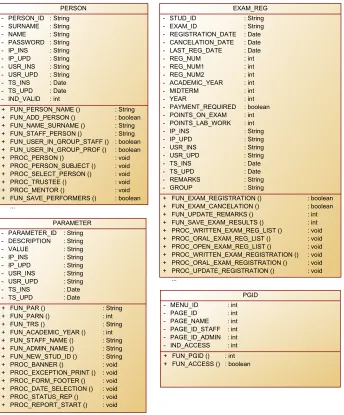
Fig. 3.Four classes of e- ˇStudent class diagram.
exist-ing e ˇStudent code, not added). Keeping the same names simplifies the analysts transition from the old application to the new model.
5.2. Use case diagrams
A use case diagram represents system functionality by exhibiting the interac-tions between system’s users and the transacinterac-tions that provide value to users. They display relationship between actors and use cases [31]. In reverse engi-neering they are important as they offer unrivaled top-down insight of the sys-tem’s functionality.
In most web applications, a use case diagram specifies a set of actions that can be performed by a certain user. In fact, as each user may play different roles, each use case diagram specifies main operations that can be performed by a particular user group. Hence a list of user groups must be retrieved from the system using one of the following two methods:
– by checking the list of user groups stored in the Portal;
– by inspecting the system from the user’s point-of-view (in most cases, user roles can be determined by inspecting how each user logs into the applica-tion).
Once the list of user roles is established, one use case diagram per each user group should be produced. The generation of the use case diagram de-pends heavily on the technology and tools the web application is made with, and therefore no list of procedures applicable to all and every tool can be given here — for the Oracle DB/Portal case, see the case study below.
Users performing different user roles might be allowed to perform operations common to many different roles. Although a clear sign of an incautious design, two situations can nevertheless arise in practice:
– One particular function is found in different use case diagrams, either under the same name or under different names.
– Two functions found in two different use case diagrams share the same name but denote two substantially different actions.
Using the static analysis of the code it is possible to check whether two functions are carried out by the same code. However, if they are not, the resolution must be made manually by a developer/analyst.
Case study: Initially, the five user roles of e- ˇStudent have been determined using the domain knowledge but the list of user roles kept by the Oracle Portal has been checked for verification.
The use case diagrams for e- ˇStudent were obtained from the e- ˇStudent menu files. The menu files were generated by HVMenu 5.413, a public-domain
3http://www.dynamicdrive.com/dynamicindex1/hvmenu; the latest version
Using Reverse Engineering to Construct the PIM of a Web App for Student IS
Alumni Menu
Thesis Topics
Thesis Assignments
Thesis Defense
All Thesis Data
Certificate
Thesis Appendix
Book of Alumni Records
List of Alumni Records
Number of Alumni Records
Alumni Analysis
Exit
New / Update
List
Printout
New / Update
Printout
Slovene version
English version
High School
High School Ratings
Overview
Fig. 4.The use case diagram for theses and alumni records: internal nodes represent (sub)-menus, leaves represent the main operations.
the diagrams using thedottool of GraphViz package by simply ranking graph nodes from left to right (rankdir=LR). Due to their size, only one of the re-sulting seven diagrams is shown; see Fig. 4. There are seven diagrams instead of five because the menu of one particular user group is split into three menus (one main menu and two submenus).
5.3. Activity diagrams
Activity diagrams are the most important artifacts in terms of the future reimple-mentation of the existing application as they denote the operational semantics of business processes [31].
At first glance, the activity diagrams can be produced automatically from the existing code. Certain tools are available, each specialized for a particular plat-form. However, no tool seems to be capable of generating activity diagrams for a real world application that would be suitable for reengineering the application. In most cases the generated activity diagrams are simply distilled code shown in a different form and thus they should not be used in the subsequent MDD for the following two reasons:
– The generated diagrams face granularity problem: understanding of the di-agrams is obstructed as too many unnecessary details are included while sometimes some important details are systematically omitted [23, 43, 44]. – The generated diagrams may include some bad design elements which
should not be propagated to the next versions of the application [23].
Hence, producing adequate activity diagrams cannot be fully automated but it can be machine supported. Namely, before the PL/SQL code is given to an analyst to retrieve the business logic, the code should be significantly simplified by automatically removing as much implementation details as possible. The heuristics used for code simplification is based on the classification of code fragments into the following categories:
– object structure items;
– control structures(declare,begin,end,if,for, etc.); – SQL blocks(cursor,select,update,fetch, etc.); – data presentation(htp.commands for data output); – data retrieval(textbox, submit, button, checklist, etc.); – stored procedure and functions calls;
– other PL/SQL code; – comments;
– other code.
Using Reverse Engineering to Construct the PIM of a Web App for Student IS
The simplification introduces a risk some important details are removed. The analyst must be aware of this and when in doubt the original code of each simplified fragment must be checked.
The described method of code simplification is derived from the method used for producing workflows in IBM WebSphere Business Integration Work-bench [43, 44], but it has been modified for the PL/SQL code in the Oracle platform — the list of categories has been compiled on the basis of authors’ experience.
The code simplified in this way is raised to a higher level of abstraction and enhances the productivity of the analyst. Once the analyst performs the transformation of the PL/SQL code, the activity diagram can be generated from the simplified PL/SQL code automatically.
Case study: To actually produce the activity diagrams for e- ˇStudent, the follow-ing sources needed to be reverse engineered:
– dynamic pages (HTML + PL/SQL),
– stored procedures and functions (PL/SQL), – reports (SQL),
– triggers (PL/SQL), and – JavaScript code.
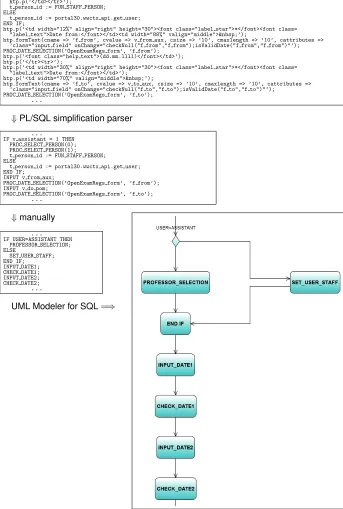
A naive approach of using a tool to generate activity diagrams, e.g., ‘UML Modeler for SQL’ as
PL/SQL code: DynPages,procedures,functions
↓UML Modeler for SQL
Activity Diagrams,
failed exactly for the reasons outlined above. For a single stored procedure the number of elements within the activity diagram produced automatically using some tool is proportional to the number of lines of codes, and such a diagram is not readable even in case of moderate size procedures [36].
Illustrating the processing of a complete dynamic page exceeds the avail-able space and thus only an excerpt is shown in Fig. 5. The first step consists of automatic PL/SQL code simplification. Classification of source code constructs and their subsequent removal or transformation in accordance with the rules specified above was implemented atop of another PL/SQL parser (also based on Patrick Higgins’s ANTLR v3-based PL/SQL parser, see Subsection 5.1). Af-ter manual inspection and further simplification the activity diagram was gener-ated using the reverse engineering options of ‘UML Modeler for SQL’.
. . .
IF v assistant = a THEN
htp.p(’<tr><td width="30%" align="right">’); PROC SELECT PERSON(0);
htp.p(’</td><td width="70%"> ’); PROC SELECT PERSON(1);
htp.p(’</td></tr>’);
t person id := FUN STAFF PERSON; ELSE
t person id := portal30.wwctx api.get user; END IF;
htp.p(’<td width="12%" align="right" height="30"><font class="label star">*</font><font class= "label text">Date from:</font></td><td width="88%" valign="middle"> ’);
htp.formText(cname => ’f from’, cvalue => v from aux, csize => ’10’, cmaxlength => ’10’, cattributes => ’class="input field" onChange="checkNull("f from","f from");isValidDate("f from","f from")"’); PROC DATE SELECTION(’OpenExamRegs form’, ’f from’);
htp.p(’<font class="help text">(dd.mm.llll)</font></td>’); htp.p(’</tr><tr>’);
htp.p(’<td width="30%" align="right" height="30"><font class="label star">*</font><font class= "label text">Date from:</font></td>’);
htp.p(’<td width="70%" valign="middle"> ’);
htp.formText(cname => ’f to’, cvalue => v to aux, csize => ’10’, cmaxlength => ’10’, cattributes => ’class="input field" onChange="checkNull("f to","f to");isValidDate("f to","f to")"’);
PROC DATE SELECTION(’OpenExamRegs form’, ’f to’);
. . .
. . .
IF v assistant = 1 THEN PROC SELECT PERSON(0); PROC SELECT PERSON(1); t person id := FUN STAFF PERSON; ELSE
t person id := portal30.wwctx api.get user; END IF;
INPUT v from aux;
PROC DATE SELECTION(’OpenExamRegs form’, ’f from’); INPUT v do pom;
PROC DATE SELECTION(’OpenExamRegs form’, ’f to’);
. . .
. . .
IF USER=ASSISTANT THEN PROFESSOR SELECTION; ELSE
SET USER STAFF; END IF; INPUT DATE1; CHECK DATE1; INPUT DATE2; CHECK DATE2;
. . .
⇓PL/SQL simplification parser
⇓manually
UML Modeler for SQL=⇒
Using Reverse Engineering to Construct the PIM of a Web App for Student IS
processing all this code objects is a tremendous task, but it is significantly re-duced using the automatic code simplification and automatic generation of ac-tivity diagrams using UML Modeler for SQL. In many cases, e.q., maintenance or consulting, not all activity diagrams should be produced.
In e- ˇStudent, the complexity of reports (generated using Oracle Report Buil-der), triggers and Javascript sources is not an issue. Therefore, they are con-sidered as an appendix to the business model.
5.4. Sequence diagrams
Sequence diagrams express interactions and data flow between different ob-jects within an application and thus describe a dynamic component of business processes. They may be used at different levels of abstraction to present differ-ent views of the application: usage scenarios (a description of a potdiffer-ential way the application is used), the logic of methods (explore the logic of a complex operation, function, or procedure) or the logic of services (a high-level method, often invoked by clients).
To generate sequence diagrams, a sequence of calls performed by every programming object must be obtained first. In PL/SQL code the programming object are dynamic pages (representing user’s main operations) and stored pro-cedures and functions (transformed to class methods).
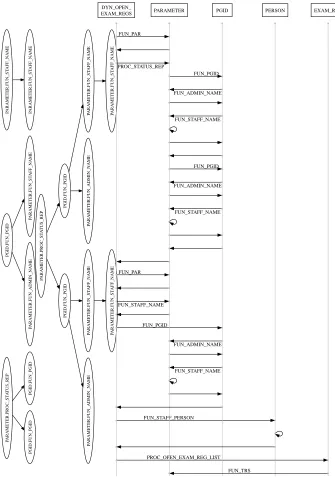
Next, for each object a direct call tree is constructed: the root node contains the artifact itself and the leaves contain, from left to right, the artifacts called. Thus, the direct call tree is an ordered tree of height 1 if there are some calls from the programming object in the root node or 0 otherwise.
A direct call tree is transformed into a complete call tree by repetitive re-placement of leaves with their direct call trees: a leaf is replaced if its direct call tree is of height 1 and no internal node on the path from the root to the leaf does not contain the programming object in the leaf. The transformation is completed once no leaf can be replaced any more.
Finally, the generated sequence diagram contains user’s main operations (found in the use case diagrams) and classes (found in the class diagram) in the head sections while transitions are obtained by a preorder traversal of the complete call tree.
In this manner, a complete sequence diagram is obtained statically (disre-garding PL/SQL control structures). There are at least two ways of producing the sequence diagram dynamically during reverse engineering. The first one is based on the reconstruction of clickstreams from the data obtained in the ap-plication’s log files accumulated over many years [34]. The other way is to con-struct and apply a comprehensive set of test cases [9]. Using the dynamic ap-proach, a number of sequence diagrams are obtained for each user’s main op-erations while using the static method outlined above one complete sequence diagram per user’s main operation, although bigger, is generated.
source code additionally relying on information stored in Portal’s Data Catalog. By another custom tool these sequences were transformed using the method described above into a GraphViz format and finally produced bydot.
An example of a sequence diagram is shown in Fig. 6. Due to the size of direct/complete call trees and the size of sequence diagrams, only a small ex-cerpt of a single sequence diagram can be presented.
6.
Producing the hypertext model
A suitable model is needed to adequately present the complex navigation of a dynamic web application. Several formal descriptions like FSM [10] and WebML [15] more or less meet this criterion, but the Atomic Section Model (ASM) [33] was chosen as it is capable of representing complex web applications with sim-ple graphs. Furthermore, it can be produced using the static analysis.
ASM is a well known model primarily developed for testing web applications. Each HTML page is represented by a Component Interaction Model (CIM); CIMs of all HTML pages are combined together into an Application Transition Graph (ATG) representing ASM. Thus, the ATG of a web application is the for-mal representation of the hypertext model.
The CIM of a single HTML page is a quadrupleCIM =hS,A,CE,Tiwith
– a set of start pagesSfrom which the page is referenced, – a set of atomic sectionsAthe page is made of,
– a component expressionCEdescribing the page structure, and – a set of transitionsTpointing from and to (other) HTML pages.
An atomic section (AS) is a basic block of PL/SQL code producing the HTML page contents send to a client. The component expression is a regular ex-pression denoting all possible sequences, selections and iterations of diverse ASs when dynamically constructing HTML page. All sets are fixed; in reverse engineering they can be retrieved by parsing HTML code or objects which dy-namically create HTML pages, and by some manual processing by an analyst.
Originally the first component of a CIM is a single start page [33]. However, to produce the adequate hypertext model the first component of a CIM must be a set of all pages pointing to a page the CIM is made for. This is important for the construction of the ATG.
The ATG of an application is a quadrupleATG =hΓ, Θ, Σ, αiwith
– a setΓ of software components (CIMs), – a setΘcontaining all transitions of all CIMs,
– a setΣof variables defining possible states of the presentation layer, and – a setαof of all diverse starting pages (usually one).
Using Reverse Engineering to Construct the PIM of a Web App for Student IS PA RA M E T E R.P RO C_S T A T U S _RE P P G ID .F U N _P G ID P G ID .F U N _P G ID P G ID .F U N _P G ID PA RA M E T E R.F U N _A D M IN _N A M E PA RA M E T E R.F U N _S T A F F _N A M E PA RA M E T E R.F U N _S T A F F _N A M E PA RA M E T E R.F U N _S T A F F _N A M E PA RA M E T E R.P RO C_S T A T U S _RE P P G ID .F U N _P G ID P G ID .F U N _P G ID PA RA M E T E R.F U N _A D M IN _N A M E PA RA M E T E R.F U N _S T A F F _N A M E PA RA M E T E R.F U N _A D M IN _N A M E PA RA M E T E R.F U N _S T A F F _N A M E PA RA M E T E R.F U N _S T A F F _N A M E PA RA M E T E R.F U N _S T A F F _N A M E DYN_OPEN_
EXAM_REGS PARAMETER PGID PERSON EXAM_REG
FUN_PAR PROC_STATUS_REP FUN_PAR FUN_STAFF_NAME FUN_PGID FUN_STAFF_PERSON PROC_OPEN_EXAM_REG_LIST FUN_PGID FUN_PGID FUN_ADMIN_NAME FUN_STAFF_NAME FUN_ADMIN_NAME FUN_STAFF_NAME FUN_ADMIN_NAME FUN_STAFF_NAME FUN_TRS FUN_TRS FUN_TRS FUN_TRS FUN_TRS FUN_TRS FUN_TRS FUN_TRS FUN_TRS FUN_TRS FUN_TRS FUN_TRS FUN_TRS FUN_TRS FUN_TRS FUN_TRS PROC_OBROBA FUN_PREDMET_SKUPINAH PROC_OBROBA PROC_OBROBA
Fig. 6.An example of a sequence diagram generation (only cca 15 % is shown). The transitions corresponding to the call ofPARAMETER.PROC STATUS REPfrom dynamic
pageDYN OPEN EXAM REGSis based on the complete call graph (center) produced from
the three direct call graphs (left).
A CIM is extracted from a dynamic page or a stored procedure using a method similar to extracting an activity diagram: it consists of (1) code sim-plification, (2) manual extraction of CIM structure and generation of graphical representation of CIM.
Code simplification is performed by the parser used for generation of ac-tivity diagrams except that the code fragments are classified into the following categories:
– presentation elements(code fragments which are copied to HTML page or produce the contents that is copied to HTML page);
– links(links to other HTML pages, SUBMIT parameter definitions, etc.); – control structures;
– procedure and function calls;
– other code(SQL blocks, declarations, etc.).
All fragments classified as ’other code’ are eliminated. Note that this code sim-plification concentrates on code fragments that were mostly left out by the code simplification used for producing activity diagrams.
Once the code is simplified, the CIM is produced manually by an analyst defining atomic sections and the control flow among them, and the transitions to and from other dynamic pages. Each atomic section represent a description of a group of presentation elements, stored procedure and function calls at a higher level of abstraction. The ATG is constructed simply by connecting CIMs using the transitions among them.
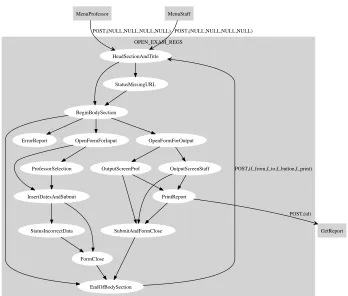
Case study: For instance, the CIM of a dynamic page for open exam regis-trations is shown in Fig. 7. It contains 15 atomic sections (labeled P1. . .P15)
connected as described by the regular expression
P1((P2|ε)P3((P4(P5|P6)(P7|ε)P8)|(P9(P10|ε)P11(P12|ε)P13)|ε)P15)|P14
whereP1is “HeadSectionAndTitle”,P2is “StatusMissingURL”, etc. Futhermore,
it contains 4 transitions, namely
MenuProfessor−→DYN OPEN EXAM REGS[POST(⊥,⊥,⊥,⊥)]
MenuStaff−→DYN OPEN EXAM REGS[POST(⊥,⊥,⊥,⊥)]
DYN OPEN EXAM REGS.PrintReport−→GetReport[POST(id)]
DYN OPEN EXAM REGS.EndOfBodySection−→
DYN OPEN EXAM REGS[POST(f from,f to,f button,f print)]
The first two transitions specify where is this dynamic page reachable from while the third one specifies which dynamic page is used after the main oper-ation performed by this dynamic page has been finished. The fourth transition specifies a return to the same dynamic page once the parameters have been refined using HTML form elements contained within the page.
Using Reverse Engineering to Construct the PIM of a Web App for Student IS
OPEN_EXAM_REGS
HeadSectionAndTitle
StatusMissingURL
BeginBodySection
OpenFormForInput OpenFormForOutput
EndOfBodySection ErrorReport
ProfessorSelection
InsertDatesAndSubmit
OutputScreenStaff
OutputScreenProf POST,(f_from,f_to,f_button,f_print)
PrintReport
SubmitAndFormClose StatusIncorrectData
FormClose
GetReport POST,(id) MenuProfessor
POST,(NULL,NULL,NULL,NULL) MenuStaff
POST,(NULL,NULL,NULL,NULL)
Fig. 7.The CIM for the dynamic page for processing open exam registrations.
classification as described above. Once the analyst produced the CIM descrip-tion, the graphical presentation of CIMs was generated using thedottool from the GraphViz package.
Apart from the four pages used during the login process, e- ˇStudent contains five entry points, one for each user group. After a quick check it was established that one CIM must be produced for each of 186 dynamic pages 349 of 388 stored procedures and 65 of 207 stored functions. Thus, the hypertext model of e- ˇStudent consists of almost 600 CIMs. To produce the ATG, each transition is augmented with a link to a dot file containing a CIM of a dynamic page reachable by the transition.
7.
Lessons from the case study
The change of the goal was due to the decision of the new development team not to implement the new e ˇStudent from the described models because of the complexity of the application, major modifications of the existing requirements and a number of new requirements.
The initial e ˇStudent development team consisted of 9 developers but only one developer (the first author) actively maintains the application nowadays. The construction of the models proved to be a great advantage during main-tenance for a number of reasons. First, it provided the maintainer a consistent top-down understanding of various aspects of the entire application. Second, it enabled the maintainer to understand the entire source code even though most of the past developers are no longer of any help. It turned out that code modifications (due to an urgent requirement changes) or bug fixes were much easier to perform once the corresponding activity diagrams were constructed. Before the diagrams were produced, finding and fixing the part of the code to be changed and testing the fix demanded significantly more work.
Once the new development team started on the next generation of e ˇStudent in autumn 2012, the models were used intensively for the domain knowledge transfer during the design phase of the new application. The class diagram was transferred into the new application and later modified according to new requirements, and the use case diagrams were user for establishment of the compulsory tasks.
The consultant (the first author) found the activity diagrams made at a higher level of abstraction as described in this paper invaluable since the new devel-opment team needed information on operations at a higher level of granularity. More precisely, once the main elements of the PIM were available, the con-sulting became far more comprehensive and compact. The need for consult-ing services decreased sharply after approximately 3 months durconsult-ing which the consultant-analyst was producing and conveying the model (especially the ac-tivity diagrams). Hence, the method proved its importance in practice. When-ever low-level details were required, the original source code was preferred to the automatically generated activity diagrams, i.e., as described in [36].
As the construction of models requires a considerable amount of analyst’s work, the models were constructed to the extent requested by maintenance needs and consulting work only. Additionally, the construction of the models was interleaved with the development of the necessary custom tools and thus no clear separation of time used for each of these two tasks is available.
The construction of class diagram and use case diagrams took 2 man-weeks to complete. The most of this time was spent for assigning methods based on stored procedures and functions to classes of the conceptual class diagram.
Using Reverse Engineering to Construct the PIM of a Web App for Student IS
maintenance and consulting, we estimate that 2 hours per activity diagram are needed on average and thus for the entire set of 781 activity diagrams 40 man-weeks suffices.
As the generation of sequence diagrams is fully automated, the time needed for the generation is not an issue. The CIMs are usually produced by the same analyst as activity diagrams and thus approximately 60 % less time is needed as for the activity diagrams (but since less CIMs than activity diagrams has been produced so far, this estimation is less reliable).
Many papers agree that a large part of the reverse engineering must be per-formed manually, but the paper by Di Lucca et al. is one of the few that provide at least some metrics on actual reverse engineering of a web application. Their conclusions are the same as ours: “the most expensive steps are those requir-ing human intervention” [17, p. 96] (even though there are some inconsistencies regarding Table V on the same page).
8.
Discussion
An important issue in reverse engineering is to properly define the focus:
1. If the produced model can be used by the MDD tools to generate the new version of the application, a lot is gained since the automated code genera-tion is less error prone and can be done quickly for different platforms. However, to produce the adequate model for automated MDD, the proper understanding of the existing web application must be gained first. This understanding usually requires a shift to a higher level of abstraction which, as all authors agree, cannot be fully automated. Only after the model on the higher level of abstraction is obtained, the usual forward engineering involving “understanding→model→code” can be applied [32].
2. Otherwise, the produced model can serve as a well formalized documenta-tion and therefore it enables the switch from agile software development to other software development methodologies.
Furthermore, a proper formal documentation provides a foundation for effi-cient maintenance and consulting. Like above, the models must be shifted on the higher level of abstraction in order to yield an insight rather than simply machine readable description.
In either case, the shift to a higher level of abstraction involves primarily pro-cessing of the existing source code to produce proper activity diagrams since these diagrams represent the main formalization of business logic. The next in line are CIMs since they specify the navigation aspect. Generation of both kinds of diagrams requires analyst support.
There are certain tools available that can ease reverse engineering signifi-cantly (Visual Paradigm, UModel, PowerDesigner, . . . ), but for two reasons the task cannot be fully automated using any of them. First, even if they produce a formally correct model or a part of it, it is usually too large and too detailed, and thus inadequate for later use as shown in [36]. Second, obviously no tool can gain a proper insight into the logic behind the application. This proves to be the major obstacle in reverse engineering of an application based on the entity relationship diagrams and PL/SQL code as producing the PIM involves a shift to the OO design. Hence, a number of custom tools must be made during reverse engineering to support but not replace the manual construction of the PIM.
As it turns out reverse engineering of PL/SQL code must be done by some-one who is at least to some degree familiar with the design of the system being reverse engineered. There are at least three operations that must be human assisted: transformation of the entity relationship diagrams to class diagrams, transformation of the PL/SQL code to activity diagrams, and transformation of the presentation elements of the PL/SQL code into the hypertext model.
Furthermore, a lesson learnt the hard way is that if a reverse engineering of a PL/SQL-based web application that was produced by agile development is to be economically viable, reverse engineering must be performed by at least some members with the domain knowledge who participated in the develop-ment of the application.
Finally, even though PL/SQL is not a good starting point for a reverse en-gineering towards the PIM, sometimes it simply must be done. And although it might encompass a lot of manual processing, the resulting model is worth the effort [18].
9.
Related work
Recently, a number of authors reported a different approaches to reverse engi-neering of dynamic web or similar applications. Favre described a MDA-based framework of platform-independent and platform-dependent models that are to be produced by reverse engineering of object-oriented code [20]. It is “pro-pose(d) to apply static and dynamic analysis to generate models” [20] but no actual procedures for the generation of these models are given and no test based on a real-world application is included.
Di Lucca et al. [17] presented a reverse engineering process for dynamic web application supported by the WARE tool. Both static and dynamic analysis were performed to describe business model using class diagrams, use-case di-agrams and sequence didi-agrams. Although similar to our work, their approach does not include activity diagrams — but only activity diagrams enable a com-prehensive understanding of business logic, i.e., not just what tasks are per-formed but also how they are actually perper-formed.
Using Reverse Engineering to Construct the PIM of a Web App for Student IS
technique involves source code simplification using a heuristic based on cat-egorizing programming language constructs. However, they only describe the generation of workflows which roughly correspond to activity diagrams while our method covers other models of PIM and the hypertext model as well.
Bellucci et al. described the MARIA tool to perform static reverse engineer-ing of user interfaces of dynamic web applications [12]. The static transforma-tion from the concrete language (HTML, CSS, Ajax, JavaScript) to the abstract (platform independent) one is described — again it is based on categorizing source code constructs. The tool produces the description of the user interface at two different abstract levels but it cannot be used to generate a complete business and hypertext model.
The dynamic approach to reverse engineering has also been considered. Like Zou et al. [44, 45] Di Francescomarino et al. presented a reverse engi-neering process leading to the web application’s business model only using the dynamic analysis of GUI-forms [16]. Amalfitano et al. focused on dynamic analysis of Rich Internet Applications (RIA) user interface to produce a proper description using Finite State Machines (FSMs) [8]. Similarly, Marcheto et al. presented a ReAjax tool to perform on Ajax web applications [28]. It is focused on Ajax specifics and produces GUI-based state model. Alalfi et al. [6] perform reverse engineering to obtain UML sequence diagrams for PHP web applica-tions using instrumentation and analysis of execution traces. Likewise, Briand et al. described reverse engineering of distributed Java applications to produce sequential diagrams as well [14].
To summarize, certain papers include no or very little concrete procedures for reverse engineering [19, 20, 35] while we include the generation of these models as well. Other papers focus on a single aspect, i.e, workflow based business model [44, 45], reverse engineering of UIs [12, 16, 28], sequence dia-grams [6, 14], or leave out some important aspect [17]. However, our approach tends to come as close as possible to the PIM of a web application which should consist of a business model, a presentation model and a hypertext model as many authors working on a standard (forward) modeling agree, i.e., UWE [21, 22], WebML [15], OOHDM [38], Netsilon [32], W2000 [11].
10.
Conclusion
Instead of yet another paper describing a methodology of a reverse engineering for producing different models, we concentrated on one particular kind of web applications, namely those written primarily in PL/SQL and based on Oracle Portal/DB. Our methodology produces the business and the hypertext model, both at the level of abstraction suitable for human insight into the application. In presenting it, we focused on procedures rather than on a tool that might implement them.