An XML-algebra for Efficient Set-at-a-time
Execution
Maxim Lukichev1, Boris Novikov1, and Pankaj Mehra2
1 Saint-Petersburg University
Saint-Petersburg, Russia
[email protected], [email protected]
2 Whodini,Inc.
CA, USA [email protected]
Abstract. The importance of XML query optimization is growing due to the rising number of XML-intensive data mining tasks. Earlier work on algebras for XML query focused mostly on rule-based optimization and used node-at-a-time execution model. Heavy query workloads in modern applications require cost-based optimization which is naturally supported by the set-at-a-time execution model. This paper introduces an algebra with only set-at-a-time operations, and discusses expression reduction methods and lazy evaluation techniques based on the algebra. Our exper-iments demonstrate that, for queries with complex conditional and quan-tified expressions, the proposed algebra results in plans with much better performance than those produced by the state-of-the-art algebras. For rel-atively simple queries, the proposed methods are expected to yield plans with comparable performance.
Keywords:native XML databases, XML query optimization, query alge-bras.
1.
Introduction
High-level declarative query languages are one of the most important tools of-fered by database management systems. These languages have great expres-sive power and are easier to use than conventional programming languages. Modern query execution engines contain sophisticated query optimizers that transform a declarative query into an efficient sequence of low-level operations. The overall optimization process can be presented as a two-phase process, where the first phase is logical optimization and the second one, cost-based optimization [7]. Logical optimization focuses on rewriting the query into logi-cally equivalent forms that are hopefully more efficient. Cost-based optimiza-tions first creates detailed plans for each rewritten query and then selects the best one based on available statistics of the data.
partly historical, and partly to do with the complexity of the XQuery language. Known XQuery algebras can be classified according to the optimization phase that they target, as eitherrule-based (RB) orcost-based (CB).
RB algebras target the logical optimization phase. The operations of such algebras support both node-at-a-time (NT) and set-at-a-time (ST) execution models [10]. The former type sequentially pass execution for each input item to subsequent operations. Operations of the latter type take as arguments sets of tuples, just as relational operators do.
CB algebras require their operations to be cost-estimation friendly. Tradi-tional cost estimation techniques [8] work only for ST operations for which the cardinality of the result can be estimated from the cardinalities of the arguments. For these techniques to apply, conditional predicates (if any) in the ST opera-tions should test for simple value-based condiopera-tions, such as value equality or a structural relationship in case of XML (e.g.parent-child).
The XQuery language includes quantified and conditional expressions and where-clauses, each of which could involve potentially expensive predicates. Lazy evaluation of the query, i.e.performing only those operation evaluations that are necessary for producing the result, hence turns out to be an important technique. While NT-strategy naturally supports lazy evaluation, ST requires entire sets of input to be explicitly pre-evaluated, that in turn can lead to unnec-essary computations.
In this paper, we propose algebraic transformations that generate more efficient ST plans by pushing selective operations closer to the leafs of the query plan. Unlike in the relational algebra, these algebraic transformations for XQuery are non-trivial, as they require additional logical-plan transformations in order to preserve correctness. An algebra that facilitates such transforma-tions is the focus of this paper. Our algebra, XAnswer, covers all the XQuery constructs except recursive functions.
We do not discuss cost estimation techniques in detail, instead focusing on logical transformations of the inherently more efficient ST plans. We experimen-tally demonstrate performance gains for queries with complex conditional and quantified expressions by executing ST-operations in the order discovered using the proposed transformations.
The remainder of the paper has following structure. In the section 3 we de-fine the XAnswer algebra and its main operations. In the section 4 we describe our rules for expression construction and their normalization. The expression construction rules map XQuery to XAnswer. Since the proposed rules produce redundant operations, in the section 5 we discuss transformations that reduce redundancy and enable lazy evaluation. The section 6 presents our experimen-tal validation.
2.
Related work
in [18] and utilize rewriting rules over expressions of XQuery Core [6]. Such approaches, while are feasible for relatively simple queries, yield poor perfor-mance on queries with nested expressions because of use of the use of NT-style operations.
Later approaches fall into two groups:tree-based andtuple-based. These approaches differ in the kind of elements their operations are defined over. The former use tree-based algebras [4, 9] which operate on ordered sets of trees. The latter use relational-like structures, sets of tuples.
The operations used in tree-based approach generate trees for intermediate results and use pattern matching over those trees.
While most of the tuple-based approaches require the sets of tuples to be ordered, others such as the query algebra [14] avoid this limitation. While some algebras for tuple-based approach assume that tuples contain only atomic val-ues [14], others permit valval-ues to be sequences [13, 15, 19], and some oth-ers [11, 16] allow values to be sets of tuples.
Tuple-based algebras enable traditional optimization techniques known from relational databases. Significant performance gains can be obtained by us-ingquery unnesting [11, 13], which is special transformation to substitute NT-operations with combinations of ST-NT-operations. This gain is due to the ability to exploit hash join for implementing ST-operations, whereas for NT-operations a nested-loop join is likely the only possible implementation. One of the most aggressive unnesting schemes is used in Galax [13]. For query translation it uses special NT-operations MapConcat, MapFromItem and Cond for con-ditional expressions (if-then-else). It also defines an ST-operation GroupBy. Query unnesting is based on the idea of introducing the GroupBy operation where possible (actually, inside operations corresponding tofor-clauses). Then, using other rules,GroupBy andMapConcat are swapped to replace MapCon-cat with cartesian product (or join) when possible.
Recent algebras [13, 15] are unable to unnest certain classes of nested ex-pressions, instead being forced to utilize NT-operations. These operations ap-pear in selections with complex predicates, as well as in quantified (some or every) or conditional expressions.
Let’s consider a FLWOR withif-then-elseclause:
for \$i in A/B let \$b := \$i/D
return if \$i/c then \$b/T else \i/F
3.
Algebra overview
In this section we introduceXAnswer, our tuple-based algebra, in which all op-erations can beset-at-a-time (ST). Our algebra, has some similar components to XAT [19] and Galax. Just like XAT and Galax, its operations are defined over ordered sets of tuples. Each tuple is a set of items that can be either a single value (XML atomic value, XML-node [17]) or a sequence of single values. We call this structure anenvelopeand define it formally:
Definition 1 Envelope (< he|be|re >) is a triple of header he, body be and result attributere. Header heis an unordered set of unique-whitin-this-header names called attributes (A). Result attribute re is an attribute from he. Body beis an ordered set of tuples (τ), where each tuple is a set of pairs(A, v)for each attributeAof the header.vis either a single value or a sequence of single values.
In what follows, we will denote tuples asτ(e), whereeis a sequence of val-ues of corresponding tuple pairs. Envelopes are denoted as< h|τ(e1). . .|r >, wherehis the header,ris the result attribute,τ(ei)forms envelope body, and
ei denotes the sequence of values corresponding to thei−thattribute within
h. The signature<||>is used for the empty envelope.
Envelopes aresimilar (') if they have identical headers and their bodies differ only in order of tuples. An envelopeincludes() another envelope if they have identical headers and if the the body of the first contains all the tuples of the latter.
We continue with the description of the operations that form an algebraic basis. Next, we briefly introduce additional operations that simplify notations or support more efficient implementation.
3.1. Basic operations
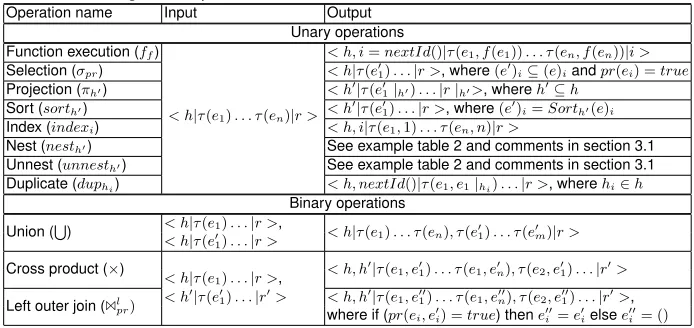
Basic operations are presented in the Table 1. To uniquely identify new at-tributes, we use the function nextId() to generate the attribute’s names. An operation for attribute renaming is trivial, and we do not list it among the opera-tions in the table.
Along with relational-like operations that appear in other tuple-based alge-bras [13, 14, 19], XAnswer adds theunionoperation. Unlike its relational coun-terpart, XAnswer’suniondoes not remove duplicates.
In XAnswer, we introduced a left-outer-join operation instead of express-ing it usexpress-ing selection, cross product, and union operators. This is so because envelopes’ bodies are ordered and may contain duplicates. Using the left-outer-join along with selection and union, it is possible to express other set operations, namely intersection and subtraction.
Table 1.Main algebraic operations
Operation name Input Output
Unary operations Function execution (ff)
< h|τ(e1). . . τ(en)|r >
< h, i=nextId()|τ(e1, f(e1)). . . τ(en, f(en))|i >
Selection (σpr) < h|τ(e01). . .|r >, where(e0)i⊆(e)iandpr(ei) =true
Projection (πh0) < h0|τ(e01|h0). . .|r|h0>, whereh0⊆h
Sort (sorth0) < h0|τ(e01). . .|r >, where(e0)i=Sorth0(e)i
Index (indexi) < h, i|τ(e1,1). . . τ(en, n)|r >
Nest (nesth0) See example table 2 and comments in section 3.1
Unnest (unnesth0) See example table 2 and comments in section 3.1
Duplicate (duphi) < h, nextId()|τ(e1, e1|hi). . .|r >, wherehi∈h
Binary operations Union (S
) < h|τ(e1). . .|r >, < h|τ(e1). . . τ(en), τ(e01). . . τ(e
0
m)|r > < h|τ(e01). . .|r >
Cross product (×) < h, h0|τ(e1, e01). . . τ(e1, e0n), τ(e2, e01). . .|r0>
< h|τ(e1). . .|r >,
Left outer join (1l pr)
< h0|τ(e01). . .|r0> < h, h0|τ(e1, e100). . . τ(e1, e00n), τ(e2, e001). . .|r0>,
where if (pr(ei, e0i) =true) thene00i =e0ielsee00i = ()
the results of the query into sequences, and append the sequences to corre-sponding tuples. In [13], this is done using a complex operation calledgroup by. We define a lower-level operationnestalong with anunnestoperation that un-groups grouped tuples. The semantics of these operations is shown in the Table 2. Whilenestandunnestappear in [19], previously proposed tuple groupings are different from ours. Ournestandunnestoperations are not complementary (see Table 2). Note that if h is empty in nesth, all tuples fall into one group,
and the resulting envelope has a single tuple with sequences of values for each attribute.
Table 2.Input and output of algebraic operations (a)nestA,B
Input Output A B C A B C a1b1
c1 a1b1
c1 c2 c2 a1b2c3 c2 a1b1c2 a1b2 c3
(b)unnestA,B
Input Output A B C A B C
a1b1
c1 a1 b1c1 c2 a1 b1c2 c2 a1 b1c2 a1b2 c3 a1 b2c3
(c)dupB
Input Output A B A B B’ a1 b1 a1 b1b1 a2 b2 a2 b2b2
(d)quanteverytrue,B
Input Output
A B A B
a1 true
a2true f alse
true a2 true
For duplication of attribute values we useduplicate operation (dupa). The
3.2. Additional operations
In order to simplify notation, we introduce specific leaf algebraic operations, leaf path step(LP Sp :=unnestre(f)(fp(<|| >))) andleaf constructor (LCc :=
unnestre(f)(fc(<|| >))).LP S is used to extract values stored in a document.
LC is used to extract XML-values (constants) that are not present in a docu-ment (e.g. they occur in the text of a query). InLCcoperation,cis a sequence
constructor (e.g.(1,2,3)) or an element constructor (e.g.<a>text</a>). In LP Spoperation,pis an XPath expression (e.g./a/b//c).
Structural joinis the traditional join operation with a structural predicate that specifies the relation between two nodes (e.g. parent-child). If structural predi-cate is applied to sequences of values, it evaluates to true if there is at least one value satisfying the predicate in each sequence. Unary path step and structural join are used in path expressions mapping.
XAnswer has a basic function operation (ff). The pattern f specifies the
overall structure of the element and places where corresponding tuple val-ues should be substituted. In our notation, we add a special operation called element constructor(θp), where p is an element pattern which describes the
schema of an element.
The purpose ofquantify (quantqc,h
i) operation is to efficiently implement lazy
evaluation (section 5.3). The operation is a specific kind of selection used for controlling the pipeline. A sample input and output of the quantify operation are presented in Table 2.
Addition operation is a special complex operation included in the algebra to avoid unnecessary steps in physical plan. The operation appears during the plan reduction described in the section 5.2.Addition is a combination of pro-jection, nest and join:ALv
pB = nesthe(A)(πhe(A)Sv(A 1l
p B)), wherepis a
predicate andv⊆he(B).
4.
Plan construction
The plan construction process consists of two steps, normalization and trans-lation. During the process FLWOR expressions are broken into single for- and let-clauses [6], predicates are moved from xpath to where-clauses [5, 11, 13] and complex expressions are removed by introducing new variables [11].
4.1. Normalization
let $k := for $i in expr (for $j in. . .) returncond
(: if ”some” :)
let $r := $k = true
(: if ”every” :)
let $r := not($k = false) return $r
Fig. 1.Quantifiers nor-malization
The proposed normalization differs from previous work mostly in the normalization of nested, quantified and conditional expressions.
moved to where-clauses. Quantified expressions are replaced with FLWORs (see Figure 1).
4.2. Translation
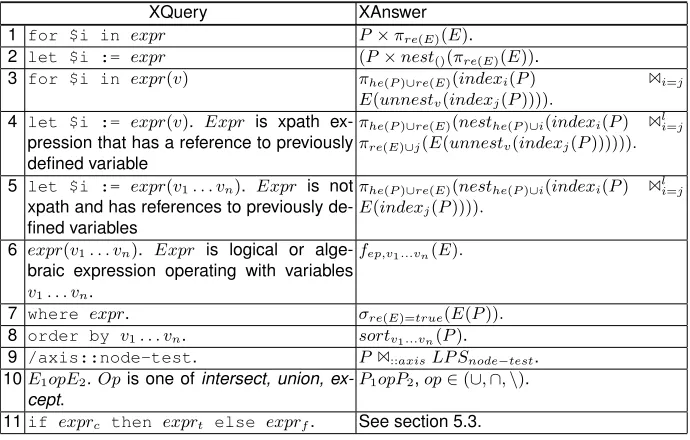
An algebraic expression is constructed in a top-down fashion. The Table 3 il-lustrates some of the expression construction rules. We assume that P is a subexpression that was constructed on a previous step andEis an expression corresponding to the bound expression (expr) of a let- or a for-clause,he(E)or re(E)means header or return attribute extraction from the resulting envelope of the expressionE.
Table 3.Construction rules
XQuery XAnswer
1 for $i in expr P×πre(E)(E).
2 let $i := expr (P×nest()(πre(E)(E)).
3 for $i in expr(v) πhe(P)∪re(E)(indexi(P) 1i=j
E(unnestv(indexj(P)))).
4 let $i := expr(v). Expr is xpath
ex-pression that has a reference to previously defined variable
πhe(P)∪re(E)(nesthe(P)∪i(indexi(P) 1li=j
πre(E)∪j(E(unnestv(indexj(P)))))).
5 let $i := expr(v1. . . vn). Expr is not
xpath and has references to previously de-fined variables
πhe(P)∪re(E)(nesthe(P)∪i(indexi(P) 1li=j
E(indexj(P)))).
6 expr(v1. . . vn). Expr is logical or
alge-braic expression operating with variables
v1. . . vn.
fep,v1...vn(E).
7 where expr. σre(E)=true(E(P)).
8 order by v1. . . vn. sortv1...vn(P).
9 /axis::node-test. P1::axisLP Snode−test.
10E1opE2.Opis one ofintersect, union,
ex-cept.
P1opP2,op∈(∪,∩,\).
11if exprc then exprt else exprf. See section 5.3.
Note that, if P =< || >, in the rules 1,2,9 only right operand of1 and×
should be considered as a resulting subplan.
Example 1
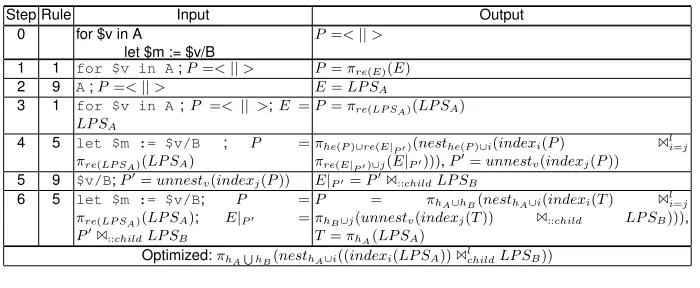
Below we demonstrate sample plan construction process. Let’s denotehA =
Step Rule Input Output
0 for $v in A
let $m := $v/B
P=<||>
1 1 for $v in A;P=<||> P=πre(E)(E)
2 9 A;P=<||> E=LP SA
3 1 for $v in A;P =< || >;E = LP SA
P=πre(LP SA)(LP SA)
4 5 let $m := $v/B ; P =
πre(LP SA)(LP SA)
πhe(P)∪re(E|P0)(nesthe(P)∪i(indexi(P) 1li=j πre(E|P0)∪j(E|P0))),P0=unnestv(indexj(P))
5 9 $v/B;P0=unnest
v(indexj(P)) E|P0=P01::childLP SB
6 5 let $m := $v/B; P =
πre(LP SA)(LP SA); E|P0 =
P01::childLP SB
P = πhA∪hB(nesthA∪i(indexi(T) 1li=j πhB∪j(unnestv(indexj(T)) 1::child LP SB))), T=πhA(LP SA)
Optimized:πhA
S
hB(nesthA∪i((indexi(LP SA))1lchildLP SB))
5.
Optimization
Efficient physical plans are derived by applying optimizing transformations to the constructed algebraic plans. The logical transformations of algebraic plans also enables further physical plan optimization.
::child
LPSA index
i LPSB
project h
A v unnest i=i project hA,i nest
hA,i project
hAhB
Fig. 2.The plan from Example 1
We explain all our transformations with the help of a directed graph in which vertices (nodes) represent algebraic operations and edges connect those oper-ations to their operands (the Figure 2). In Example 1 above,indexi(πhA(LP SA))
andindexj(πhA(LP SA))produce envelopes which differ only in headers. Such
envelopes can be converted to each other with theHRoperation. In such cases we consider the two subplans identical and leave only one in the graph (see Fig-ure 2).
Below we consider an expressionB1(B2), whereB1andB2 are operation blocks, and allinput nodesofB1have outgoing edges lead to theoutput node ofB2.
Definition 3 An operation blockB is non-reducingif an envelope Enpassed to the block is not empty and πhe(En)(B(En)) En. An operation blockB is non-modifyingifπhe(En)(B(En))'En.
Non-reducingoperation blocks keep all tuples of the input envelope. Non-modifyingoperation blocks are non-reducing blocks that do not add new tuples to the inputenvelope. Non-reducing and non-modifying properties can be nat-urally generalized from operation blocks to unary operations, join and left outer join (for joins, the left operand is considered as the input in the sense of Defini-tion 3). Non-modifying operaDefini-tions includeduplication,function, sort, etc. Non-reducing operations additionally includeleft outer join. Join and selectionare reducing operations because tuples of the (left) operand may be eliminated.
Cycles appear in the graph as a result of constructing parts of the plan corre-sponding to for- (for-cycles) and let-clauses (let-cycles) that refer to previously defined variables.Let-cycleare non-modifying due to use ofnest andleft outer join(see rule 5 of Table 3).For-cyclesare reducing operation blocks.
Definition 4 Twooperation blocksB1andB2areindependentifB2(B1(P))' B1(B2(P)).
If a block operates with attributes that were added to the header of the re-sulting envelope by another block, itdepends on the other block. Independent blocks never depend on each other.
Optimizing transformations listed in the following sections preserve the value of πre(P)(P). This is achieved by using an HRoperation to change thereturn attributeif needed. For compactness we omit usages of anHRoperation.
5.1. Blocks pushdown
Optimizing transformations include reordering, removal, and replacement of op-erations. The goal of optimizing reordering is to make the intermediate results created during the plan execution smaller. With respect to this, it is important to perform selective operations as early as possible. In graph terms, it means that these operations should be placed closer to the leaves of the graph (i.e. pushed down). Often, selective operations can be pushed down only along with a con-taining operation block. We present a blocks pushdown algorithm that enables selective operations pushdown.
We refer tooperation blockscorresponding tofor-, let-, where-, etc. clauses asclause-blocks. Twoclause-blocksare independent if one clause of normal-ized query does not refer to a variable introduced in another.
1. SupposeP =Bs(Br)is a plan, whereBsandBrare operation blocks and
2. Locate aclause-block Bm,Br=Be(Bm(Bb)):Bsdepends onBm. If there
is no suchBm, thenBe=Br.
3. Recursively perform the algorithm onBm, obtainingBm0 .
4. Push downBsthroughBein order to obtain:P =Be0(Bs(Bm0 (Bb0))).
5.2. Redundant operation reduction
In this section we present logical optimizations that remove redundant opera-tions or group several operaopera-tions into complex ones. The optimizaopera-tions include:
– removal of unnest operations; – introduction of addition operations;
– removal of unnecessary index operations; and – cycle removal.
Unnest removalis trivial and can be applied directly:unnesth0(P)⇒P ifP
does not containnesth00 andh00⊂h0.
Theaddition operation is also introduced directly based on its definition (see section 3.2). The addition operation groups several operations (nest, join, projection) into a single one and allows further physical plan optimizations.
Removal of unnecessary index operations is a two-step operation that consists of preliminary reordering of index operations and subsequent index operations removal itself. After unnest removal and introdution of addition oper-ationlet-blocksare identified by the presence of addition operation. Such blocks are non-modifying operation blocks due to use ofleft outer joinandnest. Con-sequently, if an index operation is performed before such block, indexes are retained in the result, and the following transformation is valid:
indexi(πhe(P)∪re(B)B(indexj(P)))⇒πhe(P)∪re(B)∪i(B(indexi(indexj(P)))).
Subsequent application of this transformation produces a plan that contains sequences ofindexoperations. The sequences are replaced with a singleindex operation.
Cycle removalis performed on for- and let-cycles that appear (as implied by the construction rules) whenever the respective bound expressions reference previously defined variables. The bound expressions can be one of three kinds: an xpath expression, a FLWOR expression, or a conditional expression.
If the bound expression of a for- or a let-clause is anxpath. Xpath expres-sions are mapped using structural join and LPS operations. Assume Bx is a
block corresponding to some xpath. It consists ofstructural joinandLPS oper-ations. Whilestructural joinsare reducing operations, they have left outer ver-sions (1l) that are non-reducing.Bl
xis obtained fromBxby replacingstructural
joinswith left outer joins.
We propose the following transformation forlet-cycles:
πhe(P)∪re(Bx)(nesti indexi(P)1
l
i=j (Bx(unnestv(indexj(P))))
)⇒
πhe(P)∪re(Bl
x)(nesti B
l
The transformation forfor-cycleis:
πhe(P)∪re(Bx)(indexi(P)1i=jBx(unnestv(indexj(P))))⇒ πhe(P)∪re(Bx)(Bx(unnestv(dupv(P)))) .
The topmostjoinoperation in the original plans of the cycle is used to set up a correspondence between variable values of the query context with the new values obtained within the clause.Unnest operation can break the correspon-dence. To keep it, we use dup operation instead ofjoin and then perform re-quired unnesting on the introduced attribute. If theunnestoperation is removed in optimization process,dupcan also be eliminated.
If the bound expression of a let-clause is a nested FLWOR. The optimization is based on the fact that the topmost join1li=j that organizes a cycle can be
removed if it has a non-reducing operation block as a right-hand operand. After query normalization, each nested FLWOR starts withforand ends with where,order by, andreturn. The last three clauses are mapped with, respec-tively,σ,sortandπoperations. Let an operation blockB1corresponds toorder by andreturn, and B2 corresponds to the sequence oflet-andfor-clauses. A plan for completelet-clausewith a nestedFLWORis:
πhe(P)∪re(B1)(nesti(indexi(P)1
l
i=j B1(σp(B2(indexj(P)))))). (1)
1lin this plan can be pushed down overB1. The transformation also
modi-fiessortoperation to preserve original order.
LetB2=BF1(. . . BFn), whereBFiarefor-orlet-blocks.
There are two cases:∀i BFiis not dependent onP and∃i BFi is dependent
onP. In caseBFi is not dependent onP according to normalization rules,BF1
is afor-block. According to construction rules and independence withP,F1 = P×Bx, whereBxis a block corresponding to a xpath expression. SinceBF2is
also independent ofP, it is easy to see thatBF2(P×BF1) =P×BF2(BF1). After
application of this transformation sequentially for expression (1), combining σ and×into1l
p, and removing outer1li=i, we obtain:
πhe(P)∪re(B1)(nesti(B1(indexi(P)1
l
pBFn(. . .(BF1))))).
In case BFi is dependent on P, we use the fact that let-cycles are
non-modifying blocks (see section 5) andfor-cycles are reducing due to their top-mostjoinoperations.
Let’s denoteBl2=BL1(. . . BLn), whereBLi =BFi ifBFi is alet-block and BLi=B
l
FiifBFiis afor-block.B
l
Fiis obtained by replacing its topmostjoinwith
left outer joininBFi. We perform (1) to the following: πhe(P)∪re(B1)(nesti(B1(σp(B
l
2(indexi(P)))))).
Cycle removal is applied recursively for inner cycles.
5.3. Transformations for lazy evaluation
Lazy evaluation is preferable in quantified expressions, positional predicates, and conditions of where, if-then-else, typeswitch clauses. In XAnswer, these types of expressions are mapped with ST-operations. When a physical plan is executed, the operands of the ST-operations are pre-evaluated, thus potentially making expensive unnecessary computations. To reduce such computations, certain support, e.g. pushing down of selective operations closer to leaves, is required in the process of algebraic plan modification.
Transformations of quantified expressions and positional predicates. Positional predicates allow physical plan execution to avoid the calculation of the whole operand of the operation. For quantified expressions, if one satisfy-ing (or not satisfysatisfy-ing - dependsatisfy-ing on whether “some” or “every” is used) value is found, there is no need to evaluate further the operand of the quantified opera-tion.Positionandquant operations are introduced into algebraic plans to allow pipelined evaluation at the physical level.
According to normalization and construction rules, positional predicates are mapped using selections and index operations. If hi = re(indexi) and p is a
positional predicateσp(hi)is replaced withpositionp(hi).
A similar mapping is used for quantified expressions. Unlike the case of positional predicates, the selection is performed over nested values. According to the proposed optimizations, the nestings are included inadditionoperations. Then, ifhi=re(L), an expressionσp(hi)is substituted withquantp(hi).
Transformations of conditions. Consider a where-clause where A op B. A and B are logical expressions or terminals (variable references). Op is a logical operator andoror. We assume without loss of genrality thatA andB are terminals; if not, the process described below can be applied recursively.BA
andBBare operation blocks corresponding toAandBrespectively. In case of
if-then-elsewe useBC,BT andBF to denote corresponding operation blocks
for thecondition,then-, andelse-branches. We assume that other blocks in the plan are independent with A and B. Without this assumption lazy evaluation does not bring performance benefits and there is no much point in applying this transformation.
Transformation of conditions is preceded by sequential pushdown of BA,
BB (where-clause) orBC,BT,BF (if-then-else-clause) using the algorithm
de-scribed in section 5.1.
Logical “and” in a where-clause.Selection decomposition is: σA&B(BB(BA(P))) =σA(σB(BB(BA(P)))).
Due to normalization,BAandBBare independent blocks.
BlocksB0A, BB0 ,P0 (possibly empty) are obtained by pushdown of BA and
BBaccording to the algorithm in section 5.1:BB(BA(P))⇒BB0 (BB(B0A(BA(P0)))).
BB0 has blocks depending on it, all blocks are independent withBA0 . We also as-sume thatB0Bcontainssortoperation that restores original order of tuples. The transformation result is:
Logical “or” in a where-clause. Since A∪B = A∪(B\A), the selection decomposition is:
sorti[πhe(P)∪i(σA(BB(BA(indexi(P)))))
∪πhe(P)∪i(σ¬A&B(BB(BA(indexi(P)))))].
Block pushdown then gives us:
BB0 (π(σA(BA(P0)))∪π(σB(BB(BA0 (σ¬A(BA(P0))))))).
An algebraic expression forif-then-else clause caseis: sorti[HR(re(BT)→k)(σC(P
00))∪HR
(re(BF)→k)(σeC(P 00))],
whereP00=BF(BT(BC(indexi(P)))).
Blocks pushdown results in:
BT F0 (HR(π(BT(B0C(σC(BC(P0))))))∪HR(π(BF(B00C(σC(BC(P0))))))).
The blocksBC0 , BC00, BT F0 , and P0 are obtained by pushing downBC, BT, and
BF blocks. OnlyBT is not independent withBC0 andBFis not independent with
B00
C. As withB0Bin the previous case,BT F0 containssortoperation that restores
original order of tuples.
Similar optimization, whose description we omit here, is used for typeswitch-clauses.
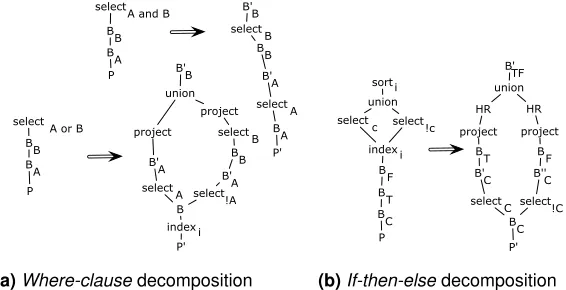
The proposed optimizations are presented on the Figure 3.
select A and B
A select B B' B select select A or B
A B B B A B' A select P' B select !A select union B project A B' B B B B' project indexi P A B B B P A B B B P' A B'
(a)Where-clausedecomposition
T B F B C select C B'' !C select union c select !c select P C B union T B C B' HR indexi sort i P' C B F B TF B' project HR project
(b)If-then-elsedecomposition
Fig. 3.Optimizations for lazy evaluation
6.
Experiments
structural operations can be evaluated using just the ids. Thus, envelopes were implemented as arrays of tuples that contain either atomic values (e.g. string, integer), ids, or sequences of the ids or atomic values.
The code was written in Java and experiments were conducted under Win-dows XP on Intel Dual Core T2300 @1.6 GHz with 2Gb of main memory. The XMark benchmark [3] was used as data set.
0 100 200 300 400 500 600 700 800 900
Size, nodes*1000 103
104
Time, ms
Performance comparison NT (1) ST (2) ST optimized (3)
Fig. 4.ExperimentE1
Known approaches can perform unnesting for relatively simple queries with nested FLWORs. That kind of optimization allows switching from NT to ST-execution, which can bring dramatic performance gain, since it allows the hash join algorithm to be used instead of nested loops. Using normalization tech-niques similar to ours, known approaches achieve performance comparable to XAnswer. However, known approaches cannot perform unnesting when the query contains quantifiers, where-clauses, or conditional clauses with nested FLWORs. Moreover, many such cases require lazy evaluation.
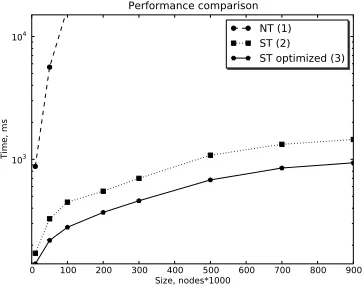
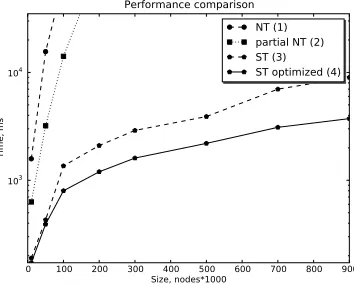
To compare other approaches with ours, we implemented NT-style plan cre-ation for conditional clauses as well as ST-opercre-ations of XAnswer. In experi-ments we focused only on such queries over the XMark’s data set. We present details for only two experiment sets. The first set (E1) evaluates performance of naive NT-execution (the default plan generated by eXist), ST (initial XAnswer plan), and optimized-ST (optimized XAnswer plan) on a typical XMark query (such as query Q8) where earlier approaches can perform unnesting.
0 100 200 300 Size, nodes*1000400 500 600 700 800 900 103
104
Time, ms
Performance comparison NT (1) partial NT (2) ST (3) ST optimized (4)
Fig. 5.ExperimentE2
Query 1A query example from the setE2
let $doc := doc(’doc.xml’)
for $ca in $doc//closed-auction let $b :=
for $p in $doc//person
where $p/@id = $ca/buyer/@person
return $p return
if ($ca/price >200)
then (
let $c := \b/country
let $n := $b/name
return <rb>{$c,$n}</rb>)
else (
let $item :=
for $it in $doc//regions//item where $it/@id=$ca/itemref/@item return $it
let $l := $item/location let $n :=$item/name
Figure 4 demonstrates performance comparison forE1. The huge perfor-mance gain of ST-plan compared to NT is observed due to use of hash join over input sets instead of evaluating inner expression in a loop. Since the query has a relatively simple where-clause that does not require lazy evaluation, the ST-optimized plan does not demonstrate major performance gain. The increase is mostly achieved through removal of a cycle and use of addition operation, which reduces amount of hash operations in the physical plan.
Figure 5 demonstrates performance evaluation forE2. Note, that the time axis has a logarithmic scale. Since partial NT-plan utilizes ST-execution for the first nested FLWOR, the performance gain compared to naive NT is similar to the one obtained inE1. But NT-style condition leads to evaluation of nested expressions in a loop, which causes difference in performance with the ST plan. The gain of the optimized-ST is due to the smaller sizes of intermediate results. The sizes are smaller because evaluation of the first nested FLWORthen-and else-branches happens only when teh condition has corresponding values: for example FLWOR andthenare evaluated only whenprice >200in line 7 of the code in Query 1.
7.
Conclusion
Heavy query workloads in modern applications require algebras that support cost-based optimization. Set-at-a-time execution is a natural way to support cost estimation. While set-at-a-time execution appeared in earlier work on effi-cient XQuery processing techniques, known algebras combine it with node-at-a-time to cover the complete set of XQuery operations.
In this paper we presented an algebra with only set-at-a-time operations that supports compilation of complete XQuery except recursive functions. We intro-duced optimization rules eliminating unnecessary operations and enabling lazy evaluation. It was experimentally shown that for complex queries with condi-tional and quantified expressions the proposed methods yield plans with much better performance than those that can be obtained with known algebras.
References
1. Exist DBMS Home Page. http://exist-db.org/, exist DBMS Home Page
2. Sedna DBMS Home Page. http://modis.ispras.ru/sedna/, sedna DBMS Home Page 3. XMark Benchmark Home Page. http://monetdb.cwi.nl/xml/, xMark Benchmark
Home Page
4. Chean, et al.: From tree patterns to generalized tree patterns: On efficient evaluation of xquery. In: VLDB. pp. 237–248 (2003)
5. Deutsch, A., et al.: The next framework for logical xquery optimization. In: VLDB ’04: Proceedings of the Thirtieth international conference on Very large data bases. pp. 168–179. VLDB Endowment (2004)
6. Fankhauser, P.: Xquery formal semantics state and challenges. SIGMOD Rec. 30(3), 14–19 (2001)
8. Ioannidis, Y.: The history of histograms. In: VLDB ’2003: Proceedings of the 29th international conference on Very large data bases. pp. 19–30. VLDB Endowment (2003)
9. Jagadish, H., et al.: Tax: A tree algebra for xml. In: DBPL ’01: Revised Papers from the 8th International Workshop on Database Programming Languages. Springer-Verlag, London, UK (2002)
10. Jagadish, V., et al: Timber: A native xml database. The VLDB Journal 11(4), 274– 291 (2002)
11. May, N., et al.: Nested queries and quantifiers in an ordered context. Proc. ICDE Conference, Boston, USA pp. 239–250 (2004)
12. Meir, W.: Index-driven xquery processing in the exist xml database (2006)
13. Re, C., et al.: A complete and efficient algebraic compiler for xquery. In: ICDE ’06: Proceedings of the 22nd International Conference on Data Engineering. p. 14. IEEE Computer Society, Washington, DC, USA (2006)
14. Sartiani, C., Albano, A.: Yet another query algebra for xml data. In: IDEAS ’02: Pro-ceedings of the 2002 International Symposium on Database Engineering and Ap-plications. pp. 106–115. IEEE Computer Society (2002)
15. Wang, S., et al.: Optimization of nested xquery expressions with orderby clauses. In: ICDEW ’05: Proceedings of the 21st International Conference on Data Engineering Workshops. IEEE Computer Society (2005)
16. Weiner, A., Mathis, C., Haerder, T.: Towards cost-based query optimization in na-tive xml database management systems. In: Proceedings of the SYRCoDIS 2007 Colloquium on Databases and Information Systems (2008)
17. Extensible Markup Language (XML) 1.0 (Second Edition) (6 October 2000), w3C Recommendation
18. XML Query Algebra (15 February 2001), w3C Recommendation
19. Zhang, X., Pielech, B., Rundesnteiner, E.: Honey, i shrunk the xquery!: an xml al-gebra optimization approach. In: WIDM ’02: Proceedings of the 4th international workshop on Web information and data management. pp. 15–22 (2002)
Maxim Lukichev is Sr. Software Engineer at Whodini, Inc. Previously Maxim was a researcher at HP Labs Russia and was a member of Information Man-agement Research group at St.Petersburg University. Maxim received his Mas-ters and Ph.D. in Comp.Sci. from St.PeMas-tersburg University. His research inter-ests are in the area of query optimization, indexing and data structures, seman-tic data and information extraction.
Boris Novikov is a professor and a head of Operations Research Laboratory and Information Management Research Group at St.Petersburg University. He also works as a database expert for the industry. Boris received his PhD in Comp.Sci.in 1981, and Dr. Sci. degree in 1994 from St.Petersburg University. His research interests include design of database systems, transactions, in-dexing and data structures, query processing and optimization, performance tuning, and management of distributed heterogeneous information resources.
Science. He is on the editorial board of IEEE Internet Computing magazine. Previously Pankaj was a Chief Scientist of HP Labs Russia, and before that faculty member at IIT Delhi. Pankaj received his B Tech from IIT Delhi, and his Ph.D. in Computer Science from University of Illinois at Urbana-Champaign.