World Maritime University
The Maritime Commons: Digital Repository of the World
Maritime University
World Maritime University Dissertations
Dissertations
2016
Seafarer training in Somalia as a deterrent to piracy
Koki Matsushima
World Maritime University
Follow this and additional works at:
http://commons.wmu.se/all_dissertations
Part of the
Defense and Security Studies Commons
,
Education Policy Commons
,
Other Public
Affairs, Public Policy and Public Administration Commons
, and the
Transportation Commons
This Dissertation is brought to you courtesy of Maritime Commons. Open Access items may be downloaded for non-commercial, fair use academic purposes. No items may be hosted on another server or web site without express written permission from the World Maritime University. For more information, please [email protected].
Recommended Citation
Matsushima, Koki, "Seafarer training in Somalia as a deterrent to piracy" (2016).World Maritime University Dissertations. 518.
WORLD MARITIME UNIVERSITY
Malmö, Sweden
SEAFARER TRAINING IN SOMALIA AS A
DETERRENT TO PIRACY
By
KOKI MATSUSHIMA
Japan
A dissertation submitted to the World Maritime University in partial
Fulfilment of the requirements for the award of the degree of
MASTER OF SCIENCE
In
MARITIME AFFAIRS
(MET)
2016
Declaration
I certify that all the material in this dissertation that is not my own work has been
identified, and that no material is included for which a degree has previously been conferred on me.
The contents of this dissertation reflect my own personal views, and are not
necessarily endorsed by the University.
(Signature):
(Date):
.,YitL%p
Supervised by: Michael Ekow Manuel Associate Professor World Maritime University
Assessor: Maximo Q. Mejia Jr.
Professor
World Maritime University
Co-assessor: Peter M. P. Muirhead
Professor Emeritus
World Maritime University
iii
Acknowledgement
I would like to express sincere thanks to all the people who gave me support to
complete this work. It is impossible to express my gratitude to all considering the
number of persons who supported me and limitations of space. I appreciate your help!
I would like, however, to specifically thank the following persons for the significant
support given me.
Special and sincerest thanks to:
- Dr. Yohei Sasakawa, the Chairman of the Nippon Foundation, who gave me the
fellowship and this great opportunity to study at the World Maritime University.
- Mr. Mohamoud Boss Ahmed, who coordinated my research field visit to
Somaliland and kindly welcomed and hosted me there.
- All the people who cooperated with me in my research in Hargeisa and Berbera,
Somaliland, especially the staff and students of the Berbera Maritime and Fishery
Academy.
- Dr. Michael Ekow Manuel, Associate Professor at the World Maritime University,
who supervised this research.
- Mr. Eisuke Kudo and Mr. Shinichi Ichikawa of the Sasakawa Peace Foundation,
who supported my life and study in Malmö.
iv
Abstract
Title of Dissertation: Seafarer Training in Somalia as a Deterrent to Piracy
Degree: MSc
This dissertation is a study into the development of seafarer training in Somalia as a deterrent to piracy off the coast of Somalia. The number of piratical attacks attributed Somali pirates has decreased dramatically in recent years due to the deterrent of private armed security guards on-board commercial vessels and naval patrols by stakeholder nations. However, these anti-piracy measures cannot be said to have addressed the root causes of the piratical problem in Somalia, such as poverty and absence of good governance. The development of seafarer training in Somalia is therefore examined, in this study, as a new potential solution to the piratical problem off the coast of Somalia.
Online questionnaires and semi-structured interviews were used as research instruments. Questionnaires were sent to Japanese shipping companies and students of a maritime academy in Somalia. Semi-structured interviews of maritime stakeholders were conducted in person (by the researcher) on site in Somalia.
From the analyses of the data collected using the research instruments, it was found that there is quite high interest level of Somali people for the development of seafarer training. The steady found grounds to conclude that seafarer training in Somalia could be a deterrent to piracy.
KEYWORDS: Somalia, Somaliland, Seafarer, Maritime, Training, Education, Piracy,
v
Table of Contents
Declaration... ii
Acknowledgement ... iii
Abstract ... iv
Table of Contents ... v
List of Tables ... ix
List of Figures ... x
List of Abbreviation ... xi
Chapter 1: Introduction ... 1
1.1 Background ... 3
1.2 Purpose of the Study... 4
1.3 Research Questions... 4
Chapter 2: Literature Review ... 6
2.1 Introduction ... 6
2.2 Piracy ... 6
2.2.1 Definition of Piracy ... 6
2.2.2 Legendary and Modern Pirates ... 8
2.2.3 Somali Pirates ... 10
2.3 Impact of Education on Crime ... 14
2.4 Somali Traditional Clan System and Common Law ... 16
2.4.1 Clan-based Society ... 16
vi
2.4.3 Summary ... 25
2.5 Modern History of Somalia ... 26
2.5.1 Colonial period ... 26
2.5.2 Independence ... 28
2.5.3 Muhammad Siad Barre Regime ... 29
2.5.4 South Central Somalia after Siad Barre Regime ... 30
2.5.5 Somaliland ... 31
2.5.6 Puntland ... 32
2.6 Current Situation of the Three Regions in Somalia ... 32
2.6.1 South and Central Somalia ... 33
2.6.2 Puntland ... 35
2.6.3 Somaliland ... 36
Chapter 3: Research Methodology... 43
3.1 Introduction ... 43
3.2 Selection of Participants ... 44
3.2.1 Shipping Company ... 44
3.2.2 Location - Comparison of Three Regions in Somalia ... 44
3.3 Instrumentation ... 46
3.4 Research Ethics ... 47
3.5 Questionnaire Instrument ... 47
3.6 Interview Instrument ... 48
3.7 Data Collection... 48
vii
3.7.2 Qualitative Method ... 49
3.8 Data Analysis ... 49
3.8.1 Quantitative Analysis ... 49
3.8.2 Qualitative Analysis ... 50
3.9 Summary ... 50
Chapter 4: Presentation and Analysis of Data ... 51
4.1 Introduction ... 51
4.2 Interview in Somaliland and Questionnaire for BMFA ... 51
4.2.1 Characteristics of Somali people ... 51
4.2.2 Deterrent to the Piracy ... 55
4.2.3 Interest level to engage in the international shipping ... 59
4.2.4 Feasibility ... 63
4.3 Questionnaire for shipping company ... 67
4.3.1 Counter measures to piracy off the coast of Somalia ... 67
4.3.2 Employing African Seafarers and Employing Somali Seafarers ... 69
4.3.3 Deterrent to the Piracy ... 71
4.4 Summary ... 72
Chapter 5: Discussion of Findings... 73
5.1 Summary of the Study ... 73
5.2 Discussion of the Findings ... 75
5.2.1 Research Question 1 ... 75
5.2.1 Research Question 2 ... 77
viii
5.3 Implications of the Findings ... 78
5.4 Limitation and Future Research ... 80
5.5 Conclusion ... 81
References ... 83
Appendix 1: Interview Consent Form ... 90
Appendix 2: Semi-Structured Interview Questions ... 91
ix
List of Tables
x
List of Figures
Figure 1: Genealogical table of major Somali clans ... 18
Figure 2: Map by Lewis... 21
Figure 3: Map by Abikar ... 22
Figure 4: Disputed area between Somaliland and Puntland ... 40
Figure 5: Colonial Borders ... 41
Figure 6: Traditional Residential Area of Somali Clan ... 42
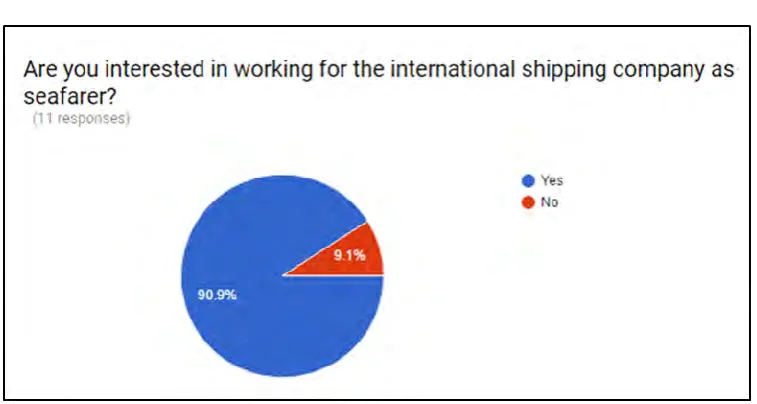
Figure 7: Interest in seafaring (BMFA students) ... 60
Figure 8: Interest level of the BMFA students ... 60
Figure 9: Employment after graduate BMFA ... 66
Figure 10: Counter measures to the piracy off the coast of Somalia ... 68
Figure 11: Annual cost for the counter measures to the piracy ... 69
Figure 12: Begin or increase the employment of African seafarers? ... 70
xi
List of Abbreviation
AMISOM African Union Mission to Somalia
BMFA Berbera Maritime and Fisheries Academy
CPC Counter Piracy Coordination
CSR Corporate Social Responsibility
EASO European Asylum Support Office
FGS Federal Government of Somalia
GPS Global Positioning System
ICRC International Committee of the Red Cross
ICU Islamic Courts Union
IMF International Monetary Fund
IMSS International Maritime Shipping Services
IUU Illegal Unregulated Unreported
MDTF Multi Donor Trust Fund
MET Maritime Education and Training
MoU Memorandum of Understanding
MSC Mediterranean Shipping Company
NFD Northern Frontier District
NGO Non-Governmental Organization
SFG Somalia Federal Government
SNA Somali National Army
xii
SNM Somali National Movement
SPM Somali Patriotic Movement
SSDF Somali Salvation Democratic Front
SSF Somali Salvation Front
SYL Somali Youth League
TFG Transitional Federal Government
TNG Transitional National Government
UN United Nations
UNCLOS United Nations Convention on the Law of the Sea
USC United Somali Congress
USP United Somali Party
1
Chapter 1: Introduction
For five years, since 2007, the number of piratical attacks (actual and attempted)
attributed to Somali pirates ranked first in the world. In the peak year, 2011, 200
attacks attributed to Somali pirates were reported (ICC International Maritime Bureau,
2012). This number decreased dramatically due to the deterrent of private armed
security guards on-board commercial vessels and naval patrols by stakeholder
nations. According to the latest annual report published by ICC International Maritime
Bureau (2016), the number of piratical attacks attributed to Somali pirates decreased
greatly from 2012 to 2014; no piratical attack attributed to Somali pirates was reported
in 2015. Have Somali pirates disappeared from the world? Not quite. The
afore-mentioned anti-piracy measures, armed security guards and naval patrols cannot be
said to have addressed the root causes of the piratical problem in Somalia.
The root causes of piracy off the coast of Somalia may include a lack of control by the
coastal state, Somalia, and poverty (Osei-Tutu, 2011). After the collapse of the Siad
Barre regime in 1991 till the establishment of the Federal Government of Somalia
(FGS), there was no formal central government in Somalia. Somalia was called a
2
Because of the absence of the central government, there was no naval or police
control over Somalia waters. It allowed foreigners to exploit the resources in the
waters off the Horn of Africa. Many foreign vessels invaded the water and conducted
Illegal Unreported and Unregulated (IUU) activity (Murphy, 2011). IUU activities were
conducted on a large scale with modern methods by large fishing vessels, compared
to local fishermen who only used was small boats and traditional fishing gear. The fish
stock off the coast of Somalia was severely impacted by these IUU activities.
Moreover, illegal dumping by foreign vessels, exacerbated the damage to the
environment and fish stock. The local population, who in many cases, was heavily
reliant on fishing, lost this source of income and became increasingly poor.
Consequently, they took up the arms to protect their waters. Later, piracy off the coast
of Somalia was transformed in style and scale to become a big business; it is no
longer fishermen's defensive activity (Osei-Tutu, 2011).
Given that these conditions that started the phenomenon of piracy of Somalia has not
changed, it can be argued that the root cause of piracy has not changed. Unless the
problem of poverty in Somalia (often triggered by external factors), is solved, the
piratical problem of Somalia would not be solved. Therefore, current anti-piracy
measures relying on military power cannot be expected to be the ultimate solution to
root out piracy off the coast of Somalia in the long term. These measures are just
suppressing the pirates. If the IUU activities in Somali waters were to continue,
3
Somali pirates could be expected to the surface/increase again (Stewart, 2015). It is
reasonable; therefore, to suggest that a new solution (unlike the current measures) is
required to root out this phenomenon.
Development of education and the creation of employment opportunities have been
shown to improve poverty and reduce crimes. The Association for the Development
of Education in Africa (2016) note, for example, that “education is key in addressing
the root causes of conflict and instability in Africa”. Similarly, Moretti (2005) and the
Chicago Urban League (n.d.) respectively indicate that “increased educational
achievement in young men reduces the probability that they will engage in criminal
activity, and thereby decreases crime-related costs” and that “youth employment
opportunities reduce crime”. This research work puts forward the hypothesis that
"seafarer training in Somalia could serve as a deterrent to piracy" and seek to analyze
the effectiveness and feasibility of this approach.
1.1 Background
Piracy is of great concern to the world. Piracy threatens maritime security and the
safety of seafarers' lives. In the last five years, 2,742 seafarers were assaulted, held
as hostages, injured, kidnapped, went missing, threatened, or killed by pirates in total
(ICC International Maritime Bureau, 2016). At the end of 2010, approximately 500
seafarers from more than 18 countries were held hostage by pirates. Piracy damages
4
industry have been forced by threats and actual acts of piracy to pay large amounts
of money for ransoms, insurance, re-routeing, security equipment, armed guards and
naval forces, piracy prosecutions, and anti-piracy organizations. Between 7 to 12
billion USD. were spent for these measures related to piracy (Bowden, 2010). There
is an urgent need for piracy to be eradicated to secure maritime security and the world
economy.
1.2 Purpose of the Study
The purpose of this study is to analyze the merits of a suggested new
approach/solution to the piratical problems attributed to Somalia. The suggested
approach/solution is the development of seafarer training in Somalia. In this research
effort, the effectiveness and feasibility of development of seafarer training in Somalia
as a deterrent to piracy, will be analyzed.
1.3 Research Questions
The research will be conducted based on the following questions:
Could the sustainable development of Somali seafarers be a deterrent to the
Somali piracy?
Do the Somali people have an interest in developing the Somali seafarers for
5
6
Chapter 2: Literature Review
2.1 Introduction
This chapter analyses and examines the literature on piracy, impact of education on
crime, traditional social system in Somalia, modern history of Somalia, and current
situation in Somalia. Examining the literature about piracy would help develop an
understanding of current piratical issues in Somali waters. Similarly, examining the
literature about the impact of education on crime would help interrogate the possible
impact of seafarer training on piracy. Moreover, interrogating the traditional social
system and modern history of Somalia would help to understand the background of
piracy off the coast of Somalia. Furthermore, examining the current situation in
Somalia with respect to its different regions, would help the selection of the location
for developing seafarer training.
2.2 Piracy
2.2.1 Definition of Piracy
7
This definition allows for universal jurisdiction over this crime, in terms of arrest and
prosecution. However, it is not easy to clamp down on piracy conducted on the open
sea. Historically, coastal states and the international community have made great
efforts to clamp down and root out it (Itsumi, 2009). To understand piracy correctly, it
is essential to understand the definition of piracy. The New Oxford Dictionary defined
it as "the practice of attacking and robbing at sea" (Pearsall, 2001, p.1411). However,
the international maritime community has given a narrower definition drawn from the
United Nations Convention on the Law of the Sea (UNCLOS). UNCLOS in article 101
(1982), defines piracy as:
(a) any illegal acts of violence or detention, or any act of depredation, committed for
private ends by the crew or the passengers of a private ship or a private aircraft,
and directed:
(i) on the high seas, against another ship or aircraft, or against persons or
property on board such ship or aircraft;
(ii) against a ship, aircraft, persons or property in a place outside the
jurisdiction of any State;
(b) any act of voluntary participation in the operation of a ship or of an aircraft with
knowledge of facts making it a pirate ship or aircraft;
(c) any act of inciting or of intentionally facilitating an act described in subparagraph
(a) or (b).
This means piracy is conducted only for private ends. The UNCLOS definition of
8
Counter measures by the international society against piracy have been conducted in
the context of this UNCLOS definition. Given the notion of hostis humani generis, any
state can arrest pirates on the high sea and prosecute them within its jurisdiction.
While this remains true, the practice of piracy itself as well as the international
community has changed. The current state of piracy is quite different from piracy in
earlier centuries. Pirates are no longer people wearing eye patches or with the sword
artificial hook hands. The scope of 21st century piratical activities is broad and use is
made of advanced weaponry. In addition, the state of Somalia – perceived by some
as a “failed state” (Endo, 2015, p.55) made the situation surrounding the potential for
piracy in the waters off the horn of Africa more complicated. To gain a correct
understanding of piracy, a discussion of its history is as essential as the legal definition.
2.2.2 Legendary and Modern Pirates
Piracy has origins in very early centuries. Actually, it has been called the second oldest
profession (Manuel, 2012). Moreover, it could be seen in many places in the world.
Bradford(2007) classified the age and the place of piracy as follows:
1. The Greeks (800–146 BC)
2. The Romans (753 BC to AD 476)
3. The Vikings (AD 793–1066)
4. The Buccaneers (1650–1701)
5. The Barbary Pirates (1320–1785)
9
7. America and the Barbary Pirates (1785–1815)
One of the oldest piratical activities is the one in the ancient Greece. In the beginning,
it was not viewed as a criminal act but as "the industry of the ancient Mediterranean"
(Irving, 2012). Originally, pirates in many cases were fishermen, but when their
income was not enough to live, they restored to petty “piratical activity”. Subsequently
Roman pirates appeared in ancient Mediterranean regions. Initially, Roman pirates
were “tolerated” by the society and were involved in slave trading for profit. However,
they became more radical; culminating in an attack on the port of Ostia and the
kidnapping of two senators. As a result of this incident, Rome promulgated anti-piracy
laws and started clamping down on piracy. The pirates, shut out from the then legal
industry of activities such as slave trading turned to more radical activities involving
significant ransoms (Irving, 2012). Pirates became the enemy of states, a criminal
group of people.
In the early middle ages, one of the most famous names of such groups appeared the
"Vikings". They lived in Scandinavia, on agriculture, fishing, trade, and robbery. Their
scale and geographical scope of their piratical activity were quite broad. They acted
over the east Europe and attacked, pirated, and colonized. Their activities were quite
different from today's piracy (Fjalldal, 2015). Buccaneers were lawful seafarers and
soldier in Caribbean Sea. They attacked and robbed from Spanish ships under the
colonial government's official permission. For Spanish people, they were just pirates,
10
However, after the end of the war between England and Spain, piratical activity was
prohibited by law, and Buccaneers disappeared from the sea (The Way of the Pirates,
n.d.). Barbary pirates, based on the north of Africa, also acted vigorously with ample
funds and official authorization as privateers. They were mainly Muslims with African
origins, but some were Europeans who having converted to Islam joined this piratical
group.
Today the pirates with official authorization such as privateers no longer exist. Piracy
is now carried out by individuals or group of gangs. However, the nature of pirates has
not changed from legendary pirates. They all seek to assault the ship, seize cargo
and ship, kidnap crew as hostages for ransom. However, their way of perpetrating
such act has changed dramatically. Pirates use night vision equipment, speed boats
with modern equipment such as Global Positioning System (GPS) devices and radar,
and are armed with heavy weapons such as “bazookas” and machine guns (Maritime
Connector, n.d.). As shipping develops and globalizes, they have deepened their
status as hostis humani generis at a global level.
2.2.3 Somali Pirates
One of the most significant factors that contributed to the genesis of modern piracy
off the coast of Somalia was the absence of an “in-control” central government. In fact,
no piratical attack on commercial vessels had been reported until the end of 1980s,
11
weaken. The first reported piratical attack attributed to Somali pirates was reported in
December 1989 (Samatar, Lindberg, & Mahayni, 2010). Subsequently, the number of
piratical attacks attributed to Somali pirates increased radically from 2009, and
peaked in 2011 (ICC International Maritime Bureau, 2013). After 2011, due to
increasing anti-piracy measures, such as naval patrols by stake holders and the use
of private armed security guards on-board commercial vessels, the number of piratical
attacks attributed to Somali pirates decreased greatly. In 2015, no piratical attack was
reported (ICC International Maritime Bureau, 2015). However, the piratical attacks
reported in 1989 and those reported in the 2000s were somewhat different in nature.
Their motivation and objectives were not the same. To understand the piratical
problem attributed to Somalia, it is essential to consider not only the number of attacks,
but also the nature of piracy, such as motivation and objectives. According to the
research of Samatar, Lindberg and Mahayni (2010), from 1989, there were four types
of pirates off the coast of Somalia; they were "political pirates", "resource pirates",
"defensive pirates" and "ransom pirates".
Political pirates had been seen from 1989 to 1990. Their activities were conducted as
a part of anti-government movement. To weaken the power of the national
government, anti-government organizations tried to block the seaborne trade of
Somalia. As a significant example of the political piracy, on December 1989, the Italian
ship "Kwanda" was seized by one of the major anti-government organizations, Somali
National Movement (SNM), and was released 27 days later. Their aim was to weaken
12
political pirates disappeared from the sea(Samatar, Lindberg, & Mahayni, 2010).
After the collapse of the Siad Barre regime however, due to the absence of good
governance by the government, Somali fishery was despoiled through IUU fishing by
foreign vessels. Moreover, Somali waters were polluted by illegal dumping conducted
by foreign vessels. Samatar, Lindberg, and Mahayni (2010) called these foreign
(non-Somali) vessels engaged in IUU activities, resource pirates.
As a counter movement against the resource pirates, the former coast guard of
Somalia and local fishermen started confronting IUU fishing vessels and the vessels
conducting illegal dumping using weapons. As an example, they seized a commercial
vessel, "MV Bonsella", on 9th September 1994. Cargoes and money in the vessel
were looted, but ransom was not demanded, because their aim was to use the vessel
for eliminating the resource pirates(Murphy, 2007). Samatar, Lindberg, and Mahayni
(2010) called these Somali “resistance forces”, defensive pirates. Murphy (2011)
concurs with this terminology, calling the counter actions of the local Somali fishermen
against IUU fishing "defensive piracy".
Defensive pirates appeared as opponents against resource pirates, IUU fishing and
illegal dumping. Their aim was to protect their waters from illegal activities. However,
defensive pirates gradually evolved from their originating rationale and the nature of
their activities. On 15th December 1994, two fishing vessels were captured by Somali
13
Consequently, 1,000,000 USD was paid as ransom to the pirates (Ocean Beyond
Piracy, 2015). The objectives of the pirates thus changed from protection of the waters
to earning money as ransom. Defensive pirates had transitioned in nature to the
ransom pirates.
It may be said that the pirates who have threatened international shipping off the coast
of Somalia in the last few decades are “ransom pirates”. Their motivation is to earn
money from the sea through criminal means. Moreover, the origin of ransom piracy
was in defensive piracy triggered by IUU fishing and illegal dumping. To develop an
adequate solution to the piratical problem off the coast of Somalia, the current
motivation for piracy and the background of exploitation of IUU fishing and illegal
dumping, as well as the absence of a strong functional central government, have to
be acknowledged. To understand the cause of the absence of central government,
knowing the modern history of Somalia is quite important. Similarly, understanding the
traditional clan-based society of Somalia is essential to gaining an understanding of
the modern history of Somalia. Furthermore, given that “increased educational
attainment and improved school quality can significantly reduce crime rates”
(Hjalmarsson & Lochner, 2012, p.49) the relationship between education and crime
has to be explored. The following section, therefore, reviews the Somali traditional
clan system, the modern history of Somalia as well as the impact of education on
14
2.3 Impact of Education on Crime
The impact of education on crime has been studied by many researchers. Moretti
(2005) concluded in his paper that education reduces crime due to five reasons. First
of all, it increases opportunity cost. Schooling increases individual’s wage earning
capacity thus increasing the opportunity cost of crime. For the person who earns
higher wages, the amount of “loss” gets bigger when crime is discovered. Secondly,
there is a big loss where incarceration is a consequence of this person’s crime. When
incarcerated people cannot, in most cases, work for profit. Therefore, for highly
educated persons and high earners, the loss from incarceration would be bigger.
Thirdly, education increases individual's patience and risk aversion. These
characteristics could draw people away from crime. Fourthly, education encourages
a law-abiding mindset. It could be psychic break with respect to crime. Finally,
schooling keeps people away from the crime physically. Schools bind the youth to
classrooms during day time. School attendance keeps students off the streets which
could be the hotbed of crime. In this way, increase of education has positive impact
on crime. Education could reduce crime.
Quantitative values of the crime-reducing effect of education have been estimated by
some researchers. Lochner and Moretti (2003) estimated that 10% of increase of high
school graduation could reduce 20% of murder and assault, 13% of vehicle theft, and
8% of arson. Machin, Marie, and Vujić (2011) estimated from the case study of
15
than 20%. In contrast to this, however, Moretti (2005) also indicates not only the
positive impact of education on crime, but also a possible negative impact. Certain
white collar crimes, such as fraud, cybercrime, money laundering, and insider trading
are mainly conducted by educated people. Moreover, education could help criminals
to evade detection and punishment. Therefore, education also could have negative
impact on crime, especially on white collar crime. Despite this fact, when the
quantitative estimates of previous research (as mentioned earlier) are considered, the
positive impact of education is likely to be much bigger than the negative impact.
Especially regarding violent crime, education has a great impact as those estimated
numbers show.
As noted by the German Seamen's Mission (n.d.) piracy is a "violent crime against
seafarers". Moreover, as mentioned previously, current Somali pirates are ransom
pirates, whose aim is earning money (criminally) at sea. Therefore, the deterrent of
education against crime introduced previously, could also have similar impact on
piracy. Turkkahraman notes that "schools are an indispensable part of the general
social system of societies" (2015, p.381) and thus, understanding a particular local
society is quite important in interrogating exactly how that society can be developed
through education. Moreover, the historical background that generated Somali pirates
is also important. Accordingly, the literature on traditional Somali society and history
16
2.4 Somali Traditional Clan System and Common Law
2.4.1 Clan-based Society
"Somali society is highly structured, anchored in the system of clans and sub-clans
that bind and divide Somalis" (CHF International, 2006, p.12). Traditional Somali
clan-based society has been influenced by colonial rule by European countries,
dictatorship, anarchy, disunion and democratization. Hence, its influence and status
are not completely the same as before and depend on regional location. However,
definitely the clan system exists in today's Somalia, and understanding it is essential
to understand Somalia.
The majority of Somalis belong to clans which are believed to be descendants of
Prophet Mohammed. The clan system is a patrilineal structured system. Hence,
Somali children belong to their father's clan, fathers belong to grandfather's clan, and
grandfathers belong to great-grandfather's clan. Generally, Somali people can trace
their genealogy via their clan family and learn this by heart. In Somali's original
nomadic culture which did not settle down in one place, knowing one’s clan and its
origin was quite important to identify oneself. The clan system consists of a
hierarchical structure. It starts from clan families, and branches from clan family to
clan, clan to sub-clan, sub-clan to sub-sub-clan, and so on. The sense of belonging
for the clan is stronger than that for the clan family, and the one for the sub-clan is
stronger than the one for the clan. In smaller groups, loyalty becomes stronger(EASO,
17
"mag" (translated literally "blood money"; generally, this is used as “compensation”
when members of one diya paying group harm the other diya paying group members),
and constitute a community (Sage, 2005).
Clan families are divided in two group by their origin. The clan families which have
their origin in nomadic pastoralists called "Somale", and the clan families which have
their origin in pastoral people called "Saab". Somale has four clan families "Darood",
"Hawiya", "Isaaq", and "Dir". The Darood clan family is divided into five clans,
"Ogaden", "Mareexaan", "Majeerteen", "Warsangeli", and "Dhulbahante". Moreover,
the federation of the three clans, Majeerteen, Warsangeli, and Dhulbahante is called
"Harti". The Hawiya clan family is divided into six clans, "Gurreh", "Ajoran", "Mobilen",
"Habr Gedir", "Sheikkel", and "Abgal". The Isaaq clan family is divided into four clans,
"Habar Garhaji", "Habar Awal", "Habar Yunis", and "Habar Jeclo". The Dir clan family
is divided into four clans, "Gadabursi", "Issa", "Samaroon", and "Bimaal" (Abbink,
2009). Saab has a clan family called "Rahanweyn"; and it is divided into two clans,
18
Figure 1: Genealogical table of major Somali clans
Somali society does not consist of only majority clan families, but diverse minority
groups, such as ethnic minority groups, religious minority groups, and occupational
minority groups. Major ethnic minority groups do consist of the descents of migrants.
They have different cultural and language backgrounds from majority Somalis. To be
19
are five main ethnic minority groups, "Bantu", "Benadiri", "Sheikhal", "Ashraf", and
"Bajuni". There is no exact data about the population of the ethnic minority groups.
The population rate of the ethnic minorities is estimated between 6% and 33% of the
population of Somalia (EASO, 2014). According to the Pew Research Center (2012),
the population of Somalia was approximately 9,330,000 and 98.8% of them are
Muslim. The remaining 0.2% people constitute the religious minority groups. The
occupational minority groups have same cultural and ethnical backgrounds. However,
they traditionally engage in the occupations considered impure or dishonorable. In the
past, they were ranked as the lowest level of the social hierarchy. For example, the
occupations, such as hunting, leather tanning, shoemaking, and blacksmith were
discriminated against. There are many occupational minority groups in Somalia, such
as "Midgaan", "Tumaal", "Yibir", "Galgale", "Gaheyle", "Yahhar", "Jaaji", "Musa
Dheryo", "Guuleed Hadde", "Hawr Warsame", "Habar Yuqub", "Medgal", and
"Warabeeye" (EASO, 2014). In addition, Hill (2010) consider "Boni" and "Eyle" as
occupational minority groups also. They are not clans, but some of them have
systems similar to the system major clans have.
Generally, the clans and the minority groups mentioned above have their own territory
or residential area. They fall, not only in the present territory of Somalia, but also in
parts of Kenya, Ethiopia, and Djibouti. For example, Majeerteen is dominant in
Puntland, Hawiye is dominant in South Central Somalia, Isaaq is dominant in
Somaliland, and Ogaden is dominant in the Ogaden region in Ethiopia as the name
20
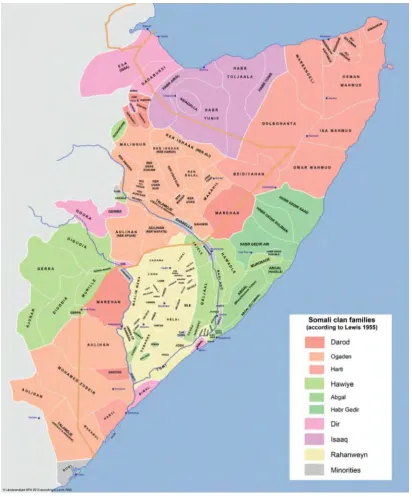
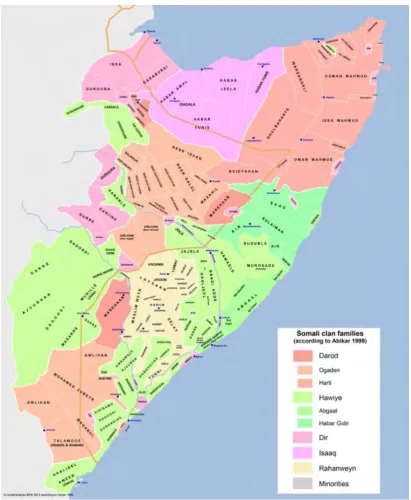
detailed clan distribution maps made by Lewis, and Abikar (see figures 2 and 3). They
are the only two maps which cover the lower level such as sub-clans, and sub-sub
21
Figure 2: Map by Lewis
Source: EASO. (2014). Map by Lewis (1955) [Map]. In EASO Country of Origin Information
report South and Central Somalia Country Overview. Retrieved September 10, 2016, from
22
Figure 3: Map by Abikar
Source: EASO. (2014). Map by Abikar (1999) [Map]. In EASO Country of Origin Information
report South and Central Somalia Country Overview. Retrieved September 10, 2016, from
23
As the maps show, many Somali clans and minority groups are distributed in a rather
confused manner in the Horn of Africa.
2.4.2 Somali Traditional Customary Law
There is an essential factor to understand Somali traditional clan-based society. It is
Somali traditional customary law, "xeer". Xeer has been exist since long time ago.
Even under the anarchy, Somalia was in order in certain level, due to the xeer. The
influence of the xeer is not same as before. The rise of Islamist group in South,
demilitarization of the clans, development of regular army and police, development of
laws; these factors have weakened the influence of the clans and the xeer (Sage,
2005). Nevertheless, xeer is still important in Somali society. EASO emphasized the
influence of the xeer in the country of origin information report as following; "the
protection mechanism exists all over Somalia, working best in rural areas" (2014,
p.61). Moreover, the influence of the xeer is reinstating in specific areas where
Al-Shabaab withdrew (EASO, 2014). To understand Somali society, the xeer is still one
of the indispensable factors.
The xeer, apart from being the traditional customary law, is also a contractual
arrangement between the clans. In this context, the size of the clans is not big like
clan family, but small groups; diya/mag paying groups consist of between hundreds
and thousands of men. The xeer can be divided in two parts; an unchangeable part
24
principles of xeer are called "xissi adakaaday" (Sage, 2005). The xissi adakaaday
provides collective payment of diya/mag, maintenance of inter-clan harmony, family
obligations, and resource-utilization rules (Indarat Maritime, 2011).
An English translation of the word, "diya" or "mag" would be "blood money", as
generally diya/mag is the money for the compensation for acts of murder or
manslaughter or injury. It is not for the individuals but for the clans (diya/mag paying
groups). For example, if a man belonging to diya/mag paying group "A" killed a man
belonging to group "B", diya/mag collected from all individuals in group "A", is paid as
compensation to group "B". Later, the compensation is shared in group "B" with the
bereaved family getting a greater share. Generally, the xeer provided compensation
for a male death as one-hundred camels, and for a female death fifty camels (CHF
International, 2006). A noteworthy point is that the diya/mag paying group is obligated
to compensate another group for an act committed by an individual. Individuals are
protected by the group, but individual behavior could be a nuisance for the whole
group. This fact helps restrain the acts of individual group members.
The xeer is also applied to conflicts between clans. Traditional clan leaders determine
adequate precedent(s) or find a new solution for new cases under the xeer to give
judgments in respect of conflicts (Sage, 2005). Moreover, even in the state of war, the
xeer restricts people's behavior. In the xeer, there is a rule called "Biri-ma-Geydo"; it
is the traditional Somali customary code of war. In the context of Biri-ma-Geydo,
25
captives would be protected and treated humanely during the conduct of hostilities"
(ICRC, 2008). The xeer restrains not only individual behavior but also that of clans
even in times of war.
Thus, Somali people and clans are bound by the clan system and traditional
customary law and contracts. In other words, they are protected by clan influence and
the xeer. In the main, however, these social norms apply only for majority clans.
Nevertheless, minority groups also can be protected by clan society and the xeer.
They can establish client relationships with majority clans. This client relation is called
"gaashaanbuur" (pile of shields). Through the gaashaanbuur, minority groups can also
subscribe to the protection of the majority clans and the xeer. The gaashaanbuur is
not mandatory but voluntary. Both of them, protection provider and protection receiver,
can choose, by their own decision, to renounce the relationship (EASO, 2014).
2.4.3 Summary
Generally speaking, it is difficult for foreigners to identify to which clan a Somali
individual belongs by appearance. The xeer is not written law, but oral law. These two
factors make it difficult for foreigners to understand them. Nevertheless, to understand
Somali history and present condition and to visualize potential scenarios about future
of the Horn of Africa, making best efforts to know and understand the clan system is
very important. It can be the cause conflicts, and it could be the key of the peace as
26
including behaviors and motivations that support the growth or otherwise of piracy.
Somalia is still under the influence of clan system.
2.5 Modern History of Somalia
2.5.1 Colonial period
Somalia has experienced three significant events in its modern history. They are
colonial rule by foreign countries and subsequently, independence from these nations
as well as a number of civil wars. Originally, Somali -as an ethnic group- lived in the
horn of Africa regardless of national borders. However, in the period of colonial rule,
they were segregated into five regions; Italian colony, British colony, French colony,
Ethiopia, and British Kenya (Endo, 2015). After the end of colonial rule, today, their
original inhabiting area in horn of Africa is divided in four countries, Djibouti, Ethiopia,
Kenya, and Somalia. Colonial rule, in particular by Italy and Britain, influenced the civil
wars after the independence and still greatly influences the current situation of
Somalia.
In 1887, Britain started to govern the north-western part of the horn of Africa as a
protectorate called British Somaliland. However, Britain was not so active in respect
of the colonial administration of this protectorate, probably because it was a place with
limited resources, poor mineral resources and poor agriculture resource. That was
one of reasons that nomadic culture had earlier developed in this area. In fact, British
27
to the British Empire, resulting in Britain not having much interest in this colony. Britain
governed this colony in an indirect way as part of British India, and through powerful
local individuals (Millman, 2013). As a result, the earlier clan system of ruling this
region was not destroyed by the colonial rule, but amplified (Center for Justice and
Accountability, n.d.). However, Britain tried to convert the people to Christianity even
though Islam was the established religion there. It aroused people's antipathy, and led
to an intense resistive movement. Britain oppressed and attacked militarily the people
who supported the resistance movement, until they overwhelmed the movement in
1920. However, the resistance movement conducted by Abdullah Hassan and his
votaries called "Dervishes" fought tenaciously for twenty years; the movement,
organized within the frame work of the traditional clan system and encompassing
many clan groups aroused Somali nationalism leading to Pan-Somalism – the aim for
one great Somalia (Endo, 2015).
Italy started to rule the north-eastern, central and southern part of the horn of Africa
as a colony named Italian Somaliland. In contrast to the passive attitude of Britain to
the British Somaliland, Italy administrated this colony positively and directly. Originally,
the soil of this region was richer compared with the soil of British Somaliland. As a
consequence, Italy made strategic plans to develop the agriculture potential of the
area. Moreover, Italy developed infrastructures during the period of its colonial rule
especially in Mogadishu. The resulting disparities between the north and the south
increased over time and continued to be fueled by the different colonial rule styles of
28
of the Italian regions, Italian Somaliland was still a colony, and not a self-ruled State.
There was discontent against colonial rule such as laws that were against the Somali
people. In 1946, the Somali Youth League (SYL) was established, and appealed for
the rectification of the unfair legal framework, development of education, and
development of the Somali language. As with British Somaliland, the “resistance”
movement from the local people, in this case the movement of SYL was conducted
within the clan framework and gained many supporters. SYL stimulated Somali
nationalism here (Africa Japan Forum, 2006).
2.5.2 Independence
After World War II, many countries gained their independence including many in Africa.
On 26th June 1960, British Somaliland became independent of Britain and called itself
the Republic of Somaliland. Five days later, on 1st July 1960, ex Italian-Somaliland
which was a trust territory under UN after the defeat of Italy in World War II, became
independent and merged with Somaliland to become the Somali Republic (BBC News,
2016a). Actually, the Republic of Somaliland disappeared only five days after its birth.
The Somali Republic was established by the merging of two countries, British
Somaliland and the Trust Territory Somaliland (ex-Italian Somaliland) under the name
of great Somalia. Consequently, Pan-Somalism was one of the most important
policies of the government. The government of Somali Republic tried to gain the
29
On June 1963, Kenya became independent from the Britain. Subsequently the
nationality of the north-eastern region known as the Northern Frontier District (NFD)
was discussed between Kenya and Somalia. Since the NFD was historically a Somali
residential area, and the percentage of Somali in the population at the time was more
than 60%, there was a basis for possible Somali nationality. However, Britain decided
that NFD to be a part of Kenya regardless of the will of the people. This decision made
the establishment of the great Somalia even more difficult. Moreover, African countries
were afraid of the influence of Pan-Somalism on the determination of borders of
sovereign states in Africa. Consequently, the government of Somali Republic could
not gain the support of other African countries, and became increasingly isolated. In
addition, inside the government, clan-based nepotism and corruption took root.
Popular discontent with the government consistently increased. The person who
significantly changed this situation was Muhammad Siad Barre (Endo, 2015).
2.5.3 Muhammad Siad Barre Regime
After the assassination of the second president, General Muhammad Siad Barre
seized power in a bloodless military coup in 1969. The name of country was changed
to the Somali Democratic Republic. The Muhammad Siad Barre regime continued for
twenty years. Under this regime, specific clans were given favorable treatment, while
some other clans were treated coldly or oppressed in contradiction with the regimes
formal policy. In particular, the Isaaq and Majeerteen clans were strongly oppressed
30
(Elmi & Barise, 2006).
Because of the defeat of the Ogaden war (1977 – 1978) against Ethiopia, the power
of the Siad Barre regime was weakened. Consequently, the anti-government
movement in Somalia briskly increased. In 1979, the first resistance movement,
Somali Salvation Front (SSF) was established by the Majeerteen people. SSF
changed its name to Somali Salvation Democratic Front (SSDF) and merged with two
smaller anti-governmental groups in 1981 (INS Resource Information Center, 1993).
In 1981, the Somali National Movement (SNM) was formed by the Isaaq people. In
addition, the Hawiye people formed the United Somali Congress (USC) and started
an anti-government movement (Terdman, 2008). Against these anti-government
movements, the Siad Barre regime strongly retaliated. In particular the northern
region occupied by SNM was severely bombed, and Hargeisa, the capital of the state,
was ruined completely with tens thousands killed (The East African, 2016). However,
the anti-government resistance further weakened the Siad Barre regime. Ultimately,
on 26th January 1991, a USC army led by General Mohamed Farrah Aideed occupied
Mogadishu, and the Siad Barre regime was overthrown (Country Information & Policy
Unit, 2004).
2.5.4 South Central Somalia after Siad Barre Regime
After the USC brought Mogadishu under its control and overthrew the Siad Barre
31
into two groups, and started fighting to establish a hegemony. South Central Somalia
entered period of anarchy. About ten years later, the Somalia Transitional National
Government (TNG) was established in 2000 through peace conferences. However,
TNG could not gain any advantage over the hegemony. Later, in 2004, the Somalia
Transitional Federal Government (TFG) was established, and fought against Islamic
Courts Union (ICU) over the hegemony and succeeded in putting a major part of
South Central Somalia including Mogadishu under its control (U.S. Department of
State & Central Intelligence Agency, 2012). Finally, in 2012 TFG finished its
transitional period, and officially the Federal Republic of Somalia was established.
Today, South Central Somalia is under the control of the government of the Federal
Republic of Somalia; the period of anarchy is over. However, Al-Shabaab, a violent
extremist group split from ICU, is still conducting many terrorist attacks (Endo, 2015).
2.5.5 Somaliland
When the Siad Barre regime collapsed, the SNM declared independence for the
Republic of Somaliland in the North West Somalia, which was the territory of the
British Somaliland on 18th May 1991. At present, one of the biggest issues preventing
the recognition by UN of this declaration of the independence of Somaliland is the
unofficial rule that prohibits the change of African colonial borders (Fisher, 2012).
Against this issue, Somaliland has insisted its lawfulness based on the border fixed
on 26th July 1960, and which existed for five days (Somalilandlaw.com, n.d.).
32
UN. Despite this, so far, there is currently relative political stability, democracy, and
public security (Hesse, 2011).
2.5.6 Puntland
After the collapse of the Siad Barre regime, SSDF tried to secure a safe and stable
area in North East Somalia. Consequently, SSDF formed the Puntland State of
Somalia in 1998. While the South Central Somalia entered a period of anarchy as
stated earlier, this autonomous region established its democracy and was relatively
stable, though there were many problems including piracy, clan based conflicts, and
security issues (Johnson & Smaker, 2014). Puntland maintained better governance
condition than pertained in South Central Somalia.
2.6 Current Situation of the Three Regions in Somalia
As mentioned previously, current Somalia can be divided in the three regions, South
Central Somalia, Puntland, and Somaliland. They are governed by different
“governments”. Naturally, the current diversity of the different regions means that the
pros and cons for the provision of the seafarers are different. Therefore, a review of
the current situation of these regions for developing seafarer training and education
33
2.6.1 South and Central Somalia
In South Central Somalia, there has been a formal government recognized by UN
since 2012. The International Monetary Fund (IMF) recognized the federal
government of Somalia formally in 2013. In addition, IMF launched a Multi Donor Trust
Fund (MDTF) in 2015. For this fund, some organizations, such as the Arab Fund for
Economic and Social Development, the Canadian Department for Foreign Affairs,
Trade and Development, and the United Kingdom's Department for International
Development, have decided to contribute: and the IMF is still collecting more
contributions. Over nine million dollars will be budgeted by 2018 to assist the
improvement of the macroeconomic system in Somalia (IMF Communication
Department, 2015). Thus, due to the international recognition since 2012, South
Central Somalia is open to the contributions of and collaboration with other countries
and foreign companies. This could be an advantage to launch the seafarer training in
this region.
In South Central Somalia, a good security situation has not yet been established.
Establishment of the formal government in 2012 was a key step, but it did not lead to
the instant realization of peace. South Central Somalia is still under a state of a civil
war. The Somali National Army (SNA), a regular army of the Federal Republic of
Somalia, and the African Union Mission to Somalia (AMISOM) is engaged in severe
fighting against the Al-Shabaab. The power of the Al-Shabaab has been weakened
34
9,000 soldiers and some areas in the South Central Somalia are still under their
control (U.S. Department of State, 2016). Even areas under the control of the federal
government are always threatened by invasions or terrorist attacks by the Al-Shabaab
(BBC News, 2015). For example, more than 50 soldiers were killed by Al-Shabaab
near Mogadishu on 26th June 2015. An AMISOM's base in Janale was attacked by
Al-Shabaab and more than 20 persons were killed on 1st September 2015. In 2016
also, there were multiple terrorist attacks by Al-Shabaab; and more than 100 people
were killed (BBC News, 2016b). Their targets are not only soldiers, but also civilians
including people working for non-governmental organizations (NGO), the UN, and
diplomatic missions. Al-Shabaab is seriously threatening the security of South Central
Somalia. On the other hand, agencies of the Federal Government of Somalia (FGS)
which maintain public security, such as SNA and the police have some problems
themselves. Their sense of belonging to the clan is generally stronger than the
identification with the FGS (U.S. Department of State, 2016). Therefore, they often do
their security work with more focus on their clan (IRIN, 2014). This could make them
almost a “private army” of the clan and especially when a conflict among the clans
arises, their greater allegiance to the clan could lead to abuse of the security power.
Moreover, the Somali National Army (SNA) has been known to have setup illegal
check points and imposed a toll on civilians at least until 2015 (U.S. Department of
State, 2016). The weak loyalty to the government and abuse of the security power
35
2.6.2 Puntland
Puntland is not insisting on independence from Somalia. As the name "Puntland State
of Somalia" suggests, they view their position as being a part of the Federal Republic
of Somalia. Therefore, as a part of UN recognized country Puntland can have access
to the international society. Accordingly, as the formal central government, FGS was
established in 2012, and the international organizations, such as IMF started funding
to the Federal Republic Somalia, Puntland also could increase its accessibility to the
international fund. Moreover, Puntland government maintained its stability even in the
absence of the central government (Murphy, 2011). When South Central Somalia was
in anarchy, Puntland still maintained its territory in order, and even maintained the
democratic mechanisms such as elections (Puntland Development Research Center,
2015). Accessibility to the international society, stable government, and democracy,
could be the positive factors to launch the seafarer training.
However, the international recognition of Puntland exists only to the point that it is
seen as a part of the Federal Republic of Somalia. The Puntland government itself
has not recognized formally by the international society. Access to the international
grants and loans is thus still limited. Because of the lack of major industries, most of
revenue of Puntland relies on port revenue; and most of this revenue is used for the
maintenance of the administration, police, and military (Johnson & Smaker, 2014).
36
stability, such as conflict between Somaliland, and poor public security. Somaliland
declared its independence in 1991, and determined its territory following the area
which was British Somaliland. The independence movement was led by the SNM
consisting of Isaaq people, but the territory of the British Somaliland includes other
clan people's residential areas. In the eastern part of Somaliland, for example, the
majority of people belong to the Darood clan. On the other hand, Puntland has not
recognized the independence of Somaliland. Puntland, regarding Somaliland as just
an Isaaq residential area, decided to set its territory over the Darood residential area
including part of British Somaliland. This has generated ongoing conflict over the
territory between Somaliland and Puntland since their origin (Mesfin, 2009). Moreover,
public security inside Puntland is not secure regardless of this conflict with Somaliland.
In the worst period of Somali piracy, many piratical businesses were established and
conducted in this region (Endo, 2015). It was even suspected that there was a
beneficial relationship between governmental officers and Somali pirates (Murphy,
2011). In addition, Al-Shabaab having lost its southern territory after 2012, is
threatening the security situation (Endo, 2015). Limited access to the international
society, conflict between Somaliland, and poor public security - these are serious
problems preventing Puntland stability and development.
2.6.3 Somaliland
First of all, public security in Somaliland is much better than other regions in Somalia.
37
decades (Hesse, 2011). After the declaration of independence of the Republic of
Somaliland in 1991, clan-based civil wars happened many times. However, since the
Hargeisa conference, a peace conference held in the capital of Somaliland, in 1996,
unity of the people, democratization, and disarmament proceeded with certainty and
peacefully (Endo, 2015). There has been no civil war inside Somaliland since the
Hargeisa conference. On the other hand, as Al-Shabaab gained power in the South,
Somaliland was also exposed to its threat. On 29th October 2008, synchronized
terrorist attacks happened in Hargeisa (Somaliland), and in Bosaso (Puntland). At
least 30 people were killed by these attacks (McKenzie & Adow, 2008). However,
because of the reinforcement of the maintenance of public security after the attacks
and deterioration of the power of Al-Shabaab, Somaliland has not had any terrorist
attack for eight years. Security situation in Somaliland has been secured to a degree.
Somaliland has developed its own democracy since the declaration of the
independence in 1991. Somaliland has bicameral legislature consisting of the House
of Elders (Guurti) and the House of Representatives. The House of Elders consists of
two traditional leaders, and the House of Representatives consists of
eighty-two members elected through democratic election (United Kingdom Home Office,
2013). Furthermore, the President of Somaliland is elected through direct elections.
Politics in Somaliland has shifted from clan to individual. There are, however,
difficulties and doubts regarding the fairness of elections. Because of some of the
people's nomadic life style, registration of voters is particularly difficult, and it could be
38
the election as president of an individual belonging to a minority clan, and the change
of government through the elections in 2010, prove that democracy exists in
Somaliland to a degree (Johnson & Smaker, 2014).
In Berbera, the main port of Somaliland, there is a maritime academy named Berbera
Maritime and Fisheries Academy (BMFA) established in 2012. BMFA provides a
Bachelor degree program in Marine Engineering, Nautical Science, and Fishery as
the only MET institute in Somaliland. They do not have enough facilities or human
resource yet. They do not have any latest ship simulator, and enough numbers of
lecturers. However, they are - with these limited resources - producing seafarers to
the shipping industry every year. Furthermore, they are trying to establish
relationships with foreign organizations. For example, BMFA and World Maritime
University (WMU) signed a Memorandum of Understanding (MoU) in 2014. There
exists a basis for developing MET (World Maritime University, 2014).
The biggest problem of Somaliland is that they are not recognized by the international
society. It makes it difficult to access the international community, be funded by foreign
organizations, and engage in international shipping. In the UN view, Somaliland is just
a part of the Federal Republic of Somalia. However, the desire for international
recognition has enhanced the development of Somaliland (Johnson & Smaker, 2014).
Gaining the recognition is "the number one priority" (Somaliland Government, n.d.)
for them. Somaliland people have made great efforts to be recognized by the
39
developed their economy (Johnson & Smaker, 2014). To achieve the number one
priority, Somaliland will keep making efforts and developing themselves.
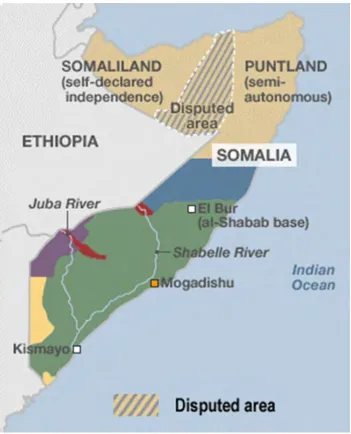
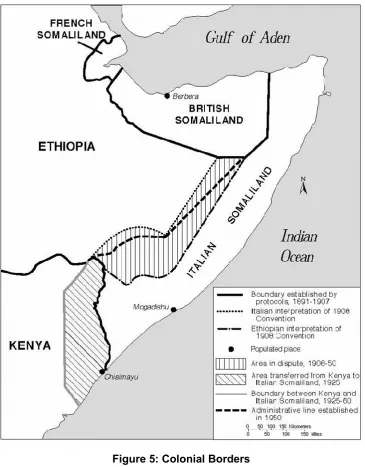
As mentioned previously, there is a disputed area between Somaliland and Puntland
(see figure 4). The major clan in Somaliland is the Isaaq; and the most major clan in
Puntland is the Majeerteen. Somaliland insists its territory is based on the territory of
the British Somaliland, including the residential areas of Warsangeli and Dhulbahante
clan (see figure 5 and figure 6). However, Puntland has not recognized the
independence of Somaliland. Moreover, Puntland regards Somaliland just as a
residential area of the Isaaq clan. Therefore, in the context of Puntland, the residential
areas of Warsangeli and Dhulbahante clan should not be included in Somaliland. On
the other hand, the Puntland government defines itself as the community of Harti
clan-collective. Majeerteen, Warsangeli, and Dhulbahante clan, all of them belong to Harti
clan-collective. Accordingly, Puntland is insisting its territory is based on the residential
areas of Harti, including the residential areas of the Warsangeli and Dhulbahante
clans. However, Somaliland regards Puntland as a community of the Majeerteen.
Consequently, the residential areas of Warsangeli and Dhulbahante clans are still
under dispute between Somaliland and Puntland. This is a quite sensitive problem
which could lead to military conflict; and could reduce the stability in Somaliland
40
Figure 4: Disputed area between Somaliland and Puntland
Source:Gagale, I. H. (2015, June 16). Somaliland Puntland Disputed [Map]. In Somaliland:
Focus on Border Dispute with Puntland. Retrieved August 30, 2016, from
41
Figure 5: Colonial Borders
Source:Center for Justice and Accountability. (n.d.). Somalia Colonial Map [Map]. In
SOMALIA: COLONIAL LEGACY. Retrieved August 30, 2016, from
42
Figure 6: Traditional Residential Area of Somali Clan
Source: United States Central Intelligence Agency. (2012) Somalia Country Profile.
[Washington, D.C.: Central Intelligence Agency] [Map] Retrieved from the Library of
43
Chapter 3: Research Methodology
3.1 Introduction
The aim of this research is to analyze the feasibility of developing a sustainable supply
of Somali seafarers, and the effect this could have as a deterrent to sustainably
avoiding the resurgence of piracy off the coast of Somalia. The research methodology
described was aimed at answering the following questions:
Could the sustainable development of Somali seafarers be a deterrent to the
Somali piracy?
Do the Somali people have an interest in developing the Somali seafarers for
employment in the international shipping industry?
Do shipping companies have an interest in employing Somali seafarers?
The mixed method approach was used to answer those research questions. In this
chapter, the research methodology and associated approaches and methods are
discussed. It includes a discussion of the selection of research participants, the
44
3.2 Selection of Participants
3.2.1 Shipping Company
According to the Cabinet Secretariat of Japan (2015) approximately 1,700 Japan
related vessels sailed through the Gulf of Aden in 2014. This means about 10% of
vessels passing through the Gulf of Aden was owned/managed by Japanese shipping
companies. Therefore, to interrogate the interest level of shipping companies in
employing Somali seafarers, workers of selected Japanese shipping company
operating ships off the coast of Somalia were targeted as participants in the research.
Moreover, to examine the relationship between the level of interest to employ Somali
seafarers and the ability of such employment to act as a deterrent to Somali piracy,
the participants were selected from only the shipping company operating the ships off
the coast of Somalia.
3.2.2 Location - Comparison of Three Regions in Somalia
Considering the current situation reviewed in previous chapter, South Central Somalia,
Puntland, and Somaliland have different pros and cons with respect to the
development of MET. To select the most adequate region to develop seafarer training
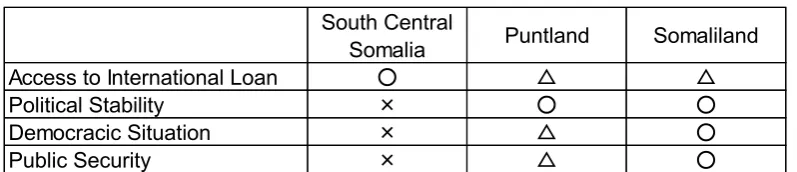
and education, four aspects, access to the international loan, political stability,
democratic situation, and public security will be compared.
45
government recognized internationally. Therefore, they have good access to the
international loan, such as IMF. Puntland is recognized internationally as part of the
Federal Republic of Somalia, but not as a government itself. Therefore, access to the
international loan is limited compared with South Central Somalia. Somaliland has no
international recognition. Therefore, access to the international loan is quite limited,
but efforts to gain such access have been made continuously.
Secondly, political stability. In South Central Somalia there has been a formal federal
government since 2012, but this is still relatively new. Political stability is poor, or at
least difficult to expect. Puntland and Somaliland have maintained their stable
gover